Home Blog Page 5622

Intellicare: Staying in touch safely with technology

Intellicare believes that the way forward for healthcare is balancing high-touch and high-tech care.

The disruption brought about by the global pandemic proved to be an opportunity for us to reimagine how we deliver our services to our members safely without compromising the quality of care and patient experience.

As we are committed to adapt and innovate, we strive to provide our members multiple touchpoints to ensure ease and convenience in availing their benefits.

Here are some of the ways we stay in touch using technology.

AGORA Mobile App

Agora, Intellicare’s official mobile application, was developed with our members in mind. It is envisioned to be accessible, convenient, personal, and intuitive. Downloading this app will give our members easy access to a digital version of their health card along with other pertinent account information such as benefit plan and coverage. Members may also request and generate electronic referral control sheets (RCS) for consultations and diagnostics, locate accredited medical hospitals and clinics nearby, and search for affiliated doctors and dentists. Agora is available for download on Google Play and the App Store.

Telemedicine

Even before the pandemic, we have recognized that telemedicine and mobile health are not just mere trends but are vital means of reimagining service delivery for healthcare in the future. Providing this channel helps us live up to our commitment of providing affordable, accessible, quality, and efficient healthcare. Remote consultation is here to stay. Intellicare’s telemedicine partners are TelAventusMD and Medgate Philippines.

Email Automation with RPA

To complement our customer service team, we have recently employed the use of Robotic Process Automation (RPA) to help us improve our turnaround time in processing email requests.

Remote Assistance of Patient Relations Officers

Even with limited physical interaction, we are able to assist our members during hospital admission and discharge through mobile calls and messages.

24/7 Call Center

Of course, if a member prefers the warmth of another person’s voice, we have our call center operating constantly to serve our members.

We understand that different people have different needs or preferences when it comes to requesting healthcare services so we make sure that we have an omni-channel approach.

These channels are just some ways we foster a nurturing relationship with our members. Hand in hand with human connection, this is the natural progression of our promise to provide access to quality and compassionate healthcare through changing times and continue to care in infinite ways.

For more information, you may visit www.intellicare.net.ph and follow our official social media accounts. We are Intellicare on Facebook, LinkedIn, YouTube and Twitter, and intellicareph on Instagram.


Spotlight is BusinessWorld’s sponsored section that allows advertisers to amplify their brand and connect with BusinessWorld’s audience by enabling them to publish their stories directly on the BusinessWorld Web site. For more information, send an email to online@bworldonline.com.

Join us on Viber to get more updates from BusinessWorld: https://bit.ly/3hv6bLA.

SM Supermalls welcomes you into a new era of change

The honest truth: No one came out of the COVID-19 pandemic in quite the same way. The pandemic was an isolating period of self-discovery, emotional growth, and life-altering realizations. It changed people, and in the process, it shaped the way so many of us view ourselves and the world around us.

Because of this, consumer tastes and behaviors have shifted. Where in a pre-pandemic world, people often spent on luxuries and experiences that allowed them to celebrate their accomplishments, studies show that consumers now want a different experience, one that is kinder and more embracing of the changes that each individual had gone through in the past two years. People are now prioritizing their personal wellness and supporting products and services that champion growth.

As consumer tastes have shifted, brands are starting to adapt to these changes. And true to its foundational commitment to make people happy, SM is ready with a host of new offerings as the entire brand is poised for a refresh this year.

“The history of SM Supermalls is one that has been built on innovation and change to serve the needs of millions of Filipinos,” says SM Supermalls President Steven Tan. “We’ve been with our customers through their every milestone for almost four decades. And we are committed to always changing, always growing with our customers in the years and decades to come.”

SM Supermalls: Welcoming Every Change in You

SM continues to stay true to its mission to provide Filipino families with a fun and engaging in-mall experience so they can go home with a smile on their faces.

There will always be a plethora of experiences for each person who comes through SM’s doors. This is true for the various personalities that emerged during the pandemic; from eco-warriors and Plantitas to health buffs and sports personalities who embraced biking, healthy eating, and home gyms, and bakers and homemakers who turned their passion projects into small businesses.

“I believe that now more than ever, it is important to recognize the new changes to our world,” adds Mr. Tan. “And people are continuing to grow as they invest in experiences that uplift their lives.”

Ushering the Future with the Transformation of SM Supermalls

In the next few months, Filipinos across Luzon, Visayas and Mindanao will get to experience the wellness-oriented and sustainability-driven transformation of SM Supermalls with a host of new and exciting activities. These include paw parks for pet moms and dads, al fresco dining areas for hangout groups, plant hubs for eco-enthusiasts, bike facilities for the growing cycling community, co-working spaces, experiential retail, blockbuster and larger-than-life cinema escapades, and so much more.

As SM’s brand refresh campaign ushers in a newness to the Philippine mall experience, curious visitors, foodies, friends and families will have much to rediscover. So come on in, you’re always welcome here!

For more information, follow SM Supermalls on Facebook: https://www.facebook.com/smsupermalls to experience what’s new in any SM Supermall near you today!


Spotlight is BusinessWorld’s sponsored section that allows advertisers to amplify their brand and connect with BusinessWorld’s audience by enabling them to publish their stories directly on the BusinessWorld Web site. For more information, send an email to online@bworldonline.com.

Join us on Viber to get more updates from BusinessWorld: https://bit.ly/3hv6bLA.

Ayala Museum x Globe launch the digital gallery

(IN PHOTO, from L-R): Ayala Foundation President Ruel Maranan, Ayala Foundation Head of Foundation Planning and Resource Mobilization Marianne Quebral, Globe’s Chief Sustainability and Corporate Communications Officer Yoly Crisanto, Ayala Foundation CFO Rosallie Dimaano, and Ayala Museum Senior Director Ma. Elizabeth “Mariles” Gustilo

Ayala Museum and Globe bring a new cultural learning experience with the Globe Digital Gallery

Ayala Museum, under the management of Ayala Foundation, Inc. (AFI), and Globe Telecom, Inc. held a signing ceremony on Tuesday, June 28, to mark a new milestone in their partnership with the launch of the Globe Digital Gallery.

The Globe Digital Gallery enables Filipinos to access and interact with 1,000 pieces from the Ayala Museum and the Filipinas Heritage Library’s permanent collections through this newest experience. Made up of 8 sprawling touchscreens located in the museum’s lobby, the Globe Digital Gallery allows onsite guests to “touch the art” and even zoom in on the finer details of each art piece.

Some of the pieces that guests can enjoy in the Digital Gallery are from the Ayala Museum’s pre-colonial gold collection, indigenous textiles from its ethnographic collection, rare prints from the Filipinas Heritage Library, works from National Artists, and so much more. The 1,000 pieces currently featured is only the beginning as Ayala Museum intends to upload more of its collection to the Globe Digital Gallery for more to enjoy.

The Globe Digital Gallery is a manifestation of Ayala Museum’s omnichannel approach — combining the physical, defined by refreshed exhibitions and a rich collection, and digital technology — to complete a new museum experience.

The Globe Digital Gallery enables guests to access and interact with 1,000 pieces from the Ayala Museum and the Filipinas Heritage Library’s permanent collections through this newest experience. Guests can come and literally “touch the art.”

Present at the signing were Ayala Museum Senior Director Ma. Elizabeth “Mariles” Gustilo, Ayala Foundation CFO Rosallie Dimaano, and Yoly Crisanto, Globe’s Chief Sustainability and Corporate Communications Officer.

“We are excited to partner with Globe to excite a new generation of Filipinos about art and culture by using technological platforms that define their way of life these days. Globe has been a longstanding partner of Ayala Foundation and we are glad to continue our omnichannel journey as a museum with them,” said Ms. Gustilo.

“Technology has become a huge part of our lives, especially these last few years,” said Ms. Crisanto.

She added, “We are grateful to have the opportunity to partner with the Ayala Foundation in bringing a new cultural experience to our fellow Filipinos through the Globe Digital Gallery. We hope that this exhibit helps us further appreciate our vast art collection and the richness of our culture.”

To experience the Globe Digital Gallery, guests can book a visit to the Ayala Museum through its website.


Spotlight is BusinessWorld’s sponsored section that allows advertisers to amplify their brand and connect with BusinessWorld’s audience by enabling them to publish their stories directly on the BusinessWorld Web site. For more information, send an email to online@bworldonline.com.

Join us on Viber to get more updates from BusinessWorld: https://bit.ly/3hv6bLA.

A more seamless and inclusive banking experience through digitalization

The Bank of the Philippine Islands (BPI) is celebrating its 171st anniversary by rolling out a full suite of digital products that will revolutionize the way Filipinos bank.

Turning 171 this August, Southeast Asia’s oldest bank is reaffirming its rich history of leadership in banking innovation with six digital platforms that will make banking easier and more intuitive for every Filipino. The institution that first brought revolutionary technology such as the ATM and mobile banking to the Philippines is once again looking to capture lightning in a bottle with its revamped BPI Online and Mobile platforms, BPI Bizlink, Real-time Payments platform, BanKo, Open Banking, and BPI BizKo.

BPI Online and Mobile

From setting the standard in online banking back in the day with BPI Express Online, the new and improved BPI Online and BPI Mobile app are now the primary digital platform for a better and more convenient banking experience for all BPI retail customers. Containing everything from important announcements to thought leadership and sustainability content, it not only perfectly integrates BPI’s many online platforms, but its brick-and-mortar experience as well. Anchored on strong data-driven security and technology, it facilitates the smooth flow of funds between BPI customers, merchants, and service providers making it a truly inclusive platform that BPI customers have and continue to rely on.

BPI Bizlink

The premier banking platform for BPI corporate clients, BPI Bizlink offers a wide range of technology and financial management solutions that allow business clients to better manage their accounts and liquidity, collections and disbursements. By providing an extremely robust and convenient platform, BPI strengthens businesses and supports business owners with what they need in order to hit their targets and achieve their financial goals, and sustain financial stability.

BPI BizKo

BPI BizKo enables micro, small, and medium enterprises (MSMEs) to better manage their business finances through a simple, affordable, and convenient subscription-based digital banking platform that even has an integrated online system for invoicing and collection. Small business owners can now streamline their cash flow safely and conveniently so they can spend their valuable time growing their business.

BanKo

BPI, through microfinance arm BanKo, fulfills its promise of financial inclusion by providing access to easy, convenient, and affordable deposit and loan products to fund the operations or grow the business of self-employed microentrepreneurs (SEMEs). The aim of BanKo has always been to strengthen the financial capacity of its clients in order to create a real, positive impact on their lives, and ultimately, the economy.

Open Banking

Accelerated by the recent pandemic and the rapid advancement of technology, BPI understands the necessity to break down barriers in order to improve the flow of funds and provide Filipinos with tools they need and can really rely on. BPI’s Open Banking allows the convenient access of third-party businesses and partners to access BPI financial services, allowing clients with online credentials to pay for their business services digitally and powering payments to government, billers, merchants, and even donations.

Real-time Payments

Recognizing the accelerating digital consumer payments landscape, BPI offers innovative digital financial products and services that support real-time processing of financial transactions. In line with the Bangko Sentral ng Pilipinas’ (BSP) digital transformation roadmap, the Real-time Payments platform helps facilitate the shift from a cash-heavy to a cash-lite economy without sacrificing speed, efficiency, and security.

Staying true to its promise to reinvent local banking, BPI is now inviting everyone to move with them as they begin a new decade of building a better today and a better tomorrow, one family and one community at a time.


Spotlight is BusinessWorld’s sponsored section that allows advertisers to amplify their brand and connect with BusinessWorld’s audience by enabling them to publish their stories directly on the BusinessWorld Web site. For more information, send an email to online@bworldonline.com.

Join us on Viber to get more updates from BusinessWorld: https://bit.ly/3hv6bLA.

Q2 growth slows amid rising inflation 

A VENDOR sells eggs in Marikina public market, May 30, 2022. — PHILIPPINE STAR/ WALTER BOLLOZOS

By Diego Gabriel C. Robles

THE Philippine economy expanded by 7.4% in the second quarter — slower than expected — as rising inflation weighed on consumer spending.

Preliminary data released by the Philippine Statistics Authority (PSA) showed second-quarter gross domestic product (GDP) growth was slower than 12.1% a year earlier and 8.2% in the first quarter.

It was a tad lower than the 7.5% median forecast in a BusinessWorld poll last week, but at the upper end of the government’s 6.5-7.5% full-year target.
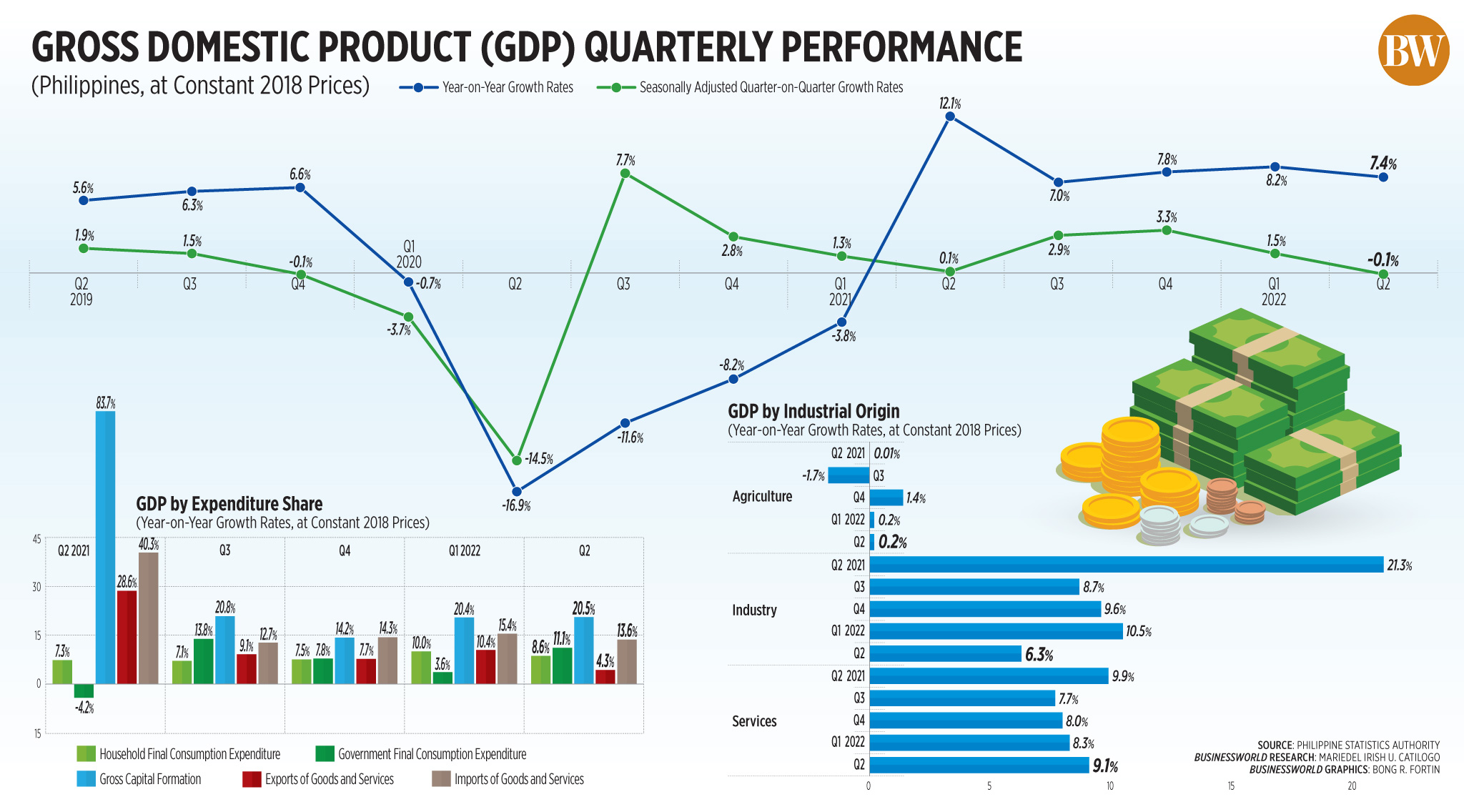
Gross domestic product (GDP) quarterly performance

The second-quarter GDP growth was the slowest in three quarters or since 7% in the third quarter of 2021.

“I think the global headwinds, particularly inflation — particularly those coming from energy, fuel and food — contributed to the slowdown. As expected this would continue in the second half. We would likely face some challenges sustaining the growth,” Socioeconomic Planning Secretary Arsenio M. Balisacan told a briefing on Tuesday.

Inflation surged to a near four-year high of 6.1% in June, bringing average inflation to 5.5% for the second quarter.

Mr. Balisacan said elevated inflation would weigh on economic growth.

“The full reopening of the economy will indeed generate more income-earning opportunities. The purchasing power of that income may be eroded by the high inflation, primarily resulting from increased fuel and food costs,” he said.

Despite the slowdown in April to June, GDP growth averaged 7.8% in the first half.

Mr. Balisacan noted the country’s second-quarter GDP growth was still the second highest among major emerging economies in the region, after Vietnam’s 7.7%.

He expressed confidence economic growth would settle within the government’s 6.5-7.5% goal this year even as the country faces “uncertainties and risks in these trying times.”

“To achieve 6.5%, all you need is a growth in the second semester of 5.3%. Still, very highly achievable. On the other hand, to achieve 7.5%, we are likely to grow by something like 7.2%. It’s very likely we will be able to achieve that growth target despite the headwinds,” Mr. Balisacan said.

At constant 2018 prices, the Philippine economy in the second quarter was valued at P4.99 trillion, surpassing the pre-pandemic GDP of P4.985 trillion in the second quarter of 2019 and P4.645 trillion in the second quarter of 2021.

In current terms, economic output in the second quarter amounted to P5.39 trillion, higher than P4.985 trillion in the second quarter of 2019.

“The GDP’s current value per semester is already P10.32 trillion, and this is higher compared with the 2019 first semester of P9.29 trillion,” National Statistician and Civil Registrar General Dennis S. Mapa said at the same briefing.

CONSUMER SPENDING
However, PSA data showed the country’s economic output shrank by 0.1% on a seasonally adjusted quarter-on-quarter basis.

By expenditure share, household consumption grew by 8.6% year on year in the first quarter, slower than 10.1% in the previous quarter but faster than  7.3% in the second quarter of 2021. This accounted for about three-fourths of the country’s economic output and added 5.8 percentage points to the 7.4% GDP growth for April to June.

Quarter on quarter, household spending fell 2.7%, as inflation accelerated.

Government spending rose by 11.1%, a reversal of the 4.2% contraction a year ago.

“In investment, the government’s contribution of general expenditure in construction was big, growing by 22.7% year on year, compared with the contribution of the private sector which only grew by 8.9%,” Mr. Mapa said in Filipino.

The share of Capital formation, the investment component of the economy, eased to 20.5% in the second quarter from 83.7% last year.

Meanwhile, export growth slowed to 4.3% from 28.6% last year. Similarly, import growth eased to 11.1% from 40.3% a year ago.

By economic sector, services and industry expanded by 9.1% and 6.3%, respectively, while agriculture growth was flat at 0.2%. Quarter on quarter, agriculture grew by 0.9% and industry by 0.2%, while services contracted by 0.4%.

“Transport, accommodation, food service, and other services have shown continued yet slow signs of recovery to their pre-pandemic levels,” Mr. Balisacan said. “Meanwhile, the agriculture sector remained weak at 0.2% growth as the sector remains vulnerable to natural calamities and rising input costs.”

Manufacturing sector growth slowed to 2.1% in the second quarter from 22.4%  a year earlier.

“The slowdown was due to the weaker growth in computers, electronic and optical products, chemical and chemical products, and food products,” Mr. Balisacan said. “The slowdown may be due to inflationary pressures brought about by the Russia-Ukraine war, weakening global demand, and supply chain disruptions brought by lockdowns in China.”

Net primary income from the rest of the world stood at 64.8% in the second quarter, a reversal of the 55.7% decline in 2021.

Gross national income, the sum of the nation’s GDP and net income received from overseas, climbed by 9.3% during the period, from 6.8% a year ago.

SUBDUED GROWTH
Economists now expect subdued growth in the second half of 2022.

Makoto Tsuchiya, assistant economist at Oxford Economics, said the dip in GDP growth would likely be temporary, but the outlook faces rising headwinds.

“We expect growth over (the second half) will be bumpy given the Ukraine war, China’s ongoing COVID strategy, and global monetary tightening are set to weaken external demand,” he said in a note. “On top of this, elevated inflation and higher debt servicing costs are set to constrain household budgets and weigh on private consumption.”

Gareth Leather, senior Asia economist at Capital Economics, said in a note they slashed the Philippine GDP forecast for this year to 6.5% from 8% due to the weaker-than-expected outturn.

Nicholas Antonio T. Mapa, senior economist at ING Bank N.V. Manila, said GDP might now settle at 6.5% or the low end of the government’s target.

“The economy is facing the triple threat of accelerating inflation, rising borrowing costs and a relatively high debt-to-GDP ratio,” he said. “Faster inflation, which was last reported at 6.4% (in July), should cap overall household spending while rising interest rates are likely to deter investment outlays.”

Rizal Commercial Banking Corp. Chief Economist Michael L. Ricafort said the government could still hit its target this year, citing the further reopening of the economy, increased infrastructure spending and the resumption of tourism and face-to-face classes.

With the disappointing second quarter data, some economists expect the BSP to slow the pace of tightening.

“We believe, however that BSP may dial down the magnitude of tightening, resorting to 25-bp rate increases for the remainder of 2022 policy meetings,” Mr. Mapa said.

Mr. Leather said the drop in second quarter growth “will be enough to tip the central bank to slow the pace of its tightening and have penciled in a 2-bp hike.”

The BSP has raised policy rates by 125 bps so far this year as it seeks to tame inflation. The Monetary Board meets on Aug. 18 to review its policy settings.


June trade gap widens to record $5.8 billion

PHOTO COURTESY OF ICTSI

By Abigail Marie P. Yraola, Researcher

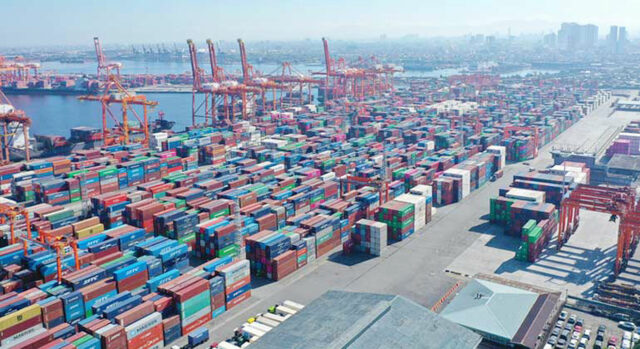
THE Philippines’ merchandise trade deficit hit another record in June as imports continued to outpace exports despite a year-on-year slowdown.

Imports grew by 26% annually to $12.487 billion in June, according to preliminary data from the Philippine Statistics Authority (PSA). This was slower than the revised 30.2% in May and 42.4% in June 2021.

The yearly increase in imports eased to its lowest since the 23.4% jump in March.

Philippine trade year-on-year performance

June marked the 17th straight month of imports growth.

Meanwhile, exports inched up  by 1% to $6.644 billion in June, sharply slower than the revised 6.4% in May and 18.9% in June last year.

This was the slowest annual growth since the 1.4% contraction in February 2021.

This brought the balance of trade in goods — the difference between exports and imports — to a record deficit of $5.843 billion in June.

It was wider than the $3.331-billion gap in the same month last year and the revised $5.556-billion deficit in May.

Meanwhile, total trade — the sum of exports and imports — jumped by 16.1% to $19.131 billion. The growth was slower than the revised 20.8% in May and 32% in June a year ago.

In the first semester of 2022, imports rose by 26.7% to $68.320 billion, above the government’s 18% target for this year.

Exports likewise went up by 7.1% to $38.527 billion, in line with the 7% full-year growth target set by the Development Budget Coordination Committee.

Year to date, the trade balance  has ballooned to a $29.793-billion deficit from the $17.953-billion gap a year ago.

Socioeconomic Planning Secretary Arsenio M. Balisacan said the country’s trade deficit is expected to widen this year.

“We are ramping up and continuing the rapid growth in our construction spending for capital formation,” Mr. Balisacan said at a press conference on Tuesday.

UnionBank of the Philippines, Inc. Chief Economist Ruben Carlo O. Asuncion said the trade activity has slowed as it returns to its pre-pandemic level.

“The continued widening of the trade deficit is still mainly due to the bloated imports made up largely of higher oil costs and higher priced imported inputs,” he said in an e-mail.

“Nevertheless, with global oil prices on the decline due mainly to higher supplies, we will see the trade deficit ease in the coming months and therefore easing off pressure on the local currency.”

Security Bank Corp. Chief Economist Robert Dan J. Roces said in an e-mail that global supply chain issues affecting electronic components drove exports lower in June.

“This was exacerbated by the extraordinary level of electronics demand post-pandemic, and as such there is a need to make the electronics manufacturing process resilient to supply chain disruptions in the future,” he said. For now, the strain and challenge that global supply chain issues are creating for the electronics manufacturing industry may be prolonged.”

Electronic products, with a 53% share in total exports and 67.5% of manufactured goods, fell by 5.2% to $3.524 billion.

Semiconductors, which accounted for more than three-fourths of electronic products and 40.4% of total exports, dipped by 2.5% to $2.685 billion.

“There will be no trade deficit for the electronics industry,” Semiconductor and Electronics Industries in the Philippines Foundation, Inc. President Danilo C. Lachica said in a separate e-mail.

“In fact, electronics exports are projected to grow by 10% in 2022,” he said.

By major type of goods, manufactured goods had the biggest share of the total exports in June by 78.6%, amounting to $5.224 billion.

However, this was down by 2.4% year on year from $5.35 billion in June last year.

Meanwhile, imports of raw materials and intermediate goods grew by 14% on an annual basis to $4.631 billion.

Imports of capital and consumer goods were valued at $3.108 billion (up by 2.9%) and $2.042 billion (up 30.2%), respectively.

Mineral fuels, lubricant, and related materials more than doubled to $2.641 billion from $1.173 billion a year ago.

The United States was the top export destination in June with export receipts amounting to $1.047 billion, accounting for 15.8% of the total.

Exports to Japan hit $1.027 billion (15.5% share), while exports to China reached $868.676 million (13.1%).

Meanwhile, China remained the main source of inbound shipment of goods, amounting to $2.547 billion or 20.4% of the total. This was followed by Indonesia with $1.319 billion (10.6% share) and Japan with $1.178 billion (9.4% share).

“We still expect double-digit import growth in [the second half of 2022], while exports could weaken further as global growth cools down amid high inflation and rising rates environment,” Mr. Roces said.

The PSA noted that import figures for June to December 2021 (except for November) and January to May 2022 were revised due to exclusion of duplicate transactions identified by the Bureau of Customs.

It said that these transactions came from the withdrawal of manufactured goods from the freeport zone area.

PHL debt now at 62.1% of GDP

REUTERS

THE National Government’s (NG) outstanding debt as a share of the gross domestic product (GDP) eased to 62.1% at the end of June.

Data from the Bureau of the Treasury showed the latest quarterly debt-to-GDP ratio was lower than 63.5% as of end-March.

The debt level in GDP terms was 1.4 percentage points lower than the previous quarter’s 63.5%, the highest since 65.7% in 2005.

However, this still exceeded the 60% threshold considered manageable by multilateral lenders for developing economies.

At 62.1%, the debt-to-GDP ratio was higher than 60.4% at the end of 2021, and 39.6% at the end of 2019 or before the pandemic.

Outstanding NG debt rose by 2.4% to a record P12.79 trillion at the end of June, “due to the net issuances of domestic and external loans as well as currency adjustments.”

The debt stock was equivalent to 59.4% of the gross national income. The debt service bill was equivalent to 2.7% of GDP.

“The quarterly easing of the debt-to-GDP ratio was partly due to relatively faster economic growth that widened the GDP base and also effectively reduced the debt-to-GDP ratio, as seen in previous economic cycles,” said Rizal Commercial Banking Corp. Chief Economist Michael L. Ricafort.

“The faster growth in the government’s tax revenues as the economy reopened further towards greater normalcy also partly helped the debt-to-GDP ratio,” he added.

The Philippine economy grew by 7.4% in the second quarter, slower than 12.1% a year earlier and 8.2% in the previous quarter.

Mr. Ricafort attributed the reduction of the debt to the lack of large-scale lockdowns, which lessened the need for the government to ramp up borrowings.

“Large-scale lockdowns during the pandemic, were very expensive for the government in terms of foregone tax revenues, more spending on financial assistance, healthcare system, and other COVID-19 programs,” he said.

Asian Institute of Management Economist John Paolo R. Rivera said the lower debt-to-GDP ratio might have been brought about by fluctuating foreign exchange rates.

Finance Secretary Benjamin E. Diokno last month said the government seeks to bring down the debt-to-GDP ratio to 61.8% by end-2022. It is expected to steadily drop to 61.3% by next year all the way to 52.5% by 2028.

“This kind of debt structure is nothing to worry about. This is one of the lowest among emerging markets… The way out of this is by growing at a faster rate. We simply outgrow our debt,” Mr. Diokno has said. — Diego Gabriel C. Robles

Banks’ NPL ratio falls to 21-month low in June

BW FILE PHOTO

By Keisha B. Ta-asan

SOURED LOANS held by Philippine banks fell for a fourth straight month in June, bringing the nonperforming loan (NPL) ratio to its lowest in 21 months as economic activity continues to pick up.

However, economists said the decline in bad loans might slow in the coming months amid the central bank’s monetary tightening.

Latest data from the Bangko Sentral ng Pilipinas (BSP) showed the gross NPL ratio of the Philippine banking industry dropped to 3.6% in June, from 4.48% a year ago and 3.75% in May.   

The June bad loan was the lowest since 3.5% in September 2020.   

Bad loans dropped by 12.7% to P421.311 billion in June from P482.991 billion a year earlier. This was also 1.8% lower than P429.106 billion in May.

Loans are considered nonperforming once they remain unpaid for at least 30 days after the due date. They are deemed as risk assets given borrowers are unlikely to settle such loans. 

“NPL ratios continue to dip as cash flows improve now that the economy has reopened,” ING Bank N.V. Manila Senior Economist Nicholas Antonio T. Mapa said in an e-mail on Tuesday.   

Since March, Metro Manila and some provinces have been under the most lenient alert level, though coronavirus infections have started to rise again. 

BSP data showed banks’ gross loan portfolio expanded by 8.7% to P11.71 trillion in June from P10.77 trillion a year ago. It also went up by 2.7% from the P11.44 trillion in May.    

Meanwhile, past due loans dropped by 14.9% to P490.834 billion from P577.060 billion a year ago. This brought the ratio to 4.19% from 5.36% a year ago. 

Restructured loans climbed by 3.1% to P338.936 billion from P328.647 billion in the same month in 2021. These accounted for 2.89% of banks’ loan portfolio.

Banks continued to boost their loan loss reserves to P409 billion in June from P397.790 billion a year ago. This brought the ratio to 3.49% from 3.69% a year earlier. 

The industry’s NPL coverage ratio improved to 97.08% from 82.36% the year before. 

“Declining NPL is due to recovering employment and the return of economic activities. This will continue as we further reopen the economy and jobs resume and the employment rate improves,” Asian Institute of Management Economist John Paolo R. Rivera said.   

Based on data from the Philippine Statistics Authority, the jobless rate stood at 6% in June, steady for the second straight month.   

“We can expect the NPL to sustain its downward trend but the decline may somewhat now that the BSP is hiking policy rates,” Mr. Mapa said.   

BSP Governor Felipe M. Medalla signaled a 50-basis point (bp) increase in policy rates at their Aug. 18 meeting, as inflation quickened in July. 

The consumer price index at the national level climbed by 6.4% year on year last month. It was the fourth straight month that inflation exceeded the central bank’s 2-4% target.

The July inflation print was also the fastest in 45 months, or since the 6.9% logged in October 2018.

The BSP has raised benchmark interest rates by a total of 125 bps so far this year, bringing the overnight reverse repurchase rate to 3.25%.

The central bank earlier said the NPL ratio of Philippine banks might peak at 8.2% this year. The ratio stood at 3.99% as of end-December 2021, as the economy started to reopen.

Globe wants DITO to pay P622M for deal ‘violation’

STOCK PHOTO | Image by terimakasih0 from Pixabay

Smart says third telco player’s PCC complaint meant to avoid liability

By Arjay L. Balinbin, Senior Reporter

GLOBE Telecom, Inc. on Tuesday said it recently requested the National Telecommunications Commission (NTC) to compel DITO Telecommunity Corp. to pay a P622-million fine for allegedly violating their interconnection agreement.

“The penalties were brought about by fraudulent calls placed through DITO’s network to Globe, bypassing proper voice traffic channels,” Globe said in an e-mailed statement. Its appeal was filed on Aug. 2.

Globe made the announcement on Tuesday after DITO filed competition complaints on Monday against the Ayala-led company and Smart Communications, Inc. of the PLDT group.

“An average of 1,000 fraudulent calls — identified as international in origin but masked as local calls — are allowed to pass through DITO’s network to Globe users every day, in violation of interconnect rules,” Globe said.

“The penalty covering one year, from July 2021 to July 2022, has ballooned with DITO’s adamant refusal to compensate Globe, defying provisions of its interconnect agreement on bypass traffic,” it added.

The company noted that reports of fraudulent calls continue to “illegally pass through” the third telco player’s network.

Globe wants the NTC to authorize its temporary disconnection of interconnection trunk lines with DITO until the latter has “taken positive and concrete steps to stop all illegal bypass operations emanating from its network and paid all its outstanding liabilities to Globe for fraudulent calls.”

“DITO has not only failed to compensate Globe, it also has not taken any serious actions to curtail bypass activities emanating from its network and terminating in Globe’s. Indeed, these bypass activities have not waned but have in fact continuously increased over the said period,” the company said.

It also noted that DITO’s “twin failures” to check such activities and pay the listed telecommunications company “what it is justly due have worked on a continuing serious prejudice against Globe.”

‘ADMISSION’
DITO Chief Administrative Officer Adel A. Tamano said in a separate statement that Globe’s position that interconnection will be done only if DITO pays for the alleged penalties “is an admission that they are making interconnection, which is mandated by law, subject to the acceptance of this alleged obligation.”

“Informing the media about these alleged interconnection penalties or ISR (international simple resale) is a disclosure of confidential business information that is a violation of the PCC’s (Philippine Competition Commission) rules of procedure,” he also said.

He pointed out that such calls are not made by DITO. “Rather, these are fraudulent calls made by third parties — and DITO is equally a victim of such calls.”

“Additionally, there are also ISR calls from Globe to DITO. It is not true that DITO has not taken steps to stop ISR calls to Globe. We have the data and the facts to show the steps undertaken by DITO to minimize these ISR calls.”

At the same time, the DITO official argued that the NTC is not a collection agency.

“If Globe has any monetary claims against DITO, [it] should go to the proper tribunal to enforce its claims,” Mr. Tamano said.

“Finally, let us reiterate that DITO Telecommunity is pursuing the case filed with the [PCC]. We are doing this to fulfill our mandate to provide true competition in the telecom industry and to ensure that the Filipino people are given world-class telco services they rightfully deserve.”

‘AVOIDING LIABILITY’
Roy Cecil D. Ibay, Smart Communications vice-president for regulatory affairs, said separately that it is “not engaged in any act constituting abuse of dominant position or anti-competitive behavior against DITO.”

“Simply false,” he said, referring to the reports about DITO’s claim that its subscribers “are not being allowed to interconnect with the Smart network.”

He also said that Smart and DITO have an existing interconnection agreement, which the former “continues to honor.”

“DITO is now requesting additional capacity, and has raised this via petition to NTC, where it is pending. DITO’s filing of the PCC complaint on the same subject-matter is blatant forum-shopping,” he continued.

At the same time, he pointed out that DITO should first “clamp down on its subscribers who have abused the interconnection framework to make fraudulent international calls to Smart subscribers under local rates.”

“Simply put, DITO has failed to prevent its network from being misused for fraud, with DITO SIMs masking international calls as domestic, resulting in huge monetary losses for Smart,” the Smart official noted.

The mobile network operator is willing to grant DITO’s request for capacity augmentation.

But DITO should “sign an agreement to compensate Smart fairly in the event that such fraudulent calls continue to proliferate,” according to Mr. Ibay.

“Otherwise, Smart cannot allow its interconnection arrangement with DITO to perpetuate fraud,” he said.

“It is a disturbing development that while Smart continues to interconnect with DITO despite these outstanding issues and while we were still negotiating with DITO on a bypass agreement, DITO now attempts to avoid liability for these fraudulent international calls by filing a baseless complaint with the PCC accusing Smart of anti-competitive behavior,” he added.

DITO has yet to respond to Mr. Ibay’s comments as of press time.

Hastings Holdings, Inc., a unit of PLDT Beneficial Trust Fund subsidiary MediaQuest Holdings, Inc., has a stake in BusinessWorld through the Philippine Star Group, which it controls.

DMCI Holdings’ profit up 73% on energy, real estate growth

DMCI Holdings, Inc. reported on Tuesday that its second-quarter consolidated net income went up by 73% to P9.03 billion from P5.23 billion, driven by growth in its energy and real estate businesses.

Without one-off items, core net income rose by 113% to P8.99 billion from P4.23 billion, it said in a disclosure to the stock exchange.

“We had a very strong first half because of elevated market prices. If the current trend holds till October, we hope to declare another round of special dividends for our shareholders before yearend,” DMCI Holdings Chairman and President Isidro A. Consunji said.

Among its businesses, Semirara Mining and Power Corp. (SMPC) accounted for the biggest contribution, which more than doubled to P6.11 billion from P2.34 billion, driven by higher coal selling prices and higher spot sales volume amid elevated market prices.

DMCI Project Developers, Inc. (DMCI Homes), the firm’s real estate arm, contributed P1.31 billion, which was 63% higher than the P804 million recorded a year earlier.

The firm said the growth was due to “higher revenue recognition from ongoing projects and upward adjustment in selling prices.”

Meanwhile, contributions from D.M. Consunji, Inc. more than quintupled to P516 million from P91 million due to the completion of select projects and conservative revenue take-up the previous year. 

DMCI Mining Corp.’s contributions climbed by 27% to P510 million from P403 million primarily due to higher average selling prices for nickel ore.

On the other hand, associate Maynilad Holdings Corp., which owns 93% of Maynilad Water Services, Inc., dropped by 9% to P393 million from P431 million amid flattish billed volume and higher costs.

Contributions from DMCI Power Corp. jumped by 35% to P205 million from P152 million due to higher electricity sales volume and prices.

“While consolidated full-year results is on track to be significantly higher versus last year, the group maintains its prudent second-semester outlook on persisting market volatility because of the Russia-Ukraine war, poor weather conditions and unpredictable policy shifts in the commodity markets,” DMCI Holdings said.

“Pronounced demand weakness for real estate and private construction is also likely to continue into 2023 owing to inflationary pressures, higher interest rates, tightening credit standards and weak consumption,” it added.

DMCI Holdings added that accelerated public infrastructure spending and an influx of foreign investors for public-private partnership projects could provide some relief, which the group will remain cautiously optimistic about.

The firm is primarily engaged in general construction, coal, and power generation, real estate development, water concession, nickel mining and manufacturing.

On Tuesday, DMCI shares rose by 1.62% or 15 centavos to finish at P9.40 on the stock market. — Luisa Maria Jacinta C. Jocson

Megaworld earnings rise 6.5% to P2.8B

MEGAWORLD Corp. recorded a 6.5% increase in its attributable net income to P2.82 billion for the second quarter from the P2.65 billion recorded a year ago after booking double-digit growth in its core businesses.

“For the first time since the pandemic, we have achieved double-digit growth across all business segments. This is a clear indication that we are on the right track in our goal to finally go back to the pre-pandemic levels of our core businesses,” Megaworld Chief Strategy Officer Kevin L. Tan said in a press release on Tuesday.

Its topline climbed to P14.32 billion for the three months ended in June, a 17.1% increase from last year’s P12.23 billion.

Its year-to-date attributable net income increased by 18% to P5.9 billion from last year’s P5 billion.

The company’s consolidated topline for the first six months reached P27.45 billion, 22.6% higher than the P22.4 billion in the same period the previous year.

Megaworld’s residential segment remained to be the primary contributor with real estate sales soaring by 17.2% to P8.94 billion in the second quarter from P7.63 billion last year.

Year to date, its real estate sales climbed by 25.6% to P16.99 billion from P13.53 billion last year.

The company also recorded a surge in its rental income by 18.6% to P3.81 billion in the second quarter and a 19.2% increase to P7.51 billion in the first half.

Megaworld Premier Offices posted a 15% improvement in its rental income to P6 billion, as the business process outsourcing sector maintained a higher than industry occupancy rate of 91%.

Rental income in Megaworld Lifestyle Malls showed improvement as it grew by 41% year on year to P1.5 billion during the first two quarters.

The operator of 11 hotel properties, Megaworld Hotels & Resorts, posted 49% growth in its hotel revenues to P1.1 billion.

“This was due to the consistent performance of its in-city hotels and the increase in leisure-related activities,” the company said.

“As the economy continues to recover, Megaworld maintains its positive outlook for the future as we build on the company’s consistent performance with an aim to go beyond our targets for the rest of year, ” Mr. Tan added.

To date, Megaworld has 28 master-planned integrated urban townships, integrated lifestyle communities, and lifestyle estates across the country.

Shares in Megaworld inched up on Tuesday by 0.45% or P0.01 to P2.24 apiece. — Justine Irish D. Tabile

ACEN income surges 25% as new plants deliver

ACEN Corp. reported a consolidated net income of P1.78 billion in the second quarter, 25.4% higher than the P1.42 billion earned in the same period last year, boosted by fresh contributions of new Philippine and international power plants and strong wholesale electricity prices during the quarter.

“We’re delighted to see the strong rebound in the second quarter, which helps generate momentum as the company sets out its bold ambition to reach 20 gigawatts (GW) of renewables by 2030,” said Eric T. Francia, president and chief executive officer of ACEN, in a press release.

In its financial report filed to the exchange on Tuesday, the Ayala-led energy company reported a P2.18-billion net income for the first semester, an 19% decline compared to P2.69 billion reported in the same period last year.

The company said revenues for the second quarter were recorded at P8.57 billion, 11.4% higher compared with P7.69 billion in the same period last year.

Consolidated revenues for the first semester rose by 19.1% to P15.97 billion from P13.41 billion previously, due to higher spot market prices balancing the impact of curtailment and customer buyout fees in the first quarter.

According to ACEN, attributable output in the first semester grew 11% to 2,482 gigawatt-hours due to increased operating capacity from its wind farms in Vietnam and its solar plants in India, which offset the impact of thermal outages during the first quarter.

“The Philippine business has returned to profitability as we start to recover from short-term headwinds experienced in the first quarter of the year,” said ACEN Treasurer and Chief Financial Officer Maria Corazon G. Dizon.

ACEN has close to 4 GW of pro forma attributable capacity spread across five countries in the Asia-Pacific region. Of the capacity, 87% is renewables.

In the Philippines, the company has close to 600 megawatts of solar and wind farms under construction that are targeted to be completed by 2030. The country remains to be ACEN’s core market, accounting for 40% of its portfolio.

On Tuesday, shares in the company declined by 2.92% or P0.26, finishing at P8.64 each on the stock market. — Ashley Erika O. Jose