Home Blog Page 5536

Inflation sizzles to 14-year high of 8% in November
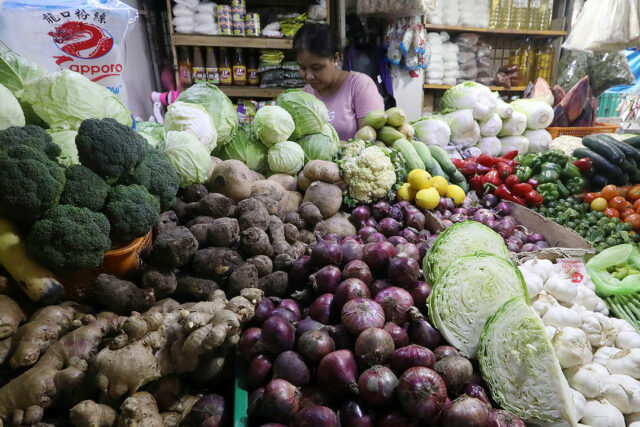
A market vendor arranges assorted vegetables inside the Quinta Market in Manila, Sept. 19. Vegetable prices continued to rise in November. — PHILIPPINE STAR/EDD GUMBAN

RISING FOOD PRICES pushed inflation to a 14-year high in November, the Philippine Statistics Authority (PSA) said on Tuesday.

Preliminary data from the Philippine Statistics Authority (PSA) showed headline inflation accelerated 8% in November, the most since the 9.1% print during the Global Financial Crisis in November 2008.

The latest print was faster than the 7.7% in October, and 3.7% in November 2021. It was also higher than the median estimate of 7.8% in a BusinessWorld poll of 15 analysts conducted last week, but within the 7.4-8.2% forecast range of the Bangko Sentral ng Pilipinas (BSP).

Headline inflation rates in the Philippines

November inflation also breached the BSP’s 2-4% target range for an eighth straight month. 

President Ferdinand R. Marcos, Jr. on Tuesday said that while the economic growth is healthy, inflation is “running rampant and out of control.”

“The main drivers of that inflation, unfortunately, are still imported… So again, import substitution is still a good idea not only for foreign exchange reserves but also so that we can keep our inflation rate down,” he said in a speech at the Arangkada Philippines Forum after the release of inflation data.   

For the January-to-November period, inflation averaged 5.6%, faster than the 4% in the same period a year ago. However, this was still below the BSP’s full-year forecast of 5.8%.

Month on month, the consumer price index (CPI) inched up by 0.9%. Stripping out the seasonality effects on prices, inflation dipped 0.7% in November from October’s 1%. 

Core inflation, which discounts volatile prices of food and fuel, climbed 6.5% in November from 5.9% in October and 2.4% in November 2021. In the eleven months to November, core inflation averaged 3.7%.

Divina Gracia L. Del Prado, PSA officer-in-charge and deputy national statistician, said at a briefing that November inflation quickened due to the spike in food prices, which reflected the spillover effect of the typhoon that hit the country in late October. Severe Tropical Storm Paeng (international name: Nalgae) that caused about P6.4 billion in agricultural damage.   

The heavily-weighted food and non-alcoholic beverages index rose 10% in November, from 9.4% in the previous month. This was the fastest rise in food inflation since September 2018.

“Higher prices of vegetables, fruits, and rice were a result of lower production brought about by the onslaught of typhoons and higher cost of inputs. Similarly, sugar production is still reeling from the damage caused by recent typhoons,” the National Economic and Development Authority (NEDA) said in a separate statement.

Vegetable inflation surged 25.8% in November (from 16% in October), while sugar, confectionery and desserts rose 38% (from 34.4% in October). Rice prices went up 3.1%, from 2.5% in the previous month.

Another driver of November inflation was the restaurants and accommodation services index, which jumped 6.5% in November, from 5.7% in the prior month, reflecting continued “revenge spending” by Filipinos.

Out of 13 commodity groups, 10 reported faster inflation in November, including alcoholic beverages (10.6% from 10.4% in October), clothing and footwear (3.6% from 3.1%), furnishings and household equipment (4.5% from 3.8%) and health (2.8% from 2.6%).

On the other hand, slower rates of increases were seen in housing, water, electricity, gas and other fuels (6.9% from 7.4% in October); and transport (12.3% from 12.5%).   

Ms. Del Prado said the rise in pump prices started to slow in November.

“Inflation is decelerating for petroleum products. So, if we see the effects of food prices (slow down), that might decrease (overall) inflation,” she said in a mix of English and Tagalog.   

PSA data showed inflation for the bottom 30% income households, which still use the 2012-based prices, rose to 7.7% in November — the highest since October 2018. This was faster than the 7.3% print in October and 4.2% last year.

For the 11-month period, the average inflation for this income group stood at 5.1%.   

“The government is continuously implementing targeted subsidies and discounts to allay the impact of the higher prices of essential goods, especially for the vulnerable sectors and low-income earners of our society,” Socioeconomic Planning Secretary and NEDA chief Arsenio M. Balisacan said in a statement.

Inflation in the National Capital Region (NCR) decelerated to 7.5% in November, from 7.7% in October and 2.2% a year ago.

Outside of NCR, consumer prices rose 8%, from 7.6% in October and 4% in the same month of 2021.

INFLATION TO SLOW
Ms. Del Prado said inflation can rise as much as 8.5% in December to hit the BSP’s full-year forecast of 5.8%.

“If headline (inflation) is lower than that, then average inflation for the year should also be lower,” she said, adding that inflation does not always peak in December.

The Development Budget Coordination Committee (DBCC) on Monday also raised its average inflation rate assumption to 5.8% this year, from 4.5-5.5%.

“Inflation is projected to decelerate in the subsequent months due to easing global oil and non-oil prices, negative base effects, and as the impact of BSP’s cumulative policy rate adjustments work its way to the economy,” the central bank said in a statement.

The BSP maintained it “remains prepared to take all further monetary policy actions necessary to bring inflation back to a target-consistent path over the medium term.”

The BSP has raised the key policy rate by 300 basis points (bps) to 5% since May to curb soaring inflation. The Monetary Board’s last policy review meeting for the year is on Dec. 15.

Finance Secretary Benjamin E. Diokno said in a separate statement that inflation is expected to ease by the second half of 2023, averaging between 2.5-4.5%.

Bank of the Philippine Islands Lead Economist Emilio S. Neri, Jr. said the November inflation print showed that food continues to drive inflation higher amid supply issues in the agriculture sector and the impact of recent typhoons.

“Distribution of food products remains expensive given the elevated price of oil… Even if oil prices have stabilized recently, the pressure on consumer prices may not ease until the second half of 2023,” he said in a note.

Despite the faster November print, Mr. Neri said inflation may be nearing its peak.

“We expect a decline in the coming months mainly due to the stabilization of oil prices recently,” he said. “Given the outlook for inflation, there is a compelling reason for the BSP to continue hiking interest rates.”

In a note on Tuesday, ING Bank N.V. Manila Senior Economist Nicholas Antonio T. Mapa said headline inflation could still peak in December and slow in January, but inflation will not decelerate quickly similar to what happened in 2018.   

“We do believe inflation will grind lower and not repeat the quick deceleration we saw in 2018. High inflation has ‘infected’ roughly 60% of the CPI basket showing us that price pressures are now more broad-based,” he added.

Mr. Mapa said the BSP will likely remain hawkish at its meeting next week.

“Demand-side pressures remain evident after items related to ‘revenge spending’ experienced quicker inflation. Thus, we expect BSP to carry out a 50-bp increase next week or matching any rate increase by the Fed,” Mr. Mapa said. — Keisha B. Ta-asan


World Bank lowers 2023 PHL growth forecast

More policemen are deployed in Divisoria, Manila as the shopping area is expected to draw bigger crowds ahead of the holidays, Dec. 1. — PHILIPPINE STAR/EDD GUMBAN

THE WORLD BANK upgraded its growth forecast for the Philippines this year but expects the economy to expand at a weaker pace in 2023 amid a global slowdown and elevated inflation.

In its Philippines Economic Update report, the multilateral lender raised the Philippines’ gross domestic product (GDP) growth outlook to 7.2% this year, from the 6.5% given in September. This is at the upper end of the government’s 6.5-7.5% goal this year.

World Bank Country Director for the Philippines Ndiame Diop said at a virtual briefing on Tuesday that strong domestic demand is driving economic growth this year, contributing to the recovery in jobs and income.

The economy expanded by 7.6% in the third quarter, bringing the nine-month average to 7.7%.

“The Philippine economy has remained resilient despite a challenging global environment,” World Bank Philippines Senior Economist Ralph van Doorn added.

However, the World Bank warned growth momentum may slow starting next year, as it trimmed the GDP growth projection to 5.7% for 2023-2025, from 5.8% previously.

“The growth slowdown in 2023 is premised on the fading of pent-up demand, alongside elevated inflation and higher interest rate environment that will temper domestic demand,” the World Bank said.

Mr. Diop said this outlook is premised on a sharp slowdown in global growth, and moderate shocks that can push the world’s economy into a recession, which “will have dire consequences in the recovery of emerging markets like the Philippines.”

The World Bank expects global growth to decelerate in 2023, due to global monetary tightening, worsening financial conditions and disruptions caused by the war in Ukraine.

“These external challenges have channeled through the Philippines in the form of high inflation, peso depreciation, and capital market volatility,” it added.

Inflation quickened to a 14-year high of 8% in November, bringing the 11-month average to 5.6%.

The BSP’s average inflation forecast is at 5.8% this year, 4.3% in 2023, and 3.1% in 2024.

“We see inflation will continue to rise. We expect inflation to peak in 2023. This is premised on the second-round effects, not only has headline inflation increased through food and fuel prices, it has crept into core inflation,” Mr. van Doorn added.

Higher interest rates may temper growth in private lending and investments at a time when the government is expected to implement measures to rein in the deficit and slash debt, the World Bank said.

Since May, the BSP has raised borrowing costs by 300 bps, bringing its key policy rate to 5%. 

“Continued near-term monetary tightening is appropriate to prevent a de-anchoring of inflation expectations,” the World Bank said.

The World Bank recommended that the Philippine government focus its policies on addressing the immediate challenge of elevated inflation, staying the course on fiscal consolidation, sustaining investments in health and education, and reversing the low agricultural productivity.

“The immediate challenge is to address rising inflation. This means employing both monetary and non-monetary measures, like lower tariff barriers, supporting agriculture production, and rate hikes to prevent the de-anchoring of inflation,” Mr. van Doorn said.

For fiscal consolidation, he said targeted social measures are important to manage spending.

“It’s important to eliminate spending inefficiency and add new tax measures to mobilize revenues,” he added.

Mr. van Doorn said that sustaining investments in health and education to reduce vulnerabilities from the scarring impact of the pandemic remains important.

Agriculture is also a key sector that the government must prioritize if it seeks to accomplish its development goals.

“Over the medium term, public spending on agriculture will address low productivity and food security in the country. While agriculture is only 10% of GDP, it deploys a disparate share to labor force and food production is influential to bringing down inflation,” Mr. van Doorn said. — Luisa Maria Jacinta C. Jocson

Bill seeks to require NEDA Board OK only for projects over P5B

PHILIPPINE STAR/ RUSSELL PALMA

By Arjay L. Balinbin, Senior Reporter

A PROPOSED MEASURE seeks to require National Economic and Development Authority (NEDA) Board approval only for projects worth over P5 billion.

Newly filed House Bill (HB) No. 6527 states that “upon favorable recommendation” of the NEDA Investment Coordination Committee (ICC), only projects that cost more than P5 billion will be submitted to the NEDA Board for approval.

The substitute bill, which seeks to amend the Build-Operate-Transfer (BOT) Law, was filed on Tuesday by House Ways and Means Committee Chairman and Albay Rep. Jose Ma. Clemente S. Salceda.

Under the current BOT Law’s implementing rules and regulations, projects that cost more than P300 million need to be submitted to NEDA Board for approval upon the recommendation of NEDA ICC.

The NEDA Board is chaired by the president of the Philippines.

This would remove a significant bottleneck for many projects as these would no longer need the president’s approval, Public-Private Partnership Center Deputy Executive Director Jeffrey I. Manalo said in an interview on the sidelines of the Arangkada Philippines Forum in Pasay City on Tuesday.

Mr. Manalo said President Ferdinand R. Marcos, Jr. wants to improve PPP policies “to address bottlenecks and ambiguities and improve competition.”

Under HB 6527, projects that cost between P2.5 billion to P5 billion only need to be submitted to the NEDA-ICC for approval.

For projects that cost below P2.5 billion, it would only require approval from heads or boards of implementing agencies.

The proposed measure also allows NEDA-ICC to update the amounts “when the need arises.”

This is to “future-proof” the law, according to PPP Center’s Mr. Manalo.  “This is so we do not need to change the law if we need to update the numbers.”

At the same time, he noted that the bill recognizes the autonomy of local government units.

Under the bill, local governments will approve their own projects “regardless of project cost.”

“Prior to approval, projects implemented by LGUs (local government units) shall be confirmed by the respective local development council,” it said.

However, PPP projects undertaken by local governments that would affect national development or master plans and national projects should “secure the endorsement of the National Government.” 

During the Arangkada forum, NEDA Undersecretary Rosemarie G. Edillon noted that the proposed measure ensures that the identification of PPP projects is guided by the principles set by the government, including “effectiveness in meeting government objectives; appropriateness of the chosen procurement modality; value for money, accountability, and transparency; and public, access, safety, and security.”

Senator Francis N. Tolentino said at a recent budget hearing for NEDA that investors seeking to build local government transport infrastructure are deterred by the low threshold for triggering mandatory national government review.

Senator Juan Edgardo M. Angara said the process of adjusting thresholds should be indexed to inflation.

Sought for comment, Terry L. Ridon, a public investment analyst and convenor of think tank InfraWatch PH, said in a phone message: “Government should limit the highest regulatory scrutiny (i.e. NEDA Board approval) only to the most important PPP projects which have threshold project costs of P10 billion and above.”

“Almost all current PPPs with national significance, such as new train lines and expressways, have project costs way beyond P10 billion,” he added.

Mr. Ridon said all other projects with estimated costs between P2.5 billion to less than P10 billion can then be approved at the ICC level while projects below P2.5 billion can be approved by agencies, local governments or government-owned and -controlled corporations (GOCCs).

“It should be noted that our proposal limits the approval authority of agencies, local governments and GOCCs similar to the pending bills as projects higher than P2.5 billion should be subjected to greater scrutiny by an interagency panel such as the ICC. This ensures greater transparency and accountability in conducting PPPs,” he added.

MAP pushes for creation of public-private sector advisory council

BW FILE PHOTO

THE MANAGEMENT ASSOCIATION of the Philippines (MAP) is seeking the creation of a public-private sector advisory council for various sectors, in order to improve transparency and accountability in terms of government contracts.   

“We suggest a strong joint public-private sector advisory council for specific areas like agriculture, trade and investment, infrastructure projects, energy, and water,” MAP President Rogelio L. Singson said during his keynote speech at the Arangkada Philippines Forum in Pasay City on Tuesday. 

For instance, Mr. Singson said the government may discuss the draft concept of a project with the private sector and potential investors before the final terms of reference are published.

“This opens us for transparency and accountability,” he added.   

Mr. Singson said collaboration between the public and private sectors is essential and “will definitely redound to the faster economic recovery of the Philippines.”

He noted there should be more cooperation among government infrastructure agencies, and that the roles and responsibilities are “clearly defined” in the review and approval process of public-private partnerships (PPP).   

“There are just too many reviews and government institutions involved in the review process… Another area of improvement is for government infrastructure agencies to get together and make sure that all government infrastructure projects being implemented are coordinated according to a government infrastructure master plan,” Mr. Singson said.

“More often than not, many of the delays in PPP projects whether local or foreign investments are due to the delays in the delivery of government responsibilities,” he added.   

Meanwhile, Shinichiro Shimada, Japanese Chamber of Commerce and Industry of the Philippines president, said the Philippines can maximize its potential if it continues to “reform, rebuild, and recover.”

“We believe in the enormous potential of the Philippines as a foreign direct investment destination and the capability of the Philippine government with support from private sector to pursue and implement the necessary reforms and policies to improve the investment climate and competitiveness of the country,” he added.    

Meanwhile, Chamber of Mines of the Philippines Chairman Michael T. Toledo said the mining industry could recover with the help of stable regulations.   

“As long as these minerals are on the ground, these are worthless. We need to bring them out of the ground… What we need is a stable regulatory and legal framework. A business cannot plan long term if after passing a law, suddenly after one or two years, you change,” Mr. Toledo said. — R.M.D.Ochave 

Five tips to stay healthy amid the holiday feasting

UNSPLASH

THE HOLIDAYS shouldn’t be used as an excuse to binge-eat, warned a dietitian. 

Christmas is just around the corner and with it comes an abundance of delicious food, whether it’s at the family noche buena, a gathering with friends, or an office Christmas party.   

“To eat smart, you have to have a balanced diet and be mindful of your body’s needs. This should stay the same even during the holidays,” said Dr. Virgith B. Buena, a dietitian and nutritionist at the Cardinal Santos Medical Center, who shared healthy eating tips for this year’s festivities in a Dec. 2 webinar hosted by the University of the Philippines.   

Drink lots of water.  

Water, which makes up about 60 to 70% of the human body, serves as a solvent for all nutrients and aids in the transport of these nutrients to the different parts of the body.  

Even if one eats lots of food, water is still needed for the body to get as much nutrients from the food as possible, said Dr. Buena.  

Drinking water will also avoid dehydration.  

Learn to read a nutrition label.  

The nutrition facts printed on containers of food items can be a guide to ensuring a balanced diet. Dr. Buena suggested starting with the serving size and number of calories to know how much an item contributes to one’s daily intake.  

Next up is to try and limit eating food with high levels of fat and cholesterol, which are weighted in grams on the nutrition facts label.   

“The nutrients you have to get a lot of are vitamins like Vitamin A and C,” she said. These are found in fruits and vegetables.  

Stick to regular mealtimes.  

“Eat a variety of nutritious foods in moderate amounts and stick to regular mealtimes,” Dr. Buena said.  

Variety and regularity will provide the body with what it needs during the energy-intensive season.   

Skipping meals, usually breakfast, just to feast on a large meal for lunch and/or dinner is a common unhealthy habit. Since the body seeks regular nutrition, depriving it of food will encourage gorging later on.   

Instead, practice mindful eating, which is a form of “loving yourself,” she said.  

Eat vegetables and fruits first.  

When a spread includes salad, it’s always best to eat greens first.   

“When you eat this ahead of heavier portions of a meal, it reduces your food intake. You end up eating less of what comes after,” said Dr. Buena.  

This is also true for fruits served as snacks before mealtimes.   

Think small and frequent, and enjoy.  

It’s bad to think of holiday eating as long periods of fasting followed by large, sumptuous feasts. The key to staying healthy is to stick to small and frequent meals, neither dieting excessively nor eating excessively.  

Don’t obsess over avoiding carbs, Dr. Buena added.  

“There’s no such thing as zero carbohydrates. Fruits have carbs, vegetables have carbs. It’s important because it’s our main source of energy,” she said. 

She recommended that diabetics who need to control sugar levels but still crave sweet Filipino desserts should only have a taste, to satisfy the craving but not gorge on it.  

“Eat better, not less,” she said. — Brontë H. Lacsamana

Meralco gets CSP exemption for power supply deal

MANILA Electric Co. (Meralco) has secured a certificate of exemption from the Department of Energy (DoE) from the competitive selection process (CSP) for the supply of 670 megawatts (MW) of power after a temporary restraining order (TRO) suspended its deal with a unit of SMC Global Power Holdings Corp.

“We have secured a certificate of exemption from the DoE. It was issued last week, but that is only for — since the TRO is only for — 670 MW. The certificate of exemption is only covering that,” Jose Ronald V. Valles, Meralco first vice-president and head of its regulatory management, told reporters on Monday.

The power distributor has been trying to secure emergency power supply agreements (EPSAs) after the Energy Regulatory Commission (ERC) rejected its joint petition with SMC Global Power, the power arm of San Miguel Corp. (SMC), for a rate increase, saying it had no basis as the agreement is a fixed-rate contract.

Meralco said in October that it filed for a certificate of exemption from CSP with the DoE.

In November, the Court of Appeals issued a TRO in favor of SMC Global Power. The TRO suspended the implementation of South Premiere Power Corp.’s (SPPC) power supply deal with Meralco that covers 670 MW of power supply.

Mr. Valles on Monday said Aboitiz Power Corp. (AboitizaPower) has an offer to supply Meralco an equivalent capacity of 300 MW until Jan. 25. The power will be sourced from GNPower Dinginin.

“What we have negotiated so far is with Aboitiz, their Dinginin, but only for 300 MW covering a period of two months, until Jan. 25. We are now looking for additional power supply,” he added.

He said the DoE approval includes AboitizPower and SMC’s Masinloc coal-fired plant and Limay fuel-fired plant, but SMC has “withdrawn all its offers” in exchange for Ilijan’s natural gas output. SMC Global Power earlier this month said it has offered the 1,200-MW capacity of its Ilijan plant to Meralco.

“We’re running the numbers right now. If we can do Ilijan that quickly, then that will be more beneficial than the AboitizPower’s offer. I’m looking for a capacity that will cover my exposure to WESM (Wholesale Electricity Spot Market) during summer months so that should be until July, so that is why we are interested in exploring San Miguel’s new offer,” Mr. Valles said.

He said they will talk to First Gen Corp. as Malampaya gas is fully allocated to the company’s plants.

“We cannot source from elsewhere except from the fuel coming from Malampaya if DoE and First Gen are willing to reallocate the Malampaya gas to Ilijan because Ilijan cannot run on liquid fuel,” he said.

SMC Global Power’s unit SPPC is the administrator of Ilijan. In June, SMC purchased the remaining banked gas of Philippine National Oil Co. (PNOC) at $1.2 billion for 70.26 petajoules.

However, the PNOC has yet to deliver the banked gas. SMC Global Power said the gas will support the fuel requirements of Ilijan power plant until February 2024. 

Mr. Valles said gas from Malampaya needs to be diverted for the use of Ilijan, which stopped sourcing from Malampaya after its gas supply agreement expired in June.

“First Gen needs to run on liquid fuel, but the liquid fuel has to be a pass-through cost. These are the mechanics, generally. But this needs to be agreed upon by the DoE then the ERC,” he said.

Mr. Valles said if SMC Global Power’s offer will not materialize, Meralco will be left with no choice but to source from WESM, which typically costs more.

“We are doing everything possible to ensure we will not have a shortage of supply during summer months and to mitigate the impact of the TRO, as well as the impact of any increases that will be brought about by the price offers of generators under EPSAs,” Mr. Valles said.

Meralco’s controlling stakeholder, Beacon Electric Asset Holdings, Inc., is partly owned by PLDT, Inc. Hastings Holdings, Inc., a unit of PLDT Beneficial Trust Fund subsidiary MediaQuest Holdings, Inc., has an interest in BusinessWorld through the Philippine Star Group, which it controls. — AEOJ

The role of spirituality in the care of terminally ill patients

UNSPLASH

END-OF-LIFE CARE will benefit from conversations about spirituality and the limits of the human body, according to a priest.  

“If we want to really take care of the patient, we take care of the patient as body and spirit, and not only as body,” said Fr. Gregory Ramon D. Gaston, rector of the Pontificio Collegio Filippino in Rome, Italy. “That is the reality of our human nature that we have to communicate with others, and in healthcare.” 

While modern medicine has increased the longevity of human beings, there is still a limit to what it can do, he said at a Nov. 25 event hosted by UP Med Webinars. “Sometimes, procedures and operations, what they do is not really prolong life, but delay the dying process,” he said.  

The debate among doctors should not be whether or not to communicate the truth of a patient’s medical condition but the “how, when, and in what manner” it should be shared, said Fr. Gaston. 

“That changes the reality of the patient’s view, the patient’s world,” he said. 

According to a Social Weather Survey conducted in November 2020, 73% of adult Filipinos said that religion is very important in their lives. 

Religious commitments, such as church attendance, have been found to yield health benefits such as a lower risk of depression and anxiety, as well as a reduced risk of cardiovascular disease and death from cancer.   

Religion can also reduce anxiety surrounding death, according to studies in the Journal of Palliative Medicine and the Journal for the Scientific Study of Religion.   

Fr. Gaston encouraged respecting the patient’s religiosity without imposing one’s own beliefs. 

Meanwhile, Dr. Michael Angelo L. Wambangco, a home care specialist, said that patient comfort and empowerment are the by-products of effective communication and ministering. 

“As a Catholic, our faith teaches us that there is a beyond after this earthly life,” Dr. Wambangco said. “A health professional has that crucial role, especially in cases where the patient is terminally ill.” — Patricia B. Mirasol

CCP stages its first opera in two years

A SCENE from Giacomo Puccini’s opera Turandot in Turkey

AFTER a two-year hiatus, live opera returns to the Main Theater of the Cultural Center of the Philippines (CCP) this month with Giacomo Puccini’s Turandot.

The gala is scheduled for Dec. 9, 8 p.m., with a matinee performance on Dec. 11, 3 p.m.

Based on an ancient Persian fairytale, Mr. Puccini’s opera is set in ancient China where Princess Turandot declares that she will only marry the suitor who can solve three riddles. Prince Calaf accepts the challenge — but if he fails, he will be executed. But when the prince passes the test, the princess refuses to marry him. Prince Calaf then suggests that if Princess Turandot is able to guess his name before dawn the following day, he will accept execution.

“Puccini is one of most performed composers also because he was a great theater man. He wasn’t just a great musician… He always picked up the right story,” Marco Clemente, Ambassador of Italy to the Philippines, told BusinessWorld shortly after a press conference on Nov. 21 at the Hilton Manila.

Turandot was Mr. Puccini’s final opera, which he left unfinished when he died suddenly in 1924. It premiered in Milan in1926 with the ending finished by composer Franco Alfano. The opera features one of the best-known arias, Nessun Dorma, which was sung by Luciano Pavarotti at the 1990 World Cup soccer tournament in the United Kingdom.

In Alexandra Wilson’s Opera: A Beginner’s Guide, the author noted that Turandot uses a “very modern and at times dissonant musical language, and its movement flows on relatively seamlessly, and naturally.”

Leading the creative team for the opera’s Manila production is Italian director Vincenzo Grisostomi Travaglini who also directed Donizetti’s L’Elisir d’ Amore and Lucia di Lammermoor at the CCP in 2017 and 2020 respectively. Mr. Travaglini is working with Prince Ravivaddhana Monipong Sisowath as assistant director. “He is very creative, and his mind is much ahead of what he is saying. So, you have to guess what is in his mind and to follow what he is saying knowing that he is able to change everything at the end,” the assistant director said of working with Mr. Travaglini in the production.

Valentino Favoino will conduct the Philippine Philharmonic Orchestra along with the choral ensembles that make up the Turandot Opera Chorus. Giovanni Pirandello is joining the team as lighting designer.

The role of Prince Calaf is played by Italian tenor Alessandro Liberatore. Korean soprano Lilla Lee plays Princess Turandot. Bass Jinsu Lee plays Timur, the exiled Tartar king. Other performers are Filipino soprano Rachelle Gerodias in the role of Liu; Byeong In Park as Ping the Grand Chancellor; tenor Ervin Lumauag as Pang the Grand Administrator; tenor Ivan Nery as Pong the Grand Intendant; tenor Nomher Nival as Emperor Altoum, and baritone Greg de Leon as Mandarino. The opera dance ensemble feature artists from Alice Reyes Dance Philippines.

“[Opera] is a catalyst of the artistic development of a country,” Mr. Clemente told BusinessWorld, “It involves various arts from music, dance, and theater.”

Mr. Clemente describes watching an opera like opening a treasure. “Opera is so much more. You have to know the plot, the story, what was the experience of the author, and the origin of the story.”

He noted that the language barrier is not necessarily a hindrance to appreciating the art.

“Opera is so powerful that you do not have to understand every single word. But you have to understand the situation,” Mr. Clemente said. He suggests reading the summary of the story beforehand, then at the theater, the focus is to enjoy the action onstage.

“If the organizer realizes that after this Turandot there is more interest [in opera], they might also extend the number shows next time,” he said.

Turandot is presented by CCP, the Filipinas Opera Society Foundation Inc., and Rustan’s Group of Companies, with the Italian Embassy.

Tickets are available at Rustan’s Customer Service in the department store branches in Makati (8813-3739 Loc 280), Shangri-la (8633-4636 Loc 400), Alabang (8850-5592), and Gateway (8931-2460); at the CCP Box Office (8832-3704); Ticketworld  (8891-9999); and SM Tickets (8470-2222; 0917-870-2222 or e-mail customercare@smtickets.com). Ticket prices for the Dec. 9 gala range from P6,000 for Orchestra Center to P2,500 for Balcony I Sides; while tickets for the Dec.11 matinee range in price from P4,000 for Orchestra Center to P1,500 for Balcony I Sides. Michelle Anne P. Soliman

Cebu Air says leadership change to support growth plans

CEBU AIR, Inc. (CEB) said recent leadership changes in the company form part of its succession planning as it seeks continued growth and to become more “globally competitive”.

“It’s really about succession planning and really preparing us for the next phase of growth of the airline,” CEB Vice-President for Marketing and Customer Experience Candice Jennifer A. Iyog said at a media briefing on Tuesday.

“With the amendment of the Public Service Act last March 2022, which is really intended to make Philippine businesses globally competitive, this is now going to enable us to actually hire or have a chief executive officer (CEO) who has experience and expertise who can help us with the next phase of our growth regardless of nationality,” Ms. Iyog added. “But having said that, it’s also good to know or be reminded that 96% of our employees are Filipino.”

The amended Public Service Act was signed in March to allow up to 100% foreign ownership of public services in the country.

On Monday, CEB said in a disclosure to the local bourse that it has appointed its president and CEO Lance Y. Gokongwei as chairman, which will give him the responsibility to preside over all meetings of the stockholders and the board.

Meanwhile, it elected its current chief executive adviser, Michael Szucs, as CEO, while its incumbent chief commercial officer, Alexander G. Lao, will also be the president of the company in addition to his existing position.

The appointments, as approved by the company’s board of directors, will be effective by Jan. 1.

Meanwhile, the company said it will be adding 11 brand new Airbus NEO aircraft to its fleet in 2023 to support its growing capacity and travel demand.

The 11 additional planes are: three A320neo, four A321neo, and four A330 neo.

“All aircraft deliveries will use blended Sustainable Aviation Fuel (SAF) as part of the airline’s sustainability efforts,” the company said in a press release.

The carrier aims to transition to an all-NEO fleet by 2028 and incorporate the use of SAF for its entire commercial network by 2030.

The company said it has now restored 92% of its system-wide capacity and expects to fully recover by next year. — J.I.D. Tabile

Ovialand gets P600-M loan facility

MASS HOUSING developer Ovialand, Inc. has secured a P600-million loan facility from Security Bank Corp. for its expansion plans.

Ovialand said in a press release on Tuesday that SB Capital Investment Corp. solely arranged the issuance of the loan facility that was fully taken up by its parent.

“We are pleased to partner with SB Capital and Security Bank as we attempt to achieve new milestones in our history,” Ovialand President and Chief Executive Officer Marie Leonore Fatima Olivares-Vital said in a statement.

“Ovialand is enjoying a stellar performance in 2022 despite current economic headwinds, and this financing package from Security Bank will enable the company to be more aggressive in realizing its growth potential,” she added.

Ovialand said they intend to use the funds in pursuing its expansion plans which include developing new horizontal projects and in increasing the size of its landbank.

“We are greatly appreciative of the trust provided to us by Ovialand in arranging this facility that will be crucial to their growth,” SB Capital President Virgilio O. Chua said.

“We believe that this transaction will ripple into bigger and better capital raising exercises and we are excited to partner with Ovialand in such efforts,” he added.

Meanwhile, Ovialand said in a separate press release that it was awarded as one of “Asia’s Leading SMEs” in the Enterprise Category by The Asia Corporate Excellence & Sustainability Awards last month.

The company offers premium affordable housing in South Luzon and has recently launched its third project in Laguna called Santevi.

The Santevi project is expected to expand the company’s portfolio in Laguna to more than 2,100 units.

Ovialand said it is eyeing P2.3 billion from the sale of 707 house-and-lot units and it will meet its year-end projection of P1.2 billion in revenues.

“As we head towards the end of 2022, we reflect on the success we have achieved while looking forward to what we can do in the years to come,” Ms. Olivares-Vital said. — Justine Irish D. Tabile

Pfizer applies for FDA authorization for Omicron-retooled vaccine booster in kids under 5

FREEPIK

PFIZER, INC. and its German partner BioNTech SE said on Monday they have submitted an application to the US Food and Drug Administration (FDA) for emergency use authorization of their Omicron-adapted coronavirus disease 2019 (COVID-19) vaccine booster for children aged 6 months through 4 years.  

If authorized, children would receive the primary series consisting of two doses of the original Pfizer-BioNTech COVID vaccine and one shot of the Omicron-adapted bivalent vaccine, the company said.  

The bivalent COVID-19 vaccine, which targets the original strain and the BA.4/BA.5 Omicron subvariants, is currently authorized as a booster dose for ages 5 years and older in the United States and the European Union.  

Last month, a real-world study of more than 360,000 people in the US found the updated bivalent boosters, including those of rival Moderna, Inc., offered increased protection against new coronavirus subvariants in people who have received up to four doses of the older vaccine. — Reuters

PETA Theater returns to live theater with new original musical

A SCENE from Rody Vera’s musical Walang Aray

THE PHILIPPINE Educational Theater Association (PETA) returns to live theater with a new original musical, Rody Vera’s Walang Aray.

The musical was chosen to launch the company’s comeback and cap the company’s Emerald year after waiting in the wings since its first laboratory performances in 2018 and 2019.

After the coronavirus pandemic disrupted life for the last three years, the audience deserves a time to laugh and enjoy themselves.

“It’s necessary, after three years of what we went through — not only the pandemic, but also the elections — to do something irreverent and funny. I think that is what people need right now. They need a space to laugh, to sort of allow themselves to have fun and enjoy something,” PETA artistic director, Maribel Legarda said at the media launch on Nov. 28.

“But of course, in PETA, it’s not just having fun. PETA believes that good comedy makes you think and reflect, and Walang Aray is exactly that,” Ms. Legarda added.

Presented by PETA with Indie.Go Media, in partnership with Star Magic, Walang Aray is an adaptation of a screenplay of the same name, based on Severino Reyes’ classic zarzuela, Walang Sugat.

“We must evolve. We cannot do things over and over the same way, we must change, challenge, and chase forward. That is why Walang Sugat evolved to Walang Aray, from the stage, adapted to screenplay, and back to the stage — and we tried to make the comeback different,” Ms. Legarda said.

Jun Reyes, the grandson of Severino Reyes said, that if his grandfather is alive today, “He would be amazed.”

“The retelling of this story with the creative mind of Rody [Vera] is made more relevant for our generation now,” Mr. Reyes said. “It [is] history retold in a fresh way…I think he would be very happy of the refreshed idea for his classic Walang Sugat.”

Mr. Reyes first commissioned playwright Rody Vera in 2008 to do a hip film version of the story. It was envisioned as a jukebox musical which would feature OPM songs. However, the film project was shelved for almost a decade.

“I decided to have it read by PETA Artistic Director Maribel Legarda, hoping it could be adapted into a stage play instead. She was interested but wanted original songs written in place of the OPM covers. Initially I was a bit reluctant because some of the scenes in the screenplay were written with the chosen OPM song in mind,” said Mr. Vera in his playwright’s notes.

Walang Aray follows lovers Julia and Tenyong who struggle to hide their relationship from Julia’s mother Juana who wants her daughter to wed the affluent Miguel. However, Julia and Tenyong’s relationship struggles when she joins the revolution.

Walang Aray merges the classic with contemporary language, pop tunes, and tongue-in-cheek humor.

Walang Aray also pokes fun at the usual villains in our history — but also it is just as irreverent at those we have traditionally held high in our regard: the demure Filipina, now a feisty, daring, passionate woman who knows exactly what she wants and will do anything to achieve it,” Mr. Vera wrote.

With the various issues continuously plaguing the nation, Mr. Vera noted that Filipinos overcome them “with a stubborn resilience and defiance in ways only we Pinoys know best: our scathing and penetrating humor.

“Whether we laugh at ourselves or we laugh at our oppressors, we have used it to understand and frame our lives as Pinoys, still keeping our dignity intact despite our furtive mischievous smile,” he wrote.

Walang Aray stars Star Magic’s KD Estrada and Alexa Ilacad (KDLex), alternating with theater artists Gio Gahol and Marynor Madamesila as Tenyong and Julia.

The cast includes PETA artists Jarred Jaicten, Kiki Baento, Carlon Matobato, Gie Onida, Norbs Portales, Neomi Gonzales, John Moran, Tom Bienvenida, Donn Boco, Gerard Dy, Yeyin Dela Cruz, Ada Tayao, and Ayla Garcia.

Young PETA artists make up the creative team including Ian Segarra (director), Vince Lim (composer, musical director, sound designer, additional lyrics), Happy Constantino (sound designer), Gio Gahol (choreographer), Julio Garcia (production designer) and Ayla Garcia (voice coach). They are joined by guest artists David Esguerra (lighting designer), and JayLo Cunanan (costume designer).

Walang Aray will run at the PETA Theater Center from Feb. 17 to May 14, 2023. Tickets will be available via TicketWorld.com.ph starting Dec. 10. For bulk tickets and show buying inquiries, contact Mitch Go at 0917-539-1112. — Michelle Anne P. Soliman

ADVERTISEMENT
ADVERTISEMENT