Home Blog Page 5523

Toy manufacturers, sellers pressed to observe ban on toxic phthalates 

ENVIRONMENTAL group EcoWaste Coalition pressed manufacturers, importers and sellers to follow the governments regulation on banning phthalates in plastic toys due to health risks amid the holiday shopping rush.  

Despite the 11-year-old rule restricting phthalates in toys, we still find some soft plastic toys with high phthalate content in blatant violation of the law,  

EcoWaste Coalition National Coordinator Aileen A. Lucero said in a statement on Monday. 

The group also called on consumers to examine the toys sold in the market to protect children against phthalate exposure.    

Administrative Order No. 2009-0005-A issued by the Department of Health on Dec. 14, 2011 prohibits the selling, distribution in commerce, or importation of any childrens toy that has more than 0.1 percent of di-(2-ethylhexyl) phthalate, dibutyl phthalate (DBP) or benzyl butyl phthalate (BBP) in the Philippines.    

The order also banned diisononyl phthalate (DINP), diisodecyl phthalate (DIDP) and di-n-octyl phthalate (DnOP) in concentrations exceeding 0.1 percent in toys that can be placed in a childs mouth.   

Toy manufacturers, importers, distributors and sellers must see to it that toys are fully compliant to quality and safety standards, free of hazardous substances such as endocrine disrupting chemicals (EDCs), and duly labeled to reduce health risks and uphold childrens right to health, Ms. Lucero said.   

According to Geminn Louis C. Apostol, environmental health specialist at the Ateneo School of Medicine and Public Health, exposure to phthalates and other EDCs could affect the essential functions of the endocrine system and cause hormonal imbalances, which may lead to reduced intellectual capacity, reproductive disorders, weakened immune system, and other behavioral and health issues. Revin Mikhael D. Ochave  

Marcos seeking investments that improve national security — Zubiri

PRESIDENT Ferdinand R. Marcos, Jr. wants to direct investment into assets that will shore up the Philippines’ national security position, Senate President Juan Miguel F. Zubiri said.

“There are certain assets that the President wants to invest in that may be deemed national security matters,” Mr. Zubiri said at a news conference, without elaborating about the President’s specific investment targets.

Citing his “personal opinion,” Mr. Zubiri noted that the power grid is “right now being run by the Chinese… kung magkaroon tayo ng problema sa China, one switch off lang at wala na tayong kuryente sa buong Pilipinas (If we ever run into problems with China, they can easily switch off our power).

“I mean it make sense if (the power grid is) nationalized… that’s my opinion, no one else’s opinion,” he added.

The power grid is operated by the National Grid Corp. of the Philippines, a private company whose ownership includes China’s State Grid Corp.

He also called the power grid a suitable investment target for the proposed Maharlika Wealth Fund because “it’s an economically viable business, hindi matatalo ’yung gobyerno diyan kasi natural monopoly ’yung grid eh (the government can’t lose because the grid is a natural monopoly” which would be safe to invest in if in Filipino hands. Investments like that are safe to say where Maharlika funds can actually be utilized.”

The Maharlika Wealth Fund is a sovereign wealth fund proposed by House Bill 6398.

Regarding the debate over the appropriateness of the wealth fund for the Philippines’ financial situation, Mr. Zubiri said, “Ang general sentiment namin dito sa Senado is to wait for the final version ng House, kaya wala pang nagpa-file dito (The Senate’s general sentiment is to wait for the House’s final version, which is why no one has filed a counterpart Senate bill).

Hindi namin minamadali ito, medyo matagal na usapin ito, kailangan namin itong pag-aralan nang mabuti (We are in no hurry and expect the process to take time… we will need to study the matter closely).

He said he warned Mr. Marcos of possible difficulties in the Senate in passing a Maharlika measure.

“I spoke with the President about it two Sundays ago,” he said. “Kasama ko si Speaker Martin (Fernando Martin G. Romualdez). I even mentioned to him, Mr. President, malaking friction sa amin ’yung pagpasok ng pension funds sa aming members sa Senado (The use of pension funds to provide capital to Maharlika is a big source of friction among members of the Senate).”

He was referring to the original Maharlika bill which called for the wealth fund to be provided capital from the Government Service Insurance System (GSIS) and the Social Security System (SSS).

“And I think, because of that, the week after, because Speaker Romualdez was there, the House contingent removed the SSS and GSIS from their version of the Maharlika (bill), meaning wala nang pension funds na gagamitin dito sa fund na ito. (Which rules out the use of pension funds for Maharlika).”

“It’s a step on the right direction, but nevertheless we want to see the safeguards; we want to see if CoA can actually access the reports (for) transparency,” he added.

On the role of the major government banks as potential Maharlika funders:

’Yung pera naman ng DBP and LANDBANK nakatengga lang ’yun (the DBP and LANDBANK funds are just sitting there) — in the bank accounts not being utilized. They also don’t have the power to reinvest it elsewhere, under their charter… so you can (mobilize) a portion of LANDBANK’s stored wealth together with DBP and utilize that for investment purposes, for the benefit of the government.” — Alyssa Nicole O. Tan

Legislative process will refine Maharlika — Marcos

President Ferdinand Marcos Jr. answers questions from the media after his first Cabinet meeting in Malacañan Palace, July 5, 2022. — PHILIPPINE STAR/KRIZ JOHN ROSALES

PRESIDENT Ferdinand R. Marcos, Jr. said on Monday that Congress must be allowed to perform its legislative functions in improving the proposed sovereign wealth fund bill.

“Let’s not debate until we see the final form because we could be debating provisions that will no longer exist,” Mr. Marcos was quoted in a Palace statement as telling reporters accompanying him on a flight to Brussels, where he is due to attend the Association of Southeast Asian Nations-European Union summit on Dec. 13-14.

Mr. Marcos said he is letting legislators do their jobs and expects them to deliver a “perfect” version of the bill for him to sign.

“It is very clear that we need added investment and this (sovereign wealth fund) is another way to get that,” he added when queried about House Bill 6398, which proposes to create the Maharlika Wealth Fund.

The original form of the bill called for the fund’s seed money to be provided by the two major pension funds, the Government Service Insurance System (GSIS) and the Social Security System (SSS), as well as the two big government banks, the Land Bank of the Philippines and the Development Bank of the Philippines.

The legislation has since been altered, with the Bangko Sentral ng Pilipinas designated as the source of the fund’s capital.

Last week, House committee on appropriations Senior Vice Chairperson Stella Luz A. Quimbo said the proposed fund would no longer tap the GSIS and SSS for capital.

Labor groups have expressed concern over the proposal saying the government should not waste funds meant to benefit both private and public sector workers, including minimum-wage earners.

The economic managers, led by Finance Secretary Benjamin E. Diokno, have backed the fund as a means of increasing investment in infrastructure projects and countryside development, particularly in agriculture, according to the Palace statement. — John Victor D. Ordoñez

Banking committee chair says Maharlika bill has ample deterrents to mismanagement

PHILSTAR

A SENIOR legislator said the Maharlika Wealth Fund bill contains sufficient punishments for mismanagement, and disputed the view put forward by critics that the bill is “beyond repair,” saying that the legislative process will tweak the measure further to address any concerns about Maharlika’s governance.

House banks committee chairman Rep. Irwin C. Tieng noted on Monday that House Bill 6398 proposes a P2-million maximum fine and up to five years’ imprisonment for fund officials who violate investment policy or commit acts of gross negligence.

“Any director, trustee or officer who will fully and maliciously violate investment policies and guidelines set by the board of directors as defined pursuant to Section 19 of this act, or whose acts of gross negligence, willful misconduct, (or) fraud actions in breach of any investment agreement (result) in a loss suffered by the fund shall be liable,” Mr. Tieng told reporters.

Legislators were working to address any governance loopholes in the bill, which has attracted backlash over its original plan — since withdrawn — to seed the fund with pension money from the Government Service Insurance System and the Social Security System.

The banks committee has approved amendments that include removing the Maharlika Wealth Fund’s exemption from the competition law, and a requirement to invest 20% of the fund’s net profit in social welfare projects.

The board will also have four independent directors instead of two. Any investment is subject to assessment by the investment officer, an advisory board, and the National Economic and Development Authority.

The Secretary of Finance was also installed as the Maharlika board’s chairman for a fixed term of seven years, replacing the President.

Mr. Tieng added that the corporation to be created under the bill, the Maharlika Investments Corp., will only act as a passive investor and will manage companies it invests in.

On claims that the bill is “beyond repair,” Mr. Tieng said, “We’re trying our best… Let’s not call it ‘beyond repair’ because we’re doing this to improve the bill and at the same time, show how much it could help our country.”

The House Committee on Appropriations on Friday approved a provision requiring the central bank to surrender 100% of its dividends — about P30-35 billion a year — to the fund.

The Maharlika legislation was recast late yesterday as a substitute bill, House Bill 6398, in which the measure refers to the fund as the Maharlika Investment Fund. — Beatriz Marie D. Cruz

Sen. Marcos calls for more RCEP safeguards

PHILIPPINE STAR/ RUSSEL PALMA

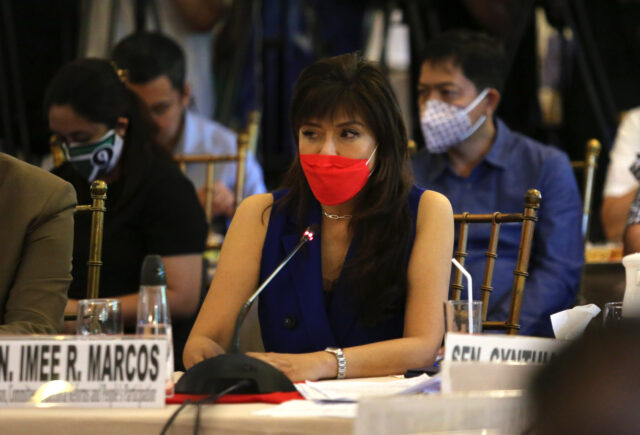
THE head of the Senate foreign relations committee called for safeguards to ensure that affected industries are sufficiently protected from the effects of what is being billed as the world’s largest free trade agreement.

Senator Maria Imelda Josefa Remedios R. Marcos, who chairs that chamber’s foreign relations committee, said of the “transitional safeguards” at a hearing: “We have to do it ourselves, so we should have measurable, time-bound plans for the next 10 to 15 years on the effectiveness of RCEP (Regional Comprehensive Economic Partnership) in full.”

She called on the Departments of Agriculture, Environment and Natural Resources, Trade and Industry, and the Bureau of Customs, among others, to prepare long-term plans to deal with RCEP’s impact

“I hear nothing from any of you, the only thing I hear is that you’re selling RCEP to us, but you do not plan for those that will be affected,” she said. “We should have a plan on how to help and overcome the difficulties that will come with RCEP.”

“Let us stop denying that there will be difficulties and sacrifices. Of course, this will happen because this will lead to bulk imports,” she added.

Trade Assistant Secretary and RCEP chief negotiator Allan B. Gepty, speaking at the hearing, said RCEP allows for adequate accommodations.

“We are ready,” he said. “If you will note, under the provisions of RCEP, when it comes to commitments, there are grace periods, transitions, flexibilities, they have really taken into account the capacity of RCEP parties.”

“This is not so sudden that the moment that RCEP takes effect in the Philippines, all the commitments will already have to be implemented,” he added. “Depending on the commitment, there will be transitions and they will also have their own segments.”

There are also complementary initiatives that will help RCEP parties become more prepared, Mr. Gepty said.

“But you have to be ready at the point of signing,” Ms. Marcos said. “We cannot get into an arrangement where we are completely bereft of any skills or powers.”

“At the point of signing, not at some mythical future date,” she added.

Mr. Gepty concurred, noting that in negotiations, their first consideration was ensuring that the deal does not breach Philippine law and the capacity of the country’s institutions.

The RCEP started taking effect in the various jurisdictions on Jan. 1. Participants include the 10 members of the Association of Southeast Asian Nations, Australia, China, Japan, South Korea, and New Zealand.

The Philippines and Myanmar are the only remaining countries that have yet to formalize their participation in RCEP.

Ms. Marcos has called for the establishment of a technical working group to finalize the committee report on the ratification of the RCEP trade agreement. The committee expects to report it out to plenary after the Christmas break. — Alyssa Nicole O. Tan

Sugar supply seen beginning to stabilize

PHILIPPINE STAR/ MICHAEL VARCAS

THE supply of sugar is stabilizing following stronger-than-expected refinery output, a Negros Occidental-based sugar industry association said.

“We are fortunate that good weather was on our side, thus production is high in terms of purity which has led to better sugar output as well,” Gerard Joseph Sarrosa, a spokesman for industry group Tatak Kalamay, said in a statement on Monday.

Tatak Kalamay cited data from the Sugar Regulatory Administration indicating a refined sugar inventory of 228,000 metric tons for the September to November period, which is up 91% from a year earlier.

Mr. Sarrosa added: “We are thankful that industry stakeholders are working together to ensure that we can respond to the needs of our consumers.”

Tatak Kalamay consists of sugar federations, groups of agrarian reform beneficiaries, labor groups, and cane millers.

Separately, Rex C. Estoperez, deputy spokesman of the Department of Agriculture, said that the Philippines has imported 150,000 metric tons of sugar. The department is currently looking into why sugar prices are high and will come to a decision soon on whether to import more. — Ashley Erika O. Jose

ERC halts power disconnection of contestable customers

THE Energy Regulatory Commission (ERC) has issued a cease-and-desist order against retail electricity suppliers (RES) issuing disconnection notices to contestable customers.

A similar order was also issued to distribution utilities (DUs) and the Independent Electricity Market Operator of the Philippines (IEMOP), the ERC said in a statement.

The ERC directed the parties to maintain the status quo while the energy regulatory body is still evaluation motions to dismiss filed by the RES segment of the power market.

Contestable customers are large end-users authorized to purchase power directly from the RES segment under the retail competition and open access program (RCOA), as allowed under Republic Act No. 9136 or the Electric Power Industry Reform Act.

“During this period, the parties are required to observe the terms and conditions of their supply agreements,” the ERC said.

The ERC said it has issued 13 cease-and-desist orders following complaints of customers, whose interpretation of the rules on RES entitlements to fuel cost recovery adjustments are at variance with the RES interpretation.

The ERC said that the contestable customers claim their contracts specify a fixed rate. The RES segment claims the issue is beyond the ERC’s jurisdiction.

“RES respondents meanwhile raised jurisdictional issues against ERC. DUs and the IEMOP, on the other hand, were impleaded since the issuance of notices and the disconnections of service are performed by such parties,” ERC said.

RCOA introduces retail competition to the energy industry. It allows consumers of an average of 500 kilowatts over the last 12 months to obtain retail supply contracts from the RES segment. Energy consumers can also customize their supply contracts according to dispatch, technology, or power plant.

The ERC said it will strive to ensure the continuity of the electricity supply pending a final resolution. — Ashley Erika O. Jose  

Hungary seeking to expand trade, BoI says 

HUNGARY indicated its interest in expanding trade with the Philippines at an event bringing together representatives from the environment, labor market, and information and communications technology industries, the Board of Investments (BoI) said.

In a statement on Monday, the BoI said that the Hungarian government expressed its interest at a Dec. 1 networking event bringing together about 80 Hungarian and Philippine companies.

Katalin Bihari, deputy state secretary of the Ministry of Foreign Economic Relations and Foreign Affairs of Hungary, said the Philippines has a “prominent position” in Hungarian foreign economic policy as a member of the Association of Southeast Asian Nation countries.

Ceferino S. Rodolfo, BoI managing head and Trade undersecretary, noted a recent increase in trade with Hungary.

“Philippine exports to Hungary increased by 40.26% — from $110.06 million in 2020 to $154.37 million in 2021. We believe the new exports of machine parts and accessories, as well as the increase in outward shipment of products such as digital monolithic integrated circuits, contributed to this growth,” Mr. Rodolfo said.

“Philippine imports from Hungary expanded by 16.68%, a development attributed to the sharp increase of imports of parts of refrigerators and freezers, as well as in the inward shipment of materials for electronic machinery,” he added.

Mr. Rodolfo invited Hungarian firms to consider the Philippines as a manufacturing hub, saying that the country has green metals such as nickel, copper, and cobalt used in battery production.

He said the Philippines is planning to implement a zero-tariff policy on imported electric vehicles, and the country’s decision to allow 100% foreign ownership of renewable energy projects. — Revin Mikhael D. Ochave

Rules on collection pending appeal

Being the subject of an audit by the Bureau of Internal Revenue (BIR) is a daunting challenge for any taxpayer. A single mistake could cost the taxpayer millions and put him in dire financial straits. As such, it is important for the taxpayer to keep abreast of recent developments in tax rules and regulations so that they may better protect themselves against any possible mistake.

One such development would be the recent case of Light Rail Transit v. Bureau of Internal Revenue (LRT v. BIR, G.R. No. 231238, June 29, 2022). In this case, the Supreme Court (SC) laid down some enlightening rules on the enforcement of collection of the BIR while pending appeal and the nature of a Warrant of Distraint and Levy (WDL) which we will now seek to break down for the taxpayer’s benefit.

WDL IS NOT A FINAL DECISION OF THE CIR
Often, taxpayers file a request for reconsideration to appeal the final decision on disputed assessments (FDDA) to the office of the BIR Commissioner. Taxpayers usually resort to this appeal process to avoid going to court, which is expensive and time-consuming. However, despite the pending appeal to the office of the Commissioner, the BIR will start the collection process, leaving the taxpayer in a quandary as to why the BIR is collecting when the assessment is still pending appeal.

Such was the situation in the Light Rail Transit case. In this case, while the FDDA was pending appeal to the office of the Commissioner of Internal Revenue (CIR), the RDO issued a Preliminary Collection Letter demanding payment of the deficiency taxes. The taxpayer informed the Regional Director that it had filed an appeal with the Commissioner. Nonetheless, the RDO issued a Final Notice Before Seizure. The taxpayer reiterated that its appeal was still pending with the Commissioner. The RDO then issued a Warrant of Distraint and/or Levy. Upon receipt of the decision on its appeal to the office of the CIR, the taxpayer filed the Petition for Review to the Court of Tax Appeals and later on a Petition for Certiorari to the Supreme Court.

One of the issues brought to the SC was whether the CTA had jurisdiction over the Petition for Review and whether the FDDA is the final decision of the respondent CIR appealable to the Court of Tax Appeals.

The BIR argued that the taxpayer should have gone to the CTA upon receipt of the WDL which, it averred, is tantamount to a final decision on appeal to the CIR. The CTA En Banc decided that the 30-day period for filing a petition for review should be reckoned from the day the taxpayer received a copy of the FDDA and not on the day it received the decision of the CIR on the appeal.

The SC ruled that a Preliminary Collection Letter, Final Notice Before Seizure, and/or WDL are not final decisions on the appeal by the CIR and therefore could not be considered as appealable to the Court of Tax Appeals (CTA). It also ruled that the FDDA was timely appealed to the CIR.

The SC ruled that the WDL, which was issued pending the appeal to the CIR, could not be considered as the decision appealable to the CTA because to rule so would deprive the taxpayer of the option of awaiting the decision of the CIR on its appeal.

This overturned the previous decision of the SC in the case of CIR v. Isabela Cultural Corp. (CIR v. ICC, 413 Phil. 276) wherein the SC ruled that the Final Notice Before Seizure is considered a final decision of the CIR and is therefore appealable to the CTA. It should be noted that when CIR v. ICC was promulgated, the jurisdiction of the CTA had yet to be amended to add inaction by the Commissioner as appealable to the Court of Tax Appeals. In light of new legislation and recent jurisprudence, the case of CIR v. ICC is no longer controlling.

The SC noted that the Preliminary Collection Letter, the Final Notice Before Seizure, the Warrant of Distraint and/or Levy, the Letter reconsidering the issuance of the Warrant of Distraint and/or Levy, and the Letter dropping the request for reconsideration of the Warrant of Distraint and/or Levy were not final decisions on the appeal by the Commissioner of Internal Revenue. All of these were issued on the premise that “delinquent taxes” exist, an incorrect premise. The SEC emphasized that the assessment was still pending appeal with the Office of the Commissioner when these issuances were made. They all emanated from a non-demandable assessment. As such, all were void and should be of no force and effect.

The SC also emphasized that in the case of a decision on the protest, the appeal must be filed 30 days from receipt of the adverse decision. On the other hand, in the case of inaction on the protest, the SC reiterated its rulings in the cases of Rizal Commercial Banking Corp. v. CIR and Lascona Land Co., Inc. v. CIR where it was clarified that a taxpayer may either:

(1) file a petition for review with the Court of Tax Appeals within 30 days after the expiration of the 180-day period fixed by law for the CIR to act on the disputed assessment; or

(2) await the final decision of the Commissioner on the disputed assessments and appeal such final decision to the Court of Tax Appeals within 30 days after receipt of a copy of such decision. This is true even if the 180-day period for the Commissioner to act on the disputed assessment had already expired.

In this case, the taxpayer chose to wait for the FDDA and thereafter elevated it to the Commissioner within the 30-day period. Hence, it never became final, executory, and demandable.

THE BIR HAS NO RIGHT TO COLLECT PENDING APPEAL
The SC also ruled in the case of LRT v. BIR that a WDL, while the assessment is pending protest, is void and of no effect, because the tax assessment on the taxpayer is not yet demandable.

Under Sections 205 and 207 of the Tax Code, a WDL is a civil remedy afforded to the government for the collection of delinquent taxes. As such, in order for a WDL to be validly issued, there must be delinquent taxes in the first place and there could only be delinquent taxes when the assessment has become final, executory, and demandable.

Subsection 3.1.5 of Revenue Regulation (RR) No. 12-99 provides that if the protest is elevated by the taxpayer to the CIR, the latter’s decision shall not be considered as final, executory, and demandable. As such, as long as the protest is still under appeal, the assessment issued by the BIR would not be considered as demandable. It being non-demandable, there are no delinquent taxes to collect and a WDL is not an available civil remedy to the government. Therefore, any WDL, while the assessment is pending appeal is void.

The next time the taxpayer receives a WDL while their assessment is pending appeal, the taxpayer need not be overly worried about it. The WDL is not considered a final decision and therefore, the BIR should discontinue the practice of issuing WDL while the assessment is still being appealed. To do so causes unnecessary worry, time, and expense on the part of the taxpayer.

To anyone operating a business in the Philippines, being the subject of a BIR audit is inevitable. This is a necessary process to ensure that correct taxes are collected and paid. The process seems intimidating and causes an immeasurable amount of anxiety on the part of the taxpayer. This emphasizes the importance of being updated when it comes to tax regulations to better protect the taxpayer’s rights. It is our hope that by informing the taxpayer of new developments in the field of taxation, taxpayers would be better armed to tackle a BIR audit and make the task just a little bit more manageable.

Let’s Talk Tax is a weekly newspaper column of P&A Grant Thornton that aims to keep the public informed of various developments in taxation. This article is not intended to be a substitute for competent professional advice.


Nolan Redji D. Domingo is an associate from the Tax Advisory & Compliance division of P&A Grant Thornton, the Philippine member firm of Grant Thornton International Ltd.

pagrantthornton@ph.gt.com

Filipinas dominate higher-ranked Papua New Guinea in 5-1 match

PRESSING high and winning the ball in dangerous areas, the Filipinas opened a 2-0 lead on Carleigh Frilles’ left-footed shot at the 29th and Tahnai Annis’ neat finish nine minutes later. — PFF

CARLEIGH Frilles fired a brace to power the Philippines to a 5-1 romp over Papua New Guinea (PNG) in the first of their two friendly matches Sunday at the Western Sydney Wanderers Park in Australia.

Ms. Frilles blasted goals in each half while skipper Tahnai Annis, veteran Eva Madarang and sub Meryll Serrano also struck as the No. 53 Filipinas dominated an opponent ranked two places higher in the FIFA rankings.

“Good opportunity to play a game where we could dominate possession again and give some more players critical game time,” said Philippine coach Alen Stajcic, whose squad is holding a camp in Sydney as part of its buildup for next year’s FIFA Women’s World Cup.

Pressing high and winning the ball in dangerous areas, the Filipinas opened a 2-0 lead on Ms. Frilles’ left-footed shot at the 29th and Ms. Annis’ neat finish nine minutes later.

PNG pulled one back at the 50th with Calista Maneo nodding the ball in but the Philippines countered with Ms. Madarang’s header, Ms. Frilles’ second and Ms. Serrano’s goal off the bench.

“Even though we were a bit rusty and clunky at times, there were some really good moments, too. Looking forward to building for the next game on Thursday,” said Philippines coach Alen Stajcic.

The return match will also be played at the Wanderers’ Park and will mark the Filipinas’ final game for the year. — Olmin Leyba

Vanessa Sarno plunges into World Championship action in Bogota, Colombia

VANESSA SARNO — PHILSTAR FILE PHOTO

VANESSA Sarno has topped the Tashkent Asian Championships at the age of 17 years old and the Hanoi Southeast Asian Games at 18.

Now a year older, the Tabilaran, Bohol lass will try to add another conquest to her growing list of triumphs and prove she’s the worthy successor to Hidilyn Diaz-Naranjo’s throne as queen of Philippine weightlifting as she plunges into World Championships action in Bogota, Colombia tonight.

The sky is the limit for Ms. Sarno, who is being tipped as the heiress to the Filipina Tokyo Olympics gold winner after her exploits in the international meets that included a fifth-place finish in the Worlds in Tashkent, Uzbekistan a year ago at only 18.

Ms. Sarno will plunge into action in the women’s 71-kilogram division alongside countrywoman Kristel Macrohon, a SEA Games mint winner herself, and try to send some shockwaves down the competition hall against the world’s best and strongest headed by Commonwealth Games titlist Marie Fegue of Cameroon.

Other notable names in Ms. Sarno’s division are two-time Pan-American silver medalist Mari Sanchez of Colombia and three-time European queen Loredana Toma of Romania.

Ms. Sarno will give it her all and try to add to the three glittering gold snared by Ms. Diaz-Naranjo in the 55kg class several days back.

Precious qualifying points to the 2024 Paris Games also await Ms. Sarno, who is being groomed to make the cut in the next edition of the quadrennial event alongside Ms. Diaz-Naranjo and possibly more.

“We’re eyeing to earn qualifying points here, not just medals,” said Samahang Weightlifting ng Pilipinas President Monico Puentevella. — Joey Villar

Concio sees action in rich, tough chessfest in General Santos City

MICHAEL CONCIO JR — FIDE

FILIPINO International Master (IM) Michael Concio, Jr. will try to carry over the momentum of his string of recent feats of late as he sees action in the rich Maharlika Pilipinas Chess League’s Manny Pacquiao International Open Chess Festival starting today in General Santos City.

Just over the weekend, the 17-year-old Mr. Concio has topped the sixth edition of the Kamatyas Rapid Invitational at SM Sucat after edging IMs Ronald Dableo and Angelo Young via tiebreak.

It was apart from his rapid title and standard silver in the Asian Juniors Championships in Tagaytay last month and the Hanoi International Master closed tournament last May.

And if things go the way he wants it, Mr. Concio could end up pocketing the top purse worth a cool P1.14 million, and more importantly, a second of the three norms required to become a Grandmaster.

“We’ll just do our best and see what happens,” said the Dasmariñas-based Zonal champion and World Cup veteran, who left yesterday along with GM Darwin Laylo, IM Daniel Quizon and Mark Jay Bacojo for General Santos.

Mr. Concio, however, knows he’s in for a tough ride as he tackles an ultra-competitive field that included GMs Hovhannes Gabuzyan of Armenia, Lucas Van Foreest of the Netherlands, Vitaly Sivuk of Sweden and Pier Luigi Basso of Italy as well as Konstantin Sek of Russia and IMs John Daniel Bryant of the United States and Dragos Ceres of Moldova.

Other players to watch are Mr. Laylo, GM John Paul Gomez, IMs Kim Steven Yap, Chito Garma, Ricky de Guzman, Ronald Bancod, Cris Ramayrat, Joel Pimentel and Angelo Young and FIDE Masters Alekhine Nouri, Mari Joseph Turqueza, David Elorta and Jeth Romy Morado.

The meet is bankrolled by boxing legend and former senator Manny Pacquiao and backed by President Bong Bong Marcos, Philippine Sports Commission Chairman Noli Eala and National Chess Federation of the Philippines Chairman and President Butch Pichay. — Joey Villar

ADVERTISEMENT
ADVERTISEMENT