Home Blog Page 5511

BPOs hope to ride WFH wave by expanding to countryside

REUTERS

THE business process outsourcing (BPO) industry said 30% of its workforce has relocated to the countryside due to the pandemic, presenting an opportunity for the industry to decentralize operations and generate opportunities in untapped markets.

The IT and Business Process Association of the Philippines (IBPAP) said BPO companies, which are also known collectively as the Information Technology and Business Process Management (IT-BPM) industry, could end up establishing new hubs given the level of talent now dispersed in the countryside.

Frankie Antolin, IBPAP talent attraction and development executive director, said at a conference hosted by the Makati Business Club on Wednesday that “about 30% of our headcount … in the countryside and we want to look for different ways that we can expand that (headcount) a lot more,” Ms. Antolin said.

Ms. Antolin hopes that rural expansion brings IT-BPM work opportunities closer to the people.

“It is not really just about decongesting, but we want to be able to bring the (IT-BPM) sector and create more IT-BPM digital hubs across the country. That is certainly one of the priorities that we have which is to move and expand into the countryside,” Ms. Antolin said.

Ms. Antolin said hybrid work has been a success for the industry since the pandemic began in 2020, with staffing levels and revenue rising in 2021.

“The last two years have been a success for the industry. We have seen that there is no sacrifice in terms of productivity as long as we have appropriate work-from-home (WFH), work from anywhere arrangements,” Ms. Antolin said.

“We’ve had a strong 2021. The number of full-time employees increased by 120,000 bringing the industry’s total headcount to 1.44 million and registering growth of 9.1% compared to 2020. We’ve also recorded very good growth in terms of revenue, (at) P29.49 billion, or a 10.6% jump,” she added.

Digital platform Grab Business Director for Sales Amit Patel said that hybrid work will remain even after the pandemic.

“I feel that hybrid work will be here to stay. Not every organization can support this. There are industries that will need to work in the office because of their type of work. We need to balance that as well. (Hybrid work) will stay. It is probably something that is going to outlast the pandemic,” Mr. Patel said.

On June 21, the Fiscal Incentives Review Board (FIRB) issued FIRB Resolution No. 017-22 which  temporarily permitted registered IT-BPM firms to implement 70% onsite and 30% WFH arrangements between April 1 and Sept. 12 without affecting their fiscal incentives.

Incentives are governed by Republic Act No. 11534 or the Corporate Recovery and Tax Incentives for Enterprises (CREATE) law, which normally requires all operations by companies enjoying the perks to do their work within economic zones.  — Revin Mikhael D. Ochave

PHL shift to LNG imports under threat from high gas prices

REUTERS

THE Philippines’ plan to import its natural gas needs following the depletion of the Malampaya field is being upended by the rise in natural gas prices, according to the Institute for Energy Economics and Financial Analysis (IEEFA).

“The country is entering the global LNG market at a time of extreme uncertainty. Global LNG supply is constrained due partly to the Russian invasion of Ukraine, and LNG prices continue to hit record highs,” according to Sam Reynolds, an energy finance analyst writing in an IEEFA report.

IEEFA said that risks surrounding limited global LNG supply are expected to continue over the next decade, potentially derailing the Philippines’ growth plans, which are predicated on generating sufficient energy.

The market for gas was disrupted by the Ukraine war, which triggered sanctions on Russia and caused Europe to seek gas elsewhere in order to reduce dependence on Russian gas, sending prices upward. 

Several LNG importing countries are protected by long-term purchase contracts, which require sellers to deliver LNG on a predetermined schedule and price formula. The Philippines, however, does not have any long-term contracts according to the International Energy Agency’s gas market update.

“This means that the country will be forced to outbid wealthy buyers in Europe and Northeast Asia for limited LNG supplies, exposing the country to high prices and extreme volatility. Without access to affordable fuel, LNG-to-power proposals in the Philippines could be delayed, canceled, or stranded,” IEEFA added.

IEEFA also said that the window of opportunity for LNG investment is closing quickly. It warned that inability to buy LNG at competitive rates could leave new terminals and LNG-fired power plants idle.

According to the Center for Energy, Ecology, and Development, the Philippines has 36.5 million tons per annum of LNG terminal capacity under development. The Philippines also has 29.9 gigawatts of gas-fired power projects.

San Miguel Corp. accounts for the largest share of the proposed capacity, while First Gen Corp. and Atlantic Gulf & Pacific International Holdings Pte. Ltd.  were anticipated to commence commercial operations of LNG projects. — Ashley Erika O. Jose

Ex-PEZA head claims investors confused by OIC arrangement

THE FORMER director-general of the Philippine Economic Zone Authority (PEZA) said economic zone locators are finding it confusing to operate amid conflicting statements on the status of the agency’s leadership.

Charito B. Plaza, in a news conference on Wednesday, was responding to a Department of Trade and Industry (DTI) order affirming the new leadership at the agency following a period when certain agency officials were declared officers in charge (OIC) by the new administration.

Ms. Plaza said she is awaiting an official response of the Office of the President (OP) after seeking clarification on her status.

Ms. Plaza was appointed by former President Rodrigo R. Duterte as the PEZA’s Director General in September 2016. The change of government created a situation where certain agency heads were instructed to remain in their posts temporarily.

“I will only abide by the OP decision. It is only the President who (can) appoint the PEZA Director-General. Locators are at a loss and are worried. We are praying that the OP can address the issue,” Ms. Plaza said.

Trade Secretary Alfredo E. Pascual had issued Department Order No. 22-68 on Aug. 2 which affirmed as PEZA OIC Director-General Tereso O. Panga until Dec. 31, or until a replacement is appointed.

According to Ms. Plaza, Memorandum Circular (MC) No. 3 issued by the OP on July 27 superseded MC No. 1 issued on June 30.

MC No. 1 declared vacant all positions held by presidential appointees; in the absence of designated replacements, the OIC position will be taken up by the agency official who is next in seniority.

Ms. Plaza said that MC No. 1 did not specify whether a government instrumentality such as PEZA was covered. PEZA was conferred government instrumentality status by a Supreme Court ruling (G.R. No. 184203), prompting Ms. Plaza to seek clarification from the OP.

MC No. 3 subsequently clarified that government instrumentalities and government-owned or controlled corporations with corporate powers are exempt from MC No. 1.

“MC No. 1 clearly stated that we are exempt (from the co-terminous rule for appointees of President Duterte) because PEZA is a government instrumentality, with corporate powers, exempted from paying real estate tax, as stated by the Supreme Court decision in PEZA’s case against Lapu-lapu City in Cebu in 2018,” Ms. Plaza said.

Before Ms. Plaza’s news conference, PEZA’s Corporate Communications Division said in an e-mail that the agency is obeying the DTI’s order.

“Please be informed that we in PEZA are bound and are obeying DTI Department Order No. 2022-88 affirming Mr. Panga as the PEZA OIC,” it said.

Asked to comment, Mr. Panga said in a Viber message that he issued a statement to PEZA employees that work within the agency should not be disrupted.

“Let’s focus on our work and not allow ourselves to get distracted. We have the law on our side and the full support of the DTI, PEZA officers and employees, ecozone locators and partner industries,” Mr. Panga said in the statement.

“We also pray for Ms. Plaza and for all PEZAns that we may resolve as soon as possible this crisis in a peaceful, decent and honorable manner. I am just an OIC and doing my job, following the OP directives under MC 1 and MC 3. I would be glad to turn over the reins to whoever will be appointed PEZA Director-General by the President,” he added.

Mr. Panga has spent 24 years with PEZA. He was a former division chief of Policy Planning, zone manager of Lima Technology Center and other ecozones in Batangas, zone administrator of Baguio City Economic Zone and Cavite Economic Zone, and had been deputy director general for Policy and Planning since 2010. — Revin Mikhael D. Ochave

Let’s talk about sanctions

In February, Russia invaded Ukraine, bringing down upon Moscow a regime of sanctions mostly from Western countries. What does it mean when sanctions are imposed on an individual, class of persons, entity or country?

The Association of Certified Anti-Money Laundering Specialists (ACAMS) defines sanctions as “punitive or restrictive actions taken by individual countries, regimes, or coalitions with the primary purpose of provoking a change in behavior or policy. Sanctions can restrict trade, financial transactions, diplomatic relations, and movement. They can be specific or general in their implementation and enforcement. Sanctions are also referred to as restrictive measures.”

Sanctions can be imposed by one country (unilateral) or by multiple countries (multilateral) on an individual, class of persons, entity, or country to influence their actions.

For instance, under the United Nations Charter, the Security Council can take action to maintain or restore international peace and security under Chapter VII of the charter. The Security Council is composed of 15 Members. The five permanent members are China, France, the Russian Federation, the UK, and the US. The 10 non-permanent members are elected for two-year terms by the General Assembly. Sanctions that have been approved are binding on all member states.

The European Union (EU) implements all sanctions adopted by the UN Security Council. In addition, the EU may also decide to impose sanctions on its own initiative (‘EU autonomous sanctions’). EU sanctions apply within the jurisdiction of the EU, to EU nationals in any location and to companies and organizations incorporated under the law of a member state. Enforcement must be undertaken by the member states.

Moreover, the Office of Foreign Assets Control (OFAC) of the US Department of the Treasury administers and enforces economic and trade sanctions based on US foreign policy and national security goals against targeted foreign countries and regimes, terrorists, international narcotics traffickers, those engaged in activities related to the proliferation of weapons of mass destruction, and other threats to the national security, foreign policy or economy of the US. OFAC publishes lists of individuals and companies owned or controlled by, or acting for or on behalf of, targeted countries. It also lists individuals, groups, and entities, such as terrorists and narcotics traffickers designated under programs that are not country-specific.

The Export Control Organization (ECO) of the UK licenses controlled goods and goods caught by a country-specific embargo, while Her Majesty’s Treasury licenses funds or assets.

Taking the war in Ukraine as an example, the US and the UK have both imposed additional sanctions on Russia, which include: banning new inbound investment, as well as severe sanctions on two Russian financial institutions (Alfa Bank and Sberbank), on major state-owned enterprises, and on government officials and their family members.

As part of the UK’s efforts to isolate Vladimir Putin, it announced sanctions against seven oligarchs. Roman Abramovich, the owner of Chelsea Football Club, had his assets frozen, and was prohibited from transacting with UK individuals and businesses, and barred from travel. Abramovich’s one-time business partner, industrialist Oleg Deripaska, was also similarly sanctioned.

Another notable example is the long-time sanctions regime imposed on North Korea due to the country’s continuing pursuit of its nuclear and missile program. Executive Order 13722 blocks the Government of North Korea and the Workers’ Party of Korea; prohibits the export and re-export of goods, services (including financial services), as well as technology from the US, or by a US person to North Korea; and prohibits new investment in North Korea by a US person.

Sanctions can further be classified into four types: diplomatic, financial, trade and travel. A diplomatic sanction restricts or suspends membership in international organizations and diplomatic visits that affect the ability of the target to interact with other countries. It can also limit access to financial aid or loans. Financial sanctions can involve account seizures or freezing. Trade sanctions, sometimes called embargoes, limit the import/export of specific goods (e.g., arms, oil or diamonds) or services (e.g., technology, training, financing). Travel sanctions restrict the mobility of individuals on the list (preventing them from traveling to and through certain countries). It can extend to any asset including bank accounts to pay for travel.

As payment transactions are predominantly the only record that can detect a potential sanctions violations, a financial institution’s role is crucial in discerning the circumstances that warrant sanctions. Financial institutions also have the right to seize or freeze assets to prevent payments to certain individuals.

Thus, a financial institution must have a robust Anti-Money Laundering (AML) compliance program in place which should be based on the following pillars to combat financial crime: internal policies, procedures and controls; designation of an AML officer; employee training; independent testing; and customer due diligence (CDD). As part of CDD, financial institutions must identify and verify the identity of the customer as well as the parties that own or control them, their transactions and the applicable sanctions. The customer’s and parties’ name would need to be screened against the sanctions list. These are done through intelligence gathering, checking of transactions with violations, and filing of suspicious activity reports. A good AML compliance program will help financial institutions determine any involvement that a customer has with a sanctioned target or if the customer itself is a sanctioned individual or entity. Lastly, there should be a check done on the customer’s transactions to make sure that they are not dealing with sanctioned individuals or entities. When done properly, it should help prevent financial institutions from violating sanctions.

The views or opinions expressed in this article are solely those of the author and do not necessarily represent those of Isla Lipana & Co. The content is for general information purposes only, and should not be used as a substitute for specific advice.


Joanne Reyes is a manager at the Financial Crime practice of PricewaterhouseCoopers Consulting Services Philippines Co. Ltd., a Philippine member firm of the PwC network.

+63 (2) 8845-2728

joanne.reyes@pwc.com

PHL men’s team stuns Sweden with Paragua heroics on Board 1

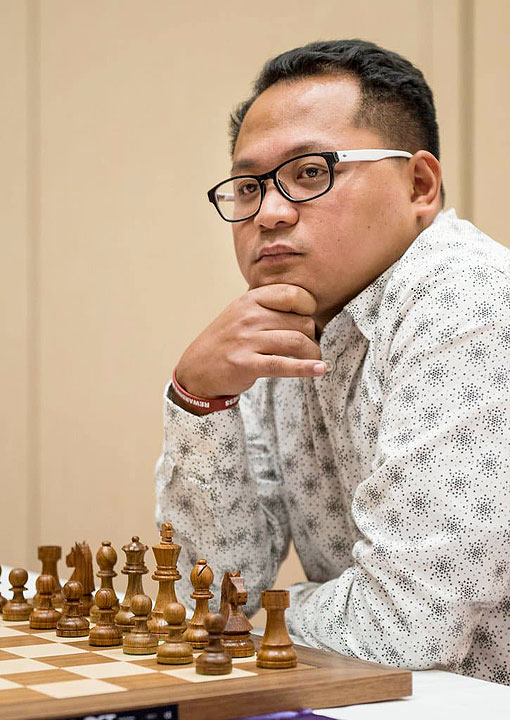
Grandmasters Mark Paragua — MARK PARAGUA FB PAGE

Women’s team suffer setback against Swedes, 2.5-1.5

Grandmasters Mark Paragua — MARK PARAGUA FB PAGE

GRANDMASTER (GM) Mark Paragua dug deep into his endgame bag of tricks as he carved out the nerve-wracking victory on top board in lifting the Philippines to a stunning 2.5-1.5 win over a fancied Sweden in the fifth round on Tuesday night and into the top 10 of the 44th World Chess Olympiad in Chennai, India.

Left with the responsibility of carrying the fight after GMs John Paul Gomez and Darwin Laylo and International Master (IM) Paulo Bersamina drew their respective games in the lower boards, the 38-year-old Mr. Paragua willfully went for a win when he could have easily sent his duel with GM Erik Blomqvist into a draw.

The New York-based many-time World Cup veteran built on a slim lead brick by brick, layer by layer until he got the much needed break against an unnerved Mr. Blomqvist and turned it into lasting advantage.

When it was over, his unnerved higher-rated foe was facing the specter of losing his rook to Mr. Paragua and resigned on the 69th move.

The emphatic win sent the Filipinos, who are being sponsored by the Philippine Sports Commission, into an 18-nation logjam at eighth spot with eight match points apiece and a highly anticipated duel with 21st ranked Israel in the sixth round at press time for a chance at climbing up into the top five along with the big guns.

The country was just two points behind co-leaders India 2 and Armenia, which own perfect scores of 10 points, and a point closer to third to seventh placers Uzbekistan, India 1, Cuba, Iran and a Wesley So-paced United States of America with nine points each.

National men’s coach Eugene Torre said they would rest Mr. Gomez in favor of GM Banjo Barcenilla.

WOMEN’S TEAM
It was, in contrast, heartbreaking for the Filipinas as Janelle Mae Frayna lost to Eline Roebers on top board that sealed their 2.5-1.5 defeat at the hands of the higher-ranked Swedes.

WIM Marie Antoinette San Diego prevailed over FIDE Master Machteld Van Foreest on board three while WGM candidate Kylen Joy Mordido halved the point with WIM Rosa Ratsma on board four.

WIM Jan Jodilyn Fronda fell to grizzled veteran GM Peng Zhaoqin on second board.

The GM Jayson Gonzales-mentored Filipinas slipped to a 35-nation tie at 39th with six points and they were facing the Ecuadorians in the sixth round. — Joey Villar

Thrower Asusano captures lone gold for PHL bets in 11th ASEAN Para Games

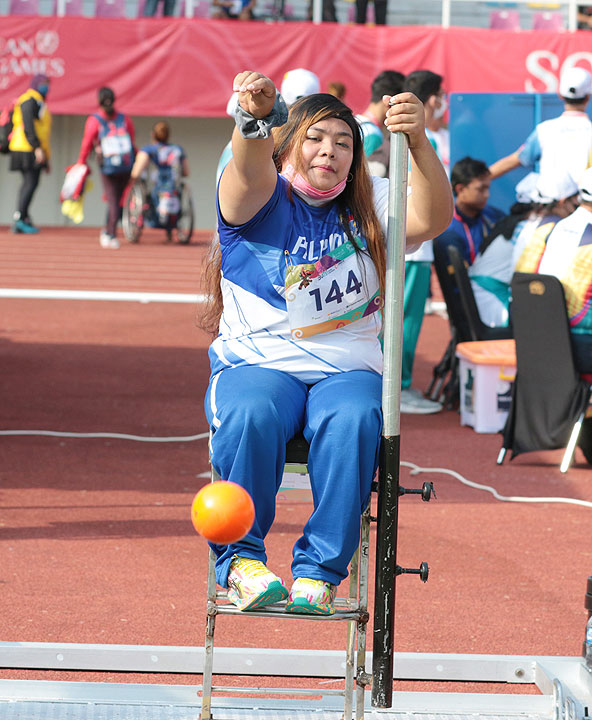
CENDY Asusano shows winning form in ruling the women’s shot put F54 in athletic action at the Manahan Stadium in the 11th ASEAN Para Games on Wednesday in Surakarta, Indonesia. — TEAMPHI ASEANPARAGAMES
Golden throw
CENDY Asusano shows winning form in ruling the women’s shot put F54 in athletic action at the Manahan Stadium in the 11th ASEAN Para Games on Wednesday in Surakarta, Indonesia. — TEAMPHI ASEANPARAGAMES

THROWER Cendy Asusano emerged the lone bright spot to what had been a slow and uneventful day for the Philippines, snaring the women’s shot put F54 gold medal in the 11th Association of Southeast Asian Nations (ASEAN) Para Games in Solo, Indonesia.

Ms. Asusano heaved a 5.65 meters on her fourth attempt to not only capture her second gold after ruling javelin on Monday, but also eclipse her old mark of 5.50m she registered in copping one of the three mints she took home in the 2017 edition of the biennial meet in Kuala Lumpur, Malaysia.

But she will no longer match her triple-gold haul last time as she was disqualified in the discus throw the day before that was caused by an accidental loose strap on her throwing chair, which was prohibited, that denied her that important mint.

“I just did not think of it (disqualification) anymore so that I won’t be stressed. And I’m thankful to God that I won,” said the proud Pasig native.

It was the lone gold the country produced in the day after an eight-gold deluge that was highlighted by the magnificent chess team’s four-gold rampage in the standard event the day before.

It somehow slowed down the country’s bid in surpassing, if not replicating, its 20-gold, 20-silver and 29-bronze harvest in Kuala Lumpur.

At press time, the country had amassed 14 mints in all.

It was not as if the Filipinos, whose trip here is being bankrolled by the Philippine Sports Commission, didn’t try.

Over at the Jatadiri Sports Complex in Semarang, swimmers Roland Sabido and Arnel Aba added silver and bronze medals, respectively, to the country’s collection in the stint backed by the Philippine Sports Commission.

Mr. Sabido was second in the men’s 100-meter backstroke S9 event in one minute, 15.820 seconds while Mr. Aba bagged the bronze medal in the men’s 100-meter butterfly stroke S9 event in 1:23.40.

Contributing bronze medals in athletics were King James Reyes and Andy Avellana in the men’s 1,500-meter T46 race and men’s high jump F11-13 event, respectively.

Table tennis likewise delivered a bronze through the Class 10 mixed doubles tandem of Pablo Catalan, Jr. and Minnie Cagdag, who took a 6-11, 8-11, 4-11 loss to Indonesia’s Komet Akbar and Aminah in the semifinals.

Overnight, judo also gave the country its first medal in the sport courtesy of Peterson Onas in the men’s J1-60kg class.

But the swimmers hope to recover from their anemic showing on Thursday with 2017 Malaysian Para Games gold medalist Gary Bejino, veteran Ernie Gawilan and Angel Otom expected to vie for gold on Thursday. — Joey Villar

HD Spikers seek revenge vs sister team Power Hitters

CIGNAL HD Spikers expected to show no mercy this time vs PLDT Power Hitters. — PHILIPPINE STAR/ RUSSEL PALMA

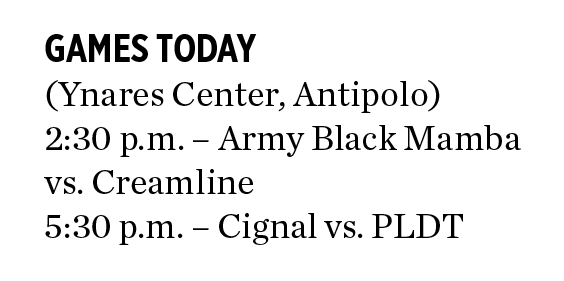
CIGNAL seeks to get back at sister team PLDT as the former shoots for a first win in the semifinals of the Premier Volleyball League Invitational, which goes to the Ynares Center in Antipolo on Thursday.

The HD Spikers were shorthanded the last time they faced the Power Hitters in a 25-19, 25-20, 21-25, 25-22 defeat in an elimination-round showdown last Saturday at the Filoil EcoOil Centre.

Cignal played minus Ces Molina (sore ankle) and skipper Rachel Anne Daquis, Jerillie Malabanan, Roselyn Doria, Ayel Estranero and Chai Troncoso (various health reasons).

Their absence helped PLDT get the win that catapulted them in the six-team semis where it jumpstarted its campaign with a 25-22, 25-18, 25-21 triumph over Army Black Mamba on Tuesday.

But with its title bid on the line, Cignal is expected to show no mercy this time as it is expected to send back the cavalry headed by Mses. Molina and Daquis and show PLDT that the Open Conference third place is the better team.

Game time is at 5:30 p.m.

Creamline, for its part, aims to ride on their strong showing in the elims where they ended up No. 1 with a 5-1 record, as it tangles with Army Black Mamba (0-1) at 2:30 p.m.

A win for the Cool Smashers would relaunch their bid to claim one of the two berths to the one-game finale where they would have a chance to snare their second crown following their Open Conference conquest last April.

Creamline is expected to draw strength from what everybody calls “The Fantastic Four” of skipper Alyssa Valdez, setter Jia de Guzman, reigning Open Conference MVP Tots Carlos and Jema Galanza. — Joey Villar

Eala beats lowly Svatíková in Poland tourney, 6-4, 6-4

ALEX EALA — RAFAEL NADAL ACADEMY FB PAGE

ALEX M. Eala debuted in her first $100,000 tourney in style after a 6-4, 6-4 win over Slovakia’s Laura Svatíková in the opener of the W100 Grodzisk Mazowiecki in Poland.

Ms. Eala scored the win in one hour and 23 minutes despite having seven faults against a lower-ranked opponent in Svatíková, who is outside the Women’s Tennis Association’s (WTA) Top 1000.

The 17-year-old ace is currently No. 280 in the WTA, a new career best for her after moving from No. 282 last week.

Ms. Eala was to face Germany’s Kartharina Hobgarski, who gained a first-round bye as the No. 14 seed in the prestigious tourney, in the next phase.

The Filipina pride is hoping for another deep playoff run this time in Poland after a pair of Final Four campaigns in Spain.

Bidding for her third professional title, Ms. Eala made the semifinals of the W25 El Espinar/Segovia and W60 Vitoria-Gasteiz last month plus a finals appearance in the W60 Madrid in June.

Ms. Eala won her first two titles in her promising career in the 2021 W15 Manacor in Spain and the 2022 W25 Chiang Rai in Thailand. — John Bryan Ulanday

Lyceum remains unbeaten; UE scores first win in three years

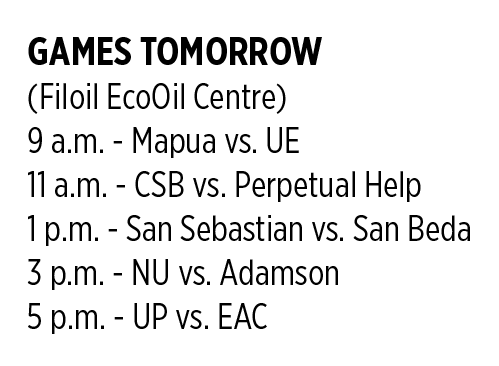
UNIVERSITY of the East (UE) ended its three-year drought while Lyceum of the Philippines University extended its unbeaten run in the Filoil EcoOil Preseason Cup on Wednesday at the Filoil EcoOil Centre in San Juan.

The Red Warriors bested Arellano University in the battle of listless squads, 58-50, to barge into Group A’s winning circle while the Pirates sank Santo Tomas, 83-73, and improved to 3-0 for a solo lead in Group B.

More than its Filoil breakthrough, UE posted its maiden victory in three years since taming National University, 79-76, in the UAAP Season 82 in 2019 prior to the pandemic.

Nikko Paranada made sure to rescue UE from that long futility with 17 points, four rebounds, three assists and four steals. Harvey Pagsanjan and Calvin Payawal chipped in nine each.

UE’s agony included a 0-14 campaign in the University Athletic Association of the Philippines (UAAP) return from a long hiatus last summer.

Vincent Cunanan (17) and Renzo Navarro (12), meanwhile, bannered the Pirates in their takeover of Group B leadership from idle La Salle (2-0).

In the other game,  Far Eastern University (FEU) rolled past San Beda in Group B, 82-73, as Yuri Escueta fell short in his hunt for a debut win as the Red Lions’ new head coach.

Bryan Sajonia (16) and Royce Alforque (15) starred for the Tamaraws, who have slowly but surely found their groove at 2-2 after a winless start.

Arellano (0-4) and San Beda (0-2) stayed winless in their respective pools while Santo Tomas slid to 1-1. — John Bryan Ulanday

Djokovic likely to miss US Open over COVID-19 vaccine status

THERE is a petition circulating to allow Novak Djokovic to play at the US Open but the Serbian appears likely to miss the entire North American hardcourt swing barring a sudden change in coronavirus disease 2019 (COVID-19) protocols in the United States and Canada.

Djokovic has refused to take the COVID-19 vaccine, yet the 21-time Grand Slam winner remains on the entry lists for the ATP 1000 events in Montreal and Cincinnati that serve as tune-ups for the Aug. 29-Sept. 11 US Open in New York.

In the case of the US Open, which does not have a vaccine mandate, organizers previously said that per the Grand Slam Rule Book, all eligible players are entered into the main draw based on their ranking 42 days prior to the first Monday of the event.

US Open organizers also said that while they do not have a vaccination mandate in place for players, they will respect the US government’s position regarding travel into the country for unvaccinated non-US citizens.

Former world number one Djokovic, whose website shows no upcoming events, said last week he was preparing for the US Open as if he will be allowed to compete in the year’s final Grand Slam despite not being vaccinated.

Djokovic’s camp and organizers of the three North American hardcourt events did not immediately respond when asked by Reuters on Tuesday for comment.

The hashtag #LetNovakPlay was circulating on social media as a slew of Djokovic supporters voiced their support for a player who moved to within one of Spaniard Rafa Nadal’s record of 22 Grand Slam titles after his Wimbledon triumph last month.

An online petition that launched a month ago calling for the United States Tennis Association to work with the US government to allow Djokovic to compete in the US Open was edging closer to its target of 50,000 signatures on Tuesday. — Reuters

6 of 52 drug war cases dismissed for lack of witnesses — DoJ 

BW FILE PHOTO

By John Victor D. Ordonez, Reporter 

GOVERNMENT prosecutors have dismissed for lack of witnesses six out of 52 cases against police officers accused of involvement in the previous administrations war on drugs, the Justice department said on Wednesday.  

In a live-streamed press briefing, Justice Undersecretary Jesse Hermogenes T. Andres said other factors for the dismissal were no sign of foul play and families choosing not to pursue the cases.  

He added that case buildup is ongoing for seven more cases. 

“We are confident with the evidence in these seven cases. It’s the certainty of punishment that deters crimes,” Mr. Andres said.  

Justice Secretary Jesus Crispin C. Remulla told the same briefing that the Department of Justice (DoJ) intends to pursue the cases filed by the government and appealed to witnesses to cooperate.   

“Please come forward. We will welcome these people who wish to put forward their testimonies,” he said.  

Mr. Remulla said the DoJ intends to share all its information on the drug war with the Commission on Human Rights.  

The Justice department had only brought five of the 52 cases involving 150 police officers to court since it started its own probe last year.  

An inter-agency committee formed 15 teams last year that probed alleged extralegal killings and human rights violations involving the governments anti-illegal drug operations.  

President Ferdinand R. Marcos, Jr. on Monday said the Philippines would not rejoin the International Criminal Court (ICC) as it may resume its probe into his predecessor’s deadly anti-illegal drug campaign.  

Mr. Duterte had canceled Philippine membership in the international tribunal in 2018.  

Mr. Remulla said the Philippines’ non-membership to the ICC does not deprive Filipinos of an avenue for justice as the country has a functioning justice system. 

In a 53-page request to the international courts pre-trial chamber in June, ICC Prosecutor Karim Ahmad A. Khan said the Philippines had failed to show it investigated crimes related to the campaign. 

He said the chamber should issue an order on an expedited basis.It should receive any further observations it considers appropriate from victims and the government of the Philippines,he added.  

The ICC, which tries people charged with crimes against humanity, genocide, war crimes and aggression, suspended its probe of Mr. Dutertes deadly war on drugs last year upon the Philippine governments request.  

Data from the Philippine government released in June 2021 showed that at least 6,117 suspected drug dealers had been killed in police operations as of April 2021. Human rights groups estimate that as many as 30,000 suspects died. 

Marcos appoints FDA head, others in various agencies 

PRESIDENT Ferdinand R. Marcos, Jr. has appointed his personal physician, Samuel A. Zacate, as chief of the Food and Drug Administration (FDA), according to Malacañang.  

Mr. Zacate is eminently qualifiedto head the agency that regulates food and drugs before they enter the market, Press Secretary Trixie Cruz-Angeles told a televised news briefing.  

He is a known public health advocate with years of expertise in medicine and medical consultancy in other government units and offices, including the Public Attorneys Office and Presidential Security Group Hospital,Ms. Cruz-Angeles added.   

Mr. Zacate was a diplomate for the Philippine Society of Venereology and a fellow at the International College of Surgeons, the Palace official said.   

Meanwhile, Mr. Marcos picked Carlo Dimayuga as acting chief of the Metropolitan Manila Development Authority.  

The President also chose Roman A. Felix, a retired police general, as secretary of the Office of the Presidential Adviser on Military Affairs.   

Ms. Cruz-Angles said Ariel R. Caculitan, a retired military general who served in different units of the Philippine Marine Corps and Philippine Navy, was appointed undersecretary of the Office of the Presidential Adviser on Military Affairs (OPAMA).  

Isagani R. Nerez, a lawyer and retired police officer, will serve at OPAMA as undersecretary for police affairs.   

For the Justice department, the President has named five new undersecretaries and two assistant secretaries.  

Jesse Hermogenes T. Andres, Geronimo L. Sy, and Jose Ragus Cadiz, Jr., Deo L. Marco, and Nicholas Felix L. Ty were appointed as undersecretaries, according to the appointment letter dated July 29.  

Also appointed were Jose Arturo R. Malvar and Majken Anika S. Gran-Ong as assistant secretaries. Kyle Aristophere T. Atienza and John Victor D. Ordoñez