Home Blog Page 5511

What to See This Week (12/16/22)

TRINITY Jo-Li Bliss in Avatar: The Way of Water

Avatar: The Way of Water

SET more than a decade after the events of the first film, the sequel to James Cameron’s Avatar follows the story of the Sully family (Jake, Neytiri, and their children) whose peaceful life is interrupted when the Sky People (humans), return for Jake. The family seeks refuge with an oceanic clan and learn the ways of the water to survive. The film stars Zoe Saldana, Sam Worthington, Sigourney Weaver, Stephen Lang, Cliff Curtis, Joel David Moore, CCH Pounder, Edie Falco, Jemaine Clement, and Kate Winslet. It is being screened in IMAX, 3D, and 4DX versions. Book tickets at https://disney.asia/dQZ2Oj. Entertainment Weekly’s Leah Greenblatt writes, “The world both above and below the waterline is a thing to behold, a sensory overload of sound and color so richly tactile that it feels psychedelically, almost spiritually sublime.” Film review aggregate site Rotten Tomatoes’ Tomatometer gives it a score of 83%.

MTRCB Rating: PG


Broken Blooms

SET during the COVID-19 pandemic, a young newlywed couple’s relationship is tested by their circumstances. The film reflects the difficulties faced by Filipino families living in poverty. Directed by Louie Ignacio, the film stars Jaclyn Jose, Therese Malvar, and Royce Cabrera. Broken Blooms has made a splash in a number of film festivals, with its cast and director receiving a number of awards. Among these are: the Harlem International Film Festival, New York (Best Actor Jeric Gonzales); the Mokho International Film Festival, India (Best Narrative Feature Film, Best Actor Jeric Gonzales, Best Actress Therese Malvar, and a Special Jury prize for Director Louie Ignacio); and the 2nd Saskatchewan International Film Festival, Canada (Best Feature Fiction, Best Director, Best Actor Jeric Gonzales, Best Actress Therese Malvar, Best Supporting Actor Norman Boobay Balbuena, Best Supporting Actress Jaclyn Jose, and Best Musical Score Jake Abella).

MTRCB Rating: R-16

Robots set their sights on a new job: sewing blue jeans

REUTERS

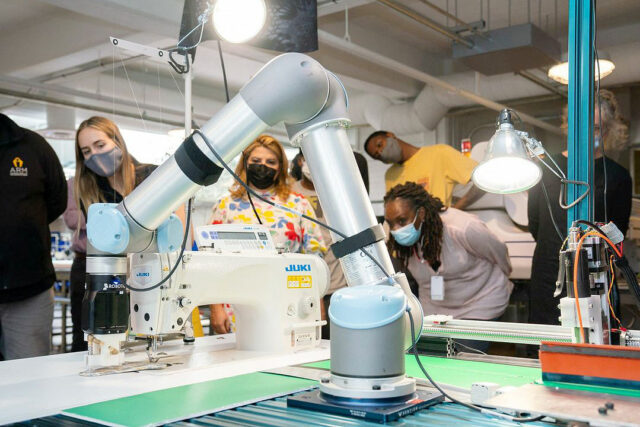
WILL a robot ever make your blue jeans? There is a quiet effort underway to find out — involving clothing and technology companies, including Germany’s Siemens AG and Levi Strauss & Co.

“Clothing is the last trillion-dollar industry that hasn’t been automated,” said Eugen Solowjow, who heads a project at a Siemens lab in San Francisco that has worked on automating apparel manufacturing since 2018.

The idea of using robots to bring more manufacturing back from overseas gained momentum during the pandemic as snarled supply chains highlighted the risks of relying on distant factories.

Finding a way to cut out handwork in China and Bangladesh would allow more clothing manufacturing to move back to Western consumer markets, including the United States.

But that’s a sensitive topic. Many apparel makers are hesitant to talk about the quest for automation, since that sparks worries that workers in developing countries will suffer.

Jonathan Zornow, who has developed a technique to automate some parts of jeans factories, said he has received online criticism — and one death threat.

A spokesperson for Levi’s said he can confirm the company participated in the early phases of the project but declined to comment further.

Sewing poses a particular challenge for automation. Unlike a car bumper or a plastic bottle, which holds its shape as a robot handles it, cloth is floppy and comes in an endless array of thicknesses and textures.

Robots simply don’t have the deft touch possible with human hands. To be sure, robots are improving, but it will take years to fully develop their ability to handle fabric, according to five researchers interviewed by Reuters.

But what if enough of it could be done by machine to at least close some of the cost differential between the United States and low-cost foreign factories? That’s the focus of the research effort now underway.

Work at Siemens grew out of efforts to create software to guide robots that could handle all types of flexible materials, such as thin wire cables, said Mr. Solowjow, adding that they soon realized one of the ripest targets was clothing.

The global apparel market is estimated to be worth $1.52 trillion, according to independent data platform Statista.

Siemens worked with the Advanced Robotics for Manufacturing Institute in Pittsburgh, created in 2017 and funded by the Department of Defense to help old-line manufacturers find ways to use the new technology.

They identified a San Francisco startup with a promising approach to the floppy fabric problem. Rather than teach robots how to handle cloth, the startup, Sewbo, Inc., stiffens the fabric with chemicals so it can be handled more like a car bumper during production. Once complete, the finished garment is washed to remove the stiffening agent. 

“Pretty much every piece of denim is washed after it’s made anyway, so this fits into the existing production system,” said Mr. Zornow, Sewbo’s inventor.

This research effort eventually grew to include several clothing companies, including Levi’s and Bluewater Defense LLC, a small US-based maker of military uniforms. They received $1.5 million in grants from the Pittsburgh robotics institute to experiment with the technique.

There are other efforts to automate sewing factories. Software Automation, Inc., a startup in Georgia, has developed a machine that can sew T-shirts by pulling the material over a specially equipped table, for instance.

Eric Spackey, CEO of Bluewater Defense, the uniform maker, was part of the research effort with Siemens but is skeptical of the Sewbo approach. “Putting (stiffening) material into the garment just adds another process,” which increases costs, said Mr. Spackey, though he adds that it could make sense for producers who already wash garments as part of their normal operation, such as jeans makers.

The first step is getting robots into clothing factories. Sanjeev Bahl, who opened a small jeans factory in downtown Los Angeles two years ago called Saitex, has studied the Sewbo machines and is preparing to install his first experimental machine.

Leading the way through his factory in September, he pointed to workers hunched over old-style machines and said many of these tasks are ripe for the new process. “If it works,” he said, “I think there’s no reason not to have large-scale (jeans) manufacturing here in the US again.” — Reuters

ICTSI says Mexico subsidiary undertakes expansion project

LISTED ports operator International Container Terminal Services, Inc. (ICTSI) on Thursday said its subsidiary in Mexico recently started its third phase expansion project.

The project is expected to boost ICTSI-Contecon Manzanillo’s (CMSA) capacity to two million twenty-foot equivalent units (TEUs) from 1.4 million within the next five years, the company said in an e-mailed statement.

“Manzanillo is the most important node of international logistics in the Pacific Coast of Mexico and it will continue to be so,” CMSA Chief Executive Officer José Antonio Contreras said.

CMSA is spending $230 million on the project, mainly to upgrade shipping and terminal infrastructure, storage yards, and equipment.

The company noted that the capacity increase will position Contecon as the “largest terminal in Mexico’s Pacific coast.”

“We are convinced that this expansion, as well as the construction of land access to the northern zone of the terminal and the acquisition of new inspection equipment for Customs, will consolidate and strengthen the port’s position among competitors,” Mr. Contreras said.

“This port is designed to meet present and future needs, as well as handle 400-meter ships. If the port wins, we all win – from our clients to the families of our employees,” he added.

The project is expected to create more than 600 new direct jobs, in addition to the existing 1,200, along with 11,600 indirect jobs.

ICTSI is involved in 34 terminal concessions and port development projects in 20 countries worldwide. It has nine terminal operations in the Philippines, including an inland container terminal, a barge terminal, and combined terminal operations in Subic.

For the nine months that ended September, the company saw its net income attributable to equity holders increase by 47% to $465.1 million from $316.4 million previously.

Revenues from port operations climbed 20.1% to $1.64 billion from $1.37 billion last year. — Arjay L. Balinbin

Fed’s Powell says inflation battle not won, more rate hikes coming

WASHINGTON — The US Federal Reserve will deliver more interest rate hikes next year even as the economy slips towards a possible recession, Fed Chair Jerome H. Powell said on Wednesday, arguing that a higher cost would be paid if the US central bank does not get a firmer grip on inflation.

Recent signs of slowing inflation have not brought any confidence yet that the fight has been won, Mr. Powell told reporters after the Fed’s policy-setting committee raised its benchmark overnight interest rate by half a percentage point and projected it would continue rising to above 5% in 2023, a level not seen since a steep economic downturn in 2007.

Those rises in borrowing costs would come despite an economy that Fed officials projected will operate at near stall speed through next year, with an annual growth rate of 0.5% and an unemployment rate nearly a full percentage point higher by the end of 2023, well beyond the increase historically associated with a recession.

“We don’t talk about this kind of recession, that kind of a recession. We just make these forecasts,” Mr. Powell said in a news conference. “I wish there were a completely painless way to restore price stability. There isn’t, and this is the best we can do.”

He described the slow rate of economic growth penciled in by Fed officials next year as still “modest.”

“I don’t think it would qualify as a recession … That’s positive growth,” the Fed chief said, even though “it is not going to feel like a boom.”

But other aspects of the Fed’s projections, notably a rise in the unemployment rate to 4.6% from the current 3.7%, are consistent with a downturn settling in as the central bank keeps its target policy rate at a “restrictive level” for at least the next two years.

The rate increase on Wednesday, which was approved unanimously by Fed policy makers and widely expected by financial markets, lifted the targeted policy rate to the 4.25%-4.5% range, with officials expecting it to rise to a level between 5% and 5.25% next year.

If anything, the bias is higher: seven of 19 policy makers projected even higher rates will be needed, and US central bankers are unanimous that the risks are tilted towards higher-than-expected inflation rather than a surprise in the other direction.

Still, Mr. Powell said, repeating the hard-line on enforcing the Fed’s 2% inflation target that he has developed through the year, “the largest amount of pain, the worst pain, would come from a failure to raise rates high enough and from us allowing inflation to become entrenched.”

“The new economic projections imply an even higher pain threshold than before” for a Fed willing to tolerate the equivalent of about 1.6 million lost jobs, wrote Aneta Markowska, chief financial economist at Jefferies. “This suggests hawks still outnumber the doves by a significant margin.”

Even with recent improvements, the Fed’s preferred measure of inflation remains around triple the central bank’s target, and policy makers project it will take at least three years to fall all the way back.

Only two of 19 Fed officials see the benchmark overnight interest rate staying below 5% next year, a sign of a still broad consensus to lean against inflation.

The message from the Fed on Wednesday also leaned against market expectations that recent data showing slowing inflation might push the central bank from its hawkish path and move policy makers toward cutting rates before the end of next year.

“Getting markets to hear that is key to fixing financial conditions” that have loosened in recent months as inflation data has improved, a move counter-productive to the Fed’s inflation-fighting strategy, said Carl Riccadonna, chief US economist at BNP Paribas.

‘RESTRICTIVE ENOUGH’
The new statement was released after a policy meeting at which officials scaled back from the three-quarters-of-a-percentage-point rate increases delivered at the last four gatherings.

US stocks closed lower on Wednesday. In the US Treasury market, which plays a key role in the transmission of Fed policy decisions into the real economy, yields were little changed to slightly lower. The dollar dipped against a basket of currencies.

“Taken together, today’s statement and economic projections tell a simple, but persuasive story: this Fed isn’t prepared to ‘pivot’ in any meaningful way until it sees sustained and conclusive evidence of a reversal in inflationary pressures,” said Karl Schamotta, chief market strategist at Corpay.

Mr. Powell said the speed of coming rate rises is less critical now than earlier in the year when the central bank was “front-loading” rate hikes to catch up with accelerating prices.

“It’s not as important how fast we go,” he said, noting the bigger question facing policy makers is finding an “appropriately restrictive” endpoint and determining how long to stay there.

“Our focus right now is really on moving our policy stance to one that is restrictive enough to ensure a return of inflation to our 2% goal over time, it’s not on rate cuts,” Mr. Powell said.

“The inflation data received so far in October and November show a welcome reduction in the pace of price increases, but it will take substantially more evidence to give confidence inflation is on a sustained downward path,” Mr. Powell said. — Reuters


Entertainment News (12/16/22)


Eraserheads holds Huling El Bimbo concert

SMART offers live pay-per-view access to the Eraserheads’ Huling El Bimbo Concert 2022 via the new Smart LiveStream App, for P650. Fans can stream the iconic OPM rock band’s concert as the Eraserheads perform their generation-defining hits like “Ang Huling El Bimbo,” “Minsan,” “Magasin,” and “Spoliarium.” The concert will be held on Dec. 22, 8:30 p.m., at the SMDC Festival Grounds in Parañaque City. For Smart subscribers who were not able to secure tickets early on, the concert will be made available on a pay-per-view basis via the Smart LiveStream app, formerly known as GigaPlay, at smart.com.ph/livestream.   


Sponge Cola drops new single

AFTER a concert tour in Canada to mark their 20th anniversary as a band, Sponge Cola returns with a new single inspired by the K-drama Hometown Cha-Cha-Cha. Combining grunge rock elements with electronic textures and anthemic pop sounds, Sponge Cola’s “Hometown” is a song about coming home after a long, tiring journey. The rock tune was penned by vocalist and guitarist Yael Yuzon as a way to reimagine the coastal town, with its nosy neighbors forming a tight community, and a love story that “felt very warm and familiar,” despite being entirely new and foreign. “I was pleasantly surprised by the outcome given that it was written about a fictional piece,” Mr. Yuzon said in a statement. “As a writer, I was one layer away from phenomena that should have made the end product more removed, disconnected. Instead, we ended up with something more visceral, something that resonates from within.” “Hometown” is available on all the digital music platforms worldwide via Sony Music Entertainment.   


Ballet Manila presents Cinderella 

EXPERIENCE classic romance, magic, and happy endings through dance as Ballet Manila stages the Cinderella from Dec. 25 to 30, 4 p.m., at the Aliw Theater, Star City, CCP Complex, Pasay City. Featuring all-original choreography by the company’s CEO and Artistic Director Lisa Macuja-Elizalde, Ballet Manila’s re-telling of its all-time hit is perfect for kids and kids-at-heart who want a bit of magic and romance this holiday season. The staging is part of Ballet Manila’s Holiday Cheer Series, a new annual Christmas tradition of the company. “It is our first full-length ballet since the pandemic shrunk the number of dancers in the company. So, we are adding outstanding students from the [ballet] school to add to the cast. It will be different as well as we will be using the new stage facilities — especially the LED screen of the newly refurbished Aliw Theater. So, the experience will be more high-tech with special effects and animation,” Ms. Macuja-Elizalde said in a statement. Ticket prices range from P500 to P800 and are available through Ticketworld. For more information, call 8891 9999 or visit www.ticketworld.com.ph. 


The Simpsons meet the Bocellis on Disney+

CHRISTMAS is coming early this year for fans of The Simpsons with the premiere of the new short movie, The Simpsons meet the Bocellis in ‘Feliz Navidad’, on Disney+. The story follows Homer who surprises Marge with the ultimate gift: an unforgettable performance from Italian opera superstar Andrea Bocelli, his 25-year-old son Matteo, and 10-year-old daughter Virginia. The three Bocellis will also release the new single, “Feliz Navidad,” featured in the short film and off their new album, A Family Christmas. The first 33 seasons of The Simpsons are currently available to stream on Disney+.

Dealing with seminar absentees

Two workers failed to attend a kaizen seminar that you conducted two weeks ago. Despite ample notice and reminders, the absentees gave excuses that are difficult to verify. Our suspicions were roused by the fact that the seminar was scheduled for Saturday, with all participants given cash allowances. How do we sustain the kaizen program and bring the two absentees up to speed so they can help us in the program? — Gray Matter.

The issue boils down to two major questions — who benefits more from a company-sponsored training program — labor or management? What’s the assurance that after attending several training programs, the employee will stay on and put their learning to good use by the company?

The answer to the first question is debatable for some people, but not to Bruce Rudy, who says in his 2022 article in Harvard Business Review that “learning and development programs are critical for the success of any organization.”

Dr. Rudy, a University of Texas System Regents’ Outstanding Teaching Award winner and associate professor of management strategy at the University of Texas at San Antonio, said training programs “ensure that employees have the skills and capabilities necessary to do their jobs well, and demonstrate to those employees that their employers believe they are worth investing in — ultimately boosting company culture and fostering greater commitment to the organization.”

On the second question, there is no assurance that employees will stay after attending a management program. If you want to compel workers to stay for a certain number of years, you’ll have to require them to sign a training agreement that the organization will be investing in.

This includes sending employees to affiliate companies or suppliers in other countries to learn advanced technologies that they may be expected to bring home and train other workers in. Other factors might be the duration of a foreign training program and the quality of work performance exhibited by the employees benefiting from such a program.

A foreign-trained worker is typically expected to stay in the company between two to three years. After that, the employee becomes a “free agent” who can move elsewhere.

A similar arrangement could be required of people who have shown great potential and may be rewarded with an all-expenses paid post-graduate program at places like the Asian Institute of Management (AIM).

DISCIPLINARY ACTION
However, if we’re talking of a one-day program, it would be onerous, if not administratively burdensome, for management to require all participants to sign a training contract. For one, the cost of many one-day programs is often negligible, even considering a $1,000 expert professional fee, renting a training venue, meals, and other logistical support.

If you’re thinking of penalizing the two workers for insubordination, then I would caution against that, unless you’re covered by a specific provision of the company’s code of conduct. If that’s the case, then go ahead and do it without delay. The example made of the two could signal to the other workers that it is not possible to simply ignore a training program.

I’ve seen this happen many times with some of my clients who hire me for management training. The potential for waste is enormous. Imagine a 25-participant seminar where 10 don’t show up. The cost of the wasted food and the failure to maximize the venue space (if rented) can add up.

Of course, I understand that your basic concern is how to bring the two absentees in line with other employees who attended the one-day program. Depending on the training methodology and the materials used by your resource person and facilitator, you can require the two absentees to duplicate what others accomplished during the seminar.

In my case, you can require the two absentees to read the accompanying workbook for the kaizen workshop. After reading the book, arrange for them to take an online test, with three attempts allowed to pass. If they pass, the next step is to require them to select a problem and solve it using my prescribed 8-step problem-solving guide.

I can make myself available online to review their presentations at no extra cost. If they fail the exam, document everything and take it up again next time when you review their work performance.

RETRAINING
The two absentees must have realized the gravity of missing the seminar. If necessary, they must be coached by their direct boss, if the boss attended the program. This is better than ignoring the two absentees. If necessary, do a bit of retraining with the help of their work colleagues.

As you can imagine, retraining is more difficult than training. But there’s always a better way of doing things with the help of the line supervisor and work colleagues. Make the direct boss responsible for the retraining process. Make it crystal clear that you expect everyone to do their share.

Let the colleagues of the two absentees understand that kaizen is a team effort. Whenever possible, require them to attend all meetings whenever they discuss certain problems. Soon enough, the two absentees will follow everyone else’s lead.


Chat with Rey Elbo about any questions on Facebook, LinkedIn or Twitter or e-mail elbonomics@gmail.com or visit https://reyelbo.com

Manila Water expands its distribution network

MANILA Water Co. announced on Thursday that it has expanded its Metro Manila east zone network to 5,362.73 kilometers of water pipelines.

“The robust expansion of our water connections is part of Manila Water’s commitment to ensure accessible and reliable clean, potable water to cater to the increased demand of more customers,” Nestor Jeric T. Sevilla, Jr., Manila Water’s corporate strategic affairs group head, said in a media release.

The company said that when it inherited the water network in 1997, it had 2,497 kilometers of pipelines. It said the expanded pipelines as of September 2022 will help supply clean and potable water within its franchise area while ensuring 24/7 water supply to its customers.

The company said that it has so far installed about 1.14 million service connections, including 26,643 new household connections as of the third quarter of this year and 631 new service connections for commercial and industrial sites.

Last week, Manila Water said that it is ramping up its water sampling to ensure water potability within its coverage area.

The water concessionaire serves Manila’s east zone network, which comprises Marikina, Pasig, Makati, Taguig, Pateros, Mandaluyong, San Juan, portions of Quezon City and Manila, and several towns of nearby Rizal province. — Ashley Erika O. Jose

Preserving a 100-year legacy of banking

THE country’s first privately owned commercial bank, China Banking Corp. (China Bank), marked its 100th anniversary in August 2020. While preparing to celebrate its centennial amid the pandemic, the bank embarked on a genuine restoration of its original headquarters located in Manila’s Binondo district — the world’s first Chinatown.

Now known as the China Bank Binondo Center, the building was completed in 1924 and served as the head office for six decades. German architect Arthur Gabler-Gumbert designed the seven-story structure in the Neoclassical fashion using a variation of the Beaux-Arts architectural style.

As the centerpiece of China Bank’s centennial celebration, the Binondo Heritage Restoration Project (BHRP) aimed to preserve the bank’s legacy in the history of the Chinese Filipino community for future generations, without disrupting the branch banking operations while the structure was undergoing a massive renovation. This building now stands as an architectural reminder of Binondo’s heydays as the “Wall Street of the Philippines” as well as the center of trade and commerce in the country.

Recently, the Federation of Filipino Chinese Chambers of Commerce and Industry, Inc. (FFCCCII) organized a tour of the China Bank Museum occupying the fourth floor of the restored building, where memorabilia and photographs honor the bank’s founder Dee C. Chuan and his successors. On hand to welcome the FFCCCII delegation were China Bank Chair Hans Sy and President William Whang.

During the tour, Mr. Sy revealed that it was his first time to step into the museum curated by art critic Marian Pastor Roces. He said: “The gravity of the pandemic necessitated a modification of plans, but it does not diminish the significance of the occasion. The restoration and heritage project is China Bank’s contribution to the revitalization of Binondo.”

This was affirmed by Mr. Whang, who shared that the project’s objective is to preserve not only China Bank’s culture and legacy, but more importantly, the bygone character of Binondo for generations to come. He disclosed that among the bank’s first clients were the late taipans Henry Sy and John Gokongwei.

Both the National Historical Commission and the National Museum of the Philippines (NMP) recognize the significant role of the China Bank Binondo Center in the nation’s history. In fact, it has been designated by the NMP as an “Important Cultural Property.” According to BHRP Chair Alex Escucha, great care was taken to ensure that the building met the highest standards of resilience and structural sustainability, in addition to bringing it up to modern building and safety codes. The result is touted as the most faithful restoration of any building in the Philippines today.

PACQUIAO NFT LAUNCH
Filipino boxing legend Emmanuel “Manny” Pacquiao has been appointed brand ambassador and honorary chair of Systems Technologies Apps Robotic Trading, Inc. (START).  The Japan-based company is primarily involved in the creation and marketing of non-fungible tokens (NFTs) along with its Singapore-based partner NFT One. They have created a lot of buzz in the Japanese NFT trading community due to their fast-selling “Neo Stackey” collection of NFTs.

Fresh from his triumphant exhibition match against South Korean martial artist DK Yoo last weekend, Mr. Pacquiao flew back to Manila from Seoul for the contract-signing ceremony with START Founder and CEO Kousei at the EDSA Shangri-La Hotel in Mandaluyong City. The partnership is envisioned to leverage on the former senator’s image as one of the most bankable sportsmen in the world — with his diehard followers numbering in the millions. In Japan alone, he has gained a cult following and is accorded with rock-star status who is revered wherever he goes.

START also plans to build schools and encourage a new generation of engineers to help create breakthroughs in the NFT industry as part of its core advocacies. After all, its mission is to become the dominant player in the global NFT market.

The opinion expressed herein does not necessarily reflect the views of these institutions and BusinessWorld.


J. Albert Gamboa is the chief finance officer of Asian Center for Legal Excellence and chair of the FINEX Media Affairs Committee.  #FinexPhils www.finex.org.ph

Overseas Filipinos’ cash remittances (Oct. 2022)

MONEY SENT HOME by overseas Filipino workers (OFWs) rose by 3.5% in October, with migrants taking advantage of the strong dollar ahead of the holiday season. Read the full story.

Overseas Filipinos’ cash remittances (Oct. 2022)

How PSEi member stocks performed — December 15, 2022

Here’s a quick glance at how PSEi stocks fared on Thursday, December 15, 2022.


Prices of Noche Buena items surge in 2022

The general increase of the Noche Buena items, as measured by the basket’s price index, surged by 25.7% annually this year.This was a turnaround from the 15.2% contraction in 2021. This brought the average price hike of the basket to 2.8% from 2012 until present. Since 2011, the Noche Buena Price Index has climbed by 25.5%. BusinessWorld has been monitoring the annual prices changes of the Noche Buena items through a price index that gauges how faster (or slower) the price of this representative basket of goodshas risen (or fallen) over the years. The prices of goods are based on the Department of Trade and Industry’s (DTI) list of suggested retail prices. Earliest available data date back to 2011, which also serves as the base year for calculating the Noche Buena index.

Prices of Noche Buena items surge in 2022

Stocks fall as Fed chief hints at more rate hikes

BW FILE PHOTO

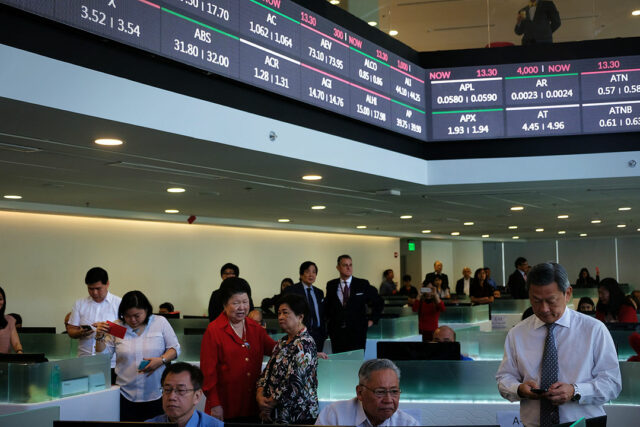
SHARES closed lower on Thursday after the US Federal Reserve chief said more rate hikes are needed to rein in elevated inflation.

The bellwether Philippine Stock Exchange index (PSEi) lost 48.27 points or 0.73% to close at 6,566.80 on Thursday, while the broader all shares index declined by 18.68 points or 0.54% to 3,430.89.

“Share prices pulled back as the US Fed chairman remained firm on his hawkish stance on monetary policy,” AB Capital Securities, Inc. Vice-President Jovis L. Vistan said in a Viber message.

“The local bourse dropped … following the expectation that the Fed may keep high interest rates longer while waiting for the decision of the Bangko Sentral ng Pilipinas (BSP),” Philstocks Financial, Inc. Research Analyst Claire T. Alviar said in a Viber message.

Ms. Alviar said the Fed chief’s hawkish tone caused negative sentiment.

“Chart-wise, the market was still struggling to stay above the 6,600 level,” she added.

The US central bank will deliver more interest rate hikes next year to get inflation under control, Fed Chair Jerome H. Powell said on Wednesday.

The statement came after the Fed its benchmark overnight interest rate by 50 basis points (bps) to the 4.25%-4.5% range and projected it could rise to 5%-5.25% next year.

The Fed has now hiked borrowing costs by 425 bps since March.

Meanwhile, on Thursday, the BSP likewise raised benchmark interest rates by 50 bps, bringing its policy rate to 5.5%. Rates on the overnight deposit and lending facilities were likewise raised to 5% and 6%, respectively.

The BSP has raised rates by 350 bps since May.

All the sectoral indices closed lower on Thursday. Services declined by 23.86 points or 1.39% to 1,687.17; property lost 35.68 points or 1.23% to end at 2,844.97; financials decreased by 16.41 points or 0.98% to 1,655.30; mining and oil went down by 70.91 points or 0.67% to 10,398.57; industrials dropped by 38.29 or 0.41% to 9,260.96; and holding firms inched down by 1.14 points or 0.01% to close at 6,401.77.

“All sectors were in the red, led by the 1.39% drop in the services sector. Among index members, Wilcon Depot, Inc. had the biggest gain of 2.5%, while PLDT, Inc. was at the bottom, declining 4.29%,” Ms. Alviar said.

Value turnover dropped to P7.27 billion on Thursday with 2.06 billion shares changing hands from P115.96 billion with 5.5 billion issues traded on Wednesday.

Decliners outnumbered advancers, 101 to 71, while 45 names closed unchanged.

Foreigners turned net buyers on Thursday with P7.6 million from the P688.71 million in net selling seen the previous day.

AB Capital’s Mr. Vistan placed the PSEi’s support at 6,440 and resistance at 6,660, while Philstocks Financial’s Ms. Alviar put support at 6,400 and immediate resistance at 6,600. — Justine Irish D. Tabile

ADVERTISEMENT
ADVERTISEMENT