Home Blog Page 5503

British nurses begin first ever strike as pay dispute deepens

Image via Duncan C/Flickr/CC BY-NC 2.0

LONDON — National Health Service (NHS)  nurses in Britain will strike on Thursday in their first ever national walkout, as a bitter dispute with the government over pay ramps up pressure on already-stretched hospitals at one of the busiest times of year. 

An estimated 100,000 nurses will strike at 76 hospitals and health centers on Thursday, canceling thousands of non-urgent operations, such as hip replacements, and tens of thousands of outpatient appointments in Britain’s state-funded NHS. 

Britain is facing a wave of industrial action this winter, with strikes crippling the rail network and postal service, and airports bracing for disruption over Christmas. 

Inflation running at more than 10%, trailed by pay offers of around 4%, is stoking tensions between unions and employers. 

Of all the strikes though, it will be the sight of nurses on picket lines that will be the stand-out image for many Britons this winter. 

“It is deeply regrettable some union members are going ahead with strike action,” health minister Steve Barclay said. 

“I’ve been working across government and with medics outside the public sector to ensure safe staffing levels — but I do remain concerned about the risk that strikes pose to patients.” 

The widely admired nursing profession will shut down parts of the NHS, which since its founding in 1948 has developed national treasure status for being free at the point of use, hitting healthcare provision when it is already stretched in winter and with backlogs at record levels due to COVID delays. 

Barclay said patients should continue to seek urgent medical care and attend appointments unless they have been told not to. 

The industrial action by nurses on Dec. 15 and Dec. 20 is unprecedented in the British nursing union’s 106-year history, but the Royal College of Nursing (RCN) says it has no choice as workers struggle to make ends meet. 

Nurses want a 19% pay rise, arguing they have suffered a decade of real-terms cuts and that low pay means staff shortages and unsafe care for patients. The government has refused to discuss pay. 

The government in Scotland avoided a nursing strike by holding talks on pay, an outcome which the RCN had hoped for in England, Wales and Northern Ireland, but Mr. Barclay is not budging. 

The government has said it cannot afford to pay more than the 4–5% offered to nurses, which was recommended by an independent body, and that further pay increases would mean taking money away from frontline services. 

The RCN has accused the government of “belligerence.” It said as late as Tuesday that the strikes could still be stopped if the government was prepared to negotiate. 

Some treatment areas will be exempt from strike action the RCN has said, including chemotherapy, dialysis and intensive care. 

Polling ahead of the nursing strike showed that a majority of Britons support the action, but once the walk-outs are underway politicians will be closely monitoring public opinion. — Reuters

Fed’s Powell says inflation battle not won, more rate hikes coming

WASHINGTON — The Federal Reserve will deliver more interest rate hikes next year even as the economy slips towards a possible recession, Fed Chair Jerome Powell said on Wednesday, arguing that a higher cost would be paid if the US central bank does not get a firmer grip on inflation. 

Recent signs of slowing inflation have not brought any confidence yet that the fight has been won, Mr. Powell told reporters after the Fed’s policy-setting committee raised its benchmark overnight interest rate by half a percentage point and projected it would continue rising to above 5% in 2023, a level not seen since a steep economic downturn in 2007. 

Those rises in borrowing costs would come despite an economy that Fed officials projected will operate at near stall speed through next year, with an annual growth rate of 0.5% and an unemployment rate nearly a full percentage point higher by the end of 2023, well beyond the increase historically associated with a recession. 

“We don’t talk about this kind of recession, that kind of a recession. We just make these forecasts,” Mr. Powell said in a news conference. “I wish there were a completely painless way to restore price stability. There isn’t, and this is the best we can do.” 

He described the slow rate of economic growth penciled in by Fed officials next year as still “modest.” 

“I don’t think it would qualify as a recession … That’s positive growth,” the Fed chief said, even though “it is not going to feel like a boom.” 

But other aspects of the Fed’s projections, notably a rise in the unemployment rate to 4.6% from the current 3.7%, are consistent with a downturn settling in as the central bank keeps its target policy rate at a “restrictive level” for at least the next two years. 

The rate increase on Wednesday, which was approved unanimously by Fed policymakers and widely expected by financial markets, lifted the targeted policy rate to the 4.25%–4.50% range, with officials expecting it to rise to a level between 5.00% and 5.25% next year. 

If anything, the bias is higher: seven of 19 policymakers projected even higher rates will be needed, and US central bankers are unanimous that the risks are tilted towards higher-than-expected inflation rather than a surprise in the other direction. 

Still, Mr. Powell said, repeating the hard-line on enforcing the Fed’s 2% inflation target that he has developed through the year, “the largest amount of pain, the worst pain, would come from a failure to raise rates high enough and from us allowing inflation to become entrenched.” 

“The new economic projections imply an even higher pain threshold than before” for a Fed willing to tolerate the equivalent of about 1.6 million lost jobs, wrote Aneta Markowska, chief financial economist at Jefferies. “This suggests hawks still outnumber the doves by a significant margin.” 

Even with recent improvements, the Fed’s preferred measure of inflation remains around triple the central bank’s target, and policymakers project it will take at least three years to fall all the way back. 

Only two of 19 Fed officials see the benchmark overnight interest rate staying below 5% next year, a sign of a still broad consensus to lean against inflation. 

The message from the Fed on Wednesday also leaned against market expectations that recent data showing slowing inflation might push the central bank from its hawkish path and move policymakers toward cutting rates before the end of next year. 

“Getting markets to hear that is key to fixing financial conditions” that have loosened in recent months as inflation data has improved, a move counter-productive to the Fed’s inflation-fighting strategy, said Carl Riccadonna, chief US economist at BNP Paribas. 

‘RESTRICTIVE ENOUGH’
The new statement was released after a policy meeting at which officials scaled back from the three-quarters-of-a-percentage-point rate increases delivered at the last four gatherings. 

US stocks closed lower on Wednesday. In the US Treasury market, which plays a key role in the transmission of Fed policy decisions into the real economy, yields were little changed to slightly lower. The dollar dipped against a basket of currencies. 

“Taken together, today’s statement and economic projections tell a simple, but persuasive story: this Fed isn’t prepared to ‘pivot’ in any meaningful way until it sees sustained and conclusive evidence of a reversal in inflationary pressures,” said Karl Schamotta, chief market strategist at Corpay. 

Mr. Powell said the speed of coming rate rises is less critical now than earlier in the year when the central bank was “front-loading” rate hikes to catch up with accelerating prices. 

“It’s not as important how fast we go,” he said, noting the bigger question facing policymakers is finding an “appropriately restrictive” endpoint and determining how long to stay there. 

“Our focus right now is really on moving our policy stance to one that is restrictive enough to ensure a return of inflation to our 2% goal over time, it’s not on rate cuts,” Mr. Powell said. 

“The inflation data received so far in October and November show a welcome reduction in the pace of price increases, but it will take substantially more evidence to give confidence inflation is on a sustained downward path,” Mr. Powell said. — Reuters

Pag-IBIG Fund launches virtual Pag-IBIG mobile app

Pag-IBIG Fund successfully launched the virtual Pag-IBIG mobile app to bring services closer to members. In photo are Pag-IBIG Fund officials (from left) Chief Legal Counsel Atty. Marcial Pimentel, Jr., Trustee Pedrito Angeles, Deputy CEO Benjamin Felix, Jr., Trustee Ma. Lorelei Fajardo, Chief Executive Officer Marilene Acosta, Trustee Mylah Roque, Deputy CEO Alexander Aguilar, Trustee Atty. Cornelio Aldon, Deputy CEO Atty. Robert John Cosico, and Trustee Anthony Cesar Arellano.

Pag-IBIG Fund officially launched the Virtual Pag-IBIG Mobile App to bring its services closer to members as it marked its 42nd anniversary on Dec. 14.

President Ferdinand Marcos Jr. recognized Pag-IBIG Fund’s accomplishments over the years and welcomed the launch of its official mobile app through a recorded message for the agency.

“Through the years, the Pag-IBIG Fund has stayed true to its goal to realize the dreams of millions of Filipinos by providing secure savings programs and dependable and affordable housing loans,” said Marcos. “Today, we also welcome the launching of the Virtual Pag-IBIG Mobile Application. The app will bring Pag-IBIG Fund’s services and benefits closer to every Filipino. In line with the unwavering commitment of this administration to digitize and streamline our services, be assured that this administration is committed to support you as you implement housing and development programs and initiatives,” the president added.

Secretary Jose Rizalino Acuzar of the Department of Human Settlements and Urban Development (DHSUD), who also heads the 11-member Pag-IBIG Fund Board of Trustees, meanwhile, assured members that Pag-IBIG Fund will continue to make use of information technology to improve its processes and services.

“I congratulate the Pag-IBIG Fund for launching the Virtual Pag-IBIG Mobile App. This service innovation will significantly help in providing social benefits to our fellow Filipinos, in line with the call of President Marcos to maximize the use of information technology in the delivery of public service,” Acuzar stated.

Pag-IBIG Fund Chief Executive Officer Marilene Acosta demonstrated the service features and the user-friendly interface of the agency’s mobile app during the launch.

“With the Virtual Pag-IBIG Mobile App, our members can now get their Pag-IBIG Membership ID number, view the status of their Housing or Short-Term Loans, make online payments and create a Virtual Pag-IBIG account by using just their smartphones. Plus, once our members have their own Virtual Pag-IBIG accounts, they can also view their savings and annual dividends, the balance and due dates of their loans, as well as their payment records. And, we shall add even more features to the mobile app over the coming months. With the Virtual Pag-IBIG Mobile App, we are literally bringing our services to the palm of each members’ hand,” Acosta said.

The Virtual Pag-IBIG Mobile Application is available for download via the Apple Store and Google Play. The mobile app has been downloaded by more than 750,000 users since its beta version was made available in August this year.


Spotlight is BusinessWorld’s sponsored section that allows advertisers to amplify their brand and connect with BusinessWorld’s audience by enabling them to publish their stories directly on the BusinessWorld Web site. For more information, send an email to online@bworldonline.com.

Join us on Viber to get more updates from BusinessWorld: https://bit.ly/3hv6bLA.

Bankman-Fried charges showcase US prosecutor’s growing role in crypto enforcement

Bitcoin cryptocurrency representation is pictured on a keyboard in front of binary code in this illustration taken Sept. 24, 2021. — REUTERS

NEW YORK — When he took office as the top federal prosecutor in Manhattan in late 2021, Damian Williams pledged to prioritize “rooting out corruption in our financial markets.” 

Now, with the fraud charges filed earlier this week against Sam Bankman-Fried, the founder of the bankrupt FTX exchange, Mr. Williams has further solidified his office’s growing role in prosecuting financial crimes involving cryptocurrency, according to interviews with a half-dozen former prosecutors. 

“Every US attorney is defined in the public eye by some of the biggest cases that they bring,” said Harry Sandick, a partner at law firm Patterson Belknap and former Manhattan federal prosecutor. “This will forever be connected to the current US attorney.” 

The indictment against Mr. Bankman-Fried — who was charged with using billions in stolen customer funds to buy real estate, pay debts for his hedge fund, Alameda Research, and donate to political campaigns — situates Mr. Williams as a primary adversary for the high-profile entrepreneur whose downfall has captured public attention and led to calls for greater regulation of cryptocurrency platforms. 

Mr. Bankman-Fried, 30, has acknowledged risk management failures at FTX but said he does not believe he has criminal liability. His lawyer said he is evaluating his legal options. On Tuesday, a judge in The Bahamas ordered him detained there while he contests a US extradition request. 

Mr. Williams led the Southern District of New York’s (SDNY) securities and commodities task force before being nominated as the district’s top prosecutor by President Joseph R. Biden, Jr. Mr. Williams, SDNY’s first Black US attorney, earned his law degree from Yale and clerked for former Supreme Court Justice John Paul Stevens as well as current Attorney General Merrick Garland when Mr. Garland was an appellate judge. 

Earlier this year, Mr. Williams brought the first-ever insider trading cases involving digital assets with charges against a former employee of non-fungible token trading platform OpenSea as well as a former product manager at Coinbase Global Inc , an FTX rival. 

Both those defendants have pleaded not guilty. 

SDNY has long been known as one of the most muscular enforcers of financial crimes, and some former prosecutors compared Mr. Williams’ string of crypto-related prosecutions to the focus on insider trading by Preet Bharara, who served as US Attorney from 2009 to 2017 and secured convictions of fund managers such as Raj Rajaratnam. 

Mr. Williams was a prosecutor on several high-profile financial crimes cases during Mr. Bharara’s tenure, including the insider trading conviction of former Goldman Sachs board member Rajat Gupta and the fraud conviction of a former portfolio manager at Visium Asset Management LP. 

“Crypto is the Wild West, but at the end of the day fraud is fraud,” said Mike Ferrara, a former prosecutor and now an attorney with Kaplan Hecker & Fink LLP in New York. “Damian is doing a good job of saying, ‘we’re going to push the envelope in crypto,’ the way Preet was aggressive about insider trading.” 

A spokesman for Mr. Williams’ office declined to comment. 

‘COME SEE US BEFORE WE COME SEE YOU’
Pursuing cryptocurrency-related prosecutions is not without challenges. Defense lawyers may argue that because the sector is relatively new and questions about how it will be regulated are still being worked out, their clients were not clear on how laws crafted for traditional finance applied to them. 

“The government is having trouble keeping up and making clear to participants in the industry what they’re supposed to be doing,” said Elise Maizel, a professor at NYU School of Law and former white-collar defense lawyer. “With these criminal cases, a lot of the time they’re regulating through enforcement.” 

In one setback for prosecutors, three former founders of crypto exchange Bitmex and its first employee — who pleaded guilty to charges brought by Mr. Williams’ predecessor of failing to establish an anti-money laundering program — earlier this year received lighter sentences than prosecutors requested. 

The judge in that case said that while the crime was serious, prosecutors had not brought more weighty charges of money laundering or fraud, and there were no identifiable victims. 

To be sure, Mr. Williams’ office has pursued more traditional financial crimes cases as well, with charges filed this year against the founder of Archegos Capital Management for lying to banks to obtain loans before the firm’s meltdown, and against the former chief investment officer at a unit of Germany’s Allianz SE for inflating fund results. 

Both pleaded not guilty. 

In the wake of Mr. Bankman-Fried’s arrest, Mr. Williams has made clear he would plow on with cryptocurrency enforceme

nt. On Wednesday, he announced wire fraud conspiracy charges against the founders of two separate cryptocurrency mining and trading companies he called Ponzi schemes. 

The five individuals charged in one of the cases have pleaded not guilty, while the three individuals charged in the other have not yet entered pleas. 

On Tuesday, Mr. Williams told reporters more charges in the FTX probe were possible. 

“This investigation is very much ongoing and it is moving very quickly,” Mr. Williams said. “To anyone who participated in wrongdoing at FTX or Alameda Research and who has not yet come forward, I would strongly encourage you to come see us before we come see you.” — Reuters

China’s COVID spike not due to lifting of restrictions — WHO director

PEOPLE wearing face masks are seen at a subway station in Shanghai, China, Jan. 18, 2021. — REUTERS

GENEVA — Coronavirus disease 2019 (COVID-19) infections were exploding in China well before the government’s decision to abandon its strict “zero-COVID” policy, a World Health Organization (WHO) director said on Wednesday, quashing suggestions that the sudden reversal caused a spike in cases.

The comments by the WHO’s emergencies director Mike Ryan came as he warned of the need to ramp up vaccinations in the world’s No. 2 economy. 

Speaking at a briefing with media, he said the virus was spreading “intensively” in the nation long before the lifting of restrictions. 

“There’s a narrative at the moment that China lifted the restrictions and all of a sudden the disease is out of control,” he said. 

“The disease was spreading intensively because I believe the control measures in themselves were not stopping the disease. And I believe China decided strategically that was not the best option anymore.” 

Beijing started pivoting away from its signature “zero-COVID” policy this month after protests against the economically damaging curbs championed by President Xi Jinping. 

The sudden loosening of restrictions has sparked long queues outside fever clinics in a worrying sign that a wave of infections is building, even though official tallies of new cases have trended lower recently as authorities eased back on testing. 

In its most recent COVID report for the week to Nov. 27, the WHO said China had reported increasing hospitalizations for four consecutive weeks. 

“So the challenge that China and other countries still have is: are the people that need to be vaccinated, adequately vaccinated, with the right vaccines and the right number of doses and when was the last time those people had the vaccines,” said Dr. Ryan. 

WESTERN VACCINE 

The elation in China that met the changes in policy allowing people to live with the virus has quickly faded amid mounting concerns about surging infections because the population lacks “herd immunity” and has low vaccination rates among the elderly. 

WHO’s senior epidemiologist Maria Van Kerkhove said the UN agency was providing technical advice to China and Ryan said there were open channels. 

Among the first major announced deals in which a Western drugmaker will supply China with COVID therapies, China Meheco Group Co. Ltd. said on Wednesday it would import and distribute Pfizer’s oral COVID-19 treatment Paxlovid. 

Earlier in the briefing, WHO chief Tedros Adhanom Ghebreyesus said he was “hopeful” that the pandemic, which has killed more than 6.6 million people since it emerged in Wuhan, China, three years ago, will no longer be considered a global emergency some time next year. — Reuters


A smart investment along the flourishing C5-Pasig corridor

Artist's perspective of SYNC's building facade

The C5 road has continuously improved as a main avenue in recent years, especially in Pasig. The city itself has developed into a vibrant area making it a strategic and desirable location for real estate investments. As one of the metro’s newest growth corridors, it is brimming with possibilities for contemporary urban dwellers, including smart investment opportunities like RLC Residences’ SYNC.

This four-tower development is a promising and amazing real estate asset for new and seasoned investors due to the following reasons:

Location

Artist’s perspective of SYNC’s Sky Bridge

An amazing investment starts with the right location that easily connects residents to where they need to be. Given its strategic address along C5 Road, SYNC is an in-demand home that potential renters and even home finders would look for. Having direct access to this major city road easily connects them to key central business districts and important hubs – including Ortigas, Bonifacio Global City, Kapitolyo, and Bridgetowne destination estate.

Aside from these, SYNC is a perfect entry point to major malls like Robinsons Galleria, hospitals like St. Luke’s and The Medical City, and even universities such as UP BGC and Ateneo School of Medicine.

Best-Sized Units with Upgrades

Artist’s perspective of two-bedroom unit with balcony at SYNC N Tower

Zooming in on the details of the property, SYNC is home to multiple flats that are well-spaced for its future residents. Its newly-launched N Tower offers studio, one- and two-bedroom units with balcony options. Having this as your investment means offering a unit for lease for potential renters who are on the lookout for a city home that can provide a place to work, live, and even relax.

Inside these units are multiple home upgrades integrated to help soon-to-be residents live an amazing city life. All homes will have Smart Home features for added safety and security. Main doors will have a Smart Lock accessible by PIN, fingerprint, and manual key; Audio-Video Intercom to screen guests even before they go up the unit; and Smart Lights that can be adjusted with a mobile phone app. A work-from-home provision is also found in each home for those who want a separate space for work or for their hobbies. Lastly, kitchen and toilet and bath upgrades such as cabinets with glass doors, pull-out pantry drawer, and glass shower enclosure are also added for comfort and convenience.

Numerous Amenities

Artist’s perspective of SYNC’s indoor pool

As more people look for a place where they can be at their best, that home should be able to help them live a balanced life. At SYNC, more than 20 indoor and outdoor amenities are found inside – catering to various individual pursuits.

Fitness goals are supported at SYNC, as the development has its own Gym, Yoga Area, and Jog Trail exclusively accessible to residents. Leisure and bonding are also addressed here with indoor and outdoor pools, a Grilling BBQ area, a Private Theater, and a Game Room found inside SYNC. For those who want to just chill and relax and have a good view of the city, the Sky Deck and Sky Bridge are the perfect places to be at.

Having all these will surely make your unit a sought-after home that they would like to live in.

Limited-Time Investment Deal

Sealing the deal, this standout property offers a 5% discount on the newly-launched N-Tower units available for a limited time only. So consider SYNC as your first, or next investment – whether you opt to live here or put this for lease in the future.

Learn more about this condo investment by connecting with an RLC Residences Property Specialist via rlcresidences.com or by following them on Facebook and Instagram.


Spotlight is BusinessWorld’s sponsored section that allows advertisers to amplify their brand and connect with BusinessWorld’s audience by enabling them to publish their stories directly on the BusinessWorld Web site. For more information, send an email to online@bworldonline.com.

Join us on Viber to get more updates from BusinessWorld: https://bit.ly/3hv6bLA.

PHL growth likely 2nd fastest in SE Asia

Shoppers fill the streets of Divisoria, Manila, Dec. 8. — PHILIPPINE STAR/EDD GUMBAN

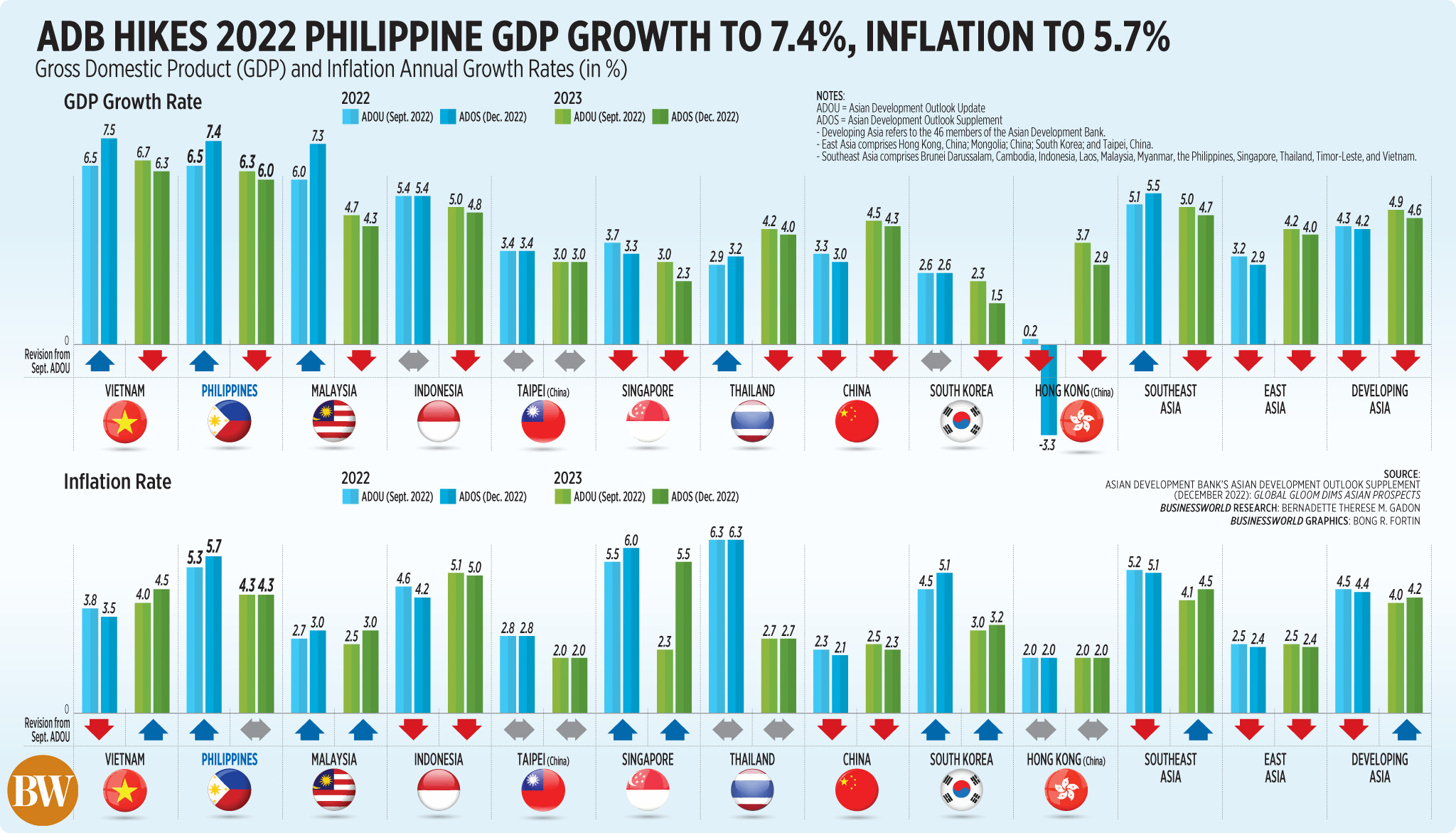
THE PHILIPPINES is expected to be the second fastest-growing economy in Southeast Asia this year and in 2023, despite global headwinds, according to the Asian Development Bank (ADB).

In its Asian Development Outlook (ADO) 2022 Update released on Wednesday, the ADB revised its Philippine gross domestic product (GDP) growth forecast upwards to 7.4% this year, higher than the 6.5% estimate given in September.

The latest GDP forecast for 2022 is within the government’s 6.5-7.5% full-year target.

ADB hikes 2022 Philippine GDP growth to 7.4%, inflation to 5.7%

At 7.4%, the Philippines is expected to be the second fastest-growing economy in Southeast Asia this year after Vietnam (7.5%). This forecast is also above the ADB’s 5.5% growth outlook for the Southeast Asia region, which was raised from 5.1% in September.

“The Philippine economy has shown strong underlying growth momentum and resilience in 2022 and this is expected to continue in 2023, with GDP growth converging towards its longer-term growth rate of about 6%,” ADB Philippines Country Director Kelly Bird said in a statement.

The ADB lowered its GDP forecast for the Philippines to 6% for 2023, from 6.3% previously. This is at the low end of the government’s 6-7% target for next year.

The ADB’s 6% forecast for the Philippines in 2023 is the second-fastest among Southeast Asian economies, following Vietnam’s 6.3%. This is also above the ADB’s 4.7% outlook for Southeast Asia next year, which was downgraded from 5% previously.

“There are downside risks to growth in 2023, including inflation stickiness, further increases in interest rates, and a sharper-than-expected slowdown in GDP growth in advanced countries,” Mr. Bird said.

The multilateral lender said Philippine inflation is expected to average 5.7% this year, up from the September estimate of 5.3%, before slowing to 4.3% in 2023.

At a briefing, Mr. Bird said core inflation is now peaking in advanced economies, but the Philippines may be two quarters behind.

Headline inflation accelerated to 8% in November from 7.7% in October. For the 11-month period, inflation averaged 5.6%, still lower than the central bank’s 5.8% full-year forecast but well above its 2-4% target.

Core inflation, which excludes volatile prices of food and fuel, climbed 6.5% in November from 5.9% in October. In the months to November, core inflation averaged 3.7%.

“So we might expect inflation to peak soon and start to hopefully gradually decline in two to three years. I remember that the central bank recognizes this concern and they have been very proactive in their response,” Mr. Bird said.

The Bangko Sentral ng Pilipinas (BSP) has hiked policy rates by 300 basis points and is widely expected to raise it by 50 bps today (Dec. 15).

DEVELOPING ASIA
Meanwhile, the ADB downgraded slightly its growth forecast for developing Asia this year and 2023, amid global monetary tightening, the prolonged Russia-Ukraine conflict, and slower global expansion.

The ADB trimmed its GDP projection for developing Asia to 4.2%, from its 4.3% projection in September.

For 2023, the multilateral lender cut its growth outlook for developing Asia to 4.6%, from 4.9% previously.

Excluding China, the rest of developing Asia is projected to grow by 5.4% in 2022 and 4.6% in 2023.

“Asia and the Pacific will continue to recover, but worsening global conditions mean that the region’s momentum is losing some steam as we head into the new year,” ADB Chief Economist Albert Park said in a statement.

“Governments will need to work together more closely to overcome the lingering challenges of COVID-19, combat the effects of high food and energy prices — especially on the poor and vulnerable — and ensure a sustainable, inclusive economic recovery.”

Despite the lower forecasts, the ADB said developing Asia will still see better growth and lower inflation than other regions

ADB cut its inflation forecast in developing Asia to 4.4% this year, from 4.5% previously.

However, the bank upgraded its inflation projection for next year to 4.2%, from 4% previously “due to lingering inflationary pressures from energy and food.” — Keisha B. Ta-asan

Vehicle sales post double-digit growth for 9th straight month

Vehicles are stuck in traffic along EDSA, Cubao in Quezon City, Aug. 18. — PHILIPPINE STAR/ MIGUEL DE GUZMAN

THE AUTO INDUSTRY continued its strong recovery, posting double-digit sales growth for the ninth straight month in November.

A joint report by the Chamber of Automotive Manufacturers of the Philippines, Inc. (CAMPI) and Truck Manufacturers Association (TMA) showed vehicle sales jumped by 32.4% to 35,037 units in November, from 26,456 in the same month in 2021. Month on month, vehicle sales grew by 9%.

“The auto sales performance has been improving, recording double-digit growth for nine successive months,” CAMPI President Rommel R. Gutierrez said in a separate statement.

Commercial vehicle sales rose by 43% to 26,106 in November from 18,251 units sold in the same month in 2021. It accounted for 74.51% of the industry’s total sales.

Month on month, commercial vehicle sales went up by 9.4%.

Broken down, sales of light commercial vehicles (LCVs) jumped by 43.9% year on year to 20,211 units, while sales of Asian utility vehicles (AUVs) increased by 52.4% to 4,938 units in November.

Sales of passenger vehicles climbed by 8.8% to 8,931 in November, from 8,205 units sold in the same month last year. Month on month, passenger vehicle sales rose by 7.68%.   

The auto industry is on track to hit its sales target this year.

CAMPI-TMA members posted a 31% increase in sales to 315,337 units in the January-to-November period, from 240,642 units a year ago.

“With the continued growing consumer demand for new motor vehicles, the industry is convinced and confident in exceeding its sales forecast of 336,000 this year,” Mr. Gutierrez said.

Commercial vehicles have driven the industry’s recovery, as it posted 45.3% year-on-year sales growth to 238,054 in the January-to-November period. Sales were led by LCVs, which jumped by 48.5% to 187,101 units sold, while AUV sales rose by 44.3% to 41,812 units.

Passenger car sales were flat, inching up by 0.6% to 77,283 units in the 11-month period.

“The automotive industry underscores the importance of pent-up demand from consumers supported by continued economic recovery, boosting business and consumer confidence. These, alongside the containment of the pandemic, are significant factors towards sustained growth,” Mr. Gutierrez said.

Among car brands, Toyota Motor Philippines Corp. dominated the industry with a 49.75% market share with 156,874 units sold in the January-to-November period.

Other top car manufacturers include Mitsubishi Motors Philippines Corp. with a 14.81% market share or 46,692 units sold, followed by Ford Motor Co. Phils., Inc. with a 6.80% share or 21,450 units sold; Nissan Philippines, Inc. with a 6.14% share or 19,373 units sold; and Suzuki Phils., Inc. with a 5.75% share or 18,118 units sold. — R.M.D.Ochave

SC junks petition seeking to void Kaliwa Dam loan deal

PHILSTAR FILE PHOTO

By John Victor D. Ordoñez, Reporter

THE SUPREME COURT (SC) junked a petition that sought to declare as illegal and to void the government’s loan agreements for the Kaliwa Dam and the Chico River irrigation projects.

In a 41-page ruling dated Dec. 7 and made public on Dec. 9, the High Court said the two petitions, filed by the Makabayan bloc in 2019, failed to present compelling arguments that the government’s $211-million loan agreement with Export-Import Bank of China for the Kaliwa Dam project and the $62-million loan with China for the Chico River Pump Irrigation project had violated the Constitution.

“(The) loan agreements have sufficiently complied with the applicable procurement laws and conform with the pertinent provisions of the Constitution,” the Supreme Court said in the decision.

The High Court noted that the loan agreements received the necessary approvals from the Monetary Board (MB) of the Bangko Sentral ng Pilipinas (BSP).

It noted the MB gave its approval through a resolution in 2018 after the Department of Finance (DoF) endorsed the Metropolitan Waterworks and Sewerage System’s (MWSS) proposed loan for the Kaliwa Dam project. The board gave its final approval for the loan worth $211.21 million through a resolution in 2019.

In 2016, the Philippine government, represented by the DoF, entered into a memorandum of understanding with the Chinese government-owned EXIM Bank on loan agreements for priority infrastructure projects.

In 2019, the Makabayan bloc, led by Neri J. Colmenares and then-Bayan Muna party-list Rep. Carlos Isagani T. Zarate, filed separate petitions questioning the legality of the Kaliwa Dam loan and the Chico River project loan.

The petitioners claimed that the government ignored the Constitutional requirement of prior approval from the MB before entering into loan agreements.

They argued that the “confidentiality clause” contained in the loan agreement was prohibited by the Constitution since the issue was of national interest.

Citing Article 12 of the 1987 Constitution, the High Court said the government has the obligation to allow public access to information on government-contracted foreign loans.

“The confidentiality grants access only to government entities, but the Constitutional provision ensures broader public availability of such information, which makes disclosure exception rather than the rule,” said the court.

The High Court also ruled that the loan agreements did not violate the Filipino First Policy, which gives preference to qualified Filipinos over foreigners in the national economy.

It noted that the preference provided by the Constitution only extends to “qualified Filipinos” which does not apply to the loan agreements since the infrastructure projects limited the bidding to three Chinese contractors.

“The Constitution still ingrains a policy that serves the general welfare and utilizes all forms and arrangements of exchange on the basis of equality and reciprocity,” said the tribunal.

Former President Rodrigo R. Duterte was also dropped from the list of the petition’s respondents due to his presidential immunity.

Environmental advocates have said that 300 hectares in the southern part of Luzon would be permanently flooded for the dam project, which the government expects to be a new source of water for Metro Manila by 2025.

The Kaliwa Dam is a bulk water supply project that started in 2019 and is part of the New Centennial Water Source of the MWSS.

The dam is expected to be ready for commercial use by 2023 and is to provide 600 million liters of water per day to the Philippine capital region.

Despite resistance from indigenous people’s groups, the project was given an environmental clearance certificate in 2019 from the state.

Sought for comment, Mr. Colmenares said in a Viber message: “We will continue fighting this onerous loan and prepare a possible motion for reconsideration.”

Maharlika Fund needs to follow strict standards — IMF

PHILIPPINE STAR/KRIZ JOHN ROSALES

By Keisha B. Ta-asan, Reporter

THE PROPOSED Maharlika Investment Fund (MIF) should adhere to high standards of governance and transparency, an International Monetary Fund (IMF) official said.

The House of Representatives is set to approve today (Dec. 15) House Bill No. 6608, which seeks to create the MIF.

IMF Representative to the Philippines Ragnar Gudmundsson said a sovereign wealth fund should have clear objectives from the start.

“Also, for a sovereign wealth fund to operate successfully, it should ensure its institutional setup is consistent with high standards of governance, transparency, and accountability to safeguard the country’s wealth,” Mr. Gudmundsson said in an e-mail interview.

Citing recent studies by the IMF, he noted the wealth fund should have a clear separation of responsibilities and authority and close coordination with macroeconomic policies and management of other assets and liabilities in the public sector.

Mr. Gudmundsson said there should be operational independence for the fund manager, and a supervisory system that includes the auditor general, an external and internal auditor, and a compliance unit.

The government should determine a risk-bearing capacity for investment strategies, and set up reporting requirements to strengthen accountability and oversight, he added.

“Many commodity-exporting countries set up such funds to (i) smoothen spending linked to volatile and often non-renewable revenue flows, (ii) achieve intergenerational equity, or (iii) both. At present, the Philippines is not a net commodity exporter,” Mr. Gudmundsson said.

He noted that if the Philippines plans to create a sovereign wealth fund for domestic development instead, like improving the country’s infrastructure, the government needs to consider a few factors.

“First, if the fund’s assets are sourced from foreign reserves, using them to pursue domestic investment is similar to using foreign reserves for domestic projects. This could ultimately reduce the adequacy of foreign reserves and pose difficulties for the central bank’s monetary and sterilization operations,” Mr. Gudmundsson said.

He noted that there may be concerns related to fiscal accounting and transparency “if the objective of the sovereign wealth fund is to invest in domestic assets and spending is allowed to take place outside the budget.”

The IMF official noted that to improve infrastructure in the country, “the priority should be to create fiscal space for public investment by implementing the government’s medium-term fiscal framework, which is geared at promoting productive investments through the budget while ensuring continued debt sustainability.”

HOUSE SET TO OK BILL
Meanwhile, House Speaker Ferdinand Martin G. Romualdez said two-thirds of congressmen are now co-authors of the MIF bill.

“The Majority Floor Leader (Zamboanga Rep. Manuel Jose M. Dalipe) told me that we had over 220 [co-authors] and I think by the time I get back baka umabot na ng 250. So there will be over two-thirds of the House who will be co-authoring because there have been exhaustive briefings,” Mr. Romualdez said in a statement, which cited his remarks to reporters in Brussels, Belgium.

Mr. Romualdez, a cousin of President Ferdinand R. Marcos, Jr., filed the measure earlier this month. As of 1 p.m. on Wednesday, 246 lawmakers are now co-authors of HB 6608.

Northern Samar Rep. Paul R. Daza, who previously raised issues over the bill, said there is no need to rush the bill’s approval.

“I stand by my previous statements that we don’t need to rush, however, if my fellow House members see it fit to push the bill urgently, I offer no resistance because we already have a more acceptable and much improved version of the MIF bill,” he said in a Viber text message.

In a separate statement, Budget Secretary Amenah F. Pangandaman said concerns raised over the proposed MIF are being addressed by legislators.

“Our legislators listened and now, they are fine-tuning the bill. I’m sure that when it gets to the Senate, the economic team will be called. Everyone who wants to share their amendments will be considered, so let’s respect the process of legislation,” she said. — with Beatriz Marie D. Cruz

Going beyond condiments

FACEBOOK.COM/MAGGIPHILIPPINES

Maggi pushes for food security with gardening, composting workshops

MAGGI — as in the condiments, seasonings, and soups brand — is empowering home cooks and students with food security measures to face economic setbacks.

On the sidelines of a media cook-off on Nov. 22, Kurt Santiago, Service Pillar Manager of Nestlé Philippines (Nestlé has owned Maggi since 1947) laid out their advocacies which are tied to the slogan Ang Nagmamahal, Nagma-Maggi (roughly translated: “Those who love use Maggi”) for 2022, and their plans to scale it up in 2023.

In 2022, through the help of the Department of Agriculture – Bureau of Plant Industry (DA-BPI), the brand established the Maggi Sarap Sustansya Garden at the Nestlé Lipa Integrated Coffee Center (LICC). Since then, Maggi has been conducting vegetable planting demonstrations via Facebook Live and onsite visits. Maggi will soon be providing vegetable gardening workshops as an exclusive perk for active subscribers of its Sarap Sustansya Kusinaskwela group, which will also include a zero-waste demonstration on how vegetable cuttings can be re-grown, and how kitchen scraps can be used as compost. The project aims to benefit marginalized communities in urban and rural areas.

The project aims to achieve food security by promoting a garden-to-table movement. The DA-BPI provides seeds, fertile soil, and skills training to the beneficiaries.

“What we provide will be a little bit of funding,” said Mr. Santiago, in addition to the use of the land at the aforementioned LICC. The aim of the project is to provide these communities with their own ingredients to keep them safe from price shocks. “So that they don’t get exposed to the volatility of our economy,” explained Mr. Santiago. So they can save money: “They don’t need to buy all the ingredients they need when they cook, if they have the produce in their own garden.”

In 2023, they plan to scale it up by partnering with satellite offices of the DA-BPI across the Philippines (particularly in the Visayas and Mindanao).

Connected to that, another partnership with the Department of Education (DepEd) seeks to harness the program and its skills to aid in special schools devoted to farming and agriculture in 2023.

NUTRITIOUS MEALS
Meanwhile, the Sarap Sustansya Kusinaskwela (an educational platform available online) is expanding its wings to cover homemakers and young people in need of good food. For young people, they have conducted virtual cookoffs to teach students and those in need how to make nutritious meals. About a month ago, they conducted a demo with the Philippine Army Officers’ Ladies Club, in order to teach army spouses to make nutritious meals on a budget. According to Mr. Santiago, some army households living on a stipend have to do with just P100-P200 a day for their meals.

Speaking about these projects aimed to help home cooks on very tight budgets, he said, “We know that they’re the most vulnerable and most exposed to food insecurity. When commodity prices rise, they are the ones who probably would let go of their access to nutritious meals.”

The thrust is on education instead of more common handout programs because, as he explained, “One of the biggest gaps is in knowledge. They don’t know that they can cook nutritious meals on a budget.”

Another part of this program is the expansion of the Sarap Sustansya Kusinaskwela, which will come to TikTok sometime this year, to be able to reach more people.

Its website added a MyMenuPlanner function that simplifies meal planning for home cooks by recommending dishes for breakfast, lunch, snacks, or dinner on a daily, weekly, or monthly basis. It will also further streamline its recipe services to provide personalized content to its Facebook followers and its website subscribers.

PROCESSED FOOD
Still, it does concede that for all the talk about nutrition, the brand addresses the issues surrounding processed food. Mr. Santiago said that the brand rests on three principles: “Everything in moderation, variety, and balance.”

“We know that there is a lot of stigma against (processed) products, right?,” he said. “We offer recipes that have a nutritional value when they use our products.”

“When we teach them the recipes, the value exchange for the brand is if we train them, then they can make these meals more delicious with the power of our products — that’s when the usage comes in,” he explained about the projects’ benefits to the brand.

“The North Star of the brand is to cook the difference, one meal at a time, but we want to scale it up.”

For recipes, visit https://www.youtube.com/@maggiphilippines9761. Joseph L. Garcia

Should Chateau Meyney be Grand Cru?

DAVID LAUNAY, Commercial Director of CA Grands Crus and brand owner of Chateau Meyney.

THE 1855 Bordeaux Classification has pretty much stood the test of time despite its being 167 years old. It was created upon the behest of Napoleon III and first unveiled during the Exposition Universelle de Paris, an important showcase world fair for France.

The Bordeaux Chamber of Commerce, which was in charge of the Bordeaux presence at the Paris fair, decided to feature a list of the region’s best wines based on the best prices fetched at that time by the Bordeaux’s Union of Brokers. On the red wine side, 61 chateaux were given classifications from the highest Premiers Crus (1st growths) to the lowest Cinquièmes Crus (5th growths). Sixty crus were from the Médoc and one from Pessac-Léognan (namely Chateau Haut-Brion).

The only revision to this classification came in 1973, 118 years later, when previous 2nd growth Chateau Mouton-Rothschild got promoted to first growth status. There are five Premiers Crus, 14 Deuxièmes Crus (2nd growths), 14 Troisièmes Crus (3rd growths), 10 Quatrièmes Crus (4th growths) and 18 Cinquièmes Crus.

Because 60 of the 61 classified growths are from Medoc, and other Bordeaux regions like St.-Emilion and Pessac-Léognan have their own Grand Cru classifications — which started in 1955 and the 1959 respectively — the 1855 Classification is better known as the Medoc Grand Cru Classification.

The 1855 Bordeaux Classification also included a white wine counterpart that was centered on sweet wines from the appellations of Sauternes and Barsac, both from the Graves region, not Medoc.

Twenty-seven crus of the Sauternes and Barsac appellations were classified: one Premier Cru Supérieur, 11 Premiers Crus and 15 Deuxièmes Crus. Chateau d’Yquem is the sole Premier Crus Supérieur on the white wine side.

Despite hundreds of ownership changes since the 1855 Classification, somehow the majority of the chateaux included in this list still deliver on their quality promise. Many could argue that some 5th growths should have been 4th, 3rd, and perhaps even 2nd growth, like a Chateau Lynch-Bages, and some 4th growths should have been 3rd or 2nd growth, like a Chateau Beychevelle, but on the flipside, few would take some chateaux out of this list completely. And there is no argument on the five 1st Growths, namely Chateau Lafite, Chateau Latour, Chateau Haut-Brion, Chateau Margaux, and Chateau Mouton Rothschild. In this sense, the classification is still quite reliable and bankable in terms of quality.

Making this 1855 list was like hitting a lottery pension, not as a one-time jackpot, but a lifetime payout due to higher prices one can peg on the wines with this Grand Cru title. Obviously, the commercial side of this classification cannot be understated and that is why ownerships change hands often, and when new chateau ownership takes over, the ultimate goal of the new management will always be to keep the integrity of the inclusion of the chateau in this 1855 classification. We have seen this with almost all the chateaux in this classification.

Not getting into this exclusive Medoc club is, however, not a death sentence, especially for the relatively younger chateaux that came to existence during or just after the 1855 classification. But these chateaux will have a harder time selling their wines at better prices.

And I must hand it to the French (or just the Bordelais perhaps) as by 1932, another classification was created — the Cru Bourgeois du Medoc. This classification has, however, been revised several times since 1932, the latest being the 2015 classification.

Titles given aside from the Cru Bourgeois AOC are the Cru Bourgeois Exceptionnel (highest tier) and Cru Bourgeois Superieur. I have not tried a lot, but some good ones I tasted included Chateau Phelan Segur (St.-Estèphe), Chateau Siran (Margaux), Chateau Citran (Haut-Medoc), Chateau Clark (Haut-Medoc and owned by Baron Edmond de Rothschild), and, very recently, Chateau Meyney (St.-Estèphe).

Chateau Meyney is part of the CA Grands Crus, a subsidiary of the Crédit Agricole Group. The Crédit Agricole Group is a huge retail bank — in fact it is the No. 1 retail bank in the European Union, the bank is also the No. 1 insurance company in France. Chateau Meyney was one of the non-Grand Cru brands that I’d often hear about, perhaps it is due to their long heritage as it existed centuries before the 1855 classification. For Chateau Meyney to be excluded from the 1855 classification seemed strange for me if it already had that pedigree that far in the past. Fortunately, David Launay, Commercial Director of CA Grands Crus, was in town a few weeks back, and I was able to sit down with him ask him during an interview.

THE INTERVIEW
Question: Despite Chateau Meyney’s centuries of existence, long history of wine tradition, and also being one of the oldest chateaux in Medoc, why do you think Chateau Meyney was excluded from this sacred 1855 Medoc Bordeaux wine classification?

David Launay: Chateau Meyney and Chateau Calon Segur are the two oldest estates in St.-Estèphe, as a piece of the vineyard of Chateau Meyney [dates back to the] 14th century.

In 1625, Pierre Forton bequeathed his property to the Cistercians monks called Les Peres Feuillants. The monks expanded the size of the vineyard up to 51 hectares as a single vineyard facing the Gironde estuary. In 1662, they built a small monastery — this date you could see on the label of Chateau Meyney.

In 1791, Jacques Luetkens, from a Dutch wine-merchant family related to the king’s family in France, came to Bordeaux to invest in wineries. Among several, they acquired Chateau La Tour Carnet and Chateau Meyney. The children would run these estates after the death of Jacques Luetkens. The son, Oscar, took over Chateau La Tour Carnet, as he was also the mayor of the nearest town. The two sisters, who became widows, would run Chateau Meyney. Oscar Luetkens was very connected to the négociants and courtiers, as a mayor and a lawyer unlike his sisters, who struggled to manage Chateau Meyney. Without enough transactions with négociants, the price of Meyney was too low to apply for the Classification. (Author’s Note: Chateau La Tour Carnet made the 1855 Classification as a 4th Growth.)

But to me, Chateau Meyney is in the league of the Grand Cru chateaux that made the 1855 list. For one, the soils and location confirmed that Chateau Meyney is the only non-classified estate to have its vineyard close to the river, like esteemed Grand Crus Chateau Latour in Pauillac, Chateau Leoville Las Cases in St.-Julien, and Chateau Montrose, its neighbor in St.-Estèphe.

Chateau Meyney is one the rare vineyards to have some “blue” clay soil on the slope facing the water, which only a few Grand Crus possess in their terroir. The blue soil gives wine a creamy and velvety touch with some black truffles notes too as the wine ages. The most famous vineyard with this specific “blue” clay soil is Chateau Pétrus. That is the reason why Michel Bettane, a famous journalist and wine critic, has called Chateau Meyney the “Petrus of St.-Estèphe.”

Q: What has CA Grand Crus done with Chateau Meyney since their acquisition of this estate in 2004 to improve the quality of the wines?

DL: The company respected even more the vineyard and the Chateau Meyney’s ecosystem by using organic methods for more than 10 years already.

We replanted vines with the best adequation between soils and grape varieties in order to get the best expression in the wine: Cabernet Sauvignon for gravel soil, Merlot for the clay, and Petit Verdot on a combination of clay, sand, and gravel.

We also take some risks by picking the grapes, especially Cabernet Sauvignon and Petit Verdot, a little bit later, thus sacrificing some yield to acquire perfect maturity.

We also brought more precision to winemaking by investing in smaller stainless-steel vats and doing optic sorting. We adapt our extractions during the vinification on the potential of the vintage before us. Science and technology are behind the further improvements made on Chateau Meyney.

Q: I noticed a more than usual percentage of Petit Verdot in Chateau Meyney. Why is this important in creating the taste or quality profile of Chateau Meyney? And what do you want consumers to taste and experience when they try Chateau Meyney?

David: Petit Verdot and Chateau Meyney is a very long love affair as the first vines of Petit Verdot were planted in 1928 by Désiré Cordier, owner at the same time of Chateau Talbot and Chateau Gruaud-Larose (he bought these two St.-Julien chateaux in 1917, and in 1919, he added Chateau Meyney). Then, his son, Jean Cordier, replanted some Petit Verdot at Chateau Meyney in the early 1950s, hand-crafting from the vines of Talbot and Gruaud-Larose.

Chateau Meyney has currently 15% of Petit Verdot with most of them old vines of around 70 years old. The vineyard is made of 50% Cabernet Sauvignon, 35% Merlot, 15% Petit Verdot.

Petit Verdot adds complexity, color, freshness, tannins and acidity to the wines.

Q: Since the start of the new millennium, what would you say are the best vintages of Chateau Meyney?

DL: A difficult question — it is like asking which of your children you love the most! For Chateau Meyney, I like them all. They just have a different personality.

I would rather the question be, which ones are ready to drink or to hold and keep. Here is my answer then:

Ready to drink and enjoy: 2000, 2003, 2005, 2006, 2011, 2012. 2013, 2015, 2017 and 2018. To hold and keep: 2010. 2014, 2016, 2019 and 2020.

I truly believed in the 1855 Medoc Grand Cru classification. But as a hardcore wine guy, I always believe in legacy, heritage, reputation and longevity, aside from the obvious quality aspect. When you buy one of these wines, you are not drinking a wine from a winery that was built only in the 1990s, but one with centuries and centuries of winemaking experience — and that should count for something, as wine is not just a beverage to drink, but an indulgence and a story-telling engagement. Chateau Meyney unfortunately did not make the 1855 classification, but from what I drank and what I learned from David Launay, Chateau Meyney may well be a Grand Cru that was omitted due to unforeseen circumstances.

The author is the only Filipino member of the UK-based Circle of Wine Writers (CWW). For comments, inquiries, wine event coverage, wine consultancy and other wine related concerns, e-mail the author at wineprotege@gmail.com, or check his wine training website https://thewinetrainingcamp.wordpress.com/services/.