Home Blog Page 5460

Only Russia’s nuclear arms preventing West from declaring war — Putin ally

RUSSIAN PRESIDENT Vladimir Putin chairs a meeting via video link in Sochi, Russia, Sept. 27. — SPUTNIK/GAVRIIL GRIGOROV/POOL VIA REUTERS

RUSSIA’S nuclear arsenal and the rules Moscow has laid out for its use are the only factors preventing the West from starting a war against Russia, a top ally of President Vladimir Putin said in an article published on Sunday.

Former President Dmitry Medvedev, now deputy chairman of Russia’s Security Council, also said Moscow would pursue its war in Ukraine until the “disgusting, almost fascist regime” in Kyiv was removed and the country had been totally demilitarized.

In an interview aired separately on Sunday, Putin said Russia is ready to negotiate with all parties involved in the war, but said that Kyiv and its Western backers have refused to engage in talks.

Mr. Medvedev, who once cast himself as a liberal modernizer as president from 2008 to 2012, is one of the most hawkish proponents of the war. He regularly denounces the West, which he accuses of wanting to break Russia apart to benefit Ukraine.

“Is the West ready to unleash a fully-fledged war against us, including a nuclear war, at the hands of Kyiv?” he wrote in a 4,500-word article for the Rossiiskaya Gazeta newspaper.

“The only thing that stops our enemies today is the understanding that Russia will be guided by the fundamentals of state policy… on nuclear deterrence. And in the event that a real threat arises, it will act on them.”

Mr. Putin and other senior officials have repeatedly said Russia’s policy on nuclear weapons dictates they can be used if there is a threat to territorial integrity.

Russia has the world’s largest stockpile of nuclear weapons, with close to 6,000 warheads, according to experts.

Earlier this month, Mr. Putin said the risk of a nuclear war was rising, but insisted Russia had not “gone mad” and that it saw its own nuclear arsenal as a purely defensive deterrent.

“The Western world is balancing between a burning desire to humiliate, offend, dismember and destroy Russia as much as possible, on the one hand, and the desire to avoid a nuclear apocalypse, on the other,” said Mr. Medvedev.

If Russia did not get the security guarantees it is demanding, he said, “The world will continue to teeter on the brink of World War III and nuclear catastrophe. We will do everything we can to prevent it”.

Mr. Medvedev also said Russia could forget about normal ties with the West for years and perhaps decades to come and would focus instead on relations with the rest of the world. — Reuters

Dragons scramble to adjust to Game One ‘manhandling’

THE BAY AREA Dragons made only 30 of their 78 attempts all night and went 8-of-16 on the free throw line. — PHILIPPINE STAR/ RUSSELL PALMA

AFTER the Christmas Day “manhandling” at the hands of seasoned PBA finalist Barangay Ginebra, Bay Area buried itself in the task of re-calibrating their schemes to adjust to what the Gin Kings threw at them in Game 1.

“It’s a series, and the ball comes over to our court,” coach Brian Goorjian said after the Dragons suffered a 96-81 beating in the opener of the best-of-seven Commissioner’s Cup championship series.

“We’ve got to play better in the second game. These are young guys, it’s their first experience (in a final). We were manhandled (in Game 1) so the ball’s in our court to make adjustments.”

Mr. Goorjian cited three major things to address for Wednesday’s Game 2 at the Smart Araneta Coliseum: Putting the cuffs on Ginebra import Justin Brownlee, rebounding better and freeing up Andrew Nicholson from the Gin Kings’ rugged guarding.

“Over the course of the game, what stood out was we got to do something on Brownlee,” said the Dragons coach of the Gilas Pilipinas naturalization prospect, who dropped 28 points, including 10 in the fourth quarter, on a 9-of-16 marksmanship (56.3%), plus 13 rebounds and six assists.

“We couldn’t keep them off the glass. Scottie Thompson and Brownlee, if they keep rebounding like that, we’re in trouble,” noted Mr. Goorjian, whose wards were badly outrebounded by Ginebra, 58-35, and gave up 19 second-chance points to their rivals.

“Number three: How they played Nicholson. He’s got to be able to move somehow; everywhere he goes to step, a guy steps in front of him, smacks him. We got to come out with some solution. That caught us off-guard because we didn’t think you’re allowed to that,” he added.

Mr. Nicholson, the league’s top scorer, netted a conference-low 27 on a 10-of-17 clip against Christian Standhardinger and the Ginebra defenders.

Overall, it was a poor shooting night for the usually accurate Dragons, who made only 30 of their 78 attempts all night and went 8-of-16 on the free throw line.

Mr. Goorjian also stressed the need to adjust to how the calls are going in the finals. In Game 1, Zhu Songwei committed three early fouls and saw action for 32 minutes, finishing with 12. Olmin Leyba

Pinoys in Japan win most of their Christmas games; Abarrientos beats Belangel

RJ ABARRIENTOS, the ex-FEU ace, also did not disappoint in the battle between former Gilas Pilipinas guards against SJ Belangel with 12 points in the 76-70 win of Ulsan Hyundai Mobis Phoebus over Daegu Kogas Pegasus. — ULSAN HYUNDAI MOBIS PHOEBUS FACEBOOK PAGE

MOST of the Filipino imports in the Japan league won their respective Christmas games, while RJ Abarrientos prevailed in his match against fellow national team guard SJ Belangel in the Korean Basketball League.

Thirdy Ravena, Matthew Wright and Ray Parks Jr. helped their teams win in the Japan B. League.

Mr. Ravena, the first Filipino import in Japan, unloaded 15 points as the San-En NeoPhoenix improved to 11-12 after a 92-79 win over Gunma. Parks also had 15 in an easy 104-66 win by the Nagoya Diamond Dolphins (17-6) over Niigata.

Former PBA star Mr. Wright put up 11 markers, seven assists and four boards in the Kyoto Hannaryz’s 91-69 win over Toyama to end a seven-game skid at 8-15.

Mr. Abarrientos, the ex-FEU ace, also did not disappoint in the battle between former Gilas Pilipinas guards against Mr. Belangel with 12 points in the 76-70 win of Ulsan Hyundai Mobis Phoebus over Daegu Kogas Pegasus.

Ulsan hiked its card to 15-9 to lurk behind top-seed Anyang KGC (16-8) with the steady performance of Mr. Abarrientos, who has been named to the 2023 KBL All-Star Game next month, the only Filipino to do so.

Belangel only had three points in limited action as Ethan Alvano and the Wonju DB Promy fell to Suwon KT SonicBoom, 77-64, to cap the Christmas Day slate for Filipino imports in South Korea.

Back in Japan, Kobe Paras scored 14 as Altiri Chiba trumped Kagawa, 100-66, while Jordan Heading contributed 10 in Nagasaki’s 93-82 win over Earthfriends Tokyo Z.

Dwight Ramos (Levanga Hokkaido) and Roosevelt Adams (Kagawa) were sidelined in the losses of their respective teams due to injury while Kiefer Ravena had 11 in the Shiga Lakestars’ 105-74 loss to Alvark Tokyo to fall at 4-19.

Greg Slaughter did not see action in the 71-67 win of the Rizing Zephyr Fukuoka against Yamagata. — John Bryan Ulanday

Olympic boxer Petecio credits inspiration from gold medalist Hidilyn in recommitting to training

NESTHY PETECIO — PHILSTAR FILE PHOTO

BOXER Nesthy Petecio lost her hunger and drive after claiming a silver medal in last year’s Tokyo Olympics.

But thanks to her friend, Tokyo Games weightlifting gold winner Hidilyn Diaz-Naranjo, the 30-year-old world champion has rekindled the fire that is now fueling her desire to go at it one final time at Olympic glory.

“After ng Olympics, gusto ko talaga magpahinga at i-feel ang mga dumadating sakin na blessing (I wanted to rest and enjoy my blessings),” Petecio said. “Nawala sa isip ko kung itutuloy ko pa ito, dumating sa isip ko kung kaya ko pa ba ito o gusto ko pa ba (Continuing with boxing was not my main preoccupation; what I was thinking about was whether I could do it or whether I wanted to).”

“Pero nakita ko si Hidilyn na una kong tinitingnan sa larangan ng sports. Siya nag bigay ng inspirasiyon at pinukaw niya ulit ang init ng puso ko sa sports at sinabi ko na kung kaya ni Hidilyn, kaya ko din (I saw what Hidilyn was doing and was inspired. She lit a flame in my heart, and I concluded if she can do it, so can I),” she added.

Petecio said she’s now close to her ideal weight and rediscovering her speed and reflexes.

“Sabi ni coach (Reynaldo) Galido ibalik ko daw bilis, reflexes ko tulad nung sa Olympics. Ngayon po maganda na form ko, hindi na din ganun kalayo sa timbang ko. Bilis at power na lang kailangan ko i-develop (Coach Galido urged me to return to the level I reached in Tokyo in terms of speed and reflexes. My form has returned, and I’m not far off from ideal weight. I just need to work on speed and power),” she said.

Petecio is currently training with the rest of the national team in Baguio City ahead of a busy 2023 that includes the Phnom Penh Southeast Asian Games set for May 5-17 and the Hangzhou Asian Games on Sept. 23-Oct. 8.

They are also preparing for the Strandja Memorial tournament in early February in Sofia, Bulgaria, the Thailand Open, and the IBA World Women’s Championships in New Delhi, both in March.

From Baguio, the Nationals will fly to Muak Lek, Thailand in late February to resume training until the Cambodia SEA Games.

They also trained in Muak Lek before the Tokyo Olympics that yielded a silver each for Petecio and Carlo Paalam and a bronze by Eumir Marcial.

The Philippines is set to host a multi-nation training camp in Antipolo as a final tune up for Phnom Penh.

Also on the calendar are the Eindhoven Cup in the Netherlands in June, the ASBC Asian Clubs Elite Men’s and Women’s Boxing Championships at a still unspecified venue, the Elorda Cup in Nursultan, Kazakhstan in July, and an international training camp in China in August.

The boxers are also expected to compete at the World Combat Games in Riyadh in October and participate in another training camp for the 2024 Olympic Qualifying tournaments in November in the US, Wrapping up the year is The Grandslam in China in December. — Joey Villar

Jayson Tatum scores 41, leading Celtics past Bucks

JASON TATUM and Jaylen Brown (29 points) combined for 70 points in a game for the eighth time in their careers. — BRIAN FLUHARTY-USA TODAY SPORTS

JAYSON Tatum posted his fifth straight 30-point game, leading the Boston Celtics with 41 en route to a 139-118 Christmas Day win over the visiting Milwaukee Bucks Sunday night.

Mr. Tatum and Jaylen Brown (29 points) combined for 70 points in a game for the eighth time in their careers. Mr. Tatum added seven rebounds, five assists and three steals as Boston won back-to-back games.

Derrick White, Grant Williams and Al Horford also scored in double figures, helping Boston shoot 19 of 39 from 3-point range. Marcus Smart handed out eight assists.

Giannis Antetokounmpo had a team-high 27 points, while Jrue Holiday finished with 23, Brook Lopez scored 16 and Massachusetts native Pat Connaughton added 15 on four 3-pointers in Milwaukee’s third straight loss.

76ERS 119, KNICKS 112
Joel Embiid had 35 points and eight rebounds, James Harden added 29 points and 13 assists and Philadelphia defeated host New York.

Georges Niang contributed 16 points and De’Anthony Melton had 15 for the Sixers, who won their eighth in a row without injured guard Tyrese Maxey.

Julius Randle led the Knicks with 35 points and eight rebounds while Jalen Brunson added 23 points and 11 assists. Mr. Brunson went to the locker room with 3:59 left in the fourth quarter with an undisclosed injury and sat out the remainder of the game on the bench.

MAVERICKS 124, LAKERS 115
Luka Doncic scored 32 points, grabbed nine rebounds and dished out nine assists, and Dallas outscored visiting Los Angeles by 30 points in the third quarter to take control in a Christmas Day win.

The Lakers held a 54-43 lead at halftime behind LeBron James’ strong start, but they gave up a season-high 51 points to the Mavericks in a pivotal third quarter. Mr. James went on to finish with 38 points, six rebounds and five assists.

Christian Wood had 30 points, eight rebounds, seven assists and four steals, and Tim Hardaway Jr. shot 6 of 14 from beyond the arc en route to 26 points for the Mavericks. — Reuters

Brazil soccer legend Pelé’s family gather at hospital bedside

BRAZIL’s Pelé, one of the greatest footballers of all time. — WORLD ECONOMIC FORUM

BRAZILIAN soccer legend Pelé’s family members gathered at the Albert Einstein hospital in Sao Paulo Saturday, where the 82-year-old, widely considered one of the greatest footballers of all time, has been since late November.

Doctors said this week that Pele’s cancer had advanced and that he requires care related to renal and cardiac dysfunction. His family said he would remain in a Sao Paulo hospital over Christmas.

Pelé has received regular medical treatment since a tumor was removed from his colon in September last year.

“Almost all of them. Merry Christmas. Gratitude, love, togetherness, family. The essence of Christmas. We thank you all for all the love and light you send,” his daughter Kely Nascimento wrote on Instagram with a picture of their family in the hospital.

Pelé’s son Edinho, who played in goal for Santos in the 1990s, posted a picture of himself holding his father’s hand to Instagram on Saturday, with the caption “Father… my strength is yours.” — Reuters

Rodgers, Packers extend playoff push with Miami win

AARON Rodgers completed 24 of 38 passes for 238 yards, a touchdown and an interception to lead the Green Bay Packers to a 26-20 comeback win over the Miami Dolphins on Sunday in Miami Gardens, Florida.

Green Bay (7-8) won its third consecutive game and kept its NFC playoff hopes alive. The Dolphins (8-7) dropped their fourth in a row but still would clinch an AFC wild-card berth if they win their last two games.

Jaire Alexander, De’Vondre Campbell and Rasul Douglas each had fourth-quarter interceptions of Dolphins quarterback Tua Tagovailoa to help the Packers put the game away.

Mr. Tagovailoa threw a career-high three interceptions in a game, completing 16 of 25 passes for 310 yards and an 84-yard touchdown to Jaylen Waddle.

BUCCANEERS 19, CARDINALS 16 (OT)
Ryan Succop capped a four field-goal performance by drilling a 40-yarder with 3:41 remaining in overtime to lift Tampa Bay to a victory in Glendale, Arizona.

Tom Brady completed 32 of 48 passes for 281 yards and a touchdown to rookie Rachaad White for the Buccaneers (7-8), who remained one game ahead of the Carolina Panthers and New Orleans Saints atop the NFC South.

James Conner rushed 15 times for 79 yards and a touchdown for the Cardinals (4-11), who have lost five in a row. Trace McSorley completed 24 of 45 passes for 217 yards and an interception in his first career start.

RAMS 51, BRONCOS 14
Cam Akers ran for three touchdowns, Baker Mayfield connected with Tyler Higbee for two more and Los Angeles thoroughly embarrassed Denver in Inglewood, California.

Mr. Akers ran for 118 yards on 23 carries, becoming the first Los Angeles running back to crack the 100-yard mark this year. Mr. Mayfield picked apart the Broncos (4-11) to the tune of 24-for-28 passing for 230 yards.

It was a season-high point output for the Rams (5-10), who led 31-6 at the half and never looked back. Broncos quarterback Russell Wilson was 15 of 27 for 214 yards and three interceptions in his first game back after missing one game due to a concussion. — Reuters

How to be a techie

MARVIN MEYER-UNSPLASH

It is never too late to liberate yourself from an assistant and take things into your hands. It is the best thing you can do to keep your brain healthy.

Executives are spoiled in that they do not even need to think of bills, cut off dates, and other routine must-do or must-pay tasks. We always turn to an Executive Assistant, or these days a Virtual Assistant, to do the work for us.

I met a former bank executive who took these things into his own hands. Every month, he would open his laptop and pay the bills on their due dates, do the payments online, and this started six years ago. He was 81 years old. He was living life in retirement and just had a few dogs, a cook, and a driver to answer his daily needs. It is never too late to learn how to do these tasks even if you are just 60 or 70 years of age. All it takes is to sit down and tell yourself you can do it.

This retiree also played the stock market online. Every day he would devote a few hours to checking on his portfolio and make orders to buy, sell, or hold. As a former banker, he was organized and was a fastidiously neat worker who had a place for everything and everything in its place.

Having spent a few Sundays with him as he would invite us over for lunch or coffee, I observed his habits and hope that someday I could be as orderly with my bank details, my bills and credit cards. I thought that even in retirement or semi-retirement, one must have control over bills and confidential matters, and not just turn them over to our staff or even relatives.

My brother who is 82 still is on Viber, text, and e-mail and this keeps his mind busy and active. So, for me, being the youngest of the retirees, I challenged myself to learn a few more techie things.

Here are some ideas you can start with:

1. Pay bills online. It is now so easy to use an online bank account to pay Meralco, PLDT, mobile company bills.

2. Listen to audiobooks. The eyes get strained when we read the written word all the time. Download apps like Audible.com and find your favorite books to listen to, rather than read them or keep books that will get dusty on your shelves.

3. Bank online. New apps now allow you to deposit checks without having to visit your bank or sending someone to the bank physically. It has been a breeze depositing a check virtually.

4. Download Spotify to listen to the music of your era or to listen to podcasts of speeches, or other interesting topics discussed by experts. You have no need for Compact Discs (CDs) or USB sticks to put in your laptop.

5. Learn how everything works through Bluetooth. Get Bluetooth speakers which are so portable you can take them literally everywhere and just connect to your mobile phone (with wifi of course).

6. Play games on your mobile phone. You can pass the time and keep your brain active by doing puzzles, word games, and even Solitaire on your phone. They say it’s good for the brain to work different parts of it, not just the analytical side.

It is never too late to start. You may ask a very patient middle-aged person to teach you as the young seem to be impatient when it comes to teaching the old. They do not know why we do not get it right away. They forget we are digital immigrants while they are digital natives, being able to intuit everything without an operating manual.

But, do start. It is a liberating experience to know how to manage our affairs even without virtual or real assistants. You can start with making lists of what you ask others to do for you. Then start crossing them out as you learn to do it yourself. Even the act of crossing out an item off in your “things to do” is liberating.

Before you lose your memory, train your brain. Train it to think not only on problem-solving but on routine tasks as well. Paying bills, checking bank accounts, transferring money — these will become routine once you get the hang of it.

Challenge yourself to do the unthinkable — like letting go of your assistant. They have been half our brains and we are held hostage because we become too dependent on others.

Challenge yourself while helping your brain stay healthy. It may be the best gift you can give yourself this Christmas.

This article reflects the personal opinion of the author and does not reflect the official stand of the Management Association of the Philippines or MAP.)


Chit U. Juan is a member of the MAP Diversity & Inclusion Committee and the MAP Agribusiness Committee. She is the Chair of the Philippine Coffee Board, and a Councilor of Slow Food for Southeast Asia.

map@map.org.ph

pujuan29@gmail.com

The Top 10 fiscal and monetary news stories of 2022

Here is this column’s assessment of important macroeconomic events this year especially in the fiscal and monetary sectors, five global and five national. Covered are the major economies in the world arranged by region, and biggest GDP size per region.

1. G7, China, and Russian growth declined significantly.

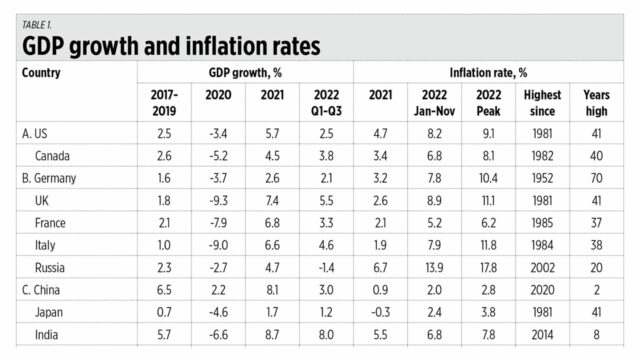
The Group of Seven (G7) industrialized countries — the United States of America (US), Canada, Japan, Germany, the United Kingdom (UK), France, Italy — renewed their growth slowdown this year after a modest recovery last year. And for the first time since 1991 or three decades ago, China this year will grow below 6%, aside from 2020’s global contraction. Russia will have another contraction as a result of the various sanctions against it after its invasion of Ukraine. But most ASEAN (Association of South East Asian Nations) countries will have faster growth this year than last year.

2. G7 countries have hit 37 to 70 years inflation rate highs.

This year, Germany has experienced the worst inflation rate since 1952. The US, UK, and Japan have hit their highest inflation rates in 41 years, while Canada, France, and Italy have had 37-to-40-year highs. Their economic sanctions against Russia and their impact on global energy prices, oil-gas-based fertilizers and industrial goods, have backfired against the G7 while Russia, the target of heavy sanctions, experienced only a 20 year high.

Asians (except Japan and South Korea) experienced inflation rates of at most 14-year highs, including the Philippines (see Table 1).

3. Public debt-to-GDP ratio remained high.

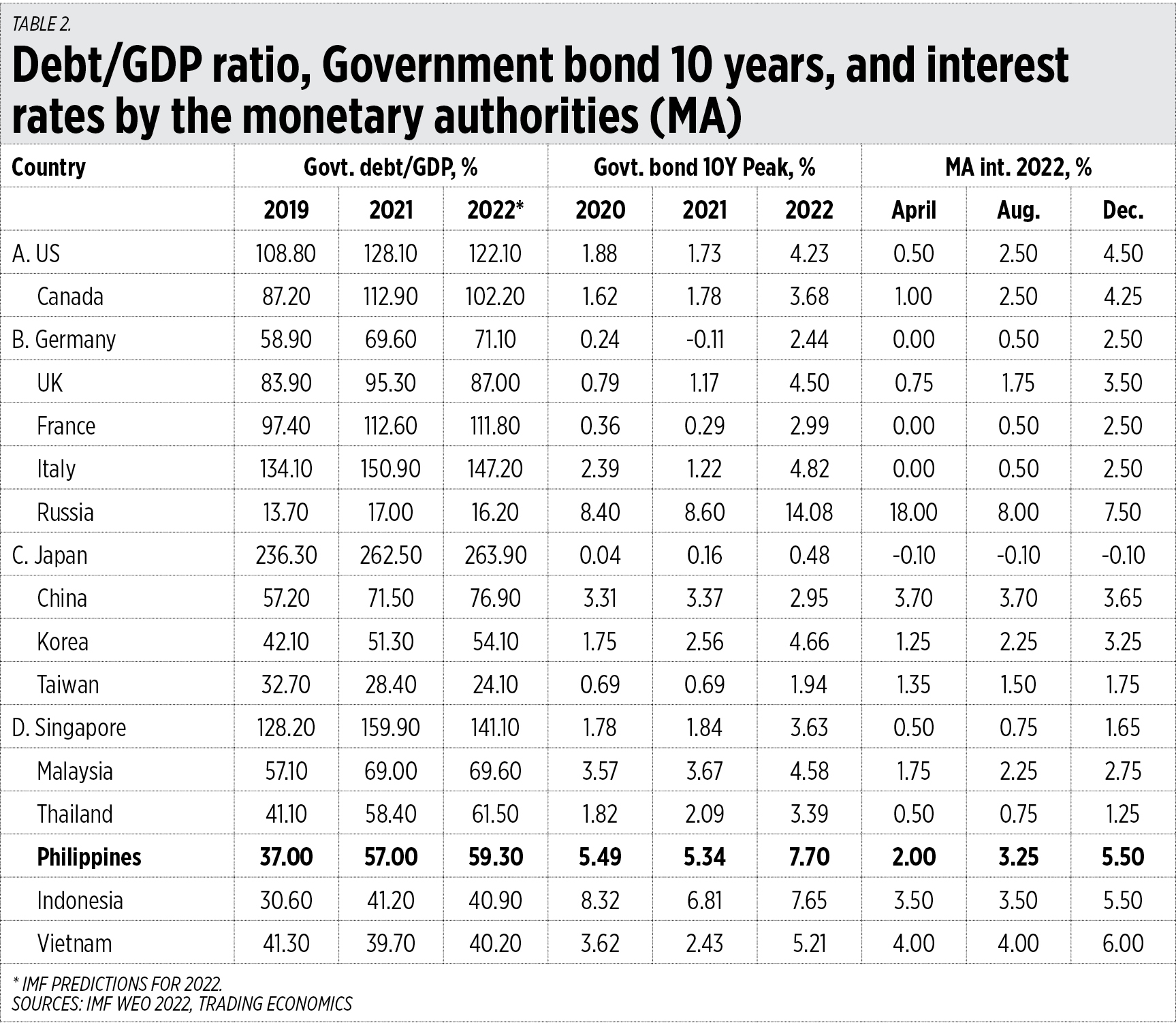
Public debt exploded in many countries in 2020-2021, and are projected to remain high in 2022. In the G7, only Germany and the UK will have a debt-to-GDP ratio of below 100%. Russia surprisingly has only 16%. Three Asians are doing well in their fiscal restraint — Taiwan, Indonesia, and Vietnam. Their debt-to-GDP ratios are below 41%.

4. Government bond rates are double or triple the 2021 levels.

This is true especially for G7 and other rich countries. I list in Table 2 the peak interest rates for 10-year bonds from 2020-2022. For Asians with already high rates in 2021 (at least 3%), the increase in 2022 is not significant.

5. There have been huge interest rate hikes by central banks to control inflation, currency depreciation worldwide.

In the US for instance, interest was only 0.5% last April, and is now 4.5%. This led to huge currency depreciation in many countries around the world as many dollar investments abroad flowed back to the US. To control further hemorrhage, other countries also raised their interest rates. Canada went from 1% last April to 4.25%, and Euro area like Germany, from zero to 2.5%. At least three Asian nations — the Philippines, Indonesia and Vietnam — have high rates at 5.5-6% (See Table 2).
6. The Philippines in the top five fastest growing economies among the world’s top 50 largest economies.

It seems that of the world’s largest economies, the fastest growing in 2022 will be Malaysia and Vietnam, to be followed by India, Bangladesh, and the Philippines. I see three factors for why this happened.

One, President Ferdinand Marcos, Jr.’s lifting of all forms of COVID-19 lockdown in the country. Two, the formation of a competent, experienced economic team led by Finance Secretary Benjamin Diokno, Bangko Sentral Governor Felipe Medalla, Economic Planning Secretary Arsenio Balisacan, and Budget Secretary Amenah Pangandaman. Three, the series of Philippine Economic Briefing investment roadshows held here and abroad — Singapore, Jakarta, New York City, and Washington DC — where the economic team explained and highlighted recent major economic reforms like the liberalization in the Public Service Act, Foreign Investment Act, and Retail Trade, and assured businesses that no major tax hikes will happen.

7. The Philippines experienced its highest inflation rate in 14 years — 8%.

Despite the series of interest rate hikes by the central bank, the inflation rate has continued its upward trend. The huge depreciation of the peso in recent months and the continued high global energy prices contributed to this. But average inflation for 2022 will only be around 5.8%.

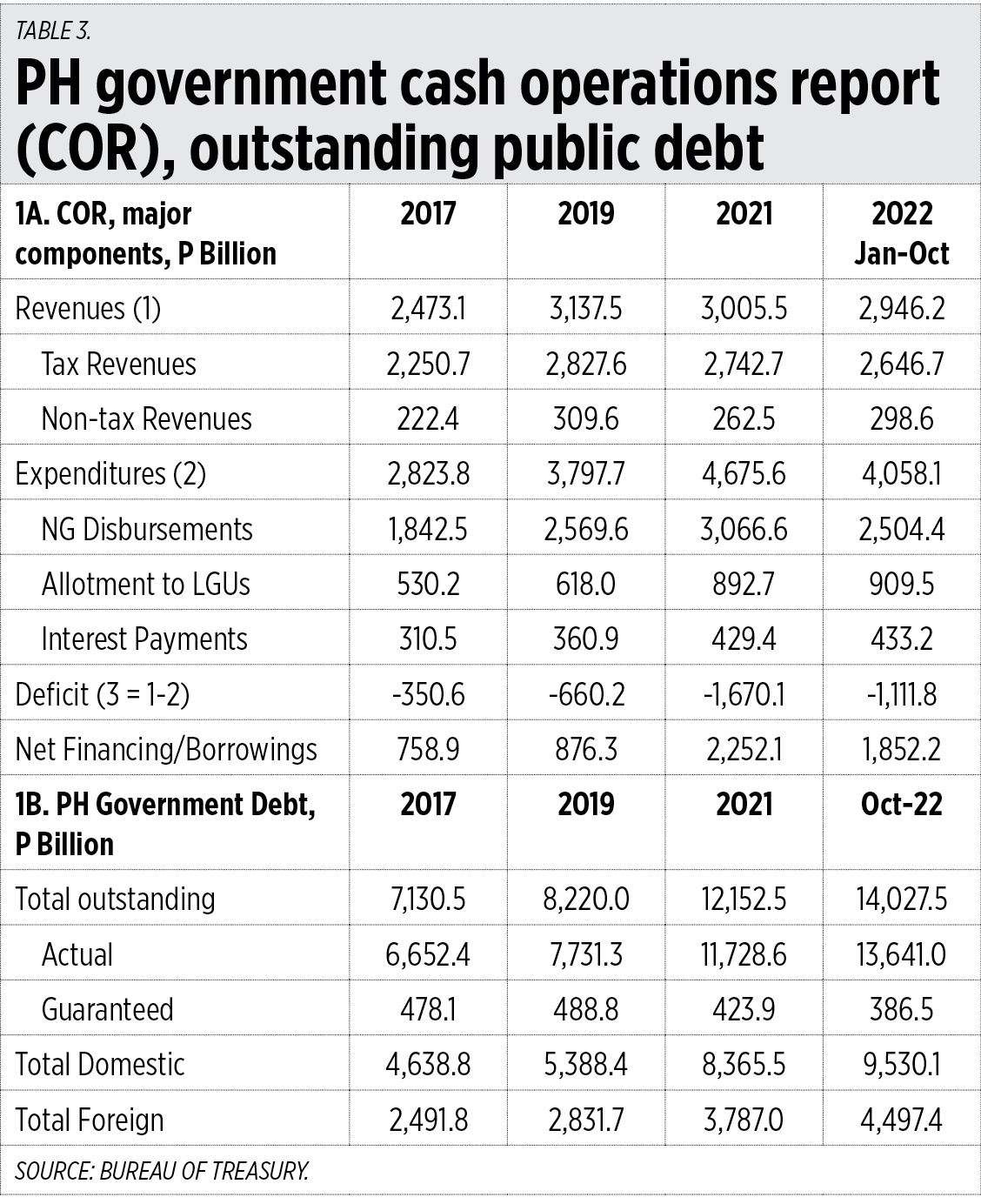
8. The budget deficit remains above P1 trillion, while financing/borrowings will remain at P2 trillion/year.

This is the big fiscal burden created by the Duterte administration’s irrational and prolonged pandemic lockdown which led to business closures from 2020 to early 2022, its huge vaccine procurement spending and the seemingly timetable-less giving of ayuda or subsidies, plus the irrational pension program for military and uniformed personnel (MUP). The MUP, because they do not contribute to their pensions, keep all their salaries and allowances, and their bloated retirement pensions are shouldered by taxpayers once more.

9. Public debt has reached P14 trillion.

The interest payments to service this huge government debt reached P429 billion in 2021, P433 billion as of October 2022, and will likely be P520 billion by end-December (See Table 3). It is never rational and desirable for taxpayers to keep sending money to the government to sustain huge interest payment alone, endless or no timetable ayuda and welfare programs, bloated public personnel lists that need a bureaucracy rightsizing program, and the bloated MUP benefits that need drastic pension reforms.
10. The creation of a sovereign wealth fund (SWF).

The proposed Maharlika Investment Fund (MIF), a SWF act has already passed its third reading in Congress. The idea of creating a SWF is good because it forces a country/the government to find a fiscal surplus somewhere. Funding for the MIF’s capitalization should primarily come from fossil fuel and mining development like the Malampaya gas royalties (about P22 billion/year from 2019-2022), coal royalties and mining taxes, and the privatization of some government corporations like the Philippine Amusement and Gaming Corporation, better known as Pagcor. It is estimated that the privatization of Pagcor will bring the government about P350 billion — right now its annual remittance to the government is only about P15 billion a year.


Bienvenido S. Oplas, Jr. is the president of Minimal Government Thinkers.

minimalgovernment@gmail.com

Avatar struggles show how Japan is ditching Hollywood

IN ITS ECONOMIC HEYDAY of the late 1980s and early 1990s, there was a curious phenomenon of Hollywood celebrities showing up in Japanese commercials: Arnold Schwarzenegger hawking instant noodles, Harrison Ford pitching Kirin beer. To this day, Tommy Lee Jones still appears in a long-standing series advertising canned coffee.

You won’t, however, see much of the current generation of Hollywood stars — no Dwayne Johnson promoting Toyotas, no Ryan Reynolds plugging energy drinks. That’s not just because Japanese firms don’t have the market budget they once had — Johnny Depp recently advertised Asahi beer — but because of a growing, often ignored fact: In Japan, Hollywood isn’t the draw it used to be.

The US share of the world’s third-biggest box office has been dropping for years, a phenomenon that predates the pandemic and has only been aggravated by it. Four of the top five grossing movies this year are domestic hits, with Hollywood’s only representative the ’80s throwback Top Gun: Maverick.

It’s part of a broader decoupling between Hollywood and Japan. But unlike the woes studios face in China, this is no ideological departure. Japan is a free market, with no equivalent of the quota Beijing places on US movies, nor censors stepping in to prevent their release on moral grounds. Neither is it a pandemic phenomenon. Japan is one of the few countries that largely kept cinemas open during the global outbreak.

Instead, Japanese audiences are favoring domestic fare, a trend accelerated by an increase in big-budget animated movies. Every other film, except Top Gun, in the top five this year is Japan-made and uses animation, led by One Piece Film: Red and Jujutsu Kaisen 0: The Movie. Even James Cameron isn’t immune. His Avatar: The Way of Water debuted at a disappointing third place in Japan, behind two animated motion pictures that have been on screens for weeks. Some estimates say it’s the only market where Avatar failed to debut at number one.

While the first Avatar was a box-office hit in Japan and the country’s 12th-highest grossing movie of all time, tastes have shifted in the decade-plus since. The phenomenon is epitomized by the success of Demon Slayer: Kimetsu no Yaiba — the Movie: Mugen Train — which despite opening in the midst of the pandemic became Japan’s biggest-ever box office hit, toppling a record held since 2001 by Studio Ghibli’s Oscar-winning Spirited Away.

There’s no single reason behind the audience’s changing tastes. But one must be the rising quality of domestic movies. The days of reusing animations and dragging the same action scenes out for episode after episode are over. Japanese animation these days is a big-budget affair, illustrated nowhere better than by the hits from director Makoto Shinkai, the creative force behind Your Name, the 2016 tale of body-swapping teens that is Japan’s fifth-biggest box-office blockbuster. Shinkai’s recently released Suzume, a disaster-themed animated fantasy that’s one of the movies that beat Avatar last weekend, is nearing ¥10 billion ($75 million).

Meanwhile, the same pressures that impact the movie industry elsewhere also affect Japan. The rise of streaming means that films need to be tent-pole events to get people in seats. Animation directors like Shinkai or Studio Ghibli alum Mamoru Hosoda have become brand names unto themselves, with budgets to match. That pressure for success encourages making movies of established franchises such as One Piece, the long-running pirate series that is Japan’s all-time top-selling manga, or perennial high-school basketball tale Slam Dunk, a movie adaption of which beat Cameron to the top of the box office last weekend.

The rise of high-quality movies from the pages of comic books also means there’s less room for Hollywood’s equivalents. Another reason for its shrinking share is the limited audience for the now-ubiquitous superhero movies. With a few exceptions, such as Avengers and Spider-Man, consumers haven’t taken to them in the way they previously flocked to franchises like Harry Potter or Pirates of the Caribbean. While Black Panther might rank globally as the 10th biggest-grossing movie of the last decade, it scored just $14.7 million in Japan. This year’s Thor: Love and Thunder earned a paltry $9.8 million.

Even Walt Disney Co.’s animation hits seem to be struggling. While 2013’s Frozen grossed nearly $250 million in Japan — fully 20% of its total — recent entries have done startlingly poorly. Last year’s Encanto earned just $6.8 million, Raya and the Last Dragon $3.3 million, and Strange World, released a month ago, less than $1 million. For a Disney-crazy country, that failure should be concerning. Notably, remakes of previous hits like Aladdin and Beauty and the Beast seem unaffected by this disinterest, a further indication that it’s the properties themselves, not the hassle of going to the theater, that’s turning audiences off.

Japan’s success in capturing audiences at home is to be applauded. There’s no question of protectionism here. But it’s hard not to feel a little troubled if this trend continues long term. Among certain generations, despite a lack of a common language, it’s easy to bond over a shared love of Arnie blockbusters or the early career of Leonardo DiCaprio. For that to disappear entirely would be to lose something precious.

Of course, there’s always the alternative: Japan could better export its increasingly high-quality products. Animé already scores highly on Netflix, Inc. worldwide, with more than one generation of westerners having grown up watching Japanese cartoons. Sony Group Corp.’s purchase of animé streaming service Crunchyroll bears close attention.

It’ll be interesting to see if the second season of the Japan-produced Netflix show Alice in Borderland, released this week, resonates with audiences. The first season largely sank without trace abroad, only for the similarly themed South Korean Squid Game to become an international phenomenon. Instead of aging Hollywood stars in Japanese commercials, it might be Japanese stars, real or otherwise, hawking products on western screens.

BLOOMBERG OPINION

Japan minister signs clean energy cooperation document during Saudi visit

PIXABAY

Saudi Arabia and Japan signed a memorandum of cooperation (MoC) on Sunday in the fields of the circular carbon economy, carbon recycling, clean hydrogen and fuel ammonia, the Saudi Energy Ministry said on Twitter.

The MoC was signed by Saudi Energy Minister Prince Abdulaziz bin Salman and Japanese Industry Minister Yasutoshi Nishimura, who is visiting the kingdom, after a meeting in which they both stressed the importance of supporting the stability of global oil markets through encouraging dialogue and cooperation between producers and consumers, the Saudi state news agency (SPA) reported.

The two ministers also highlighted the need to ensure safe supplies from all energy sources to global markets and noted that the kingdom is “the largest dependable source” of crude oil supplies to Japan and “a reliable partner in this aspect” as well, SPA said. — Reuters

Bloomberg has no interest in acquiring Dow Jones or Washington Post, spokesman says

Bloomberg L.P. has no interest in acquiring either Dow Jones or the Washington Post, a Bloomberg L.P. spokesman said in a tweet.

“There have been no conversations with anyone or either organization about an acquisition,” spokesman Ty Trippet said in the tweet, which was retweeted by billionaire owner Michael Bloomberg.

News website Axios reported on Friday that Bloomberg was interested in acquiring either Wall Street Journal parent company Dow Jones from Rupert Murdoch’s News Corp, or the Washington Post from Amazon.com’s Jeff Bezos, citing a source familiar with Bloomberg’s thinking.

On Friday, citing sources, Reuters reported Michael Bloomberg had expressed a desire to own a big-name newspaper over the years but had not reached out to Mr. Murdoch to discuss a possible purchase of Dow Jones and its flagship paper the Journal.

A spokesperson for the Washington Post, which Mr. Bezos bought in 2013 for $250 million, said on Friday it was not for sale.

Antitrust experts agreed the merger of Bloomberg and Dow Jones business news divisions would draw the scrutiny of US regulators, especially as the Biden administration has taken a more muscular approach to enforcing antitrust laws.

Reuters, part of Thomson Reuters Corp, competes with Dow Jones and Bloomberg News, a unit of Bloomberg L.P., a provider of financial news. — Reuters