
General wholesale price index in the Philippines
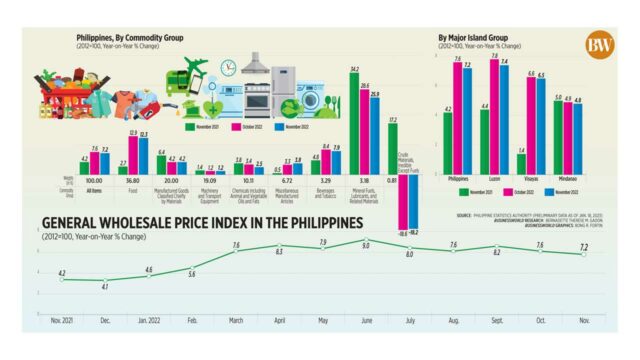
GROWTH in the bulk prices of general goods eased to a nine-month low in November as supply stabilized. Read the full story.

GROWTH in the bulk prices of general goods eased to a nine-month low in November as supply stabilized. Read the full story.

DOLLY De Leon has been nominated for a British Academy Film Award (BAFTA) in the Supporting Actress category for her turn as Abigail in Ruben Östlund’s Triangle of Sadness.
Nominations for the annual BAFTA Film Awards were announced on Thursday. Britain’s top film award ceremony will be held in London on Feb. 19.
Below is a list of the nominees in the main categories:
— Reuters

THE PESO slipped against the dollar on Thursday as weaker economic data from the United States fueled recession fears.
The local unit closed at P54.63 per dollar on Thursday, inching down by a centavo from Wednesday’s P54.62 finish, data from the Bankers Association of the Philippines’ website showed.
The peso opened Thursday’s session at P54.70 versus the dollar. Its worst showing was at P54.78, while its intraday best was at P54.53 against the greenback.
Dollars exchanged dropped to $1.25 billion on Thursday from $1.427 billion on Wednesday.
The peso inched down on weaker US retail sales and manufacturing data, Rizal Commercial Banking Corp. Chief Economist Michael L. Ricafort said in a Viber message.
“The peso weakened slightly amid lingering market concerns of a near-term US recession this year,” a trader likewise said in an e-mail.
US retail sales fell by the most in a year in December, pulled down by declines in purchases of motor vehicles and a range of other goods, putting consumer spending and the overall economy on a weaker growth path heading into 2023, Reuters reported.
The second straight monthly decrease in retail sales, which are mostly goods, is undercutting production at factories. Manufacturing output recorded its biggest drop in nearly two years in December, while monthly producer prices also tumbled, other data showed on Wednesday.
Retail sales plummeted 1.1% last month, the biggest drop since December 2021. Data for November was revised to show sales decreasing 1% instead of 0.6% as previously reported. Retail sales rose 6% year on year in December.
A separate report showed manufacturing output dropped 1.3% in December, the largest decline since February 2021, and production in the prior month was much weaker than initially thought.
For Friday, the trader said the peso could strengthen anew following the release of US jobless claims data.
The trader sees the peso moving between P54.50 and P54.75 a dollar on Friday, while Mr. Ricafort gave a narrower P54.55 to P54.75 forecast range. — AMCS with Reuters
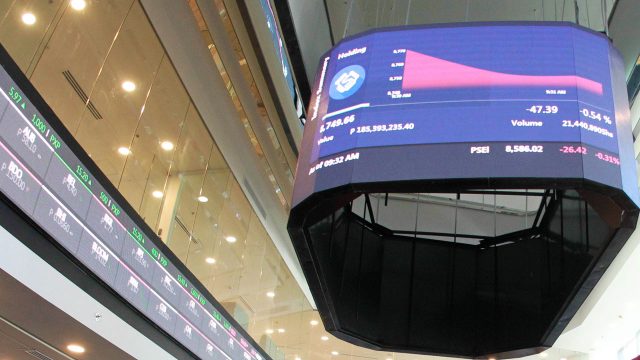
SHARES dropped on Thursday on profit taking as sentiment was dampened by recession fears and Wall Street’s decline.
The benchmark Philippine Stock Exchange index (PSEi) went down by 32.85 points or 0.46% to close at 7,062.01 on Thursday, while the broader all shares index inched down by 5.83 points or 0.15% to end at 3,686.68.
“The PSEi gapped down at the open today as rising investor concerns on slowing global growth dampened sentiment. This may have also led to a resurgence of selling pressure, with investors securing more gains,” China Bank Securities Corp. Research Director Rastine Mackie D. Mercado said in an e-mail on Thursday.
“Philippine shares weakened along with the rest of the region, due to some profit taking weighed by earnings miss by Goldman Sachs Group, Inc.,” Regina Capital Development Corp. Head of Sales Luis A. Limlingan said in a Viber message.
US economic data and their impact on Wall Street also affected market sentiment.
Goldman’s profit for the fourth quarter was at $1.19 billion, or $3.32 per share, which missed the Street estimate of $5.48 per share.
Meanwhile, the S&P 500 and the Dow lost almost 2% on Wednesday, their biggest daily drops in more than a month, after weak economic data fueled recession worries while hawkish comments from US Federal Reserve officials soured investor moods further, Reuters reported.
Before the market opened, US economic data showed retail sales and producer prices declined more than expected in December, while production at US factories fell more than expected and November output was weaker than thought.
The Dow Jones Industrial Average fell 613.89 points or 1.81% to 33,296.96 and the S&P 500 lost 62.11 points or 1.56% to 3,928.86. The Nasdaq Composite dropped 138.10 points or 1.24% to 10,957.01.
Back home, most sectoral indices closed lower on Thursday except for mining and oil, which rose by 182.17 points or 1.58% to 11,665.06, and services, which inched up by 2.99 points or 0.16% to 1,790.22.
Meanwhile, financials lost 18.95 points or 1.03% to close at 1,820.07; property decreased by 16.86 points or 0.54% to 3,097.97; industrials went down by 48.82 points or 0.48% to 9,970.51; and holding firms inched down by 3.07 points or 0.04% to end at 6,818.60.
Value turnover declined to P7.03 billion on Thursday with 1.87 billion shares changing hands from the P7.99 billion with 991.91 million issues traded on Tuesday.
Advancers outnumbered decliners, 107 versus 83, while 53 names closed unchanged.
Net foreign buying dropped to P506.66 million on Thursday from the P532.16 million seen the previous trading day.
“[Thursday’s] move also continues to indicate that the uptrend remains intact, with prospects of further gains in [Friday’s] session,” Mr. Mercado said.
He placed the PSEi’s immediate support at 6,900 and resistance at 7,200. — Justine Irish D. Tabile with Reuters

THE House of Representatives will give the proposed E-Government Act its full attention when the chamber resumes session, Speaker Ferdinand Martin G. Romualdez said.
“The House of Representatives remains committed to pass the priority legislation of President Ferdinand R. Marcos, Jr., including measures for digitalization in both government and private transactions that would bolster efficiency, productivity, and security,” Mr. Romualdez said.
“Upon the resumption of the (Congressional) session, among the top priorities of the House is the passage of the E-Government and E-Governance Act, which will help accelerate our digital transformation to fuel growth momentum,” Mr. Romualdez said.
Mr. Romualdez said a shift to digital platforms in government will enhance the Philippines’ standing as an investment hub.
Mr. Romualdez issued the statement in Davos, where he is participating in the World Economic Forum.
At an open forum at the Swiss mountain resort, Mr. Marcos said upgrades to cybersecurity and connectivity will go hand-in-hand with digitalization.
If signed into law, the E-Governance Act will establish an Integrated Government Network, a platform for sharing and communication of resources, information, data, through and on all digital and electronic platforms. It will be in use in all offices and branches of national and local government.
More than 10 House bills related to e-government are pending at the committee on information and communications technology. — Beatriz Marie D. Cruz

THE National Electrification Administration (NEA) said on Thursday that National Power Corp. (Napocor) will reduce services to areas served by its Small Power Utilities Group (SPUG) due to the high price of diesel fuel.
“Starting Feb. 1, Napocor will implement the reduction of electricity service in SPUG areas due to fuel shortages and the delay in the universal cost for missionary electrification (UCME) subsidy payment,” NEA said in a statement on Thursday.
As authorized by Republic Act No. 9136 or the Electric Power Industry Reform Act (EPIRA), the UCME is collected from on-grid electricity end-users to fund Napocor’s electrification programs and projects, particularly in remote areas not connected to the grid which must use diesel generators.
In a statement, Napocor said that the continuous increase in diesel fuel prices has exhausted its allotted funds for fuel.
“Napocor continues to find ways to bridge this gap in funding through any of its projected sources — approval of ERC petitions, borrowings, or additional subsidy from the National Government,” Napocor said.
Last year, the Department of Energy (DoE) authorized Napocor to borrow from banks to support its operations following a legal opinion from the Justice department.
In a statement, Napocor President Fernando Martin Y. Roxas said the company has requested a P5-billion loan for fuel purchases, which it expects to receive by May.
“At present, Napocor’s current fuel supply continues to dwindle after its fuel supplier again halted delivery. Much as it wanted to maintain current service hours, Napocor is left with no option but to reduce the operating hours of its power plants to stretch the current fuel supply until the 31st of December,” Napocor said.
Mr. Roxas is now asking electric cooperatives (ECs) for advance payment for fuel.
NEA Administrator Antonio Mariano C. Almeda said that he has instructed ECs to make advance payments and warned of a looming power crisis.
The Energy Regulatory Commission (ERC) said in an advisory dated Jan. 17 that it is currently reviewing all pending petitions of Napocor to avail of UCME.
“The Commission is faced with the challenge of balancing the interests of our consumers and end-users in missionary areas on one hand, and on-grid end-users, who are made to shoulder the burden of subsidizing the UCME, on the other,” the ERC said. — Ashley Erika O. Jose

THE Maritime Industry Authority (MARINA) said on Thursday that its partnership with South Korea’s Busan Marine Engineering Association (BUEA) will help shipping companies and shipyards build modern ships.
“The role of MARINA is to assist the shipping companies and shipyards in availing of the modern ship designs offered by BUEA based on the shipowner’s requirements,” MARINA said in a statement when asked by BusinessWorld for details of the partnership.
MARINA said it will also assist Philippine companies in obtaining financing for ship construction from government institutions “such as, but not limited to, the Development Bank of the Philippines.”
The “Integrated Ship Construction Support System Project” of MARINA and BUEA is expected to help introduce modern ship design and technology from South Korea.
According to MARINA, shipping companies have until Feb. 15 to submit applications to participate in the first phase of the project, which involves conceptual design.
The second phase is design development, while the third phase is contract signing.
MARINA and BUEA met with domestic shipping companies on Jan. 16, according to the agency.
Among the domestic shipping companies that attended were Oceanic Container Lines, Inc., Magsaysay Shipment, Inc., and 2GO Group, Inc. — Arjay L. Balinbin

THE Department of Agriculture (DA) said it will seek to enhance domestic corn production in order to meet the needs of the feed and livestock industries.
In a memorandum signed by Senior Undersecretary Domingo F. Panganiban dated Jan. 16, the DA will implement a Corn Production Enhancement Project to increase the yield per hectare of yellow and white corn by 3% a year to increase the supply of yellow and white corn for animal and human use.
According to the memorandum, corn production is increasing but not sufficiently to address the needs of corn processors.
“The local yellow corn-feed sufficiency is only 59% in 2021, other feed millers are also using cassava in their feed formulation (to account for) about 6-7% of the requirement,” according to the memorandum.
In the white corn segment, demand has increased for food and industrial applications.
The program applies to both yellow and white corn for the first cropping year of 2023.
“Priority areas include new/idle lands and crop/varietal shifting,” it said, adding that the average grain yield is less than 4.20 metric tons and 2.50 metric tons per hectare for yellow and white, respectively.
Targeted farmers are those tilling at least 0.50 hectares who are on the registry system for basic sectors in agriculture database.
Farmers will be given 18 kilos of hybrid seed corn, 20 kilos of improved seed corn and two bags of inorganic fertilizer per hectare planted to corn.
The cap on the benefits is one hectare, the DA said. — Ashley Erika O. Jose

THE United Sugar Producers Federation (UNIFED) said on Thursday that it supports a government plan to import sugar, with volumes initially estimated at 450,000 metric tons (MT), in light of the imminent establishment of a two-month buffer stock for the commodity.
In a statement on Thursday, UNIFED President Manuel R. Lamata said the import plan is “an acceptable volume for a buffer stock amid speculation that there may be a shortage by the end of the milling season.”
Mr. Lamata said the federation “fully supports” the plan to import about 450,000 MT of sugar, saying that it hopes the presence of a buffer stock will help keep retail prices contained.
On Wednesday, Rex C. Estoperez, deputy spokesman of the Department of Agriculture, said the DA is considering importing sugar in response to President Ferdinand R. Marcos, Jr.’s order to establish a two-month buffer stock of sugar.
Mr. Lamata said that the Sugar Regulatory Administration (SRA) should schedule the releases of the imported sugar to ensure that millgate prices are not be affected.
“UNIFED will leave the discretion of formulating the guidelines and mechanics for importation to the President and the SRA,” UNIFED added.
Enrique D. Roxas, president of National Federation of Sugarcane Planters, said he recognizes the need for imports and a sugar buffer stock.
“However, without knowing the actual and projected production and consumption figures for this crop year, we are groping in the dark as to the actual volume of imported sugar which we need for domestic consumption,” Mr. Roxas said in a statement on Thursday.
He said that imports should be calibrated in volume and timed to arrive after the close of milling, “so that it does not depress milling prices to the disadvantage of sugarcane farmers.”
“The 450,000 MT might be enough or it might not be enough, we do not know. Unless SRA provides us with the figures,” Mr. Roxas said.
Mr. Roxas asked the SRA to provide projections for production and consumption for this crop year.
Jayson H. Cainglet, executive director of the Samahang Industriya ng Agrikultura, said the DA needs to consult with planters and millers before proceeding with imports.
“As far as we know, we are still in the peak of harvest and milling activities and there is abundant local stocks at this point. The DA, it seems, is now the biggest enemy of local producers,” Mr. Cainglet said.
He said the DA should determine if there is a real shortage and import in a manner that “does not affect the local harvest or milling.”
The SRA estimates that for crop year (CY) 2022 to 2023, which covers the period of Sept. 1, 2022 to Jan. 1, 2023, the raw sugar inventory was 282,524 MT, up 0.77% from the 280,352 MT output recorded in CY 2021-2022.
For the refined sugar, the inventory estimate is 214,713 MT, up 64.9% from the crop year earlier. — Ashley Erika O. Jose

THE Philippine Ports Authority (PPA) said the completion of the Zamboanga port passenger terminal building, which is set to become the country’s largest, will be delayed until next year.
“Originally, completion was to be within this year; but it’s not going to happen,” PPA General Manager Jay Daniel R. Santiago told reporters on Wednesday.
“It’s encountering delays for so many reasons, including material supply issues and weather disturbances, so we are trying to think of a catch-up plan,” he added.
When completed, the project will be the biggest passenger terminal in the country, with capacity of 4,500 passengers at any given time against the current capacity of 750.
The soon-to-be-opened Calapan Port’s new passenger terminal in Mindoro will have a capacity of 3,500 passengers at any one time, up from 800 currently.
“I’m excited really for that (Zamboanga) passenger terminal building) because it’s reflective of the Muslim culture down south… even the amenities are different,” Mr. Santiago said.
The agency expects to complete the Calapan port passenger terminal building on Feb. 18.
“The assessment of the Port Management Office of Mindoro revealed that the completion rate of our (project) is 17% ahead of its target schedule, and we are set to inaugurate it in March,” Mr. Santiago has said.
The current biggest passenger terminal building is the one in Cagayan de Oro, which has a capacity of 3,000 passengers at any one time. — Arjay L. Balinbin

THE Japan International Cooperation Agency (JICA) said it hopes to sign a financing agreement soon for the next financing tranche of the Metro Manila Subway project.
In a media briefing on Thursday, JICA President Akihiko Tanaka said the Japanese development agency has been working with the government on the infrastructure development programs, especially on the financing of the subway.
“I think it’s up to the agreements between the two governments. I cannot let you know the exact date but I’m quite hopeful the signing should be coming soon,” Mr. Tanaka said.
“This year is going to be a very fruitful year in launching many productive projects,” he added.
According to JICA Chief Representative to the Philippines Takema Sakamoto, the next tranche will depend on the pace of construction progress and the timing of critical expenditures.
“If they send some list to exhaust the money, we are very happy to (implement a) further phasing of lending,” Mr. Sakamoto said.
The loan agreement for the second tranche of funding for the subway was worth P112.87 billion, payable in 27 years.
The initial tranche signed in March 2018 was valued at P47.58 billion, payable over 40 year.
Meanwhile, JICA Senior Representative Kenji Kuronuma told reporters that the number of tranches is not fixed and will be determined in discussions between the two governments.
“Tranche 1 and 2 will not cover the entire costs. So of course, definitely there should be additional funds,” Mr. Kuronuma said.
He added that the JICA continues to support the Philippine government in implementing the rehabilitation and maintenance of MRT3, as well as the extension of LRT line 1 and 2.
“Apart from those lines, there hasn’t been any concrete, specific railway that would be prospectively financed by JICA at this moment. But of course, we are open to discuss further,” he added.
JICA LAUNCHES NEW TECH
Meanwhile, JICA has launched a pilot project in Las Piñas City that introduced a Japanese technology which could clean up debris in land and water efficiently, the firm said in a statement released on Thursday.
The technology was developed by Japanese company Kochi Marutaka Corp., and can be disassembled and carried to rivers or construction sites.
According to the lending arm, the equipment is useful in times of disasters, specifically against flooding, since it can also clear up garbage that accumulates in waterways.
“Aside from Official Development Assistance (ODA) major schemes, such as provisions of soft conditioned Yen loans, JICA has been partnering with the private sector under our Sustainable Development Goals Business Supporting Survey,” JICA Philippines Project Formulation Advisor Hashizume Takuya.
“This program shares with our partner countries unique products or technology from Japanese companies to boost industrial and economic growth, improve the living environment of communities, expand business and stimulate future investments of Japanese companies,” Mr. Takuya said.
The Japanese company has partnered with JICA, Department of Public Works and Highways (DPWH), and Las Piñas City Government to launch the technology in the Philippines and test it at the local government level.
“We recognize the support of LGUs like Las Piñas City to this project since LGUs are always on the frontlines during disasters. When scaled up, use of this floating amphibious excavator can empower more LGUs to clean up river systems and mitigate disasters in the long-term,” Mr. Takuya added. — Keisha B. Ta-asan

THE PHILIPPINES has been invited by the World Economic Forum (WEF) to join a soon-to-be established technology-sharing center, the Palace said in a statement.
The Presidential Communications Office (PCO) said in a statement that the invitation was extended by World Economic Forum founder Klaus Schwab to President Ferdinand R. Marcos, Jr. at a meeting on Wednesday.
The PCO quoted Mr. Schwab as telling Mr. Marcos, “When we inaugurate it, we will invite the Philippines to be amongst the first countries to (take) residence (and) showcase your investment opportunities in a much more effective manner compared to video conferencing because you bring people into the next (stages) of what’s happening.”
“The technology of the future… will be applied to education, healthcare,” as well as energy transformation and clean fuels,” Mr. Schwab said.
Growing interest in three-dimensional virtual communities supported by artificial intelligence is enabling the global collaboration platform, Mr. Schwab told Mr. Marcos.
“We have all the representations of some countries, of companies and you can interact every time.”
Mr. Schwab cited the example of India, which is being assisted in the “application of the newest technologies to increase agricultural activity.” — Kyle Aristophere T. Atienza
