Home Blog Page 5402

Atthaya Thitikul beats Danielle Kang in second playoff to win in Arkansas

THAILAND LPGA rookie Atthaya Thitikul — REUTERS

LPGA rookie Atthaya Thitikul of Thailand sank a birdie putt on the second playoff hole to defeat Danielle Kang and win the Walmart NW Arkansas Championship on Sunday in Rogers, Ark.

Ms. Thitikul and Ms. Kang were tied at 17-under 196 at the end of the 54-hole event. They began the playoff by parring the par-3 15th hole at Pinnacle Country Club before heading to the par-4 16th.

There, the 19-year-old Ms. Thitikul rolled in a right-to-left putt for birdie to beat Ms. Kang and capture her second career LPGA title. Ms. Thitikul also won the JTBC Classic in March.

“I just feel like playing golf with Danielle is kind of tough as well because she is pretty great player, win a lot on LPGA Tour already,” Ms. Thitikul said. “But for me out there, on second hole I’m just trying to do my best every single shot.”

Ms. Thitikul, who shot a 10-under 61 in Saturday’s second round to take the lead, posted a final-round 68.

Ms. Kang shot a bogey-free 64, the low round of the day, with a chip-in eagle at the par-5 18th to get to 17 under for the event. Ms. Thitikul made birdie at the par-3 17th to tie her at the top and parred No. 18 to set up the playoff.

Ms. Kang, 29, took time off during the season after doctors discovered a tumor on her spine that needed to be removed. This was her third tournament back.

“It’s a struggle almost, sometimes in the morning — but I came out here to do something that I love, and I’m just so happy for my team that somehow got me back playing this year,” Ms. Kang said through tears. “I mean, there was part of me that I didn’t think I would ever play again or contend, but here I am. I’m not that far off and I’m happy about that.”

Ms. Thitikul and Ms. Kang beat South Korea’s Chella Choi (final-round 65) by one shot. Thailand’s Pornanong Phatlum (66) came in fourth at 14 under.

Tied for fifth at 13 under were Lizette Salas (65), Megan Khang (68), Ryann O’Toole (68), France’s Celine Boutier (65), New Zealand’s Lydia Ko (67), Muni He of China (68) and Charley Hull of England (68). — Reuters

New York Yankees win rain-shortened game to sweep Boston Red Sox

AARON Judge remained at 60 home runs, Nestor Cortes pitched six innings of one-hit ball and the New York Yankees recorded a rain-shortened 2-0 victory over the visiting Boston Red Sox Sunday night to extend their winning streak to seven games.

Heavy rain halted play at 9:15 p.m. after the Yankees batted in the sixth. Mr. Judge was due to lead off the seventh and most fans remained in the stadium. Umpires came on to the field at 10:44 and walked off two minutes later after conferring with Boston manager Alex Cora and New York manager Aaron Boone.

Mr. Judge went 1-for-2 with a walk and remained one homer behind Roger Maris for the AL record. Mr. Maris set the mark when he hit his 61st homer on the final day of the 1961 season with the Yankees.

Since his last homer in the ninth inning Tuesday against Pittsburgh, Mr. Judge is 4-for-15 with six walks. He opened Sunday’s game with a double on the second pitch he saw from rookie Brayan Bello (2-7).

The Yankees (94-58) won for the 15th time in 19 games and reduced their magic number for clinching the American League East to two.

Mr. Cortes (11-4) allowed just a ground-rule double to Rob Refsnyder in the fourth in his longest outing since returning from a groin injury. Mr. Cortes struck out five and walked two while throwing 101 pitches.

The Yankees took the lead in the fourth when rookie Oswaldo Cabrera doubled, stole second as Aaron Hicks struck out and scored on Jose Trevino’s single.

Mr. Bello allowed two runs (one earned) on six hits in six innings. The right-hander struck out four and walked two.

The Red Sox (72-80) gave Rafael Devers and Alex Verdugo the night off and dropped their fifth straight. — Reuters

PhilHealth’s road to regaining Filipinos’ trust

PHILHEALTH 2017 AR

Boasting an 85% membership rate or having roughly 94 million Filipinos as members, there is no question about how integrated the Philippine Health Insurance Corp. — more commonly known as PhilHealth — is in the lives of Filipinos.

According to a recent study conducted by communications firm EON Group, it enjoys a high level of recognition, with 76% of the respondents believing that PhilHealth contributes to public health and welfare in its role as the government agency that oversees the provision of health insurance coverage, and affordable and quality healthcare services to all Filipinos.

Yet if we dive deeper into media reports on PhilHealth since the onset of the pandemic, we’ll find headline after headline that could skew anyone’s opinion of the agency negatively.

In 2020, while the Philippines endured the effects of the first wave of the COVID-19 pandemic and the ensuing lockdowns, PhilHealth was rocked by a corruption controversy that saw several of its high-ranking officials accused of fund mismanagement and anomalous transactions. To those who can recall this period, I’m pretty sure you were livid about the issue just like the rest of the public was. Everyone was stuck at home for most of that year, constantly checking the news, and getting outraged over the alleged misuse of funds intended to cover citizens’ healthcare costs amid a global health crisis. Social media was abuzz for months with Filipinos criticizing PhilHealth officials and demanding accountability.

Although the government agency has categorically denied any fund theft, the negative publicity has done its work. A cloud of doubt over PhilHealth remains. This is supported by the results of the EON study that show PhilHealth enjoying a modest 61% trust rating from Filipinos — a number significantly lower than the client satisfaction rating in the high 90s that the agency used to get pre-pandemic. It didn’t help that PhilHealth raised its membership contribution rates this summer amid rising fuel and food costs. The additional burden on their pockets certainly reminded Filipinos of the perceived corruption among the agency’s top management.

Still, for an organization that has been under intense public scrutiny since 2020, a 61% trust rating and a 76% belief in its contribution to public health and welfare are relatively high figures. To help account for the reasons behind these numbers, the EON study also asked respondents nuanced questions about their perception of PhilHealth.

What we discovered is that they did not base their answers solely on news reports about the agency but also on their experiences in dealing with it, such as looking for information through its information channels, interacting with its staff, the quick processing of their claims, and more. Since their answers relayed a more positive experience with PhilHealth, we were able to understand that while Filipinos now have a tempered trust in the agency, they still believe in its services and its capacity to help citizens.

I’ve mentioned PhilHealth’s recent contribution rate hike that once again drew the ire of members. EON’s study also did a quick scan of the social media space in the past year and it revealed plenty of netizens’ sentiments of dissatisfaction with the agency. PhilHealth’s online mentions included corruption allegations, the suspension of claim payments, and its increased rate for members, with most online discussions occurring on Twitter. It’s a different picture from the one presented by our on-the-ground survey since social media is driven by instantaneous and reactive sentiments.

Both pictures must be taken into account, however. It is incumbent upon the current PhilHealth officials to take note of the downward trend in public trust in the agency and do the work of regaining the trust they have lost.

We believe the latter is achievable with the help of a few simple yet consistent measures.

One, PhilHealth must practice transparency. Its officials must make sure to properly audit any and all transactions, that records of these transactions can be accessed by stakeholders at any time, and that the numbers are spotless when checked. Next is implementing a more efficient system for members, including digitizing its processes. This can cut down delays and inconveniences for members, which contribute to their negative experiences with the agency.

Lastly, if membership rate hikes are inevitable, then materials that provide proper information and explanation about these increases must be given to members. Educating stakeholders on the need for higher fees will go far in quelling the public’s understandable outrage since they would then understand where a percentage of their monthly income goes. More importantly, they must be able to feel the benefits of these membership rate hikes.

If PhilHealth is to improve its trust rating, it has to commit to being transparent and consistent with its work.

As the renowned American author Robert C. Solomon once said, “Authentic trust is sophisticated, reflective, and possible to renew.” This is the kind of trust that Filipinos want to be able to have in PhilHealth, and it should prove to be worthy of it.


Junie S. Del Mundo is chair of the MAP Health Committee, vice-chair of the MAP CEO Conference Committee, and chair and CEO of The EON Group.

map@map.org.ph

junie.delmundo@eon.com.ph

The folly of remembering martial law on September 21

Last Wednesday, Sept. 21, hundreds of activists wearing black shirts took to the streets holding up banners condemning Ferdinand Marcos’ declaration of martial law 50 years ago and chanting “never forget, never again.” Martial law survivors took part in a “conversation express” at the Bantayog ng mga Bayani in Quezon City. They later joined the 8,000 or so people gathered in the University of the Philippines campus to pay homage to the thousands of Filipinos who were arrested, abducted, detained, tortured, or killed during the martial law period.

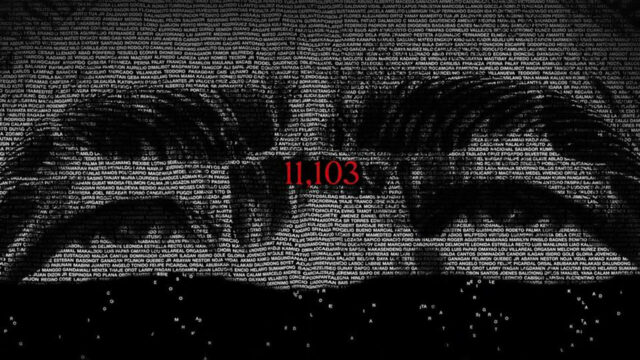
A parade of floats depicting issues under martial law kicked off the protest rally. Images of Filipinos who died during the period were shown. A billboard poster demonizing Ferdinand E. Marcos was also displayed. A documentary film, 11,103, which features the stories of survivors directly countering many of the false narratives peddled online, premiered on the campus. The title of the film is based on the number of human rights victims who were officially recognized by the government and who received compensation from the Marcoses’ ill-gotten wealth.

On the same day, a “Barikada Laban sa Historical Distortion and Disinformation” was held at the Commission on Human Rights main office in Quezon City. Journalists paid tribute to the people from the industry who risked their lives in fighting for press freedom during martial law. The National Union of Journalists of the Philippines issued this statement: “On the 50th year since the declaration of Martial Law, Filipino journalists remember those who remained loyal to the truth and who did so despite a lack of resources and at considerable risk to themselves. It is in this spirit that we stand today with them [the Mosquito Press] and with each other to join the country in saying Never Again.”

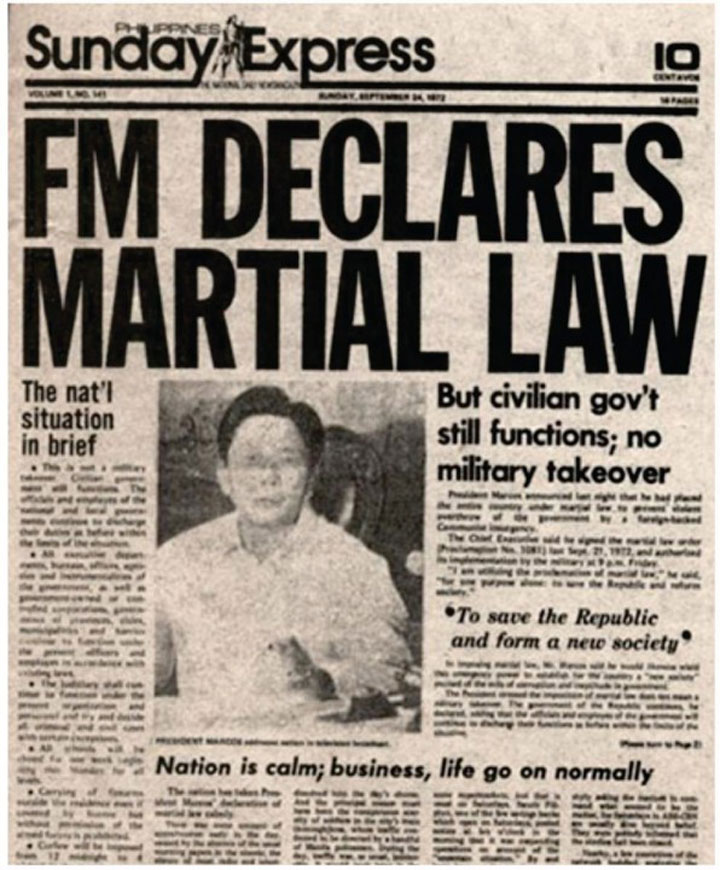
Those who participated in the protest activities last Wednesday, Sept. 21, including the survivors of martial law, did so in the belief that martial law regime began on Sept. 21, 1972. But Sept. 21, 1972 was like any ordinary weekday. Business, slowed down by continuous rain and floodwaters the past weeks, was buzzing again. Government was functioning normally. Schools were open. Newspapers were delivered to homes and sold in the streets. All broadcast stations were airing their regular programs.

On Sept. 21, 1972, democracy was vibrant and functioning magnificently. Congress and the Constitutional Convention were in animated session. Senator Benigno Aquino even delivered a privilege speech before his fellow senators, reminding them of their true role in the event martial law was imposed. In the afternoon of that day, the Movement of Concerned Citizens for Civil Liberties, headed by another bitter critic of President Marcos, Senator Jose Diokno, held a huge rally, estimated between 30,000 and 50,000, denouncing the plan of the president to suppress democracy.

The next day, Sept. 22, all the daily newspapers featured the Movement’s rally. In the afternoon, Senator Aquino was guest speaker of the graduating class of the Asian Institute of Management. There were as many as 16 military officers in the school that day. They were not there to secure the school or to arrest the senator. They were there as regular students of the Master in Business Management program of the Institute.

Among them were Air Force Major Jose Comendador and Army Captain Angelo Reyes, who both belonged to the graduating class. Comendador would become Commanding General of the 2nd Air Division but joined the rebels in the December 1989 attempted coup d’état and held Mactan Air Base hostage. Reyes would become Armed Forces of the Philippines Chief of Staff but withdrew the support of the military from President Joseph Estrada during the EDSA Revolution of January 2001.

I remember distinctly that talk of Senator Aquino because I was conducting class in the room next to the lecture hall where he was sharing with the students his vision of “The Philippines after Marcos.” After his harangue against President Marcos, Dean Gabino Mendoza invited him to the Faculty Lounge. There he told us that he didn’t think Marcos would place the country under martial law, not until 1973.

From the Institute, he went to the Hilton Hotel for a meeting with other senators. There at past midnight, or in the wee hours of Sept. 23, 1972, he was arrested — at about the same time other critics of Marcos were being rounded up and media establishments shut down.

By 1 a.m., Senators Diokno and Ramon Mitra had also been arrested. Also taken into custody that early morning were newspaper editors Amando Doronilla of the Daily Mirror, Luis Mauricio of the Philippine Graphic, Teodoro Locsin, Sr. of the Philippines Free Press, Ernesto Granada of the Manila Chronicle, and columnists Maximo Soliven of the Manila Times, Luis Beltran of the Evening News, and former senator Francisco “Soc” Rodrigo who had a political commentary program in ABS-CBN.

Free Press Associate Editor Napoleon Rama and Associated Broadcasting Company TV-5 (the Manila Times TV station) anchor Jose Mari Velez, who were Constitutional Convention delegates, were also arrested as were the other outspoken delegates — Heherson Alvarez, Alejandro Lichauco, Voltaire Garcia, and Teofisto Guingona, Jr. By dawn of Sept. 23, 100 individuals were in detention centers.

Martial law took effect in the first hour of Sept. 23, 1972 but was declared by President Marcos himself on Channel 9 of Kanlaon Broadcasting System, owned by his crony Roberto Benedicto, only at about 7 p.m. of that day.

It was only much later that Marcos said he signed Proclamation No. 1081 on Sept. 21, 1972. But on another occasion, he told a group of historians that he signed it on Sept. 17. Some say he signed it as early as Sept. 10, 1972. Others say Marcos did it on the night of Sept. 22, immediately after the staged ambush of Defense Secretary Juan Ponce Enrile that justified the imposition of martial law in the first hour of Sept. 23.

His diary entry for Sept. 22 was, “Sec. Juan Ponce Enrile was ambushed near Wack-Wack at about 8 pm tonight. It was a good thing he was riding in his security car as a protective measure. This makes the martial law proclamation a necessity.” His entry for Sept. 25 indicated that the date of Proclamation 1081 is Sept. 23, 1972.

So, even “September 21” is a date of dubious significance. Marcos had a fetish for the numeral 7. He won over President Diosdado Macapagal by 777 votes in the presidential election of 1965. That is why he was undecided for a while between 17 and 21. The number 21 is divisible by 7, unlike 23. The numerals 2 and 3 did not add up to 7. Marcos chose 21 over 17 because September 21 coincided with the dismissal in 1939 of the Nalundasan murder charge against him.

Sept. 21 was only a product of President Marcos’ penchant for romanticizing events. Political pundits believe that Marcos wanted martial law remembered on Sept. 21 to erase from memory the events involving Senators Aquino and Diokno on that day. In 1973, he issued Proclamation 1181, designating Sept. 21 as Thanksgiving Day to coincide with the establishment of his so-called “Bagong Lipunan” or New Society.

The New Society was supposed to be similar to the “Great Leap Forward” of Mao Zedong in China and the “New Order Administration” of President Suharto in Indonesia. The apologists of the martial law regime point to the improvement of peace and order, reduction of violent urban crime, suppression of the Communist insurgency, neutralization of the Muslim separatist movement, collection of loose firearms, and instilling discipline into citizens.

The propaganda effort was so successful that is why up to the present, many Filipinos — particularly those born after September 1972 and those who were then too young to know the implications of Proclamation 1081 — labor under the misimpression that martial law was declared on Sept. 21, 1972.

As Marcos wished, people remember martial law, “the golden age,” every Sept. 21. To place significance to that date is to submit oneself to the manipulation of President Marcos’ shrewd mind. Remembering martial law on Sept. 21 is like celebrating the benevolence of President Marcos.

Remembering martial law on Sept. 23 is commemorating the beginning of “the darkest chapter in the history of post-colonial Philippines.” Remembering martial law on Sept. 23 is committing to memory the malevolence of Ferdinand E. Marcos.


Oscar P. Lagman, Jr. is a retired corporate executive, business consultant, and management professor. He has been a politicized citizen since his college days in the late 1950s.

Bearing witness: #11,103

THE DOCUMENTARY 11,103 had its Philippine premiere on Sept. 21, the date of Presidential Decree 1081 which placed the Philippines under Marcos’ Martial Law. There were screenings in Quezon City, Cebu, Dumaguete, Iloilo, and Bacolod as well as in American cities. The number 11,103 represents the number of claimants officially recognized by the Human Rights Victims’ Claims Board and thus granted reparations through R.A. 10368 [An Act Providing for Reparation and Recognition of Victims of Human Rights Violations During the Marcos Regime, Documentation of Said Violations, Appropriating Funds Therefor and for Other Purposes]. Reparations were determined through a points system, with 10 being the most severe to one being the least. In this film, 11 survivors share their harrowing accounts of torture and rape individually suffered, the murders and forced disappearances of idealistic family members and innocent neighbors, the burning down of their homes, farms, and villages by the Marcos Martial Law police, military, and vigilante forces. Their accounts are interspersed with disconcerting scenes of the UniTeam presidential campaign.

For 11,103, producer Kara Magsanoc Alikpala and director Jeanette Ifurong reprise their roles in the 1997 documentary Batas Militar. The earlier film was co-directed with Jon Red while 11,103 was co-directed with Mike Alcazaren.

The film also highlights the essential work of the Human Rights Violations Victims Memorial Commission (HRVVMC) whose gargantuan task has been to preserve and to present the painful memories, not just of the 11,103, but of approximately 75,000 victims whose records are in their safekeeping. Many of the victims were unlettered peasants from the hinterlands who could not present documentary evidence of decades-old atrocities, or corroborative witness accounts. This is expected, as the rapes, tortures and other acts of state-sponsored terror were perpetrated by much-feared military, police, or government-sanctioned armed vigilantes, like the Ilaga or the Lost Command, in military camps, prisons, and safe houses. Even if the criminals could be identified, it would be difficult to find other brave souls willing to testify against them. Thus, HRVVMC Executive Director Chuck Crisanto believes that there may be well over 200,000 victims of human rights violations during Marcos’ Martial Law.

On this the year of Marcos’ Martial Law’s 50th anniversary, the cornerstone was laid for the Freedom Memorial Museum which would permanently memorialize the history of Marcos Martial Law’s victims. However, under the present administration, it is doubtful that the funding provided by law for the construction of this museum will materialize. It is some consolation though that the 75,000 case files for claims by victims of Marcos Martial Law human rights violations have been digitized. There are copies in two Philippine universities and also in an American university.

Two years after Marcos declared Martial Law, there was the Palimbang Massacre in Sultan Kudarat, perpetrated on the fourth day of Ramadan, when the men were weak from fasting. The Moro Women’s Center records show that: 1,500 male Moros aged 11-70 were killed inside a mosque. 3,000 women and children aged nine to 60 were detained separately — many women were raped. Three hundred houses were razed by the government forces. For the Kanda Family, this filmed account was their first time to speak openly about the terror they had suffered as children during the Palimbang Massacre. For 44 years, they had been silent — a common effect of severe post traumatic events. Fourteen-year-old Haj Mariam Kanda was with the other women held on a navy ship that had shelled Palimbang. Fortunately, she was not violated, but saw how other young girls were gang-raped, then drowned in the sea. The boys saw their fathers shot, and were themselves severely beaten. Madaki “Daks” Kanda spoke Ilocano, which probably saved his life. Mohammad “Max/Ustadz” Kanda believes that throughout Marcos’ Martial Law, several hundred thousand Moros and lumad (indigenous peoples) in far-flung, isolated areas were similarly killed or otherwise brutalized by Marcos’ Martial Law forces. The Kanda Family interviews take place in the shelled mosque. The bloodstains are gone, but the bullet holes in the concrete walls are still there.

Purificacion Viernes’ forever scarred and mangled body is living proof of her ordeal. Her husband, a mere copra farmer, and their two youngest children died when they were strafed by paramilitary troops in the dead of night as they lay huddled together on the family banig (woven mat). Their humble wood and nipa home stood alone in a field in sparsely populated Brgy. Carmen, in the 4th class municipality of Jimenez, Misamis Occidental. Mrs. Viernes’ leg was so riddled with bullets, that she was permanently crippled. She had shielded her 13-year-old daughter Cecilia with her body during the assault. They were the only survivors and moved away after that night of terror. After nearly 40 years, it was only during the filming of 11,103 that Mrs. Viernes and Cecilia were able to return to the hollowed-out ruins of their home, where Mr. Viernes and the younger children had been killed by state paramilitary forces. Cecilia later worked with Task Force Detainees. Her mother has found comfort in the Church. Often, the religious and catechists have been in solidarity with the millions of Filipinos who suffered from violent hamletting and displacement, or were deprived of their farms and forest lands during Marcos Martial Law.

Hilda Narciso was such a church worker and teacher in 1983, when she was forcibly taken from a pastor’s home in Davao during a military raid. While blindfolded, she was gang raped for weeks, and kept imprisoned under dehumanizing conditions for another six months. Her rapists have never been brought to justice. She founded the Women’s Crisis Center, and works with other women’s advocacy groups. Now she has transformed herself into a wounded healer, applying therapies and alternative modalities to help other survivors of rape and violent dehumanization, to find their way forward, as she is doing. Still, she longs for the healing of our land.

Edicio dela Torre’s being an SVD priest did not protect him from a beating when he was imprisoned. His own healing has come through art. He rendered the animated pen and ink wash portraits and the sketches of re-enactments interspersed throughout 11,103. As president of the Philippine Rural Reconstruction Movement, he continues to work with farmers and fisherfolk who are among the most impoverished sectors in our society.

A UP-PGH (University of the Philippines-Philippine General Hospital) medical doctor, Aurora Parong, was imprisoned for a year and a half for treating suspected NPA (New People’s Army) members. Her lawyer brother was abducted in plain view by the military from a restaurant. His tortured, lifeless body was later dumped along the highway. Despite what she and her family have been through, she continues in her healing vocation and is teaching other medical students in Nueva Vizcaya. She has hope that the younger generations will carry the torch, and reminds us that the quest for a just and equitable society is not a sprint, but a relay.

11,103 lets us see the humanity and courage of these ordinary Filipinos, in the context of their early struggles, hardships and up till the present. Now we must all face the nightmare of history repeating — 11,103 is a wake-up call.

Those who would like to organize a screening of 11,103 in their own community or institution can fill out bit.ly/11103ScreeningRequest #11103Film #NeverForget #NeverAgain.

PEB in NYC, UPSE homecoming, and transport liberalization

Last Thursday, Sept. 22, another Philippine Economic Briefing (PEB) was held in New York, USA. This was a sequel to the successful PEB held in Jakarta and Singapore on Sept. 6 and 7 where some $14.4 billion worth of investment pledges to the Philippines were made.

President Ferdinand Marcos, Jr., his entire economic team and infrastructure team, plus representatives of local conglomerates were there and gave the audience — business leaders in various industries, from manufacturing to finance and banking, real estate, etc. in the US — details on why they should come to the Philippines and invest here.

Finance Secretary Benjamin Diokno gave a presentation on behalf of the economic team, and Trade Secretary Alfredo Pascual gave a presentation on behalf of the infrastructure team. Jaime Zobel de Ayala of Ayala Corp. and Sabin Aboitiz of Aboitiz Equity spoke at both panels.

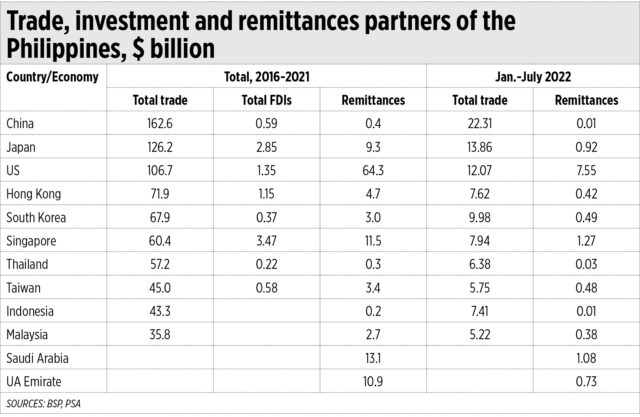
Since the audience was composed of US-based business leaders, Secretary Diokno highlighted the fact that the US is the Philippines’ 3rd largest trade partner (merchandise exports and imports), 3rd largest source of foreign direct investments (FDIs), and main source of remittances by Overseas Filipino Workers (OFWs), professionals, and businessmen. He showed the numbers for 2016-2021. I came up with some numbers for some countries, then updated the data until 2022 (see the table). Data comes from the Bangko Sentral ng Pilipinas (BSP) and the Philippine Statistics Authority (PSA).

One implication of the numbers — given the continued strengthening of the US dollar and sustained depreciation of the peso and many other global currencies — I think is that we need to further diversify our international reserves and international payment system and use less dollars and expand more use of China’s yuan, Japan’s yen, Korea’s won, and the Hong Kong and Singapore dollars.

I am not sure how practical this is, but maybe Philippine hotels, restaurant chains, and other companies can accept those Asian currencies from our Asian visitors and business transactions, then use those currencies when we buy goods and services from them. This way, many of our trade, investment, and remittance payments can be shielded from the continued strong US dollar and continued peso depreciation.

UPSE HOMECOMING 2022
The UP School of Economics (UPSE) annually holds an alumni homecoming, led by the UPSE Alumni Association (UPSEAA). After two years of COVID-19 lockdown, Homecoming 2022 — dubbed as BTS (Balik Tayo sa SE) — was held last Saturday, Sept. 24, at the school auditorium. It was sponsored by the Silver Jubilarians, batch 1997, and Golden Jubilarians 1972.

The first part of the day featured the launching of the coffee table book, More Than: The UP School of Economics, edited by eight alumni led by Professor Oggie Arcenas. Former Dean Emmanuel de Dios gave a warm description of the book and the people featured there, former Professor Winnie Monsod gave a very inspirational talk that walked the audience from the 1960s to the present, and the various alumni who joined the government and corporate world. Her talk can be summarized as: “UPSE DNA is Honor and Excellence.” Both De Dios and Monsod were my teachers in the 1980s.

More Than contains many photos of students, faculty, and alumni. Among the prominent alumni of UPSE who served in government are:

A. Former officials: President Gloria Macapagal Arroyo (PhD 1985), Vice-President Leni Robredo (BS 1986), Supreme Court Chief Justice Lourdes Sereno (MA 1992), Ombudsman Conchita Morales (AB 1964), Executive Secretary Oscar Orbos (AB 1971), Trade and Industry Secretary Ramon Lopez (AB 1981), Tourism Secretary Bernadette Puyat (BS 1990), Bangko Sentral ng Pilipinas (BSP) Governor Nestor Espenilla (BS 1981), BSP Deputy Governor Diwa Guinigundo (AB 1976), Finance Under Secretary Romy Bernardo (BS 1974), Pag-IBIG Fund CEO Zorayda Alonzo (AB 1966), Napocor President Gladys Sta. Rita (AB 1984), and Comelec Commissioner Rowena Guanzon (AB 1979).

B. Former National Economic and Development Authority (NEDA) Secretaries: Gerardo Sicat (AB, MA 1958), Solita Monsod (AB 1959), Cayetano Paderanga and Ernesto Pernia (former faculty members), Dante Canlas (MA 1974), Emmanuel Esguerra (AB, MA 1981), Karl Chua (MA, PhD 2005), former  Undersecretaries Ruperto Alonzo (MA 1969) and Rolly Tungpalan (AB 1978), and many more.

C. Legislators in the 18th Congress, July 2019-June 2022: Senators Pia Cayetano (AB 1985) and Nancy Binay (BS Econ first two years), and Representatives Isagani Amatong (AB 1964), Peter Calderon (BS 1981), Jose “Kit” Belmonte (AB 1998), Roman Romulo (BS 1990), Stella Quimbo (BS, MA, PhD 2000), Bernadette Herrera-Dy (BS 1997), and Cyrille Zaldivar (BS 1999).

D. Current officials, Marcos Jr. administration: Finance Secretary Benjamin Diokno (MA 1974), he was also a former Budget and Management Secretary and former BSP Governor; NEDA Secretary Arsenio Balisacan (former faculty and dean), DBM Secretary Amenah Pangandaman (MDE 1999), and BSP Governor Felipe Medalla (MA 1976), he was also a former NEDA Secretary.

After the book launch, the homecoming program started. Key personalities of Batch 1997 include Edu Niala as batch convenor and Program MC, Ms. Herrera-Dy who elaborately and warmly introduced the keynote speaker, and Justice Undersecretary Nicky Ty who gave the closing remarks.

Keynote Speaker was Ms. Quimbo who is now in her second term as Representative of Marikina’s 2nd Congressional District and Vice-Chairperson of the powerful House Committee on Appropriations. She gave a partly written, partly extemporaneous, mind-tickling and humorous speech that elicited wide smiles and laughter from the audience. She particularly mentioned the UPSEAA Viber group and its dynamic exchanges, and later mentioned me and my occasional wild ideas — thanks Congresswoman Stella.

Jeffrey Ng — UPSEAA President and a big donor to many of the association’s fund-raising activities, and president of Cathay Land, Cathay Metal, and Astoria Resorts and Hotels — gave a report of the association’s major activities, scholarship grants, community service work, financial condition, and much more.

Batch 1997 performed a group song number while Batch 1972 gave a fast-paced dance number with mini-fireworks and brought the house down in admiration and appreciation. There was lots of food, lots of raffle prizes courtesy of many corporate sponsors, and a live band and professional events organizer. Really fantastic and successful homecoming event. Thank you, batches 1997 and 1972, and thank you UPSEAA.

TRANSPORTATION LIBERALIZATION AND MOTORCYCLE TAXIS
During the PEB in New York, one video showed Transportation Secretary Jaime Bautista saying that his department will launch “programs that will provide our passengers with accessible, affordable, convenient and safe public transportation.”

In the panel of the infrastructure team, Secretary Bautista discussed the six big railway projects — mostly under Public-Private Partnerships (PPP) — that are being facilitated by his department. These are good projects, they will transport hundreds of thousands of passengers daily. But most passengers do not live near train stations, they live many kilometers away from the stations and they cannot drive by car or motorbike to the stations because there are no parking spaces in those stations. They must take public transport and the cheapest would be the motorcycle taxis (MCT).

Currently there is a virtual MCT duopoly by Angkas and Joyride. A third and small player, Move It, has partnered with Grab and allies of the duopoly have launched their opposition to the partnership. These groups claim to be pro-commuter, but commuters and passengers are more interested in having more choices, more options, more competition. By limiting the competition to the virtual duopoly, commuters are penalized with less choices. There should be three, four, or five major competing players in the market and not just two.

WTA REGIONAL FORUM, ATLAS LIBERTY FORUM
This coming Wednesday, Sept. 28, the World Taxpayers Association (WTA) will hold the Asia Regional Taxpayers Forum online. It was supposed to be a face-to-face meeting and forum but was changed to a virtual meeting.

Among the speakers at the event will be John O’Connel, Chair and President of WTA. John is a young dynamic leader who used to head the Tax Payers Alliance (TPA) in the UK. Former Presidents of WTA were Bjorn Tarras-Wahlberg of the Swedish Taxpayers Alliance, and Troy Lanigan of the Canadian Taxpayers Federation.

The other speakers in the Asia regional forum will be: Liu Fengjiang of the Chinese Taxpayers Association Alliance, Raymond Ho of Hong Kong Momentum 107, Gobinda Sharma of the Nepal Taxpayers Welfare Society, Raza Ullah of the Alternate Solutions Institute (Pakistan), and this writer.

Then on Sept. 29-30, the Asia Liberty Forum will be held at Shangri-La The Fort, sponsored by the Atlas Network (US) and the Foundation for Economic Freedom (FEF). Among the speakers there are several friends from FEF like Romy Bernardo and Dindo Manhit, Basanta Adhikari of Bikalpa in Nepal, Anthea Haryoko of CIPS in Indonesia, Simon Lee of Unsubject Me and formerly with Lion Rock Institute, Hong Kong, Ali Salman of PRIME Institute in Pakistan, and Adinda Muchtar of The Indonesian Institute.

I miss old friends like Wan Saiful Wan Jan of IDEAS-Malaysia, Barun Mitra of the Liberty Institute-India, Parth Shah of CSC-India, Andrew Work and Peter Wong of LRI-HK, Xingyuan Feng of CASS-China.


Bienvenido S. Oplas, Jr. is the president of Minimal Government Thinkers.

minimalgovernment@gmail.com

Iran protests Western stance on mass protests over woman’s death

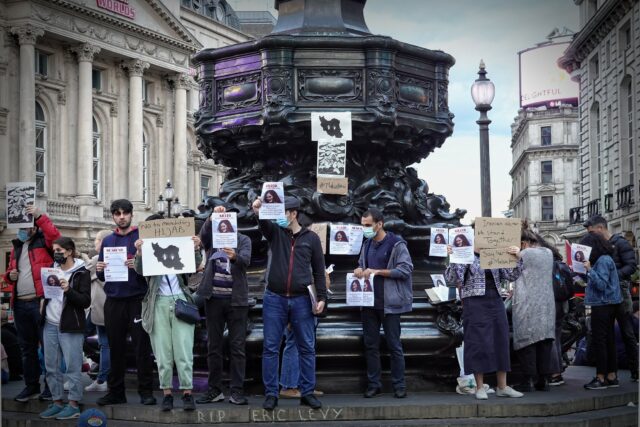
A protest in London against mandatory hijab in Iran. — Flickr | https://bit.ly/3UDjoU0

DUBAI — Iran summoned the British and Norwegian ambassadors over what it called interference and hostile media coverage of the nationwide unrest triggered by the death of a woman detained by morality police.

Foreign Minister Hossein Amirabdollahian also criticized US support for “rioters” — the label Tehran has used for many who have joined the protests which have swept the country, prompting a security crackdown and curbs on internet and phones.

Demonstrations which erupted more than a week ago at the funeral of a 22-year-old Kurdish woman named Mahsa Amini, who died in detention after being arrested by police enforcing the Islamic Republic’s strict restrictions on women’s dress, have turned into the biggest protests in years.

Clashes continued between security forces and protesters in several northwestern regions, according to sources in the cities of Tabriz, Urmia, Rasht and Hamedan. Activists said there were also protests in districts of the capital, Tehran.

A main teachers union, in a statement posted on social media on Sunday, called for teachers and students to stage the first national strike since the unrest began, on Monday and Wednesday.

It urged teachers, trade unions, military veterans and artists to “stand with pupils, students and people seeking justice in these difficult but hopeful days.”

Details of casualties have trickled out slowly, partly because of the restrictions on communication.

The sister of a 20-year-old woman identified as Hadis Najafi told a US-based activist that she died on Wednesday after being shot by security forces. Videos of Najafi had been shared on Twitter, showing her without hijab and protesting in Karaj, 30 kilometers northwest of Tehran.

European Union foreign policy chief Josep Borrell said Iran should “immediately stop the violent crackdown on protests and ensure internet access.” He also called for information on the number of people killed and arrested, and an investigation into “the killing of Mahsa Amini.”

President Ebrahim Raisi has said Iran ensures freedom of expression and that he has ordered an investigation into Amini’s death. He also said that “acts of chaos” were unacceptable and that Iran must deal decisively with the unrest. At the United Nations, he said extensive coverage of Amini’s case was “double standards,” pointing to deaths in US police custody.

ENVOYS SUMMONED
Mr. Amirabdollahian said the United States was supporting “rioters” and seeking to destabilize Iran, a stance he said contradicted American calls for stability in the region and for a nuclear deal with Tehran.

Iran’s Foreign Ministry summoned Britain’s ambassador in response to the “hostile character” of London-based Persian language media. Britain’s foreign ministry said it championed media freedom and condemned Iran’s “crackdown on protesters, journalists and internet freedom.”

Norway’s envoy was also summoned to explain the “interventionist stance” of its parliament speaker Masud Gharahkhani, who has expressed support for the protesters.

Mr. Gharahkhani, who was born in Tehran, continued to speak out on Sunday, writing on Twitter: “If my parents had not made the choice to flee in 1987, I would have been one of those fighting in the streets with my life on the line.”

Amini’s death has reignited anger in Iran over issues including restrictions on personal freedoms, the strict dress codes for women and an economy reeling from sanctions.

Women have played a prominent role in the protests, waving and burning their veils. Some have publicly cut their hair as furious crowds called for the downfall of Supreme Leader Ayatollah Ali Khamenei.

The protests are the largest to sweep the country since demonstrations over fuel prices in 2019, when Reuters reported 1,500 people were killed in a crackdown on protesters — the bloodiest bout of internal unrest in the Islamic Republic’s history.

PROTEST VIDEOS
Iranian Oscar-winning director Asghar Farhadi called on activists and artists around the world to support the protesters, who he said were “looking for simple and yet fundamental rights that the state has denied them for years.”

“I deeply respect their struggle for freedom and the right to choose their own destiny despite all the brutality they are subjected to,” Mr. Farhadi said in a post on Instagram.

Iran’s state television said 41 people have been killed since the protests broke out following Amini’s death on Sept 16. The semi-official Mehr news agency said on Sunday eight members of the Basij, a militia under the umbrella of the Revolutionary Guards, were among the dead.

State media said 12 bank branches were destroyed in the unrest in recent days, and 219 ATMs have been damaged.

The Iranian human rights group Hengaw posted a video on Twitter purportedly showing protests late on Sunday in Sanandaj, the capital of Kurdistan province, with chants of “Death to Khamenei.”

Activist Twitter account 1500tasvir posted videos it said showed protests on Sunday in western and eastern districts of Tehran. In one a protester could be heard saying: “They (security forces) won’t get the better of us. People, I beg you to join us.” Reuters could not verify the footage.

Iranian television showed thousands of people rallying in Tehran on Sunday in support of authorities and chanting slogans against the United States and opposition groups they accused of insulting the Koran.

“Sedition is the cause of riots and is directed by America,” they chanted. — Reuters

Ukraine says referendum voting under Russian-backed security

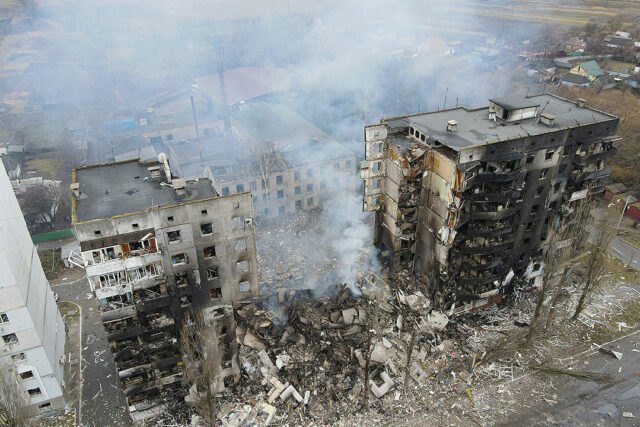
KYIV — Voting in referendums in Ukraine aimed at annexing territory to Russia entered a fourth day on Monday, after the United States warned of “catastrophic consequences” if Moscow used nuclear weapons to protect any annexed regions.

The votes in four eastern Ukrainian regions, which Kyiv and the West regard as a sham, saw Russian-backed officials carry ballot boxes from door to door, accompanied by security officials, said Luhansk’s regional governor.

Serhiy Gaidai said residents’ names were taken down if they failed to vote correctly or refused to cast a ballot.

“A woman walks down the street with what looks like a karaoke microphone telling everyone to take part in the referendum,” the governor added in an interview posted online.

“Representatives of the occupation forces are going from apartment to apartment with ballot boxes. This is a secret ballot, right?”

Russian forces control territory in the four regions that represents about 15% of Ukraine, or roughly the size of Portugal. It would add to Crimea, an area nearly the size of Belgium, that Russia claims to have annexed in 2014.

Russia’s parliament could move to formalize the annexations within days.

By incorporating the areas of Luhansk, Donetsk, Kherson and Zaporizhzhia into Russia, Moscow could portray efforts to retake them as attacks on Russia itself, a warning to Kyiv and its Western allies.

US National Security Adviser Jake Sullivan said the United States would respond to any Russian use of nuclear weapons against Ukraine and had spelled out to Moscow the “catastrophic consequences” it would face.

“If Russia crosses this line, there will be catastrophic consequences for Russia,” Mr. Sullivan told NBC’s Meet the Press television program on Sunday.

“The United States will respond decisively.”

The latest US warning followed Wednesday’s thinly veiled nuclear threat by President Vladimir Putin, who said Russia would use any weapons to defend its territory.

Foreign Minister Sergei Lavrov made the point more directly at a news conference on Saturday.

He was speaking after a speech to the UN General Assembly in New York, in which he repeated Moscow’s false claims to justify the invasion that the elected government in Kyiv was illegitimately installed and filled with neo-Nazis.

Asked if Russia would have grounds for using nuclear weapons to defend annexed regions, Mr. Lavrov said Russian territory, including that “further enshrined” in Russia’s constitution in the future, was under the “full protection of the state.”

In an interview broadcast on Sunday, British Prime Minister Liz Truss told CNN, “We should not be listening to his (Putin’s) saber-rattling and his bogus threats.

“Instead, what we need to do is continue to put sanctions on Russia and continue to support the Ukrainians.”

FIGHTING
Heavy fighting saw more than 40 towns hit by Russian shelling, Ukraine officials said on Monday.

In the 24 hours to Monday morning, Russian forces launched five missile and 12 air strikes, as well as more than 83 attacks from multiple rocket-propelled grenades, the general staff of Ukraine’s armed forces said.

More than 40 settlements in all were affected by enemy fire, mostly in southern and southeast Ukraine.

Two drones launched by Russian forces into Ukraine’s Odesa region hit military objects, causing a fire and setting off ammunition, Ukraine’s southern command said on Monday.

“As a result of a large-scale fire and the detonation of ammunition, the evacuation of the civilian population was organized,” it said on messaging app Telegram.

“Preliminarily, there have been no casualties.”

Countering Russian attacks, Ukraine’s air forces launched 33 strikes, hitting 25 “enemy” areas, the general staff added.

Reuters could not independently verify the accounts.

PROTESTS IN RUSSIA OVER DRAFT
On Wednesday, Mr. Putin ordered Russia’s first military mobilization since World War II, unleashing protests across Russia and sending many men of military age fleeing.

On Sunday, two of Russia’s most senior lawmakers tackled a string of mobilization complaints, ordering regional officials to swiftly solve “excesses” that stoked public anger.

More than 2,000 people have been detained across Russia for protests at the draft, says independent monitoring group OVD-Info. With criticism of the conflict banned, the demonstrations were among the first signs of discontent since the war began.

In Russia’s Muslim-majority southern region of Dagestan, police clashed with protesters, leading to the detention of at least 100 people.

Ukrainian President Volodymyr Zelensky acknowledged the Russian protests in a Sunday video address.

“Keep on fighting so that your children will not be sent to their deaths — all those that can be drafted by this criminal Russian mobilization,” he said.

“Because if you come to take away the lives of our children — and I am saying this as a father — we will not let you get away alive.” — Reuters

GCash mobilizes #GCashForGood drive for communities affected by Typhoon Karding

The Filipino spirit of giving remains in full force as people prepare for Typhoon Karding which is moving towards the Philippine Area of Responsibility. Signal no. 3 is forecasted for selected areas in Luzon.

In this light, GCash mobilizes its #GCashForGood donation drive to help raise funds for the relief and recovery operations in areas that will need it the most after the typhoon.

“In times of crisis, it’s vital for us to come together and extend help to those affected by Typhoon Karding. Gcash is one with government agencies and various organizations in heightening relief efforts to ensure that we can lend assistance to as many of our kababayans as possible,” said Winsley Bangit, Chief Customer officer of GCash.

#GCashForGood is now accepting donations starting September 25, 2022 via its #GCashGivesBack Pay Bill wallet and Quick Response Code (QR Code). To send funds for the typhoon victims, GCash users can click “Pay Bills” on the GCash app, tap “Others”, click the “#GCashGivesBack and type your information and click “Confirm”. The donations collected through these channels will be equally disbursed to the partner Non-Governmental Organizations (NGOs) delivering immediate relief assistance to the affected communities.

GCash partners include Caritas Manila, United Nations Children’s Fund (UNICEF), Philippine Red Cross, ABS-CBN Lingkod Kapamilya, Ayala Foundation, GMA Kapuso Foundation, Save the Children and World Vision.

All these efforts form part of GCash’s One With the Nation Corporate Social Responsibility program which highlights the important role of private and public sector cooperation in providing aid to areas that have been affected by natural calamities.

GCash can be downloaded for free on the Google Play or App Store.


Spotlight is BusinessWorld’s sponsored section that allows advertisers to amplify their brand and connect with BusinessWorld’s audience by enabling them to publish their stories directly on the BusinessWorld Web site. For more information, send an email to online@bworldonline.com.

Join us on Viber to get more updates from BusinessWorld: https://bit.ly/3hv6bLA.

US warns of catastrophic consequences if Russia uses nuclear weapons in Ukraine

REUTERS

KYIV — The United States warned on Sunday of “catastrophic consequences” if Moscow uses nuclear weapons in Ukraine, after Russia’s foreign minister said regions holding widely-criticized referendums would get full protection if annexed by Moscow.  

Votes were staged for a third day in four eastern Ukrainian regions, aimed at annexing territory Russia has taken by force. The Russian parliament could move to formalize the annexation within days.  

By incorporating the areas of Luhansk, Donetsk, Kherson, and Zaporizhzhia into Russia, Moscow could portray efforts to retake them as attacks on Russia itself, a warning to Kyiv and its Western allies. 

US National Security Adviser Jake Sullivan said the United States would respond to any Russian use of nuclear weapons against Ukraine and had spelled out to Moscow the “catastrophic consequences” it would face. 

“If Russia crosses this line, there will be catastrophic consequences for Russia,” Mr. Sullivan told NBC’s “Meet the Press” television program. “The United States will respond decisively.”  

The latest US warning followed a thinly veiled nuclear threat made on Wednesday by President Vladimir Putin, who said Russia would use any weapons to defend its territory.  

Foreign Minister Sergei Lavrov made the point more directly at a news conference on Saturday after a speech to the UN General Assembly in New York in which he repeated Moscow’s false claims to justify the invasion that the elected government in Kyiv was illegitimately installed and filled with neo-Nazis.  

Asked if Russia would have grounds for using nuclear weapons to defend annexed regions, Mr. Lavrov said Russian territory, including territory “further enshrined” in Russia’s constitution in the future, was under the “full protection of the state.” 

British Prime Minister Liz Truss said Britain and its allies should not heed threats from Putin, who had made what she called a strategic mistake as he had not anticipated the strength of reaction from the West.  

“We should not be listening to his saber-rattling and his bogus threats,” Ms. Truss told CNN in an interview broadcast on Sunday. “Instead, what we need to do is continue to put sanctions on Russia and continue to support the Ukrainians.”  

‘BOGUS THREATS’
Ukraine and its allies have dismissed the referendums as a sham designed to justify an escalation of the war and a mobilization drive by Moscow after recent battlefield losses. 

Russian news agencies quoted unidentified sources as saying the Russian parliament could debate bills to incorporate the new territories as soon as Thursday. State-run RIA Novosti said Putin could address parliament on Friday.  

Russia says the referendums, hastily organized after Ukraine recaptured territory in a counteroffensive this month, enable people in those regions to express their view.  

Luhansk’s regional governor said Russian-backed officials were going door to door with ballot boxes and if residents failed to vote correctly their names were taken down.  

“A woman walks down the street with what looks like a karaoke microphone telling everyone to take part in the referendum,” Luhansk governor Serhiy Gaidai said in an interview posted online.  

“Representatives of the occupation forces are going from apartment to apartment with ballot boxes. This is a secret ballot, right?”  

The territory controlled by Russian forces in the four regions represents about 15% of Ukraine, of roughly the size of Portugal. It would add to Crimea, an area nearly the size of Belgium that Russia claims to have annexed in 2014.  

Ukrainian forces still control some territory in each region, including about 40% of Donetsk and Zaporizhzhia’s provincial capital. Heavy fighting continued along the entire front, especially in northern Donetsk and in Kherson. 

President Volodymyr Zelenskyy, who insists that Ukraine will regain all its territory, said on Sunday some of the clashes had yielded “positive results” for Kyiv.  

“This is the Donetsk region, this is our Kharkiv region. This is the Kherson region, and also the Mykolaiv and Zaporizhzhia regions,” he said in nightly video remarks.  

In a statement on Facebook, the general staff of the Ukrainian armed forces said Russia had launched four missile and seven air strikes and 24 instances of shelling on targets in Ukraine in the past 24 hours, hitting dozens of towns, including some in and around the Donetsk and Kherson regions.  

Reuters could not independently verify the accounts.  

PROTESTS IN RUSSIA OVER DRAFT
On Wednesday, Mr. Putin ordered Russia’s first military mobilization since World War Two. The move triggered protests across Russia and sent many men of military age fleeing.  

Two of Russia’s most senior lawmakers tackled on Sunday a string of mobilization complaints, ordering regional officials to swiftly solve “excesses” stoking public anger. 

More than 2,000 people have been detained across Russia for draft protests, says independent monitoring group OVD-Info. In Russia, where criticism of the conflict is banned, the demonstrations are among the first signs of discontent since the war began.  

In the Muslim-majority southern Russian region of Dagestan, police clashed with protesters, with at least 100 people detained. 

Mr. Zelenskyy acknowledged the protests in his video address. 

“Keep on fighting so that your children will not be sent to their deaths – all those that can be drafted by this criminal Russian mobilization,” he said. “Because if you come to take away the lives of our children — and I am saying this as a father — we will not let you get away alive.” — Reuters

S. Korea’s Yoon says ‘untrue’ media reports damage alliance amid hot mic controversy

South Korean President Yoon Suk-yeol. — REUTERS

SEOUL — South Korean President Yoon Suk-yeol said on Monday “untrue” media reports over his remarks threatened to damage relations with the United States after he was caught cursing on a hot mic during his visit to New York last week. 

A series of gaffes and controversies overshadowed Mr. Yoon’s first major overseas tour which also included Britain and Canada, sending his ratings plunging and inviting scathing criticism from some lawmakers even within his own party. 

In the highest profile controversy, Mr. Yoon was caught cursing on a hot mic as he left an event in New York on Wednesday after a brief chat with US President Joseph R. Biden, Jr. 

Opposition lawmakers accused Mr. Yoon of insulting Mr. Biden and disgracing South Korea as local media initially reported Mr. Yoon was saying Mr. Biden would be embarrassed if the US Congress did not pass a bill relating to funding of a global initiative. 

“What an embarrassment … if these bastards refuse to approve it in parliament,” Mr. Yoon told Foreign Minister Park Jin in a video aired by South Korean broadcasters, which went viral on social media. 

Reuters could not independently verify Mr. Yoon’s full comments. 

His press secretary, Kim Eun-hye, dismissed the allegations, saying Mr. Yoon was referring to the South Korean parliament without mentioning Mr. Biden. 

“Well, rather than a controversy, I will say this: Except for one or two or three superpowers in the world, no country can fully protect the lives and safety of its people with its own capabilities,” Mr. Yoon told reporters when asked about the hot mic incident on Monday. 

“I’d like to say that damaging the alliance with reports that are different from the facts puts the people at great risk,” he added, calling for efforts to establish facts. 

The main opposition Democratic Party has been urging Mr. Yoon to apologize for the controversy and sack his national security advisor, his deputy and the foreign minister. 

The opposition floor leader said it would propose a resolution for their dismissal to parliament if Mr. Yoon does not take action on Monday. 

Mr. Yoon’s office declined to comment. — Reuters

Pound plunges to all-time low in scathing appraisal of fiscal plan

STOCK PHOTO | Image by Stefan Schweihofer from Pixabay

TOKYO — The British pound tumbled nearly 5% to an all-time low on Monday as investors ran for the exits after the new government’s fiscal plan threatened to stretch Britain’s finances to their limits.  

The currency dived as much as 4.85% to an unprecedented $1.0327, extending a 3.61% dive from Friday, when finance minister Kwasi Kwarteng unleashed historic tax cuts, and the biggest increase in borrowing since 1972 to pay for them.  

Economists and investors said Prime Minister Liz Truss’s government, in power for less than three weeks, was losing financial credibility in unveiling such a plan just a day after the Bank of England (BOE) hiked interest rates to contain surging inflation.  

The pound was last down 2.7% at $1.0560.  

Marc Chandler, chief market strategist at Bannockburn Global Forex, called the currency’s record plunge “incredible.”  

“The weekend press tarred and feathered sterling with assertions of its emerging-market status,” he said. “I don’t buy that schadenfreude. Still, there is now bound to be speculation of an emergency BOE meeting and rate hike.”  

Mr. Kwarteng’s announcement marked a step change in British financial policy, harking back to the Thatcherite and Reaganomics doctrines of the 1980s that critics have derided as a return to “trickle down” economics.  

The so-called mini budget is designed to snap the economy out of a period of double-digit inflation driven by surging energy prices and a 15-year run of stagnant real wage growth.  

In total, the plans will require an extra 72 billion pounds of government borrowing over the next six months alone.  

British government bond yields surged by the most in a day in more than three decades on Friday, with yields on the five-year gilt — one of the most sensitive to any near-term shift in interest rate or borrowing expectations — up by half a percentage point.  

“When we see those gilt markets open a little later on, we’re probably going to see a pretty sharp spike,” said Chris Weston, head of research at Melbourne-based brokerage Pepperstone.  

“In this environment, you either need to see much higher growth — which isn’t happening at the moment — or you need to see significantly higher bond yields to incentivize capital inflows. To get bond yields up to those levels, you need to see the Bank of England coming out and doing an emergency hike.” — Reuters