Home Blog Page 5398

PLDT group, partner tech firms move to boost cybersecurity

THE PLDT group said it is working closely with more than 20 partner technology companies to strengthen cybersecurity and protect customers from cyberattacks.

The Cyber Security Operations Group (CSOG) of PLDT Inc. and its wireless arm Smart Communications, Inc. recently met with third-party vendors and service providers to discuss how to further secure the group’s cybersecurity drive, the group said in an e-mailed statement on Saturday.

The group said that representatives from more than 20 contracted companies attended the gathering.

“Third-party vendors play a key role in the PLDT group’s cybersecurity infrastructure. They provide PLDT and Smart with critical products and services that help the group monitor its assets, warn against attacks, contain threats, secure data, and enable the companies to deliver innovations that serve customer needs,” the PLDT group noted.

Angel T. Redoble, first vice-president and chief information security officer of PLDT and Smart, stressed the need for rapid action once an alarm has been triggered.

“It is important that within two minutes, the incident is contained. We need to have an established process with our vendors, so we can quickly respond to cyber-attacks and prevent a crisis,” he said.

“The chain is only as strong as its weakest link. To eliminate any weakness in our value chain, we are closely collaborating with our technology partners to make sure that everyone is on board our cybersecurity culture,” he also said.

According to the group, its CSOG foiled more than 182 million attacks and breach attempts against its assets last year.

The group also said that its collaboration with key partners is part of a broader effort to elevate the Filipinos’ experience by keeping customers and the country safe from threats and attacks.

“These initiatives highlight the group’s commitment to the United Nations Sustainable Development Goals,” it noted.

Hastings Holdings, Inc., a unit of PLDT Beneficial Trust Fund subsidiary MediaQuest Holdings, Inc., has a majority stake in BusinessWorld through the Philippine Star Group, which it controls. — Arjay L. Balinbin

Isuzu on ‘wait-and-see’ mode over bringing in electric vehicles

ISUZU Philippines Corp. is taking a “wait-and-see” stance on introducing electric vehicles (EVs) into the local market, a company official said, citing factors such as support infrastructure and regulation.

Isuzu Philippines Assistant Division Head for Sales Robert D. Carlos said the company is supportive of EVs being launched in the country but wishes to see further developments that will help increase consumer adoption such as the installation of more charging stations.

“We support EVs. But for now, we are observing. We are ‘wait-and-see’ for now. Creating a law is one thing. Implementation is another thing. We need to see if there is infrastructure being laid out, like the charging stations,” Mr. Carlos said on the sidelines of a company event in Manila City last week.

According to Mr. Carlos, Isuzu Philippines has been receiving inquiries from customers on EVs, particularly in the truck segment.

“For our clients, there are inquiries for trucks,” Mr. Carlos said, adding that no figures are involved in the queries. “They are just asking if there are any plans for EVs in case the government really imposes and they are forced to get EVs for trucks.”

Mr. Carlos disclosed that the automaker is already preparing for EVs and its introduction to the Philippine market.

“Isuzu is already preparing for EVs. The implementation in the Philippines is just the question. We want to check that the Philippines is ready for EVs. Not only infrastructure but government support as well like incentives and tax,” Mr. Carlos said.

Mr. Carlos said this as President Ferdinand R. Marcos, Jr. signed Executive Order (EO) No. 12 on Jan. 13, which temporarily reduced the most favored nation tariff rates on completely built-up units of imported EVs and imported parts and components for five years.

The EO imposes zero tariff for imported EVs across segments such as passenger cars, buses, minibuses, vans, trucks, motorcycles, tricycles, scooters and bicycles for five years. However, the EO excluded hybrid-type EVs.

The EO also reduced the tariff on certain imported EV parts and components to one percent from five percent for five years.

The law is expected to complement Republic Act No. 11697 or the EV Industry Development Act (EVIDA), which mandates the government and companies to meet a 5% quota on their vehicle fleets.

In a separate statement, Electric Vehicle Association of the Philippines (EVAP) President Edmund A. Araga said that EO 12 would help boost the local adoption of EVs.

“Finally, our EV industry will totally roll out in line with EO 12 as it opens a very good opportunity for those interested EV enthusiasts and advocates to own one. Consumers will experience [a] wide array of models to choose from depending on their preferences,” Mr. Araga said.

“This (EO) will pave [the] way on supporting the EVIDA law, which makes the industry a promising one,” he added.

Separately, EVAP Chairman and Philippine Parts Maker Association President Ferdinand I. Raquelsantos said that the temporary tariff reduction is expected to “generally” lower the prices of passenger car EVs by 20%.

“With this exemption on tariff, the prices of passenger car EVs will generally be reduced by 20%, making it very competitive to internal combustion engine-powered vehicles,” Mr. Raquelsantos told BusinessWorld in a Viber message.

“EVs will become more affordable and its proliferation will be much wider,” he added. — Revin Mikhael D. Ochave

Pilipinas Shell targets up to 60 stations in 2023

PILIPINAS Shell Petroleum Corp. is targeting to put up between 40 and 60 new service stations each year until 2025, its top official said last week.

“For our stations, we have over 1,100 stations at the end of mid-last year and we will continue to grow that by 40 to 60 sites year on year until 2025,” Pilipinas Shell Petroleum President Lorelie Q. Osial told reporters.

To achieve its target expansion, Ms. Osial said the company is planning to have five import-range terminals, with its fifth terminal expected to be put up this year.

“We have committed to having five import-range terminals, we broke ground for the fourth one last year and we are looking forward to announce the fifth one. We will announce it in 2023,” she said.

Ms. Osial said the investment cost for the target expansion would be “a lot” but declined to disclose specific figures.

“[What] I can only disclose right now is the 40-60 [service stations]. It’s 40-60 per year until 2025,” she said.

She said the full effect of Russia’s war on Ukraine on the Philippines’ oil prices remains to be seen but described the ongoing conflict as a big disruptor, causing volatility.

“Macroeconomic conditions are still changing. Volatility is determined by market conditions [and] geopolitics. [I] can’t accurately guess the future,” she said.

Meanwhile, Ms. Osial said that the company continues to be interested in the renewable energy (RE) sector.

“You have seen that we also entered the renewable space. We signed joint ventures last year on solar, so we continue to progress,” she said.

According to the group’s website, Shell Overseas Investments B.V. in 2022 partnered with Emerging Power, Inc. in a joint venture that aims to contribute 1 gigawatt (GW) to the country’s energy system by 2028 by using alternative sources of energy.

In November 2022, Shell Overseas partnered with Alternergy Holdings Corp. to assess the feasibility of an offshore wind project in Calavite Passage for a potential capacity of 1 GW.

Aside from renewables, Ms. Osial said that the Shell group, through Shell Energy Philippines Inc., remains interested in the country’s liquefied natural gas (LNG) industry.

Shell Energy Philippines’ LNG project is one of the six LNG terminals approved by the Department of Energy.

Data provided by the department show that the company’s proposed LNG floating storage and regasification unit (FSRU) in Tabangao, Batangas City is targeted to start operating by October 2023.

The terminal project has a capacity of three million tons per annum (MTPA), with a construction cost of around P2.47 billion.

“It is in progress. These are big projects. We are working with different agencies to put it forward and progress it further,” Ms. Osial said. — Ashley Erika O. Jose

The return of the high breed

PHOTO BY KAP MACEDA AGUILA

The pioneering Lexus crossover is back in electrified guises

WHEN MITSUKOSHI, a Japanese retailer with a rich history dating back to 1673, opened shop late last year at the Bonifacio Global City in Taguig, it afforded Filipinos ready access to an aggregation of brands from the Land of the Rising Sun. But beyond fashion, food, and sundry of products and services, Mitsukoshi now also highlights a luxury mobility marque within its walls.

That brand, of course, is Lexus.

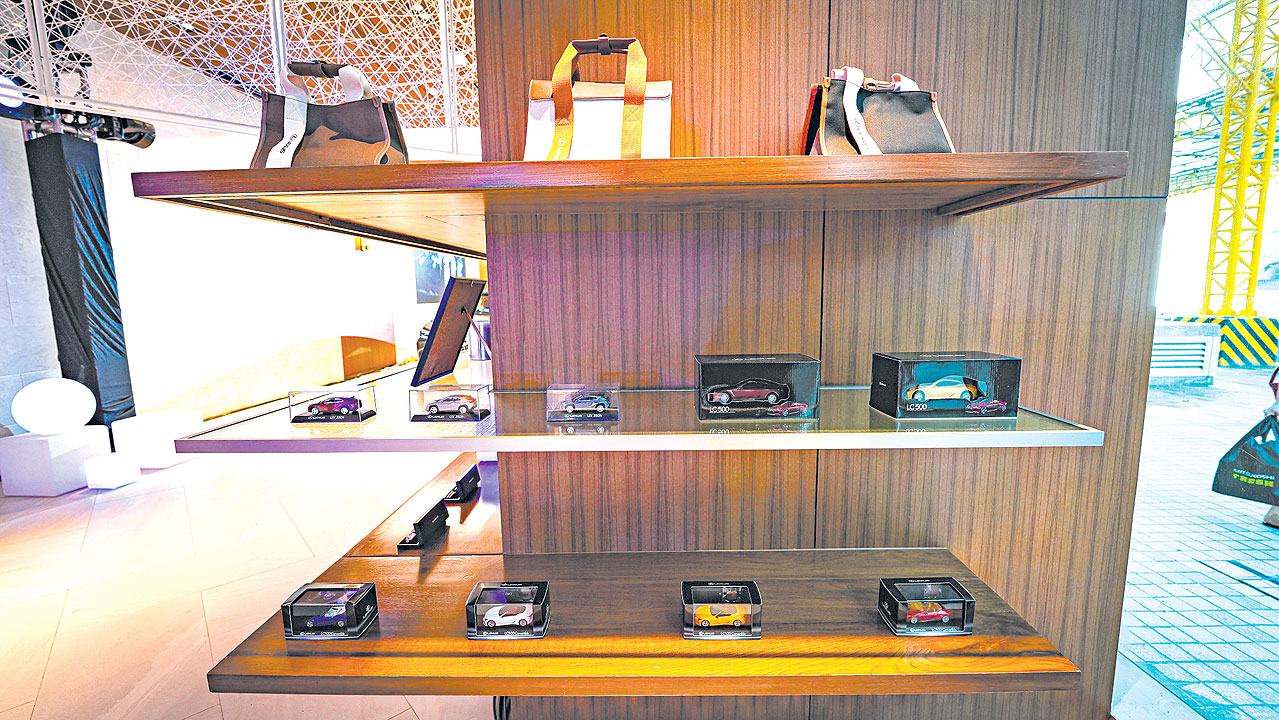
While keeping a solitary dedicated dealership a stone’s throw away, the luxury division of Toyota has now opened what its executives are calling a semi-permanent “brand space.” Simply dubbed Lexus at Mitsukoshi BGC, the 374.52-sq.m. establishment houses everything Lexus — including space for a maximum of three vehicles and shelves for exclusive branded merchandise.

“It’s basically another touchpoint for us,” said Lexus Philippines Brand Manager Jade Sison, who added that it’s also a ready events venue — a perfect site for collaborations with “like-minded brands.” The execution of Lexus at Mitsukoshi is similar to its counterpart in Japan.

However, there are very distinctly Filipino (by way of Cebu) touches in the space said to “further (embody) the seamless combination of the Philippines and Japan.” This is expressed in design touches such as the so-called “Nest Box” overhead and in key locations, which also feature local fiber, and Capiz shells, rattan, and other materials employed in other areas. Columns are wrapped in natural wood.

What visitors and Lexus fans get is a warm, inviting space which also lends itself to meetings and face-to-face interactions. A Rocket machine provides excellent espresso-based drinks.

Significantly, the facility is also touted as the “home of Lexus Electrified” vehicles, “showcasing the brand’s heritage, sensibilities, and design inspirations that symbolize the new Lexus DNA of craftsmanship, and cutting-edge technology.”

Speaking of electrified, there’s no better poster boy for Lexus in the Philippines right now than the all-new, fifth-generation RX. Known to have pioneered the luxury SUV segment in the world when it debuted in 1998, the RX again found itself at the head of the pack when, in 2005, the RX 400h became the industry’s first hybrid luxury SUV.

In the Philippines, the RX will only have electrified variants: RX 350h Executive (P5.058 million), RX 350h Premier (P6.188 million), and RX 500h F Sport (P6.668 million). The bigger picture is something we’ve reported about in “Velocity” — the electrification of their models brings Toyota and Lexus closer to big boss Akio Toyoda’s vision of carbon neutrality. Between the two brands, Lexus is understandably more aggressively championing electrification — as it has throughout the years when it brought (and sold) hybrids here in significant numbers when nobody else was in the space.

Thus, it’s quite interesting to note that just decades ago, the RX was literally fighting to be born. “Honestly, within our company, we weren’t all that convinced (that the RX) was a great idea… Fortunately, the smarter product planners won that argument, and it became very quickly our biggest-selling model,” said Lexus College of Lexus USA Product Education Manager Paul Willamsen with a smile during an interview at the sidelines of last year’s exclusive media drive in the United States of the then yet-to-be launched all-new RX.

This new generation represents a massive evolutionary leap for the model — with innovations in technology, performance, driver assistive systems, and design. Speaking of design, Toyota/Lexus big boss Akio Toyoda himself directed engineers and designers to think of that next big step for the RX. One of those big steps is a so-called Lexus Spindle Body design, which sees the familiar (and sometimes polarizing) Spindle Grille more fluidly blend into the body design.

Versus the outgoing model, the all-new RX measures the same from fore to aft (4,890mm) but boasts a longer wheelbase (+60mm to 2,850mm) – leading to shorter overhangs. It also grows in width by 25mm to 1,920mm and gets squatter by 10mm (1,695mm).

Through a planted stance and “sleeker front-to-rear posture,” Lexus wanted to evoke heightened driving performance in the RX — which it wields in spades, based on our aforementioned testing in 2022. The signature black rear pillar (or floating roof) has been given a more three-dimensional in appearance, and the vehicle has been fitted with large 21-inch wheels.

On its front end, the RX gets triple LED headlights and L-shaped daytime running lights; on the rear is an LED light strip, and a spelled out “LEXUS” badge on the tailgate, which further distinguishes this RX as the most recent iteration.

Lexus designers used what they call a Tazuna cockpit concept “to provide a more focused environment for the driver.” Tazuna is the Japanese word for using reins to control a horse, and in the RX “direct yet intuitive control” is expressed in information sources such as the multimedia screen, multi-information display, single-dial meter, centralized gauges, and head-up display — strategically grouped so that content can be read with minimal eye and head movement. The designers also sought to create a “minimalist, yet intuitive and thoughtful interior space.”

This obviously works in tandem with the Lexus Driving Signature, which is deployed to “provide superior comfort and linear, direct responsiveness, giving all drivers control and confidence at all times.” The all-new RX rides on the Lexus GA-K platform, whose rear has been “completely redesigned to extend the wheelbase and accommodate additional cross members and suspension braces that increase rigidity. This increased rigidity has allowed the suspension to be more accurately tuned, improving both performance and comfort.”

For now, the RX will only come with five seats. In a past Q&A session with Lexus RX Chief Engineer Takaaki Ohno, “Velocity” was told, “When we were developing the vehicle, the size of the current model that you see today was considered very important. And that was a starting point (gleaned) through massive feedback from all of our customers. And so, given that, we had to determine what the best setup was to achieve our performance and design-related goals.” He added, “Within that we determined that two-row seating would be the best way to achieve that. So, for now, we proceeded development with only two rows.”

Those opting for the RX 500h F Sport trim will see a different execution of the grille, skirts, and front and rear bumpers. This is also considered to be a “performance-focused turbocharged hybrid,” and comes with Direct4 drive force control. “Lexus has successfully shifted the focus from optimum efficiency to produce a model with a genuine performance edge, raising the RX’s appeal with customers who want high-end electrified performance,” said Lexus Philippines in a release.

The Executive variant, on the other hand, gets a cruelty-free, leather-like interior seat material that does not use animal products — said to have been created in response to a growing demand from vegan and other eco-conscious consumers. On the RX 350h Executive and RX 350h Premier, power delivery is governed by E-Four AWD — the innovative all-wheel-drive system of the brand, which employs a motor at the rear axle for “near-instantaneous” drive force application in low-grip or acceleration scenarios.

Powering the RX 350h, which is positioned as an efficient alternative to lower-displacement diesel and petrol powertrains, is a new 2.5-liter inline-four gas engine which is said to offer better fuel economy, along with reduced weight.

The RX 500h F Sport is fitted with a turbocharged 2.4-liter gas engine and six-speed transmission, integrated front motor and power control unit, hybrid battery and a compact 103ps rear e-axle. Its total system output is 371ps and 550Nm of torque — with a sprightly standstill-to-100kph time of 6.2 seconds.

Lexus said that the all-new RX “benefits from next-level active safety and driver assistance systems featured in the latest generation of Lexus Safety System+ with upgraded functions and increased scope for accident risk detection and prevention. The improvements include further expansion of the Pre-Collision System’s ability to detect motorcycles and other objects in the car’s path.” Even the Adaptive Cruise Control has been upgraded to quickly recognize vehicles cutting in front. With the Lane Trace Assist, the RX can follow a “more natural line” through curves in the road.

“It’s a completely new car — with all-new body shell, all-new platform, and all-new suspension. So it’s thoroughly revised, at the same time very much in character for an RX. You know, the RX has a tremendously loyal fan base, and we wanted to be certain we didn’t disappoint them in any way. It has improved in many ways, and yet, for any longtime RX owner, we think they’ll feel quite comfortable in it,” Mr. Williamsen had said.

Tax court rejects software firm’s refund claim

CTA.JUDICIARY.GOV.PH

THE Court of Tax Appeals has rejected the refund claim of Avaloq Group AG’s Philippine regional headquarters worth P3.2 million representing its excess value-added tax (VAT) traced to zero-rated sales for the first and second quarters of 2017.

In a 23-page decision dated Jan. 9 and made public on Jan. 11, the tax court’s Special Third Division said the firm failed to prove that its sales qualified for a VAT zero rating.

“The petitioner’s sales cannot qualify as subject to 0% VAT under the 1997 National Internal Revenue Code (NIRC) since it was never established that the place of performance of the subject services was in the Philippines to non-resident foreign corporations not engaged in business in the Philippines,” Associate Justice Maria Belen M. Ringpis-Liban said in the ruling.

“It is a claimant’s burden to prove the factual basis of a claim for refund or tax credit.”

Avaloq, the petitioner, is a Swiss firm that provides cloud software to banks worldwide. Its office is based in Makati City and is licensed by the Securities and Exchange Commission.

The firm generated gross receipts in the amount of P53.06 million in 2017 and accumulated input VAT for the first and second quarters worth P3.2 million. It claimed that its services were rendered in the Philippines to non-resident foreign clients and were paid for in accepted foreign currencies.

Under the NIRC, zero-rated sales are sales made by VAT-registered taxpayers that do not translate to any output tax. Receipts must have the term “zero-rated” on them to qualify for a 0% VAT rating.

The tax court agreed with the Bureau of Internal Revenue’s finding that Avaloq failed to provide enough documentation to substantiate its refund claim.

“Although petitioner is the regional operation headquarters of Avaloq Group AG (head office), it is still necessary on its part to prove that its services were performed in the Philippines,” it said.

“In cases filed before this court, party-litigants must prove every minute aspect of their case.” — John Victor D. Ordoñez

The Ertiga Hybrid is Suzuki PHL’s first electrified vehicle

All four variants of the new Suzuki Ertiga will carry a hybrid powertrain. — PHOTO BY KAP MACEDA AGUILA

By Kap Maceda Aguila

SUZUKI PHILIPPINES, INC. (SPH) has formally opened the door to electrified mobility. Last week, the company, led by Director and General Manager for Automobile Norihide Takei, took the wraps off the Ertiga Hybrid.

Notably, all four variants of the updated seven-seater MPV are powered by a 1.5-liter internal combustion engine supplemented by an integrated starter generator (ISG) and 12-volt lithium-ion battery, with the system being called the Smart Hybrid Vehicle by Suzuki (SHVS). This also features the company’s Engine Auto Stop Start System (EASS), which cuts off the engine when the vehicle stops — leading to increased fuel efficiency. When the engine is off, the system draws power from onboard batteries. The ISG then restarts the engine when the throttle is engaged. The ISG is also put to work to aid in acceleration. Meanwhile, when the Ertiga decelerates, the ISG charges the vehicle’s batteries.

The familiar K15B mill musters a maximum of 103hp and 138Nm; the ISG can blurt out an additional 3.1hp and 50Nm. The vehicle runs on 185/65 R15s.

Other new features of the Ertiga Hybrid include a 4.2-inch full-color TFT LCD multi-information display, cruise control, and automatic headlamp with follow-me-home headlamp function.

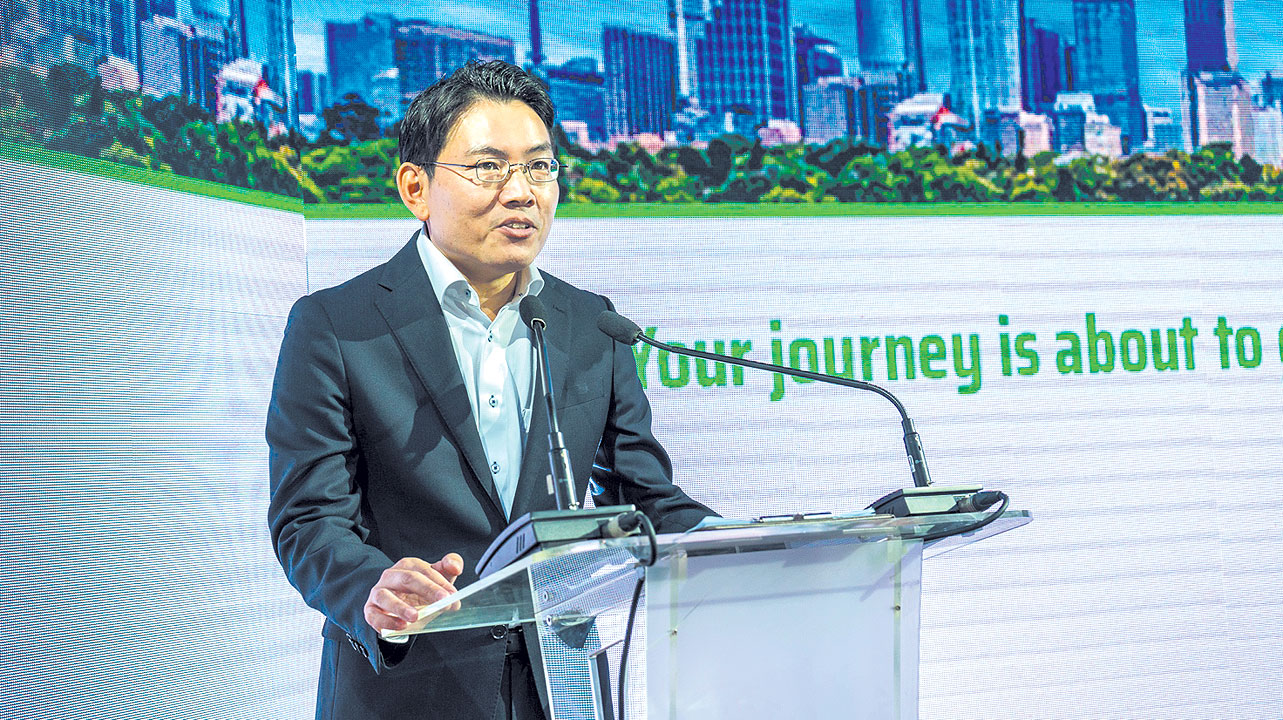
In a statement, Mr. Takei said, “The introduction of the new Ertiga Hybrid marks a great beginning for SPH as we introduce our first hybrid entry in the market. With the Ertiga being our flagship and best-selling model, incorporating the hybrid technology and other benefits that it has, this makes the product a well-packed choice for our customers.”

“The conversations about protecting the environment are getting louder and the pull of sustainability is getting stronger,” added the executive in a speech ahead of the launch of the model.

He described the Ertiga Hybrid as “very practical,” and boasting “self-charging technology.” It is also the first in the local seven-seater MPV segment to banner a hybrid powertrain.

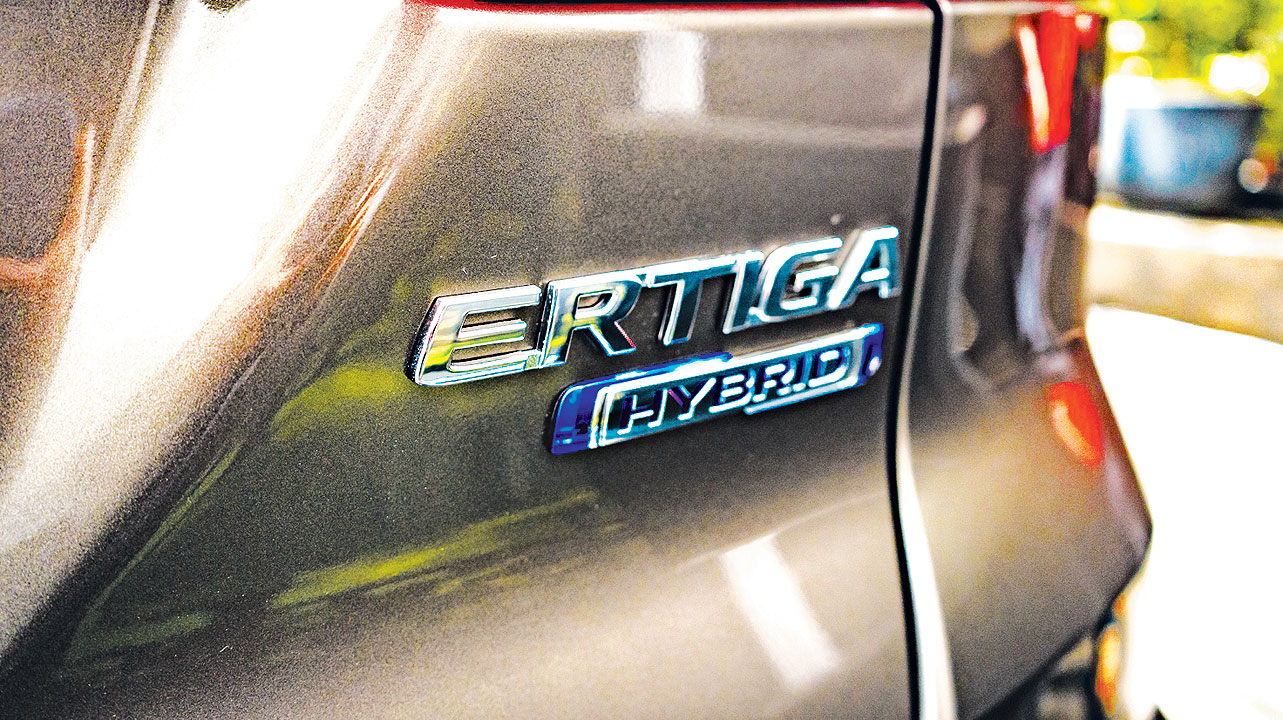
On its exterior, the Ertiga Hybrid exhibits a long shoulder line and aerodynamic roofline. The front fascia is marked by an updated grille, while its tailgate bears chrome accents, along with a Hybrid emblem to distinguish it from its predecessors. Inside, the three-row MPV is said to boast configurability or flexibility to accommodate a mix of people and cargo.

For safety, a two air-bag system, anti-lock brakes with electronic brakeforce distribution, hill-hold control and electronic stability program (ESP) are provided to the vehicle. In addition, the familiar Suzuki TECT (Total Effective Control Technology) and new Heartect platform which make the body light and rigid — effectively absorbing impact in case of a collision, and improving overall driving dynamics.

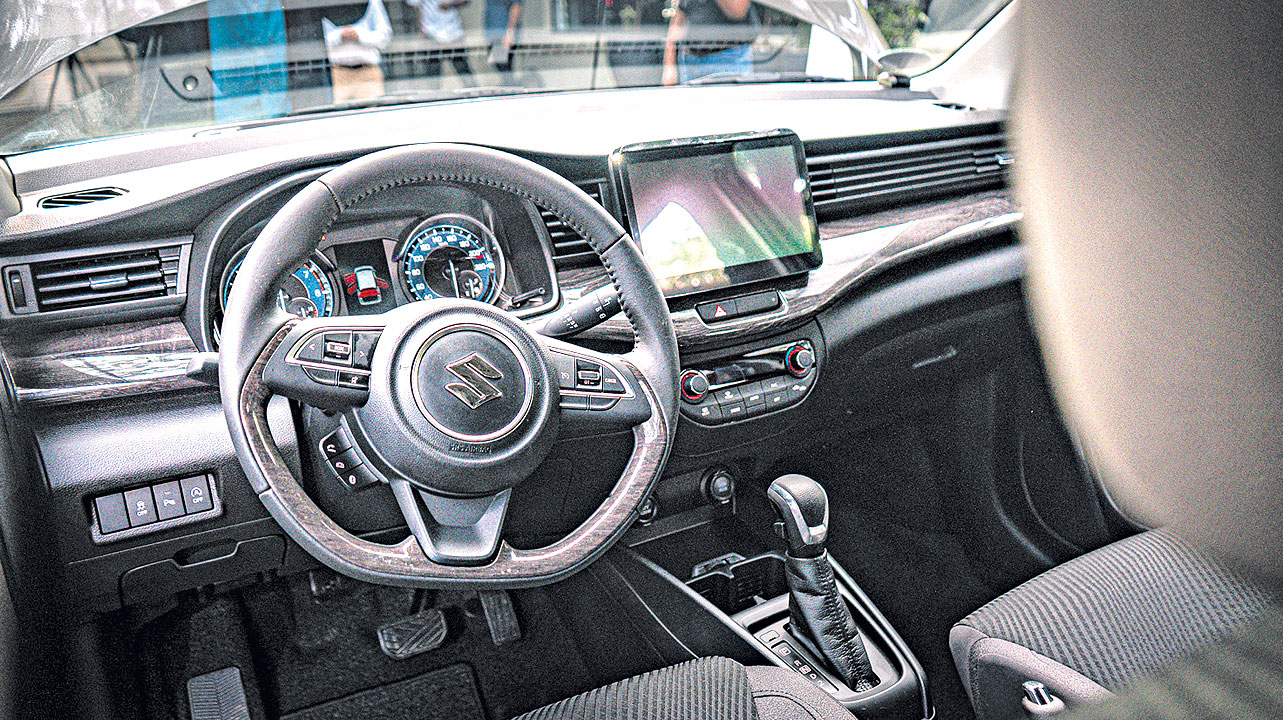
The four variants are divided into two four-speed automatic transmission and two five-speed manual-transmission trims. Drivers are conveniently given cruise control and audio system controls in the D-shaped steering wheel. The Ertiga Hybrid GLX gets a 10-inch touchscreen audio system with Smartlink connectivity, along with a start-stop button.

The new Suzuki Ertiga Hybrid is offered in Snow White Pearl, Silky Silver Metallic, and Cool Black Pearl for the GA variant; additional colors of Metallic Magma Gray, Burgundy Red Pearl, and Brave Khaki Pearl are available for the GL/GLX variants.

The company said that the Ertiga Hybrid further adds to the Suzuki “reputation of offering fuel-efficient vehicles.” According to a study overseen by the Automotive Association Philippines (AAP), the model yielded a consumption rate of 12.54 kpl or 7.6% better than the regular-engined Ertiga during city driving.

Significantly, car browsers should note, said Suzuki, that the Ertiga Hybrid “qualifies (for) EVIDA (or Electric Vehicle Industry Development Act) implementing rules and regulations.” This means exemption from number coding; a 15% discount on motor vehicle user’s charge, vehicle registration, and inspection fee for eight years from the effectivity of EVIDA; and priority lane on vehicle and franchise registration.

The Suzuki Ertiga Hybrid is priced as follows: GA M/T (P954,000), GL M/T (P1.068 million), GL A/T (P1.103 million) and GLX A/T (P1.153 million). The model is available in all 71 Suzuki Auto dealerships nationwide. For more information, visit Suzuki’s official website at https://www.suzuki.com.ph.

When asked by “Velocity” whether the company is looking at bringing in more hybrids soon, Mr. Takei smiled and said, “We’ll see.”

Only 5,000 MT expected to arrive by onion import deadline

BUREAU OF CUSTOMS

By Ashley Erika O. Jose, Reporter

THE Agriculture department said only 5,000 metric tons (MT) worth of onion imports from the initial target of 21,060 MT will arrive by the shipment deadline this week.

“The applications (for onion imports were) approved last week,” Rex C. Estoperez, deputy spokesman of the Department of Agriculture (DA), told BusinessWorld by phone on Sunday. “The volume that has been granted import clearances is only 5,000 metric tons.”

Mr. Estoperez said that the imports will be distributed to Luzon, the Visayas, and Mindanao, with a target sale price of P100 to P150 per kilogram.

“Our projection is to sell it between P100 to P150, but we’ll see once the imports arrive,” Mr. Estoperez said.

In a letter dated Jan. 6, the DA opened the application process for sanitary and phytosanitary import clearances on Jan. 9 for imported yellow and red onions, with the application deadline set at Jan. 13.

Importers were given a Jan. 27 deadline to bring in their shipments, a condition designed to minimize the impact on the domestic onion harvest.

Onion prices in wet markets rose to P420-P600 per kilo during the Jan. 6-10 period.

According to the DA’s price monitoring report from Jan. 20, domestic red onions sold for P300 to P400 per kilo, with white onions at P250 to P400 per kilo.

The suggested retail price (SRP) for onions is P250 per kilo.

Gerald Glenn F. Panganiban, officer-in-charge director of the DA’s Bureau of Plant Industry (BPI), told reporters in a briefing last week that the goal is to bring onion prices below the SRP.

He said that the BPI continues to monitor wet markets following reports of smuggled onions.

“Most of the smuggled items are misdeclared. They may bring diseases and pests, so we continue to monitor these reports and I am warning the public that these are unsafe for consumption,” he said.

Samahang Industriya ng Agrikultura Executive Director Jayson H. Cainglet said in a Viber message on Sunday that the farmgate price of onions is now at P100-P120 per kilo, barely above the cost of production estimated at P80 to P100 per kilo.

“And yet retail prices of onions remain high. Regardless of the actual volume of imported onions that will arrive, the damage has been done,” he said.

Mr. Cainglet added that traders and importers may use imports as leverage to negotiate even lower farmgate prices.

“There is no worse enemy of the local agriculture sector than these elements within the Department of Agriculture that announce onion imports. We fear the worst for our onion farmers, as the bulk of the onions has yet to be harvested,” Mr. Cainglet said.

T-bill, bond rates may drop ahead of Fed review

BW FILE PHOTO

RATES of government securities on offer this week could decline as investors look ahead to the US Federal Reserve’s first policy meeting for this year, where they expect a smaller increase in borrowing costs.

The Bureau of the Treasury (BTr) will auction off P15 billion in Treasury bills (T-bills) on Monday, made up of P5 billion each in 91-, 182-, and 364-day papers.

On Tuesday, it will offer P35 billion in reissued 10-year Treasury bonds (T-bonds) that have a remaining life of nine years and seven months.

Rizal Commercial Banking Corp. Chief Economist Michael L. Ricafort said in a Viber message that T-bill yields may drop by 10 basis points (bps) from the previous award, while the T-bond could fetch rates of 6.10 to 6.20% to track secondary market levels and amid expectations of a 25-bp hike from the Fed next week.

UnionBank of the Philippines, Inc. Chief Economist Ruben Carlo O. Asuncion also said that the 10-year bond’s rate may range from 6.10% to 6.20% as investors make bets ahead of the US central bank’s first policy meeting for this year, which will be held from Jan. 31 to Feb. 1.

“The upcoming Federal Open Market Committee meeting with Fed officials talking up the terminal policy rate while blurring the timing of the Fed’s pause may put pressure on markets to lock in gains as we approach the end of the month,” Mr. Asuncion said.

Meanwhile, a trader said in a Viber message that T-bill yields may remain steady in this week’s auction and T-bond rates may range from 6.10% to 6.20% following the broad decline in secondary market yields as “investors have been deploying excess funds.”

Slower US consumer inflation and other weak data released in recent weeks, as well as dovish comments from central bank officials, have fueled bets that the Fed could dial back its tightening, with a 25-bp hike seen in its first meeting of the year.

The US central last month hiked its federal funds rate by just 50 bps to a 4.25%-4.5% range following four straight 75-bp increases. This brought cumulative hikes for 2022 to 425 bps.

Meanwhile, at the secondary market on Friday, the 91- 182- and 364-day T-bills were quoted at 4.312%, 4.9977%, and 5.4531%, respectively, based on the PHP Bloomberg Valuation Service Reference Rates published on the Philippine Dealing System’s website.

On the other hand, the 10-year bond fetched a yield of 6.2196%.

Week on week, the 91- and 182-day T-bills saw their secondary market rates drop by 7.67 bps and 4.7 bps, respectively, while the 364-day paper’s yield went up by 4.01 bps.

The 10-year bond also dropped by 27.96 bps week on week.

Last week, the BTr raised P15 billion as planned from the T-bills it auctioned off as bids reached P45.891 billion, more than thrice the amount on offer.

Broken down, the Treasury raised P5 billion as programmed via the 91-day T-bills with tenders reaching P16.321 billion. The average rate of the three-month papers rose by 1.8 bps to 4.25%, with accepted rates ranging from 4.23% to 4.27%.

The government also made a full P5-billion award of the 182-day securities as bids for the papers reached P15.2 billion. The six-month tenor was quoted at an average rate of 4.967%, inching up by 0.8 bp, with accepted rates at 4.95% to 4.989%. 

Lastly, the BTr raised the programmed P5 billion from the 364-day debt papers as demand for the tenor reached P14.37 billion. The average rate of the one-year T-bill rose 5.5 bps to 5.448%. Accepted yields were from 5.429% to 5.493%.

Meanwhile, the 10-year bonds to be auctioned off on Tuesday were first offered on Sept. 13, 2022, where the BTr made a full P35-billion award of the fresh issue. The bond series fetched a coupon rate of 6.75%, with the average at 6.703%.

The Treasury wants to raise P200 billion from the domestic market this month, or P60 billion through T-bills and P140 billion via T-bonds.

The government borrows from domestic and external sources to finance its budget deficit, which is expected to reach P1.47 trillion this year or 6.1% of gross domestic product. — A.M.C. Sy

Former ICTSI finance chief joins Prime Infra board

PRIME Infrastructure Capital, Inc. (Prime Infra) announced that Martin O’Neil, former chief financial officer of International Container Terminal Services, Inc. (ICTSI), has joined its board of directors.

“Martin brings with him a depth of expertise to help execute Prime Infra’s strategic priorities in expanding the business, focusing on solidifying the company’s capital strength to maximize value for our stakeholders,” Prime Infra Chairman Enrique K. Razon, Jr., said in a media release on Sunday.

Prime Infra said that its board is now composed of its chairman Mr. Razon, Christian R. Gonzalez, Guillaume Lucci, Stephen A. Paradies, and independent directors Panfilo M. Lacson and Danilo S. Feliciano.

Mr. O’Neil will also serve as senior financial advisor to Prime Infra’s management.

“With over 30 years of experience in senior leadership roles, Martin’s wealth of knowledge and insight will prove invaluable to the company’s finance and business operations,” said Mr. Lucci, Prime Infra’s president and chief executive officer.

Prime Infra said that before Mr. O’Neil’s appointment, he served as the executive vice president of listed port operator ICTSI.

Prime Infra, through its unit Prime Energy Resources Development B.V., has recently acquired a 45% stake in the Malampaya gas-to-power project. The company has interest in energy, water and waste management, and infrastructure. — Ashley Erika O. Jose

Isuzu PHL seeks delay of excise tax imposition on pickups

Isuzu D-Max — PHOTO FROM ISUZU PHILIPPINES

By Revin Mikhael D. Ochave

ISUZU PHILIPPINES CORP. (IPC) is asking for more time before the proposed removal of excise tax exemption on double-cab pickup trucks, saying that the segment is primarily used by local businesses.

IPC Assistant Division Head for Sales Robert D. Carlos told in an interview at the sidelines of a company event in Manila City last week that the lead time will help the automaker plan ahead if the proposal pushes through. The IPC’s local double-cab pickup offering is the D-Max.

Despite the request, Mr. Carlos reiterated that IPC remains supportive of the government’s efforts to improve the economic state of the country.

“We fully support the government in its plans and programs for the betterment of the country. With regard to the plan of implementation of excise tax on pickup trucks, we are requesting for consideration and lead time,” Mr. Carlos said.

“We request to review our appeal because pickup trucks are primarily designed for utilitarian purposes, as a business tool designed with an open bed intended to transport cargo. It is actually classified under the N1 Category, which refers to vehicles used for the carriage of goods,” he added.

In August last year, the House Ways and Means Committee approved the fourth package of the Comprehensive Tax Reform Program, which incorporated the removal of the excise tax exemption on pickup trucks. The Department of Finance (DoF) previously pushed for the removal of the excise tax exemption on double-cab pickups under Republic Act No. 10963 or the Tax Reform for Acceleration and Inclusion (TRAIN) Law.

According to the DoF, the removal of the excise tax exemption enjoyed by pickup trucks is expected to generate P52.6 billion worth of additional revenues for the government from 2022 to 2026.

Trade Secretary Alfredo E. Pascual previously expressed his support for the DoF’s proposal, saying that an imported double-cab pickup truck is typically a “fully-accessorized passenger unit.”

The Chamber of Automotive Manufacturers of the Philippines, Inc. (CAMPI) previously voiced its opposition to the proposed removal of excise tax exemption for pickups, arguing that it would hurt the recovery of the local vehicle industry.

“Many are using pickups, since these are for business. We are concerned about the addition of the taxes… We express concern,” CAMPI President Rommel R. Gutierrez previously said.

IPC HAS A NEW PRESIDENT
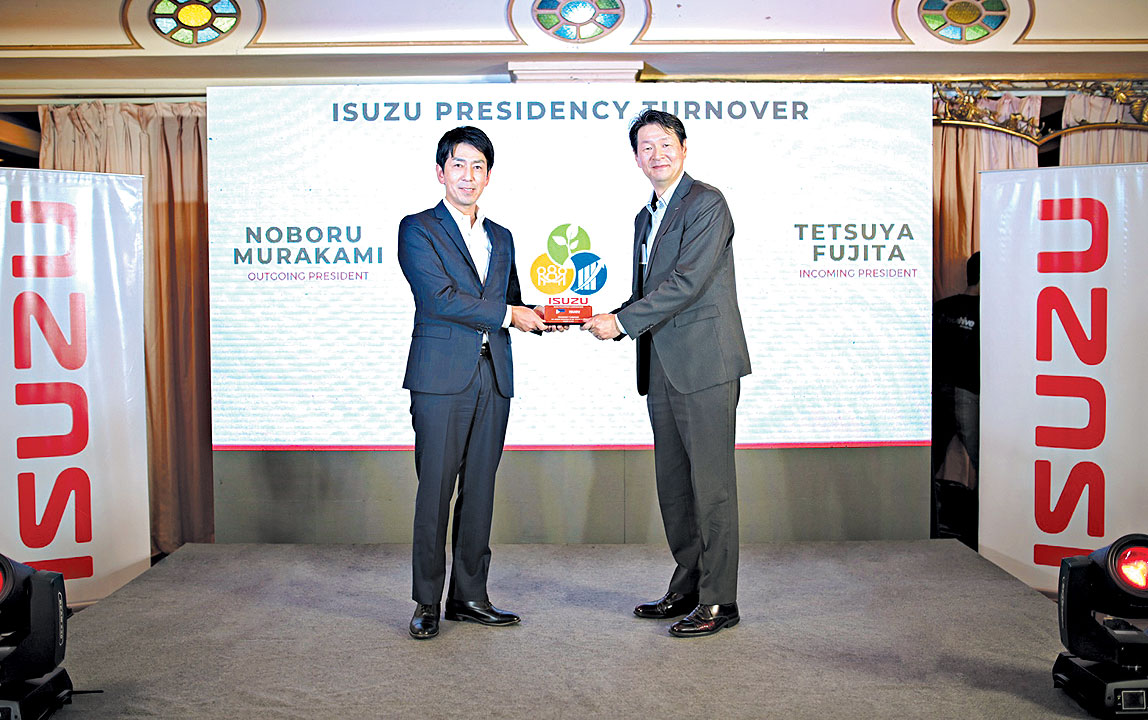
Meanwhile, IPC officially welcomed Tetsuya Fujita as its new president during turnover ceremonies held in Manila City last week. Mr. Fujita succeeded outgoing IPC President Noboru Murakami.

Mr. Fujita previously served as the chairman and chief executive officer of Isuzu Motors de Mexico from 2020 to 2021. He was previously the general manager for sales of Isuzu Motors International Operations Thailand in Bangkok from 2014 to 2017, and corporate planning manager of Isuzu Commercial Truck of America in California, USA from 2005 to 2010.

During his speech. Mr. Fujita vowed to maintain the position of IPC as the leading truck brand in the Philippines. “As I accept the IPC presidency, I also accept the challenge of ensuring that our long reign as the number-one truck brand will be maintained, as well as our good relationship with our customers and business partners,” he said.

“As the leading truck brand in the industry, we will continue innovating new products that will assist in the progress of the country while displaying more responsibility to the society and the environment through our Road to Progress vision,” the executive added.

On the other hand, IPC said that outgoing IPC President Mr. Murakami will be transferred to Isuzu North America Corp.

“With the truck market there getting quite aggressive, Isuzu Motors Limited considered me fit to oversee their operations,” Mr. Murakami said in his speech at the event.

Based on CAMPI figures, the IPC ranked sixth in terms of overall sales among car brands in 2022 after it recorded 17,639 units sold, equivalent to a 5% market share. The local automotive industry sold a total of 352,596 units in 2022, up 31.3% versus 268,488 units sold in 2021. The figures also showed that IPC’s 2022 sales figure reflected a 22.3% increase from the 14,424 units sold in 2021.

Hopping into the Year of the Rabbit

COLORFUL fireworks light up the night sky over the Binondo-Intramuros bridge in Manila during the Lunar New Year revelry on Sunday midnight. — PHILIPPINE STAR/ MIGUEL DE GUZMAN

WITH the beginning of the Year of the Water Rabbit, we should all be springing into action.

During a Lunar New Year lunch last week at the New World Makati, feng shui expert Patrick Lim Fernandez of the Yin & Yang Shop of Harmony gave his predictions for the coming Lunar New Year.

According to him, the preceding years of the Pig, the Rat, and the Ox were winter years (read: sparce), while the arrival of the Tiger in 2022 symbolized the beginning of spring. “The Rabbit is the height, or the peak of spring. We should see reinvigoration, kind of like a reintegration into society,” said Mr. Fernandez. “There’s going to be renewed energy.”

This can also be the year to find the love of your life, and a year of good relationships all throughout. “There”s also going to be a strong creative energy that’s present for the Rabbit,” he said, though he warns against losing focus. A Benefactor Star will be present in our skies. “This year, if you need help, don’t hesitate to ask for it,” he said, particularly from higher-ups. But one must return the favor: “Try to be a benefactor to other people.”

As for the country, he says that the economy usually performs better in Rabbit years, although there is a lack of the fire element this year. Lucky industries for the Rabbit year include technology, energy, communications, entertainment and events, food, banking, jewelry, mining, and healthcare.

At another Lunar New Year’s lunch at the Marco Polo Ortigas, feng shui master Joseph Chau also gave his predictions for animal signs of the Eastern Zodiac for the Lunar New Year.

WHAT IS IN STORE FOR THE SIGNSIN THE YEAR OF THE RABBIT

Rat: 1924, 1936, 1948, 1960, 1972, 1984, 1996, 2008, 2020

Mr. Fernandez says: “It’s a good year to make new friends, and deepen your relationships. You’ll find a lot of luck on the personal side. There’s also good money luck.” He advises those born in the Year of the Rat to diversify their income, and warns against rumors and backstabbing, as well as “gray moral areas.” “As long as you do the right thing, you’ll be fine.”

Mr. Chau says meanwhile for the Rat to beware of digestive problems, diabetes, and high cholesterol.

Ox: 1925, 1937, 1949, 1961, 1973, 1985, 1997, 2009, 2021

“You have to do a lot of planning,” said Mr. Fernandez of those born in an Ox year, but that just means setting timebound plans to meet goals. “You’ll be able to figure out how you’re going against the goals that you set,” he said. He did warn about fluctuating emotions and paying attention to the health of senior members of the family. Mr. Chau, meanwhile, warns the Ox-born to pay special attention when signing contracts.

Tiger: 1926, 1938, 1950, 1962, 1974, 1986, 1998, 2010, 2022

“It was your year last year, so it was like a spotlight year,” said Mr. Fernandez of the Tiger-born. This year, there’s a bit of a change of luck, and people in the social fields, like the media and public figures, might face bouts of anxiety — as well as losing objects this year. Mr. Chau says to pay attention to one’s health (and to have a medical checkup after Feb. 4).

Rabbit: 1927, 1939, 1951, 1963, 1975, 1987, 1999, 2011, 2023

Mr. Fernandez said: “Congratulations, it’s your year.”

With the same spotlight luck visiting the Tiger last year, the Rabbit can “showcase your talents and do all the things you want to do.” People will be paying attention to you this year, and it’s a good year for acquiring assets and wealth. The presence of the Intelligence Star also makes it a good year for study; though he warns against conflicts and disputes, and keeping an even temper is key. Mr. Chau meanwhile, says that this year, the Rabbit should keep away from sharp objects, but otherwise, four lucky stars augur good luck (except in relationships).

Dragon: 1928, 1940, 1952, 1964, 1976, 1988, 2000, 2012

Strong -yang energy means more luck coming from the men in your life. “Lean into these relationships. You’d be able to advance in your career or business,” said Mr. Fernandez, but he warns against losing interest. The Dragon, according to Mr. Chau, must be alert for “hidden enemies and wicked people,” though career, romance, health, and financial luck seem good — he just advises to save money and to pay attention to your diet.

Snake: 1929, 1941, 1953, 1965, 1977, 1989, 2001, 2013

“I hope you have your passport updated, because it’s a year for travel,” said Mr. Fernandez, though travel can also mean expanding one’s horizons, extending to one’s career, relationships, or business. He warns against increasingly bad moods. Mr. Chau said mostly the same, adding that one should pay attention to the health of senior family members, and pay close attention to road safety.

Horse: 1930, 1942, 1954, 1966, 1978, 1990, 2002, 2014

“You’ll be getting a lot of luck from the females in your life,” said Mr. Fernandez. This year is good for relationships, but not very good for being overly ambitious: “Don’t bite off more than you can chew,” he said. He also said to be careful of one’s words.  Mr. Chau has bright predictions for career and romantic advancements, as well as financial and physical health; just avoid dust and germs to prevent ailments in the respiratory system and the skin.

Goat: 1931, 1943, 1955, 1967, 1979, 1991, 2003, 2015

The Goat and the Rabbit are friends, which means good luck. “It’s a good year for expansion,” said Mr. Fernandez, and this extends to one’s career, friendships, and future plans. The Creativity Star means luck in the creative fields, and it will be especially beneficial to ask for help this year. He warns against stress and bad moods. Mr. Chau doesn’t see much luck in romance, especially since he also advises Goats against cosmetic surgery or treatments this year (no lasers).

Monkey: 1932, 1944, 1956, 1968, 1980, 1992, 2004, 2016

Mr. Fernandez admits there were some challenges for the Monkey last year, as it was in conflict with the Tiger. This year, it’s a good year for leadership and opportunity, as well as finding good mentors. Just don’t overspend — but then Mr. Chau says that the Monkey will have the ability to change bad luck into good fortune. Your health probably wouldn’t be very good this year, though.

Rooster: 1933, 1945, 1957, 1969, 1981, 1993, 2005, 2017

In conflict with the Rabbit, Mr. Fernandez advises the Rooster to surround themselves  with happy occasions, and to avoid funerals and hospitals. Big financial losses may also be on the horizon, so he advises acquiring investments, not expenses. He also advises Roosters to donate to charity to ward off bad luck. Mr. Chau warns against sharp objects and to mind road safety.

Dog: 1934, 1946, 1958, 1970, 1982, 1994, 2006, 2018

The best friend of the Rabbit, the Dog sees the career-blessing Emperor Star in the sky this year. “You’ll be able to really establish your reputation,” said Mr. Fernandez. A Problem-solving Star will also allow the Dog to weather out problems, and even help others as well. He does warn against unrealistic expectations and disappointment. Mr. Chau only has good things to say for the Dog, including a blooming Romance Star.

Pig: 1935, 1947, 1959, 1971, 1983, 1995, 2007, 2019

The presence of the Sky Chef star urges the Pig to surround themselves with happy celebrations as well for good energy. Mr. Fernandez warns against false information, as well as losing focus. Mr. Chau says to avoid business partnerships this year. — Joseph L. Garcia


Brazil launches first anti-deforestation raids under Lula

REUTERS

URUARA, Brazil — Brazilian environmental agents cut through the rainforest with machetes in search of criminals in the first anti-deforestation raids under President Luiz Inacio Lula da Silva, who has pledged to end surging destruction inherited from his predecessor, Jair Bolsonaro.

Reuters exclusively accompanied raids led by environmental agency Ibama in the rainforest state of Para to stop loggers and ranchers illegally clearing the forest.

The agency also launched raids this week in the states of Roraima and Acre, Ibama environmental enforcement coordinator Tatiane Leite said.

About 10 Ibama agents set out in pickup trucks on Thursday from their base in the municipality of Uruara, Para, along with a dozen federal police, heading toward a cluster of points where satellite images showed loggers and ranchers recently at work clearing the forest illegally.

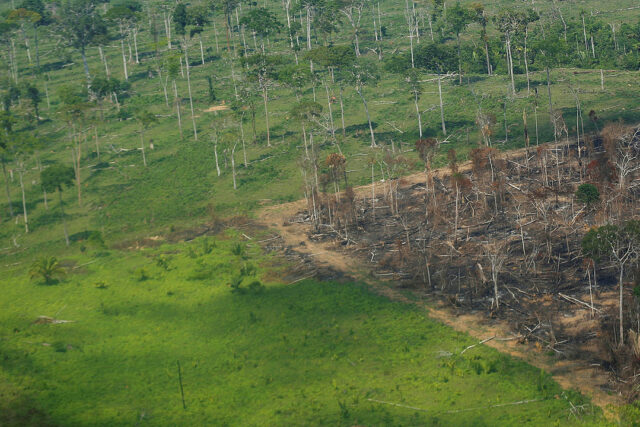
In 12 hours driving on dirt roads illegally crisscrossing an indigenous reserve, the convoy reached five areas that were deforested and burned around the time of last October’s election that pitted Mr. Da Silva against Mr. Bolsonaro.

The areas all lay within the Cachoeira Seca indigenous reserve, where deforestation is strictly prohibited. Four of the tracts appeared to be subsequently abandoned, with no signs people were living nearby or in the process of turning them into ranches.

Agents said it could be a sign that illegal ranchers gave up on investing time and money in turning illegal land into productive pasture, knowing that Mr. Da Silva campaigned on a pledge to crack down on deforestation.

“People know that in this government enforcement will tighten and won’t let them use an area they deforested illegally,” said Givanildo dos Santos Lima, the agent leading Ibama’s Uruara mission. “If the other government had won, you would have found people here, well-maintained pastures and cattle.”

The government under Mr. Bolsonaro had gutted staff and funding for environmental enforcement by Ibama in his four years in office, while the former president criticized Ibama for issuing fines to farmers and miners.

Mr. Bolsonaro gave the military and later the Justice Ministry authority over operations to fight deforestation, sidelining Ibama despite the agency’s extensive experience and success in fighting the destruction of the Amazon.

An area larger than Denmark was deforested under Mr. Bolsonaro, a 60% increase from the prior four years. In another area of the reserve, agents found a newly built house with several chainsaws and stocked with weeks of food, indicating the occupants had likely fled just before Ibama’s arrival.

Flanked by police with semiautomatic weapons, Ibama agents hacked a path through the adjacent jungle to reach an area the size of 57 football fields strewn with downed trees and charged trunks.

Some messily planted corn sprouted up to knee-level in what appeared to be an attempt to lay claim to the area to eventually turn it into cattle pasture, the agents said. “We’ll come back with a helicopter and catch them by surprise,” Lima said.

He was optimistic that Ibama would be able to conduct more raids under Mr. Da Silva, aimed at fining deforesters and spooking criminals from attempting to clear more areas.

Mr. Da Silva on the campaign trail last year pledged to put Ibama back in charge of combating deforestation with beefed-up funding and personnel.

He took office on Jan. 1, so additional money and staff have yet to reach the frontline enforcers.

Mr. Bolsonaro’s government denied several requests by Reuters to accompany Ibama missions during his 2019-2022 administration. His government instituted a gag order forbidding Ibama agents from speaking to the press, which agents say has already been reversed.

Mr. Da Silva took office for the first time in 2003 when Amazon deforestation was near all-time highs, and through strict enforcement of environmental laws reduced it by 72% to a near record low when he left office in 2010. — Reuters