Home Blog Page 5397

California shooting suspect kills himself after Lunar New Year massacre

Star Ballroom Dance Studio in Monterey Park. — STARDANCELA.COM

MONTEREY PARK, Calif. — A 72-year-old gunman killed himself when approached by police on Sunday, about 12 hours after he had carried out a Lunar New Year massacre at a dance club that left 10 people dead and another 10 wounded. 

The gunman tried to carry out another shooting at a separate club just minutes after the first one on Saturday night, but authorities said two bystanders wrestled the man’s weapon away from him before any shots could be fired. He fled that scene. 

Los Angeles County Sheriff Robert Luna identified the suspect as Huu Can Tran, a septuagenarian he said used a high-capacity magazine pistol to shoot up a ballroom dance venue popular with older patrons in Monterey Park, about 7 miles (11 km) east of downtown Los Angeles. 

Investigators did not yet know a motive, although gun violence is frequent in the United States. Mr. Luna did not identify any of the victims but said the five men and five women appeared to be in their 50s, 60s and beyond. The sheriff said the pistol Tran used appeared to be illegal in California, where state laws ban any magazine holding more than 10 rounds. 

“We want to know, we want to know how something this awful can happen,” Mr. Luna told reporters. 

After police say Tran carried out the shooting in Monterey Park at about 10 p.m. PST Saturday (0600 GMT on Sunday), he was confronted by bystanders at a second dance club in the neighboring city of Alhambra about 20 minutes later, Mr. Luna said. 

“I can tell you that the suspect walked in there, probably with the intent to kill more people, and two brave community members decided they were going to jump into action and disarm him,” Mr. Luna said. 

The sheriff said that Tran turned a handgun on himself on Sunday as police approached a white van he was driving in Torrance, about 20 miles (34 km) from the site of the shooting at the Star Ballroom Dance Studio in Monterey Park. Officers heard a single gunshot from the van as they approached, then fell back and called for a SWAT team. 

Of the 10 people injured, seven remained hospitalized Sunday night, with at least one person in critical condition. 

The shooting took place around the location of a two-day Chinese Lunar New Year celebration where many downtown streets are closed for festivities that draw thousands of people from across Southern California. 

A CLOSE-KNIT COMMUNITY
Residents stood gazing at the many blocks sealed off with police tape on Sunday in Monterey Park. Chester Chong, chairman of the Chinese Chamber of Commerce of Los Angeles, described the city of about 60,000 people as a quiet, peaceful, beautiful place where everybody knows each other and helps each other. 

The city has for decades been a destination for immigrants from China. Around 65% of its residents are Asian, according to US Census data, and the city is known for its many Chinese restaurants and groceries. 

“People were calling me last night, they were scared this was a hate crime,” Mr. Chong said at the scene. 

The Star Ballroom Dance Studio opened in 1990, and its website features many photographs of past Lunar New Year celebrations showing patrons smiling and dancing in party clothes in its large, brightly lit ballroom. 

Most of its patrons are middle-aged or seniors, though children also attend youth dance classes, according to a teacher at the studio who asked to not be named. 

“Those are normal working people,” the teacher said. “Some are retired and just looking for an exercise or social interaction.” 

A flyer posted on the website advertised Saturday night’s new year party, running from 7:30 p.m. to 12:30 a.m. Sunday. 

The gunshots were mistaken by some for new year fireworks, according to Tiffany Chiu, 30, who was celebrating at her parents’ home near the ballroom. 

“A lot of older people live here, it’s usually really quiet,” she said. “This is not something you expect here.” 

President Joseph R. Biden, Jr., condemned the killings in a written statement and said he had directed his Homeland Security adviser to mobilize federal support to local authorities. 

The attack in Monterey Park was the deadliest since May 2022, when a gunman killed 19 students and two teachers at a school in Uvalde, Texas. The deadliest shooting in California history was in 1984 when a gunman killed 21 people at a McDonald’s restaurant in San Ysidro, near San Diego. — Reuters

US wants to see quicker progress on World Bank reforms — Yellen

REUTERS

LUSAKA — US Treasury Secretary Janet Yellen on Sunday said the United States wanted to see quicker progress on the World Bank’s plans for expanding its lending capacity to address climate change and other global crises. 

The World Bank’s “evolution roadmap,” reported by Reuters earlier this month, calls for the bank to negotiate with shareholders ahead of April meetings on proposals that include a capital increase and new lending tools. 

It calls for World Bank management to develop specific proposals to change its mission, operating model and financial capacity that could be approved by the joint World Bank and International Monetary Fund (IMF) Development Committee in October. 

The plan marks the start of a negotiation process to alter the bank’s mission and financial resources and shift it away from a country- and project-specific lending model used since its creation at the end of World War Two. 

Ms. Yellen said the bank’s roadmap was a “constructive document” and formed a good basis for discussion, but more work was needed. 

“We do have some concerns,” she told Reuters as she traveled to Zambia from Senegal. “We would like to see some progress on a quicker timeline. And think there are some things that could be done to expand lending given the current capital release.” 

Ms. Yellen said working on the reforms — first of the World Bank and then other multilateral development banks — was one of her biggest priorities this year. 

The United States, the bank’s largest shareholder, worked with other countries to push the World Bank to develop the reform plan, which was discussed by the bank’s board on Jan. 11. 

“2023 is the year to reap specific progress in the short-term with the Spring Meetings (in April) … and lay the foundation for more fundamental/complex reforms by the October meetings,” a senior Treasury official said. 

The United States and other shareholders favor a staged implementation approach, with proposals for certain reforms released in time for the spring meetings of the IMF and World Bank to enable some “quick wins,” the official said. 

These would focus on the World Bank’s vision and mission, stretching its financial capacity … and stepping work on private sector mobilization, the official said. 

More work was also needed to reorient the World Bank’s operational model to focus more on global challenges, its use of incentives and a strengthened framework for the use of concessional, or low-interest resources, the official said. 

Treasury was also looking for more details on how the bank could work with supra-and sub-national entities. — Reuters

French and German leaders gloss over divisions at summit

The Elysée Palace in Paris, France. — ELYSEE.FR

PARIS — The leaders of France and Germany sought at a summit on Sunday to pave over divisions that have dogged Europe’s closest bilateral relation since the war in Ukraine broke out, leaving many of their most vexed issues to be worked out later. 

In a show of pageantry and unity, the two governments marked the 60th anniversary of a friendship treaty signed by France’s Charles de Gaulle and Germany’s Konrad Adenauer with speeches at the Sorbonne University in Paris and a joint cabinet meeting at the Elysee Palace. 

The summit between the two governments, traditionally the driving force behind broader EU policy initiatives, had originally been planned for October, but was postponed amid differences on issues ranging from energy policy to defense procurement. 

“The Franco-German motor is a compromise machine — well oiled, but sometimes loud and needing hard work,” German Chancellor Olaf Scholz said in a speech at the Sorbonne. 

The two governments issued a joint statement flagging plans to press ahead with joint initiatives for a main battle tank, in space programs, and in developing hydrogen production and battery technologies. 

But they also papered over deeper differences. 

French President Emmanuel Macron said the two countries agreed the European Union (EU) needed to find funds to make green investments in the industrial sector in response to US subsidies for green energy under Washington’s $369 billion Inflation Reduction Act (IRA). 

“We have a real convergence in the responses we are bringing,” Mr. Macron said at a news conference with Mr. Scholz, but offered no concrete details. 

German officials say Berlin sees little need for a new sovereign EU fund that France considers necessary to help European industry make investments to remain competitive against US firms benefiting from generous tax credits under the IRA. 

The two governments also committed only vaguely to work on an EU overhaul of the electricity market, on which France wants urgent progress as it prepares a vast nuclear energy push while Berlin is skeptical and does not want to rush into. 

Meanwhile, on defense, Mr. Macron opened the door to French involvement in plans between Germany and more than a dozen other European countries to pool air defense capabilities, saying Paris would weigh risks and possible investments in the “coming weeks and months.” — Reuters

COVID curbs over, China’s tourists hit Thai beaches for first time in 3 years

REUTERS

PHUKET, Thailand — Hitting the white sand beaches and eating mango sticky rice and seafood, Chinese tourists are returning to Thailand for their first trips abroad since China ended its strict coronavirus disease 2019 (COVID-19) curbs and reopened its borders.

“Because of the pandemic, we hadn’t been out of China for three years,” said tourist and business owner Kiki Hu, 28, in Krabi on Thailand’s southwest coast. “Now that we can leave and come here for holiday. I feel so happy and emotional.”

With China celebrating the Lunar New Year, Asia’s tourist hotspots have been bracing for the return of Chinese tourists, who spent $255 billion a year globally before the pandemic. Countries from Thailand to Japan had depended on China as their largest source of foreign visitors.

Beijing in December abruptly dropped some of the toughest COVID restrictions on earth, which had battered the world’s second-biggest economy.

Business owner Yoyo Chen, 32, from Yiwu in central China, said returning to Thailand felt like coming home.

“I’m here to eat seafood. Previously, when I was here, I ate mango sticky rice, which was delicious. Back in China I kept thinking about the mango sticky rice here. I’m looking forward to the food, as well as visiting the beaches,” Chen said.

“Getting visas is very convenient now. The tourism industry is more developed here, there are lots of fun activities and cuisine, and the Thai people are very hospitable,” she said.

The Chinese return was welcomed by businesses, despite some wariness about a huge spike in COVID infections in China after Beijing ended its zero-COVID policy.

“We’re glad that China finally allows their people to travel. At the moment, we’ve received some bookings through March,” said Woranuch Maungtong, 44, manager of Tip-Top Destination on the resort island of Phuket, which provides daily speed boats to nearby islands.

China’s reopening raises hopes for the return of Chinese visitors, who accounted for nearly a third of Thailand’s 40 million foreign tourist arrivals in pre-pandemic 2019.

The Thai government is expecting at least five million Chinese tourist arrivals this year, with some 300,000 coming in the first quarter. — Reuters

Online banking still a rising trend

PHOTO FROM MACROVECTOR/FREEPIK

Newer technological innovations and advances have become the center of our lives for socialization, productivity, and access to our daily needs. Thus, the evolution of traditional banking — from banking activities that can only be done by visiting local branches, to mobile banking where banking activities can be done anywhere and anytime with just a few taps on technological devices — became a huge influence on financial stability as banking activities became more manageable and more convenient.

The birth of online banking started in 1983 as the Nottingham Building Society became the first bank to offer online services, becoming the blueprint for online banking where checking balances, paying bills, transferring money, and applying for loads from home are made possible in Europe. It was soon followed by a French bank, Minitel in 1984.

Trustly Group AB described first bank websites as “online brochures that have product formation, photos, contact numbers, and branch maps but no interaction with the customers.” With international banks starting to invest in online banking, consumers now are starting to see online banking as more beneficial as it has lower fees and better interest rates. With the increased use of modern technology and an internet connection, the establishment of financial technologies had begun.

Yet as online banking continuously grew, not everyone was open to online transactions and banking due to safety and security issues. But in 1995, the first online store was created by Amazon, an American multinational technology company, focusing on e-commerce services that offered a wider selection of products than those in-store with cheaper prices. eBay followed soon after. The increase in e-commerce sites paved the way for the utilization of online banking, boosting usage and acceptance of online financial services in the west, according to Trustly Group AB.

As eBay tries to standardize e-commerce, eBay merchants, especially small business owners, found the card payment method challenging since it only offers card payment which can be impractical on their part. In order to address this issue, an online service called Confinity launched with the aim of making payments online easier, collaborating with PayPal, an online payment platform for business services.

As mobile devices evolved, so did online banking adjust to mobile advancement, thus the development of mobile banking services. With this, Norwegian bank DnB became the first bank in the world to launch mobile banking.

Through mobile banking, checking balance accounts, topping up cell phone credit, and paying bills are made possible within a few taps. On top of the technological advancements, mobile banking services have evolved to include features such as locating ATMs, transferring money, and applying for banking products and services, as well as improving its security from relying on SMS alerts to one-time passwords (OTP) and alerts flagging unusual account activities.

“In short, you could carry your bank account in your pocket wherever you went,” Trustly Group AB said.

With the arrival of the pandemic, the world was greatly affected, causing disruption in society and causing a global economic crisis. Banks took this opportunity to improve the industry’s services by shifting to online, which later became a crucial instrument to attain economic growth and recovery amidst the said crisis.

The shift to online banking received positive outcomes as the world is now continuously maximizing the benefits of the online platform. According to Accenture, the use of online banking during the pandemic has improved the relationship between banks and consumers.

According to Accenture’s 2020 Global Consumer Study, while the banking industry has been increasing digital adoption, consumer trust, which is a vital factor in banking operations, has been decreasing at the same time.

Similarly, Alan McIntyre of Accenture Banking Group pointed out that the shift to online banking became a primary threat to attaining customer trust. It became important for banks to assess the pandemic and digital channels’ effect and changed consumer behaviors.

“The right approach will balance human and machine interactions, blending the convenience of more personalized and digital interactions with human assistance when needed to create more value. This would go a long way forward reinforcing banks’ relationships with their customers, which in turn can build trust, loyalty and benefits for both,” Mr. McIntyre said.

“To forge strong customer connections, banks must reimagine the digital services they provide and make those connections more personal and relevant,” he added.

As we step forward to the new normal, the rising trend of online banking continues in the future. According to Deloitte’s 2022 survey, the accelerated use of online banking services received positive outcomes and is expected to continue doing so in the following years. With the increasing number of online bank users, “online banking is likely to become a permanent fixture in the range of services banks offers,” the company said in a statement.

Nevertheless, as banks offer digital alternatives, competition in the industry grows, and providing digital solutions is not enough. Some banks still lack in digital aspects and some bank customers still prefer going to local branches instead of going digital in terms of their banking activities.

Deloitte encourages the use of hybrid banking services, where banks offer traditional and online banking as an option to make financing easier to bank customers.

“Many customers still want personal in-branch service, in the same way as a majority continue to value local branches. Banks can continue to focus on specific customer segments and offer wholly online banking for those customers who want it, but any bank that wants to expand its customer base beyond ‘digital natives’ is well advised to offer a hybrid service, a mix of online and in-branch services,” Deloitte said. — Angela Kiara S. Brillantes

Manuel ‘Manolo’ Lopez, an icon to remember

Photo from Rockwell Land

The Philippines lost one of the biggest contributors to its progress when Manuel M. Lopez, chairman and chief executive officer (CEO) of Lopez Holdings Corp., passed away just as the year began.

Mr. Lopez had been instrumental in the growth of Manila Electric Co. (Meralco), the country’s largest energy provider, and in strengthening the relationship between the Philippines and Japan in his role as ambassador. Moreover, his contributions to Lopez Holdings have helped create the reputation it has today as one of the country’s biggest conglomerates.

He has been a director of the company since June 8, 1993, was vice-chairman from 2001 to June 2010, and became chairman and CEO from June 2010 until Oct. 1, 2020. Since then, he has been chairman emeritus.

Among his other accomplishments were his terms as chairman of Rockwell Land Corp., vice-chairman of First Philippine Holdings Corp., and a director of ABS-CBN Corp. and ABS-CBN Holdings Corp. — all publicly listed, well-known firms in the Philippines, and all of them responsible for shaping their respective industries.

In addition, Mr. Lopez also served other roles in the Lopez business empire — as an executive vice-president of Benpres Corp. from 1973 to 1986 and of AFISCO Insurance Corp. from 1975 to 1982.

He graduated with a Bachelor of Science degree in Business Administration from the University of the East and advanced studies in the Financial and Management Development Program from Harvard.

Their Imperial Highnesses Prince and Princess Hitachi with former Ambassador Manuel M. Lopez and Madame Maria Teresa L. Lopez at a dinner in honor of Their Imperial Highnesses at the Philippine Ambassador’s residence on June 20, 2013. — tokyo.philembassy.net

Lopez Holdings has been a powerhouse of Philippine business since its beginnings in the 1800’s in Iloilo, enough so that very few Filipino families can match its history. The Lopez family, through its business, have been a major proponent of business excellence, nationalism, and social responsibility in the country.

In fact, in 2009, Lopez Holdings became the first Philippine holding firm to receive the Investors in People (IiP) certification. The British IiP framework helps businesses increase profits by implementing the best people management techniques. In 2013 and 2016, Lopez Holdings underwent re-certification to the IiP standard; the most recent assessment used the 6th generation IiP Standard.

The organization maintained the following Quality Policy in 2021 as part of its ongoing compliance with its ISO-certified quality management system: “Lopez Holdings exists to lead in quality management practices and adheres to good corporate governance in the conduct of all business.”

“We shall innovate and continually pursue improvements in all our services and processes to achieve business excellence,” the company noted.

This sense of responsibility Mr. Lopez took with him when he served as Meralco’s chairman from 2001 up to 2009, when the Lopez Group decided to sell their shares to Manuel V. Pangilinan.

“I leave this company with full confidence in [Pangilinan],” Mr. Lopez had said during his final speech to the company.

“As I step down as your chairman, it is with a great sense of fulfillment and pride that I have seen the significant expansion of Meralco’s franchise reach [and] the tremendous growth of our customer base and electricity sales volume… since Meralco’s transfer to Filipino ownership and management in 1962.”

Former Philippine President Benigno S. C. Aquino III (3rd from right), with former secretary of the Department of Foreign Affairs Albert F. Del Rosario (right), former Ambassador Manuel M. Lopez (2nd from left) and Ishinomaki City Mayor Hiroshi Kameyama (3rd from left) during the former President’s visit to Ishinomaki City, Miyagi Prefecture on Sept. 26, 2011. — Malacañang Photo Bureau

Manolo, as remembered by his wife Maritess Lagdameo-Lopez in the book Manolo, A Portrait, was a man who nurtured and cherished human connection, and so led with compassion and the values of community.

“If there is any aspect of his life that speaks of him so well, it is the enduring presence of those alongside him. Beside his family, Manolo is almost never without the company of longtime colleagues, close business associates, fellow (art, guns, orchids, parrot, cockatoo) collectors, or boyhood friends. Where there were communal breakfasts and common hobbies before the global pandemic, there are now weekly Zooms and constant catchups over phone calls and group chats. All throughout this period of physical isolation, he has nurtured the bonds of friendship across multiple time zones and even multiple generations,” Ms. Maritess was quoted as saying.

This much is evident in how Mr. Lopez performed as Ambassador Extraordinary and Plenipotentiary of the Philippines to Japan. The Philippines-Japan Society awarded him the Medal of Merit for his service to the country, the highest award the Society can confer.

The Society recognized his accomplishments in the role including his management of a close working relationship with Japan towards the peaceful resolution of the West Philippine Sea issue, as well as securing Japanese support, assistance, and expertise in addressing the Philippines’ vital infrastructure needs, including the Mega Manila Transport Roadmap.

In his term, Mr. Lopez had a hand in the expansion of trade with Japan, with the result of accelerating direct investments of Japanese companies in the Philippines.

The Society also noted, “Barely two months from assuming his post, the Great East Japan Earthquake struck on March 11, 2011. Very new to the job, Ambassador Lopez heroically marshalled the Philippine Embassy staff in locating, assisting and safely evacuating Filipinos affected by the disaster, not only in the Tohoku region but the entire country as well.”

“It was a dramatic start of his fledgling diplomatic career — steeped with unprecedented challenges — which fortuitously turned into a blessing as it served to weld the strong and solid relationship of his Philippine Embassy team that would serve the large Filipino community in Japan for the next five years.”

Photo from www.facebook.com/meralco

Ms. Maritess, in her book, explained that this had been true to her husband’s character; he had always stood out as someone to be relied upon during difficult times. “You see, Manolo was never one to feel isolated — not even during the most difficult times across all the various posts he has held and the organizations he has led. Through the terror of Martial Law, the many storms that shook the corporate boardrooms, and the literal earthquake and tsunami that shook Japan very shortly after he became ambassador, Manolo’s spirit was always held aloft by the fierce loyalty and friendship of those around him, and by his own deep sense of responsibility towards his friends, his countrymen and his nation.”

“The book is a chronicle of a man well-loved who continues to lead a life well-lived. To me, he will always be the carefree and happy-go-lucky guy that I met that afternoon in San Francisco, who possessed a natural leadership and the passion of a true man of the world, who thrived in the company of family and friends — the boy who will always be our Manolo, and my beloved.”

Mr. Lopez is survived by Maritess, his sons, Martin “Mark” Lopez, chairman of ABS-CBN; Miguel “Mike” Lopez, senior vice-president and treasurer of Rockwell Land; and Manuel “Beaver” Lopez, Jr., director of First Gen Corp.; as well as his family in Maita, Jorge, Chris, and Connie with grandchildren Isabella, Bettina, Miguel, Martina, Manu, Andreas, Jack, and Luis. — Bjorn Biel M. Beltran

Sheltertech startups building sustainability in Southeast Asia

Habitat for Humanity gathered over 130 affordable shelter practitioners and enthusiasts last Jan. 16 in a conference that discussed business opportunities that exist in the shelter innovation space and highlighted sheltertech solutions being developed by startups and scaleups. — Habitat for Humanity

Solutions for sustainable, low-cost housing showcased in Habitat for Humanity conference

By Chelsey Keith P. Ignacio, Special Features and Content Senior Writer

As various issues continue to confront the housing sector, being able to live in a decent and sustainable home remains hard to attain by the general public. But, through innovation, some startups are improving access to such housing.

Over a billion people lived in urban slums in 2020, according to the United Nations (UN). The slum formation in developing regions is rooted in the shortfall in affordable housing options for low-income households, lack of housing finance, fast-paced urbanization and poverty, among many other reasons. By 2030, the UN estimated that three billion people would be in need of adequate and affordable housing.

“The summary of this is that the housing deficit is increasing around the world and is increasing in our region,” said Luis Noda, vice-president for Asia-Pacific (APAC) at Habitat for Humanity, during a conference held by the said global nonprofit last Jan. 16 in Makati City.

Living in the APAC region makes one also twice as likely to be affected by a natural catastrophe, according to Mr. Noda, and such disasters often mostly impact families residing in subpar housing.

Mr. Noda also noted that in several countries, the average housing-vulnerable person, or a person that could become homeless, is a woman 50 years or older.

“Vulnerable families are not only shocked by unachievable mortgage and financial income requirements. They are also unable to afford high-quality and durable building materials,” he added.

Mason Tan, director — Impact Investing at Providentia Wealth, also pointed out that local housing developers in Southeast Asia mostly build homes for the middle and upper classes in urban cities, and not for the poor.

He added that climate change has worsened the urgency of social housing issues in Asia.

“Imagine how the lack of a proper place to call home is affecting every member of the family, not just physically, but also emotionally, mentally, and spiritually,” Mr. Tan said.

Given these housing problems and their impacts on the people, particularly in Southeast Asia, innovations in housing services have been developed by some startups from the region to address such needs. This kind of innovation, being products and services that seek to make affordable housing more accessible, is called sheltertech.

“Sheltertech finds its niche in gathering innovations that can scale, streamline, digitize, or disrupt traditional housing services and generate social impact. At the center of this ecosystem, sheltertech startups leverage housing solutions as drivers of economic growth and equality,” Habitat for Humanity’s Mr. Noda said.

Habitat for Humanity’s recent conference, themed “Building a vibrant and investible sheltertech community in Southeast Asia,” brought together several sheltertech startups operating in Southeast Asia to showcase their housing-related innovations. Entrepreneur leaders and investors also joined the event. The conference was co-organized with innovation platform Plug and Play, startup incubator Villgro Philippines, Impact Pioneers Network, and the Manila Angel Investors Network.

The innovators

Climate change and the lack of proper housing are endeavored to be addressed by Malaysia-based startup Affordable Abodes. In building low-cost homes, the startup utilizes kenaf plants to manufacture bio-composites. Affordable Abodes calls its core technology KENAFCRETE. These are prefabricated structural wall panels, which are lighter, faster to build with, and save costs.

With a vision of creating homes that could address climate change, Singapore-based BillionBricks have built net-zero homes in the Philippines and India. One of the features of BillionBricks’ innovation is a utility-scale solar roof, which then does not need a sub-roof.

“We benefit the homeowners by making homeownership about 20% cheaper in terms of direct cash back and free electricity. To the property developer, we provide an opportunity to upgrade your real estate assets to be ESG (environmental, social, and governance)-compliant. For energy partners, renewable energy assets are unlocked closer to where the power is needed,” said Denis Lucindo, the startup’s managing director.

Also building sustainable homes in the Philippines is the CUBO Modular. This Manila-based startup, according to its Chief Executive Officer and Co-Founder Earl Forlales, seeks to address the challenge of building more houses fast without further harming the environment. CUBO’s modular house is built from engineered bamboo, which could be assembled in just a few days.

Beyond the construction itself, some sheltertech startups also developed services that people would need at home. In Cambodia, TapEffect is supplying clean and safe tap water to rural communities, which they could get at their own homes. By developing and operating its piped water systems, TapEffect seeks to address the lack of access to safe water in rural areas.

Social Light, meanwhile, brings connectivity to low-income communities. The Philippine-based startup does this by offering Wi-Fi to people in exchange for their plastic waste.

In Indonesia, Gradana provides a fintech peer-to-peer lending service focused on property-related financing. “We make it more affordable for people to get a more decent place to stay, whether to purchase, for renovating, or to renting,” Gradana Co-Founder Angela Oetama said.

Another startup aiming to address the housing shortage is My Dream Home. Based in Cambodia, the startup creates interlocking bricks, which are composed of waste materials and abandoned soil bought from local farmers. By using its interlocking bricks, My Dream Home enables less cement use and labor in construction.

Meanwhile, in Myanmar, Pounamu is doing bamboo design and construction, as well as providing services dealing with sustainable bamboo forestry and bamboo treatment.

Sampangan, another startup in Indonesia, seeks to address two problems concerning housing: the lack of affordable housing materials and the lack of construction knowledge among the people, which leads to structurally unsafe housing, said Co-Founder and Chief Product Officer Hana Purnawarman.

Hence, while a waste processing company, Sampangan attends to shelter matters by creating raw materials that could be used for building construction. For construction, the startup is currently focused on activated carbon and light concrete foaming agent. These products together could make carbon concrete construction materials.

To date, Habitat for Humanity has supported more than a hundred startups across six accelerator programs.

Web3 company-backed digital wallet to make buying crypto easier with latest integrations

Users of the digital wallet Pitaka can now purchase cryptocurrencies directly with Philippine Peso and pay using their debit cards, credit cards, GCash, Maya, GrabPay, and ShopeePay within the app as Tetrix, the Filipino-led Web3 company behind the digital wallet, has announced its partnership with Transak as its fiat on-ramp support.

Pitaka is a self-custodial digital wallet that allows users to store their crypto assets and interact with non-fungible token (NFT) marketplaces, play and earn games, decentralized autonomous organizations (DAOs), and decentralized finance (DeFi) applications. With Transak’s integration, users do not have to switch to another service and go through many intermediate steps to buy crypto.

Transak is a Web3 onboarding infrastructure provider that enables applications to accept fiat-to-crypto deposits from a global user base. It is known for its application programming interface (API)-driven solutions that enable Web3 platforms to onboard users to more than 130 crypto assets from more than 125 countries, and it is backed by top venture capital investors including Consensys and Animoca Brands.

“Transak is a trusted and reliable provider of fiat on-ramp services with a track record of successful partnerships with leading cryptocurrency companies. The integration of Transak’s fiat on-ramp is a key step in Pitaka’s mission to make it easy for users to buy, sell and use cryptocurrencies,” said Ralph Acabado, founder and chief operating officer of Tetrix.

“Self-custody wallets are on the rise as more people become aware of the importance of keeping their assets safe. They offer a high level of security, sovereignty, privacy, and control over their money and private financial information. Pitaka, now integrated with Transak, makes it even easier for customers to access crypto and Web3 with peace of mind,” he added.

Meanwhile, Etienne Gandon, business development analyst at Transak, said they are glad that they are able to provide new payment methods for Pitaka, “and we hope more and more users benefit from this as we strive to make onboarding easier and more seamless for mainstream adoption.”

For users to add crypto to their Pitaka with Transak, they have to log in into the mobile Pitaka app, then navigate to the “Buy” section of the Pitaka platform, and then select the cryptocurrency that they want to purchase and enter the amount that they want to buy.

Users are then advised to follow the prompts to complete the Transak payment process. This may include entering your personal and financial information, as well as any additional security measures required by Transak. Once the payment has been completed and verified, the purchased cryptocurrency will be credited to the user’s Pitaka account.

To make crypto transactions simpler and more intuitive, Tetrix has also teamed up with NFT domain provider Unstoppable Domains to give users a new feature where they can use human-readable domain names when buying or sending crypto assets.

Unstoppable Domains is a platform that allows users to create and use a special kind of website address called “crypto domains.” These domains are stored on a blockchain, which means they can’t be taken down or censored by anyone and belong to their holders forever.

Instead of having to share a long and confusing wallet address, Pitaka users can purchase crypto wallet address names provided by Unstoppable Domains and use them to send and receive crypto or other digital assets.

“NFT domains provide a secure and user-friendly way to store and manage non-fungible assets on the blockchain. Because they are stored on the blockchain, they are resistant to censorship and control by any single entity, and they can’t be lost or stolen like physical assets can. Additionally, because they use a standard domain name format, they are easy for users to understand and use,” Mr. Acabado explained.

“Pitaka is committed to providing a seamless and secure experience for its users, and our partnership with Transak and Unstoppable Domains is an important part of this effort. We want to provide Pitaka users with an easy and convenient way to transact with cryptocurrency and to promote the use of decentralized technologies such as blockchain and cryptocurrency,” he added.

Sandy Carter, senior vice-president and channel chief at Unstoppable Domains, said they look forward for the partnership “to give more people ownership and control of their identity.”

Tributes for a trailblazer

Former Ambassador Manuel M. Lopez joins Cadet Julwadi and Cadet Amigo for a photo with officials of the Philippine Embassy in Tokyo and PMA cadets who undertook the undergraduate program at the National Defense Academy of Japan. — tokyo.philembassy.net

Remembering his leadership, service and values, tributes poured in for Manuel M. Lopez from various organizations and people. Manolo or MML, as he was also known, passed away at 80 years old last Jan. 12.

Throughout his life, Mr. Lopez took on several roles, from being a business leader, a former ambassador, to a family man.

Among those who paid tribute to the ex-envoy was Japan Ambassador Koshikawa Kazuhiko, who offered his condolences to the Lopez family in a post on Twitter.

“I offer my sincerest condolences to the bereaved family of Ambassador Manuel ‘Manolo’ Lopez,” he wrote. “A true trailblazer, we will cherish his incredible legacy and impact to our bilateral relations. May his soul rest in peace.”

Mr. Lopez served as the Philippine ambassador to Japan from 2010 to 2016, during the administration of the late President Benigno “Noynoy” S. C. Aquino III.

His leadership was also honored by organizations he had guided through the years.

Rockwell Land, where he served as the chairman, mourned his passing and condoled and prayed for his loved ones.

In a Facebook post, the property developer remembered how it triumphed under the leadership of Mr. Lopez.

“With Chairman Lopez at the helm, Rockwell Land Corp. emerged as one of the top real estate developers in the Philippines. The company successfully made its mark in Metro Manila, South and Central Luzon, and the Visayas, through its world-class communities. His leadership has also led Rockwell to expand its signature brand of service to hotel, leisure, and commercial developments,” the statement read.

“Chairman Lopez has been an integral part of Rockwell Land’s history, and we will continue to emulate his leadership,” it added.

Rockwell also remembered how its late chairman looked after the people in the company.

“He always put us, the people behind Rockwell Land, first. He was best loved for his malasakit, a leadership brand we were inspired to take on. His vision will live on in the hearts of people whose lives he touched,” the developer said.

Also mourning the death of Mr. Lopez was Manila Electric Co. (Meralco), which also extended its condolences to the Lopez family.

“His leadership is best known for Malasakit, one of Meralco’s core values, which lives on among us and will continue to light our way,” Meralco said in a Facebook post.

Malasakit. Integrity. Leadership by example. This is your legacy with Meralco,” the company expressed. “Thank you for lighting our way, MML.”

Former Ambassador Manuel M. Lopez administers oath of allegiance of Cadet Alhisham D. Julwadi (extreme right) and Cadet James M. Amigo (second from the right) on the occasion of their graduation from the National Defense Academy of Japan. Defense and Armed Forces Attache Col. Noel Plaza (extreme left) participates as witness. — tokyo.philembassy.net

From 1986 to 2001, Mr. Lopez led Meralco as its president and a director from 1986 until 2018. He also served as the chairman and chief executive officer from 2001 to 2010 and continued as the chairman from 2010 to 2012.

The ABS-CBN Foundation, meanwhile, honored Mr. Lopez’s care for Filipinos’ welfare.

“Ambassador Lopez was a well-loved leader who kept the welfare of the Filipino people in mind throughout the institutions he served in,” the organization said in a Facebook post.

“The ABS-CBN Foundation is grateful for his steadfast support through the years. We aspire to give justice to his heart of malasakit and generosity through the work that we do,” it added.

In another Facebook post, the ABS-CBN Foundation remembered Mr. Lopez’s donations to them over the years, which have funded disaster response projects, child protection campaigns, educational initiatives, environmental programs, and livelihood projects.

“While many know Ambassador Manolo Lopez for his leadership, Kapamilyas will forever remember him for his heart for others,” the statement read.

Mr. Lopez served as a director of ABS-CBN Corp. and ABS-CBN Holdings Corp.

Gawad Kalinga’s (GK) Jose Ma. Montelibano also remembered Mr. Lopez for being a “committed supporter” for years, as well as kind and generous.

“He has a special heart for children and their early education, gifted GK with many SIBOL schools,” he wrote in a Facebook post.

“We in Gawad Kalinga condole with the family of Mr. Lopez and offer our prayers with our sympathy. Fare well, dear friend of GK,” he added.

Also paying tribute to Mr. Lopez was Retired Chief Justice Artemio Panganiban. In his column in the Philippine Daily Inquirer, the former chief justice honored Mr. Lopez as “an amiable diplomat, a hardworking business executive, a loving husband, a dedicated father, a humble billionaire for others, a dear friend, and a faithful disciple of our Lord Jesus.”

Since 2010, Mr. Lopez had served as the chairman and CEO of Lopez Holdings Corp. He also served as a director at Sky Cable Corp., Sky Vision Corp., and Lopez Group Foundation, Inc., among others.

Former Ambassador Manuel M. Lopez

While known for his leadership in the business scene and service as a former ambassador, Mr. Lopez was also remembered as a loving husband, father, and grandfather to his family.

Mr. Lopez is survived by his wife Maritess; his children and in-laws Maita and Jorge, Beaver, Mike and Chris, and Mark and Connie; as well as his eight grandchildren.

“I’d like to thank him for all the love he has given me throughout my entire life giving us all that love and always putting the welfare of our families. Don’t worry about mom. We will take care,” Mark Lopez, also the chairperson of ABS-CBN Corp., was quoted as saying in a report by ABS-CBN News.

Another friend of Mr. Lopez, Father Jerry Orbos, also expressed: “Through this one man, a lot of love, a lot of joy, a lot of hope has come into this world. Manolo not only lived a successful life but a meaningful life.” — Chelsey Keith P. Ignacio

TOMASInno Center incubates two ventures on e-learning, pain management

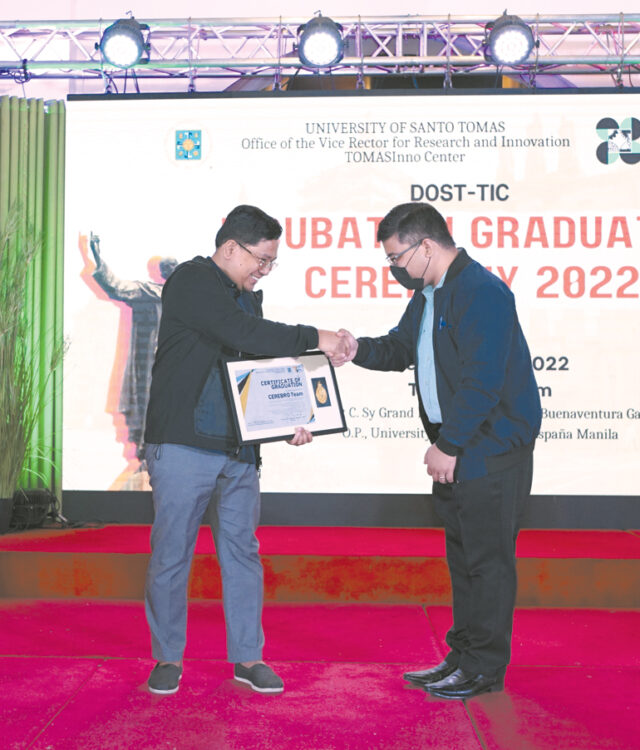
Jonald Justine Itugot (right) shakes the hand of Rev. Fr. Jannel N. Abogado as he receives his certificate.

Two incubatees from TOMASInno Center (TIC), the technology business incubator of the University of Santo Tomas (UST), have successfully completed the incubation program and are now certified DoST (Department of Science and Technology)-TIC Incubation graduates.

The first incubatee is Cerebro, an education technology (edtech) startup that helps solve teachers’ workload issues with ready-to-use digital lessons and curriculum-aligned test banks. Having been implemented as an e-learning tool in 20+ schools during the coronavirus disease 2019 (COVID-19) pandemic, Cerebro has also been in the Top 2 of the Department of Trade and Industry’s Venture Pilipinas Startup Pitch Competition — People’s Choice Awards in 2021.

Cerebro was founded by its Chief Executive Officer (CEO) Jonald Justine Itugot, a licensed professional teacher, who gained over 10 years of classroom teaching and school administration experience in different private institutions before devoting his full attention to e-learning. He is an alumnus of the UST College of Education Class of 2011.

The second incubatee is PainFree (Pain Management and Consulting, Inc.), which helps people with musculoskeletal pain. Its products and services include biomechanical tape and the fasciocutaneous release techniques. It mitigates and lessens the pain of those who suffer from debilitating musculoskeletal conditions. The company has also put up a “Go PainFree” telerehabilitation platform.

Prof. Valentin Dones III (left) receives his certificate from Assoc. Prof. Michael Jorge N. Peralta and Rev. Fr. Jannel N. Abogado.

PainFree is founded by its CEO, the UST Center for Health Research and Movement Science Research Supervisor and College of Rehabilitation Sciences academic staff Prof. Valentin Dones III, Ph.D.

Messrs. Itugot and Dones joined the graduation ceremony previously held at the Dr. Robert Sy Grand Ballroom of the Blessed Buenaventura Garcia Paredes, O.P. Building last Dec. 1, 2022.

During the graduation ceremony, the keynote address was delivered by Engr. Edward Paul H. Apigo, Sr., science research specialist at the Research Information and Technology Transfer Division of the DoST’s Philippine Council for Industry, Energy, and Emerging Technology Research and Development (PCIEERD).

TIC Assistant Manager Prof. Michael Francis D. Benjamin, Ph.D. proudly presented the graduates, while Assoc. Prof. Michael Jorge N. Peralta, MS, MSPT, Ll. M., executive assistant for intellectual property and research of UST’s Office of the Vice-Rector for Research and Innovation, and Rev. Fr. Jannel N. Abogado, O.P., UST’s vice-rector for research and innovation, awarded the certificates.

Under the supervision of the Office of the Vice-Rector for Research and Innovation and in partnership with the DoST, TIC was established in August 2019 to assist startups and to promote innovation and technopreneurship. Since its establishment, it has conducted two batches of the Incubation Program with the guidance of TIC mentors from the academe and UST alumni.

Lopez Holdings Corp.: Investments for the nation’s development

FIRSTGEN.COM.PH

From energy to entertainment, the Lopez Holdings Corp.’s investments in major sectors have provided various services to the Filipino people. And as businesses under the Lopez Group fulfill their service, they also keep in mind the “Lopez Values.”

Having been led by the late Manuel M. Lopez, who was known for his focus on malasakit, Lopez Holdings envisions becoming a “world-class” corporation committed to investments that could better Filipinos’ lives.

The conglomerate is on the mission of investing in industries that are fundamental for nation-building. In its endeavor to serve the Filipinos, it respects the Lopez Values, which involve a pioneering entrepreneurial spirit, business excellence, unity, nationalism, social justice, integrity, and employee welfare and wellness.

Lopez Holdings contributes to powering people’s day-to-day through First Gen Corp., which was established in 1998 as a subsidiary of First Philippine Holdings Corp. (FPH).

First Gen is known for being one of the leading providers of clean and renewable energy in the country. As of end-2021, the company has been providing 3,495 megawatts of electricity and generating 19% of the country’s total energy consumption through clean energy.

Further powering the country, meanwhile, primarily with geothermal energy, was the Lopez Group’s Energy Development Corp. (EDC), which is controlled by First Gen.

As a geothermal energy pioneer, EDC generates 61.30% of the country’s total installed geothermal capacity. A 100% renewable energy producer, the company has nearly 20% share in the country’s total installed renewable energy capacity.

First Gen and EDC are striving to pave the way toward “a decarbonized and regenerative future.”

Aside from sustainable energy development, Lopez Holdings is also into multimedia communications with the ABS-CBN Corp., where many Filipinos get relevant news and information as well as “world-class” entertainment.

ABS-CBN caters to Filipinos with various sources of entertainment, from Filipino movies, foreign entertainment programs, and music, to name a few. The company also ensures that Filipinos residing outside the Philippines could still get the entertainment it offers through The Filipino Channel (TFC).

Moreover, while it primarily serves the Filipino people, ABS-CBN has also expanded its reach by distributing its content to foreign audiences in countries in Southeast Asia, Eastern Europe, and Africa.

Under ABS-CBN Corp., Filipinos are also offered pay television and broadband services through Sky Cable Corp., the country’s largest cable operator.

Beyond providing entertainment to Filipinos’ lives through media, Lopez Holdings also invested in developing spaces where people could have “delightful, memorable experiences.” And that is through the properties built by Rockwell Land Corp.

For its part in the Lopez Group’s commitment to improving Filipinos’ lives, Rockwell Land works on bringing up the standard for living spaces through the development of a community that seamlessly melds residential and workspaces as well as lifestyle hubs.

One of its notable projects is the Rockwell Center, which established its reputation in the real estate scene and transformed the skyline of Makati. Rockwell Land also seeks to elevate the standard of living through its projects beyond Metro Manila, such as the development of Rockwell Center in Nepo, Angeles and the Aruga Resort and Residences — Mactan.

Also in Lopez Holdings’ portfolio that is focused on property development is the First Philippine Industrial Park (FPIP), which has become a favored investment location for manufacturers in light industries. Locators in this 450-hectare economic zone in Batangas have generated 40,000 jobs.

Lopez Holdings also invested in manufacturing through the First Philec Corp., which provides electrical distribution equipment and co-created solutions. First Philec has become a preferred brand of power utilities as well as commercial and industrial businesses. It has more than 250,000 installations across the country.

First Philec, FPIP, and Rockwell Land are also controlled by FPH.

Service for sustainability

The Lopez Holdings has also sought to improve Filipinos’ lives beyond the services offered by the businesses under the group.

Through the Lopez Group Foundation, Inc. (LGFI), various initiatives are made in the clusters focused on Education, Children’s Rights and Development, Environment, Livelihood and Social Enterprise, Health and Wellness, Humanitarian Action, and Arts and Culture.

According to its Sustainability Report, “In 2021, LGFI, committed to forge partnerships and collaborations within the Lopez Group to align advocacies, maximize resources, create deeper and long-lasting impact and significantly contribute to the global and national goals outlined in the UN Sustainable Development Goals and Ambisyon 2040 (Philippine Development Plan), respectively.”

In support of education in the country, LGFI’s scholarship program have carried on. The foundation also provided assistance to different groups and community pantries in Metro Manila amid the COVID-19 pandemic.

Meanwhile, despite the pandemic, the Lopez Museum and Library (LML) maintained its programs and activities to continue supporting the preservation and restoration of the country’s cultural heritage. LML is also looking into shifting online, specifically for the library’s extensive bibliographic collection.

The Knowledge Channel Foundation, Inc. (KCFI) also continued imparting knowledge to Filipino children during the pandemic through video lessons. “Acknowledging the alternative and distance learning modalities implemented by DepEd (Department of Education) in the absence of face-to-face sessions, KCFI strengthened its platforms and ensured greater access to its video lessons,” Lopez Holdings reported.

Knowledge Channel’s library has by far more than 2,000 video lessons.

KFCI also organized virtual training for teachers and principals in 2021 through the Knowledge Channel Teaching in the New Normal (KC TINN). It also trained child development workers and teachers, parents, and other care providers of children aged three to four through the KC TINN for early childhood development.

More students received support through Phil-Asia Assistance Foundation, Inc. (PAAFI). In the academic year 2021-2022, 1,101 scholars were enrolled, bringing PAAFI’s total number of grants offered since 1986 to 21,129.

Of the scholars supported by PAAFI for the said school year, 109 were children of ABS-CBN employees who lost their jobs after the company’s broadcast franchise denial in 2020.

Meanwhile, concerning the environment, the Oscar M. Lopez Climate Change Adaptation and Disaster Risk Management Foundation (OML Center) have expanded climate discussions and bolstered the serviceability of climate science for various actors through the help of partnerships and collaborative projects. — Chelsey Keith P. Ignacio

GDP growth may have slowed in Q4 — poll

People walk past stalls selling Christmas lanterns in San Fernando, Pampanga, Nov. 7. Philippine economic growth likely slowed in the fourth quarter, but hit the upper end of the full-year target in 2022, according to a BusinessWorld poll. — PHILIPPINE STARMIGUEL DE GUZMAN

THE PHILIPPINE ECONOMY may have slowed in the fourth quarter of 2022, but still likely hit the upper end of the government’s full-year growth target, according to analysts.

Gross domestic product (GDP) likely grew 6.8% in the October-to-December period in 2022, according to the median forecast of 23 economists polled by BusinessWorld, slower than the 7.6% rise in the third quarter and the 7.8% print in the same period in 2021.

For the full year, the economy may have grown 7.5%, according to median forecasts of economists, matching the high end of the Development Budget Coordination Committee’s (DBCC) 6.5%-7.5% target.

Analysts’ Q4 and full-year 2022 GDP growth estimates

If realized, this would be faster than the 5.7% GDP expansion in 2021 and may be the quickest economic growth since the 8.8% seen in 1976.

It would also mark the second straight year of growth after the record 9.5% contraction in 2020 due to the pandemic.

The poll’s 7.5% growth median estimate for 2022 is higher than the International Monetary Fund’s 6.5% forecast, Asian Development Bank’s 7.4%, and the World Bank’s 7.2%.

The fourth-quarter and full-year 2022 economic performance of the country will be released on Jan. 26, along with December trade data.

Economists said household consumption continued to drive GDP growth in the fourth quarter.

“We expect that the consumption boost from revenge spending continued in the fourth quarter of last year and that this outweighed the negative impact of high inflation on consumer demand,” Philippine National Bank economist Alvin Joseph A. Arogo said.

Inflation accelerated to a 14-year high of 8.1% in December, bringing the full-year average to another 14-year high of 5.8%.

Makoto Tsuchiya, assistant economist at Oxford Economics, said inflation may have peaked in the fourth quarter and weighed on consumer spending.

“We think the sequential momentum has decelerated as the initial reopening boost fades, while the deteriorating external outlook weighed on foreign demand as well as business and consumer sentiment,” Mr. Tsuchiya said in an e-mail.

ANZ Research economist Debalika Sarkar said sustained remittance flows, the improvement in the labor market, and strong demand for household credit boosted private consumption growth.

Cash remittances during the January-to-November period rose 3.3% to $29.38 billion. The unemployment rate stood at 4.2% in November, the lowest in over 17 years or since April 2005.

“The labor market has been resilient, supported by firm Purchasing Managers’ Index (PMI) manufacturing, which has resulted in a significant increase in manufacturing employment. The face-to-face school session that started in August 2022 also contributed to increased economic activities and firm domestic demand,” Suhaimi Bin Ilias, chief economist at Maybank Investment Bank said.

S&P Global Philippines’ PMI data showed factory output in the country expanded to 53.1 in December from 52.7 in November, suggesting a solid improvement in the health of the Filipino manufacturing sector.

A PMI reading above 50 indicates improvement in operating conditions compared with the preceding month, while a reading below 50 shows deterioration.

EXTERNAL HEADWINDS
“The unprecedented external headwinds have dashed hopes of sustaining high GDP growth rates for the local economy which has just caught up with the pre-pandemic level of output,” Romeo Bernardo, an economist from think tank GlobalSource Partners, said.

Shivaan Tandon, Capital Economics’ emerging Asia economist, said the impact of the Russia-Ukraine war was reflected in the elevated inflation in the Philippines and overseas.

“In response to high inflation, partly induced due to the impact of the Russia-Ukraine war on commodity prices, monetary policy has been tightened rapidly, both at home and abroad. Since monetary policy acts with a lag, we are likely to see a sharp deterioration in the domestic demand environment in 2023,” he said.

Emilio S. Neri, Jr., lead economist of Bank of the Philippine Islands (BPI), said the national elections and the government’s COVID-19 vaccination drive allowed the economy to reopen, but investor and consumer confidence was dampened by the Russia-Ukraine war.

“Higher inflation, the sharp rise in policy rates and the weak peso were some of the drags throughout most of the second semester of the year. The reopening of face-to-face classes and pent-up demand managed to outweigh these though,” Mr. Neri said.

‘CHALLENGING’
Economists expect a slowdown in the Philippine economy this year, amid the risk of a global recession.

“2023, however, appears to be a challenging one, however, as the triple threat of sticky inflation, elevated borrowing costs and high government debt all weigh on growth prospects,” Nicholas Antonio T. Mapa, senior economist at ING Bank N.V. Manila, said.

Economic managers are targeting 6-7% GDP growth this year.

“The 6.5% official target and the 7% unofficial targeted of the President will be a tall order as the odds are stacked again the Philippines, all the more with the global economy expected to face a recession,” Mr. Mapa said.

Capital Economics’ Mr. Tandon said the expected global recession this year will weigh on exports from the Philippines, which may grow by only 4.5% this year.

Oxford Economics’ Mr. Tsuchiya said inflation will remain elevated this year, which may continue to reduce consumers’ purchasing power.

“We look for the Philippines economy to grow only 3.1% in 2023 amid mounting headwinds,” he said.

Domini S. Velasquez, chief economist in China Banking Corp., said economic growth is expected to slow to 5.8% in 2023 “as demand momentum dissipates.”

“High interest rates will also be a deterrence to business expansion. However, recent Chinese reopening will be a tailwind for this year, providing much-needed boost against recessions in advanced economies,” she said.

HSBC ASEAN economist Aris Dacanay said consumption, investment and even trade growth are likely to ease this year. He expects GDP growth to average 4.4% this year. 

“Households have dipped into their savings in response to today’s higher cost of living. Thus, consumption should slow in 2023 as households readjust their purchases and start to build their savings back up. History also shows that a high interest environment will likely put a drag on growth by reining in both consumption and investment,” Mr. Dacanay said. — A.M.P. Yraola