Home Blog Page 5396

Defense powers San Francisco 49ers past Dallas Cowboys into NFC title game

CHRISTIAN McCaffrey rushed for the tie-breaking touchdown and the San Francisco 49ers went on to a 19-12 victory over the Dallas Cowboys on Sunday in Santa Clara, Calif., to advance to the NFC Championship Game.

Robbie Gould kicked four field goals and rookie Brock Purdy completed 19 of 29 passes for 214 yards as the second-seeded 49ers won their 12th consecutive game. George Kittle caught five passes for 95 yards for San Francisco, which eliminated Dallas from the postseason for the second straight year.

Dak Prescott was 23-of-37 passing for 206 yards, one touchdown and two interceptions for the Cowboys. Mr. Prescott tied for the regular-season high of 15 interceptions before tacking on more miscues against the 49ers.

San Francisco will visit the top-seeded Philadelphia Eagles in next Sunday’s NFC title game. It is the 49ers’ third appearance in the past four seasons.

Deommodore Lenoir and Fred Warner had the interceptions for San Francisco.

CeeDee Lamb had 10 receptions for 117 yards for the fifth-seeded Cowboys.

Dallas lost running back Tony Pollard to a left ankle injury late in the second quarter. He was carted off the field. Mr. McCaffrey’s 2-yard touchdown run on the first play of the fourth quarter capped a 10-play, 91-yard drive and gave the 49ers a 16-9 lead.

Brett Maher booted a 43-yard field goal to move the Cowboys within four with 11:03 to play.

Mr. Gould kicked a 28-yard field goal with 3:04 remaining to restore the seven-point advantage. Dallas was unable to threaten on its final drive before time ran out on its season.

Mr. Gould kicked three first-half goals to give San Francisco a 9-6 halftime lead.

Mr. Lenoir’s interception of Mr. Prescott set up Mr. Gould’s 26-yard field goal with 2:12 left in the opening quarter.

Dallas took a 6-3 lead on Mr. Prescott’s 4-yard pass to Dalton Schultz with 9:25 remaining in the second quarter. San Francisco’s Samson Ebukam used his left hand to block Mr. Maher’s extra point, his fifth such miss this postseason, one shy of the career playoff record held by Roy Gerela (1969-79).

Mr. Gould booted a 47-yard field goal to tie the score with 3:43 left. Warner intercepted Prescott at the 49ers’ 12 with 1:15 left and San Francisco took advantage with Mr. Gould’s 50-yard kick as time expired in the half.

Ray-Ray McCloud fumbled on a punt return early in the third quarter and Dallas’ Damone Clark recovered at the San Francisco 21. The Cowboys cashed in when Mr. Maher sent a 25-yard field goal through the middle of the uprights to tie it at 9 with 9:08 remaining in the third quarter. — Reuters

Quarterback ‘Joe Cool’ delivers as Bengals beat Bills to reach AFC Championship game

QUARTERBACK Joe Burrow overcame driving snow and a hostile road environment, leading the Cincinnati Bengals past the favored Buffalo Bills 27-10 and reaching the American Football Conference (AFC) Championship game for the second straight year.

Mr. Burrow guided the Bengals to 412 yards of total offense, 30 first downs and zero turnovers behind a commanding performance from the offensive line.

“Complete game from everybody — offense, defense and special teams,” said Mr. Burrow, who threw for 242 yards and two touchdowns. “Domination from start to finish. That’s what we expected.”

On the other side of the ball, the Bengals’ defense made life difficult for Josh Allen and the Bills offense, who converted just 5 of 12 third downs and never found a rhythm. “But the job’s not finished,” Mr. Burrow said. “We have another big one on the road next week. Excited for it.”

The Bengals will return next Sunday to Kansas City for a rematch of last year’s AFC Championship game against the Patrick Mahomes and the Chiefs, which the Bengals won 27-24 in an overtime thriller.

Had the Bills prevailed on Sunday, the AFC Championship game would have been played at the neutral site of Atlanta, and the Bengals took great motivation from the fact that tickets were already being sold for a potential Bills-Chiefs matchup.

“You better get those refunds,” Mr. Burrow said with a grin.

Cincinnati running back Joe Mixon praised his quarterback for living up to his nickname of Joe Cool in Sunday’s pressure-packed game.

“Joe Burrow was unbelievable,” Mr. Mixon said.

“In games like this he always rises to the occasion and so do our teammates. Under the brightest lights, we shine even brighter,” he said.

A predicted a “great show” next week with a trip to the Feb. 12th Super Bowl in Glendale, Arizona on the line.

“Everybody ready for the Mahomes and Burrow show and I guarantee you it’s going to be a dog fight out there,” he said. — Reuters

[B-SIDE Podcast] Filipino nurses: Heroes who can’t afford houses

Follow us on Spotify BusinessWorld B-Side

Hailed by the Duterte and Marcos administrations as the country’s new heroes—mga bagong bayani—nurses bore the brunt of the coronavirus disease 2019 (COVID-19) pandemic along with doctors and other frontliners. 

In this B-Side episode, Monina A. Hernandez, a clinical nurse specialist who left the Philippines, talks to BusinessWorld reporter Patricia B. Mirasol about why Filipino nurses leave and what the government might do to make them stay. “We are human beings. We have needs. Raise the salary of nurses [so it can] address the need for commodities and housing,” said Ms. Hernandez.

TAKEAWAYS  

There are myriad reasons Filipino nurses leave, including financial and historical.

Compensation is the most obvious reason nurses leave. “The monthly salary of nurses in the Philippines is less than a week’s salary of nurses in New Zealand and Australia,” Ms. Hernandez, who founded the Filipino Nurses Association of New Zealand, Inc.

The entry-level salaries of nurses in private Philippine hospitals range from P12,500 to P16,000 a month. Mid-level registered nurses in the Philippines are the lowest paid as compared to their counterparts in Vietnam, Malaysia, Thailand, Singapore, Hong Kong, and Indonesia. 

Beyond socioeconomic factors, Ms. Hernandez cited the Philippines’ colonial past. The country’s history as an American colony has made migration appealing, she said. (In 2019, one out of 20 registered nurses in the US was trained in the Philippines.)  

The Philippine education system, she added, is “indirectly or directly … pushing kids out of the country.” 

That greener pastures are found beyond local shores is “ingrained as early as high school,” she said. 

There are enough nursing graduates but not enough jobs that pay a living wage. 

A chunk of nursing graduates who are still in the country aren’t practicing because there are other jobs that pay more, said Ms. Hernandez. Instead of joining the medical field, they opt to teach or take call center jobs.

“The first thing the government should do is create nursing positions for these nurses,” she said. “It’s a matter of the government prioritizing health, so they can attend to the health needs of the entire country.” 

Recorded remotely December 2022. Produced by Joseph Emmanuel L. Garcia and Sam L. Marcelo.

Read the related story: “Preparing the public health system for the next pandemic”

Red flags of the Maharlika Investment Fund

The Maharlika Investment Fund has been the subject of much controversy after its swift passage in the House of Representatives. House Bill (HB) No. 6608 seeks to establish an independent fund which the government can use to make strategic investments, or what is more commonly called a “sovereign wealth fund.”

While it is easy to look at the successful sovereign wealth funds, such as Norway’s Government Pension Fund and China’s China Investment Corp. (which have trillions in assets, according to the Sovereign Wealth Fund Institute) or even Singapore’s Temasek, there are also some other funds out there that should serve as a warning — specifically, 1MDB.

PROBLEMS OF TRANSPARENCY
One of the most prominent scandals in the financial world was that involving 1MDB. 1Malaysia Development Berhad, or 1MDB, was Malaysia’s sovereign wealth fund, and was the subject of embezzlement and money laundering. An estimated $4.5 billion was alleged to have been stolen from the 1MDB and it further incurred outstanding debts amounting to $7.8 billion.

Certainly, one might say that the 1MDB is just one sovereign wealth fund and that there are more successful wealth funds out there. However, one of the oft-repeated criticisms against sovereign wealth funds is their lack of transparency and accountability.

If the Philippine government were less corrupt, then maybe they could be trusted with a fund like this. As of 2021, the Philippines ranked 117 (out of 180 countries) in the Corruption Perception Index published by Transparency International. It scored a total of 33 out of 100.

Still, even if we assume that public officials (and/or the people who would be handling the fund) are incorruptible saints, there are still several other red flags to look out for.

LACK OF SURPLUS REVENUES
One of the major problems is the source of funds. Sovereign wealth funds generally arise out of a country’s surplus revenues — whether from surpluses due to natural resources, trade surpluses, or any other similar sources.

Bangko Sentral ng Pilipinas (BSP) Governor Felipe M. Medalla claims that the balance sheet is strong enough for the Maharlika Investment Fund, and Finance Secretary Benjamin E. Diokno even went so far as to claim that the BSP has “too much” gross international reserves.

However, the figures appear to disagree. In fact, as of September 2022, the National Government recorded a P179.8-billion budget deficit. Though this is lower than last year’s P180.9 billion deficit, it is, nevertheless, still a deficit.

So, given this deficit, where exactly does the government expect to draw its funds from?

The initial capitalization of P75 billion would be sourced from the Land Bank and the Development Bank of the Philippines. For subsequent funding, it will tap the BSP’s declared dividends, PAGCOR’s gaming revenue streams, and other sources, such as royalties and/or special assessments based on natural resources, proceeds from privatization of government assets, and borrowings by the Maharlika Investment Fund (MIF).

Clearly, these are not sourced from any surplus revenue.

The initial versions of the bill also included the Social Security System and Government Service Insurance System (SSS and GSIS) as sources of funds, which means the government would be passing the burden onto its citizens. Thankfully, this idea appears to have been scrapped in the later versions.

SAFEGUARDS
Another problem is the issue of safeguards. The 1MDB scandal noted above was a result of inadequate safeguards. So, it merits asking: Does the Maharlika Investment Fund have sufficient safeguards?

Proponents of the fund are quick to assure the public that there are enough safeguards — such as the adherence to the arm’s length principle and the prudent person rule.

The Fund would also comply with the Santiago Principles, which are the generally accepted principles and practices (GAPP) voluntarily endorsed by the members of the International Forum of Sovereign Wealth Funds. These principles essentially embody the “best practices” for the operations of sovereign wealth funds. The bill also states that the fund would adhere to “internationally accepted standards of transparency and accountability” as well as with other laws, such as the Securities Regulation Code, and ethical standards.

Of course, what the law states and how it is implemented would not necessarily be the same.

Assume, then, for the sake of argument, that a violation of these safeguards occurs. What then would be the penalty against the offender? The law provides that, for the auditor, the fine is P80,000 to P500,000. In case the auditor’s failure is attended by fraud or injury to the general public, then the auditor or responsible officer may be fined P100,000 to P600,000.

What about for graft and corrupt practices? A corporation who appoints an intermediary who then engages in graft and corrupt practices would be punished with a fine of P100,000 to P1,000,000. Any director or officer who tolerates such graft and corrupt practices would be penalized P500,000 to P1,000,000 as well.

In looking at these penalties, remember that the Maharlika Investment Fund would be handling billions in taxpayer money.

OTHER PROVISIONS
Under HB 6808, 1.) all funds, assets, and properties, 2.) all revenues, income, or investment earnings, as well as accruals thereto; and, 3.) purchase of supplies, equipment, papers, or documents are exempt from tax.

Importation of supplies and equipment for the fund would also be exempt from customs duties.

Instead, in lieu of the taxes and the customs duties, the Maharlika Investment Corp. is obliged to remit at least 25% of its net profits as poverty and subsistence subsidies to Filipinos living below the poverty threshold. The remainder of the fund’s net profits would be remitted to the National Government, to be earmarked for social welfare programs.

Aside from the tax exemptions, there are also other provisions on exemptions and privileges. The Maharlika Investment Corp. is also exempt from the GOCC Governance Act of 2011, from the Government Procurement Reform Act, and the Salary Standardization Act.

The Fund’s exemption from the Government Procurement Reform Act is another possible red flag. Of course, the exemption is limited only to “the procurement or engagement of the professional or technical services needed in the selection of investments,” it is still a provision that possibly warrants looking into.

The Philippine Government is, after all, not a stranger to paying for overpriced procurements. Just over a year ago, the Pharmally scandal resulted in billions in taxpayer money being used in the payment of allegedly overpriced face shields and other COVID-19 supplies.

PRIORITIZING MEASURES OTHER THAN THE MAHARLIKA FUND
Another important question that warrants asking is on the timing. Is now the time to establish the fund? While it is possible for the fund to be profitable in the future, it certainly does not address the present economic problems faced by the country. As of December 2022, the Philippines has a national debt of P13 trillion. As of December 2022, the country’s inflation rate stands at 8.1%. These are not problems that could be solved by a sovereign wealth fund.

Instead, the government should focus on addressing the present economic issues that the country is facing. It should address inflation by either implementing fiscal restraint, developing new sources of revenues, or even possibly both. As we have been proposing, it should also look into improving tax collections by modernizing the Bureau of Internal Revenue and lifting bank secrecy laws.

More importantly, if the government is to be trusted with managing a sovereign wealth fund, it should first take steps to improve transparency and accountability, and to eradicate graft and corruption.

Overall, sovereign wealth funds do indeed appear to have some benefits, but there are plenty of red flags that make them prone to corruption by unscrupulous politicians.

Given the scope and the potential implications of such a fund, it certainly deserves more than the 17 days that the lower house accorded it. The bill would still have to pass through the Senate before it can be signed into law. Hopefully, the upper house would accord it the skepticism it deserves and carefully scrutinize the bill in question.

This article reflects the personal opinion of the author and does not reflect the official stand of the Management Association of the Philippines or MAP.


Raymond “Mon” A. Abrea is an MPA/mason fellow at Harvard Kennedy School. He is a member of the MAP Tax Committee and the MAP Ease of Doing Business Committee, co-chair of Paying Taxes on the Ease of Doing Business Task Force, and chief tax advisor of the Asian Consulting Group.

map@map.org.ph

mon@acg.ph

Ten themes in development economics (and the Ruperto Alonzo lectures)

Economics is the study of the proper allocation of limited resources given unlimited wants. Development economics is a branch of economics that focuses on developing countries’ social, economic, and fiscal allocation of resources.

The University of the Philippines School of Economics (UPSE) has three academic programs — undergraduate, MA, and PhD — and the Program in Development Economics (PDE). The last was created in the mid-1960s and designed for mid-level technical staff of various government agencies. It is applied economics with theoretical background like marginal cost curves, production possibility frontier, etc.

After finishing my AB Economics in UPSE in the 1980s, I went back to the school in the ’90s to study PDE when I was still working at the House of Representatives. Here are among the important themes in the course that I can remember and our teachers then.

1. In macroeconomics: GDP and consumption formula. GDP or gross domestic product, is the sum of household consumption (C), Investment (I), and Government consumption (G) net of exports minus imports (X-M). In formula form: GDP = C + I + G + (X-M). C is the largest part of GDP — in the Philippines it is about 67% to 70% of GDP. It is the sum of autonomous consumer spending (a), marginal propensity to consume (b), and disposable income (Yd). Or C = a + bYd. I will discuss more of this when the full year 2022 GDP will be released by the Philippine Statistics Authority (PSA) on Jan. 26. My teacher was Prof. Ruperto P. Alonzo (RPA, RIP).

2. In microeconomics or household and firm level study: the role of marginal pricing. Profit is optimum when the marginal (or extra) revenue (MR) is equal to marginal cost (MC), or MR = MC. A basic application of this principle is when a firm employs only 15 workers, not 14 or 16 or more. Because having only 14 workers means MR can still be increased while having 16 workers or more means MC is higher than MR and the company can lose money. Government social spending and tax revenues are dependent on people having jobs and companies paying taxes and not losing money. My teacher was Prof. Manny Esguerra, a former National Economic and Development Authority (NEDA) Undersecretary.

3. In math economics: linear functions like C = a + bYd. Then integral calculus and differential calculus are used to derive marginal costs and pricing. There is lots of math and Greek equations in economics, really, part of mental exercises to prepare students for quantitative and objective analysis.  My teacher was current UPSE Dean Joy Abrenica.

4. In econometrics: doing regression models to help predict something. Projections for future GDP, inflation rate, interest rate, international trade, etc. are often done via simple or complicated econometric models using many tools of statistics. My teacher was former UPSE Dean Orville Solon.

5. In development economics: the role of agriculture in rural modernization. There are many policies in this subject but among the prominent ones are agricultural lending and agrarian issues. My teacher was Prof. Arsenio Balisacan, now NEDA Secretary.

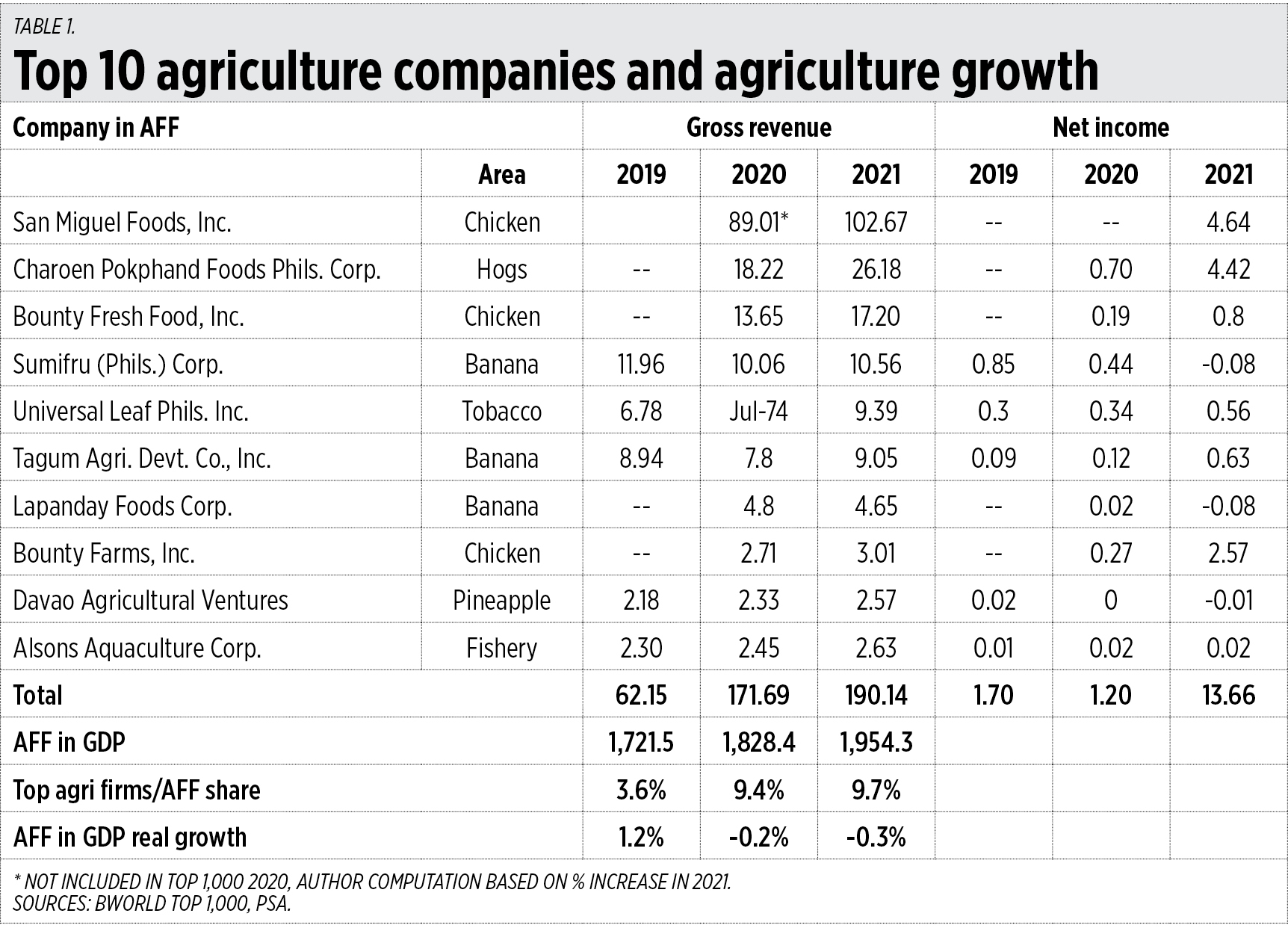
I want to use the recently published BusinessWorld Top 1000 Corporations in the Philippines 2022, looking at companies in Agriculture, Fishery and Forestry (AFF), and compare them with the overall AFF output in GDP. Companies in the AFF sector are doing well, and revenues were rising even during lockdowns of 2020 and 2021. But overall performance of AFF in GDP is low or negative (see Table 1).

This implies that the non-corporate AFF was doing badly, lacking economies of scale and the financial discipline to withstand big disruptions like the prolonged lockdown. There is a need to move towards land consolidation and more corporate farming.

6. In public finance economics: fiscal discipline to control the budget deficit and public debt. The most basic formula is Revenues (taxes, fees, privatization, etc.) less Expenditures equals Budget balance, surplus, or deficit. My teacher was Prof. Benjamin Diokno, now the Finance Secretary. The relevant numbers on the Debt/GDP ratio of many countries, the Philippines’ revenues, expenditures, deficit and borrowings were discussed in this column’s piece, “The Top 10 fiscal and monetary news stories of 2022” (Dec. 26, 2022).

7. In project evaluation economics: policies and strategies to improve success and positive impact of projects. Both public programs and private enterprises.  My teacher was Prof. RPA.

I want to use data of the UN Conference on Trade and Development (UNCTAD) and World Investment Report (WIR) 2022 on non-finance multinational enterprises (MNEs). These companies are into manufacturing, real estate, energy, mining, etc. and use heavy computations on project finance and evaluation. There are no Philippine companies in the UNCTAD’s Top 100 MNEs in developing countries, so I inserted the top five Philippine companies from the BusinessWorld’s Top 1000 2021 report. To convert the Philippine Peso to the US Dollar, I used the average exchange rate of P49.62/$ in 2020 (see Table 2).

8. In monetary economics: the role of monetary policies in price stabilization. This is heavily used now in many countries, as central banks raise their interest rates to help discourage people from high spending and save more of their money, and hope to fight very high inflation that way. Our Dean that time was Prof. Felipe Medalla, now Central Bank Governor.

9. The role of public-private partnership (PPP) in infrastructure and economic development. This has an important role in controlling the budget deficit and public debt, which heavily uses tools and concepts in project finance and evaluation. And this is the topic of the first PDE Ruperto P. Alonzo (RPA) Lecture Series. The Executive Director of the PPP Center, an engineer-economist, PDE alumna, and student of RPA, Cynthia Hernandez, will be the speaker and she will discuss “29 years of BOT (build-operate-transfer) law and the way forward.” She will have three reactors, from government, a private infrastructure company, and an LGU official. This will be on Feb. 8, Wednesday, from 3-5 p.m., at the UPSE auditorium.

10. The role of a bright, friendly and warm teacher. Prime example is Prof. “Ruping” RPA. In the words of his loving wife, Zorayda Amelia “Mel” Alonzo, Sir Ruping “was a dedicated teacher, both to his children and students and even to me and other people he touched during his lifetime. He wanted people to excel to the best of their abilities not only for themselves but for the country, that they may be positive contributors to the welfare of the Filipino people especially those who have less in life. Shy and often silent in the company of new acquaintances, he lost this shyness in the classrooms and lecture halls while he imparted his knowledge, beliefs and advocacies to his students in the decades he spent as a teacher and professor at UPSE.”

So readers, I hope to see you at the lecture on Feb. 8 — which is also Sir Ruping’s 75th birthday — at the UPSE auditorium, UP Diliman, QC.

To get the latest edition of the Top 1000 Corporations in the Philippines, go to https://bworld-x.com/ or contact BusinessWorld’s Circulation department at 8527-7777 locals 2649 or 2650 or e-mail at circ@bworldonline.com.


Bienvenido S. Oplas, Jr. is the president of Bienvenido S. Oplas, Jr. Research Consultancy Services, and Minimal Government Thinkers.

minimalgovernment@gmail.com

The crypto crackdown is just getting started

KANCHANARA—UNSPLASH

There was much mirth online when the US Justice department announced the arrest of crypto exchange Bitzlato’s founder last week. Unpronounceable, unknown, and unlike any of the far bigger fish (like Binance) getting headlines, Bitzlato looked like a small-fry, a nothingburger. The fact that Bitcoin resumed its march past $21,000 seemed to confirm it.

But this ignores the bigger picture. In the first few weeks of 2023, watchdogs have done a lot. On Jan. 3, a joint statement by US bank regulators warned the industry of crypto risks creeping into the banking system. Then came a $100-million settlement with Coinbase Global, Inc. over weak internal controls, a lawsuit against the Winklevoss twins’ Gemini and broker Genesis for allegedly selling unregistered securities, and a $45-million settlement with lending platform Nexo (which has ceased US operations). Subpoenas are flying.

The wheels of justice turn slowly — the Gemini and Genesis complaint came too late for customers fighting to get back $900 million in trapped funds — but they’re accelerating now. Regulators like the SEC rightly feel vindicated by the past year’s events, which saw a widespread loss of faith in crypto fail to snowball into a wider economic crisis. The collapse of FTX demonstrated the industry’s failings but also the benefits of a tough regulatory line on exchanges, such as when the SEC intervened behind the scenes in 2021 to ward Coinbase off launching its own crypto-lending product. As one official put it last year, the “runway is getting shorter” for unruly platforms.

There may be plenty of debate over whether crypto tokens are more like securities, commodities, shadow banking, or gambling, but the ongoing focus is to ensure crypto’s troubles don’t leak into the financial system. While legislative attempts to craft crypto rules designed to prevent another “Lehman Brothers moment” run into procedural delays and embarrassing revelations about FTX’s history of cozy ties with Capitol Hill, regulators with long memories are keeping an active eye on banks’ crypto exposure as the real risk gauge. Silvergate Capital Corp., already crushed by its exposure to FTX, seems to have gotten the message and written down the value of stablecoin assets it bought from Meta Platforms, Inc.’s Diem — worth almost $200 million at the time — to basically nothing.

The Bitzlato action is part of this push, with the Department of Justice citing the exchange’s inadequate anti-money-laundering controls and “substantial” business with US customers — two examples of the kind of regulatory gaps in the system that missed FTX’s red flags. Carol Van Cleef, a lawyer with a long experience in digital assets, sees a blueprint for future actions, including the US Treasury’s determination that Bitzlato is a “primary money laundering concern,” rendering it effectively an international pariah. This goes beyond the SEC.

Regulation has critics. Some fear overreach; others think it counter-productive to try to build guardrails around digital assets rather than stepping back and letting it “burn.” It’s true that crypto is rife with activity that’s more gambling than investing. And it’s somewhat depressing to see that those at the heart of last year’s crypto collapse already have redemption in mind, from Three Arrows Capital to FTX.

But money laundering, fraud, market manipulation, and tax evasion aren’t risks that just fix themselves. As the European Central Bank’s Fabio Panetta has pointed out, regulators see the costs to society of unregulated digital assets as high and requiring more action. The crackdown is clearly just getting started; those who are keen to dive back into crypto, even having just taken a bath, should take note.

BLOOMBERG OPINION

Dated HR practices could threaten privacy of applicants — security expert

PIXABAY

Human resources (HR) departments should take better care of the personal information that passes through their hands during the hiring process, a data security expert said.

Sensitive documents, such as the resumes of rejected applicants, should be shredded and anonymized by hiring managers instead of being used as scratch paper, said Ernest Richard Ocson of Cosaint Consulting, a company that offers governance, risk, and compliance services.

“The data is still theirs,” he said. “We process their documents, but the data is still theirs.”

HR practices that also need to be reevaluated include selling old documents, such as manuals, for recycling as well as processing a job applicant’s resume without their explicit consent. Neither align with the Data Privacy Act, Mr. Ocson said in a Jan. 13 webinar organized by the Learning Innovation Hub PH.

The Data Privacy Act (DPA) of 2012, or Republic Act 10173, assures the “free flow of information to promote innovation and growth” while protecting an individual’s rights to privacy.

“Integrity is ensuring data privacy is kept throughout the life cycle of that data,” Mr. Ocson said, who also advised verification before disclosure.

If the HR department gets a call from someone supposedly doing background checks on an employee applying for a bank loan, whoever accepts the call shouldn’t “blindly disclose information,” said Mr. Ocson.

“We need to verify the identity of the person calling first,” he added. “If we don’t verify, then we already violated that employee’s rights.”

Coordination is likewise necessary between HR and the information technology department as the company submits its annual security incident report to the National Privacy Commission (NPC).

The definition of a security incidence is relatively broad, Mr. Ocson said. A security breach can mean anything from sending documents to the wrong person, opening files that should not have been opened, visiting links that should not have been visited, losing access to corporate resources, or misplacing identification cards.

Not every company will need to register their data processing systems in compliance with NPC Circular 17-01, Mr. Ocson added. Every company that processes personal information, however, will need to comply with the DPA.

(Per NPC Circular 17-01, an organization that employs fewer than 250 persons is not required to register, unless “the processing it carries out is likely to pose a risk to the rights and freedoms of data subjects, is not occasional, or includes sensitive personal information of at least 1,000 individuals.”)

“Data privacy compliance at the organizational level has business value,” Mr. Ocson said. “The other risks for not complying — apart from penalties and fines — are employee disengagement, operational disruptions, and reputational damage.” — Patricia B. Mirasol

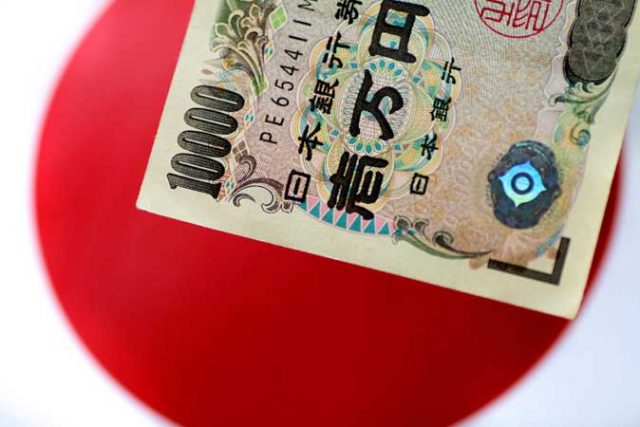
Japan’s finances are becoming increasingly precarious — Suzuki

REUTERS

TOKYO — Japan’s finances are becoming increasingly precarious, Finance Minister Shunichi Suzuki warned on Monday, just as markets test whether the central bank can keep interest rates ultra-low, allowing the government to service its debt.

Japan’s public debt is more than double its annual economic output, by far the heaviest burden in the industrialized world.

The government has been helped by near-zero bond yields, but bond investors have recently sought to break the Bank of Japan’s (BoJ) 0.5% cap on the 10-year bond yield, as inflation runs at 41-year highs, double the central bank’s 2% target.

“Japan’s public finances have increased in severity to an unprecedented degree as we have compiled supplementary budgets to respond to the coronavirus and similar issues,” Mr. Suzuki said in a policy speech starting a session of parliament.

Mr. Suzuki reiterated the government’s aim to achieve an annual budget surplus — excluding new bond sales and debt-servicing costs — in the fiscal year to March 2026. The government, however, has missed budget-balancing targets for a decade.

The Ministry of Finance estimates that every 1-percentage-point rise in interest rates would boost debt service by 3.7 trillion yen ($29 billion) to 32.5 trillion yen ($251 billion) for the 2025/2026 fiscal year.

“The government will strive to stably manage Japanese government bond (JGBs) issuance through close communication with the market,” he said.

“Overall JGB issuance, including rolling over bonds, remain at an extremely high-level worth about 206 trillion yen ($1.6 trillion). “We will step up efforts to keep JGB issuance stable.”

“Public finance is the cornerstone of a country’s trust. We must secure fiscal space under normal circumstances to safeguard trust in Japan and people’s livelihood at a time of emergency.”

Prime Minister Fumio Kishida echoed Mr. Suzuki’s resolve to revive the economy and tackle fiscal reform. He stressed the need for a positive cycle of growth led by corporate profits and private consumption, which accounts for more than half of the economy.

“Wage hikes hold the key to this virtuous cycle,” Mr. Kishida said in his policy speech. He vowed to push labor reform to create a structure that allows sustainable wage growth and overcome the pain of rising living costs.

“First of all, we need to realize wage growth that exceeds price increases,” Mr. Kishida added, pledging to also boost childcare support, and push investment and reform in areas such as green and digital transformation.  Reuters

Deadly shooting turns Monterey Park’s mass celebration into massacre on Lunar New Year

JANNOON028 — FREEPIK

MONTEREY PARK, Calif.  — The red lanterns bobbed and banners proclaimed “Happy Year of the Rabbit” but Monterey Park’s famous Lunar New Year festivities were brought to an abrupt end by a shooting that left 10 people dead and another 10 wounded.

Vendors dismantled stalls and workers took apart a fairground on Sunday in the normally placid community of 60,000, where thousands from across Southern California gathered on Saturday.

The city on the eastern edge of Los Angeles was holding its first in-person celebration of the Lunar New Year since the COVID-19 pandemic began.

But the festivities turned into bloody mayhem as a man was accused of fatally shooting 10 people at a ballroom dance venue late on Saturday. Officials said at least another 10 people were taken to local hospitals to be treated for wounds.

Video taken by local news media after the shooting showed injured people, many of them appearing to be middle aged, being loaded into ambulances on stretchers.

“Monterey Park should have had a night of joyful celebration of the Lunar New Year. Instead, they were the victims of a horrific and heartless act of gun violence,” California Governor Gavin Newsom said.

Monterey Park is around 7 miles (11 km) from downtown Los Angeles. About two-thirds of its residents are Asian, according to US Census data, and the city is known for its many Chinese restaurants and groceries.

Heading into the planned weekend celebrations, the city said on its official Twitter page that a two-day open street event was going to be held in the downtown area.

“It has always been an exciting and memorable event with thousands of guests and hundreds of vendors joining us for fun activities, shopping and entertainment, and delicious food,” the city said in its Thursday announcement.

The festivities scheduled for Sunday were canceled after the mass shooting.

When police arrived at the shooting scene, people were “pouring out of the location screaming,” said Andrew Meyer, captain of Los Angeles County Sheriff’s Department.

The suspect entered the ballroom dance venue and opened fire. The shooting site was near the Lunar New Year festival.

Police have not named the dance club but were seen going in and out of the Star Ballroom Dance Studio, access to which was blocked off by police tape. The club opened in 1990, and its website features many photographs of past Lunar New Year celebrations showing patrons smiling and dancing in party clothes in its large, brightly lit ballroom.

A flyer posted on the website advertised Saturday night’s new year party, running from 7:30 p.m. to 12:30 a.m. Sunday.

“I was just in this area with my parents and I was celebrating Lunar New Year last night,” said Cindy Phung, who attended the festival celebrations.

Her family left the area before the shooting happened, she said. — Reuters

China’s tourists hit Thailand’s beaches for 1st time in 3 years

REUTERS

PHUKET, Thailand — Hitting the white sand beaches and eating mango sticky rice and seafood, Chinese tourists are returning to Thailand for their first trips abroad since China ended its strict COVID-19 curbs and reopened its borders.

“Because of the pandemic, we hadn’t been out of China for three years,” said tourist and business owner Kiki Hu, 28, in Krabi on  that we can leave and come here for holiday. I feel so happy and emotional”.

With China celebrating the Lunar New Year, Asia’s tourist hotspots have been bracing for the return of Chinese tourists, who spent $255 billion a year globally before the pandemic. Countries from Thailand to Japan had depended on China as their largest source of foreign visitors.

Beijing in December abruptly dropped some of the toughest COVID restrictions on earth, which had battered the world’s second-biggest economy.

Business owner Yoyo Chen, 32, from Yiwu in central China, said returning to Thailand felt like coming home.

“I’m here to eat seafood. Previously, when I was here, I ate mango sticky rice, which was delicious. Back in China I kept thinking about the mango sticky rice here. I’m looking forward to the food, as well as visiting the beaches,” Ms. Chen said.

“Getting visas is very convenient now. The tourism industry is more developed here, there are lots of fun activities and cuisine, and the Thai people are very hospitable,” she said.

The Chinese return was welcomed by businesses, despite some wariness about a huge spike in COVID infections in China after Beijing ended its zero-COVID policy.

“We’re glad that China finally allows their people to travel. At the moment, we’ve received some bookings through March,” said Woranuch Maungtong, 44, manager of Tip-Top Destination on the resort island of Phuket, which provides daily speed boats to nearby islands.

China’s reopening raises hopes for the return of Chinese visitors, who accounted for nearly a third of Thailand’s 40 million foreign tourist arrivals in pre-pandemic 2019.

The Thai government is expecting at least five million Chinese tourist arrivals this year, with some 300,000 coming in the first quarter.  Reuters

Pakistan suffers major power outage after grid failure

STOCK PHOTO | Image by Uzairmaqbool from Pixabay

ISLAMABAD — Pakistan suffered nationwide power outages on Monday morning due to a “major breakdown” of the national grid, the power ministry said, with factories, hospitals and schools impacted in all its major cities.

The breakdown began at 7:34 am (0234 GMT) when a voltage fluctuation in the grid occurred between the cities of Jamshoro and Dadu in southern Sindh province, power minister Khurrum Dastagir.

“There was a fluctuation in voltage and the systems were shut down one by one. This is not a major crisis,” Mr. Dastagir told Geo TV news channel.

Outages were reported in the southern port city of Karachi, the capital Islamabad, the eastern city of Lahore and Peshawar in the north.

Mohammad Asim, a spokesman for Peshawar’s Lady Reading Hospital, the largest hospital in Khyber Pakhtunkhwa province, said backup generators were used to provide uninterrupted electricity for the emergency ward, intensive care units, and laboratories.

The power ministry issued a statement saying that work was ongoing to revive the system, and the minister said that electricity had been restored in some parts of the country.

Pakistan has enough power installed capacity to meet the demand, especially in winter, when it mostly has a surplus. But the country lacks resources to run its oil and gas-powered plants and the sector is heavily in debt, and inadequate investment in infrastructure and power lines has resulted in the National Grid suffering frequent breakdowns. — Reuters

Australia to speed up purchase of sea mines to shore up maritime defense

SYDNEY — Australia said on Monday it would accelerate plans to buy advanced sea mines to protect its maritime routes and ports from “potential aggressors” amid China’s plans to increase its influence in the Pacific region. 

The so-called smart sea mines are designed to differentiate between military targets and other types of ships, a defense department spokesperson said in a statement. 

“(Australia) is accelerating the acquisition of smart sea mines, which will help to secure sea lines of communication and protect Australia’s maritime approaches,” it said. “A modern sea mining capability is a significant deterrent to potential aggressors.” 

Though the defense department did not specify any further details, a report in the Sydney Morning Herald newspaper on Monday said Canberra would spend up to A$1 billion ($698 million) to procure the high-tech underwater weapons. 

The federal government will soon announce a contract to buy “a substantial number” of sea mines from a European weapons supplier, the report said, citing unidentified defense industry sources. 

Prime Minister Anthony Albanese told ABC television he would not “pre-empt those national security issues.” 

“What we need is to make sure we have the best possible defenses. So we have looked at missile defense, we’re looking at cyber security, we’re looking at all of these issues,” Mr. Albanese said. 

China has plans to step up its presence in the Pacific and entered a security pact with Solomon Islands last year, raising concerns in the United States and Australia, who for decades have seen the region as their sphere of influence. 

Australia has been looking to boost its defense spending over the past few years, including entering into a deal in 2021 to buy nuclear submarines from the United States and Britain. — Reuters