Home Blog Page 5331

Giannis drops 50 points as Bucks defeat Pelicans

GIANNIS Antetokounmpo had 50 points and 13 rebounds and the host Milwaukee Bucks rolled to a 135-110 victory over the reeling New Orleans Pelicans on Sunday night.

Jrue Holiday added 17 points and Brook Lopez scored 15 as the Bucks won their fourth straight game. They have averaged 133.3 points during the streak.

Jose Alvarado scored 18, Jonas Valanciunas and Trey Murphy III had 16 each, Kira Lewis Jr. had 15, Herbert Jones Jr. had 11, Larry Nance Jr. had 10 points and 12 rebounds and Devonte’ Graham scored 10 for the Pelicans, who lost their eighth straight game and their 11th in 16.

Brandon Ingram sat out after playing two games in the wake of a 29-game absence due to a bruised toe. New Orleans was completing a back-to-back.

The Pelicans started the third quarter with their best offensive stretch of the game. Mr. Alvarado had seven points and three assists as New Orleans scored 21 points in less than six minutes to close an 18-point halftime deficit to 77-65.

But Mr. Holiday had eight points and three assists as Milwaukee regained command with a 106-88 lead at the end of the third quarter. Both teams scored 44 points in the period.

The Bucks held a comfortable edge throughout the fourth quarter and went on to lead by as many as 27 points on Sandro Mamukelashvili’s late dunk.

Mr. Antetokounmpo had three points and an assist as Milwaukee scored the first eight points of the game. After Mr. Alvarado made two free throws for New Orleans’ first points, Mr. Antetokounmpo made three consecutive Bucks baskets as they opened a 14-2 lead. Mr. Valanciunas followed with the Pelicans’ first field goal more than four minutes into the game.

Mr. Antetokounmpo increased his point total to 16 as Milwaukee took a 21-12 lead before his teammates started getting more involved in the scoring. Mr. Middleton scored seven points before Mr. Antetokounmpo made the final basket, giving the Bucks a 37-19 lead at the end of the first quarter.

Pelicans prevented things from getting any worse in the second quarter as both teams scored 25, leaving Milwaukee with a 62-44 halftime lead. Giannis finished the half with 29 — one more than the Pelicans’ starters combined for — and 10 rebounds. — Reuters

Where are the ladies?

JOEL MUNIZ-UNSPLASH

As we continue to advocate for diversity and inclusion in the board room, many naysayers would react negatively and say that they do not know any candidates to fit the bill anyway, even if they wanted to find some. This only means that qualified women directors are not known to these publicly listed companies (PLCs) or they seem to see the same women sitting in various boards. Where are the others? Are there only a handful of women directors? Is this why the same few women sit in most of the public boards?

This is the reason we directors got together to organize the Nextgen Organization of Women Corporate Directors, or NOWCD as we call ourselves. Truly, the time is NOW and boards must look at diversifying their composition if they should be sustainable as a company. Are we pushing our way in? Hardly. A lot of qualified women with corporate experience simply are not promoting themselves enough or are too humble and just wait to be noticed. Waiting to be noticed makes it difficult for boards to find qualified women. We must be prominently in the circles of those who need to find women candidates.

Now imagine all that wealth of corporate experience going to waste if we are not able to use the minds of these women for our corporate boards? Further, women are known to throw in a different mindset and a different way of looking at situations, which we so badly need. We do not like “Yes men” or “Yes women” in boards. We want to challenge ideas if a company has to grow and adapt to the times.

We were pleasantly surprised to know that we even have a former commissioner of the Securities and Exchange Commission (SEC) among our members. She, at one meeting, pointed out the companies with public interest that we must also penetrate as board members. And to endeavor to add women to boards that are usually all-male or “all in the family.”

The Management Association of the Philippines (MAP), an esteemed organization, now has about 25% of its members who are women and a good percentage of younger corporate leaders, to refresh the organization which has gotten a reputation of being too old and too male. We look forward to the MAP’s next generation, which is set to also pepper the board rooms with their youth and fresh take on today’s challenges in business. MAP is truly setting the pace with its new strategy to also survive as a leading management organization. It is one thing to represent the business community, but another thing to be a relevant organization. Kudos to MAP and its new Board of Governors for being inclusive.

Now it’s time to find these women who can be our candidates at the next stockholders meeting of our PLCs, and even for private companies. It gives the public a good sign when a company looks at diversity in management and in the board room. This only means the company is progressive and has forward-looking leaders to take the corporation into the next decade.

How do we find these women directors? Check out the NOWCD website — www.nowcdphils.com — or attend some of our events. We have one coming up on Feb. 27 at Manila House to get more women corporate officers interested in becoming board directors. It will also tackle issues like board liability in case the company gets into trouble with government and other regulators. You may also reach out to any member to find out how a woman you know can be part of us.

Diversity is not just adding women. It can also mean adding younger board members who are more familiar with today’s technology and are born digital natives. It can also mean adding people of various creeds and persuasions. It can also mean diversity in experience — biotech, fintech, and the other new areas of learning for adapting to the challenging times.

But adding women directors can be a good start. While we do not ask for legislation (yet), we find that diversifying board compositions may be the easiest way to make a company more adaptable to the business climate these days. Sustainability is not just about climate change and adapting to social issues. Sustainability can be about adapting to our customers by adding the representative of such markets to our boards. And a lot of purchase decisions are made by women. So, putting a rep in the board may be a good idea for consumer-focused companies. And that is a woman.

Find out more about how women and diversity add value to corporate boards. There have been many studies on how it has made financial impact as well as an assurance of sustainability. Diversity and inclusion are today’s hot topics in business and you can definitely adapt well by just looking at the top — the board room.


Chit U. Juan is a member of MAP’s Diversity and Inclusion Committee and Agribusiness Committee. She is chairwoman of the Philippine Coffee Board and councilor of Slow Food for Southeast Asia.

map@map.org.ph

pujuan29@gmail.com

Bongbong Marcos’ mission: to defend his father’s legacy

PHILIPPINE STAR/KJ ROSALES-WIKIMEDIA COMMONS

In his conversation with World Economic Forum (WEF) President Borge Brende in Davos, Switzerland, on Jan. 19, President Ferdinand Marcos, Jr. said: “I was determined not to go into politics. I could see the sacrifices he [his father, Ferdinand Marcos, Sr.] had to make to do a good job. But after we came back from the United States, after exile, the political issue was Marcos. And for us to defend ourselves politically, somebody had to enter politics and be in the political arena so that not only the legacy of my father but even our own survival required that somebody go into politics.”

So, that was what his entry into politics was all about — to defend the legacy of his father and the family politically, not to serve the people. He ran for senator in 1995, just four years after his return from exile, but the veterans of the People Power uprising in 1986 waged a vigorous campaign against him, foiling his first bid for national office.

He retreated to Ilocos Norte, home province of the Marcoses, to mend his wounded pride. There he ran for and was elected governor of the province in 1998. He was re-elected twice. Having reached his term limit, he ran for and was elected representative of the 2nd District of the province in 2007.

Considering himself ripe for the Upper House of Congress, he ran again for senator in 2010. By then, the remnants of the anti-Marcos forces that foiled Bongbong’s previous senatorial bid had passed on and people who were too young to know what life was like during Marcos Sr.’s military rule and those born in the 1990s had become voters. He got enough votes to win a Senate seat.

In the Senate he gained the reputation of being the laziest member. He was absent 67 times. He was also among the senators who were frequently late. After all, he entered politics not to craft laws that would benefit the people, but to defend the legacy of his father and to defend the Marcos family politically.

Having been a senator for six years, he felt he had become vice-presidential timber in 2016, even if only one of the bills he filed — the postponement of the 2013 Sangguniang Kabataan elections — was enacted into law. He lost to the unpretentious representative of the 3rd District of Camarines Sur, Leni Robredo. In the three elections where Bongbong ran for national office, he got no more than 35% of the votes of the electorate.

Bongbong became a private citizen after June 30, 2016 when his term as senator ended. He did not do anything between that time and 2021 to improve his political stock or gain the admiration, gratitude, or goodwill of the electorate. He did not champion any worthy cause, or add his voice to any advocacy, or visit any disaster area to extend help or at least comfort the afflicted.

While his battery of election lawyers filed protest after protest against the election of Robredo as vice-president, his vast army of trolls re-launched a decade-old campaign to rebrand is father’s presidency as the “Golden Era” of a booming economy and magnificent infrastructure, with discipline and order the habit of the day — rather than a period of horrific human rights violations, unbridled corruption, massive looting of state coffers, soaring prices of basic commodities, with the economy on the verge of collapse, and millions of Filipinos living in abject poverty, all while the First Family lived a life of imperial luxury and extravagance.

The campaign was waged vigorously in social media. Younger generations live in the age of social media. Social media play an important role in that they greatly influence the thinking of the youth. According to the Commission on Elections, the number of registered voters as of 2021 as 65.7 million. More than 37 million, or 56%, are aged 18-40.

Hundreds of old videos were edited and then uploaded to YouTube, which were later reposted in Facebook. Social media was also used to counter the campaign of Leni Robredo with false or distorting information. The rebranding was helped by President Rodrigo Duterte’s decision to bury Ferdinand Marcos, Sr. in the Libingan ng mga Bayani (the National Heroes’ Cemetery).

On Oct. 5, 2021, Bongbong Marcos announced he would seek the presidency in the 2022 elections. He ran on a campaign of “national unity,” a subtle way of telling the electorate to forget the corruption and brutality of his father’s regime and to think of the reprise of the “Golden Era” that his father supposedly brought about. Bonifacio Ilagan, a martial law survivor, said before a group of aging activists and their young supporters at a shrine for martial law victims, “Can you imagine we were young when we fought Marcos Sr.? Now I’m 70 and we’re facing Marcos Jr. It’s hard to accept.”

Bongbong Marcos won with more than 31 million votes, an unequivocal mandate. He is the first presidential candidate to be elected by a majority of voters since his father. By that alone he has fulfilled his personal mission to defend the legacy of his father and the family politically.

But not by deeds alone but by words as well he must defend the legacy of his father. At his inauguration as president, Ferdinand Marcos, Jr. said: “I once knew a man who saw what little had been achieved since independence in a land filled with people with the greatest potential for achievement, and yet they were poor. But he got it done. Sometimes, with the needed support. Sometimes, without. My father built more and better roads, produced more rice than all administrations before his.”

Bongbong Marcos has told the Filipino people how great his father was. He must also tell the whole world. After all, the Guinness World Records attribute to his father the record for “the greatest robbery of a government.”

So, that was what his trip to the World Economic Forum in Davos was all about, to tell the world the Marcos version of the Ferdinand Marcos, Sr. story. That must have been what all the previous seven foreign trips were all about, to show the peoples of the member nations of ASEAN, of the European Union, and of the United Nations that the Filipino people truly acknowledge the greatness of his father by electing him to the same office that his father occupied for 20 years. He brought with him to Davos the heads or representatives of the eight biggest business empires in the Philippines to show the business world that not only the Filipino public has faith in him but the business sector as well.

As to his flying to Singapore in acceptance of Prime Minister Lee Hsien Loong’s invitation to watch the Singapore Grand Prix, it can be said that was to undo the damage Mr. Lee’s late father had done to the reputation of Bongbong Marcos’ father. Prime Minister Lee Kuan Yew had said: “Only in the Philippines could a leader like Ferdinand Marcos who pillaged his country for over 20 years still be considered for a national burial. Insignificant amounts of the loot have been recovered yet his wife and children were allowed to return and engage in politics.”

Indeed, only in the Philippines!


Oscar P. Lagman, Jr. is a retired corporate executive, business consultant, and management professor. He has been a political activist since the late 1950s.

Ten things about the military and uniformed personnel pension system

Continuing the “Top 10” economic issues being discussed in this column, this 8th installment will tackle one huge elephant in the room, the ever-rising taxpayers’ burden which is the military and uniformed personnel (MUP) pension system.

Here are 10 issues that Philippines taxpayers and public finance researchers should consider.

1. Government civilian personnel contribute for their future pension, MUP do not. Government doctors, nurses, teachers, engineers, agriculturists, etc. Accept the additional deductions from their monthly pay that go to the Government Service Insurance System (GSIS), the MUP do not. Taxpayers pay for active service MUP salaries and other compensation, then when they retire, taxpayers again have to pay for their pension — and the scheme is egregious.

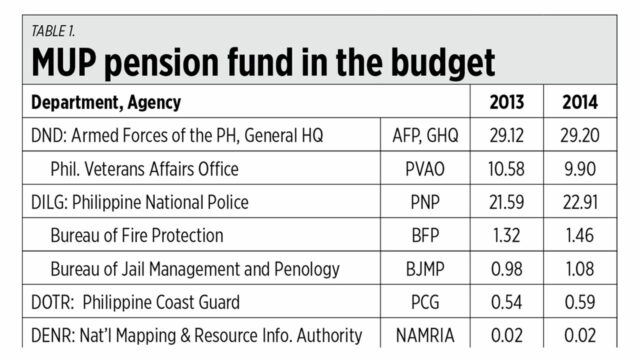
2. The amount is huge, P65 billion/year a decade ago, P130 billion this year. In an article written a decade ago by Benjamin Diokno (now Finance Secretary), “Military Pension,” (BusinessWorld, Aug. 13, 2013), he observed and presented the numbers (see Table 1).

“The uniformed personnel of the AFP, the DILG, NAMRIA and the PCG [Armed Forces of the Philippines, Department of Local Government, the National Mapping and Resource Information Authority, and Philippine Coast Guard] have to rely on direct appropriations by the National Government. Why? Because the military’s pension fund collapsed a long time ago as an aftermath of the Asian financial crisis and the financial mismanagement of their respective retirement funds.”

3. MUP pensions are up to 88% of base pay of active soldiers, policemen. The share of MUP pension/base pay averaged 66.5% in 2019-2021, then jumped to 88% in 2022. In contrast, the civilian personnel pension/base pay averages only about 1.3%. Including various allowances, hazard pay, etc., MUP pension/total compensation averaged 34% in 2019-2021 then jumped to 44% in 2022.

4. MUP in active service already get generous pay, averaging P335 billion/year in 2019-2022. In Table 2, “Other compensation common to all” includes longevity pay, subsistence allowance, relief allowance, mid-year bonus, year-end bonus, and others.
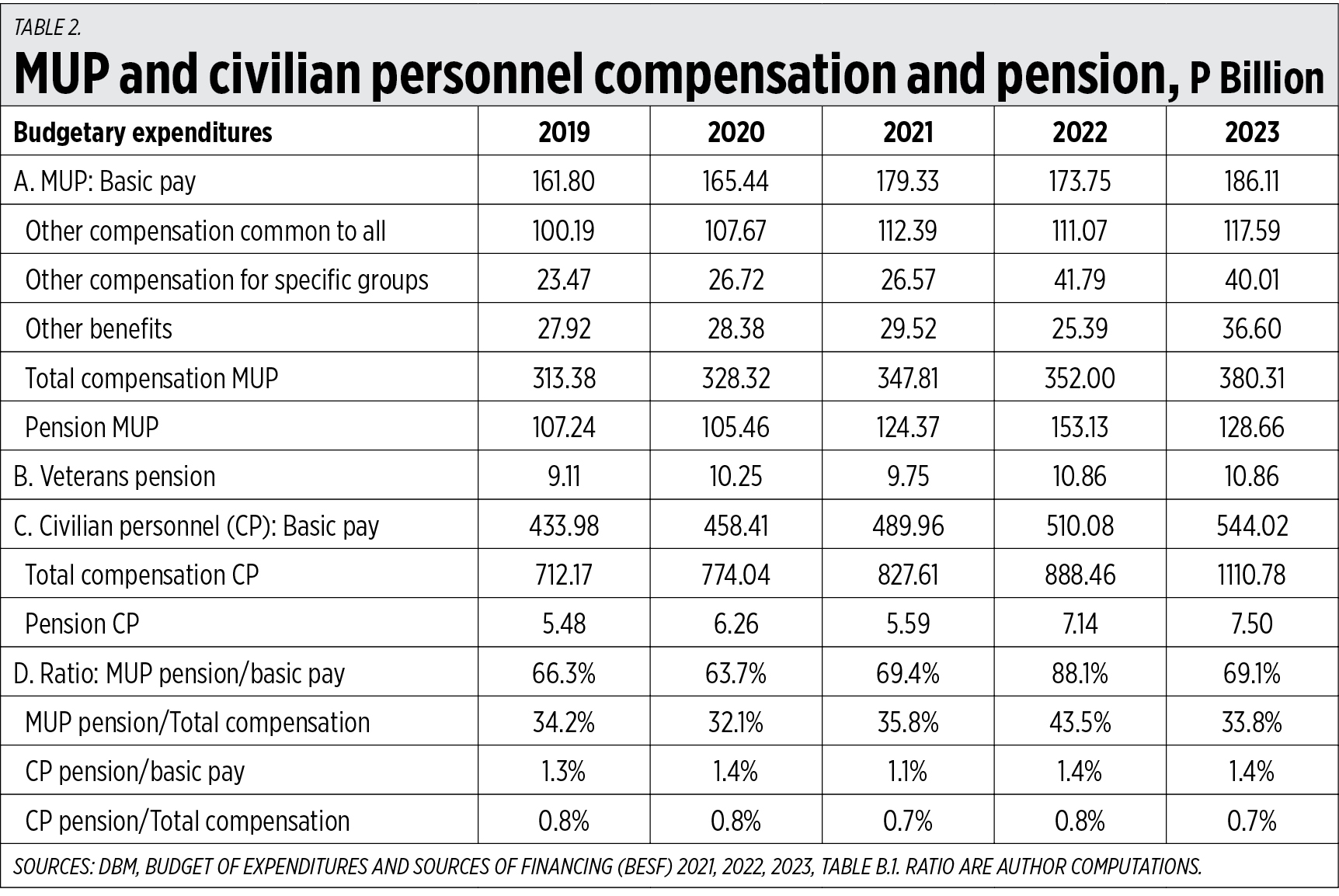
“Other compensation for specific groups” includes combat duty pay, combat initiative pay, hazardous duty pay, lump-sum for filling of positions MUP, others. And “Other benefits” include terminal leave, retirement gratuity, and PhilHealth contributions, others.

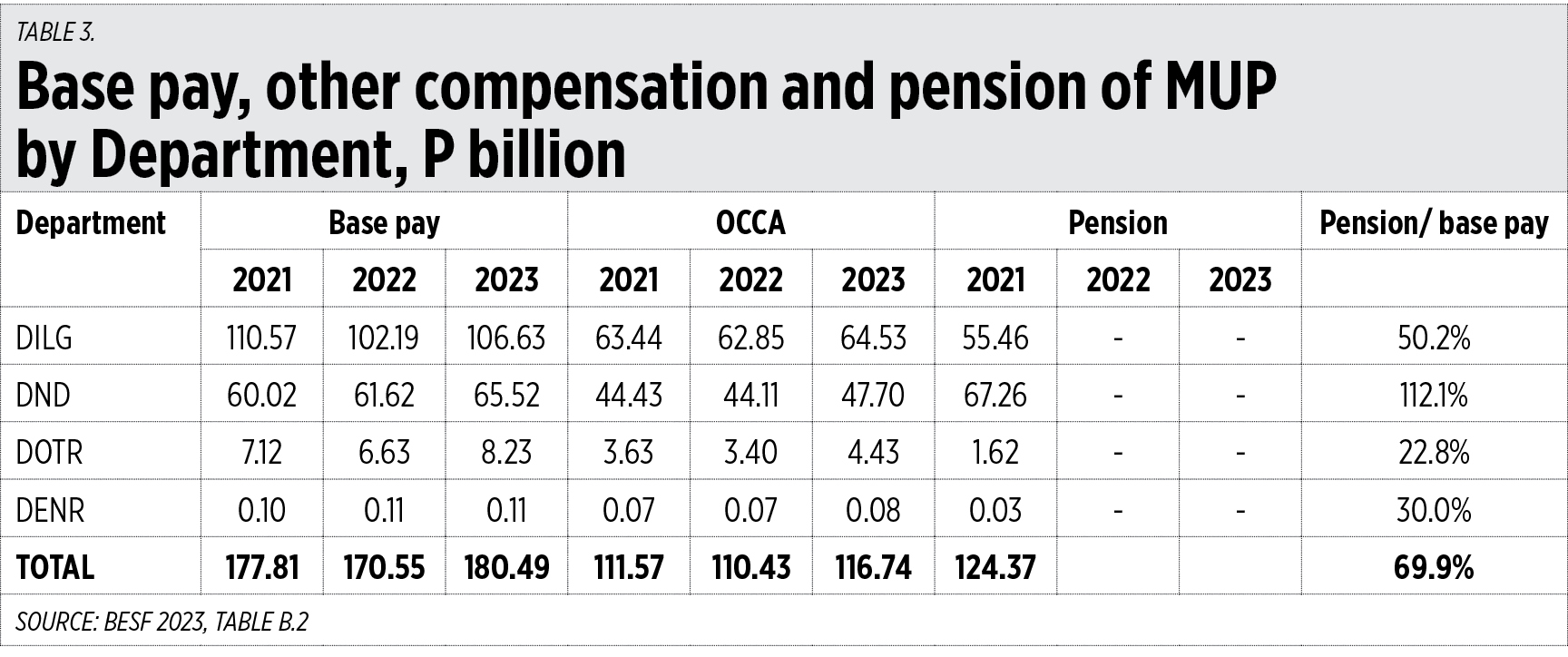
5. MUP under DILG have larger base pay than the Armed Forces of the Philippines-Department of National Defense (AFP-DND) but have lower pensions than the AFP. From 2021-2023, the average base pay of MUP in the DILG was P106 billion/year while base pay in the AFP-DND was P62 billion/year. But the pension of MUP in the DILG was only P55 billion in 2021, lower than the P67 billion pension in the DND.

6. The AFP pension is larger than base pay of active soldiers. In 2021, the pension in the AFP-DND was 112% of base pay while the Philippine National Police (PNP) pension was 50% or one half of base pay of active policemen. The average for all MUP was 70% of base pay (Table 3).
7. An AFP pensioner can get P191,000/month for life. Consider these two recent columns in BusinessWorld: “The Game of the Generals” by Amelia H. C. Ylagan (Jan. 22, 2023) and “Dealing with a looming military pension crisis” by Victor S. Limlingan (Oct. 18, 2022).

Ms. Ylagan wrote, “A retired (full) General can get lifetime pension of up to P190,975.88 per month, computed on 85% of highest base pay plus longevity pay for the maximum number of years served. (The pension lowers as the rank lowers, with the lowest, Brigadier General, still getting about P100,000 per month pension or close to this.)”

Mr. Limlingan wrote, “The GSIS actually did an actuarial study of the financial impact of absorbing the military and estimated that this would involve assuming P9.6 trillion in unfunded liabilities, clearly beyond the financial capacity of the GSIS. And so the problem looms… Our Congressional Planning and Budget department estimates that if no reform is undertaken, the National Government will need P800 billion for the next 20 years.”

8. The Development Budget Coordination Committee (DBCC) of previous and current administrations rang the bell on MUP pension. The DBCC — a.k.a. the “economic team” composed of the heads of the Department of Finance (DoF), the Department of Budget and Management (DBM), the National Economic and Development Authority (NEDA), and the Bangko Sentral ng Pilipinas (BSP) — of both of the Duterte and Marcos Jr. administrations raised the alarm bells on this huge fiscal burden. Consider these reports in BusinessWorld:

“Gov’t facing P9.6-trillion bill for military pension obligations” (Feb. 2, 2021),

“Economic managers back military pension reform” (June 16, 2021),

“GSIS deemed stable despite AFP pension risk” (Dec. 5, 2021).

From the Dec. 5 report: “An actuarial study by the Department of Finance concluded that the creation of a retirement fund solely for military and uniformed personnel will require an additional P45 billion annually.”

9. Suggested Reform No. 1: All MUP in active service should contribute to GSIS. Among the important reforms advocated by the DBCC and other concerned groups is that the MUP should pay for their own retirement pension. And there is no need to create another agency to handle this — GSIS can handle civilian pension and MUP pension. I say “amen” to this. The MUP pension should not come from taxpayers again as they are already over-burdened. Think of the P2 trillion/year of new borrowings for three years, 2020-2022, the taxpayers will ultimately pay for that.

10. Suggested Reform No. 2: Scrap, abolish the indexation of pensions on salaries of the incumbent, not the retiree. As Mr. Diokno wrote in 2013, “Well, during the final months of the Fidel Ramos (FVR) presidency, he approved what I consider to be the most generous pension system for the military in the entire world. While the common practice is to base the pension benefits on the highest salary (usually the last) of the retiree, under the law approved by Mr. Ramos, the pension is based on the salaries of the incumbent. Absurd but true.”

Again, I say “amen” to this reform. I admired and praised former President FVR’s handling of the economy — see this column’s piece, “The Post-SONA Economic Briefing; FVR’s economy” (Aug. 1, 2022) — but such admiration is now diminished. But if he was alive today, I think he would be among the reformers who would call for the scrapping of this egregious scheme.

I hope that MUPs in active service in various departments and agencies will not resist these two reforms. Their motto, to “serve and protect,” should refer more to the public and taxpayers, not to themselves and their future pensions.

I also hope that the public and other media also begin to discuss the elephant in the room. The amount is so huge. People were scandalized by the Education department’s laptop overpricing scandal in the previous administration, estimated at P0.96 billion. And rightly so. But the MUP pension, like the P153 billion in 2022 budget, should have not been there in the first place and it is a huge hole in taxpayers’ pockets.


Bienvenido S. Oplas, Jr. is the president of Bienvenido S. Oplas, Jr. Research Consultancy Services, and Minimal Government Thinkers.

minimalgovernment@gmail.com

Risky Manila currency move tells a big global story

BW FILE PHOTO

ECONOMIC POLICY in the Philippines strayed into the forbidden zone and survived. That a risky tactic to counter pressure on emerging markets worked out also tells the story of a shift in the global interest-rate terrain in recent months and points to where they might be headed.

Things could have gone very wrong after the top Philippines finance official identified a specific value for the-then beleaguered currency that the government would defend, perhaps at considerable cost to the nation’s coffers. Failure would have dented the nation’s credibility — or worse.

Instead, the country scraped through, with much help from forces beyond the archipelago. In particular, the US, the place emerging markets have long desired to stand apart from but can never quite manage to decouple.   

Mid-October was a perilous time for global markets. The prior weeks had experienced tumult unseen for at least a generation: Japan propped up the yen for the first time since the late 1990s, Switzerland was forced to end an experiment with negative interest rates, while a collapse in the British pound and debt destroyed a prime minister. Emerging markets were having a torrid time, too. South Korea and Indonesia stepped up intervention to cushion their currency’s retreat. The Philippine peso just slid to a record low of P59 per dollar. Behind it all was an uber-hawkish Federal Reserve and the byproduct of the American central bank’s escalating battle against inflation: A rampaging greenback.

This was the backdrop for Finance Secretary Benjamin Diokno’s remarks to Bloomberg News on Oct. 21 in Bangkok that he didn’t want to see the peso weaken beyond P60 per dollar. His desire for a circuit breaker was understandable: The currency had been hammered the prior six months, along with counterparts through much of Asia, exacerbating a local inflation problem and carrying more than a whiff of financial instability.

Except you are not supposed to say that.

Conventional wisdom has long held that the minute top officials publicly nominate a line in the sand, speculators will test — and likely burn — them.

Robert Rubin, who as US Treasury secretary from 1995 to 1999 intervened to both weaken and bolster the dollar, was wary of committing himself publicly to a particular course of action. Rubin tweaked his language on exchange rates very rarely and acted only when he could do so with the benefit of surprise. Even Mahathir Mohamad, the former Malaysian prime minister and foe of traders, avoided being too specific when plotting to challenge markets. “We are willing to spend some more just to defend it,” Mr. Diokno said in the interview. “Let’s not worry about drawing down reserves,” he said. “That’s the reason why we’re building up our buffers.”

Risky stuff. Yes, reserves can sometimes be used effectively to cushion swings in exchange rates, to slow the pace of appreciation or decline, or inject a bit of two-way risk in trading. What they usually can’t do, unless the country in question prints a reserve currency, is stand against the overall direction of markets. More than $7 trillion changes hands each day in the global currency market, reckons the Bank for International Settlements. Naming a big round number as a point not to be crossed is tempting fate, especially for a relatively small economy.

In the end, the line of P60 held. Was it because traders feared Philippines authorities or was a broader story developing after the frenetic days of late September and early October, one that benefited not just the Philippines but pretty much every currency other than the greenback?

The clues lie in a speech delivered Sept. 30 by Fed Vice-Chair Lael Brainard. She talked tough on inflation, insisting that the Fed’s increases — the root cause of the dollar’s march — weren’t done. With that commitment reiterated, Brainard acknowledged the need to guard against risks to financial stability. Critically, she discussed “proceeding deliberately” with hikes. Until that point, many of her colleagues, including Chair Jerome Powell, had talked about moving with haste to a point where borrowing costs were restrictive.

Minutes of the Federal Open Market Committee’s September meeting, released weeks after Brainard’s address, echoed her line. Still, skeptics argued there was no sign of a pivot. It’s clear in retrospect that no matter what you called it, the Fed was preparing to change down a gear or two. On Nov. 1, the Fed initiated its last 75-basis-point hike; Powell signaled smaller increments ahead. December’s tightening was a mere half point.

The downshift is likely to continue. A chorus of Fed policymakers have voiced support for an increase of just 25 basis points this week. Markets see the Fed as almost done, and possibly even cutting rates this year. After peaking late September, the Bloomberg Dollar Spot Index has been in retreat. The Philippine peso has strengthened to around P54 per greenback, well shy of the levels of late September and early October. The yen, Korean won, Malaysian ringgit, and a host of emerging-market currencies enjoyed a similar boost, along with the pound and the euro.

Whether through luck or foresight — or some combination — Manila’s jawboning paid off. It’s also a tale of how currency markets stepped back from the brink, especially those in Asia, where disentangling from US influence is often mouthed as a desire but seldom practicable. “The strong dollar period is over unless there is a drastic change,” Philippine central bank Governor Felipe Medalla said Jan. 20 when describing the more benign outlook. Pauses in rate hikes are widely anticipated in Australia, Indonesia, South Korea, and the euro zone, as well as the US.

Even in their sweet spot, currency markets hinge on the US, and on one or two key people. Dollar dominance looks unshakeable, no matter what desires to the contrary others may have.

BLOOMBERG OPINION

New Zealand counts cost of Auckland floods, more rain forecast

Building inspectors assess how homes and buildings have fared in recent floods. — Auckland Emergency Management/Facebook

WELLINGTON — Flood-ravaged Auckland is forecast to receive further heavy rain in the coming days, authorities in New Zealand’s largest city said on Monday, as insurers counted the costs of what looks likely to be the country’s most expensive weather event ever. 

Four people lost their lives in flash floods and landslides that hit Auckland over the last three days amid record downpours. A state of emergency remains in place in Auckland. A state of emergency in the Waitomo region south of Auckland was lifted. 

Flights in and out of Auckland Airport are still experiencing delays and cancellations, beaches around the city of 1.6 million are closed and all Auckland schools will remain closed until Feb. 7. 

“There has been very significant damage across Auckland,” New Zealand Prime Minister Chris Hipkins told state-owned television station TVNZ on Monday. “Obviously there were a number of homes damaged by flooding but also extensive earth movements.” 

Currently, around 350 people were in need of emergency accommodation, he added. 

LOOMING CLOUDS
Metservice is forecasting further heavy rains to hit the already sodden city late on Tuesday. 

“We have more adverse weather coming and we need to prepare for that,” Auckland Emergency Management duty controller Rachel Kelleher told a media conference. 

Fire and Emergency services received 30 callouts overnight Monday, including responding to a landslide when a carport slid down a hill. 

The council has designated 69 houses as uninhabitable and has prevented people from entering them. A further 300 properties were deemed at risk, with access restricted to certain areas for short periods. 

The north of New Zealand’s North Island is receiving more rain than normal due to the La Nina weather event. 

The National Institute of Water and Atmospheric Research (NIWA) said Auckland has already recorded more than eight times its average January rainfall and 40% of its annual average rainfall. 

INSURERS FACE HEFTY BILL
The cost of the clean up is expected to top the NZ$97 million ($63 million) bill for flooding on the West Coast in 2021 but will not be anywhere near as expensive as the estimated NZ$31 billion insured costs of two major earthquakes in Christchurch in 2010-2011, said Insurance Council of New Zealand spokesperson Christian Judge. 

Insurance Australia Group’s New Zealand divisions have received over 5,000 claims so far and Suncorp Group said it received around 3,000 claims across the Vero and AA Insurance Brands. New Zealand’s Tower said it had received around 1,900 claims. 

“The number of claims is expected to rise further over the coming days, with the event still unfolding and as customers identify damage to their property,” IAG said in a statement. 

Economists say the recovery and rebuild could add to inflationary pressures in New Zealand as vehicles and household goods need to be replaced and there is an increase in construction work needed to repair or rebuild houses and infrastructure damaged by the flooding. — Reuters

Australia prepares for thousands of Chinese students to return as relations improve

REUTERS

SYDNEY — Australia is preparing for the arrival of thousands of Chinese students, the education minister said on Monday, days after China’s education ministry warned students enrolled overseas that online learning would no longer be recognized.

Australia’s education sector, which generated A$39 billion ($27.66 billion) in export earnings before the pandemic, has strong ties to China, with roughly 150,000 nationals enrolled in Australian universities. Tens of thousands remain offshore after pandemic restrictions and strained diplomatic relations led many to return home.

But with three weeks to go before Australian universities start, the Chinese Ministry of Education’s Chinese Service Center for Scholarly Exchange (CSCSE) said on Saturday it would no longer recognize overseas degrees obtained via online learning and urged students to return to overseas campuses as soon as possible.

“At present, the borders of major destinations for international study have reopened, and foreign (overseas) colleges and universities have fully resumed offline teaching,” it said in a statement.

China dropped nearly all of its COVID curbs in December, leading to a surge in COVID cases and deaths as Beijing shifted focus to salvage a faltering economy.

The normalizing of educational ties comes weeks after Chinese officials relaxed import bans on Australian coal as both countries work to improve diplomatic relations after more than two years of Chinese trade sanctions that have frozen trade in barley, coal and wine and other goods and services.

Minister for Education Jason Clare on Monday welcomed the move and said he would work with his counterpart in the home (interior) ministry to help universities resolve any short-term logistical issues.

Phil Honeywood, chief executive officer at International Education Association of Australia, an advocacy body for international education in Australia, said there were currently about 40,000 Chinese students still offshore.

“We anticipate a lot of Chinese students will be scrambling as we speak to get on flights to Australia. However, we imagine there will be a number of deferral applications where students just won’t be able to get back in time,” said Honeywood.

The University of Sydney expects the “vast majority” of students to be on campus when classes start in late February. It plans to phase out on-campus remote learning later this year.

The move by China’s Ministry of Education has been met with anger from Chinese students.

“There are only 15 days left before the school starts — I have no visa, no flight, nowhere to live. With such a short notice, do you want us all sleeping on the streets?” said one comment on social media platform Weibo. — Reuters

NATO chief urges SK to step up military support for Ukraine

NATO Secretary General Jens Stoltenberg speaks to the press in advance of the meetings of NATO Defence Ministers, June 14. — COURTESY OF NATO

SEOUL — NATO Secretary-General Jens Stoltenberg urged South Korea (SK) on Monday to increase military support to Ukraine, citing other countries that have changed their policy of not providing weapons to countries in conflict after Russia’s invasion.

Mr. Stoltenberg is in Seoul, the first stop on a trip that will include Japan and is aimed at strengthening ties with US allies in the face of the war in Ukraine and rising competition with China.

Speaking at the Chey Institute for Advanced Studies in Seoul, he thanked South Korea for its non-lethal aid to Ukraine, but urged it to do more, adding there is an “urgent need” for ammunition. Russia calls the invasion a “special operation”.

“I urge the Republic of Korea to continue and to step up on the specific issue of military support,” he said. “At the end of the day, it’s a decision for you to make, but I’ll say that several NATO allies who have had as a policy to never export weapons to countries in a conflict have changed that policy now.”

In meetings with senior South Korean officials, Mr. Stoltenberg argued that events in Europe and North America are interconnected with other regions, and that the alliance wants to help manage global threats by increasing partnerships in Asia.

South Korea has signed major deals providing hundreds of tanks, aircraft and other weapons to NATO member Poland since the war began, but South Korean President Yoon Suk-yeol has said that his country’s law against providing arms to countries in conflicts makes providing weapons to Ukraine difficult.

Mr. Stoltenberg noted that countries such as Germany, Sweden, and Norway had similar policies but changed them.

“If we don’t want autocracy and tyranny to win, then they need weapons, that’s the reality,” he said, referring to Ukraine.

The NATO chief said it was “extremely important” that Russia doesn’t win this war, not only for the Ukrainians but also to avoid sending a wrong message to authoritarian leaders, including in Beijing, that they can get what they want by force.

Although China is not NATO’s adversary, it has become “much higher” on NATO’s agenda, Mr. Stoltenberg said, citing Beijing’s rising military capabilities and coercive behavior in the region.

“We believe that we should engage with China on issues like arms control, climate change and other issues,” he said. “But at the same time, we are very clear that China poses a challenge to our values, to our interests, and to our security.”

In a statement carried by state media on Monday, North Korea called Mr. Stoltenberg’s visit a “prelude to confrontation and war as it brings the dark clouds of a ‘new Cold War’ to the Asia-Pacific region.”

Last year South Korea opened its first diplomatic mission to NATO, vowing to deepen cooperation on non-proliferation, cyber defense, counter-terrorism, disaster response and other security areas.

The NATO chief’s visit also comes as U.S. Defense Secretary Lloyd Austin was due to arrive in Seoul on Monday for talks with his South Korean counterpart Lee Jong-sup.  Reuters

Under-funded WHO seeks ‘reinforced’ role in global health at key meeting

IMAGE VIA WHO/P. VIROT

GENEVA — The World Health Organization (WHO) will push at its board meeting this week for an expanded role in tackling the next global health emergency after COVID-19, but is still seeking answers on how to fund it, according to health policy experts.

The Geneva meeting sets the program for the U.N. agency this year — as well as its future budget — with the WHO facing two key challenges: a world that expects ever more from its leading health body, but which has not yet proven willing to fund it to tackle those challenges.

At the Executive Board’s annual meeting from Jan. 30-Feb. 7, countries will give feedback on WHO Director-General Tedros Adhanom Ghebreyesus’ global strategy to strengthen readiness for the next pandemic which includes a binding treaty currently being negotiated.

“I think the focus is very much on the program budget, then sustainable financing,” Timothy Armstrong, WHO director for governing bodies, told journalists when asked about the agenda.

Also on his list was “the position of the World Health Organization, recognizing there is a need for a reinforced central role for WHO” in the global health emergency system.

The WHO is seeking a record $6.86 billion for the 2024-2025 budget, saying that approving this sum would be “a historic move towards a more empowered and independent WHO.”

But approval will require member states to make good on promises made last year to hike mandatory fees — a fact which is uncertain since the deal was always subject to conditions.

“What we are currently seeing is that some member states are now trying to pre-condition lots of things,” said a source close to the talks, saying it “remains to be seen” if all countries will commit to raising fees. Reuters could not immediately establish which countries might withhold support.

The current base budget, which does not include the funding changes, has a nearly $1-billion financing hole, a WHO document showed — although that gap is not unusual at this point, two sources added. However, one did add that it was “absurd” that the WHO still has to scrabble for money after COVID-19.

“It’s a huge knot,” said Nicoletta Dentico, the co-chair of the civil society platform the Geneval Global Health Hub. “The weakness of WHO is under our eyes.”

The agency is also considering starting big replenishment rounds every few years to top up its coffers, a document showed.

The WHO, which celebrates its 75-year anniversary having been set up in 1948, will also use the meeting to advocate for a boosted role in pandemic preparedness, documents showed.

Tedros will call for a Global Health Emergency Council to be set up linked to WHO governance. However, external experts have said such a council needs higher-level political leadership.

“Given that pandemic threats involve and impact almost every sector, it must be an outcome of a UN General Assembly resolution, be appointed by and accountable to it,” Helen Clark, former prime minister of New Zealand and head of the independent panel set up to review the handling of COVID, told Reuters. — Reuters

Australia searches for tiny radioactive capsule believed lost on desert highway

MELBOURNE — Rio Tinto Ltd. apologized on Monday for the loss of a tiny radioactive capsule believed to have fallen from a truck that has sparked a radiation alert across parts of the vast state of Western Australia.

It is unclear how long the radioactive capsule, part of a gauge used to measure the density of iron ore feed, has been missing.

The gauge was picked up by a specialist contractor from Rio’s Gudai-Darri mine site on Jan. 12. When it was unpacked for inspection on Jan. 25, the gauge was found broken apart, with one of four mounting bolts missing and screws from the gauge also gone.

Authorities suspect vibrations from the truck caused the screws and the bolt to come loose, and the radioactive capsule from the gauge fell out of the package and then out of a gap in the truck.

Authorities are now grappling with the daunting task of searching along the truck’s 1,400 kilometer (870 mile) journey from north of Newman — a small town in the remote Kimberley region — to a storage facility in the northeast suburbs of Perth — a distance longer than the length of Great Britain.

“We are taking this incident very seriously. We recognize this is clearly very concerning and are sorry for the alarm it has caused in the Western Australian community,” Rio’s iron ore division chief Simon Trott said in a statement.

The silver capsule, 6 millimeters (mm) in diameter and 8 mm long, contains Caesium-137 which emits radiation equal to 10 X-rays per hour.

Authorities have recommended people stay at least five meters (16.5 feet) away as exposure could cause radiation burns or radiation sickness, though they add that the risk to the general community is relatively low.

The state’s emergency services department has established a hazard management team and has brought in specialized equipment that includes portable radiation survey meters to detect radiation levels across a 20-meter radius and which can be used from moving vehicles.

Mr. Trott said Rio had engaged a third-party contractor, with appropriate expertise and certification, to safely package and transport the gauge.

“We have completed radiological surveys of all areas on site where the device had been, and surveyed roads within the mine site as well as the access road leading away from the Gudai-Darri mine site,” he said, adding that Rio was also conducting its own investigation into how the loss occurred.

Analysts said that the transport of dangerous goods to and from mine sites was routine, adding that such incidents have been extremely rare and did not reflect poor safety standards on Rio’s part.

The incident is another headache for the mining giant following its 2020 destruction of two ancient and sacred rock shelters in the Pilbara region of Western Australia for an iron ore mine. — Reuters

Viber adds features to increase brand awareness among users, aims to become superapp

MESSAGING PLATFORM Viber launched two features last week to improve brand-user interaction, a “high priority” given the app’s 106% year-on-year growth in retail users in the Philippines. 

Business Inbox is a dedicated folder for business messages from official brand accounts while Commercial Accounts is a channel where users can find brands and communicate with them through a mini-website experience within the app. 

“It’s our ambition to have brands on Viber build awareness, generate interest, and drive conversion down to user loyalty and after-sales care. A brand can use our solutions to meet the users at every step in the customer journey,” said Cristina V. Constandache, chief revenue officer of Viber, at a media briefing on Jan. 26. 

“Our vision for 2023 is to become a superapp,” she added.  

Business Inbox, the default space for brand-user interactions, is pinned at the top of the chat screen and is kept separate from personal messages. It allows Viber users to store and organize notifications — bank reminders, delivery order confirmations, or promotional offers — from brand accounts in one folder. 

Meanwhile, Commercial Accounts allows users to engage with a brand in just one channel, where they can find business information, services, and Viber chats under a single searchable business entity. Brands will be better able to customize the customer experience through this feature. 

David Tse, Rakuten Viber’s senior director for APAC, told BusinessWorld that the new features will increase user safety and trust when engaging with a business. 

“For example, the Business Inbox will automatically have business messages from verified brands, which have a blue tick, and it’s basically inaccessible to private accounts trying to impersonate a business,” he explained. 

In 2022, Philippine stats for the app show a 603% growth in transactional business messages, an 83% growth in conversational business messages, and an 11% growth in promotional messages year-on-year. There has also been a 34% increase in chatbots. 

With these stats, adding new features is a “no-brainer,” according to Ms. Constandache. 

“We want to become a single gateway to manifold services, wherein users can do everything that they want or as many things as they want within one app,” she said. 

Mr. Tse also shared at the briefing that the Viber Pay feature, available in Germany and Greece, has to “overcome quite a few licensing hurdles” before launching in the Philippines. — Brontë H. Lacsamana

The goal is to launch the payment feature within the year, said Ms. Constandache. 

Adani firms lose $65 billion in value as US short-seller battle escalates

ADANI.COM

NEW DELHI — Most Adani Group shares fell sharply on Monday as the Indian conglomerate’s rebuttal of a US short-seller’s criticism failed to pacify investors, deepening a market rout that has now led to losses of $65 billion in the group’s stock values.

Led by Asia’s richest man Gautam Adani, the Indian group has locked horns with Hindenburg Research and on Sunday hit back at the short-seller’s report of last week that flagged concerns about its debt levels and the use of tax havens.

Adani said it complied with all local laws and had made the necessary regulatory disclosures.

Adani Transmission, Adani Total Gas, Adani Green Energy, Adani Power and Adani Wilmar fell between 5% and 20% on Monday.

Flagship Adani Enterprises, which is facing a crucial test this week with a follow-on share offering, swung between gains and losses before settling 4.8% higher. It stayed well below the offer price of the issue, which if successful will be largest such share offering ever in India.

Adani Enterprises’ $2.5 billion secondary share sale closed its second day amid weak investor sentiment. The stock closed at 2,892.85 rupees, 7% below the 3,112 rupees lower end of the offer price band. The upper band is 3,276 rupees.

Data from stock exchanges on Monday showed Adani has now received bids for 1.4 million shares, or just over 3%, of the 45.5 million shares on offer. The deal closes on Tuesday.

Foreign and domestic institutional investors, as well as mutual funds, have made no bids so far, according to the data.

“Retail participation is likely to have a shortfall with current market prices still trailing the offer price and sentiment taking a hit due to the Hindenburg controversy,” said Hemang Jani, equity strategist at Motilal Oswal Financial Services.

“While there is a risk that the share sale does not go through, it will be crucial today to wait and see how institutional investors participate.”

Abu Dhabi conglomerate International Holding Company said on Monday it would invest 1.4 billion dirhams ($381.17 million) in the offering.

ON SCHEDULE
Adani Group told Reuters in a statement on Saturday that the sale remained on schedule at the planned issue price, even as sources said bankers of the country’s largest secondary share sale were considering extending the timeline beyond Jan. 31, or tweaking the price due to the fall in its share price.

Indian regulations say the share offering must receive minimum subscription of 90%, and if it does not the issuer must refund the entire amount. Maybank Securities and Abu Dhabi Investment Authority are among investors who bid for the anchor portion of the issue.

Maybank said in a statement “there is no financial impact” on it as the subscription to Adani’s offer was fully funded by client funds.

State-run insurance behemoth Life Insurance Corporation (LIC) told Reuters on Monday it was reviewing the Adani Group’s response to Hindenburg’s report and would hold talks with the management within days.

LIC took 5% of the $734 million anchor portion. It already holds a 4.23% stake in the flagship Adani firm, while its other exposures include a 9.14% stake in Adani Ports and 5.96% in Adani Total Gas.

“Since we are a large investor we have the right to ask relevant questions,” LIC Managing Director Raj Kumar said.

DEBT, DE-LEVERAGING
US dollar-denominated bonds issued by Adani Ports and Special Economic Zone continued their fall into a second week with the bond maturing in August 2027 down 5 cents to 73.03 cents, the lowest since June 2020. Other dollar denominated bonds of the group were also trading lower.

Index provider MSCI has said it was seeking feedback from market participants on Adani and was monitoring the factors that “may impact the eligibility of those relevant securities” in SCI indexes.

In its response on Sunday, Adani highlighted its relationships with local and international banks and its access to diverse funding sources and structures, listing US banks
Citigroup and JPMorgan Chase & Co, as well as other lenders including BNP Paribas, Credit Suisse, Deutsche Bank, Barclays, and Standard Chartered.

The stock market meltdown is a dramatic setback for 60-year-old Adani. The school-dropout’s stunning rise came with over 1,500% gains in some of his group stocks over three years, making him the world’s third richest man before he slipped to rank eighth on the Forbes list on Monday.

Responding to Adani’s rebuttal, Hindenburg said the company’s “response largely confirmed our findings and ignored our key questions.”

Hindenburg in its report said Adani companies had “substantial debt” and that shares in seven Adani listed companies have an 85% downside due to what it called “sky-high valuations.”

Adani’s response stated that over the past decade, its group companies have “consistently de-levered.” — Reuters

ADVERTISEMENT
ADVERTISEMENT