Home Blog Page 5331

Strong Group on brink of prelims sweep in Dubai

FILIPINO-AMERICAN Sedrick Barefield, fresh from his outburst in the first two games form a scoring combo with Shabazz Muhammad, and Jerom Lastimosa. — UAE BASKETBALL FEDERATION

STRONG Group brought itself to within reach of a group sweep, walloping the listless Al Wahda of Syria with an 87-61 win in the 32nd Dubai International Basketball Championship at the Al Nasr Club Hall.

As in their first two games, ex-NBA gunner Shabazz Muhammad led the onslaught with 37 points and 11 rebounds as Strong Group stayed immaculate in three matches in Group A. 

Mr. Muhammad, the 14th overall pick in the 2014 NBA Draft, was on target from the get go in anchoring Strong Group’s 22-9 start en route to a coast-to-coast victory. The wards of coach Chris Tiu led by as many as 29 points for a fitting follow-up after beating the United Arab Emirates (UAE) national team, 91-87, and Libya’s Al Nasr, 93-76.

“Shabazz carried us offensively, he was great so we kept riding him but the defense was solid today and I am happy,” said Mr. Tiu, who also steered Mighty Sports to the Dubai title in 2020 before the pandemic.

Mr. Muhammad, who also served as San Miguel’s import in the PBA Governors’ Cup last year, was not alone in Strong Group’s barrage with fellow ex-NBA player and SMB reinforcement Renaldo Balkman adding nine markers and 11 boards.

Filipino-American Sedrick Barefield, fresh from his outburst in the first two games to form a scoring combo with Muhammad, and Jerom Lastimosa threw in 10 points apiece.

But more than yet another balanced attack, Mr. Tiu was delighted by the defensive clinic displayed by his charges after limiting Al Wahda to its lowest output in the nine-team tourney.

“We have been improving every game and this was our best defensive performance,” added Mr. Tiu as Al Wahda remained winless at 0-3.

The Philippine contingent, owned by former Ateneo guard and the Converge PBA team’s  assistant manager Jacob Lao with support from Mighty Sports and Acrocity, stands a chance of sweeping Group A against Lebanon’s Dynamo today.

Dynamo is also unbeaten in three games after wins over Al Wahda, 95-75, UAE, 103-68, and Al Nasr, 101-87. — John Bryan Ulanday

Yulo to skip Asian Games for World Championships

GYMNAST CARLOS YULO — REUTERS/PHIL NOBLE

CHAMPION gymnast Carlos Yulo will miss the Hangzhou Asian Games to join the Artistic Gymnastics World Championships in Antwerp, which is a qualifying tournament for next year’s Paris Olympics.

“(Yulo) is not joining the Asian Games as it is the same time as the Belgium World Championships,” Gymnastics Association of the Philippines president Cynthia Carrion Norton said.

The Hangzhou Games are set for Sept. 23-Oct. 8, which will be in direct conflict with the Antwerp meet, which runs between Sept. 30 and Oct. 10.

The Filipino champion from Leveriza, Manila has yet to win in the Asiad, one of the major trophies missing from the collection of the two-time World champion and 2022 Hanoi Southeast Asian Games quintuple gold medallist.

But the Olympics is the grander stage where he can resume the hunt for the gold that had eluded him in the 2021 Tokyo Games, where he faltered despite being a favorite in the floor exercise.

Ms. Carrion Norton, however, said Yulo will be competing in the Phnom Penh SEA Games between May 5 and 17, where his medal haul will be capped at two even if he sweeps all his seven events, due to restrictions on the medal count set by the hosts.

“He is joining. We’re doing it out of sportsmanship and for the sport that we love,” Ms. Carrion Norton said. — Joey Villar

Orlando Magic rally to end Sixers’ winning streak

PAOLO Banchero had 29 points and nine rebounds, Moritz Wagner added 22 points and the Orlando Magic rallied from a 21-point deficit for a 119-109 victory over the host Philadelphia 76ers Monday.

Mr. Banchero’s dunk with 36 seconds remaining gave the Magic a 117-109 lead. Moritz Wagner also hit a clutch jumper and sank two free throws in the final 2:34.

Franz Wagner scored 19 points, Wendell Carter Jr. contributed 12 points and nine rebounds and Markelle Fultz added 12 points and 10 assists for the Magic, who snapped a two-game losing streak.

Joel Embiid finished with 30 points and 11 rebounds to lead the Sixers, who had their seven-game winning streak snapped. James Harden amassed 17 points, eight rebounds and six assists, and Tobias Harris also had 17 points.

MAVERICKS 111, PISTONS 105

Luka Doncic reached the 50-point mark for the fourth time this season, pouring in 53 points to carry host Dallas past Detroit.

Mr. Doncic’s fifth career 50-point game came after he sat out the previous game with a sprained ankle. He added eight rebounds and five assists. His 24 points were the highest first-quarter total for any player this season.

Bojan Bogdanovic’s 29 points led the Pistons, who lost for the sixth time in seven games. Saddiq Bey had 18 points, and Jaden Ivey tossed in 14 before fouling out.

TRAIL BLAZERS 129, HAWKS 125

Damian Lillard registered 42 points and six assists to lead Portland to a victory over visiting Atlanta.

Jerami Grant scored 22 points and Anfernee Simons added 21 points and seven assists as the Trail Blazers closed out a 3-3 homestand.

Dejounte Murray scored a career-high 40 points and also had eight rebounds and seven assists for the Hawks, who lost for the fourth time in the past five games. Bogdan Bogdanovic had 23 points and seven assists, while John Collins scored 16 points.

Grant made two free throws with 23.9 seconds remaining and Josh Hart split two free throws with 10.9 seconds left to make it a five-point margin. Mr. Bogdanovic hit a trey to bring Atlanta within 127-125 with 5.7 seconds left. Lillard sank two free throws with 3.1 seconds left to seal it.

WARRIORS 128, THUNDER 120

Stephen Curry scored 38 points to lead Golden State over host Oklahoma City, and he equaled a season high with eight 3-pointers as the Warriors won for the third consecutive game.

Mr. Curry and Draymond Green each had 12 of Golden State’s 37 assists. Klay Thompson added 28 points while Jordan Poole and Andrew Wiggins, who returned from a two-game absence caused by a non-COVID illness, scored 15 each.

Shai Gilgeous-Alexander led the Thunder with 31 points on 10-of-24 shooting, despite going just 1-for-8 from the floor in the first quarter. Josh Giddey added 21 points for Oklahoma City, which has alternated wins and losses over the past six games.

NETS 121, LAKERS 104

Kyrie Irving scored 26 points as Brooklyn started quickly and made enough plays down the stretch for a victory over Los Angeles in New York.

Cam Thomas capitalized on extended playing time at guard due to the absences of Ben Simmons (left knee) and T.J. Warren (left shin) and added 21 for the Nets. Patty Mills also finished with 21 points as he and Thomas combined to shoot 15 of 25 and hit eight 3-pointers.

Thomas Bryant led the Lakers with 18 points and Russell Westbrook had 17. Mr. Westbrook added 10 assists to move past Gary Payton for 10th place on the NBA’s all-time list. The Lakers were without Anthony Davis (right foot) and LeBron James (sore left ankle) along with Austin Reeves (left hamstring strain).

SUNS 114, RAPTORS 106

Mikal Bridges scored 29 points, Deandre Ayton recorded a double-double of 22 points and 13 rebounds, and host Phoenix nabbed its sixth win in seven games, holding off Toronto in a back-and-forth contest.

The teams exchanged the lead 16 times, with neither holding an advantage of more than 10 points at any juncture. The Suns pulled ahead for good with 3:02 remaining, however, when Bridges scored on back-to-back buckets off of assists from Mr. Ayton.

Mr. Paul scored seven of his 19 points in the closing 90 seconds, tacking on four free throws after his clutch 3-pointer. He also dished out nine assists and grabbed four rebounds. Fred VanVleet put up 24 points and nine assists for the Raptors, and Gary Trent Jr. had 21 points.

WIZARDS 127, SPURS 106

Deni Avdija scored a career-high 25 points off the bench to pace seven players in double figures as visiting Washington ran past San Antonio to win its sixth consecutive game.

Bradley Beal added 21 points for the Wizards, with Kristaps Porzingis hitting for 17 and Kyle Kuzma scoring 16.

Keldon Johnson scored a game-high 26 points for the Spurs, who took their sixth loss in a row. Jeremy Sochan had 17 points, Zach Collins had 16 points and 11 rebounds and Stanley Johnson added 10 points.

KINGS 118, TIMBERWOLVES 111 (OT)

Trey Lyles stepped in for fouled-out Domantas Sabonis to score eight key points in overtime (OT) and De’Aaron Fox capped a 32-point night with a late hoop, an assist and two clinching free throws as Sacramento outlasted Minnesota in Minneapolis.

Fox produced his 13th 30-point game of the season as the Kings ended a two-game losing streak. Sabonis had 17 points and 13 rebounds before fouling out, and Keegan Murray put up 13 points and 13 rebounds, the third double-double of his rookie season.

Anthony Edwards was the game’s leading scorer with 33 points for the Timberwolves, whose three-game winning streak ended. Rudy Gobert registered his 20th double-double of the season with 19 points and a game-high 14 rebounds. — Reuters

PSC’s Bachmann vows accounting overhaul to minimize delays in payments to athletes 

PSC CHAIRMAN RICHARD BACHMANN

AN EXECUTIVE all his life, Philippine Sports Commission (PSC) chairman Richard Bachmann is slowly turning the government sports-funding agency the way he’s been doing it in the past — by injecting a measure of corporate efficiency.

“I’m kind of tired (of being) asked that question since I took over here, and my answer to that ‘basta tama, wala namang corporate, corporate, walang gobyerno, gobyerno” (as long as it’s right, it doesn’t matter whether it’s the corporate or government approach), Mr. Bachmann said at the Philippine Sportswriters Association Forum Tuesday at the Rizal Memorial Sports Complex.

One of his priorities is automating the agency’s accounting system in order to minimize delays in disbursing national athletes’ monthly allowances.

“We just want to make it easier, faster for everyone and prevent delays,” Mr. Bachmann said.

He is also seeking to implement its own ticketing system at the Rizal Memorial Coliseum, the Ninoy Aquino Stadium, Rizal Football field and PhilSports Complex instead of contracting the service out to a private ticketing agency.

“Why can’t we have our own ticketing system,” he said.

To generate revenue, Mr. Bachmann is studying leasing some sites with commercial potential to “7-11, Family Mart, or a coffee shop for our athletes,” he said.

“I hired eight to 10 consultants to address all these concerns,” he said. — Joey Villar

Fire still burning, Djokovic and GOAT debate move on to Paris

REUTERS
AUSTRALIAN Open winner Novak Djokovic — REUTERS

A TRIUMPHANT Novak Djokovic paraded the Australian Open trophy around the gardens of Melbourne’s Government House Monday, his 10th title having added another notch in the plus column for those who argue he is the Greatest Of All Time (GOAT).

That debate may never be settled but if it is to be decided purely in terms of major championship success, it now moves on to the French Open in the European spring with the Serbian and Rafael Nadal tied on 22 titles.

While the blue courts of Melbourne Park are undoubtedly Djokovic’s domain, the red clay courts of Roland Garros are the preserve of Spaniard Nadal, the other open-era GOAT contender along with 20-time Grand Slam champion Roger Federer.

Mr. Federer is now retired and sent his congratulations to Mr. Djokovic on Instagram — “Incredible effort, again!” — but Mr. Nadal was back in Spain being treated for the latest in a series of injuries that have blighted his career.

The 36-year-old is confident he will recover from the hip flexor issue he sustained at the Australian Open in time to drag his battered body to Paris in May in a bid for a 15th French Open title.

And, despite a hamstring issue that hindered him throughout the year’s first Grand Slam, Mr. Djokovic left little doubt that he would also be there trying to win major number 23.

“I think there’s still a lot of that fire inside of me that is burning of passion for the sport and for competition and I think that’s what allows me to still push myself to the limit,” he said Monday.

“In the practice sessions, day in, day out after so many years to go through the same routines, repetitively, that sometimes is not so interesting.

“But I know that there is always a greater goal and a guiding star, so to say, and this trophy is one of those guiding stars, it’s something that I always strive to achieve.”

While the resilience shown by Mr. Djokovic and Mr. Nadal means men’s tennis can continue to enjoy the back end of the most glittering of golden eras, women’s tennis continues with its first season trying to fill the void left by Serena Williams.

The American, when fit, dominated the women’s game for the best part of two decades while hoovering up 23 Grand Slam singles titles — a tally only bettered by Australian Margaret Court (24) mostly in the amateur era.

Even if Mr. Djokovic’s opposition to COVID-19 vaccines keeps him out of the US Open for a second year running, Sunday’s title put him firmly in touching distance of those tallies. “I really don’t want to stop here,” he said after the final.

“I don’t have any intention of stopping here. I feel great about my tennis. I know that when I’m feeling good physically, mentally present, I have a chance to win any slam against anybody.

“I like my chances going forward.” — Reuters

Japan Inc strives to lure skilled workers as inflation bites

A JOB SEEKER walks past a corridor of a commercial building in Tokyo, Aug. 28, 2014. — REUTERS

TOKYO — From inflation allowances to the reskilling of workers, firms in Japan are stepping up efforts to help employees fight rising prices and a labor crunch, even though some cannot afford pay hikes that do more than offset cost-push inflation.

As annual shunto labor talks get into full swing, momentum from both labor and management is growing for firms to offer such hikes to cushion, even if not beat, consumer inflation, which hit a 41-year high of 4% in December.

At the spring session of the labor talks, set to wrap in mid-March, major firms, such as Toyota Motor Corp. 7203.T, negotiate with in-house unions to set wages for the coming fiscal year from April.

Labor shortages and rising consumer inflation, which is double the central bank’s target of 2%, are spurring cautious firms, with a 500-trillion-yen ($3.85 trillion) hoard of internal reserves, to hike wages.

About a quarter of Japanese firms have offered inflation allowances or plan to do so, said corporate credit research firm Teikoku Databank. Such allowances range from 6,500 yen ($50) for monthly payments to 54,000 yen in lump sums, on average.

“I received the money just when we had our second baby,” said Shinichiro Mori, who received a one-off allowance of 150,000 yen last summer from groupware developer Cybozu, Inc. The company offered the payment to all its 800 employees.

“I appreciated the money,” Mori, 41, told Reuters. “We spent it on baby goods, utility bills and other living expenses, as we stayed home all day taking care of our baby.”

News that Fast Retailing Co., operator of the Uniqlo clothing chain, will revise its pay system for employees, with raises as much as 40%, provides another example.

The private sector expects the drive to help boost productivity, meshing with Prime Minister Fumio Kishida’s “new capitalism” initiative on wealth distribution that put a top priority on wage hikes.

Such demands by Japanese policymakers come against the backdrop of 15 years of grinding deflation that saw firms shelve hikes in base salary from the early 2000s to the early 2010s, when rounds of stimulus failed to spark economic growth, but piled up public debt instead.

SUSTAINABLE PAY HIKES
OECD data shows Japanese workers’ wages have grown about 5% over a period of 30 years from 1990, during which US pay rose 1.5 times and pay for South Koreans doubled.

Takahide Kiuchi, a former member of the board of the Bank of Japan, called for wage hikes to be sustained over time so that cumulative pay rises could offset price hikes in the long run.

“Bonuses or inflation allowances would have only a limited impact on easing the pain of cost-push inflation, as consumers tend to save one-off payouts rather than spend,” added Kiuchi, now an executive economist at the Nomura Research Institute.

The government and the central bank say inflation must grow in tandem with wage growth to fuel private consumption, which accounts for more than half the economy, paving the way for the Bank of Japan to achieve its inflation target in a sustainable, stable fashion.

But one-off payments do not make consumers more confident about increasing spending, although a rise in base pay, a salary component that is hard to reverse, is more likely to boost such confidence and set workers spending more.

Real wages fell 2.5% in November, down for the ninth straight month, following the previous month’s decline of 3.8%, the latest data shows.

Mori’s employer, Cybozu, has offered employees a record pay hike in the upper reaches of the 1% to 10% range this year.

That would surpass the 3% target of Mr. Kishida’s government, and even the 5% sought by the Japan Trade Union Confederation (Rengo), while Japan’s biggest business lobby Keidanren urged companies to offer positive wage hikes, including base pay.

“We always feel the need to respond to labor shortages of engineers, in particular,” said Yumika Nakane, the firm’s human resources head. “We set pay scales as we’re fully aware salary is one of the keys to attract workers.”

Despite a jobless rate of 2.5% in December that reflects the tight labor market, and steady job availability, at a ratio of 1.35 per seeker, policymakers complain about the absence of demand-pull inflation that entails wage growth.

LABOR TALKS
At this year’s shunto talks, large firms are likely to offer the biggest pay hikes in 26 years, or an average of 2.85% for the financial year starting in April, a poll of 33 economists by the Japan Economic Research Center (JERC) showed.

However, small firms, which employ seven of every 10 workers, face a severe situation, and more than 70% of them have no plan to raise wages, a separate poll by the Jonan Shinkin Bank and the Tokyo Shimbun newspaper showed.

To push small firms in this direction, authorities want to improve labor productivity and encourage more workers to switch to industries with better prospects for growth, provided that they will not lack for employment.

Kishida’s government plans to tap 1 trillion yen over the next five years in human resources, providing new support for firms hiring mid-career workers as well as for reskilling efforts to spur labor turnover.

Workers have high expectations from this year’s labor talks, which they hope will counter cost-push inflation while tackling the tight labor market to help boost the economy.

Some companies are ready to take the initiative.

For instance, Internet media firm Cyberagent’s “reskilling center” has trained 200 information technology engineers, upgrading their skills to match its needs, besides wooing engineers from outside.

From this spring, it will also raise the starting salary for new graduates by 12% to 420,000 yen.

“As the IT industry faces a lack of engineers, we can contribute to resolving the labor crunch by cultivating human resources, which is our strength,” said Hiroto Minegishi, the firm’s general manager for technical human resources.

“As a result, we can help wages growth and enhance productivity across the IT industry.” — Reuters


Disillusioned at home, super-rich Chinese set their sights on Singapore 

STORM CLOUDS gather over the Marina Bay Sands casino and resort in Singapore, April 5, 2021. — REUTERS

SINGAPORE — Like many rich Chinese, graduate student Zayn Zhang thinks Singapore could be ideal to park his family’s wealth.

He’s hoping that studying at a university in the Asian financial hub will lead to permanent residency and while the 26-year-old hits the books, his wife is out looking for a S$5-7 million ($4-5 million) penthouse.

“Singapore is great. It is stable and offers a lot of investment opportunities,” Mr. Zhang told Reuters at a business and philanthropy forum here late last year. His family might establish a Singapore family office to manage its wealth in the future, he added.

Hosting discussions on topics like family wealth and sustainable investing, the forum at Singapore’s Shangri-La hotel was attended by hundreds of wealthy people, many bedecked in designer gear from Hermes belt buckles to monogrammed Gucci shawls and the latest Dior bags. Several Chinese attendees said they had recently relocated to Singapore or were thinking of doing so.

With its tax-friendly regime and seen as politically stable, Singapore has long been a haven for ultra-rich foreigners.

But it has seen a fresh influx of wealth since 2021 after it became one of the first Asian cities to significantly ease pandemic restrictions and as many Chinese became disillusioned with their country’s draconian COVID policies.

That disenchantment propelled Mr. Zhang, who gained Hong Kong residency in 2021, to look at Singapore.

“We just lost patience over time,” he said, describing the lengthy quarantines he had to endure when traveling between Hong Kong and mainland China. Political turmoil in Hong Kong has also been disheartening, he added.

FAMILY OFFICE BOOM
Singapore’s number of family offices — which handle investments, taxation, wealth transfer and other financial matters for the super-rich – surged to about 700 in 2021 from 400.

Well-known Singapore family offices include those set up by James Dyson of vacuum cleaner fame, hedge fund manager Ray Dalio and Zhang Yong, founder of China’s Haidilao hotpot restaurant chain.

Though fresher statistics are not available, those involved in the industry said interest in family offices picked up in 2022 and is expected to continue unabated this year. China’s abandonment of zero-COVID policies is not expected to change the trend, given concern among the country’s rich about President Xi Jinping’s common prosperity drive that aims to reduce inequality, they added.

Chung Ting Fai, a lawyer who helps set up family offices, said in late 2022, he had one enquiry a week from people who want to move at least $20 million into Singapore. That’s up from about an enquiry a month in 2021, while in January this year, he received two enquiries a week.

Many are parents looking to obtain permanent residency for their children, he said, noting enquiries also came from Japanese and Malaysian potential clients in addition to Chinese.

Part of Singapore’s attraction for the rich is its government-administered global investor program under which people who invest at least S$2.5 million in a business, a fund or a family office can apply for permanent residency.

Grace Tang, executive director at Phillip Private Equity which operates one of two global investor program funds in Singapore, said her new year has been filled with meetings with potential investors, most of them Chinese.

While some are setting up family offices, others are setting up business headquarters in Singapore or investing in funds domiciled in Singapore, she said.

WEALTH MANAGEMENT HUB
Singapore’s assets under management grew 16% to S$5.4 trillion in 2021 — the latest year for which data is available. More than three-quarters of that originated outside Singapore, with just under a third coming from other Asia-Pacific countries.

The influx of wealth is part of a wider trend of people returning to Singapore after an exodus of ex-patriates during the pandemic. Last year, the city had 30,000 more permanent residents and 97,000 more foreigners on a work or other long-term visa, boosting its population to 5.64 million.

Singapore’s new additions sent rents surging 21% in the first nine months of last year. Home prices have also jumped over the past two years with mainland Chinese buyers continuing to be the top foreign buyers of expensive private properties.

Another telling sign of how private wealth is flowing in is skyrocketing golf club memberships. The cost of membership to Singapore’s prestigious Sentosa Golf Club has hit S$880,000 for foreigners, more than double 2019 levels, according to club membership brokerage Singolf Services.

Desmond Teo, Asia Pacific family enterprise leader at consulting firm EY said the inflows of money support Singapore’s financial services sector and startups, creating a “rich ecosystem” that makes the country more attractive to new stakeholders.

“When you hit a certain critical mass, the critical mass itself is an attraction,” he said. — Reuters

US watchdog identifies $5.4B in potentially fraudulent COVID-19 loans

United States one-dollar bills are seen in this Nov. 14, 2014 file photo — REUTERS

WASHINGTON — The US government likely awarded about $5.4 billion in COVID-19 aid to people with questionable Social Security numbers, a federal watchdog said in a report released on Monday.

The watchdog, the Pandemic Response Accountability Committee (PRAC), said it “identified 69,323 questionable Social Security Numbers (SSNs) used to obtain $5.4 billion from the Small Business Administration’s (SBA) COVID-19 Economic Injury Disaster Loan (COVID-19 EIDL) program and Paycheck Protection Program (PPP).”

The loans were disbursed between April 2020 and October 2022, the watchdog said in its report, which comes ahead of a scheduled Wednesday hearing by the Republican-led House of Representatives Oversight Committee on fraud in pandemic spending.

About 57,500 Paycheck Protection Program forgivable loans worth $3.6 billion were disbursed by August 2020, the report added.

The United States is probing many fraud cases pegged to US government assistance programs, such as the Paycheck Protection Program, unemployment insurance and Medicare. In May 2021, Attorney General Merrick Garland launched a COVID-19 Fraud Enforcement Task Force.

Last year, the US Justice Department tapped federal prosecutor Kevin Chambers to lead its efforts to investigate fraudsters who used the pandemic as an excuse to bilk government assistance programs.

The report demonstrates “the significant fraud and identity theft that occurred under the prior administration due to the lack of basic anti-fraud controls, as well as how consequential were the Biden administration’s quick actions to reinstate strong anti-abuse measures in these emergency small business programs,” Gene Sperling, a senior adviser to President Joseph R. Biden said in an emailed statement.

The watchdog report mentioned that in 2021 the US Small Business Administration made improvements to its assistance program controls. Mr. Biden took office in January that year.

In September, the inspector general for the US Labor Department said fraudsters likely stole $45.6 billion from the United States’ unemployment insurance program during the coronavirus outbreak by applying tactics like using Social Security numbers of deceased individuals.

Also in September, federal prosecutors charged dozens of defendants, who were accused of stealing $250 million from a government aid program that was supposed to feed children in need during the pandemic. — Reuters

Indonesia to offer 10 oil and gas blocks, including in South China Sea

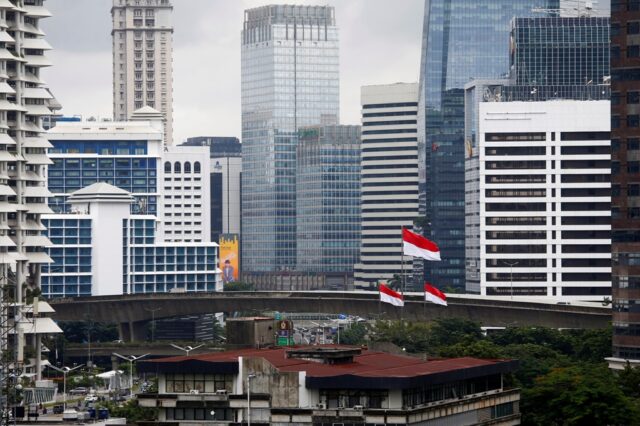
INDONESIAN national flags fly at a business district in Jakarta, Indonesia, Feb. 5, 2021. — REUTERS

JAKARTA — Indonesia plans to offer 10 oil and gas working areas this year, including a block in the South China Sea, amid efforts to boost energy production and make new discoveries, a senior energy ministry official said on Monday.

In 2022, Indonesia auctioned 13 oil and gas fields and has appointed contractors for six of them.

The country is aiming to reach crude oil lifting of 1 million barrels per day (bpd) and gas lifting of 12,000 million standard cubic feet per day (mmscfd) by 2030. Last year, it missed its oil and gas lifting target amid delays in projects and unexpected shutdowns.

Among the oil and gas fields Indonesia plans to offer this year are working areas in Natuna D Alpha, which are giant gas fields situated in the South China Sea, energy ministry official Tutuka Ariadji told reporters.

“Hopefully this year, in May, we would be ready to launch the offering. We also need to gauge the interest for this Natuna block before we open this to public offering,” he said.

Last year, Indonesia approved development plan for $3-billion Natuna gas field in South China Sea.

Tutuka also hoped stalled gas mega-projects such as Indonesia Deepwater Development (IDD) and Masela could soon be resumed. 

Oil giant Cheveron is close to reaching a deal with an investor to transfer its stake in IDD, according to upstream oil and gas regulator SKK Migas.

Tutuka last week declined to disclose details of the discussion on IDD stake.

Meanwhile, Indonesian state oil and gas Pertamina is still negotiating with Shell to potentially take over its partnership in the Masela project. — Reuters

Philippine Long Term Investment Fund: a good set-up

BW FILE PHOTO

(Part 2)

To assess the wisdom of House Bill No. 6608 or “An Act Establishing the Maharlika Investment Fund, Providing for the Management, Investment, and Use of the Proceeds of the Fund, and Appropriating Funds Therefor,” let us make sure that we know what exactly are the provisions contained in the final draft of the bill that was already passed in the Lower House, on which the Senate will start deliberating once it resumes its session this month. It is necessary to know the final form of the proposed bill because it has gone through a good number of modifications as a result of a most democratic process of feedback from all the sectors of Philippine society that will be affected by the law if it is finally passed and implemented.

Section 10 of the Act enumerates the functions of the Maharlika Investment Corp. (MIC). It states that in carrying out its objectives and functions, the MIC shall:

a.) Establish a diversified portfolio of investments in the local and global financial markets and in other assets that promote the objectives of the Fund;

b.) Manage and invest the initial and future contributions to the Fund in accordance with this Act;

c.) Accept and manage investment mandates whose investment purpose is to increase income for development goals;

d.) Develop and foster skills in finance, economics, risk mitigation, good governance and other related areas, consistent with the capacity and capabilities build-up of human resources in the industry; and,

e.) Implement international best practices in investing and managing assets in accordance with the internationally accepted standards and principles of transparency and accountability.

From the functions enumerated above, it is clear that the Government is not unnecessarily putting up a state enterprise like the former National Development Corp. (NDC) that invested in extractive and processing industries aimed at the export market. These state enterprises failed miserably as they were flawed with what national scientist Raul Fabella refers to as “the moral hazard arising from state intervention.”

The nature of the Maharlika Investment Fund is that of a passive investment instrument that can, if properly managed, pump prime billions of dollars of foreign direct investments into very capital-intensive infrastructure and large-scale agribusiness projects that will surely help create millions of jobs today and contribute to sustaining the Philippine GDP growth at its present rate as one of the most rapid in the Indo-Pacific region. At the same time, these investments in much-needed infrastructure in telecom, transport, energy, and large-scale agriculture will greatly benefit future generations, thus replicating what sovereign wealth funds in other countries are able to do, i.e., transfer benefits from one generation to another.

That is why it was predictable that one of the first to cite the benefits of the Maharlika Fund (in contrast with numerous naysayers from the academe and civil society) was the President of the Philippine Stock Exchange (PSE), Ramon Monzon, who pointed out that the fund’s goals of sustaining infrastructure spending would help spur investments, ultimately benefiting the country’s capital markets. In an official statement, Mr. Monzon said: “The PSE’s primary mission is to facilitate the flow of capital into more productive and beneficial channels and as a result contribute to efficient capital formation for the country. Since the MIF seeks to attract and invest capital for big ticket infrastructure projects, sustainable green and blue infrastructures and countryside development, we believe these investments will create a multiplier effect that would attract more fund-raising activities and portfolio investments and in turn contribute to the growth and development of the capital markets.”

With the abysmally low level of domestic savings and a government buried in debt for at least the next five years, the greatest challenge to the Philippine economy is the shortage of long-term funds that can be invested in much needed infrastructure projects and large-scale agricultural investments that will improve productivity. That is why the battle cry should be the words of Secretary of Economic Planning Arsenio Balicasan: “The more sources of funding we have, the better.”

If a small amount of very scarce funds investment (a beginning capitalization of only $5 billion) in the Maharlika Fund can unlock some 10 billion or more dollars of FDIs every year, then it is worth the sacrifice involved in diverting some of the funds to be contributed by the investing government financial institutions away from more urgent needs like education, health, and poverty alleviation.

The proponents of the Maharlika Fund are not blind to the opportunity costs of the P250 billion to be contributed by the government financial institutions, the Philippine Amusement and Gaming Corp. (PAGCOR), and other government-owned gaming operators as well as other sources such as royalties and/or special assessments on natural resources such as in mining. They, however, have made the prudential judgment that these opportunity costs are far outweighed by the financial as well as social benefits of the billions of dollars that will flow into the country, facilitated by a partnership with the Investment Fund.

This is not pure theorizing. I have tested the concept with large foreign infrastructures companies from Spain, South Korea, and Japan. A good number of them are already preparing unsolicited proposals to build and own international airports, seaports, renewable power plants, data centers, railways, and subways. They are looking at the Mactan International Airport (our most modern international airport) that was a partnership between the Indian GMR and Megawide as a model. But instead of having a private company as partner, they would be more than happy to have a government entity like the Maharlika Fund as the one to “hold their hand” as they navigate the difficult waters of the Philippine investment environment.

Those who fear incompetence or corruption in the management of the fund (with constant reference to the Malaysian case) should be reassured by the provision of Section 16 of the proposed bill by the House of Representatives: The management of the MIF shall be subject to a set of investment policies, guidelines and risk management limits and procedures, as approved by the Board of Directors, upon due of the recommendations of the Advisory Body. Investment and risk management strategies of the MIC shall be in line with the policies and objective hereunder stated to ensure the long-term viability of the Fund. The Chairperson of the Board will not be a politician but will be the Secretary of Finance, a position in the Executive Department that has always been occupied for the last 40 years by some of the best, brightest, and honest professionals, whatever the quality of the political leadership.

This criterion of appointing only those among the best and brightest can readily be applied to the key positions of the MIF. They are the Chief Executive Officer of the MIC, President of Land Bank of the Philippines, President of the Development Bank of the Philippines, five independent directors from the private sector, the academe, business sector, and investment sector. The independent directors shall be chosen by the advisory body which shall be composed of the Secretary of the Department of Budget and Managment, the Directory General of the National Economic and Development Authority (NEDA), and two members from the private sector: the President of the Philippine Stock Exchange and the President of the Bankers Association of the Philippines.

Humility aside, I have been so deeply involved in advising Philippine banks, business corporations, civil society organizations like the Makati Business Club, the various chambers of commerce and industry, and business schools on a wide range of business issues, that I can, at the spur of the moment, recommend a list of the best and the brightest that can be considered by the Advisory Board for both the key executive positions and the independent directors of the MIC. From my close interaction with literally hundreds of business executives, especially in the financial sector, the following is a list of very experienced and highly respected investment bankers and investment specialists who can be considered (among others) by the Advisory Board (they are listed at random): Cesar Consing, Roberto de Ocampo, Francis Sebastian, Francisco del Rosario, Jr., Anton Periquet, Robert Panlilio, Omar Cruz, Lorenzo Tan, Jerry Kilayko, Raul de Mesa, Michael de Guzman, Rex Mendoza, Melo Bautista, Vaughn Montes, Edwin Bautista, Jose Teodoro Limcaoco, Rabboni Francis Arjonillo, Eugene Acevedo, Emmanuel Herbosa, Fabian Dee, Hans Sicat, Antonio Itchon, and Antonio Mancupa. There are some who are equally if not more qualified whom I did not include in this list because I have certain information that, for political reasons, they will never accept a position in this present Administration. Some of the persons listed are still very active in banking and may not find the time to be independent directors.

What I want to illustrate is if the present Administration is really intent in making the MIC truly a competent and honest instrument for drawing long-term funds to development projects, they will seriously consider choosing at least some of the executives and independent directors of MIC from this long list. It will be very easy for the Advisory Body to find the biodata of each of my nominees on the internet. They are very public figures, having occupied top positions in both domestic and multinational banks as well as in professional organizations that have to do with banking such as the Bankers Association of the Philippines and the FINEX.

(To be continued.)


Bernardo M. Villegas has a Ph.D. in Economics from Harvard, is professor emeritus at the University of Asia and the Pacific, and a visiting professor at the IESE Business School in Barcelona, Spain. He was a member of the 1986 Constitutional Commission.

bernardo.villegas@uap.asia

Who’s afraid of the NCAP?

PHILIPPINE STAR/ MIGUEL DE GUZMAN

The Supreme Court has finally wrapped up oral arguments on the No Contact Apprehension Policy (NCAP). Two petitions that raised legal issues caused the issuance of a temporary restraining order (TRO) on a policy that was meant to make the enforcement of traffic rules more efficient, less vulnerable to human intervention, and bolster overall road safety. In fact, a significant decrease in the number of traffic violations had been attributed to the NCAP.

One of the petitions was by transport groups, who claimed that motorists were under the constant threat of being arbitrarily apprehended. They also said that the penalties under the NCAP were unreasonable.

The second petition was filed by a lawyer who claimed that the NCAP violates his right to due process. He also claimed that the NCAP compromises people’s right to data privacy since traffic violation records and personal details of motorists could be accessible by anybody who keyed in the plate number of the vehicle involved.

It is fair to acknowledge the right of these petitioners to raise these concerns. It is a given, for example, that the system must have safeguards to protect personal data in compliance with the Data Privacy Act and safeguards are in place against this risk.

However, we must go back to the main principle that gave rise to the NCAP in the first place: to discipline erring motorists which would in effect help ease the flow of traffic and avoid vehicular accidents often caused by reckless driving.

Local government units (LGUs) control the implementation of the NCAP in their respective jurisdiction and has yielded very positive results.

In the City of Manila, fatal and non-fatal injuries dropped by 917 from its 2019 numbers, according to the Metro Manila Reporting and Analysis System 2021 Annual Report of the Metropolitan Manila Development Authority (MMDA). Average daily violations per camera dropped significantly from 56 in December 2020 to just three in August 2022.

Quezon City Mayor Joy Belmonte said in August last year that traffic violations in areas under the city’s NCAP program fell by 75%.

Parañaque City adopted the NCAP in 2018 using artificial intelligence and technologies in identifying traffic violators 24/7. On a per-camera basis, traffic violations dropped by a staggering 84% according to recorded data from 2018 to 2022.

Meanwhile, in Valenzuela City, Mayor Wes Gatchalian said that since they implemented the NCAP in 2019, some 200,000 traffic violators had been apprehended.

Public perception strongly supports the NCAP as revealed by a Pulse Asia survey that we in Stratbase commissioned. The vast majority of Filipinos agree that NCAP will be effective in instilling driver discipline and improve road safety. No less than eight of 10 of the respondents in the nationwide survey approve of the NCAP’s implementation.

Foremost is the non-discriminatory nature of the NCAP technology. It does not matter what kind of vehicle you drive, what prominent stickers are displayed on your windshield, or which influential people you know. The cameras of the system records in video the act of a violation, a Notice of Violation is sent to the registered owner who is subjected to penalties accordingly.

It thus does not hold that the penalties for the violations are unreasonable or unconscionable. There is one foolproof way to avoid these penalties: to drive carefully and conscientiously. Drivers wantonly disregarding traffic regulations are a serious safety risk to all road users and expecting light punishment for a life-threatening offense is downright outrageous.

Through the lens of good governance, the NCAP is very effective because it removes opportunities for bribery. There is no chance for apprehended drivers to slip a bill with their licenses when they hand them to enforcers, whether or not these motorists acknowledge their wrongdoing. If they want to explain their case, they will, instead, have to go to their LGU’s traffic adjudication board — personnel amply trained to review and approve the violations.

Finally, the NCAP is consistent with the government’s push for e-governance. President Ferdinand Marcos, Jr., in numerous pronouncements, the most recent of them being at the World Economic Forum in Davos, Switzerland, acknowledged that digital transformation is a priority of his administration, and a significant part of it is enabling the bureaucracy to transact its business and provide services to the people with digital technologies. He also committed to certify the proposed law on E-Governance as urgent.

The gains and benefits from the NCAP far outweigh the issues raised by the petitioners because these issues can easily be addressed with the proper implementation by the LGUs. It is in the interest of the LGUs, in turn, to make the NCAP work for them for the benefit of their constituents and in pursuit of our nation’s digitally driven development and governance.

The NCAP is a technological innovation that greatly enables the enforcement of traffic rules that are there to ensure the safety of our roadways. Only habitual offenders are afraid of NCAP and getting them off our streets will be best for all.


Victor Andres “Dindo” C. Manhit is the president of the Stratbase ADR Institute.

Dry January? Yes! Free-for-All February? Not so fast.

STOCK PHOTO | Image by Vinicius "amnx" Amano from Unsplash

WE’RE ALMOST done with Dry January, a transatlantic experiment in abstention that started a decade ago in the UK. The concept of an annual break from drinking has become something of a cultural phenomenon, with some 15% of adults in the US and UK participating this year.

The biggest benefit of Dry January seems to be in forcing us all to reflect honestly on our relationship with alcohol: how often and how much we drink, our triggers for drinking more, and how alcohol might be affecting our day-to-day lives.

The need to more deeply evaluate our habits is particularly acute coming out of the pandemic. Deaths in the US from alcohol-related liver disease, which had already been slightly increasing between 2017 and 2019, rose sharply in 2020. A worrisome trend in increased alcohol consumption among women only worsened during the first year of the pandemic.

On its surface, it would seem that Dry January is the hard reset that everyone needs. But as I watch more friends participate in the break (and even dabble myself this year with more of a “damp” than a “dry” approach), I wonder how much we know about its value. Are people treating the month as the start of real change or is this more of a feel-good hiatus? And if Dry January simply begets Free-for-All February, does that temporary break make a difference in our health?

On that last question, experts in alcohol use disorder told me unequivocally that yes, even that short break can matter for our health. Just a few weeks off from drinking can do wonders for repairing the liver, and can improve insulin resistance and blood pressure in even moderate drinkers. And people typically report tangible improvements to their daily lives, like sleeping better and losing weight.

But do the behavioral changes carry through the rest of the year? Here, the answer seems more tentative. Most of the evidence that an annual pause alters our long-term behavior comes from a study out of the UK. Researchers surveyed about 900 people who participated in Dry January at both the start and end of the month and again six months later. Overall, they found that even months later, participants felt more in control of their drinking; were imbibing on average one less day per week; and consumed about one less drink on the days they did partake, says Richard De Visser, the University of Sussex professor who led the study. “When you put those things together, it has a big benefit.”

Whether those outcomes translate to the US remains to be seen. The UK’s efforts to help people succeed seem more coordinated than the ad hoc approach in the US. For example, people in the UK can formalize their commitment by signing up to participate through a website run by the British charity Alcohol Change UK, which also offers a related app to help keep them on track, both during and after Dry January. An analogous program might help Americans make Dry January less of a quick detox and more of a long-term habit.

Science aside, a simple gut check at the end of the break might be the most compelling reason for people to reassess their drinking habits. “If you do Dry January and you feel better, then your body is trying to tell you something,” says George Koob, director of the National Institute on Alcohol Abuse and Alcoholism. “Listen to your body.”

Koob and other experts I spoke with suggest asking yourself a few basic questions: Did you sleep better this month? Did you have more energy or lose weight? Were you more regularly getting to work on time or having better interactions with your friends or family?

If the answer to some or all of those was yes, then you might want to seriously consider a drier 2023. Every expert I spoke with stressed that people don’t need to give up alcohol altogether, but cutting back can make a difference to our health.

Develop a plan for drinking less, says Henry Kranzler, director for the Center for Studies of Addiction at the University of Pennsylvania’s Perelman School of Medicine, emphasizing that any reduction at all is good for you.

One of the best ways to reduce overall consumption is to take days off. Kranzler suggests taking one day off after any two consecutive days where alcohol is consumed.

And set limits for yourself, whether that’s the number of drinks consumed on a night out or a total amount for the week. If you’re at a bar, alternating between cocktails and mocktails can help you stick to those goals.

Small changes like this can halve weekly alcohol consumption for someone who previously might have downed a glass of wine or two with dinner every night, Kranzler says.

So before pouring that first glass of wine on Feb. 1, consider what you got out of the last few weeks. If you felt healthier or happier, make a plan for how you’re going to sprinkle some of the Dry January philosophy into the rest of the year.

BLOOMBERG OPINION