Home Blog Page 5312

Meralco unit installs 2 more solar rooftops

MANILA ELECTRIC CO. (Meralco) said on Thursday that its renewable energy unit has turned over solar rooftop projects to The Orchard Golf and Country Club and Biostar NutriProducts, Inc.

In a media release, MSpectrum, Inc. or Spectrum said it installed The Orchard’s solar panels, which have a combined capacity of 99.9-kilowatt-peak (kWp), at the country club’s facility in Dasmariñas, Cavite. The power source began operating early last year.

Since its completion, The Orchard’s solar rooftop has generated more than 125,000 kilowatt-hours (kWh) of clean energy equivalent to saving around 10,000 kWh in monthly consumption. In energy costs, the savings amounted to P785,000 last year, Spectrum said.

With the project, The Orchard’s carbon footprint was cut by about 89 tons, “which is equivalent to planting 4,100 trees or reducing approximately 355,000 kilometers in vehicle travel per year.”

Meanwhile, the project with Biostar, which distributes and manufactures animal health products, involves a 24.96-kWp rooftop facility at the company’s poultry farm in San Pablo City, Laguna.

Biostar’s solar rooftop was energized in April 2022 and has so far generated about 21,520 kWh, resulting in savings of nearly P167,000.

With the project, the company was able to cut its carbon footprint by 15.33 tons, or the equivalent of planting at least 700 trees or reducing yearly vehicle travel by 61,054 kilometers.

Meralco’s controlling stakeholder, Beacon Electric Asset Holdings, Inc., is partly owned by PLDT Inc. Hastings Holdings, Inc., a unit of PLDT Beneficial Trust Fund subsidiary MediaQuest Holdings, Inc., has an interest in BusinessWorld through the Philippine Star Group, which it controls.

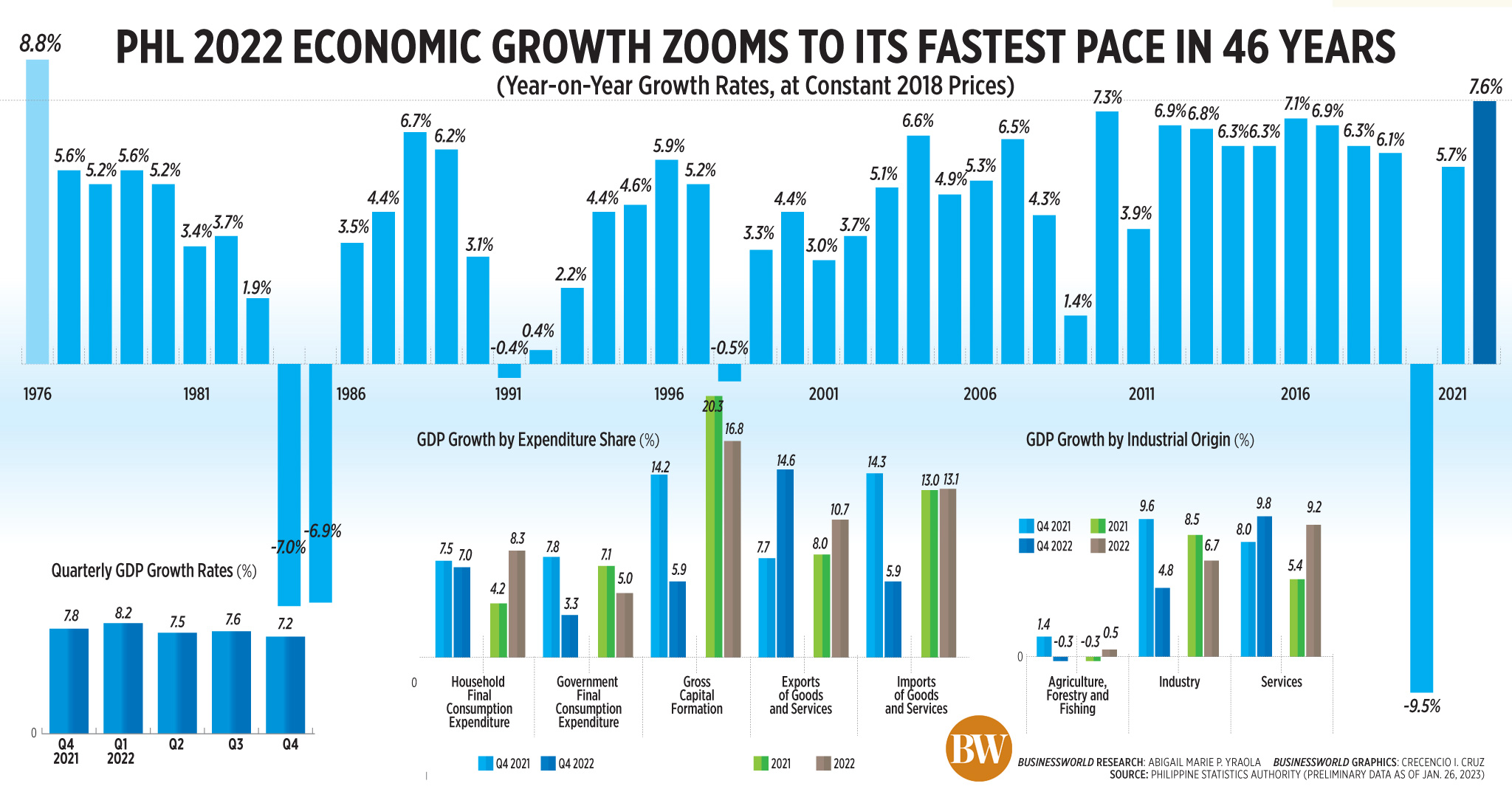
PHL 2022 economic growth zooms to its fastest pace in 46 years

THE PHILIPPINES weathered record inflation and interest rate increases last year by posting the fastest economic growth since 1976 — one of the strongest in Asia amid a dreary global outlook. Read the full story.

PHL 2022 economic growth zooms to its fastest pace in 46 years

What to See This Week (01/27/23)

TOM HANKS in A Man Called Otto.

A Man Called Otto 

WHEN a lively young family moves in next door, grumpy widower Otto Anderson meets his match in a quick-witted, pregnant woman named Marisol, leading to an unlikely friendship that turns his world upside down. Directed by Marc Forster, the film stars Tom Hanks, Mariana Treviño, and Rachel Keller. IGN Southeast Asia’s Ryan Leston writes: “A Man Called Otto is a benign comedy-drama that peppers a heart-wrenching story with plenty of eye-rolling jokes to distract you from its perfectly pedestrian plot. A tear-jerking performance from Tom Hanks shows a certain subtlety you won’t find in its storyline, while Hanks’ son Truman fills in the gaps with some adequate flashbacks in a reverse-Forrest Gump.” Film Review aggregate site Rotten Tomatoes gives it a score of 69%, and an audience score of 97%.
MTRCB Rating: PG  


Alice, Darling

SHOWING exclusively at Ayala Malls Cinemas, Alice, Darling follows a young woman trapped in an abusive relationship who becomes an unwitting participant in an intervention staged by her two closest friends. Directed by Mary Nighy, it stars Anna Kendrick, Charlie Carrick, Wunmi Mosaku, and Kaniehtiio Horn. Monica Castillo of www.rogerebert.com writes: “Kendrick’s performance is one of the strongest aspects of Alice, Darling. Under [Mary] Nighy’s direction, they create an emotional portrait of someone on the verge of being lost to a warped distortion of love but who realizes they were surrounded by the real thing the entire time.” Film Review aggregate site Rotten Tomatoes gives it a score of 83%, and an audience score of 50%.

MTRCB Rating: PG


Hello, Universe

ARIEL, a middle-aged man full of regrets, gets another chance to rewrite his past when he meets a magical figure who grants his wish to live a life of a basketball player. Directed by Xian Lim, it stars Anjo Yllana, Benjie Paras, and Janno Gibbs.

MTRCB Rating: PG


Operation Fortune: Russe de Guerre

SPECIAL agent Orson Fortune and his team of operatives recruit one of Hollywood’s biggest movie stars to help them on an undercover mission when the sale of a deadly new weapons technology threatens to disrupt the world order. Directed by Guy Ritchie, the film stars Jason Statham, Aubrey Plaza, and Hugh Grant. The AU Review’s Peter Gray writes, “Operation Fortune sits somewhere in the middle, serving as an actioner that has its share of exciting sequences but also committing itself to a level of exposition that requires a certain amount of focus from those in attendance. It requires just enough brain power to stay in tune with the ins-and-outs of its plot, but then makes sure that there’s enough loud noises, sexual innuendo and well-timed gags to offset its own intelligence.” Film Review aggregate site Rotten Tomatoes gives it a score of 68%.

MTRCB Rating: PG

Arbitrage opportunities

AS a student of finance, I have always been fascinated by the Big Mac Index which The Economist invented in 1986 as a lighthearted guide to whether currencies are at their correct level. Briefly, it is based on the theory of purchasing power parity (PPP), the notion that in the long run exchange rates should move towards the rate that would equalize the prices of an identical basket of goods and services (in this case, a burger) in any two countries.

Thirty-six years have passed and burgernomics has flourished, becoming the subject of academic reviews and discussion. Today, The Economist continues to update and improve the methodology on how they calculate the Big Mac Index. Soft and fun at first sight, it is a very instructive introduction to the law of one price.

The law of one price states that in a competitive market, if two assets are equivalent, they will tend to have the same market price. There are specific conditions for this to happen. One, free competition allows the forces of supply and demand to run its dynamic effect. Two, trade frictions are absent such as tariffs, transportation fees and transaction costs. And three, everyone is a price taker and no one can manipulate prices.

To illustrate, let’s review the onions situation. If the price of onions is P600 per kilo in Manila, ask yourself what its price is in another country. The global average is reported to be around P85.00 a kilo. Consider how much it would cost to buy onions say, in Taiwan, and then sell it in Manila. There will be costs of shipping, handling, insuring, etc. If total transaction costs are less that the price differential, and you can delay paying for the onion purchase until you receive payment from selling it, then you avoid the financing cost and you will have engaged in a pure riskless arbitrage.

Arbitrage is the purchase and immediate sale of equivalent assets in order to earn a sure profit from a difference in their prices. If markets are efficient, this price discrepancy will be well known, and traders would get into the picture to take advantage of the gaps. In theory, succeeding transactions will close the price differential and arbitrage will force onion prices to correct and be the same in the two markets.

So, you might ask why onions remain expensive. Unfortunately, onions do not satisfy the law of one price conditions we earlier enumerated, i.e., free competition, trade friction (importation not allowed but smugglers suspected) and not everyone is a price taker in this commodity (unscrupulous speculators abound).

Here’s another simple arbitrage example I read about Warren Buffett. At 6 years old, he would purchase a six-pack Coca Cola soda for 25 cents and sell each bottle for 5 cents in his neighborhood, profiting 5 cents per pack. This the classic buy wholesale and sell by piece strategy. Even at a young age, Buffett intuitively adopted arbitrage tactics.

In my past corporate life, we had an officer who used to visit our Davao branch for corporate inspection and audit. I was told, he often travels with an empty suitcase going to the region but packs his bags with all sorts of provincial goods on his return. Simple repackaging of the goods provides profit through arbitrage of place.

Understanding the importance of doing arbitrage is a prime model for business development. If currency, commodity, security, or even goods like bags, sneakers, etc., are priced differently in two separate markets, traders buy the cheaper version and sell it at the higher price to make money.

The problem with arbitrage is pricing discrepancies are expected to be short-lived and small. Thus the strategy benefits the astute investor who can execute transactions with large sums of money while the market is in the process of correction. In the securities market, however, advances in technology and the digitization of the process are making it easier to identify and resolve pricing errors. Algorithm based trading in first world markets quickly spot and execute arbitrage opportunities. The machine is faster than humans in execution.

The more efficient the market is, the less the arbitrage opportunities. The internet is allowing better view of price differentials. There was a time when the globalization trend predicted full convergence of prices. Competition in financial markets predicted not only that the prices of assets would be the same, but also interest rates.

One emerging trend globally is protectionism by specific economies. The more this pattern continues, the less chances for prices to converge. If domestic and imported goods cannot be readily and easily substituted, higher input prices can increase domestic firm’s production costs and reduce household purchasing power. Inflation is one expected outcome. Consumption, investment, and employment are all negatively affected. The macroeconomy suffers.

Inefficiencies in the market, and the deterioration in trade allow more arbitrage openings. This is a case of bad news, good news, who knows? What is clear is that arbitrage remains a powerful tool for those fast enough in identifying the differences. Finding mismatches in prices provides opportunities to make less risky returns.

The views expressed herein are his own and does not necessarily reflect the opinion of his office as well as FINEX.


Benel Dela Paz Lagua was previously EVP and chief development officer at the Development Bank of the Philippines. He is an active FINEX member and an advocate of risk-based lending for SMEs. Today, he is independent director in progressive banks and in some NGOs.

The lost art of writing commendation letters

Ive read two of your articles on low-cost employee motivational strategies. However, I think you missed one important aspect of motivation — the writing of commendation letters. Aren’t such letters a type of low-cost motivation? — Sun Flower.

I agree. As I’ve said in that article, praising people is akin to sunlight, available and free to all. So why can’t we do the same thing to our workers? All we need to do is discover what’s readily available, easy and practical. This includes writing commendation letters to those who deserve it.

In my Oct. 23, 2020 column, I wrote the following: “(F)ocus on giving non-monetary rewards that motivate. There’s no shotgun approach for this. You must tailor-fit your zero-cash reward to employees who value them the most.

“This includes the right to choose and manage a project, a letter of praise signed by the CEO, a testimonial plaque from peers signifying their high regard for the employee, and the opportunity to help develop an important new product for the company.”

As you can imagine “a letter of praise signed by the CEO” is something out of the ordinary, say when the concerned worker has done something monumental that’s favorable to the image of the organization. It could be that an employee who loves bowling may have excelled in a national competition.

At one bank, an employee was given more than a CEO’s commendation letter when she got a bronze medal in the last Southeast Asian Games. I’ve used this example many times to explain the principle of “self-actualization” — the apex in Abraham Maslow’s Hierarchy of Needs.

SINCERE PRAISE
Ordinarily, commendation letters are signed by the department head and co-signed by the worker’s immediate boss. The higher the position of the signatories, the better as it lends credibility and significance. That must happen when the achievement is pertinent to one’s particular job and the worker has exceeded many times over the prescribed job requirements.

But tell me, when was the last time you wrote a commendation letter to a deserving employee? I imagine almost never, other than to verbalize or write bland marginal notes like “thank you,” “well done” and “keep it up,” which to me are purely mechanical in nature.

Commendation letters must not be taken for granted by line management. You don’t need much time, money and effort to write it. However, we’ve lost the fine art of writing such commendation letters, mainly due to the allure and convenience of social media.

When you received such praise through the social media, how did you feel? Elated, perhaps, but not for long. That’s because praise on social media has become routine, especially when they are informal and accompanied by emoticons. Such pro-forma expressions are akin to polite applause for ordinary achievement. Nothing more, nothing less.

That means you did something acceptable to management but not enough to merit a well-crafted commendation letter. So what’s missing here? The ideal commendation letter must, first of all, show an incredible amount of sincerity on the part of the signatories. When you receive something like this, it should make you feel elevated.

Therefore, to manifest sincerity in your commendation letter, you must consider the following:

One, be specific about the employee’s accomplishment. In general, it must address what makes this accomplishment stand out compared to the achievements of other employees who are similarly-situated, and how the accomplishments stack up against the actual job expectations, as verified by independent sources, like the accounting department.

Two, emphasize the impact of the achievement. Be clear how it benefited the organization. Say something along the lines of: “Your discovery of a low-cost solution that eliminated oil waste in our operations saved us $3,000 every month or $36,000 a year is very much appreciated by management.

“What was remarkable was the fact that you used the lessons of our recent kaizen problem-solving workshop in making it happen.”

Three, issue the commendation letter as soon as possible. Don’t delay. Delay signifies that such a letter is not important to management. Apply the “hot stove” rule in employee discipline to writing commendation letters — the moment you touch a hot stove, the penalty will be immediate. And every time you touch the stove, the pain will be repeated.

The same should apply to praising people.

Four, write the commendation letter the old-fashioned way. That means issuing a printed, original copy of the letter to the employee, in the presence of other employees in a casual set-up, like in an afternoon pizza party. This signals the importance of the occasion to the receiver and provides a pretext for picture-taking or an item in the company newsletter.

A copy of the letter must be forwarded to the human resource (HR) department for the employee’s file.

Last, don’t encourage false hopes. If you’re elated by an employee’s above-average work performance, don’t be tempted to promise a promotion or a merit increase even if that employee deserves it. Better to keep silent about things that are beyond your authority to grant. Or even if it’s within your authority, unless you intend to act on the promise immediately.

If you’re limited only to giving commendations, it’s best to keep mum as anything coming out of your mouth could be taken the wrong way.


Contact Rey Elbo for his unique program called “Superior Subordinate Supervision” designed as a preventive approach to workplace conflict. Or chat your workplace questions via Facebook, LinkedIn or Twitter or e-mail them to elbonomics@gmail.com or via https://reyelbo.com


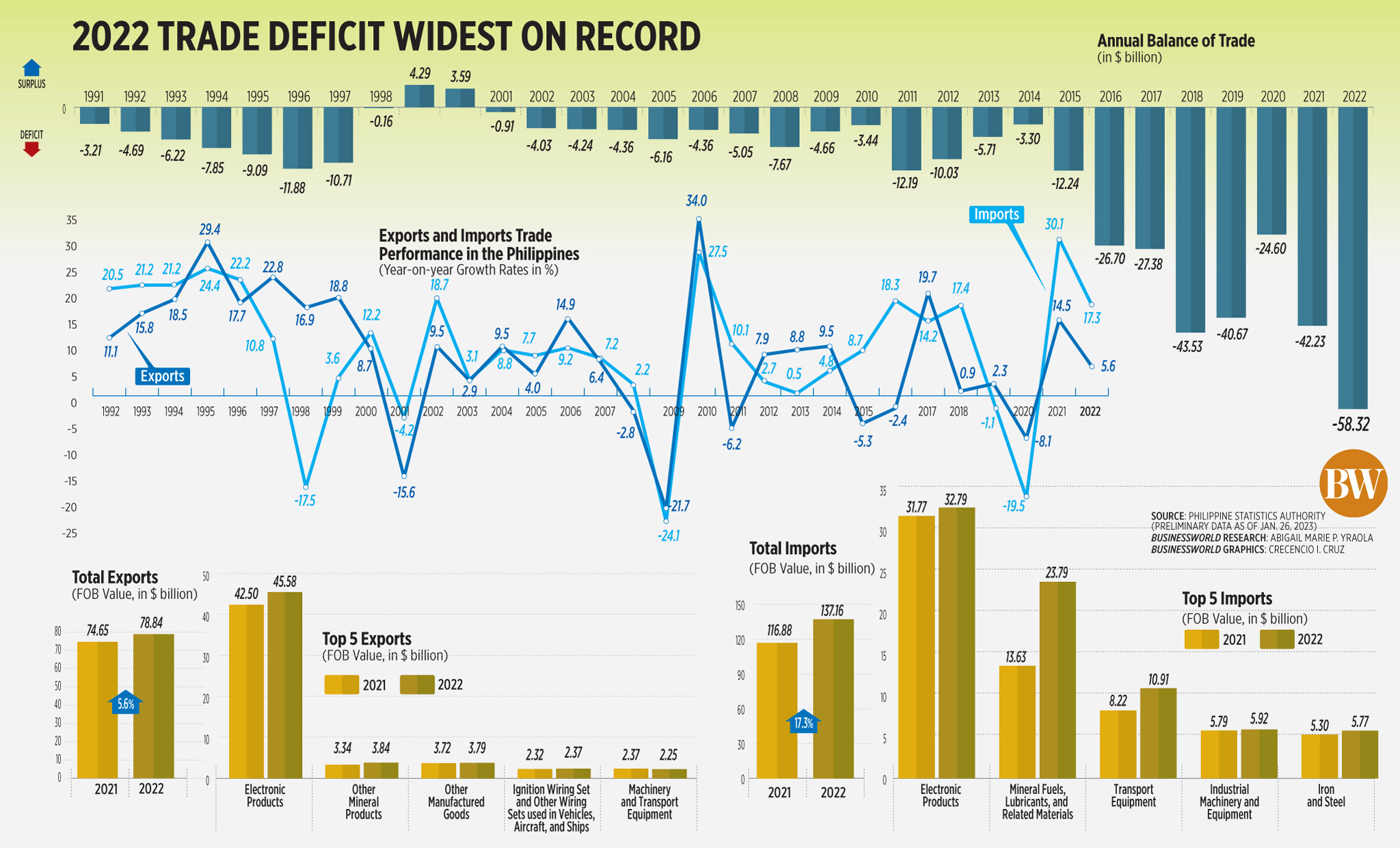
2022 trade deficit widest on record

THE PHILIPPINE trade deficit widened in December from the previous month after exports declined to the lowest in more than two years, while imports continued to fall for the second straight month, the Philippine Statistics Authority (PSA) said on Thursday. Read the full story.

2022 trade deficit widest on record

Kia Philippines launches dealership in Libis

KIA PHILIPPINES recently inaugurated a new dealership in Libis, Quezon City as part of its expansion efforts across the country.

The South Korean car brand said in a statement on Thursday that the dealership, Kia Acropolis, is under Filipino-owned Autoklassik Motors Corp. The latest dealership features Kia Philippines’ refreshed look, alongside outlets in Alabang, Sto. Tomas, BGC, Ortigas, and Kawit.

“Soon, all 42 Kia dealerships nationwide will have refreshed exteriors, and by next year all will share Kia’s revamped interior design aesthetic. Newly appointed Kia dealers will also proudly display the new corporate identity,” Kia Philippines said.

“The opening of Kia Acropolis espouses Kia’s tagline and its commitment to its loyal customers. This milestone brings a movement that inspires closer to those who reside or work in the vicinity of Libis, Katipunan, White Plains, Green Meadows — and other neighboring areas,” it added.

Kia Acropolis is situated on E. Rodriguez Jr. Ave. Brgy. Bagumbayan, in Libis. It will offer sales, after-sales, maintenance, support services, body repair, and painting services.

Meanwhile, Kia Philippines President Emmanuel A. Aligada said the company’s sales increased by 34% in 2022, without giving specific figures.

“The industry is back to pre-pandemic levels in terms of overall sales. Everyone was hungry to go back into the business and to ride their new cars, so Kia has been riding that crest. In 2021 Kia grew by 76%. In 2022, we grew by 34%; outpacing the industry’s 26%,” he said. — Revin Mikhael D. Ochave

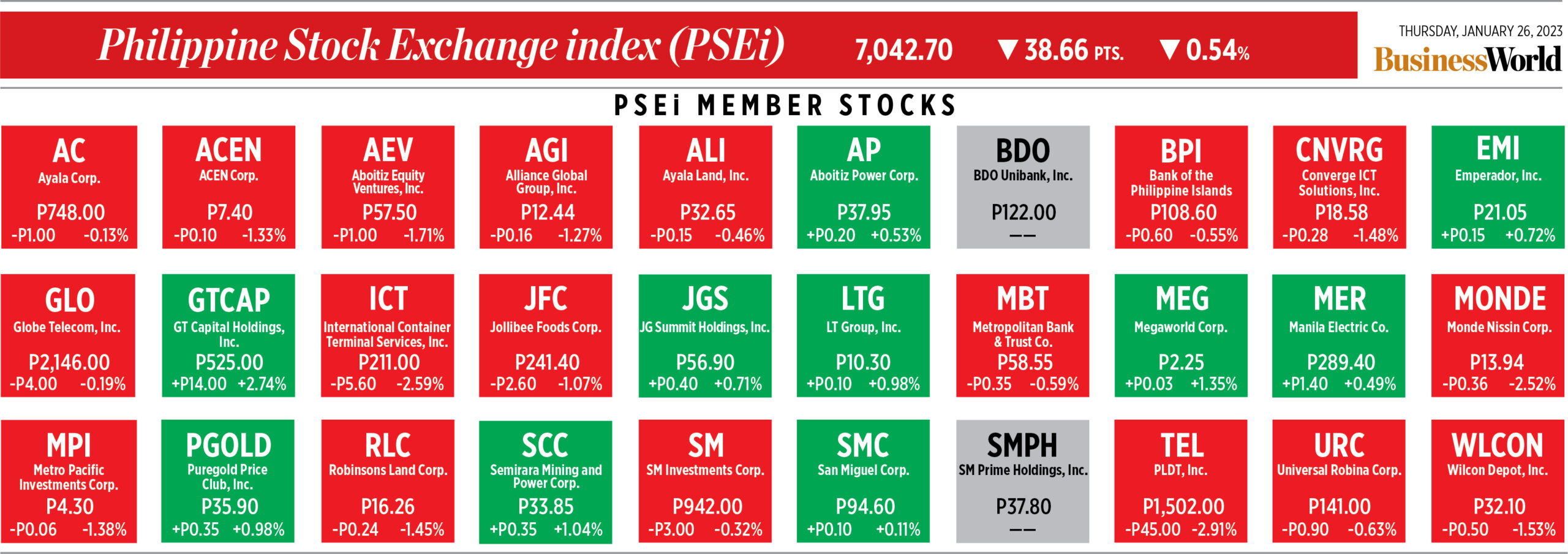
How PSEi member stocks performed — January 26, 2023

Here’s a quick glance at how PSEi stocks fared on Thursday, January 26, 2023.


ECCP: PHL to attract ‘billions’ after easing investment caps

ACENERGY.COM.PH

THE European Chamber of Commerce of the Philippines (ECCP) is expecting the Philippines to attract “billions” worth of investments after various industries were cleared to receive up to 100% foreign ownership.

ECCP President Lars Wittig said at a launch of event in Makati City on Thursday that the group is expecting “billions of dollars” worth of foreign direct investment into industries like renewable energy (RE).

The ECCP said investment will be unlocked by the Department of Energy’s green light to relax foreign ownership caps in RE, as outlined in Department Circular No. 2022-11-0034, as well as the amendments to the Foreign Investment Act, Retail Trade Liberalization Act, and Public Service Act.

Mr. Wittig said that there should be an increased efforts to create green and resilient infrastructure, and to prioritize the wellness and education of the workforce.

Mr. Wittig made the remarks at the launch of its investment guide, “Doing Business in the Philippines 2023,” prepared in partnership with attorneys from DivinaLaw.

The guide updates the previous edition released in 2020.

“The Doing Business in the Philippines publication gives vital information to investors seeking to expand in or enter the Philippine market,” Mr. Wittig said.

“As a valuable resource for businesses interested in exploring opportunities in the country, this booklet aims to arm potential investors with knowledge of the Philippine business environment as well as relevant laws and procedures, empowering businesses to make informed investment decisions,” he added.

Mr. Wittig called for the maintenance of a “sound regulatory environment” and to streamline government processes.

“The ECCP has actively advocated for the development of physical and digital infrastructure for investment facilitation, as well as the creation of a competitive fiscal incentives regime, further economic liberalization, and the strengthening of the sanctity of contracts. Such reforms are imperative to attain a more competitive, fair, and more inclusive business climate in the country,” Mr. Wittig said. — Revin Mikhael D. Ochave

‘Hot money’ flows turn net positive in 2022

BW FILE PHOTO

FOREIGN portolio investment funds entering the Philippines outweighed those exiting in 2022, the Bangko Sentral ng Pilipinas (BSP) said on Thursday, representing a turnaround from the net outflow posted in 2021.

Foreign portfolio investments registered with the central bank through authorized agent banks (AABs) posted a net inflow balance of $886.7 million last year, against the net outflow of $574.46 million in 2021.

Foreign portfolio investment is known as “hot money” because of the ease with which they can enter or exit a jurisdiction, as opposed to foreign direct investment, which is considered stickier and less fickle.

The net inflow was the largest since the $1.2 billion posted in 2018. However, it missed the BSP target of $3.5 billion for 2022.

“Hot money inflows were supported by the better economic outlook at the end of last year,” China Banking Corp. Chief Economist Domini S. Velasquez said in a Viber message.

“(Easing) inflation in the US led to expectations of smaller rate hikes in 2023, providing a much-needed boost to the US equities market,” she said.

She also noted that Philippine Stock Exchange (PSE)-listed securities registered gains following corresponding international market movements.

The US consumer price index (CPI) slipped 0.1 percentage point month on month in December, the first decline since May 2020 and following a 0.1 percentage point rise in November. Year on year, the CPI rose 6.5%, easing from the 7.1% posted in November.

The Federal Reserve raised borrowing costs by 425 basis points (bps) last year, which brought the Federal funds rate to 4.25-4.5%. The Fed will hold its first policy review for this year between Jan. 31 and Feb. 1. 

In December, the Philppine hot money balance was a $92.95 million net inflow, much lower than the $488.75 million inflow in November. A year earlier, hot money posted a $4.38 million net outflow.

Gross inflows in December amounted to $1.092 billion, down 17.9% year on year, but up 3.6% from November.

Over the full year, gross inflows declined 9.4% to $12.34 billion.

Gross outflows in December totaled $999.12 million, down 25.2% year on year and up 76.6% from  November.

This brought the full-year gross outflow to $11.46 billion, down 19.2%.

Five countries accounted for 80.5% of short-term foreign investments in December — the UK, Singapore, US, Luxembourg, and the Netherlands.

Some 74% of their investments went to PSE-listed holding firms, telecommunications, banks, property companies, food producers, as well as beverage and tobacco makers. The remaining 26% was invested in government securities.

“Investors were possibly more bullish on emerging economies as the monetary tightening cycle is about to end for most economies. Risk-on sentiment was observed not just in the stock market but also in the foreign exchange market,” Ms. Velasquez said.

“The sudden reopening of China will be positive for hot money in 2023,” she added.

The BSP hiked its key policy rate by 350 bps to a 14-year high of 5.5% in 2022.

BSP Governor Felipe M. Medalla is looking at more rate increases in the first quarter to ensure that inflation falls within the 2-4% target by the second half.

Headline inflation rose to 8.1% in December from 8% in November, bringing average inflation in 2022 to 5.8%, the highest in 14 years.

The BSP expects hot money to post a $5 billion net inflow in 2023. — Keisha B. Ta-asan

Galunggong imports below quota as end of closed season nears

BFAR.DA.GOV.PH

IMPORTS of round scad, known as galunggong, topped 25,000 metric tons (MT) as the closed fishing season neared its end in northern Palawan, the main fishery for the species.

Imports of 25,056.27 metric tons (MT) amount to over half of the target volume during the closed season, according to the Bureau of Fisheries and Aquatic Resources (BFAR).

The BFAR said imports were authorized starting November, as a measure to keep prices from rising while domestic fishing was suspended.

Regulators periodically shut down fisheries in order to allow fish stocks to regenerate.

The BFAR did not discuss why the import target was not met.

Galunggong is widely eaten as a source of protein by low-income families, and high prices of the commodity are deemed politically sensitive.

The BFAR said actual imports of frozen galunggong, bigeye scad, mackerel, bonito, and moonfish for wet markets have been within the volumes authorized when the Certificates of Necessity to Import (CNI) were issued.

CNIs were issued by the Department of Agriculture on Nov. 10 and are good until Jan. 31 this year.

The three-month closed fishing season was implemented annually since 2015 to “give the species time to reproduce and grow during its spawning season and to ensure sufficient supply of galunggong in the country.”

“Despite the on-going implementation of the closed season, the price of galunggong remains stable with local galunggong valued at P280/kilo while imported galunggong ranges from P220/kilo to P240/kilo,” BFAR said.

Palawan accounts for 89% of the galunggongs catch landed at Navotas Fish Port Complex last year.

Separately, overall volumes of fish unloaded at fish ports rose 41.33% from a month earlier to 45,355.24 MT in December, even as half of all fish ports reported declining volumes.

The Philippine Fisheries Development Authority said only two of the eight regional fish port complexes posted volume gains while volumes at two more were flat.

The other four posted declines due to bad weather or the closed fishing seasons.

The Navotas Fish Port Complex serving Metro Manila landed 15,493.89 MT in December, up 86.56% from a year earlier.

Volumes at the General Santos Fish Port Complex rose 7.61% year on year to 25,531.63 MT. The month-earlier total was 17,900.32 MT.

Volumes reported by the Lucena Fish Port Complex and Iloilo Fish Port Complex were flat year on year at 1,510.38 MT and 1,339.339 MT, respectively.

Posting declining volumes year on year were the Zamboanga Fish Port Complex (676.235 MT from 806.54 MT); Bulan Fish Port Complex (438.48 MT from 1,201.13 MT); Davao Fish Port Complex (310.72 MT from 371.61 MT); and Sual Fish Port (54.53 MT from 206.08 MT). — Sheldeen Joy Talavera

Meat processors confer with DA to review border inspection rules

PHILIPPINE STAR/MIGUEL DE GUZMAN

MEAT processing companies said they met with the Department of Agriculture (DA) to review the import inspection process and whether to adopt the international system for classifying regions where livestock diseases have broken out.

In a statement, the Philippine Association of Meat Processors, Inc. (PAMPI) said its representatives met with Senior Undersecretary Domingo F. Panganiban and other officials to go through the policies affecting the industry.

They reviewed the rules on first border inspection of imports ahead of the establishment of the long-delayed Cold Examination Facility for Agricultural goods, the first of which is expected to rise at the Subic Bay Freeport.

The two sides discussed the potential adoption of the World Organization for Animal Health’s guidelines for zoning regions suffering from outbreaks of animal disease.

“The (DA) can help us with science-based food safety and inspection systems, access to safe and nutritious meat materials from both local and global sources, and constant collaboration to further refine food safety standards,” PAMPI told reporters on Thursday.

PAMPI promised to help keep processed meat products affordable for consumers.

“As we represent 85% of the country’s meat processors and food chains, we are committed to provide safe and affordable meat protein to the vast majority of consumers,” the association said.

Mr. Panganiban said he has directed the Bureau of Animal Industry (BAI) and National Inspection Service (NMIS) to address the industry’s concerns. No further details of the discussions were given.

Other officials at the meeting were Assistant Secretary for Operations Arnel V. De Mesa, BAI Director Paul C. Limson, NMIS Director Clarita M. Sangcal, and PAMPI Vice-President Jerome D. Ong. — Sheldeen Joy Talavera