Home Blog Page 5298

Manila Water commits full water supply to service institutions

MANILA WATER Co., Inc. is ensuring 24/7 water supply to public service institutions within its east zone water concession spanning several cities and municipalities in Metro Manila and Rizal province.

“We need to ensure that our services remain uninterrupted and water flows 24/7 for important institutions, especially now that face-to-face classes have already resumed, and mobility has returned to pre-pandemic levels with the easing of restrictions,” Nestor Jeric T. Sevilla, Jr., Manila Water’s corporate strategic affairs group head, said in a media release on Thursday.

Under Manila Water’s Lingap and We Care programs, the company aims to provide uninterrupted water supply to institutions such as public schools, daycare centers, public markets, hospitals, and health centers.

The company also said it managed the rehabilitation of water lines in public institutions as well as technical assistance, repair, and rehabilitation work of internal reticulation systems.

To date, Manila Water said that over 400 public service institutions — including schools, public markets, hospitals, and government offices and facilities — have benefited from its program.

In September, Manila Water announced that it had reached a total of 7.4 million customers as its coverage had expanded to 1.13 million water service connections as of June 2022.

Last month, the listed water company said it was targeting to spend about P181 billion for capital investments in the next five years for water and wastewater projects.

At the stock exchange on Thursday, shares in the company closed 4.06% lower to finish at P15.60 apiece. — Ashley Erika O. Jose

The policy rate and small businesses

EVERYDAY, we receive newspaper, television, radio and online platform reports on changing policy interest rates, both local and abroad. A typical report is the Bangko Sentral ng Pilipinas (BSP) raising the key policy rate in September by another 50 basis points (100 basis points or bps equals 1%) to 4.25%.  Analysts expect another 50-bp hike in November and a 25-bp hike in December, bringing the policy rate to 5% by yearend.  In the US, the current Federal Reserve interest rate is 3% to 3.25%, and it is projected to be raised by 125 bps, bringing the rate to 4.25% to 4.5% before 2022 ends.

How important are these policy rates?  It impacts everything, from the rate we earn on our savings account to the rate we pay for loans. Deposit money in banks provide the capital needed for extending loans or credit to customers. Regulators like the Fed in the US and our BSP require that banks keep a certain percentage of capital in reserve as a safeguard for stability and solvency. Banks also borrow money from each other to meet the reserve requirement. These rates serve as the reference for institutions as they are borrowing or lending reserves.

The Fed and our BSP take action to influence money supply as part of their monetary policy toolkit. An expansionary monetary policy, for example, will lower interest rates and thereby stimulate investment and consumption demand in the short run. These days, however, the key concern of regulators is rising inflation, which in the US has been hovering at the 8.3% to 8.5% mark. The Fed has therefore been increasing the policy rate, which will raise short-term borrowing costs, reduce the supply of credit and make loans more expensive. The end objective is to combat inflation.

With inflation headwinds now worldwide, affected by the Ukraine war and other global disruptions, the Philippines is not spared. Combined with local issues like our widening trade deficit, the country must somehow track the policy moves of the US. Already, the peso has depreciated so much that any inaction by our regulators will lead to capital flight and further drops in the currency. Observers believe the BSP has been supporting the local currency, even as some economists argue it cannot do so on a sustained basis.

As the Fed and our BSP move these rates, the rate banks charge each other ripples through the rate charged to customers, both depositors and borrowers.  The prime rate, for example, is what banks charge to large, corporate customers with substantial financial resources. Once the policy rates are adjusted, the prime rate (which is the policy rate plus a premium) will follow suit, and so will the other lending products in the same direction. It sets the baseline for a variety of bank products.

Interest rates represent a promised rate of return and there are so many interest rates as there are borrowing and lending products. The policy rate serves as the starting point for all types of interest rate setting -— mortgage rate for housing loans, commercial loan rates for businesses, personal loan rates, credit card rates, among others.

Banks are rational business entities that need to account for the risks. Once the banks factor in the policy rate, it will adjust the prime rate and many of its other lending products. The adjustments will represent the banks’ perception of different risk premiums. Banks will factor in an inflation premium based on its expectations. The risks that a borrower will default will be considered.  Banks will assess the liquidity of the assets of the potential borrower’s source of repayment. They are also concerned about capital loss exposure because of the changing interest rates and the maturity of the loan.

Bottom line, the regular and ordinary consumers will bear the brunt of the projected upward movements of interest rates. Remember that the prime rate is reserved for the big and the affluent. Small businesses are thus in for a tough ride.

The prospects of the firm are tied to the direction of the broader economy and the policy rate is an important determinant. Firms must keep the big picture in mind as they navigate prospects for growth and at worse, for survival. Being prepared, hopefully the firm can study how it can maneuver, pivot, and adjust its path through an expected more expensive future. But as one expert correctly observed, even in the troughs of business cycles, there are opportunities to be tapped.

Small businesses must keep a close eye on their entire value chain and be prepared for potential disruptions.  There will be strong temptation to apply the all-encompassing cost-cutting tool, but in these days of fine data centric analysis, the scalpel must be strategic, and evidence based.  The firm must develop a good game plan which looks at the important business segments, limiting risks where it can stand mitigation. It must understand its capital structure. At the end of the day, it is better to be ready and  proactive by paying enough attention to the signals of increasing policy rates.

***

The views expressed herein are his own and does not necessarily reflect the opinion of his office as well as FINEX.


Benel Dela Paz Lagua was previously EVP and chief development officer at the Development Bank of the Philippines.  He is an active FINEX member and an advocate of risk-based lending for SMEs.  Today, he is independent director in progressive banks and in some NGOs.

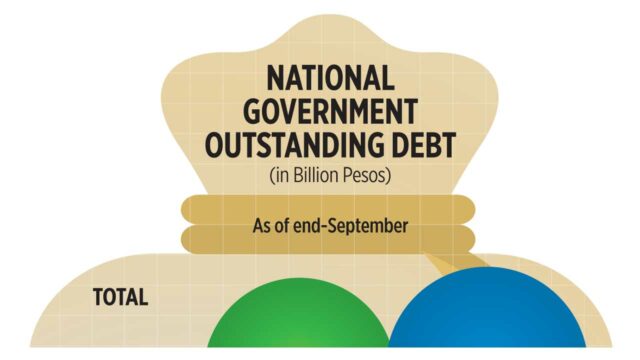
National Government outstanding debt

THE NATIONAL GOVERNMENT’S (NG) outstanding debt hit a record P13.52 trillion as of end-September, mainly due to the weakness of the peso and higher domestic borrowings, the Bureau of the Treasury (BTr) said on Thursday. Read the full story.

National government outstanding debt

James Bond’s ethnicity might change — but his accent probably won’t

Daniel Craig in No Time To Die

THE CINEMATIC character of James Bond has changed with the times since the first Bond film Dr. No was released back in 1962. We have seen Bond as a chauvinistic womanizer, a fun-loving bon vivant, and, more recently, a sometimes brutal yet three-dimensional character, capable of empathy and sorrow.

Most obviously, the face of Bond has changed over the years, with six actors — seven if you include David Niven in the first Casino Royale — playing the coveted role. All these actors have been white — leading to discussion over whether a future Bond could be another ethnicity. However, while Bond’s race or even gender might change in the future, there is one aspect of his portrayal that I believe will be unlikely to shift: his accent.

Granted, there is some degree of accent diversity with the various Bond actors. Sean Connery’s Scottish tones occasionally creep through, for instance. But overall, these are brief moments. All the actors who have played Bond used an upper-class British “Received Pronunciation” (RP) accent — whether more “pure,” such as that of Roger Moore and Daniel Craig, or one which went to lengths to remove regional features, such as Connery’s.

Sean Connery had been advised early in his career to “get rid” of his Scottish accent, and the Australian George Lazenby had elocution lessons to prepare for his role as Bond. It is unlikely that Bond would ever use a more regional accent, one which might suggest a working-class hero.

The character of James Bond attended top private schools, and — in the films at least — studied at Cambridge. He served as an officer in the Royal Navy before working for the British Secret Service. He knows his wines (and sherries and brandies), speaks several languages, enjoys fine cuisine and luxury hotels, and has traveled the world. He owns a mansion and family estate in Scotland.

This all invokes a member of society who is part of the societal elite. Given RP’s association with the ruling class and those with societal power, it is a fitting accent for a character whose background indeed belongs to a member of this exclusive group. This does not mean Bond must be portrayed as an aristocrat and use a variety of RP that suggests landed gentry, but the character must speak with an accent that nonetheless still represents the cultural capital he embodies.

RP does not have the same grip on British society as it once did — it is no longer the standard for the BBC, for instance. But it remains an accent which is both associated with the upper classes and is difficult to pinpoint to a specific geographical region. A nondescript accent like this means there is less potential to stereotype the speaker. A Bond with a broad regional accent risks – in Britain at least — being associated with the potential negative imagery that often accompanies such accents.

Britain may be ready for a regionally accented Bond, precisely as a reflection of the more diverse society in which we live. “BBC English” is no longer synonymous with RP. And we must not forget the camaraderie — and pride — that speakers with broad regional accents can share.

But Bond inherits the connotations of his RP accent, which to this day are still mostly positive in terms of suggested societal prestige and power. And, for a character who embodies power, sophistication and dominance, an accent which reflects this is entirely necessary.

In the most recent Bond film, No Time to Die, actor Lashana Lynch portrays a double-O MI6 agent who is black, female — and speaks with an RP accent. Regardless of how the character changes in the 2020s and beyond, it seems highly likely that the cinematic Bond will retain an accent which does not fall too far from RP, with only a hint of regionality here and there, if at all. The Conversation via Reuters Connect


Alexander Baratta is a Lecturer in English Language at the University of Manchester.

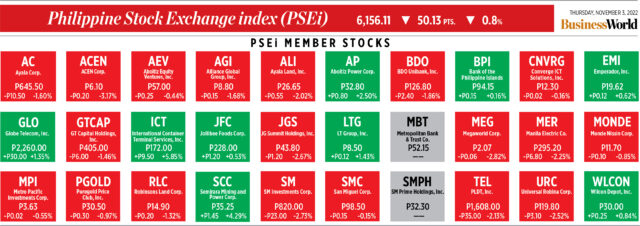
How PSEi member stocks performed — November 3, 2022

Here’s a quick glance at how PSEi stocks fared on Thursday, November 3, 2022.


PHL shares decline as Fed delivers big rate hike

REUTERS

SHARES declined on Thursday after the US Federal Reserve delivered another jumbo rate hike, with the Bangko Sentral ng Pilipinas (BSP) expected to match the move at its own meeting this month.

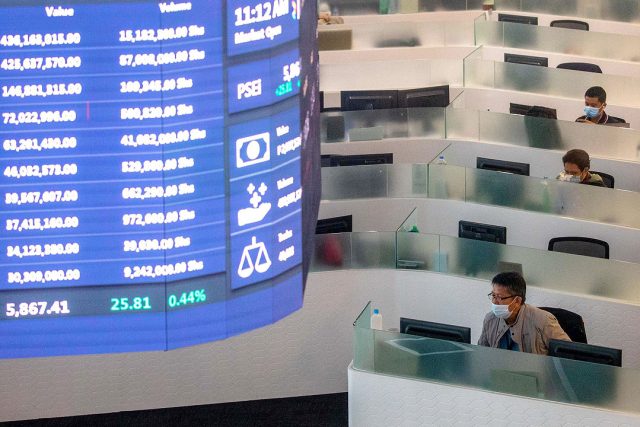
The Philippine Stock Exchange index (PSEi) went down by 50.13 points or 0.8% to end at 6,156.11 on Thursday, while the broader all shares index declined by 19.18 points or 0.58% to close at 3,257.83. 

Philstocks Financial, Inc. Research Analyst Claire T. Alviar said PSEi went down following the Fed’s move to hike borrowing costs. 

“Along with other markets, the main index dropped after the Fed raised interest rates by 75 basis points (bps) while hinting to do more ahead,” Ms. Alviar said in a Viber message on Thursday.

“Initially, the Fed’s rate hike weakens the peso if the BSP will not go point-by-point. However, aggressive rate hikes may come at the expense of our economic growth. This scenario worries investors,” Ms. Alviar added.

The US central bank delivered a fourth consecutive 75-bp hike on Wednesday to fight inflation, bringing the fed funds rate to a level within 3.75-4%. The move brought cumulative increases since March to 375 bps.

BSP Governor Felipe M. Medalla on Thursday said the Monetary Board will increase benchmark interest rates by 75 bps at its Nov. 17 meeting to match the Fed as it seeks to stabilize prices.

“Philippine shares and the rest of the region softened following the Fed’s delivery of another 75-bp interest rate adjustment. Initially, the indices were up during the day, but gains were reversed when Fed Chair Jerome Powell said it was ‘premature’ to talk about a rate hike pause and that the terminal rate would likely be higher than previously stated,” Regina Capital Development Corp. Head of Sales Luis A. Limlingan said in a Viber message.

The majority of sectoral indices ended lower on Thursday, except for mining and oil, which climbed by 191.15 points or 1.95% to 9,954.72 and services, which went up by 19.91 points or 1.27% to 1,584.45.

Meanwhile, holding firms went down by 104.50 points or 1.73% to 5,918.91; industrials declined by 92.27 points or 1.02% to 8,884.77; property lost 20.12 points or 0.75% to end at 2,643.73; and financials dropped by 9.11 points or 0.57% to 1,585.93.

Value turnover declined to P4.45 billion on Thursday with 430.75 million shares changing hands from the P6.29 billion with 496.31 million issues traded on Wednesday. 

Decliners outnumbered advancers, 114 versus 61, while 37 names closed unchanged.

Net foreign selling stood at P74.71 million on Thursday versus the P580.99 million in net buying seen on Wednesday.

Mr. Limlingan said investors will monitor Philippine October inflation data to be released on Friday for leads, as well as the US nonfarm payrolls report.

The BSP on Monday said headline inflation could have settled at 7.1% to 7.9% in October, driven by rising food prices, higher transport fares and the peso’s depreciation. — Ashley Erika O. Jose

Peso drops further after Fed tightening

BW FILE PHOTO

THE PESO weakened further against the dollar on Thursday after the US Federal Reserve delivered a fourth straight 75-basis-point (bp) rate increase to rein in inflation.

The local unit closed at P58.80 versus the greenback on Thursday, shedding 33 centavos from its P58.47 finish on Wednesday, data from the Bankers Association of the Philippines showed.

The peso opened Thursday’s session at P58.40 against the dollar. Its intraday best was at P58.30, while its worst showing for the day was at P58.87 versus the greenback.

Dollars exchanged inched up to $847.7 million on Thursday from $844.15 million on Wednesday.

Currencies across Asia depreciated against the dollar in response to the Fed’s decision, China Banking Corp. Chief Economist Domini S. Velasquez said in a Viber message.

“The peso’s depreciation followed a broader dollar strength after the Fed hiked… and Fed Chair Powell’s statement of a higher terminal rate for the Fed against what they plotted in their September meeting,” Ms. Velasquez said.

The US central bank has so far hiked borrowing costs by 375 bps since March, bringing the fed funds rate to a level within 3.75-4%. 

The US central bank said its battle against inflation will require more rate hikes. However, Fed Chairman Jerome H. Powell said even if policy makers scale back future increases, they remain undecided about how high rates need to be to get inflation under control.

The Bangko Sentral ng Pilipinas (BSP) chief’s statement on Thursday following the Fed’s decision also helped prevent the peso from declining further, Ms. Velasquez said. 

“Governor Medalla’s statement before markets opened today on cementing a matching rate hike for the BSP likely helped in preventing a greater depreciation today. We think that this statement removed some uncertainty on how the BSP will act in its next meeting, warding off market volatilities,” she added. 

BSP Governor Felipe M. Medalla on Thursday said the Monetary Board will raise benchmark interest rates by 75 bps at its Nov. 17 meeting to match the Fed as it seeks to stabilize prices. The central bank has raised rates by 225 bps since May.

The peso also weakened after the government’s outstanding debt hit a new record high, Rizal Commercial Banking Corp. Chief Economist Michael L. Ricafort said in a Viber message.

The National Government’s outstanding debt rose to P13.52 trillion as of September due to the peso’s depreciation and increased local borrowings, the Bureau of the Treasury reported on Thursday.

For Friday, Ms. Velasquez said the market will monitor US data releases to see if previous Fed hikes have affected the world’s largest economy.

Mr. Ricafort expects the peso to move from P58.65 to P58.85 on Friday. — K.B. Ta-asan

Marcos commits to more infra after subway contract signing

PRESIDENT Ferdinand R. Marcos, Jr. said he will pursue more major infrastructure projects after witnessing the signing of two contracts covering the construction of the Metro Manila Subway.

“The signing of these contract packages is a clear demonstration of this administration’s commitment to pursuing big infrastructure projects that will foster growth and revitalize the economy,” he said in a speech during a ceremony in Malacañang.

The two contracts involve the construction of stations and tunnels along Quezon Avenue, East Avenue, Anonas and Camp Aguinaldo in Quezon City.

The first contract, designated CP102, is worth P21 billion, and was awarded to the joint venture of Nishimatsu Construction Co., Ltd. and D.M. Consunji, Inc. The P28-billion second contract, known as CP103, was awarded to Sumitomo Mitsui Construction Co., Ltd.

The government and the Japan International Cooperation Agency (JICA) signed the ¥253.307-billion second tranche of the loan agreement funding the project in February.

JICA has provided assistance for the project amounting to about P142 billion, according to a statement issued by the Japanese Embassy in Manila.

Once completed in 2028, the project will reduce travel time between Quezon City and Pasay City to 35 minutes from 1 hour and 30 minutes, Mr. Marcos said. It is also projected to benefit more than half a million passengers a day “from as far north as Valenzuela City to as far south as Parañaque City.”

“We hope to reduce the terrible sight of going home at midnight along EDSA and still see people waiting to take the bus,” the President said. “That is the advantage of what the subway could bring.”

Mr. Marcos said his government will focus on railway projects such as the Metro Rail Transit (MRT)-7, the Light Rail Transit (LRT)-1 Cavite Extension, and the Philippine National Railway (PNR) Clark Phases 1 and 2, to make the railways a more viable option for commuters. — Kyle Aristophere T. Atienza

Sugar repricing awaiting outcome of talks; DA may consider SRP range of P85-90/kg

PHILIPPINE STAR/ MICHAEL VARCAS

THE new suggested retail price (SRP) for sugar has not yet been set pending the completion of consultations, though the Department of Agriculture (DA) cited a possible range of P85-90 per kilogram.

Pagdating sa presyo, hindi pa po tayo naglalabas ng SRP sa refined sugar. Meron pong stakeholders meeting na nagaganap ang Sugar Regulatory Association (SRA) ay nakikipag-ugnayan sa kanilang traders, planters, and millers. (In terms of pricing, we are not yet releasing an SRP for refined sugar. The SRA is still consulting traders, planters and millers) Once we come up with a price (of around) P85 to P90 per kilogram (/kg), iyan ang presyong tinitignan ngayon (that is the price range being looked at now), then we can suggest an SRP,” Agriculture Assistant Secretary Kristine Y. Evangelista said in a Laging Handa briefing on Thursday.

“We’ve monitored na merong effect iyong nakaraang bagyo sa ating sugar millers and planters. (We have monitored the impact of the latest storm on millers and planters) We are closely coordinating with SRA kung ano ang epekto nito (how this has affected) the volume of production,” she added.

Recently, the United Sugar Producers Federation asked President Ferdinand R. Marcos, Jr. to intervene in order to increase the retail price of sugar charged by major supermarkets to P85 to P90/kg from the current price of P70/kg.

In August, major supermarkets reached an agreement with Mr. Marcos to sell sugar at P70/kg.

Separately, Trade Assistant Secretary Ann Claire C. Cabochan said prices charged by retailers for basic necessities and prime commodities in areas affected by Tropical Storm Paeng (international name: Nalgae) have been stable, following monitoring conducted by the regional offices of the Department of Trade and Industry.

Ms. Cabochan added that the price of some ingredients needed for the traditional holiday meal, known as Noche Buena, will increase. She did not specify the products.

“The manufacturers told us that they will implement price increases in certain Noche Buena products, but not all. If there are increases, they will be tempered,” Ms. Cabochan said.

The DA estimated late Thursday afternoon that agricultural damage caused by Paeng amounted to P2.86 billion. Lost production was estimated at 116,291 MT across 86,574 hectares of farmland. — Revin Mikhael D. Ochave

Palace adviser wants vaccines-for-pay led by private hospitals

PHILIPPINE STAR/ MICHAEL VARCAS

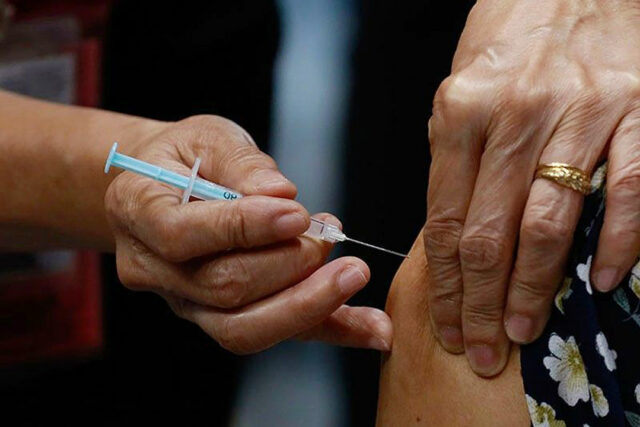
PRIVATE hospitals need to be deputized to procure and administer the new class of bivalent vaccines for recipients deemed non-priority who are willing to pay, according to Presidential Adviser Jose Maria A. Concepcion III.

Mr. Concepion, the Go Negosyo founder who is also a member of the government’s Private Sector Advisory Council, said private hospitals can explore agreements with the government on vaccine procurement.

Bivalent vaccines are thought to provide broader protection against the newer COVID-19 Omicron subvariants.

“The 10 million doses, or however much the government decides to buy, will of course be set aside for the priority sectors, namely the elderly, the immunocompromised and those with comorbidities; but there may be others outside of these priority sectors who would also want the bivalent vaccines,” Mr. Concepcion said in a statement on Thursday.

Mr. Concepcion said that bivalent vaccinations can be carried out via a tripartite agreement, the arrangement adopted during the early rounds of vaccination which involved employers, the government, and drugmakers.

“Unless the vaccine manufacturers file a certificate of product registration (CPR), this round of bivalent vaccinations can be done through a tripartite agreement like we did before, but this time with the private hospitals,” Mr. Concepcion said.

“We already have the arrangement with the Health department that we will pre-register employees who qualify under the priority sector. But for those who are not in the priority sector but are willing to pay to be vaccinated with bivalent vaccines, we should also make it available to them through the hospitals owned by the private sector,” he added.

According to Mr. Concepcion, all COVID-19 vaccines are still under emergency use authorization, meaning that only the government can procure and administer vaccines.

He added that vaccine manufacturers need a CPR to sell the COVID-19 vaccines to the public.

Metro Pacific Hospital Holdings Chief Medical Officer Benjamin Co said that the best option is to offer the bivalent vaccines to paying recipients.

“For those who can very well afford it, they can get it from private clinics that offer this and we can charge an administration fee plus the cost of the vaccine,” Mr. Co said.

“The remaining free vaccines can be appropriated to the rest of the population who cannot afford this but would like to get vaccinated,” Mr. Co said.

Rontgene M. Solante, San Lazaro Hospital chairman of adult infectious diseases and tropical medicine, said private hospitals can relieve the government of the vaccination burden, allowing it to focus its efforts on vulnerable people.

“This is critical especially with waning interest in booster doses of COVID-19 vaccines. Government should always find ways to engage with the private sector, which has been an important partner of DoH during the pandemic,” he added.

On Oct. 18, the Philippines detected the first cases of the COVID-19 Omicron subvariants XBB and XBC. The Philippines has recorded 81 cases of XBB and 193 cases of XBC. — Revin Mikhael D. Ochave 

European hiring of seafarers ongoing amid concerns over training standards

MARINA FACEBOOK PAGE

THE Transportation department said on Thursday that European ship operators continue to hire seafarers from the Philippines even amid concerns raised about their standard of training.

“In one of the Cabinet meetings a few weeks ago, it was reported to the President that there was a finding by the European Maritime Safety Agency (EMSA) that the Philippines did not comply with some of the standards relating to certification, training, and watchkeeping,” Department of Transportation (DoTr) Secretary Jaime J. Bautista said during a virtual briefing.

He said that President Ferdinand R. Marcos, Jr. ordered the EMSA findings to be addressed “so that we will be compliant and prevent blacklisting of our seafarers.”

“It’s important to tell you that we should not be alarmed by this because we did not fail the audit,” he added.

Various agencies, including Maritime Industry Authority, Commission on Higher Education, Department of Migrant Workers, Department of Labor and Employment, and Philippine Coast Guard, are now working to address the audit results, Mr. Bautista noted.

He said Filipino seafarers continue to be hired by shipping companies in Europe despite the concerns about training standards. “I have met with many shipping companies and manning companies and patuloy pa rin ang pag-e-employ ng ating mga seafarer (our seafarers continue to be employed).”

The Transportation department has approached various European governments to assure them of the government’s commitment to raise training standards, according to Mr. Bautista.

Sabi nga namin sa mga ambassadors (We told the ambassadors), we will continue to give you an update on what the Philippine government, through the different agencies, are doing para ma-maintain natin ang ating membership (to maintain our membership) with the International Maritime Organization and patuloy tayong magpadala ng seafarers sa Europe (and continue to deploy seafarers to Europe),” he noted.

The European Union (EU) has advised the Philippines to enhance its efforts to comply with the Standards of Training, Certification and Watchkeeping for Seafarers convention.

Following an inspection conducted in 2020, the European Commission notified the Philippines of a number of deficiencies — including serious ones — in education, training, and certification.

The EU had noted “inconsistencies… in relation to the competencies covered by the education and training programs leading to the issuing of officers’ certificates, as well as in several approved programs regarding teaching and examination methods, facilities and equipment.”

“Inconsistencies have also been identified in the monitoring of inspections and evaluations of the schools. In addition, there have been concerning findings as regards simulators and on-board training,” it added. — Arjay L. Balinbin

Face masks in workplace now voluntary, Labor dep’t says

PHILIPPINE STAR/ MIGUEL DE GUZMAN

THE wearing of face masks in private workplaces is now voluntary in the wake of Executive Order (EO) No. 7, issued last month by President Ferdinand R. Marcos, Jr., the Department of Labor and Employment (DoLE) confirmed, adding however that the EO stipulates key exceptions for whom face masks remain required.

Still required to observe the mask rules are people working in healthcare offices and medical transport vehicles, as well as passengers using public transport, DoLE said in an advisory on its website late Wednesday.

EO 7 allows the “voluntary wearing of face masks in indoor and outdoor settings,” according to its title.

The wearing of masks is “encouraged” for the elderly, unvaccinated individuals, pregnant women and those with comorbidities, the immunocompromised, and individuals showing coronavirus symptoms, according to the order.

“Employers and their workers have a shared responsibility to ensure safe and healthful working conditions in accordance with the provisions of the Labor Code of the Philippines and minimum public health standards,” the Labor department said.

It noted that employers and workers may still require the wearing of face masks and implement measures to address non-compliance.

In a separate statement, the Institute for Occupational Health and Safety Development said DoLE should clarify its guidelines and specify which work environments are most at risk of coronavirus outbreaks.

“We recommend that workers wear masks because they can still be infected by the virus, which is airborne,” it said. “We should all remember that we are still in a pandemic.”

Last week, Tourism Secretary Esperanza Christina Codilla Frasco said the President eased the mask mandate to keep up with regional neighbors that have long done away with mask requirements.

“The overarching direction of the Marcos administration is to allow our country to convey an openness and readiness to the world to receive tourists and investments so that we give our fellow Filipinos to regain all the livelihood and losses that were incurred during the pandemic,” she said at a televised briefing on Oct. 25.

Mr. Marcos also approved a pandemic task force recommendation to ease quarantine rules for foreigners and Filipinos entering the country.

In September, the President first made face masks optional outdoors.

The OCTA Research Group on Wednesday said new coronavirus pandemic infections might fall to 500 per day, after the Philippines tallied its lowest daily caseload since June 28 on Tuesday with 676 infections. — John Victor D. Ordoñez