Home Blog Page 5293

EPIRA amendments urged to allow government role in power auctions

THE power industry law needs to be amended to allow the government to play a role in power auctions, a senior legislator said.

“There is a lot of fine tuning that we need for EPIRA (Electric Power Industry Reform Act of 2001); for example, the government should be allowed to hold a bidding process. As of now, under the CSP (Competitive Selection Process) regime, it’s Meralco (Manila Electric Co.) that seeks bids. The government should be allowed to hold a bid as well,” Senator Sherwin T. Gatchalian told reporters on Friday. 

The Department of Energy (DoE) requires all distribution utilities to procure power via a CSP, attracting bids to supply electricity from power generators.

EPIRA sought to restructure the power industry by deregulation and privatizing most state-owned power generation and transmission assets.

Mr. Gatchalian said his proposal will ensure fair auctions.

“My proposal is that the government should facilitate the bidding process, whether via electronic bids or physical, to ensure that it is fair,” he said.

Mr. Gatchalian said that this approach would reduce the likelihood of power outages because the government can determine the supply requirement.

“We need new legislation for this; in effect, that is an amendment to EPIRA. In other countries, the government is not completely hands off in the power sector,” he added.

Energy Secretary Raphael P.M. Lotilla said at a Senate Committee on Finance hearing on Friday that power supply is expected to be tight in the first quarter of 2023.

“The first quarter of next year will be difficult; we need every source of power to bridge that period,” Mr. Lotilla said.

Mr. Lotilla said that the DoE is working to secure resources as well as ramping up the delivery of stranded power.

“Solar plants will also be coming in towards the first quarter. So that would help address this,” Mr. Lotilla said.

National Grid Corp. of the Philippines (NGCP) President Anthony L. Almeda has said that NGCP is in discussions with DoE to assure a sufficient energy supply.

Pedro H. Maniego, Jr., senior policy advisor of the Manila-based climate and energy policy group Institute for Climate and Sustainable Cities said in a tweet on Saturday that to reduce overdependence on imported fuel, the Philippines should ramp up the transition to renewable energy.

“That is why we must speed up the energy transition to distributed generation anchored on indigenous sources,” he said. — Ashley Erika O. Jose

Quezon City sees market size, available land as main draws to investors

PHILSTAR

THE Quezon City government said its main attractions to investors are available land and the size of its consumer base and work force, with the city also having largely digitized its permit processes.

Quezon City Mayor Maria Josefina G. Belmonte said in a speech at the Quezon City Investors Summit 2022 last week that “Quezon City is… one-fourth of the land of Metro Manila… Size means space. The space in Quezon City is 16,112 hectares, which at present still has a lot of room for development. There is still much more space to move around in Quezon City relative to the majority of cities in the National Capital Region (NCR),” Ms. Belmonte said.

Ms. Belmonte added “Quezon City’s size contributes considerably to its competitive advantage. Quezon City’s 3.1 million residents also mean 3.1 million customers for your business. Of these, two-thirds are at least 18 years old. That’s a workforce of potentially 2.1 million people. This workforce is also a young workforce with an average age of 28 years.”

“We made a conscious and deliberate effort to win back the trust of people in the government, so that they could see the government as an enabler, rather than a hindrance. With trust, relationships can be built with relationships, cooperation, and progress,” she added.

Trade Secretary Alfredo E. Pascual called Quezon City the “richest city” in the country in terms of locally generated revenue.  

“We invite top-notch businesses to consider setting up their businesses here or if they have existing businesses, to expand. We invite them to build high-impact infrastructure projects and contribute to the city’s economic development, social services delivery, good governance, and sustainable growth,” Mr. Pascual said.  

In a statement, the Quezon City government said that over 200 investors, business leaders, business associations, chambers of commerce, and foreign delegates participated in the Investors Summit 2022, including representatives from New Zealand, Singapore, Indonesia, Ireland, France, Denmark, Israel, the US, Germany, and the UK.

“As Quezon City (strives) to be the top business destination in the country, applying for business permits and licenses has been made easier through the development of QCBizEasy under the city’s QC E-Services platform. The local government has automated and digitized 95% of the city’s services,” it said. — Revin Mikhael D. Ochave

Germany working to expand PHL environment tech, RE footprint

REUTERS

By Alyssa Nicole O. Tan, Reporter

GERMANY is encouraging business delegations to explore Philippine partnerships in renewable energy (RE) and environmental technology, the German Embassy in Manila said.

In an e-mail, the embassy said other industries it deems promising for collaboration are consumer-related services and goods, and business process outsourcing.

It said its approach is to connect small and medium enterprises from both countries via the German-Philippine Chamber of Commerce and Industry (GPCCI), noting that such companies make up 99.4% of Germany’s economy. The corresponding number for the Philippines is 99%.

A virtual business initiation trip will take place in November on civil security technologies, organized by the Federal Ministry for Economic Affairs and Climate Action.

In March 2023, GPCCI will organize another business initiation trip on energy efficiency in buildings, including Photovoltaic hybrid and storage systems.

The first physical business initiation trip took place in late September, focused on recycling and waste management.

“We (conceive of) our role as a door opener, someone who makes the introductions to help companies settle on either side — either in Philippines or in Germany — and help them navigate this process. But in the end, it’s up to these companies to build partnerships and develop them,” the embassy’s First Secretary Kai Tomzig has said.

“Apart from these visits, both the embassy and GPCCI receive requests by German companies that are interested in the Philippines as a market and potential place for investment on a daily basis,” the Embassy said.

Other than strengthening small and medium enterprises and the industrial sector, the embassy’s economic priorities include enhancing post-pandemic recovery, boosting of new investments, shaping digitization, supporting innovative startups and advocating for renewable energy and energy transition.

“The Philippines are a promising market in the Asian-Pacific region,” the Embassy said. “German companies wish to invest in the Philippines for various reasons, including good business opportunities, attractive labor conditions, supplier diversification and other reasons.”

The embassy said it also expected more intensified collaboration in the fields of education and energy, noting that investing in renewable energies will help reduce the cost of energy production, as well as the effects of global warming on the planet.

It welcomed the Philippine government’s decision to lower investment barriers for foreign companies.

“Being the largest trading partner of the Philippines among the European Union member states, this might open up new avenues for the business sector in Germany,” it said.

The main fields of cooperation between the Philippines and Germany include climate and renewable energy, the peace process in Mindanao, the health sector, and human rights and the rule of law.

Congress urged to focus on food, RE, inflation-cooling measures

PHILSTAR FILE PHOTO

CONGRESS must concentrate its efforts on measures expanding food production, promoting renewable energy (RE), and the continued opening of the economy in order to keep inflation in check, legislators said.

Northern Samar Rep. Paul R. Daza told BusinessWorld via instant message that legislation should seek to strengthen food security.

“The aim is to attain self-sufficiency and better price regulation, and to decrease our vulnerability to currency fluctuations,” he added. “We also must take climate resilience more seriously.”

Food security should also be evaluated through the lens of climate change, as food abundance can easily disappear in a calamity, he added.

A recent survey by Pulse Asia Research conducted in September found that 66% of respondents consider inflation an issue of national importance to be addressed urgently.

The Department of Agriculture last week said that the damage to agriculture caused by Typhoon Karding (international name: Noru) has increased to P3.12 billion.

Rising fuel prices have affected food production, which can be addressed via measures promoting the use of alternative energy, Surigao del Norte Rep. Robert Ace S. Barbers said via Viber.

“In effect, this would cut food production costs and eventually reduce inflation.”

The Department of Justice recently issued a legal opinion declaring that renewable energy investments are not subject to the 60:40 foreign ownership restrictions in the 1987 Constitution.

Energy Secretary Raphael P.M. Lotilla said last week that in response, the department is preparing amendments to Rule 6, Section 19 of the Implementing Rules and Regulations of the Renewable Energy law.

Party-list Representative France L. Castro said that the recent survey is a wake-up call for the legislative and executive branches to address inflation.

“This should be reflected in the proposed national budget and it should contain more aid for consumers,” she said in a Viber message. “More funding should also be given to education, health, fisheries and agriculture as well as for teacher and nurse salaries.”

Albay Rep. Edcel C. Lagman countered via Viber that legislation is not needed to address inflation.

The President must only assure the purposeful implementation of the laws that control inflation, he said.

Mr. Lagman said that laws prescribing price controls and regulating hoarding and cartels should be enforced. The government can also focus on programs like credit facilities and subsidies for farmers, free seed and fertilizer, and the establishment of post-harvest facilities.

Last week, Albay Rep. Jose Ma. Clemente S. Salceda sent draft executive orders to the President which seek to lower energy prices, increase the food supply, and generate new jobs.

Congress is set to resume its session by Nov. 7 and is set to adjourn by Dec. 17. — Kyanna Angela Bulan

BEPS 2.0: A Philippine perspective

More than a year since the OECD/G20 Inclusive Framework proposed the two-pillar approach, we have heard much about BEPS 2.0 from a global standpoint. In this article, we now look at the Philippine perspective, what MNEs in the Philippines should start considering and what’s at stake once it is implemented.

LOOKING BACK ON BEPS 1.0
BEPS 1.0 started back in 2015 when the Organization for Economic Cooperation and Development (OECD) and the G20 countries led the first ever global initiative to address base erosion and profit shifting (BEPS) practices. Essentially, these referred to aggressive tax planning strategies that tend to exploit gaps and mismatches in the tax rules of various countries. Some Multinational Entities (MNEs) would often choose to locate in lower tax jurisdictions and treat their profits as sourced from that country instead of the jurisdiction where the activity creating those profits takes place (profit-shifting) or reduce tax bases through certain deductions (base erosion). While not illegal per se, BEPS practices were viewed as unfair since they allowed international companies to reduce their effective tax rate and gain competitive advantage over local competitors.

The rise of the digital economy in recent years created another gap in prevailing tax rules as MNEs took advantage of online platforms to enter foreign markets without having to establish a physical presence. Some of the early responders began imposing a “Digital Services Tax” on the revenue of MNEs engaged in online economic activity. However, this approach was viewed as ineffective not only because the additional tax cost will likely be passed on to the consumers, but also because it could lead to double taxation and other trade-related issues due to inconsistent tax treatment.

ENTER BEPS 2.0
To effectively address the increasing tax challenges and complexities arising from the digitalization of the economy, the OECD introduced BEPS 2.0.

A two-pillar approach was proposed under this reform package to help ensure that MNEs pay their fair share of taxes wherever they operate in the world:

(1) Pillar 1 on new nexus and profit allocation rules aims to reallocate a certain portion of taxable profits of MNEs with more than €20 billion in global revenue and profitability above 10% to market jurisdictions.

(2) Pillar 2 has two components: the Global Anti-Base Erosion (‘GloBE’) Rules, which seek to ensure that MNEs pay a 15% minimum tax and the Subject To Tax Rule (STTR), which seeks to limit the treaty benefits on certain related-party payments.

PILLAR 1: NEW NEXUS AND PROFIT ALLOCATION RULE
Pillar 1 proposes a new taxation system to capture and reallocate 25% of excess profits of MNEs to the various jurisdictions where the goods and services are actually sold and consumed. Ultimately, it will give a taxing right to these market jurisdictions to facilitate re-allocation.

Realistically, however, Pillar 1 may take longer to implement given the complexity of the issues at the MNE Group level as well as the removal of the Digital Services Taxes (DST) from some jurisdictions.  Hurdling these issues is necessary before Pillar 1 can take effect. 

Pillar 2, on the other hand, is more likely to take off earlier as some jurisdictions are already looking at legislation to implement the minimum tax. Given this, it is imperative to understand the concept of global minimum tax and how it stands to affect MNEs headquartered or operating in the Philippines.

PILLAR 2: GLoBE RULES
To start off, Pillar 2 does not require any country to increase corporate income tax rates. Instead, it envisions imposing an additional tax (top-up tax) to bring the total Effective Tax Rate (ETR) for MNEs in that particular jurisdiction to 15%.

The GloBE rules are intended to cover only MNE groups with consolidated annual revenue of more than €750 million. Moreover, government entities, international organizations, non-profit organizations, pension funds or investment funds that are ultimate parent entities of an MNE group or any holding vehicles used by such entities, organizations or funds are exempt.

Now, the mechanism for the 15% minimum tax is quite tricky as Pillar 2 talks about three kinds of top-up taxes (Qualifying Domestic Minimum Top-up Tax, Income Inclusion Rule and Undertaxed Payments Rule) imposed either at Subsidiary or Parent level.

In applying these top-up taxes, Pillar 2 contemplates a hierarchical approach where the taxing right is primarily exercised at the subsidiary level of an MNE, followed by parent level and then finally by another subsidiary within the group (in case any residual amount of the top-up tax remains unpaid).

CONSIDERATIONS FOR MNEs
As MNEs continue to do business and invest in the Philippines and overseas, much thought should now be given on how they should approach the future with the GloBE rules in mind. Some initial considerations and action items for the MNEs are:

• Review of the group structure to determine (1) whether one is likely to fall within the scope of the GloBE rules under the €750-million consolidated revenue test, (2) which are in-scope entities where the top-up taxes may be applied and (3) which are excluded entities.

• Run initial simulations on GloBE Income and ETR of each in-Scope entity. For this purpose, the group should consider subsidiaries in the Philippines (and elsewhere) enjoying income tax holidays and special income tax rates in the ETR calculation.

• Conduct a resource assessment across functions such as Tax, Treasury, Internal Audit and IT to determine if any capability is lacking and consequently tap the necessary internal or external resources to ensure the group’s overall preparedness.

• Consider any potential accounting, legal, transactional issues and other complications resulting from potential application of different top-up taxes.

It is also important to note that even in cases where the GloBE ETR of a group is more than 15%, it is not necessarily compliance-free. There could still be compliance and calculation requirements to be made especially if the jurisdictions involved have local GloBE legislation in place.

REGULATORY AND POLICY CHALLENGES
Admittedly, developing countries like the Philippines stand to gain tax revenue if and when they implement local top-up tax rules. However, this must be weighed against possible foreign investment flight and other adverse effects on investment promotion efforts. In such a case, the government will have to revisit our investment packages to maintain our competitive advantage.

The other practical consideration is the resources needed to manage the complexity of the implementation framework and address possible challenges at every stage. Without a tried and tested framework, the top-up tax may not translate to real tax collections and instead end up as disputed assessment cases in the tax courts.

CONCLUSION
The Philippines has yet to adopt its own legislation to implement Pillar 2. For now, it appears that it is not yet at the top of the government’s tax agenda. From an MNE perspective, however, the top-up tax could always find its way into the group — with or without a local top-up tax as yet. Accordingly, there is clear value in preparation and early Pillar 2 impact assessment. Without it, MNEs may not have sufficient time and resources for potential restructuring and other planning opportunities to address associated risks.

This article is for general information only and is not a substitute for professional advice where the facts and circumstances warrant. The views and opinions expressed above are those of the author and do not necessarily represent the views of SGV & Co.


Maria Margarita D. Mallari-Acaban is a lawyer and tax principal and Michelle C. Arias is a tax senior director of SGV & Co.


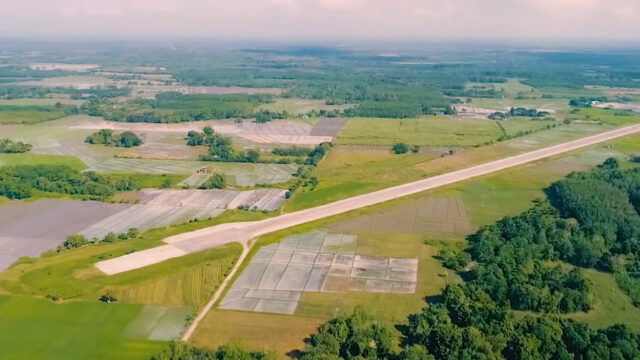
Cotabato officials press on with land acquisition, funding for Central Mindanao Airport 

MLANG.GOV.PH

COTABATOs provincial government and congressional representatives are pressing on with the development of the mothballed airport in Mlang town through land acquisition and funding initiatives. 

Third District Rep. Ma. Alana Samantha Taliño-Santos said she has been in talks with officials of the national tourism and transport agencies to secure funding for the planned reopening of the Central Mindanao Airport.   

The solon, along with Cotabato Governor Emmylou LalaTaliño-Mendoza, also met in late August with Public Works Secretary Manuel M. Bonoan to discuss the airport project, which was revived during the previous Duterte administration.   

“Cotabateños have long dreamed of having an airport. This will be a big help in economic growth and tourism in the Province of Cotabato,” Ms. Santos said in an interview last week.  

Meanwhile, the provincial government of Cotabato, also referred to by its old name North Cotabato, recently held consultations with landowners of properties adjacent to the airport to expedite acquisition.   

Ms. Santos said the meetings were also intended to get recommendations from stakeholders for the campaign that will be pitched to investors and airline operators.   

The Central Mindanao Airport is included in the Mindanao Development Authoritys (MinDA) priority infrastructure projects portfolio.   

It is seen to catalyze inclusive and balanced rural development in Mindanaocomplement the General Santos and Awang Airports and will boost the economic activities of the area where many agricultural products, including highly-perishable fruits come from,according to MinDA. Maya M. Padillo

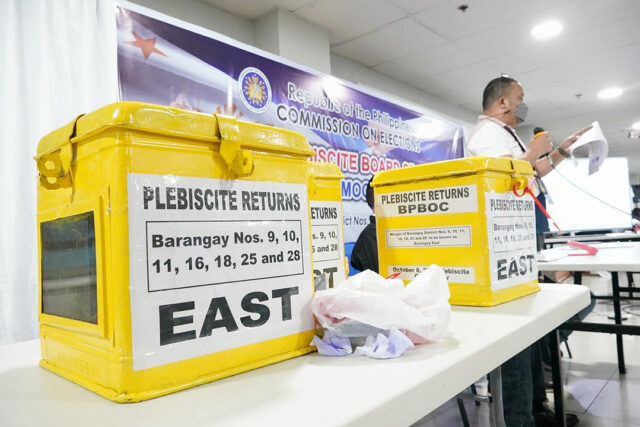
Ormoc residents approve merger of 28 villages into just 3

ORMOC CITY GOVERNMENT

ORMOC CITY residents voted in favor of the merger of barangays the smallest and community-level political unit under the Philippine government system — into just three from 28, the Commission on Elections (Comelec) announced on Saturday.  

Comelec, in a statement sent to reporters Saturday night, said 89.34% of the voters agreed to consolidate the villages, while only 10.08% voted against the measure.  

“With this reverberating decision, the city government of Ormoc hopes and intends to bring barangay governance more efficiently and effectively to people, ensure the delivery of basic services and usher the whole government closer to the Ormocanons,” it said.  

The plebiscite, the first electoral exercise intended to merge villages in a locality, had a 53% voter turnout of more than 10,000 residents.  

Data from the Philippine Statistics Authority show there were 42,044 barangays nationwide, spread across 146 cities and 1,488 municipalities. Elections for barangay leaders are held separately from national and local polls.     

The three new villages in Ormoc are now called Barangay South, Barangay East and Barangay West.  

The city government, in a statement posted on its official Facebook page, said the measure would create “super barangays, which aims to improve efficiency in the delivery of social services. 

“Time will tell if this is a very good move and it will redound to better services to the barangays,” Ormoc City Mayor Lucy Torres-Gomez said in Facebook video.  

In a separate statement on Saturday, election watchdog National Citizens Movement for Free Elections (Namfrel) said the plebiscite ran smoothly and orderly.  

However, Namfrel said the voting center was not easily accessible to the elderly and persons with disabilities (PWDs).  

“The voting center is not senior citizen- and PWD-friendly due to uneven grounds, dark hallways, and pipes crossing some pathways,” said the watchdog, an accredited citizens’ arm for the plebiscite.  

Comelec held two plebiscites last month that resulted in the conversion of the town of Calaca, Batangas into a city and the split of Maguindanao into two provinces. John Victor D. Ordoñez 

DoT breaks ground for tourist centers in Cebu, Mindanao

SAMAL INFORMATION OFFICE

GROUNDBREAKING ceremonies were held over the weekend for four tourist centers in central and southern Philippines, the first batch of multi-purpose facilities that the Department of Tourism (DoT) aims to establish in every region.   

The tourist rest area was conceptualized in fulfillment of one of our objectives in the Department of Tourism to ensure that we equalize tourism promotion and development not only in the key destinations within the country but also to lesser-known areas that have great potential for tourism development,Tourism Secretary Christina Garcia-Frasco said during the ceremony in Manolo Fortich, Bukidnon in Mindanao.   

Similar events followed in Samal, an island province in southern Mindanao, and in the towns of Carmen and Medellin in Cebu.   

Each Tourist Rest Areawill have toilets, coffee shop, store for local goods, charging station, and information kiosk.  

The facilities will be funded by the Tourism Infrastructure and Enterprise Zone Authority (TIEZA), managed by the host local government unit (LGU), and monitored by the Department of Tourism.   

The Tourist Rest Area is not just about clean restrooms(these) are grounded on seamless travel and convenience to tourists, job generation to those who will be servicing the rest areas and promotion of local products coming from surrounding localities,said TIEZA Chief Operating Officer Mark T. Lapid.  

Ms. Frasco said there will also be a reward system to ensure proper maintenance of the facilities.   

We will have a criteria for the maintenance of the tourist rest area to be monitored by our regional office. If the LGU reaches 90% of this criteria, then we will give a prize to the LGU by way of project or financial incentive and that is how we will ensure that the tourism rest area will be properly maintained,she said.   

The Tourism department is aiming to launch another seven centers before yearend, including in Baguio City, Bohol, and Ilocos. MSJ 

More than 243M COVID-19 vaccine doses delivered as end-Sept.

PHILIPPINE STAR/ MICHAEL VARCAS

THE BUREAU of Customs (BoC) on Sunday said it has cleared over 243 million doses of coronavirus disease 2019 (COVID-19) vaccines as of last month. 

Among the latest batch of deliveries are doses for children, the bureau said in a statement.

BoC – Port of Ninoy Aquino International airport processed 3 million doses of Pfizer (Pedia) which arrived at (Terminal 3) Bay in September,” the bureau said in a statement.

The vaccines delivered include eight approved brands, namely: AstraZeneca, Hayat-Vax, Johnson & Johnson, Moderna, Pfizer BioNTech, Sinopharm, Sinovac and Spufnik V. 

The bureau said it expedited the release and delivery of the vaccines, which are controlled by the COVAX Special Handling Task Force.  

About 163.97 million COVID-19 vaccine doses have been administered nationwide, according to Department of Health data as of Oct. 6. These include 70.69 million for first dose, 73.27 million second dose, and 20.01 million for booster shots. Matthew Carl L. Montecillo

Women students tell Iran president Raisi to ‘get lost’ as unrest rages

A newspaper with a cover picture of Mahsa Amini, a woman who died after being arrested by the Islamic republic’s “morality police” is seen in Tehran, Iran Sept. 18, 2022. — MAJID ASGARIPOUR/WANA (WEST ASIA NEWS AGENCY) VIA REUTERS

DUBAI — Female students in Tehran chanted “get lost” as Iranian President Ebrahim Raisi visited their university campus on Saturday and condemned protesters enraged by the death of a young woman in custody, videos on social media showed.

Mr. Raisi addressed professors and students at Alzahra University in Tehran, reciting a poem that equated “rioters” with flies, as nationwide demonstrations entered a fourth week.

“They imagine they can achieve their evil goals in universities,” Mr. Raisi said on state TV. “Unbeknownst to them, our students and professors are alert and will not allow the enemy to realize their evil goals.”

A video posted on Twitter by the activist 1500tasvir website showed what it said were women students chanting “Raisi get lost” and “Mullahs get lost” as the president visited their campus. Another social media video showed students chanting: “We don’t want a corrupt guest”, in reference to Mr. Raisi.

Reuters could not immediately verify the videos.

A state coroner’s report denied that 22-year-old Mahsa Amini had died due to blows to the head and limbs while in custody of the morality police and linked her death to pre-existing medical conditions, state media said on Friday.

Ms. Amini, an Iranian Kurd, was arrested in Tehran on Sept. 13 for wearing “inappropriate attire” and died three days later.

Her death has ignited nationwide demonstrations, marking the biggest challenge to Iran’s clerical leaders in years. Women have removed their veils in defiance of the clerical establishment while furious crowds called for the downfall of Supreme Leader Ayatollah Ali Khamenei.

The government has described the protests as a plot by Iran’s enemies including the United States, accusing armed dissidents — among others — of violence in which at least 20 members of the security forces have been reported killed.

Rights groups say more than 185 people have been killed, hundreds injured and thousands arrested by security forces confronting protests.

After a call for mass demonstrations on Saturday, security forces shot at protesters and used tear gas in the Kurdish cities of Sanandaj and Saqez, according to the Iranian human rights group Hengaw.

In Sanandaj, capital of the northwestern Kurdistan province, one man lay dead in his car while a woman screamed “shameless”, according to Hengaw, which said the man had been shot by security forces after he honked his horn as a sign of protest.

A senior police official repeated the claim by security forces that they did not use live bullets and told state media that the man had been killed by armed dissidents.

State media played down the protests across Tehran, the capital, reporting “limited” demonstrations in dozens of areas. It said many bazaar traders had shut their shops for fear of damage in the unrest, denying there was a strike.

But videos on social media showed what appeared to be the largest protests in the past three weeks in many Tehran neighborhoods, including a crowd packing streets in the lower-income southern neighborhood of Nazi Abad. 

Videos shared on social media showed protests in several major cities. One video showed a young woman lying unconscious on the ground after she was apparently shot in the northeastern city of Mashhad, Iran’s second most populous city.

The Norway-based Iran Human Rights said at least 185 people had been killed in the protests, with the highest number of killings in the restive Sistan-Baluchistan province in the southeast.

As state TV showed footage of Ayatollah Khamenei on its main evening news, the broadcast was briefly interrupted in an apparent hack with his image, surrounded by flames, next to pictures of Ms. Amini and three other women allegedly killed during the protests.

The protests’ signature slogan, “Woman, Life, Freedom”, could be heard as Edalate Ali hacker group posted its web addresses. The group last year hacked security cameras and exposed mistreatment of prisoners in a jail mostly holding political prisoners.

CALL FOR UNITY
After a weekly meeting, Mr. Raisi and Iran’s head of judiciary and parliament speaker called for unity.

“Currently, the Iranian society needs the unity of all its strata regardless of language, religion and ethnicity to overcome the hostility and division spread by anti-Iranians,” they said in a statement.

Hengaw also carried a video of emergency personnel trying to resuscitate a person and said one protester had died after being shot in the abdomen by security forces in Sanandaj. Reuters could not verify the video.

One of the schools in Saqez city’s square was filled with girls chanting “Woman, life, freedom”, Hengaw reported.

The widely followed 1500tasvir Twitter account also reported shootings at protesters in the two northwestern Kurdish cities.

A university student who was on his way to join protests in Tehran said he was not afraid of being arrested or even killed.

“They can kill us, arrest us but we will not remain silent anymore. Our classmates are in jail. How can we remain silent?” the student, who asked to remain anonymous, told Reuters.

Internet watchdog NetBlocks said the internet had been cut in Sanandaj again amid protests in Kurdish areas. — Reuters

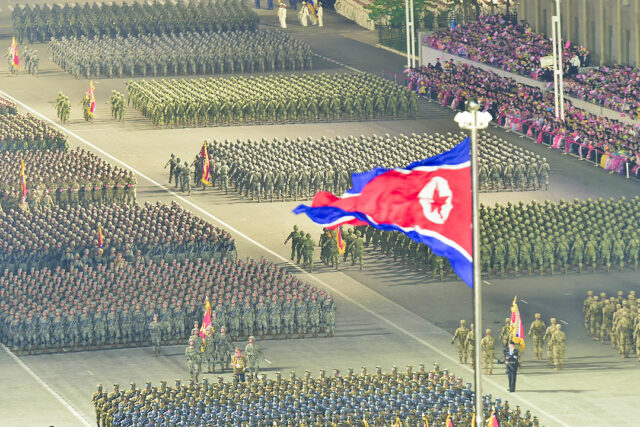
N. Korea fires two ballistic missiles in seventh of recent launches

Military personnel take part in a parade to mark the 90th anniversary of the founding of the Korean People’s Revolutionary Army in Pyongyang, North Korea, in this undated photo released by North Korea’s Korean Central News Agency on April 26, 2022. — KCNA VIA REUTERS

TOKYO — North Korea fired two ballistic missiles early on Sunday, authorities in neighboring countries said, the seventh such launch by Pyongyang in recent days that added to widespread alarm in Washington and its allies in Tokyo and Seoul.

Officials in the South Korean capital have said the uptick in the North’s missile launches could signal it is closer than ever to resuming nuclear testing for the first time since 2017, with preparations observed at its test site for months.

Both of Sunday’s missiles reached an altitude of 100 km (60 miles) and covered 350 km (218 miles), Japan’s state minister of defense, Toshiro Ino, told reporters.

The first was fired at about 1:47 a.m. (1647 GMT) and the second some six minutes later.

They fell outside Japan’s exclusive economic zone, and authorities were looking into what type they were, including the possibility that they were submarine-launched ballistic missiles, he added.

The US military said it was consulting closely with allies and partners following the launches, which it said highlighted the “destabilizing impact” of the North Korean nuclear arms and ballistic missile programs.

Still, the United States assessed that the latest launches did not pose a threat to US personnel or American allies.

“The US commitments to the defense of the Republic of Korea and Japan remain ironclad,” the Hawaii-based US Indo-Pacific Command said in a statement.

The latest missile launches from the Muncheon area on North Korea’s east coast are a “serious provocation” that harms peace, South Korean authorities said.

On Tuesday, North Korea test-fired a ballistic missile farther than ever before, sending it soaring over Japan for the first time in five years and prompting a warning to residents there to take cover.

Mr. Ino said Tokyo would not tolerate the repeated actions by North Korea. The incident was the seventh such launch since Sept. 25.

Japan’s foreign ministry said the nuclear envoys of the United States, South Korea and Japan held a telephone call and shared the view that the North’s ballistic missile launches threatened the peace and security of the region and the international community, besides posing a civil aviation risk.

North Korea, which has pursued missile and nuclear tests in defiance of U.N. sanctions, said on Saturday its missile tests were for self-defense against direct US military threats and had not harmed the safety of neighbors.

“Our missile tests are a normal, planned self-defense measure to protect our country’s security and regional peace from direct US military threats,” said state media KCNA, citing an aviation administration spokesperson.

South Korea and the United States held joint maritime exercises on Friday, a day after Seoul scrambled fighter jets in reaction to an apparent North Korean bombing drill.

The United States also announced new sanctions on Friday in response to North Korea’s latest missile launches. — Reuters

OPEC oil cuts bad for global economy, says Yellen

US Treasury Secretary Janet Yellen. — US FEDERAL RESERVE

US Treasury Secretary Janet Yellen said a decision by the OPEC+ grouping to cut oil production was “unhelpful and unwise” for the global economy, especially emerging markets, the Financial Times said on Sunday.

“We’re very worried about developing countries and the problems they face,” Ms. Yellen told the newspaper in an interview.

She also criticized allies for being slow to send financial aid to Ukraine.

“The pace of transferring money to Ukraine is far too slow,” Ms. Yellen added, pointing out that some countries that had pledged assistance had not got round to disbursing it. — Reuters