Home Blog Page 5282

Eagles’ D faces ultimate test in Super Bowl: Chiefs’ Patrick Mahomes

PATRICK Mahomes is on the verge of becoming the youngest quarterback to start three Super Bowls, but the Kansas City Chiefs star is more interested in becoming the 13th to earn multiple Super Bowl rings.

Mr. Mahomes will be playing in his third Super Bowl in the past four campaigns, and his task on Sunday is to solve the dominant defense of the Philadelphia Eagles in Super Bowl LVII at Glendale, Ariz.

Mr. Mahomes will be 27 years, 148 days old when he takes the field but is already viewed as an NFL great. He is 1-1 in previous Super Bowls, having beaten the San Francisco 49ers 31-20 in Super Bowl LIV and losing 31-9 to the Tampa Bay Buccaneers in Super Bowl LV one year later.

The right ankle injury Mr. Mahomes sustained against the Jacksonville Jaguars on Jan. 21 is healing, but he won’t be 100 percent against the Eagles.

“You won’t know exactly how it is until you get to game day,” Mr. Mahomes said on Wednesday. “I mean, I definitely move around better than I was moving last week or two weeks ago. So it’s just trying to continue to get the treatment and the rehab and get it as close to 100 percent and then rely on some adrenaline to let me do a little bit extra when I’m on the field.”

Philadelphia’s defense, ranked second in the regular season at 301.5 yards allowed per game, will be swimming like sharks around Mr. Mahomes.

The Eagles have racked up 78 sacks during the regular season and postseason. That is third most all-time behind the mid-1980s Chicago Bears, who had a record 82 in 1984 and 80 in 1985.

Linebacker Haason Reddick has been particularly ferocious with a career-high 16 regular-season sacks and another 3.5 in two playoff games.

Three other Eagles posted a career-best 11 sacks apiece in the regular season: defensive ends Brandon Graham and Josh Sweat and defensive tackle Javon Hargrave.

“Just so many great players, man,” Mr. Reddick said. “From the edges to the interior, even when our guys … come in when our starters come out, there’s no drop-off in production when our second group is in there.”

Philadelphia will look to corral Chiefs tight end Travis Kelce, who ranks second all-time in postseason receptions (127) and receiving yardage (1,467) and is tied for second with Rob Gronkowski with 15 postseason touchdown grabs. Jerry Rice leads in all three categories.

Mr. Kelce is part of a juicy storyline as he and older brother Jason (the Eagles’ center) will become the first set of brothers to play against one another in Super Bowl history. Both Kelces already own a Super Bowl ring, but Travis is 3-0 in matchups against Jason.

“Whoever wins this one will have the ultimate bragging rights,” Jason Kelce said.

Chiefs coach Andy Reid is looking for his second Super Bowl ring as he faces the organization that fired him in 2012 after 14 seasons. Mr. Reid ranks second all-time in postseason victories (21) behind Bill Belichick (31).

The 64-year-old has tried to swat away “Andy Reid Bowl” questions all week. He reached five NFC title games with the Eagles but just one Super Bowl, a 24-21 loss to the New England Patriots in Super Bowl XXXIX.

Also a hot topic is whether the Chiefs can stamp themselves as a dynasty with a second Super Bowl win in four seasons. Mr. Reid, not surprisingly, has no interest in the subject.

“I’m not really into all that,” Mr. Reid said. “It’s important in our world as coaches and players that you try to get better every day. You’re only as good as your last game, or your next game, I should say. We’re striving to focus on this thing and try not to worry about all that stuff.”

The quarterback matchup between Mr. Mahomes and Philadelphia’s Jalen Hurts is noteworthy, marking the first Super Bowl in which each team has a Black starting quarterback.

Only three Black quarterbacks have won a Super Bowl: Doug Williams (Super Bowl XXII), Russell Wilson (Super Bowl XLIX) and Mr. Mahomes.

Mr. Mahomes and Mr. Hurts are both NFL regular-season MVP candidates.

“It’s not about me. It’s about the team,” the multi-dimensional Mr. Hurts said. “Football is the ultimate team game, and you can’t have one player with the belief that he can succeed without the others around him.”

Three Eagles were limited practice participants on Wednesday: right tackle Lane Johnson (groin), center Cam Jurgens (hip) and cornerback Avonte Maddox (toe), though the team listed “rest” as a secondary reason for their partial absence.

Kansas City wide receiver Kadarius Toney (ankle, hamstring) was limited in practice on Wednesday. — Reuters

Utah acquires Westbrook as part of three-team deal

THE LAKERS, Jazz and Minnesota Timberwolves are finalizing a deal that would send Russell Westbrook to Utah and D’Angelo Russell to Los Angeles, ESPN and The Athletic reported Wednesday night.

Malik Beasley and Jarred Vanderbilt will also be headed to the Lakers, while the Jazz will also receive a first-round pick, per the reports. Minnesota will acquire Mike Conley, Jr. from Utah and will receive second-round draft pick compensation as part of the deal.

The NBA trade deadline is Thursday.

Mr. Westbrook, 34, has been ineffective since coming to the Lakers ahead of the 2021-22 season. He’s started just three of 52 games this season and is averaging 15.9 points per game. He reportedly had a heated verbal exchange with coach Darvin Ham after Tuesday’s game, during which LeBron James broke the all-time scoring mark.

Russell will be returning to the Lakers, who drafted him No. 2 overall in 2015 before trading him to Brooklyn in June 2017 for Kyle Kuzma and Brook Lopez.

Russell, 26, was in his fourth season in Minnesota. The 2018-19 All-Star is averaging 17.9 points and 6.2 assists per game in 54 starts this season. His points production has decreased every season in Minnesota since averaging 21.7 for the Timberwolves in 12 games in 2019-20. He is a career 17.7-point scorer for four teams.

Mr. Conley, 35, is in his 16th NBA season and fourth in Utah. He’s averaging 10.7 points and 7.7 assists per game in 43 games (42 starts) this season. He spent his first 12 seasons in Memphis and averages 14.7 points per game for his career.

Mr. Vanderbilt, 23, was in his first season with Utah after parts of three with the Timberwolves. He is averaging 8.3 points, 7.9 rebounds and 2.7 assists in 52 games (41 starts) this season.

Mr. Beasley, 26, served as a vital bench piece for the Jazz, averaging 13.4 points, 3.6 rebounds and 1.7 assists in 55 games (13 starts). He too was in his first season in Utah after spending parts of three with Minnesota. — Reuters

James’ personal goals

In the aftermath of LeBron James’ inevitable march to greatness the other day, basketball habitues rightly celebrated the once-in-a-lifetime experience. The career scoring record, perhaps the most hallowed of all records in the National Basketball Association, was toppled with aplomb. That Kareem Abdul-Jabbar — who had held it for close to 39 years and hitherto appeared to have a vise-like grip on it — was present to witness history being made anew made the spectacle all the more memorable. And it certainly helped that the stars were aligned in more ways than one; both were wearing purple and gold and in front of hometown fans when they climbed to the top of the mountain.

Given the considerable resources and formidable confluence of events James (and Abdul-Jabbar before him) required to reach the scoring summit, it’s fair to argue that the mark will never be broken anew — and not simply because the 38-year-old, 19-time All-Star figures to keep adding to it for the foreseeable future. Drive, determination, and durability will need to be mixed with a singular skill set and, lest it be forgotten, no small measure of good fortune in order for another player to come close to the number that will ultimately be etched in hoops annals.

The irony, of course, is that James won the other night even as the Lakers lost once more. It didn’t matter that the beyond-capacity crowd of 19,068 brought more glitz than usual, as if that were at all possible. Especially for the jaded, the Thunder, well, stole the thunder in claiming the match and compelling the hosts to absorb their 30th setback in 55 games. And critics wouldn’t be wrong to contend that they may well have had a chance to triumph had their acknowledged leader not been physically -— and, needless to say, emotionally spent in the fourth quarter. Bottom line, they’re a mere two spots from the bottom of the Western Conference, and not even his otherworldly efforts seems enough to stave off the inevitable.

James is no fool, which is why he acknowledges the futility of casting moist eyes on the Larry O’Brien Trophy in the absence of ample support. These days, his goals are more personal: to play as long as he can, to share the floor with son Bronny at some point, to exit in a blaze of glory. He’s not blameless in this regard. Who knows how the last couple of years would have played out had he been less greedy after the bubble championship and valued the bird in his hand instead of wanting the two in the bush?

What’s done is done, though, and if there’s anything James doesn’t do, it’s get consumed with regret. It’s why he continues to carve new paths with gusto; unlike the scoring mark, age is just a number to him.


Anthony L. Cuaycong has been writing Courtside since BusinessWorld introduced a Sports section in 1994. He is a consultant on strategic planning, operations and human resources management, corporate communications, and business development.

Turkey leader faces crescendo of criticism over quake response

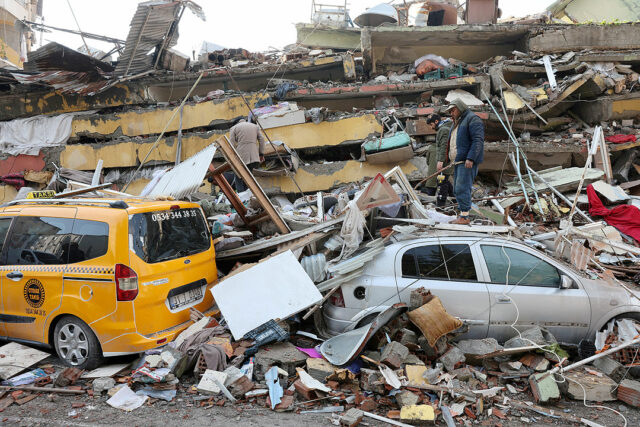
PEOPLE inspect the damage as rescuers search for survivors in the aftermath of a deadly earthquake in Hatay, Turkey, Feb. 8. — REUTERS

AHRAMANMARAS/ANTAKYA, Turkey — The death toll from earthquakes that struck Turkey and Syria this week passed 15,000 on Thursday amid anger from those left destitute and frustrated over the slow arrival of rescue teams.

Turkish President Tayyip Erdogan, who contests an election in May, said on a visit to the disaster zone on Wednesday that operations were now working normally and promised no one would be left homeless.

Across a swathe of southern Turkey, people sought temporary shelter and food in freezing winter weather, and waited in anguish by piles of rubble where family and friends might still lie buried.

The confirmed death toll in Turkey rose to 12,391 by Thursday morning, the Disaster Management Authority said, up more than 30% on Wednesday’s toll.

Rescuers were still finding some people alive. But many Turks have complained of a lack of equipment, expertise and support to rescue those trapped — sometimes even as they could hear cries for help.

“Where is the state? Where have they been for two days? We are begging them. Let us do it, we can get them out,” Sabiha Alinak said on Wednesday near a snow-covered collapsed building in the city of Malatya where her young relatives were trapped.

There were similar scenes and complaints in neighboring Syria, whose north was hard hit by Monday’s huge quake and where the death toll had climbed to at least 2,950 by Wednesday, according to the government and a rescue service operating in the rebel-held northwest.

Syria’s ambassador to the United Nations admitted the government had a “lack of capabilities and lack of equipment,” blaming more than a decade of civil war in his country and Western sanctions.

The death toll from both countries was expected to rise as hundreds of collapsed buildings in many cities have become tombs for people who had been asleep when the quake hit.

In the Turkish city of Antakya, dozens of bodies, some covered in blankets and sheets and others in body bags, were lined up on the ground outside a hospital.

Melek, 64, bemoaned the lack of rescue teams. “We survived the earthquake, but we will die here due to hunger or cold.”

Many in the disaster zone had slept in their cars or in the streets under blankets in freezing cold, fearful of going back into buildings shaken by the 7.8 magnitude tremor — Turkey’s deadliest since 1999 — and by a second powerful quake hours later.

Turkish authorities released video of rescued survivors, including a young girl in pajamas, and an older man covered in dust, an unlit cigarette between his fingers as he was pulled from the debris.

Turkish officials say some 13.5 million people were affected in an area spanning roughly 450 km (280 miles) from Adana in the west to Diyarbakir in the east. In Syria, people were killed as far south as Hama, 250 km from the epicenter.

Some who died in Turkey were refugees from Syria’s war. Their body bags arrived at the border in taxis, vans and piled atop flatbed trucks to be taken to final resting places in their homeland.

More than 298,000 people have been made homeless and 180 shelters for the displaced had been opened, Syrian state media reported, apparently referring to areas under government control, and not held by opposition factions.

In Syria, relief efforts are complicated by a conflict that has partitioned the nation and wrecked its infrastructure.

The delivery of U.N. humanitarian aid via Turkey to millions of people in northwest Syria could resume on Thursday after the long-running operation was halted by the quake, U.N. officials said.

ELECTION IMPACT
Mr. Erdogan, who declared a state of emergency in 10 provinces and sent troops to help, visited Kahramanmaras on Wednesday to view the damage and see the rescue and relief effort.

Speaking to reporters, a wail of ambulance sirens in the background, he said there had been problems with roads and airports but “we are better today”.

“We will be better tomorrow and later. We still have some issues with fuel … but we will overcome those too,” Mr. Erdogan said.

Nevertheless, the disaster will pose a challenge to Mr. Erdogan in the May election that was already set to be the toughest fight of his two decades in power.

Any perception that the government is failing to address the disaster properly could hurt his prospects. Conversely, analysts say he could rally national support around the crisis response and strengthen his position.

Twitter was restricted in Turkey on Wednesday just as the public had come to “rely on the service” in the aftermath of the disaster, the Netblocks internet observatory said.

Twitter Chief Executive Elon Musk later said in a tweet that the company had been informed by the government of Turkey that full access to the social media platform would be re-enabled “shortly”.

Cyber rights expert and professor at Istanbul Bilgi University Yaman Akdeniz said it was not clear what caused the restriction, adding that access to Tiktok was also limited in Turkey.

The Transportation and Infrastructure Ministry, which could impose such restrictions, was not available for comment. — Reuters

Singapore relaxes coronavirus travel curbs, mask rules further

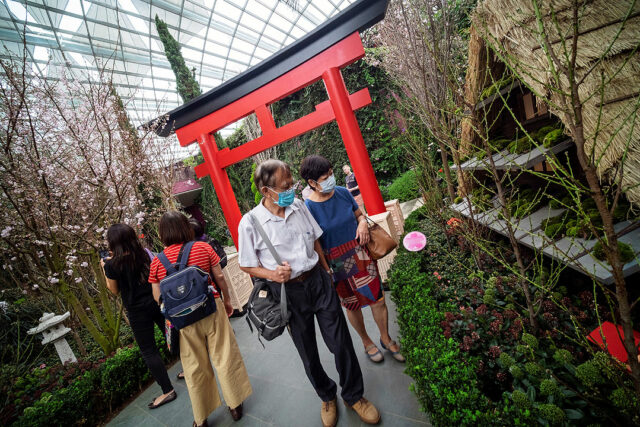
Visitors wearing face masks look at a floral display at the Flower Dome of Gardens by the Bay, March 6, 2020. — REUTERS

SINGAPORE — Singapore will drop a requirement for travelers who are not fully vaccinated to show COVID test results or purchase coronavirus travel insurance from Feb. 13, the government’s virus taskforce said on Thursday.

Masks will also not be required to be worn on public transport, the health ministry said in a statement, as authorities lowered the disease outbreak response level to “green” from “yellow,” indicating COVID-19 is not threatening.

However, masks will still be mandatory in healthcare settings, where there is interaction with patients and in indoor patient-facing areas.

“Within Singapore our COVID situation has remained stable over the recent months, despite increased travel over the year-end holidays and China’s shift from zero COVID,” Lawrence Wong, deputy prime minister and co-chair of the virus taskforce, told a media briefing.

“Our population has developed a high level of hybrid immunity,” he said.

Around 80% of the city-state’s 5.6 million population have achieved minimum COVID-19 vaccination protection, and around half are up to date with their additional booster shots, health ministry data showed.

“We’ve had to deal with many unexpected curveballs and surprises along the way. But we managed to reach this point together because we all did our part,” Mr. Wong said.

The public can also remove COVID-19 contact-tracing apps, and the government has deleted identifiable data from its servers and database, health minister Ong Ye Kung said.

Since April last year, Singapore had lifted most of its COVID-19 restrictions with many international events returning to the city-state, attracting tourists and businesses.

The Asian financial hub is expecting the tourism sector to recover to pre-pandemic levels by 2024. — Reuters

Australia orders checks on Chinese-made cameras in defense offices

CODY LOGAN/WIKIMEDIA COMMONS

SYDNEY — The Australian government will examine surveillance technology used in offices of the defense department, Defence Minister Richard Marles said on Thursday, amid reports that Chinese-made cameras installed there posed a security risk.

The checks come after Britain in November asked its government departments to stop installing Chinese-linked surveillance cameras at sensitive buildings, citing security risks. 

Some US states have banned vendors and products from several Chinese technology companies.

“This is an issue and … we’re doing an assessment of all the technology for surveillance within the defense (department) and where those particular cameras are found, they are going to be removed,” Marles told ABC Radio in an interview.

Opposition lawmaker James Paterson said his own audit had revealed almost 1,000 units of equipment by Hangzhou Hikvision Digital Technology and Dahua Technology Co – two partly state-owned Chinese firms – were installed across more than 250 Australian government offices.

Paterson, the shadow minister for cyber security and countering foreign interference, urged the government to urgently come up with a plan to remove all such cameras.

Marles said the issue was significant though adding: “I don’t think we should overstate it.”

Hikvision said it was “categorically false” to represent the company as a threat to Australia’s national security as it could not access the video data of end users, manage end-user databases or sell cloud storage in Australia.

“Our cameras are compliant with all applicable Australian laws and regulations and are subject to strict security requirements,” a spokesperson said in an emailed response.

Dahua Technology did not immediately respond to a request seeking comment.

‘MEASURED APPROACH’
Nigel Phair, an expert on cyber security at the University of New South Wales, said the government was taking a cautious approach.

“The concern is that these are Chinese manufactured cameras and there’s data being collected which is going back to the Chinese state,” he told Reuters.

“They are being very cautious and that’s not a bad thing in the online environment. We should take a measured approach and we should be looking at where the risks are, where the vulnerabilities are and then produce appropriate controls around that.”

Australian media reported on Wednesday that the national war memorial in Canberra would remove several Chinese-made security cameras installed on the premises over concern about spying.

Australia and China have been looking to mend diplomatic ties damaged in part by a 2018 Australian decision to ban Chinese tech giant Huawei from its 5G broadband network.

Relations were later damaged further by an Australian call for an independent investigation into the origins of COVID-19.

China responded with tariffs on several Australian commodities.

Prime Minister Anthony Albanese said he was not concerned about how China might react to the removal of cameras.

“We act in accordance with Australia’s national interest. We do so transparently and that’s what we will continue to do,” Albanese told reporters. — Reuters

Biden says he sees no recession in 2023 or 2024

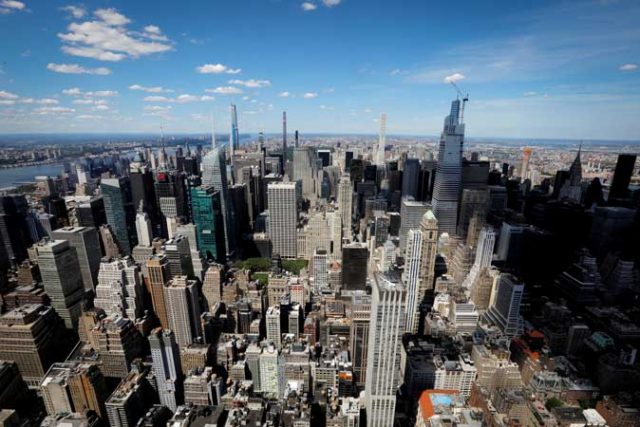
The north view of the Manhattan skyline is seen from the 86th floor observation deck of the Empire State Building in midtown Manhattan, New York City, June 24, 2020. — REUTERS/MIKE SEGAR

WASHINGTON — President Joseph R. Biden said on Wednesday he did not believe the US economy will fall into recession either this year or next year, his most confident prediction on the fate of an economy that is still rattled by fears of a downturn.

Asked in an interview on the PBS NewsHour program whether he thought there would be a recession this year, Mr. Biden responded: “No, or next year. From the moment I got elected, how many of the experts are saying within the next six months there’s gonna be recession?”

Economists for months have been warning of a possible recession as the US Federal Reserve raised interest rates in order to tame decades-high inflation.

Mr. Biden himself has said a recession was possible, and earlier this week he told reporters that the risk was very low.

On the whole, economic data in recent months has moved in the president’s favor, particularly after inflation spiked to a 40-year high last summer and government reports showed the US economy could be heading into a recession.

Strong job numbers last week, which occurred despite layoffs in the technology sector as well as in interest-rate-sensitive sectors like housing and finance, poured cold water on market expectations that the US central bank was close to pausing its monetary policy tightening cycle. — Reuters

World should ‘calm down’ about China COVID variants — Chinese scientist

HONG KONG — The world should “calm down” about the possibility of new COVID-19 variants circulating in China, leading Chinese scientist George Gao said.

A paper by Mr. Gao and colleagues published in the Lancet medical journal on Wednesday showed that no new variants had emerged in the initial weeks of China’s recent outbreak, after the end of its zero-COVID policy saw a huge wave of cases.

“The world should completely calm down from the fear that there are new variants or special variants circulating (in China),” Mr. Gao, professor at the Institute of Microbiology at the Chinese Academy of Sciences and former head of the Chinese Center for Disease Control and Prevention (CDC), told Reuters.

The variants causing infections in China were the same Omicron sub-variants — BA.5.2 and BF.7 — seen elsewhere in the world, he said by email.

The study analyzed 413 new COVID cases in Beijing from Nov. 14 to Dec. 20, 2022 and found all were likely caused by existing strains. It found that 90% of the majority-locally acquired infections were due to the above two sub-variants.

The findings are representative of the entire country, the authors said, citing the characteristics of Beijing’s population and circulation of highly transmissible COVID strains.

China ended more than three years of a stringent zero-COVID policy involving city-wide lockdowns, mass testing and extensive quarantine in December, which was followed by a wave of infections across its 1.4 billion population.

A prominent government scientist said on Jan. 21 that 80% of people had been infected already and China’s CDC has said repeatedly in the past month that continuous monitoring showed no new strains of COVID-19 have been found.

Many countries put in place COVID testing requirements for Chinese travelers in the wake of its large outbreak, citing concerns that new variants could emerge and a lack of data, though China has said the measures are not justified.

Mr. Gao said China was continuing widespread viral genomic sequencing, and would identify any new variants if they emerged.

He said cases were currently declining, but “a new wave is possible in the future.”

The Chinese-funded study in the Lancet was conducted by researchers from the Beijing Center for Disease Prevention and Control, Chinese Academy of Sciences, CDC and University of Chinese Academy of Sciences.

The authors said there were some limitations to the study, including China’s decision to end large-scale mandatory testing. — Reuters

More public funds seen needed for cancer care in PHL

Image by Marco Verch/CC BY 2.0

Medical advances have made cancer treatable even at stage 4, or when the disease has spread to other organs in the body, but public resources in the Philippines have yet to fill the gap in cancer care, according to an expert.

The 2023 General Appropriations Act includes P1.56 billion for two cancer funds. However, an expert pointed out the cost needed for each cancer case.

Each breast cancer patient needs P300,000 to P450,000 to complete the required 18 treatment cycles for the disease, according to Marvin Jonne Mendoza, head of the section of medical oncology of the National Kidney and Transplant Institute. 

The Philippines adds at least 27,000 new cases of breast cancer each year, he noted.

“If we have to save more lives, we need more funds from the government not just for treatment but for testing, because early diagnosis and treatment is far more effective than treating late-stage disease,” Mr. Mendoza said in an e-mailed statement.

The medicines for different kinds of cancer are already available locally, he said. The government provides free, targeted therapies for two types of cancer, breast and lymphoma, in 23 public hospitals nationwide.   

A cancer center at the University of the Philippines-Philippine General Hospital is in the works after it became the Marcos administration’s first approved public-private partnership 

“We can beat cancer now. We can save lives. And we are trying our best to make treatment accessible nationwide, especially to those who cannot afford the treatment,” added Mr. Mendoza.  

Neoplasms, commonly known as cancer, was the third leading cause of death in the Philippines in 2022. One hundred eighty-nine of every 100,000 Filipinos are affected by cancer, with four Filipinos dying of the disease every hour. — Patricia B. Mirasol

Some footnotes to financial stability

BW FILE PHOTO

Thanks to the global financial crisis of 2007-2009, the world is many times richer in valuable lessons to avoid another crisis. Yes, excessive risk-taking even in a period of relative macroeconomic calm is bad. There is always a time of reckoning. Escalating borrowings beyond notional limits both by banks and investors to finance their own lending and investment activities turned out to be a cardinal sin. As in the US, allowing some financial institutions and activities outside regulatory bounds proved fatal to the whole system. As a result, a whole bunch of regulations and standards was mainstreamed including the Dodd-Frank Wall Street Reform and Consumer Protection Act in the United States. Both the International Monetary Fund (IMF) and Bank for International Settlements (BIS) agreed that the crisis had forced the overhaul of the global financial regulatory architecture.

The key message was achieving greater financial system safety.

Greater safety is understood to simply mean a resilient financial system that is “less leveraged, more liquid and better supervised.” Globally, the implementation of the Basel III capital and liquidity accords and adoption of stress testing were the watershed in promoting what came to be fashionable after the global financial crisis — financial stability. Shadow banking by nonbank entities was flushed out and dealt with. Many jurisdictions established macroprudential authorities. Even bank executive pays did not escape regulatory reach.

For many emerging markets, this shotgun regulatory approach could be overwhelming because many of the factors that birthed the global financial crisis were not even heard of, or the opportunities for excessive leveraging, for instance, were quite limited. Thus, they opted for a proportionate approach to regulation and supervision. This means the technical standards and supervisory assessment were to be applied in proportion to the supervised entity’s systemic importance and the jurisdiction’s global importance.

But across all jurisdictions and financial institutions, the call was to be intensely attentive to risks.  It looks like the reforms generally worked.

More than two years ago, the BIS’ Claudio Borio, Marc Farag and Nikola Tarashev in their “Post-Crisis International Financial Regulatory Reform: A Primer,” reviewed these regulatory and supervisory reforms and concluded that one, they have greatly strengthened the financial system by improving their loss-absorbing resources and risk standards; two, the system’s shock-absorbing capacity depends significantly on the internal consistency and synergy of individual standards; and three, there remain “barren patches” requiring authorities’ attention, warranting a conservative regulatory approach.

In the case of the Philippines, financial stability became a buzzword while the global financial crisis was beginning to wind down in 2009.

We remember we would always debate the meaning of financial stability, which is the absence of financial instability. So, for a couple of years, the Bangko Sentral ng Pilipinas (BSP) struggled on how to monitor financial stability because its very definition proved elusive, and appropriate indicators were yet to be established. BSP’s conviction about dealing and promoting financial stability was always a key agenda item in its annual planning conference and at many Monetary Board meetings.

Notwithstanding the absence of explicit legal cover, being only a de facto authority on financial stability, the BSP started the groundwork by defining the parameters of financial stability and the relevant parties to be involved. A whole-of-government approach is required because financial stability cuts across public goals and institutions.

It was two years later, in 2011, when a voluntary inter-agency Financial Stability Coordination Council (FSCC) was formed. This council does not have any decision-making powers but focused only on coordinating macroprudential policies and crisis management practices. In 2017, a financial stability unit was organized within the BSP to start work on macroprudential analysis and prepare policy papers for discussion. Three years later, the Monetary Board established the Financial Stability Policy Committee to decide on macroprudential issues. The Monetary Board continued to decide on monetary policy and financial sector supervision.

This was after the BSP charter was amended by Congress in 2019 giving it explicit authority over financial stability.

In July 2020, the BSP, together with members of the FSCC such as the Department of Finance, Insurance Commission, Securities and Exchange Commission and Philippine Deposit Insurance Corp. issued the Macroprudential Policy Strategy Framework for the Philippines. This contains the views of the country’s financial authorities, the existing institutional arrangements and the possible tools to ensure the health of the financial system.

In June 2022, the council completed and released the Systemic Risk Crisis Management Framework that identifies key actions required to assess, categorize, manage and communicate systemic risks. Crisis preparedness is the focus of this publication.

The secretariat of the council, the “financial stability unit” or Office of Systemic Risk Management of the BSP, also prepared what it called a “perimeter paper” to help clarify the financial stability agenda on its coverage.

How did the IMF assess Philippine efforts to develop the framework and institutional arrangements for macroprudential supervision?

After completing its Financial Sector Assessment Program in early 2022, the Fund issued a technical note on the country’s macroprudential policy framework and tools. While noting that the BSP, together with the other FSCC members have “made significant progress,” it called for greater efforts within the BSP to further enhance the conduct of essential macroprudential risk analysis. It also challenged the council to further improve its coverage beyond risk monitoring. Cautioning against potential inaction bias, the Fund advised the council to seek formal authority so that its recommendations could be considered in their respective agencies on a comply-or-explain modality.

The Fund also advised the BSP to expand its macroprudential tools and form its operational procedures systemically. Data gaps have to be reduced to enhance risk monitoring.

In short, more work had to be done.

While all of these housekeeping concerns were being addressed and some key policy papers were being worked out, the BSP — then the council —  had been publishing the Financial Stability Report. This was a difficult task because the working model for ensuring financial stability was still evolving, though attempts were already made to identify systemic risks in the financial system to enable the council to measure and manage such risks.

This long journey in institutionalizing financial stability as an explicit mandate of the BSP has been useful in highlighting potential systemic risks in the financial system. In its 2022 Financial Stability Report issued recently, the council stressed that “the crux of our systemic risk assessment is that the market is going through a storm.” This is quite consistent with the earlier analysis of the international financial institutions particularly the IMF, that “our world economy is like a ship in choppy waters.” The council’s call was to be prepared for more rains, and more rainy days. For IMF head Kristalina Georgieva, a similar challenge is to prevent this highly unstable situation from becoming a dangerous new normal.

It was correct for the 2022 Financial Stability Report to have decided to be consistent with the definition of systemic risks after the joint seminal paper of the Financial Stability Board, IMF and BIS from early 2009. This would afford international comparison, and speaking with one language, understanding and mitigating systemic risks should not be difficult to achieve.

From the perspective of monetary policy, the most interesting aspect of the Financial Stability Report can be found in Chapter 3 which dwells on “financial market risks that will affect the general market.”

Its reassessment of valuation shows that “it does not take an officially called recession to drag financial markets.” Expectations of recession translate into expected lower income streams. Therefore, if inflation remains elevated, and in the Philippines, it is very much so, central banks are more likely to keep interest rates high.

The Financial Stability Report also made the point that while inflation should be decisively addressed and supply side issues do not lend themselves easily to monetary actions, it is possible central banks would end up either too aggressive or too timid. Both could be disruptive.

Finally, with growth constraints on further monetary action, government interventions are needed to sustain the growth momentum. Social expenditures are indispensable because of the unprecedented rise in basic commodity prices. The January 2023 inflation at 8.7% will require greater efforts from fiscal authorities to mitigate the supply side. Herein lies the dilemma. The lower growth forecast for this year is expected to have some dampening effect on public revenues so state borrowings will have to rise. The problem is made worse by the recent proposal to create a Maharlika Investment Fund that would effectively earmark revenues from government-owned or -controlled corporations, government financial institutions and even the dividends from the BSP directly to the fund. Indeed, the Financial Stability Report could not have put it more clearly: “There will be a trade-off between present day requirements and desired future outcomes.” This could be destabilizing.

That is not exactly what it means by financial stability, that is, the absence of financial instability.


Diwa C. Guinigundo is the former deputy governor for the Monetary and Economics Sector, the Bangko Sentral ng Pilipinas (BSP). He served the BSP for 41 years. In 2001-2003, he was alternate executive director at the International Monetary Fund in Washington, DC. He is the senior pastor of the Fullness of Christ International Ministries in Mandaluyong.


Foreign policy predicament

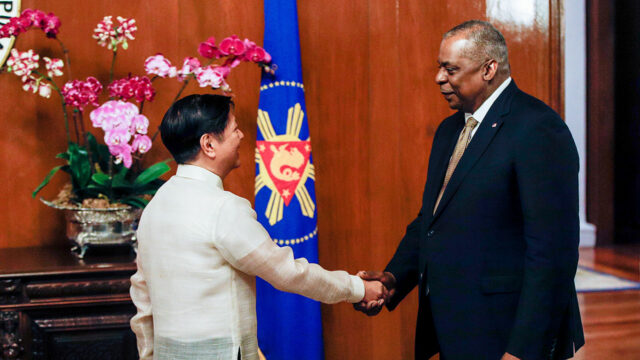
PRESIDENT FERDINAND R. MARCOS, JR. welcomes United States Defense Chief Lloyd Austin III at Malacañang Palace on Feb. 2. — NOEL B. PABALATE/PPA POOL

United States Defense Secretary Lloyd Austin’s recent visit to the Philippines was only one of several that high-ranking US officials have made since Ferdinand Marcos, Jr. assumed the Presidency. The visits underscore this country’s continuing relevance to the strategic and other interests of its former colonizer. They also indicate a departure from the less than idyllic US-Philippine relations that Mr. Marcos’ pro-China predecessor cultivated.

Among the country’s recent visitors from the US was Secretary of State Antony Blinken, who was in the Philippines last August. US Vice-President Kamala Harris was also in the country only last November, during which time the Marcos II administration received a pledge of continuing military aid and agreed to allow US visiting forces and their equipment access to additional Philippine military bases as provided for by the Visiting Forces Agreement (VFA) and the Enhanced Defense Cooperation Agreement (EDCA). Which Philippine military bases the US troops would have additional access to and other details were presumably discussed during the Austin visit.

US media have been celebrating the access of US troops to more Philippine military bases. It will disperse US military forces in Asia so they can act pro-actively or respond more quickly to any threat from China, which President Joseph Biden has described as the leading “geopolitical challenge” to his country. Indeed, if Philippine military bases in Luzon will be among those to which US troops will have additional access, it will put them only a few kilometers from Taiwan, which China regards as one of its provinces.

The expanded Philippine commitment under the VFA and EDCA is in fact occurring in the context of heightened tensions between China and the US, which the latter has attributed to the former’s supposed threat to forcibly annex Taiwan and the possibility of its supporting North Korea in the event of a confrontation between North and South in the Korean Peninsula. The most recent indication of the rising tensions between the two countries was Blinken’s postponement of his Feb. 4 visit to China because one of its surveillance balloons traversed the air space of the continental USA in violation of international law.

These tensions are fundamentally the consequences of the US policy of preventing the rise of China to superpower status through its “Pivot to Asia,” of which President Joseph Biden’s pledge to defend Taiwan in the event of any Chinese attempt to forcibly unite that island with the mainland is a major component.

The possibility of a war with China has made the expansion of EDCA coverage vital to US strategic interests. But it raises for the Philippines questions over what its consequences could be, such as whether the current administration has carefully weighed the possibility that it would involve the country in a confrontation that could escalate into a nuclear war between the only superpower on the planet and the country aspiring to equal if not replace it.

The US has emphasized that no permanent military bases will be established on Philippine soil. But US troop access to more Philippine military bases hardly makes a difference — and even multiplies their capacity to launch both offensive and defensive actions against any actual or anticipated adversary, hence China’s objections.

The brutal truth is that both the VFA and EDCA were crafty schemes to go around the ban in Article XVIII Section 25 of the Constitution on “foreign military bases, troops or facilities” in the Philippines except under three conditions. Foreign military troops, bases, and facilities can be allowed in the Philippines only if, first, it is through “a treaty duly concurred in by the Senate.” Second, should “Congress so requires,” the same treaty must also be “ratified by a majority of the votes cast by the people in a national referendum held for that purpose,” and third, it must be “recognized as a treaty by the contracting party.”

Neither the VFA nor the EDCA is a treaty between the US and the Philippines. Both are executive agreements that through the subterfuge that the presence of US troops would only be temporary, and that they will only have access to Philippine military bases rather than have their own, nevertheless bind the Philippines to the support of US strategic interests.

Despite Article XVIII, Section 25 of the Constitution, in 1999 the Joseph Estrada Presidency signed the VFA, under the terms of which Philippine troops have since held joint military exercises with their “visiting” US counterparts. The Benigno Aquino III administration complemented that already problematic agreement in 2014 by signing and ratifying the EDCA, the provisions of which allow visiting US forces, with their equipment, to access selected Philippine military bases.

Former President Rodrigo Duterte threatened to rescind the VFA while he cozied up to China by practically ignoring its intrusions in the West Philippine Sea (WPS) and welcoming into the country tens of thousands of its workers and gamers in Philippine Offshore Gaming Operations (POGO), but that threat never went beyond words. Both the VFA and the EDCA are still very much in force.

While declaring that the country would remain “close” to China, it is becoming increasingly clear that the Marcos II regime policy, as indicated by its expansion of US EDCA access, is to restore and nurture the decades-long “special relations” between the US and the Philippines.

Despite the possibly dire consequences of its VFA and EDCA pacts with the US, the Philippines hardly has any choice. There is also its Mutual Defense Treaty (MDT) with the US, which its officials have repeatedly declared they would honor by defending the Philippines from external threats. Vice-President Harris herself reiterated that pledge on Nov. 21 in reference to Philippine problems in the WPS.

The Philippines has been having its own problems with its Chinese “friend,” especially over its incursions into the WPS. That does not justify this country’s inviting US intervention in resolving the issue, given its likely consequences. But thanks to the policies of both past and present administrations, as in the Cold War years, the Philippines is being thrust into a situation over which it will have no control.

No one can blame the ruling circles of either the US or China for defending and advancing their respective economic and strategic interests at all costs. In contrast, rather than advancing the country’s own, the Philippine ruling elite has not deviated from its decades-long, US-dependent foreign policy. It has failed to develop the capacity of the country to defend itself on the basis of the fundamental truth that no nation can depend on anyone else, and that, as the late Senator Claro M. Recto pointed out decades ago, involvement in “the quarrels of the strong” is not only dangerous; it also distracts government from addressing the country’s legions of problems.

Whether against China or any other external threat, the Philippines is depending on the US to defend it — and as recent events are demonstrating, in the pursuit of its interests, the US has pledged that it will do so.

The Marcos II administration has declared that part of its foreign policy is strengthening Philippine relations with other ASEAN countries and with China. But it is still the US on which the country has to depend for its external defense because, despite the billions spent on its supposed “modernization,” the Armed Forces of the Philippines cannot even protect Filipino fisherfolk from Chinese harassment and is most expert only at the suppression of dissent and social unrest. No government is to blame for this predicament except the Philippines’ own.


Luis V. Teodoro is on Facebook and Twitter (@luisteodoro).

www.luisteodoro.com

TikTok is not only annoying. It’s much worse than that

MAY GAUTHIER-UNSPLASH

It’s widely acknowledged that depression and suicide have risen among the youth, with commonly attributed factors being traumatic events and dramatic life changes (death in the family, divorce, romantic breakups, etc.), drug use, alcoholism, and over-medication.

Nevertheless, experts (including the US Centers for Disease Control and Prevention) have long seen social media as a primary cause for mental health issues. “Over the past couple of decades, social media has impacted every generation, but none more than children and young adults,” wrote Sherry Dillon, RN, CPHRM, in a feature in bravadohealth.com (“Is Social Media Impacting Youth Depression?” May 22, 2018).

She states: “Dr. Laurel Williams, Chief of Psychiatry at Texas Children’s Hospital says, ‘Many people are worried about how busy they [children] are. There’s a lack of community. There’s the amount of time we spend in front of screens and not in front of other people. If you don’t have community to reach out to, then your hopelessness doesn’t have a place to go’.”

Additionally, “Dr. Karyn Horowitz of Bradley Hospital in Rhode Island also cites social media as a major factor for the rise in youth depression. ‘For some kids, video games can become an addiction leading to social isolation, poor school performance, and impaired sleep,’ she says.”

And the worst social media culprit? TikTok.

One study (“Accelerating dynamics of collective attention,” Lorenz-Spreen, Mønsted, et al., April 2019) found that a person’s attention span dramatically decreases over time from using TikTok and yet the same pattern is not seen in other social media platforms such as Twitter or Facebook.

Indeed, “TikTok brain’ is a real thing.” Merely viewing a “90-second video clip from the mobile app causes problems in the collective attention span of a person. Now, experts are looking into its effects on kids’ brains using TikTok.” (“TikTok Brain Explained: Endless Dopamine Rush From Short Videos Get Kids Hooked,” Science Times, April 2022)

Ultimately, TikTok is a drug dealer and the drug is dopamine. And right now, 44.4 million Filipinos (with a staggering 67.9% of Filipinos aged between 16-64) are potential addicts: “The app features short videos of lip-synched songs, acting, dances and memes of various sorts. At first glance, TikTok seems like a harmless platform for sharing content and meeting new people. However, this application is a dopamine factory,” says a feature in The Gauntlet (“TikTok is a dopamine factory,” Andrea Silva Santisteban Fort, The Gauntlet, Feb. 14, 2021).

“Dopamine is an excitatory brain neurotransmitter,” Ms. Santisteban Fort explains. “To put it simply, it’s a chemical messenger that sends information from your nerve cells to other parts of the body. The brain releases it when we eat food that we crave, drink alcohol or scroll through social media. This important neurochemical boosts our mood and motivation, giving us a feeling of pleasure and satisfaction as part of its reward system. Dopamine is what makes us desire things and take action based on how much dopamine it is expecting to get from a certain activity. It creates reward-seeking loops in the sense that people will seek to repeat pleasurable behavior, such as spending time on Instagram. Our brains reward us for absorbing information the same way our brains reward us for eating good food. By fulfilling a craving, our brains release dopamine, allowing us to feel pleasure and satisfaction. Nevertheless, dopamine wears out. When this happens, we seek more of it — and the addictive cycle continues,” says Ms. Santisteban Fort.

“TikTok takes advantage of this pattern of behavior. Users receive a constant stream of new videos — a dopamine stimulation — every 15 seconds to one minute. In a Forbes article, Dr. Julie Albright, a sociologist specializing in digital culture and communication, mentioned that TikTok users find themselves ‘in this pleasurable dopamine state, carried away. It’s almost hypnotic, you’ll keep watching and watching’.”

The foregoing takes on a magnitude of a crisis when one considers that 57% of our population are under the age of 30, those under 50 about 90%. And then consider that 57% of newborn babies in the Philippines are illegitimate, many being children of teenage mothers, still more later to become the children of broken homes due to annulled marriages. And every child will grow up amidst a culture seeking to normalize premarital sex, homosexuality, and drugs.

Consider further that the Philippine fertility rate (for women between 15 to 49 years of age) is currently 1.9. Hence, declared the Philippine Statistics Authority, “the Philippines is already below the replacement fertility level [i.e., 2.1]”.

The utterly plausible health, psychological, social, economic, security implications of all that for the country is devastating.

The Marcos administration should take a deep look into what is not only a health and security crisis but also an existential one. A good first step would be to ban TikTok in all government or government-issued computers or devices. Legislation can be made prohibiting children from using TikTok.

But indeed, it would just be better to ban TikTok all together. Philippine and international law are replete with provisions authorizing this for reasons of health and national security.

And really, just for the simple reason of maintaining good taste.


Jemy Gatdula is a senior fellow of the Philippine Council for Foreign Relations and a Philippine Judicial Academy law lecturer for constitutional philosophy and jurisprudence

https://www.facebook.com/jigatdula/

Twitter  @jemygatdula

ADVERTISEMENT
ADVERTISEMENT