Home Blog Page 5242

LGUs urged to develop capital investment plans

LOCAL government units (LGUs) have been instructed to develop a capital investment planning capability, the Department of Finance (DoF) said, citing the need to raise their creditworthiness and improve their access to financing.

“As we implement the full devolution of certain functions from the executive branch to local governments pursuant to Executive Order (EO) No. 138, government units are confronted with the challenge of funding the expanded scope of basic services and local development projects. It is therefore imperative that LGUs put in place plans on capital investment,” Finance Secretary Benjamin E. Diokno said in a statement on Thursday.

EO No. 138 outlines the devolution of National Government functions corresponding to the expansion of LGUs’ share of national taxes.

The expansion of the LGUs’ National Tax Allotment comes as local officials made only limited use of their authority to borrow.

According to the DoF, only 62% of LGUs have availed of credit in the past five years.

In 2021, LGU borrowing only amounted to P136.6 billion or around 0.74% of gross domestic product.

The Bureau of Local Government Finance (BLGF) reported that LGUs were only able to utilize 51.5% of their borrowing capacity in the past five years.

“These were most commonly used for the construction of local government buildings and roads, acquisition of lots, and procurement of heavy equipment,” it added.

The BLGF issues certificates of net debt service ceiling and borrowing capacity to LGUs to set the maximum amount that LGUs can borrow.

Mr. Diokno said the initiative is being pursued as part of an engagement with the World Bank Group, in which LGUs will be capacitated to undertake the planning of their capital investment programs.

“This initiative will steer our LGUs on the path to creditworthiness, which is key to accessing long-term financing required for sustainable investments,” he added.

Ateneo de Manila University Economics Professor Leonardo A. Lanzona said that LGUs are key players in the economy’ recovery.

“For this to happen, they should be allowed to create and develop their own economic programs and policies. The national agencies and departments should refrain from setting rules and policies for the LGUs to follow. In this case, matters relating to industrialization, agricultural development and the enhancement of the service sector, including infrastructure, should be decided at the regional level,” he said in an e-mail.

Mr. Lanzona said that LGUs should develop their own industrial policy along the lines of service expansion, which should be presented to the National Government in order to reduce barriers that can mobilize both labor and capital to competitive regions.

“It is likely that some regions may lag behind. While the National Government should keep their hands off from the economic programs of the regions, it is crucial that they provide the necessary public goods, such as health, education and infrastructure to the lagging regions. This should be the only rationale for government intervention,” he added. — Luisa Maria Jacinta C. Jocson
Moody’s Analytics downgrades Philippine growth outlook to 6.7%

BW FILE PHOTO

MOODY’S ANALYTICS said it lowered its 2022 growth estimate for the Philippines to 6.7% from 6.8% previously due to the lingering impact of the pandemic.

The downgrade comes despite a stronger-than-expected third quarter performance for Philippine gross domestic product (GDP).

The global research firm retained its forecast of 6.4% growth in 2023.

The economy expanded by 7.6% in the third quarter, exceeding the revised 7.5% growth posted in the second quarter and exceeding the 7% reported a year earlier.

In the nine-month period, GDP growth averaged 7.7%.

“The Philippines will feel the lagging effect of post-pandemic reopening as it had the longest continuous lockdowns of any country in the region,” Moody’s said in a report.

However, it noted that pent-up demand by companies and households for goods and services “will support growth next year, as well as government fiscal policy that is promoting education, public health, and a return to infrastructure development.”

Moody’s Analytics said that other primary risks include persistent inflation and potentially higher interest rates. “Current inflation exceeds 6% over the year in the Philippines,” it said.

Moody’s Analytics also raised its inflation forecast to 5.5% in 2022, 5.4% in 2023, and 3.1% in 2024, against its earlier estimates of 5.3%, 5% and 2.9%, respectively.

Headline inflation accelerated to 7.7% in October, mainly due to rising food prices.

October inflation was the highest since the 7.8% posted in December 2008, during the global financial crisis.

October also marked the seventh straight month that inflation breached the Bangko Sentral ng Pilipinas’ (BSP) 2-4% target this year.

For the 10-month period, inflation averaged 5.4%, lower than the BSP’s 5.6% full-year forecast.

The BSP this month increased its benchmark rate by 75 basis points (bps) to 5% to tame inflation and keep in step with the Federal Reserve. Since May, the BSP has hiked rates by 300 bps.

The Fed has raised rates by 375 bps since March, including its fourth 75-bp rate hike earlier this month, bringing its benchmark interest rate to the 3.75-4% range.

China Banking Corp. Chief Economist Domini S. Velasquez said that GDP will likely hit at least 7% in 2022 due to the “resiliency of domestic demand against an elevated inflation and high interest rate environment.”

“Although the Philippines was quite late in removing pandemic restrictions, this led to robust pent-up demand with service activities reaping the benefit the most. This holiday season will also be the first with almost no restrictions which could further boost fourth quarter GDP,” she said in a Viber message.

Ms. Velasquez also said 2022 inflation will likely average 5.8% this year.

“We think inflation will still hit 7.7-7.8% levels in November and December, driving the full-year average higher,” she said.

“Vegetable prices are still on the rise, some shortages in onions and garlic have been observed, and sugar prices have not gone down despite reports of imports. Core inflation, or prices of goods deemed less volatile, is still on an uptrend until the first few months of 2023,” she added.

Foundation for Economic Freedom President Calixto V. Chikiamco said that the continued tightening by the BSP will dampen GDP growth.

“Interest rate-sensitive sectors like real estate, cars, and appliances will take a hit from higher interest rates,” he said in a Viber message.

Mr. Chikiamco noted that the Moody’s Analytics forecast adjustment was “statistically insignificant.”

“I don’t have a specific inflation forecast but inflation may decelerate by next year if recession hits the global economy and prices of commodities, particularly oil, fall,” he added. — Luisa Maria Jacinta C. Jocson

PHL urged to focus economic policy on keeping middle class prosperous

PHILIPPINE STAR/ MICHAEL VARCAS

THE Philippines should manage the economy in a way that grows the middle class, to prevent members of that income category from falling back into poverty, participants at a conference discussing a World Bank report on inequality.

“If we manage to reduce poverty, we will have a large middle class that will become a stronger voice in politics and elections. The middle class is fragile and fall back into poverty with every shock or crisis they face, and that will shape the nature of politics,” IDinsight Southeast Asia Regional Director Ronald U. Mendoza told a panel discussion on Thursday, during which participants discussed the findings of a World Bank report, “Overcoming Poverty and Inequality in the Philippines: Past, Present, and Prospects for the Future.”

“And then on the political agency side, we need to give our emerging middle class and remaining poor a stronger voice in policy making, which will only happen if we reduce inequality,” he added.

Between 1985 and 2018, poverty fell by two-thirds, according to the World Bank report.

“However, income inequality did not begin to decline until 2012. It is still high: the top 1% of earners together capture 17% of national income, with only 14% being shared by the bottom 50%,” the report found.

Mr. Mendoza said reducing inequality should be a key policy focus.

“It’s no longer just economics. I think we need to open our eyes and focus on a bigger canvas, not just economic indicators, but most of the social, political, and other indicators of inequality that frustrate our efforts to build social cohesion and unite people around certain reforms,” he said.

Mr. Mendoza also noted the importance of private sector cooperation in generating more quality jobs and providing stability for the middle class.

“We (also) need to develop new markets for a recently-emancipated middle class that still faces many risks and can easily slide back to poverty if they don’t manage these risks well,” he said.

“We all agree that if you provide salaried jobs that tend to be more formal or attached to insurance mechanisms, you are more resilient to shocks and there is more stability,” he said.

Makati Business Club Director Francisco Alcuaz, Jr. said corporations should work together with micro, small and medium enterprises (MSMEs.)

“One of the keys is to help MSMEs generate more jobs. Larger businesses should make a greater effort to bring MSMEs into their supply chains so they can grow and generate more jobs,” he said.

Mr. Alcuaz said companies must also put in the effort to upskill workers.

“We need to do things at the employment level. One thing we are supportive of is adjusting rules for apprenticeship. There are safeguards that can be put in place to allow companies to bring in people, not at full minimum wage, just to get them into the system and teach them skills to become valuable workers,” he added. — Luisa Maria Jacinta C. Jocson

Philippines says it has filed 189 diplomatic protests vs China

FILIPINO fishermen spotted and retrieved metal debris off Calintaan, Occidental Mindoro on Nov. 6. — PHILIPPINE COAST GUARD FACEBOOK PAGE

THE PHILIPPINES has filed 189 diplomatic protests against China this year over their dispute on the South China Sea, the Department of Foreign Affairs (DFA) said on Thursday.

The agency issued the statement after the Philippines asked China to explain its seizure of a rocket part that landed in the waters of the Spratly Islands in the South China Sea at the weekend. 

“As of 22 November, the DFA has issued 189 protests, 61 of which were made during the current administration,” Foreign Affairs spokeswoman Ma. Teresita C. Daza told reporters via WhatsApp. 

China claims more than 80% of the South China Sea, which is believed to contain massive oil and gas deposits and through which billions of dollars in trade passes each year. It has ignored a 2016 ruling of a United Nations-backed arbitration court that voided its claim based on a 1940s map.

The Philippines has been unable to enforce the ruling and has since filed hundreds of protests over what it calls encroachment and harassment by China’s coast guard and its vast fishing fleet.

Vietnam, Malaysia and Brunei also claim parts of the waterway.

Foreign Affairs Secretary Enrique D. Manalo said the Philippine government stands by the statement of the Philippine Navy on the issue.

“We stand by the statement of the vice admiral, we are taking that to heart,” he told CNN Philippines. “That’s why we have referred it in effect in the note verbale to China and we’d like to see how they reply.”

“Depending on how their reply comes out, then we have to see what to do. In order to begin the process, we would like to get an official comment from China,” he added.

On Sunday, a Chinese coast guard vessel allegedly took by force a rocket debris that was being towed by a Philippine Navy ship in the South China Sea.

China’s foreign ministry spokeswoman Mao Ning on Monday said the incident had involved a “friendly negotiation.”   

“People from the Philippine side salvaged and towed the floating object first. After both sides had a friendly negotiation at the scene, the Philippines handed over the floating object to us,” she said. 

She said the object was debris from a rocket’s payload fairing — a casing that protects the nose-cone of a spacecraft — launched by China. “It was not a situation in which we waylaid and grabbed the object.”

Philippine President Ferdinand R. Marcos, Jr. on Tuesday said he wanted to ask the Chinese why their account was so different from the Philippine Navy report.

He said his visit to China in January could be an opportunity to find a way to avoid further incidents.

In November last year, the Philippines accused China of firing water cannons to prevent its boats from resupplying its outpost at Second Thomas Shoal.

The incident occurred as US Vice-President Kamala Harris arrived in the Philippines on Sunday for talks aimed at reviving ties with its Asian ally that is central to US efforts to counter China’s increasingly assertive policies toward Taiwan.

Ms. Harris, whose three-day trip included a stop in Palawan, an island on the edge of the South China Sea, reaffirmed US support for the 2016 international tribunal ruling.

Palawan is about 320 kilometers (200 miles) from the Spratly islands, where China has dredged the sea floor to build harbors and airstrips.

On Monday, she pledged the US would defend the Philippines if it came under attack in the waterway, reaffirming Washington’s unwavering commitment to its former colony.

Ms. Harris’ comments followed a meeting with Mr. Marcos, who welcomed her for the first time at the Philippine presidential palace in Manila.

Mr. Marcos said the two nations’ strong ties had become even more important, given what he called upheavals in the region.

He said her visit to the Philippines was a “very strong symbol” that the relationship of the Philippines with its former colonizer “remains strong.”

Mr. Marcos also said Philippine relations with the United States had gone through different phases and has been strengthened in every way.

The US seeks to pursue its Enhanced Defense Cooperation Agreement (EDCA) with the Philippines, which was signed in 2014 and builds on the Mutual Defense Treaty and 1999 visiting forces agreement, according to a fact sheet e-mailed by the US Embassy in Manila on Monday. It was also posted on the White House website.

US and Philippine forces have also used EDCA sites during Kamandag and Balikatan military exercises.

The US has allotted more than $82 million toward EDCA implementation at five existing locations in the Philippines, according to the statement.

New EDCA locations have also been identified to enable the US and Philippines to continue to work together to meet the objectives of the military pact.

The Philippines signed the military pact with the US, the country’s key western ally, under the late President Benigno S.C. Aquino III.

His successor Rodrigo R. Duterte had threatened to scrap a visiting forces agreement with the US after the US Embassy canceled the visa of his ally Senator Ronald M. de la Rosa, his former police chief who led his deadly war on drugs.

Ms. Harris’ visit to the Philippines, the highest-level trip to the Philippines by a Biden administration official, is seen as part of Washington’s effort to revive ties with Manila, which moved closer to China under Mr. Duterte.

“We stand with you in defense of international rules and norms as it relates to the South China Sea,” Ms. Harris told Mr. Marcos. — Norman P. Aquino and Kyle Aristophere T. Atienza

Manila frees 234 inmates in bid to decongest its prison system

PHILIPPINE STAR/ MICHAEL VARCAS

THE PHILIPPINES’ Bureau of Corrections (BuCor) on Thursday released 234 inmates from seven prisons who had served their sentences.

“Today, you are no longer persons deprived of liberty, but you are free,” national prison officer-in-charge Gregorio Pio P. Catapang told inmates in Filipino during ceremonies streamed live on Facebook. “Every day I see a change in the inmates, and I intend to continue reforming BuCor.”

The bureau freed 128 prisoners from the national penitentiary in Muntinlupa City near the capital, 47 from the Davao Prison and Penal Farm in the country’s south, 16 from San Ramon Prison and Penal Farm in Zamboanga City and 12 from the Sablayan Prison and Penal Farm in Occidental Mindoro.

Seven prisoners from the Leyte Regional Prison, three 3 from Iwahig Prison and Penal Farm in Palawan and 21 from the Correctional Institution for Women in Mandaluyong City were also freed, according to a list sent to reporters.

Justice Secretary Jesus Crispin C. Remulla told the same event he seeks to release 5,000 inmates by June.

Last month, he told the United Nations (UN) Human Rights Council there are efforts to decongest the country’s jails. He also wants to “change the culture” of the local justice system, which he said was prone to delays.

“We hope that what we are doing here at BuCor will be meaningful since those imprisoned should have the hope to be free and rejoin our society,” Mr. Remulla said in mixed English and Filipino.

The DoJ was studying the possible “supervised release” of inmates who are 65 years and older, he said, adding that crimes committed under the age group have decreased.

The government has released more than 700 inmates in the past two months.

Mr. Remulla earlier said the national penitentiary, which was designed to house 6,000 prisoners, had 17,000 inmates.

With 215,000 prisoners nationwide, Philippine jails and prisons are overfilled more than five times their official capacity, making them the most overcrowded prison system in the world, according to the World Prison Brief.

Many of the country’s jails fail to meet the UN’s minimum standards given inadequate food, poor nutrition and unsanitary conditions, according to Human Rights Watch.

The DoJ plans to build a P2.5-billion “world-class” maximum security facility in the town of Sablayan in Occidental Mindoro, the Justice chief said in August.

It also plans to move the national penitentiary’s minimum security facility to Nueva Ecija in northern Philippines.

Fides M. Lim, a convenor of Kapatid, a support group for political prisoners, earlier said the government should stop its deadly drug war if it wants to decongest its jails.

The Philippine Commission on Human Rights has repeatedly flagged the worsening congestion in the country’s jails, more recently spurred by the arrests of suspects in ex-President Rodrigo R. Duterte’s war on drugs that has killed thousands. — John Victor D. Ordoñez

Former PSALM CEO named acting PhilHealth president 

PHILSTAR FILE PHOTO

EMMANUEL Rufino R. Ledesma, Jr., former head of the government agency in charge of power assets privatization, has been appointed as acting president and chief executive officer of the Philippine Health Insurance Corporation (PhilHealth), Malacañang announced on Thursday.  

Mr. Ledesma took his oath on Thursday, the Office of the Press Secretary said in a statement. He is also a member of the expert panel and board of directors, it said.   

The former investment banker previously served as president and CEO of the state-run Power Sector Assets and Liabilities Management (PSALM) Corporation.  

State insurer PhilHealth had been implicated in major corruption issues, including fraudulent schemes. Various groups, including business chambers, have been calling on the government to reform the institution to ensure a competent implementation of the Universal Health Care Act.  

The law, which automatically enrols all Filipinos in PhilHealth, seeks to enhance the delivery of healthcare services. Kyle Aristophere T. Atienza

Central bank-led QR payment program seen to propel digital adoption in Davao, rest of Mindanao

BANGKO Sentral ng Pilipinas Governor Felipe M. Medalla (in white-yellow shirt) looks on as Davao City Mayor Sebastian "Baste" Z. Duterte tries out the Paleng-QR code of a sweets and fruit vendor at the Bankerohan market. — BW FILE PHOTO/MAYA M. PADILLO

BANKEROHAN, Davao Citys biggest public market, was more bustling than usual on Wednesday as various banks and mobile wallet firms set up temporary shops to assist vendors and consumers, as well as tricycle drivers, in going digital.  

The on-the-spot services were delivered in time for the launch of the governments Paleng-QR program, which aims to build up the countrys digital payment ecosystem.  

Bangko Sentral ng Pilipinas Governor Felipe M. Medalla, in his speech at the ceremony, said the introduction of the QR PH program in Davao City is seen as a launching pad for its adoption across the southern Philippine island of Mindanao.  

The central bank governor said he had conversations with market vendors, some of whom already recognize the benefits of digital payment platforms.   

I talked to a vendor of suha (pomelo) who said many tourists come to buy but not with cash, good I have G-Maya (referring to two leading money apps: GCash and Maya),Mr. Medalla said in Filipino.    

He added that the vendor narrated how subscribing to the e-money firms have opened access to loans.  

It solved not just the payment process but also access to credit,he said. 

Bankerohan fruit vendor Grace Wenceslao said in an interview that digital payment systems have also taken away the hassle of scrambling for coins to give an exact change.  

It’s easier for me and I don’t have to ask around and look for coins to give to the customers,she said in the vernacular.  

The Davao City council, meanwhile, approved on Tuesday an ordinance calling on all local business establishments to use the QR PH, which serves as the national standard as it can accept payments from any e-wallet or bank.   

This will surely help the MSMEs (micro, small and medium enterprises). The national government and the city government must do more projects to support the small entrepreneurs,Councilor Bernard E. Al-ag, author of the ordinance, said during the launch. 

“By promoting the interoperable QR PH national standard codes, Paleng-QR PH creates a simple but more powerful digital finance experience at the local community level,Orlando B. Vea, chief executive officer of Maya, the first digital financial services platform to adopt QR Ph, said in a statement.   

At Maya, we fully support Davao City’s vision to build a stronger digital ecosystem,he said.  

The Paleng-QR is a joint program of the Banko Sentral ng Pilipinas and the Department of Interior and Local Government. It was first launched in Baguio City in northern Philippines in August. Maya M. Padillo

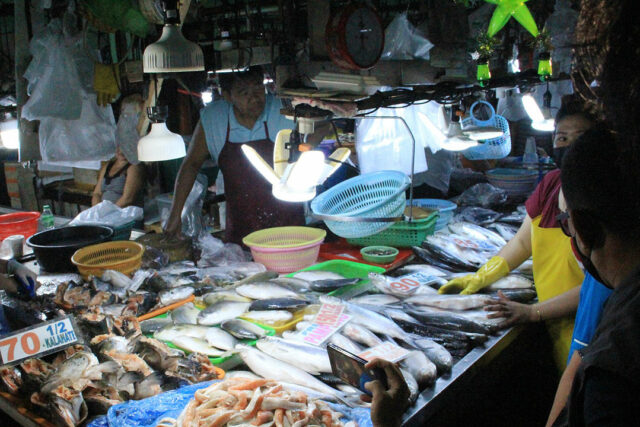
BFAR launches campaign vs sale of unauthorized fish imports in Metro Manila wet markets

BFAR

THE BUREAU of Fisheries and Aquatic Resources (BFAR) has launched a campaign to stop the selling of fish imports that are unauthorized for wet markets amid the closed fishing season.    

In a statement on Thursday, the BFAR said the information campaign will run from Nov. 24 to Dec. 3 and will cover fish vendors across 21 wet markets in Metro Manila.   

The campaign comes after the Department of Agriculture on Nov. 10 issued a certificate of necessity to import (CNI) 25,000 metric tons (MT) of frozen small pelagic fish to address supply gaps during the closed fishing season.    

Small pelagic fish include round scad (galunggong), bigeye scad, mackerel, bonito, and moonfish for wet markets.    

According to the BFAR, the importation of fish is only allowed until the end of the closed fishing season, which started in November this year and will end in January 2023.   

As the government allows fish importation anew in order to fill in the supply gap while our conservation measures are in place and keep the prices of our fish commodities in the retail markets stable, the BFAR conducts this (campaign) that will help safeguard the livelihood of our local fishers and prevent competition between our local and imported fish products,BFAR Officer-in-Charge Demosthenes R. Escoto said.    

Only fish imported through Fisheries Administrative Order (FAO) 259 and the recent CNI, which gives priority to municipal fishing associations/cooperatives and commercial fishing operators affected by the closed fishing season, are allowed to be sold in the wet markets,he added.    

Under FAO 259, fish imports are allowed for wet markets via CNI only during the closed fishing season or the occurrence of calamities.    

Meanwhile, the BFAR said that it is also implementing efforts to dissuade importation-related violations.    

One of the agencys immediate steps concurrent with the importation for wet markets is the suspension, with few exceptions, of the issuance of Sanitary and Phytosanitary Import Clearances for the importation of round scad, mackerel, bonito, moonfish, pompano and tuna by-products under FAO 195,the BFAR said.    

This is expected to minimize, if not completely eliminate, opportunities that may be exploited by violators.”   

The agency is also stepping up control measures on importation such as strengthening border control through seaport/airport and cold storage warehouse inspections, including mandatory X-ray inspection of all reefer vans, and deployment of additional personnel for the first and second borders inspection.Revin Mikhael D. Ochave

DPWH starts construction of P3.4-B labor relations building

DPWH

THE DEPARTMENT of Public Works and Highways (DPWH) announced on Thursday that it recently started the construction of a P3.415-billion building for the National Labor Relations Commission (NLRC).  

The 15-storey building, located along Agham Road in Quezon City, will have office spaces, conference halls, public spaces, multipurpose rooms, and parking lots for the convenience of the agencys workers and the transacting public, the DPWH said in a statement.  

More than just providing flexibility and convenience to its employees, the project will deliver improved process, and facility to accommodate NLRCs clients, employers, to other members of the transacting public,DPWH Secretary Manuel M. Bonoan said.  

The department noted that NLRC employees have been temporarily housed at various offices since the 1990s.  

Years of planning and collaboration between the NLRC, DPWH, and the Department of Labor and Employment brought a permanent home for the officials and employees of the agency,the department said.   

Meanwhile, the department also announced the completion of a P96-million flood control wall project in Zamboanga City.  

The project is intended to protect residents and communities of Zamboanga City from river overflow during heavy rains, the department said in a separate statement.   

The project involved construction of a 6-meter grouted riprap with rubble concrete foundation in Barangay Limpapa and 6.5 meters in Barangay Patalon,it noted.   

With the project, the department hopes to mitigate the degradation of the two riverbeds, Latap River and Miluao River, and prevent damage to infrastructure and agriculture brought by typhoons. Arjay L. Balinbin

2 Vietnamese nabbed for kidnapping compatriot 

TWO Vietnamese nationals were arrested in the Philippine capital region for kidnapping a compatriot and demanding a P50-million ransom, the Philippine National Police (PNP) reported on Thursday.  

The police said its anti-kidnapping group rescued a Vietnamese woman in Antipolo City, located east of the capital, on Nov. 16 after authorities received reports of her disappearance on Oct. 29.  

Police found her abandoned along Sumulong Highway in Antipolo City.  

The victims family had already paid P1 million in two tranches after the kidnappers sent videos to the victim’s boyfriend of her being beaten as they demanded the P50-million ransom.  

In follow-up operations on the evenings of Nov. 17 and 18, the police arrested the two foreigners separately in Pasay City and Parañaque City, both within the capital region.  

The two suspects are undergoing police investigation in preparation for the filing of criminal complaints against them.  

The PNP noted that other suspects involved in the kidnapping remain at large.  

“I commend all the operatives in this successful operation,” national police chief Rodolfo S. Azurin said. “The PNP is ready to fulfill its commitment to investigate and arrest all criminals thoroughly,” he added in Filipino. John Victor D. Ordoñez 

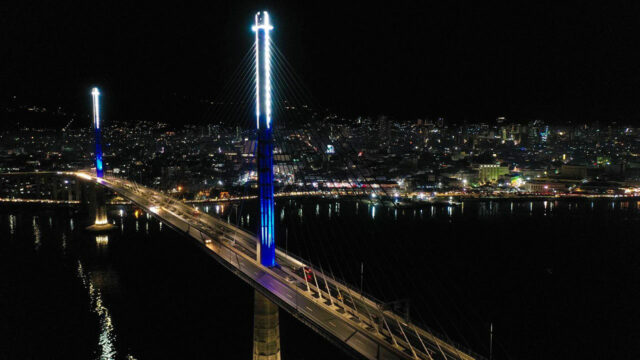
CCLEX lights up in blue

MPTC PHOTO HANDOUT

THE CEBU-CORDOVA Link Expressway was lit in blue, the symbolic color for the observance of World Children’s Day, on Nov. 19-20 in support of the UNICEF-led annual event to highlight children’s rights.

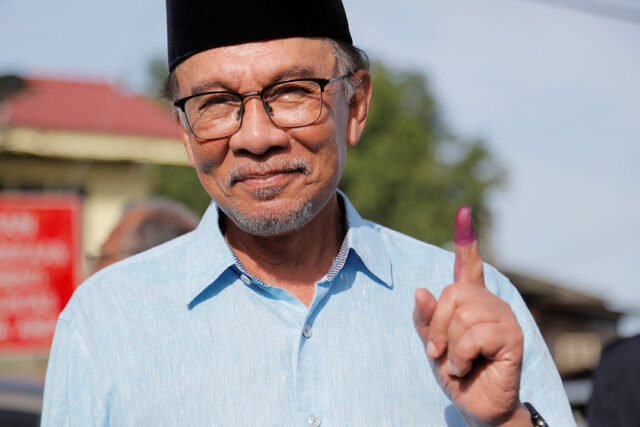
Anwar Ibrahim becomes Malaysia prime minister

Malaysia’s Prime Minister Anwar Ibrahim — REUTERS

KUALA LUMPUR — Malaysia’s Anwar Ibrahim was sworn in as prime minister on Thursday, capping a three-decade political journey from a protege of veteran leader Mahathir Mohamad to protest leader, a prisoner convicted of sodomy and opposition leader.

His appointment ends five days of unprecedented post-election crisis, but could usher in a new instability with his rival, former prime minister Muhyiddin Yassin, challenging him to prove his majority in parliament.

Both men failed to win a majority in a Saturday election, but the constitutional monarch, King Al-Sultan Abdullah, appointed Mr. Anwar after speaking to several lawmakers.

Mr. Anwar takes over at a challenging time: the economy is slowing and the country is divided after a tight election that pitted Mr. Anwar’s progressive coalition against Mr. Muhyiddin’s mostly conservative ethnic-Malay, Muslim alliance.

Markets surged upon the end of the political deadlock. The ringgit currency posted its best day in two weeks and equities rose 3%.

The 75-year-old Anwar has time and again been denied the premiership despite getting within striking distance over the years: he was deputy prime minister in the 1990s and the official prime minister-in-waiting in 2018.

In between, he spent nearly a decade in jail for sodomy and corruption in what he says were politically motivated charges aimed at ending his career.

The uncertainty over the election threatened to prolong political instability in the Southeast Asian country, which has had three prime ministers in as many years, and risks delaying policy decisions needed to foster economic recovery.

Mr. Anwar’s supporters expressed hope that his government would head off a return to historic tension between the ethnic Malay, Muslim majority and ethnic Chinese and Indian minorities.

“All we want is moderation for Malaysia and Anwar represents that,” said a communications manager in Kuala Lumpur, who asked to be identified by her surname Tang.

“We can’t have a country that is divided by race and religion as that will set us back another 10 years.”

Mr. Anwar told Reuters in an interview before the election that he would seek “to emphasize governance and anti-corruption, and rid this country of racism and religious bigotry” if appointed premier.

His coalition, known as Pakatan Harapan, won the most seats in Saturday’s vote with 82, while Muhyiddin’s Perikatan Nasional bloc won 73. They needed 112 — a simple majority — to form a government.

The long-ruling Barisan bloc won only 30 seats — the worst electoral performance for a coalition that had dominated politics since independence in 1957.

Barisan said on Thursday it would not support a government led by Mr. Muhyiddin, though it did not make any reference to Mr. Anwar. Mr. Muhyiddin, after Mr. Anwar’s appointment, asked Mr. Anwar to prove his majority in parliament.

POLICE STEP UP SECURITY
Mr. Muhyiddin’s bloc includes the Islamist party PAS, whose electoral gains raised concern among members of the ethnic Chinese and ethnic Indian communities, most of whom follow other faiths.

Authorities warned after the weekend vote of a rise in ethnic tension on social media and short video platform TikTok said it was on high alert for content that violated its guidelines.

Social media users reported numerous TikTok posts since the election that mentioned a riot in the capital, Kuala Lumpur, on May 13, 1969, in which about 200 people were killed, days after opposition parties supported by ethnic Chinese voters made inroads in an election.

Police told social media users to refrain from “provocative” posts and said they were setting up 24-hour check-points on roads throughout the country to ensure public peace and safety.

The decision on the prime minister came down to King Al-Sultan Abdullah, after both Mr. Anwar and Mr. Muhyiddin missed his Tuesday afternoon deadline to put together a ruling alliance.

The constitutional monarch plays a largely ceremonial role but can appoint a premier he believes will command a majority in parliament.

Malaysia has a unique constitutional monarchy in which kings are chosen in turn from the royal families of nine states to reign for a five-year term.

As premier, Mr. Anwar will have to address soaring inflation and slowing growth as the economy recovers from the coronavirus pandemic, while calming ethnic tensions.

The most immediate issue will be the budget for next year, which was tabled before the election was called but has yet to be passed.

Mr. Anwar will also have to negotiate agreements with lawmakers from other blocs to ensure he can retain majority support in parliament.

“Anwar is appointed at a critical juncture in Malaysian history, where politics is most fractured, recovering from a depressed economy and a bitter COVID memory,” said James Chai, visiting fellow at ISEAS-Yusof Ishak Institute in Singapore.

“Always regarded as the man who could unite all warring factions, it is fitting that Anwar emerged during a divisive time.” — Reuters