Home Blog Page 5234

P202.5-M worth of smuggled agri-fishery goods seized in Jan. 

BOC

THE DEPARTMENT of Agriculture (DA) on Tuesday said it seized P202.5 million worth of smuggled farm and fishery products at the Manila International Container Port (MICP) in January.  

In a statement, the DA said the misdeclared and misclassified goodsinside a total of 24 container vans were confiscated in several operations. 

The smuggled commodities include red and white onions, potatoes and roasted sweet potatoes, imitation crab stick, frozen boneless beef, and assorted meat products.  

The DA said the container vans were consigned to Seaster Consumer Goods, Inc. and Asterzenmed, Inc.  

The operations were conducted in cooperation with the Philippine Coast Guard, Bureau of Customs, Bureau of Plant Industry, Bureau of Animal Industry, and Bureau of Fisheries and Aquatic Resources, according to the DA.   

It also reported that the goods which originated from Hong Kong, China have no Sanitary and Phytosanitary Clearance. Sheldeen Joy Talavera

Parts of Mindanao placed under flood, landslide alert due to trough of LPA 

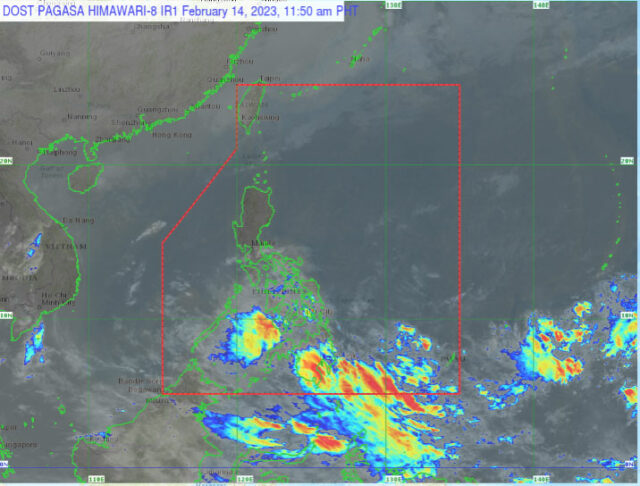
PARTS of the southern Philippine island of Mindanao have been placed under alert for flooding and landslides due to rains brought by the trough of a low pressure area (LPA), according to state weather bureau PAGASA.  

In its Tuesday weather bulletin, PAGASA said the LPA is outside the Philippine area but will bring moderate to heavy rains in the regions of Zamboanga Peninsula, Davao, and Soccsksargen.   

The local government of Dipolog City, capital of Zamboanga del Norte province, suspended classes in all levels on Tuesday due to continuous downpour.  

Light to moderate rains were also expected over the rest of Mindanao and the Visayas in the central part of the country, PAGASA said.   

Under these conditions, flooding and rain-induced landslides are possible,the agency said, especially in high-risk areas and those that have seen significantrainfall in the past weeks.   

Several parts of Mindanao were affected by flooding and landslides in January, triggered by continuous rains brought by LPAs, shear line, and localized thunderstorms.   

Although no tropical cyclone entered inside the Philippine Area of Responsibility during the month, several areas in Mindanao incurred damages due to the aforementioned weather systems,PAGASA said in its climate assessment for January.   

Aside from Mindanao, unusual rains last month poured into 14 of the 17 regions in the country, affecting over 2.1 million people, based on the last related monitoring report of the national disaster management agency dated Feb. 3.   

There were 45 reported deaths, with 20 confirmed and 25 still up for validation. Another seven were missing while 11 were injured.  

Cost of damage to infrastructure mostly roads, schools, and flood control structures was estimated at almost P522 million, according to the National Disaster Risk Reduction and Management Councils (NDRRMC) report.  

Damage to agriculture reached P1.135 billion, with more than 47,000 farmers and fisherfolk affected, NDRRMC said. MSJ

President reorganizes communications office 

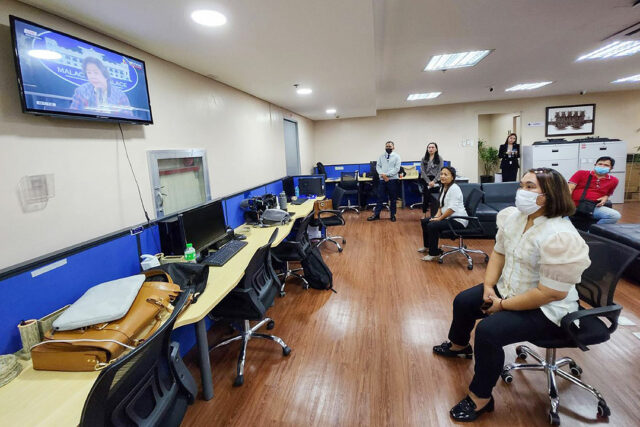
PRESIDENTIAL Communications Office Secretary Cheloy Velicaria-Garafil  monitors the press briefing at the Media Center in Malacañang on Jan. 10, 2023. — PHILIPPINE STAR/KRIZ JOHN ROSALES

PRESIDENT Ferdinand R. Marcos, Jr. has signed an executive order reorganizing the Presidential Communications Office (PCO), which will have five undersecretaries and 15 assistant secretaries supporting the secretary.    

In a statement on Monday, the PCO said Executive Order (EO) No. 16, signed on Feb. 13, is intended to consolidate its communications activities and ensure efficient delivery of its core services.”   

The order also tasks the PCO to closely coordinate with the presidential adviser for creative communications, a position held by Paul D. Soriano, a filmmaker and godson of the president.  

The PCO, formerly the Office of the Press Secretary, was renamed in December under Mr. MarcosExecutive Order 11.  

The new order also places state-owned media networks such as the People’s Television Network, Inc., APO Production Unit, and International Broadcasting Corporation under the supervision of one of PCOs assistant secretaries.   

The National Printing Office will also be placed back under the PCOs supervision.   

Other communications agencies that will be directly under PCO are: the Presidential Broadcast Service-Bureau of Broadcast Services; Bureau of Communication Services; News and Information Bureau; Freedom of Information-Program Management Office; Philippine Information Agency; and the Presidential Broadcast Staff-Radio Television Malacañang.  

Under EO 11 signed Dec. 29, the Office of the President was streamlined into five offices.    

These are the Executive Office, Office of the Chief Presidential Legal Counsel, Private Office, Office of the Special Assistant to the President, and the PCO. John Victor D. Ordoñez

Comelec denounces killing of Maguindanao del Sur election officer  

PHILSTAR
PHILSTAR

THE COMMISSION on Elections (Comelec) has condemned the killing of an election officer assigned in Maguindanao del Sur, who was shot dead on Monday in the neighboring province of Sultan Kudarat.  

In a statement on Monday evening, Comelec said it is coordinating with the police in investigating the murder of election officer Haviv M. Maindan.  

Citing a police report, the election body said unknown assailants shot at Mr. Maindan and another Maguindanao resident who were onboard a vehicle along the national highway in Purok Libas, Sultan Kudarat. The other victim was unharmed.  

The election officer, who was turning 56 this year, worked for 15 years in government service.  

“With the unknown assailants still at large, Comelec Chairman George Erwin M. Garcia, the Commissioners and the whole Commission on Elections commit to the family of election officer Maindan that we will not rest until justice is served,” Comelec said. John Victor D. Ordoñez 


Senator calls for crackdown on child trafficking, online abuse 

PIXABAY

SENATOR Sherwin T. Gatchalian has reiterated his call for better implementation of laws against child trafficking and abuse in the Philippines, citing a United Nations International Children’s Emergency Fund (UNICEF) study indicating that the problem persists.    

“It is our duty to enforce the laws to ensure the safety of our youth from various forms of trafficking,he said in Filipino in a statement on Tuesday. 

UNICEFs Disrupting Harm in the Philippines report showed 20% of Filipino internet users aged 12 to 17 have been victims of grave online sexual abuse and exploitation in 2021. This accounts for about two million minors.  

Mr. Gatchalian sought for a stronger crackdown on child traffickers through effective enforcement of newly-passed laws such as the Expanded Anti-Trafficking in Persons Act of 2022, and the Anti-Online Sexual Abuse or Exploitation of Children and Anti-Child Sexual Abuse or Exploitation Materials Act.  

Under the United States’ Trafficking in Persons Report last year, the Philippines remained at the Tier 1 status, meaning the country was able to meet the minimum standards for the elimination of trafficking. 

The report, however, identified the need for additional personnel and training on handling digital evidence. It also recommended increased support for programs providing specialized care for trafficking victims. Alyssa Nicole O. Tan 

Solons call for probe on UP professor’s arrest 

LAWMAKERS called for a House investigation on the alleged illegal arrest of a professor at state-owned University of the Philippines (UP), citing the cases relation to a pending bill protecting academic freedom.  

The three-member Makabayan coalition said the probe can also look into the need to amend accords between UP and the Department of Interior and Local Government (DILG), and UP and the Department of National Defense. 

Under House Resolution No. 774, the Makabayan bloc condemned the illegal arrest and other human rights violations committed by the police against UP professor Melania Flores.  

Ms. Flores, a unionist and former president of the All-UP Academic Employees Association, was arrested for alleged violation of Republic Act No. 11199 or the Social Security System Act as she supposedly failed to remit contributions for her house helper.  

The lawmakers said the arrest violated her right to due process. 

She did not receive a copy of any complaint informing her of any charge, much less the grounds therefor, nor was she sent any notice or subpoena relative to the complaint and proceeding, they said in the resolution.  

They said the arrest also violated the UP-DILG agreement, which prohibits police and military officers from entering UP premises or conducting arrests without informing the universitys president, chancellor, or dean.  

The resolution was filed by Deputy Minority Leader France L. Castro, Assistant Minority Leader Arlene D. Brosas, and Kabataan Party-list Raoul Danniel A. Manuel. Beatriz Marie D. Cruz

Philippine strategic environment for corporate planning

TIRACHARDZ-FREEPIK

(Part 1)

President Ferdinand Marcos, Jr. recently signed an executive order adopting the Philippine Development Plan (PDP) 2023-2028 which can be a guideline for both the public and private sectors to help the Philippines achieve the goal of becoming an upper middle-income economy by 2025 and over the longer term lay the foundation for First World economic status 15 to 20 years from now. In a recent event sponsored by the American Chamber of Commerce of the Philippines, I was privileged to listen to a detailed presentation of this PDP from Undersecretary Rosemarie Edillon. There were two other speakers who complemented the very valuable information presented by the Undersecretary. These were Dante Tinga, Jr., Senior Vice-President and Director for Research, Investor Relations and Corporate Planning Group, BDO Unibank, Inc. and Dr. Ragnar Gudmundsson, Resident Representative of the International Monetary Fund in the Philippines. The wealth of information and insights presented by these three distinguished speakers prompted me to write this series of articles to help executives and managers of both the private and government sectors in their very important task of strategic, operational and project planning during the next three to five years, to coincide with the term of President Marcos, Jr.

Let me start with the vision-mission statement implied in the PDP. Although these statements are necessarily merely aspirational, they are still useful for focusing the attention of all members of Philippine society on what all should be trying to achieve as long-term goals. I abbreviate the vision contained in the now popular “Ambisyon Natin 2040” of the National Economic and Development Authority (NEDA) into “attaining First World status by the decade of 2040 to 2050.” The eight-point agenda presented by President Marcos Jr. in his inaugural State of the Nation Address in July 2022 can be reduced to the overall goal of reinvigorating job creation and accelerating poverty reduction by steering the economy back on the high-growth path and, more importantly, effecting economic and social transformation for a prosperous, inclusive and resilient society.

What are the characteristics of a First World economy that we want to achieve some 20 years from now? The answers given in the PDP, as summarized by Ms. Edillon are: 1.) High-trust society with pro-active, smart and innovative people with high regard to quality of life, inclusive opportunities, continuous human development and innovative thinking; 2.) an economic sector that is competitive and globally connected; resilient, technology-enabled and agile; provides opportunities for all through innovation and entrepreneurship; 3.) Institutions that are collaborative, responsive, reliable and efficient, thus providing the needed services that are trustworthy, safe and secure; 4.) A physical environment that is efficient, clean and sustainable, in which resources are utilized to optimum levels without compromising balanced and healthful ecology for present and future generations.

In the process of transforming the Philippines, six items are envisioned. The first is digitalization. Every sector of the economy can improve its productivity through the use of digital technology as Industrial Revolution 4.0 intensifies. Artificial Intelligence, the Internet of Things, Data analytics and robotization can be increasingly applied to agriculture, industry and services, including the whole gamut of services that the government provides to the population. The second item is called “servicification.” Especially in an economy like that of the Philippines where services account for close to 70% of GDP, services play an increasingly important role in increasing income, creating employment, productivity improvement, investment and trade. Indeed, manufacturing activities and competitiveness increasingly depend on services. This is the phenomenon called servicification. Services are also crucial for achieving the 2030 Sustainable Goals. As we read in publications of the United Nations Conference on Trade and Development (UNCTAD), strengthening the domestic services sector by increasing its backward and forward linkage with agriculture and industry, as well as its linkage with trade, can be an effective component of comprehensive development strategy. For an emerging market like the Philippines, service trade is the new frontier for enhancing their participation in international trade and, in turn, realizing its development gains. Moreover, as services trade demonstrated relative resilience in the latest financial and economic crises (including that which resulted from the COVID-19 pandemic), this creates additional incentives for countries to incorporate services trade into their national trade and growth strategies. This is more than evident in the case of the phenomenal growth of the BPO-IT sector that is projected to earn $50 billion and employ 2 million skilled workers in the next five years.

The other four items are Dynamic Innovation Ecosystem, Enhanced Connectivity, Greater Collaboration between Local and National Government, and Partnership with the Private Sector. Innovation is especially of great importance in the agricultural sector which is the Achilles heel of the entire economy, having suffered negative growth over the last three years. All efforts must be exerted to attain an average of at least 2% to 3% annually in this sector during the present administration. This can be reasonably achieved through the innovation of consolidation of small farm units, diversification of products especially into high-value food items for both domestic consumption and exports, digitalization, and industrialization (the processing of raw materials into finished products like cacao into chocolate candies).

Enhanced connectivity is now more within reach with the opening of the telecom sector to 100% foreign direct investments. There are some megaprojects in the telecom sector, like the submarine cable connecting the US to Pagudpud, Ilocos Norte that Amazon and Meta are building that will be a game changer in significantly improving connectivity that can transform a city like Laoag into a major venue for data centers. The Mandanas-Garcia ruling can lead to the LGUs playing a greater role in implementing the development goals as they utilize their increased share of national tax revenues in development projects. Finally, the intensification of Public-Private Partnership (PPP) ventures can unlock vast amounts of foreign capital, especially through the instrumentality of the proposed Maharlika Investment Fund which can be tweaked to become a Philippine Long-Term Investment Fund that will address the serious shortage of long-term capital in the Philippines resulting from the low savings rate of only 9-10% of GDP (as contrasted with the average in the East Asian region of 25-35%) and the existing very high debt-to-GDP ratio of the economy of more than 60% as the government was forced to borrow billions of pesos to address the pandemic.

(To be continued.)


Bernardo M. Villegas has a Ph.D. in Economics from Harvard, is professor emeritus at the University of Asia and the Pacific, and a visiting professor at the IESE Business School in Barcelona, Spain. He was a member of the 1986 Constitutional Commission.

bernardo.villegas@uap.asia

‘A new growth story’: Creating a conducive investment environment

VIRGIL CAYASA-UNSPLASH

We at Stratbase have always advocated a shift away from consumption-led growth toward investment-driven development. Our experience of COVID-19 — specifically, its economic consequences — emphasized the need to be less vulnerable to external developments and hence be more resilient to external shocks. The lockdowns which restricted people’s movements, and hence consumption and other economic activities, dealt a serious blow not only to businesses, but to the economy as a whole.

When an economy is driven by investments, however, economic shocks do not have as much power to derail growth. Investments also make it easier to recover from disruptions.

But it is one thing to say a shift to investments is ideal. Even our leaders have acknowledged this. It is quite another to actually create an environment and adopt strategies that would, in fact, attract — and keep — investments.

We gathered a small group of economic experts to dissect this topic during a virtual round-table discussion held Feb. 9. The consensus was that infrastructure building through collaboration between the government and the public sector is key, but this has to be balanced with all the other problems hounding the country and our people.

University of the Philippines Professor Emeritus of Economics and former Socio-Economic Planning Secretary Dr. Ernesto Pernia, said infrastructure consists of three aspects: human, social, and physical infrastructure. Resolute action from both the public and private sectors is needed to improve all these.

The human challenges include the health of our children so that they can reach their full potential. Social challenges include schools and medical facilities. Physical infrastructure is costly and would need public-private partnerships, so “it is crucial that the conditions and guarantees imposed by the public sector on private sector partners are fair and sufficiently attractive for them to recover their investment cost and with reasonable returns.”

Mr. Pernia believes that the key strategies to fulfilling the Philippine Development Plan 2023-28 would be maintaining robust macroeconomic fundamentals for rapid economic recovery, keeping in mind that the vitality of the economy is only as good as the country’s health and educational system, and using a whole-of-government/whole-of-society approach in ensuring policy efficacy.

Dr. Alvin Ang, Chair of the Department of Economics of Ateneo de Manila University, said that the Philippines has to attract investments in areas that produce the same kind of productivity that will increase wages like finance, information and communication, and manufacturing.

But there is a gap that needs to be narrowed. The Philippines is not creating enough jobs in the agriculture sector and that most of the jobs being created are in the services sector. Addressing the problems of the agricultural sector will benefit its huge workforce and push down poverty levels.

Former Bangko Sentral Deputy Governor for the Monetary and Economics Sector, Diwa Guinigundo, said building the momentum for growth this year would entail addressing large infrastructure gaps. This, in turn, could enhance investment-led growth and appropriate the attraction of investments to the right sectors.

But there are numerous issues that he pointed out, such as the low per-capita GDP, fiscal deficit, public debt, low business and consumer confidence, and inflation.

He aptly cited a publication from the World Economic Forum in January that said what the world needs is a new growth story: “A new approach to sustaining strong and inclusive economic growth.”

The Philippines also needs a new growth story.

Jonathan Ravelas, Managing Director of eManagement for Business and Marketing Services, said that despite challenges like inflation and high interest rates, the Philippines has many advantages including its strategic location.

Investments are a special kind of economic activity, different because they transcend the here and now. They contemplate the future. It’s a commitment: when they come in, they are in for the long haul. They are a crucial tool in increasing a nation’s productivity while also generating employment, providing income security, and alleviating other economic hardships being experienced by millions of Filipinos.

It is impossible for the government to undertake this formidable task on its own. After all, the capital for investments will come from the private sector — big and small alike, foreign and domestic. The crucial role of government is to create a competitive business environment that encourages investors to come, stay, and invest some more. This can only be done through market friendly, consistent and reliable policies and regulations, and good governance — a highly efficient and transparent system of government.

The Philippines needs investments in the right sectors. For example, we believe that the manufacturing sector is an area with great potential. I would go as far as saying that the manufacturing sector that caters to the domestic market, if reinvigorated, could propel our economy to new heights. Renewed attention to domestic manufacturing will significantly narrow our trade deficit because then, there would be less imports for local consumption. It would also create jobs and other opportunities for the population, providing them income security, alleviating poverty, and revitalizing consumer spending.

And, as in any type of investment in any economic sector, the government’s role is definitive. There have to be serious policy and governance reforms to support to domestic investors via incentives, and to address issues such as the unstable supply and high cost of electricity, and ease of doing business.

At both the local and national levels, these uneven bureaucratic and regulatory roadblocks need to be squarely addressed to truly attract — and keep — investments, for a more resilient, sustainable, and most important, an inclusive economy.


Victor Andres “Dindo” C. Manhit is the president of the Stratbase ADR Institute.

Why aren’t we all rich yet?

TOWFIQU BARBHUIYA-UNSPLASH

DO YOU WANT to know how to make money in the stock market? In particular, do you want to know what will give you an edge over everyone else? I think you do. And I’m not the first finance writer to think so.

I’m reading the wonderful Invested: How Three Centuries of Stock Market Advice Reshaped Our Money, Markets, and Mind, a magnificent effort from five dedicated academics covering a full 300 years of printed investment advice. That adds up to an awful lot of books. But skim the contents of a few and you will find that under different titles and guises, they mostly give the same rather good advice — advice we are as well to follow today as we were in the 18th century.

The genre was kicked off by Thomas Mortimer in 1761, with his “pioneering” guide to the market, Every Man His Own Broker, which played on the popular idea that experts were rather overrated. (Every Man His Own Broker followed popular publications such as Every Man His Own Doctor and Every Man His Own Lawyer.) He found a very ready audience: The book was a hit “racing through five editions in little more than 12 months,” according to Invested.

Mortimer’s success at opening up what was in retrospect an obvious market (who doesn’t want to know how to get rich?) encouraged a raft of similar publications. Thomas Fortune’s Epitome of the Stocks and Public Funds, for example, first published in 1796 had hit 17 editions by 1856. In the early 1800s, the joint stock boom created a whole new arena for financial writers, and advice pamphlets on mining and railway stocks appeared in impressive numbers in the US and in the UK — A Short Sure Guide to Railway Speculation being a classic of the genre.

Then the volume of publications went nuts — there are now tens of thousands of them. But what Invested makes clear is how very little the genre has changed. From Moses Smith’s Plain Truths About Stock Speculation (1887) and Burton G. Malkiel’s A Random Walk Down Wall Street (1973) to Jim Cramer’s Mad Money: Watch TV, Get Rich (2006) and Don’t Panic: How to Manage Your Finances and Financial Anxieties During and After the Coronavirus (2020), the basic messages are the same. There is a science and predictability to the markets. You can beat them on a regular basis. Follow the rules and the whole thing is a piece of cake.

So what rules can we pull from these 300 years? What has stood the test of time?

When interest rates are high, you need stock markets less than when rates are low. One interesting dynamic is the surge in advice books when yields are low and investors feel shortchanged on deposits. Think of the late 1800s and early 1900s, when financial journalist Henry Hess noted that his readers had no choice but to “pilot their finances safely between the Scylla of low yield and the Charybdis of great risk.” Think, of course, of the last decade too.

Keep your costs low. From day one, Mortimer was warning that not only was it impossible “for a broker to give any gentleman candid and disinterested advice,” but that their commissions would eat away at any potential returns. Circumventing them, he reckoned, would “save the public half a million per annum.” Today this advice manifests itself in the hundreds of books on passive investing with John Bogle’s Little Book of Common Sense Investing being the must-read on the matter.

Look for value. William Fairman, author of The Stocks Examined and Compared (1795) was keen for his readers to make “real purchases” for example, and Benjamin Graham’s The Intelligent Investor: The Definitive Book on Value Investing, remains exactly that.

Diversify. Beeton’s Guide to Investing Money (1870) was very clear that bond investors should divide their holdings among Turkish, Italian, Spanish, Egyptian, and Argentine loans (!) rather than focus on just the one. Harry M. Markowitz modernized the idea in his classic Portfolio Selection: Efficient Diversification of Investments.

Finally, think long-term and keep your emotions in check. Here’s Malkiel summing up all 300 years of writing on this bit: “It is not hard to make money in the market. What is hard is the alluring temptation to throw your money away on short get-rich-quick speculative binges. It is an obvious lesson but one frequently ignored.”

But here’s the question: With so much published on the subject and it all seemingly straightforward, why aren’t we all rich?

You might as well ask why have we not all started successful businesses or why are we not all delightfully thin. The answer is neatly given by the title of Richard Oldfield’s investing book Simple But Not Easy.

Books on entrepreneurialism, weight loss, and investing all tell simple truths. Just get started. Change your eating habits. Buy low and sell high. But they don’t offer magic; there is no special pill. To be thin, successful, or rich, we have to do actual work (eat differently, start a business, learn valuation methods), and mostly we don’t do that. Instead, we use finance books in the same way we use self-help books — more as a reminder of possibilities than anything else. Ask a successful financial publisher what he sells, and if he is honest he will say not solutions but “hope.”

The good news is that if you would like to turn that hope into reality, now is as good a time as ever. Two years ago, says GMO’s Ben Inker, global stock markets were (with a few small exceptions) so overpriced that buying in was guaranteeing capital losses. That’s not the case today: Last year, global markets lost around 25% in inflation-adjusted terms, and there are a good many areas where you can safely buy for the medium-term, with Japan, emerging markets, and the UK being the best of the bunch on most valuation measures. (Listen to the Merryn Talks Money podcast with Inker for more on this.)

So follow the basic instructions in just one of the many investment books you have on your shelf, and while you might track the market more than beat the market, you will at least have made a start. And you won’t have to buy any more books.

BLOOMBERG OPINION

Amendments to BSP regulations on credit exposure limits

FREEPIK

Just before the close of 2022, the Monetary Board approved the amendments to the provisions of the Manual of Regulations for Banks (MORB) on credit exposure limits to a single borrower as well as the definition of capital for purposes of determining compliance with prudential limits and requirements.

Section 362 of the MORB limits the total amount of loans, credit accommodations, and guarantees that a bank may extend to any person to no more than 25% of the net worth of such a bank, subject to the increase under subsection b thereof. This is also known as the Single Borrower’s Limit (SBL) as it intends to limit or restrict a bank’s risk of exposure to single borrowers by preventing banks from extending large credit accommodations to one borrower or a group of related borrowers. The basis for determining compliance with the SBL is the total credit commitment of the bank to the borrower.

Under Bangko Sentral ng Pilipinas (BSP) Circular No. 1164, series of 2023 (the Circular), capital was redefined to refer to unimpaired capital and surplus, combined capital accounts, and net worth, and the total of the unimpaired paid-in capital, including paid-in surplus, retained earnings, and undivided profits. The following are added to capital:

1. Deposits for stock subscription recognized as equity pursuant to Section 123 of the MORB; and,

2. Other instruments that:

a. are paid-in;

b. have a minimum maturity of at least five years;

c. are callable/redeemable at the initiative of the issuer only after a minimum of five years;

d. are subordinated to depositors and general creditors of the bank; and,

e. may be converted to common shares or written off upon the occurrence of a trigger event, which occurs when a bank is considered non-viable as determined by the BSP.

On the other hand, treasury stock, unbooked allowance for probable losses, and total outstanding unsecured credit accommodations, both direct and indirect, to directors, officers, stockholders, and their related interests (DOSRI) granted by the bank proper, among others, are deducted from capital. The Circular also provides that other capital adjustments may be made as may be required by the BSP.

The above revision expands the definition of capital, thereby allowing banks to raise the same and expand their lending and investment activities.

The Circular also amended the rules on credit risk transfer (CRT) arrangements. Under the Circular, a CRT allows a bank to transfer the credit risk associated with its loan or other credit accommodation subject to the following minimum operational requirements:

1. All documentation used for documenting guarantees and credit derivatives must be binding on all parties and legally enforceable in all relevant jurisdictions;

2. Banks must have conducted sufficient legal review to verify such and undertake further review as necessary to ensure continuing enforceability; and,

3. Compliance with the requirements specific to guarantees and credit derivatives as provided under the Circular.

Loans or credit accommodations covered by a CRT arrangement that complies with the above minimum operational requirements will be excluded from the total credit commitment of the bank to a borrower in determining compliance with the SBL, whereas those not covered by an effective CRT arrangement will still form part of the credit commitment of the bank to the borrower in reckoning compliance with the SBL.

The Circular further provides that loans or credit accommodations covered by an effective CRT arrangement in the form of a guarantee or credit derivative will form part of the total credit commitment of the bank to the protection provider (i.e., guarantor in case of guarantees and protection seller in case of credit derivatives) in reckoning compliance with the SBL. This does not, however, apply to guarantees in the form of standby letter of credit, demand guarantee, or counter-guarantee between a bank’s head office and its branch/es or between the bank’s branches that are in different jurisdictions.

The Circular provides for a six-month transitory period which makes the above guidelines effective only on July 1, 2023. Thus, between Jan. 1 2023 until June 30, 2023, banks must still follow the SBL framework as of end of December 2022 for purposes of determining compliance with the SBL.

This article is only for general informational and educational purposes and is not offered as, and does not constitute, legal advice or opinion.


Justine A. Navarro is an associate of the Corporate and Special Projects department of the Angara Abello Concepcion Regala & Cruz Law Offices (ACCRALAW).

janavarro@accralaw.com

(632) 8830-8000

TNT, SMB face lowly foes in PBA Governors’ Cup

Games Wednesday
(MOA Arena)
3 p.m. — Blackwater vs TNT
5:45 p.m. — NorthPort vs San Miguel

SUCCESSFUL in its first six games with an explosive wingman, co-leader TNT aims for greater heights in the PBA Governors’ Cup with an inside threat and defensive presence moving forward.

The Tropang Giga, recognizing the need to beef up the interior, brought in former NBA player Rondae Hollis-Jefferson (RHJ) to take over from Jalen Hudson, who led the PLDT franchise to a 5-1 start.

Mr. Hollis-Jefferson, the 23rd overall pick in the 2015 NBA Draft who saw action for Brooklyn, Toronto and Portland, is expected to hit the ground running today as TNT shoots for its fourth straight versus skidding Blackwater (1-5) at the MOA Arena.

“We expect RHJ to improve our defense all over because of his size and length,” Tropang Giga coach Jojo Lastimosa said of Mr. Hollis-Jefferson, who makes his PBA debut at 3 p.m. “He’s more of an all sound game.”

Mr. Hudson, who had glowing averages of 33.8 points, 9.3 rebounds and 4.1 assists, slid to TNT’s injured/reserve list.

The Bossing are also bannered by a high-caliber reinforcement in Troy Williams, who’s good for 47.5 points, 13.5 rebounds and 5.5 assists in his two outings. However, Mr. Williams failed to bring the team out of its skid, currently running at four games.

Meanwhile, San Miguel Beer or SMB (5-1), another joint pacesetter, seeks a quick return to winning against victory-starved NorthPort in the 5:45 p.m. main game.

The Beermen are reeling from their first loss of the tournament, a 107-103 at the hands of fellow leader Converge last Saturday, and are poised to vent their ire on the only winless side of the tournament.

SMB coach Jorge Gallent after their failure to go 6-0. “We just have to bounce back from that loss. Important dito, we’re still tied for No. 1. We just have to go up again.”

To do this, Mr. Gallent said it’s imperative for the Beermen to do better defensively.

“We committed a lot of fouls and gave up 21 free throws in the fourth quarter so we have to learn from that and defend better,” he said.

Among the victims of that fouling spree was six-time MVP June Mar Fajardo, who headed to the exits with about three minutes left. It was the first time for Mr. Fajardo to foul out since April 2019 in the opener of the Philippine Cup semifinals against Phoenix Super LPG. — Olmin Leyba

UST Growling Tigers in massive rebuild under Pido Jarencio, but no SMC yet

PHILIPPINE STAR FILE PHOTO

SAN MIGUEL CORP. (SMC) has not thrown its support to the revamped University of Santo Tomas (UST) — at least for now.

Amidst multiple reports citing the official and long been rumored arrival of SMC — with proud UST son Alfrancis Chua at helm — in España, a high ranking official clarified that nothing has been signed on the dotted line as the Growling Tigers plot the initial phase of a massive rebuild under new coach Pido Jarencio.

“UST is not yet being backed by SMC. We’re still courting coach Al to come on board,” Waiyip Chong, one of the newly-appointed UST team managers, yesterday told The STAR.

Mr. Chua, the architect that weaved SMC’s dominance in the PBA and later on in the NCAA with Colegio de San Juan de Letran was present in a dinner on Monday with UST officials, management and coaching staff after the official contract signing of Mr. Jarencio for three seasons.

His presence in the gathering with the attendance of UST IPEA Director Fr. Rodel Cansancio, O.P., raised speculations of SMC’s tie-up at last with the Growling Tigers, including a rumored appointment of Mr. Chua as Special Assistant to the Rector for Basketball.

It’s similar to his role in Intramuros as Letran’s Special Assistant to the Rector for Sports Development, which in the process towed the Knights to a three-peat in the NCAA.

But Mr. Chong cleared that Mr. Chua attended only in support of Mr. Jarencio in his return to their alma mater 17 years after bringing home UST’s last UAAP title to date. It was also Mr. Jarencio who’s vouching for Mr. Chua to take the role, on a personal basis for now, and not including the SMC yet.

UST and Letran are sister Dominican schools while Messrs. Chua and Jarencio go way back from being former Glowing Goldies in the 80s before serving as vital cogs behind Bonnie Tan, now UST consultant, in Letran’s NCAA dynasty.

And while there have not been any official terms for now, the courting is in the works especially with Messrs. Tan, Chong and Jarencio — who are now all deck in UST — are wooing their good pal Mr. Chua to join on board.

“UST is still trying to convince coach Al for SMC’s blessing. The Growling Tigers are still in the infancy of a long, winding rebuild. The road will not be smooth and easy from here on but rest assured that we’re leaving no stone unturned to bring España back to its ultimate goal — to win in the UAAP,” added Mr. Chong, who also served as manager of Letran. — John Bryan Ulanday