Home Blog Page 5227

Segment of South Commuter Railway line awarded to Leighton joint venture

PHILIPPINE STAR/EDD GUMBAN

THE GOVERNMENT has awarded the civil engineering, tunnel and building works contract for a segment of the South Commuter Railway (SCR) to the joint venture of Leighton Contractors (Asia) Ltd. and First Balfour, Inc., the Department of Transportation (DoTr) said.

Leighton Contractors (Asia), a Hong Kong-based unit of Australia’s CIMIC Group Ltd., and its Philippine partner First Balfour, were named the successful bidder for Contract Package S-03b (CP S-03b) of the SCR, the DoTr said.

In a notice of contract award, issued on Monday, the Transportation department said that the contract has an estimated total value, inclusive of provisional sums and value-added tax, of P23.92 billion.

The notice also provided a breakdown of the project cost by currency as follows: P21.92 billion, $14.63 million, and €21.38 million, with the duration of the contract set at 2,160 calendar days.

The contract covers the civil engineering, tunnel and building works for the 6.1-kilometer (km) railway, 4.7-km underground railway and 1.4-km at-grade railway.

CP S-03b will also include the building of station where the railway stops at the Food Terminal, Inc. property, as well as tunneling works to connect to the Metro Manila Subway Project Senate Station.

Once completed, the 54.6-km railway line connecting Metro Manila and Calamba, Laguna will help ease road congestion and contribute to the reduction of greenhouse gas emissions.

SCR will have 18 stations in total starting from Blumentritt, Manila and ending in Calamba.

On Feb. 17, the Transportation department issued the notices of award for CPs S-01 and S-02 to the joint venture of Indonesian firms PT Adhi Karya (Persero) Tbk. and PT PP (Persero) Tbk. and the Acciona Construction Philippines, Inc. and D.M. Consunji, Inc. joint venture, respectively. 

CP S-01, worth P11.62 billion, covers the civil engineering works for a 1.2-km railway viaduct, including an elevated station at Blumentritt, while the P28.3-billion CP S-02 covers a 7.9-km railway viaduct as well as the España, Santa Mesa, and Paco, Manila stations. — Justine Irish D. Tabile

BIR firms up definition of ecozone logistics providers eligible for zero VAT 

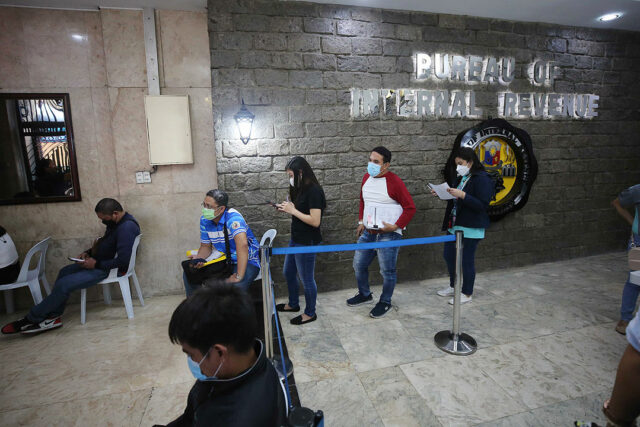
People line up to file their income tax returns at the Bureau of Internal Revenue office in Intramuros, Manila, April 18, 2022. — PHILIPPINE STAR/ RUSSELL A. PALMA

THE Bureau of Internal Revenue (BIR) said it has more clearly defined which economic zone logistics service enterprises (ELSE) are entitled to the zero value-added tax (VAT) incentive.

In a memorandum circular, the BIR said it published a clarification of eligible logistics providers as those engaged in “activities in support of exporters.”

“Despite its issuance, there are still some questions that need to be addressed,” it added.

It said ELSEs must be registered business enterprises supplying production-related raw materials and equipment catering exclusively to the requirements of export manufacturing enterprises registered with the Philippine Economic Zone Authority (PEZA), Clark Development Corp., Subic Bay Metropolitan Authority, Authority of the Freeport Area of Bataan or other special economic zones and freeports outside PEZA administration.

The industry “provides critical support, particularly to export manufacturing companies with their requirements for logistics support to facilitate their import and export shipments, sourcing raw materials, inventory management, just-in-time deliveries, localization, and process customization,” it added.

It also clarified that ELSEs that render at least 70% of their output or services to another registered export enterprise are covered by the definition of “export enterprise.”

The circular also affirmed that purchases by registered ELSEs from VAT-registered suppliers are subject to VAT at a zero rate, but this only applies to goods and services directly and exclusively used in the registered project or activity of the ELSE.

The BIR also issued guidelines on the requirements for the availment of the VAT at zero rate. — Luisa Maria Jacinta C. Jocson

House approves bills barring LGU interference in Bataan economic zone 

BW FILE PHOTO

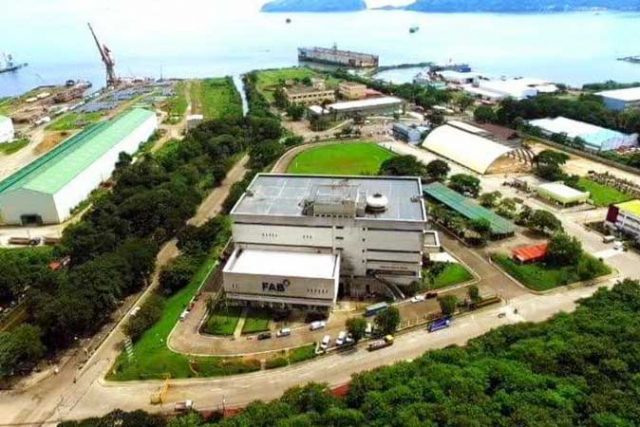
A HOUSE panel has approved bills clarifying the powers of the Authority of the Freeport Area of Bataan (AFAB) to manage the economic zone free of local government interference.

During the House joint meeting of the economic affairs and trade and industry committees, Bataan Rep. Albert S. Garcia said that while AFAB’s autonomy gives it the power to respond to its locators’ immediate needs, “the management of AFAB has noted that it still encounters certain regulatory and investment promotion challenges.”

“This bill seeks to further clarify or strengthen its regulatory jurisdiction and investment promotion function as well as introduce other amendments that can help further realize its potential as an engine of growth for Bataan and the country as a whole,” Mr. Garcia added.

House Bills No. 7058 and 7187 seek to amend the Republic Act (RA) No. 11453, known as An Act Strengthening the Powers and Functions of the AFAB, which itself amended RA No. 9728 or the Freeport Area of Bataan Act of 2009.

The bills seek to free AFAB from local government unit interference “pursuant to its autonomy and self-reliance.”

They also propose space technology as one of the industries to be managed by the AFAB.

Emmanuel D. Pineda, AFAB administrator, said the expansion of AFAB registered enterprises resulted in P7 billion in new investment in 2022.

The panel also approved bills creating special economic zones in Marinduque, Surigao City, Southern Leyte, Iligan, Camarines Sur, Occidental Mindoro, Sarangani, Maguindanao and Cotabato City, Misamis Occidental, and West Aklan. — Beatriz Marie D. Cruz

Sugar planters reject proposal for further molasses imports

PHILSTAR FILE PHOTO

SUGAR planters on Tuesday said the supply of molasses is adequate following a surge in import volumes, rejecting reported claims by the ethanol industry that more imports are needed.

“As the figures of (the Sugar Regulatory Administration) show, we have sufficient production and supply of molasses at this time,” Philippine Sugar Millers Association, Inc. (PSMA) Executive Director Jesus L. Barrera said in a Viber message.

According to Mr. Barrera, domestic production of molasses is “on upswing” while the demand has been “soft and slow.”

He noted that any additional molasses imports will further affect demand for domestic molasses, which he said was down by 17% this year.

An association of ethanol producers reportedly asked the government to allow regulated imports of molasses for use in bioethanol due to a “shortage” of the raw material.

Citing SRA data, the PSMA said domestic molasses production was 471,046.18 metric tons (MT) as of late January, up 3.38% from a year earlier.

The PSMA also said imports of molasses for potable alcohol and animal feed in 2022 was 608,310 MT, up 80%.

In January 2023, the volume of imported molasses increased 80% year on year to 88,702 MT.

“We have sufficient supply. There is no national emergency or shortage of molasses. We do not need to import more molasses specifically for bioethanol production,” the PSMA said in a statement on Monday.

Molasses is a by-product of sugarcane. — Sheldeen Joy Talavera

DBM issues warning over fund-release ‘fixers’

BW FILE PHOTO

THE Department of Budget and Management (DBM) warned against individuals or organized groups claiming to have the power to effect fund releases.

“In view of the numerous reports, all government entities are again reminded that upon submission of requests for fund releases to the DBM, the same are acted upon consistent with pertinent laws and established procedures and budgeting rules and regulations,” the department said in a Feb. 16 circular.

“It is to be emphasized that the DBM does not authorize any person or organized groups to facilitate or expedite fund releases for whatever purpose,” it added, noting that it also does not solicit requests for fund releases.

The department also called on government agencies to regularly advise their respective clients or stakeholders to rely only on official DBM channels.

“We strongly advise all National Government agencies, local government units, and all others concerned to refrain from entertaining or transacting with private individuals or organized groups of dubious character and be cautious of individuals introducing themselves as DBM employees,” it added.

The DBM added that it only deals with the agency head or local chief executive or their duly authorized representatives, who must be organic personnel of the government entity concerned. — Luisa Maria Jacinta C. Jocson

LANDBANK loans to agriculture, fisheries sectors top P261 billion in 2022

BW FILE PHOTO

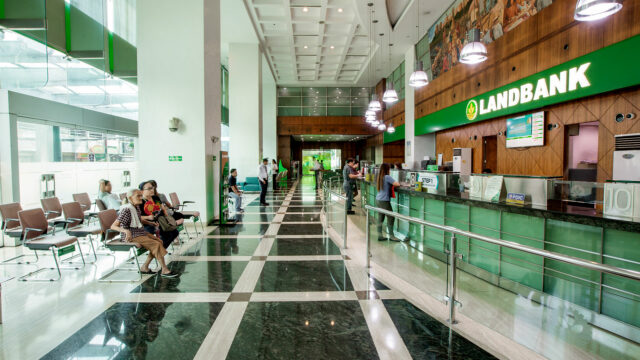
LAND BANK of the Philippines (LANDBANK) said on Tuesday that it granted loans to farmers and fisherfolk totaling P261.7 billion in 2022, supporting 3.5 million borrowers.

It added in a statement that more than 766,000 or 22% of these were in the Philippines’ 20 poorest provinces.

The bank said it hopes to lend to 3.6 million farmers and fisherfolk this year.

The bank said it will be partnering with the Department of Agriculture (DA) and the Department of Agrarian Reform (DAR) to identify potential loan clients.

“LANDBANK continues to service the growth requirements of all players in the agribusiness value chain, making it the biggest lender to the agriculture sector. We remain committed to delivering timely and accessible credit to boost economic activities in the countryside and the country’s overall food production,” LANDBANK President and Chief Executive Officer Cecilia C. Borromeo said in a statement.

The areas with the most beneficiaries were Nueva Ecija, Maguindanao, Bohol, Leyte, Pangasinan, Cotabato, Isabela, Cagayan, South Cotabato, and Ilocos Sur, the bank said.

LANDBANK said it released P15.3 billion last year under programs jointly implemented with the DA which supported over 252,000 borrowers.

It also released P751.7 million to 229 agrarian reform beneficiaries’ organizations under programs jointly implemented with the DAR.

LANDBANK said that of the P261.7 billion in outstanding loans posted in 2022, P46.6 billion directly benefited small farmers and fisherfolk. These included cooperatives, farmers’ associations, rural financial institutions, and other conduits.

Meanwhile, P87.8 million was used to finance the construction of 953.7 kilometers of farm-to-market roads, 4.5 kilometers of bridges, 50 public markets, 14 irrigation systems, and more in collaboration with local government units (LGUs), LANDBANK said. 

The bank also said that P66.5 billion of the total loans financed livestock and crop production, while P107.4 billion was deployed to agri-processing and trading projects.

It added that P166.8 billion was allocated to support small, medium, and large agribusiness enterprises, while P48.3 billion supported agri-aqua-related projects of LGUs and government-owned and -controlled corporations.

LANDBANK booked a net profit of P30.1 billion in 2022 on improved interest income, commissions, and foreign exchange gains. — Aaron Michael C. Sy

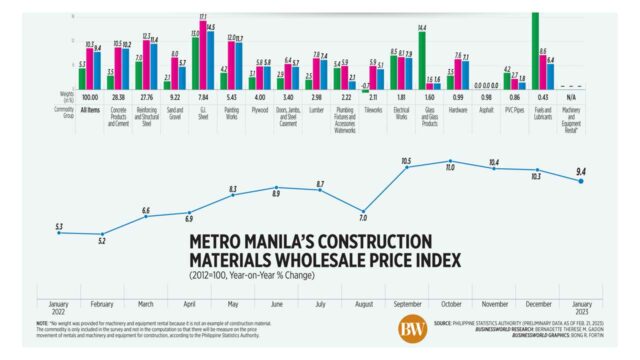
Metro Manila’s construction materials wholesale price index

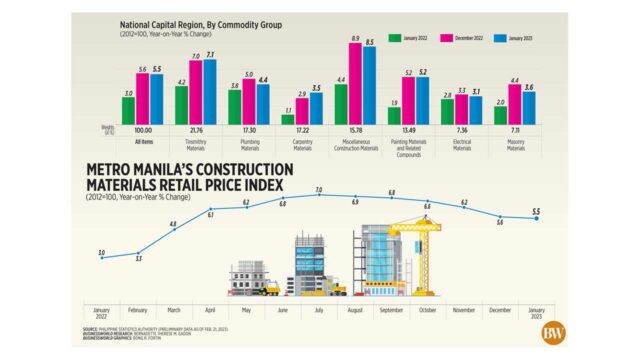
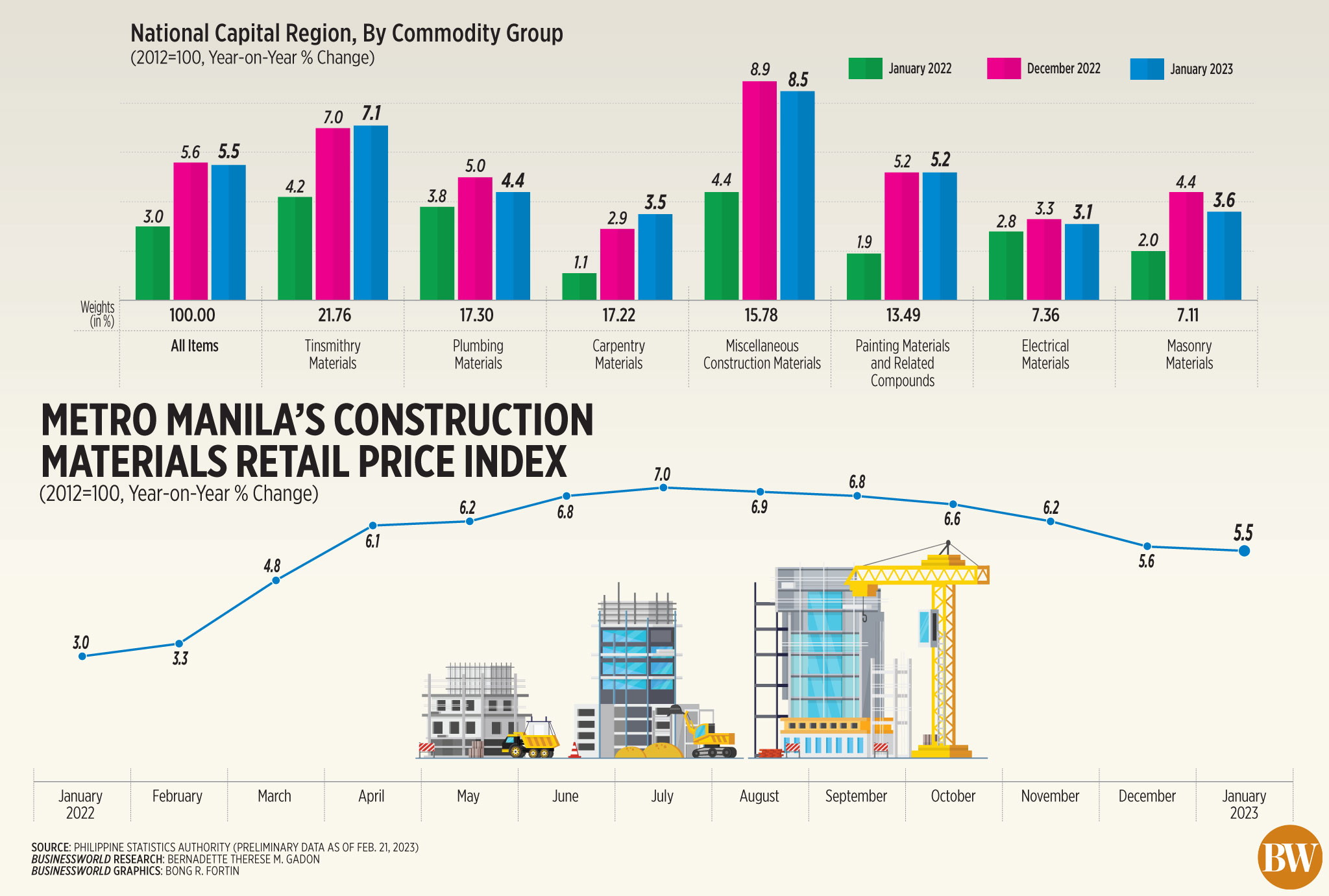
PRICE growth for construction materials in the National Capital Region slowed in January at both the retail and wholesale levels, driven by the stronger peso, the Philippine Statistics Authority (PSA) reported on Tuesday. Read the full story.

Metro Manila's construction materials wholesale price index

Metro Manila’s construction materials retail price index

PRICE growth for construction materials in the National Capital Region slowed in January at both the retail and wholesale levels, driven by the stronger peso, the Philippine Statistics Authority (PSA) reported on Tuesday. Read the full story.

Metro Manila's construction materials retail price index

Philippine Congress told not to shield Duterte from ICC probe

PHILIPPINE STAR/MIGUEL DE GUZMAN

THE BIGGEST labor coalition in the Philippines on Tuesday denounced a Senate resolution seeking to protect former President Rodrigo R. Duterte from the International Criminal Court’s (ICC) probe of his deadly drug war.

“We believe that this move is a blatant disregard of justice for the thousands of victims of extrajudicial killings in the country and an insult to the ICC’s mandate to investigate and prosecute individuals who commit crimes against humanity,” Nagkaisa said in a statement.

“Justice is not the luxury of the rich, it is the right of every Filipino.”

The labor group said working with the ICC would ensure erring state officials are held accountable for abuses during the drug war.

On Monday, Senator Robinhood Ferdinand “Robin” C. Padilla filed a resolution seeking the “unequivocal defense” of Mr. Duterte from the ICC probe.

As this developed, Senator Jose “Jinggoy” Estrada filed a similar resolution expressing the upper chamber’s “strong opposition” to the ICC investigation.

Under Senate Resolution 492 filed on Monday, the lawmaker said the pre-trial chamber’s decision to resume the probe undermines the country’s judicial system.

“The Senate of the Philippines strongly opposes the decision of the ICC to resume its investigation of the crimes committed in Philippine territory, in questioning the fully capable judicial system of the Philippines as well as disrespecting its sovereignty,” he said.

Mr. Estrada was among the 17 lawmakers who voted for the concurrence of the Senate to the Rome Statute, the treaty that created ICC, during the 15th Congress.

“I would like to make it clear that I did not change my mind insofar as casting my vote to concur with the ratification of the Rome Statute some 12 years ago,” he said in a separate statement on Tuesday.

“My stance on this issue is also based on the Rome Statute’s principle of complementarity, which recognizes a state’s right to exercise jurisdiction over most serious crimes of international concern,” he added, noting that under this principle, the ICC will only act if the state is “unable or unwilling to investigate and prosecute the crime.”

The Philippines withdrew from the ICC in March 2018 under Mr. Duterte, who said there was “a concerted effort on the part of the United Nations special rapporteurs to paint me as a ruthless and heartless violator of human rights who allegedly caused thousands of extrajudicial killings.”

‘INTERFERENCE’
“It is clear that we enforce the law and those concerned pursue individuals found guilty of violations,” Mr. Estrada said, noting that at least four criminal cases have been filed against erring cops.

“Any interference by the ICC in the jurisdiction of our government would be considered a violation of Philippine sovereignty,” he added.

Former President and Pampanga Rep. Gloria Macapagal Arroyo and more than a dozen congressmen made a similar call last week,  saying the Philippines had a functioning justice system.

President Ferdinand R. Marcos, Jr. on Saturday called the ICC’s probe a threat to the country’s sovereignty, saying the ICC did not have jurisdiction over the Philippines.

“I have stated it often, even before I took office as president, that there are many questions about their jurisdiction and what can be — what we in the Philippines regard as an intrusion into our internal matters and a threat to our sovereignty,” he told reporters.

“We call on the Senate and the House to withdraw their resolutions and to respect the ICC’s mandate to investigate and prosecute individuals who commit crimes against humanity,” Nagkaisa said.

Last month, the ICC pre-trial chamber reopened its investigation into the killings and so-called crimes against humanity under Mr. Duterte’s anti-illegal drug campaign. 

The Hague-based tribunal said it was not satisfied with Philippine efforts to probe the deaths.

In a decision on Feb. 17, the ICC appeals chamber granted the Philippine government’s request for more time to file its appeal to suspend the probe. It gave the country up to March 13.

ICC prosecutor Karim Ahmad A. Khan on Feb. 16 asked the international court to deny the Philippines’ request, saying it did not raise new arguments to justify halting the probe.

The international tribunal, which tries people charged with crimes against humanity, genocide, war crimes and aggression, suspended its probe of Mr. Duterte’s deadly war on drugs in 2021 upon the Philippine government’s request.

The Philippine government estimates that at least 6,117 suspected drug dealers had been killed in police operations. Human rights groups say as many as 30,000 suspects died.

More than 30 member-states of the United Nations Human Rights Council in November urged the Philippine government to do something about extralegal killings in connection with Mr. Duterte’s anti-illegal drug campaign. 

The Philippines has accepted 200 recommendations from the UN Human Rights Council, including investigating extralegal killings and protecting journalists and activists. — John Victor D. Ordoñez and Alyssa Nicole O. Tan


‘Government-sponsored’ sugar smuggling flagged 

PHILIPPINE STAR/MIGUEL DE GUZMAN

A PHILIPPINE senator on Tuesday flagged “government-sponsored” smuggling of 260 containers of sugar that arrived in the country before their allowed date of entry.

“On Feb. 9, a shipment of sugar in 260 20-foot containers arrived in the port of Batangas,” Senator Ana Theresia “Risa” N. Hontiveros-Baraquel told reporters, citing producer organizations whose information was corroborated by independent sources.

“If we follow Sugar Order 6, the earliest possible date for imported sugar to enter the Philippines is March 1, 2023,” she added.

Ms. Hontiveros filed a resolution asking the blue ribbon committee to investigate the shipment, noting that import orders might be prone to abuse.

The shipment appears to have been confirmed by a letter from the Department of Agriculture to the Bureau of Customs on Feb. 14, the lawmaker said.

The registered importer had used three shipping firms to transport the imported sugar, she added.

“Can a sugar order be retroactive to cover shipments that arrived before its effectivity date and before the notice of award allocation?” Ms. Hontiveros asked.

“If the answer is no, then sugar shipments that arrived must be confiscated immediately as smuggled sugar and its importers blacklisted and criminally charged with violation of the Anti-Agricultural Smuggling Act,” she added.

The Presidential Communications Office did not immediately reply to a Viber message seeking comment.

The Sugar Regulatory Administration and Customs bureau also did not immediately respond to separate text messages sent to their representatives for comments.

Ms. Hontiveros said these shipments could not have come from allocations in earlier sugar orders since the latest required that volumes arrive no later than Nov. 15.

“And since they are also not covered by Sugar Order 6, which has been awarding the allocation since Feb. 24, there is no other conclusion but to say that these sugar shipments were smuggled.”

The senator said the 260 containers of sugar were not only shipped without authority from the Sugar Regulatory Authority, but were also brought in through the Super Green Lane system of the Bureau of Customs (BoC), “where a shipment gets the VIP treatment as it goes through Customs and out of the port.” 

It also allows papers to be processed within two weeks, she said.

“Unless there was a misdeclaration by the shipper, the Bureau of Customs is supposed to have known that sugar was inside those 260 containers,” Ms. Hontiveros said. “So it is clearly contraband and the BoC should not be confused that it is indeed smuggled sugar.”

The senator also questioned the Agriculture department’s broad discretion over the sugar imports.

“The Department of Agriculture can approve seemingly any amount of allocation without any restriction,” she said. “There appears to be no criteria, no ceiling, no formula with which to determine how allocation is given to each importer.”

“It is then technically possible to just give the allocations to three favored importers,” she added. “It looks like this is what occurred in this case.” — Alyssa Nicole O. Tan

19 innovation projects worth over P115M approved

THE PHILIPPINE agency for national innovation has approved 19 projects worth P115 million, National Economic and Development Authority Secretary Arsenio S. Balisacan said on Tuesday.  

Majority of the approved projects involve the pre-commercialization and commercialization requirements of innovative products or services, the enhancement of innovation facilities and services, and the conduct of capacity-building activities,Mr. Balisacan said at a National Innovation Council meeting.  

The meeting was the councils first under the Marcos administration and the fourth since the agency’s creation in 2019.  

The innovation fund is one of the key outputs of the council, he said, noting that it aims to strengthen entrepreneurship and enterprises engaged in developing innovative solutions.”  

One of the approved projects is a creative science program by the Department of Science and Technologys (DoST) Technology Application and Promotions Institute establishment of a health research and technology innovation hubs by the DoSTs Philippine Council for Health Research and Development.  

Others include a DoST-Zamboanga Peninsula project that seeks to bring science and technology closer to the margins; an implementation of innovation, science and technology with indoor farming technology by DoST Eastern Visayas; industrial designing and finalization of production drawings for the commercialization of BUHAWI by DoSTs Metals Industry R&D Center; DoST-Davao Regions proposed enhancement of renewable and sustainable energy technologies using local innovations; and the pilot testing and commercialization of micro impeller rice mill by the Department of Agricultures Philippine Center for Postharvest Development and Mechanization.   

Projects initiated by local governments were also on the list, including the optimization of incubation centers in Nueva Vizcaya; water collection system with treatment facility in Romblon; farmersinformation and technology service center in Camiguin; and startup ecosystem development program in Naga City, among others.   

Academic institutionsproposals were also approved, including a farm machinery and seeding system by the South Cotabato State College, and the integration of localized maritime information systems by the University of the Philippines Diliman.  

In a Palace briefing after the councils meeting, Mr. Balisacan lamented that the countrys investment in research and development (R&D) remains low. 

Looking at our investment in R&D as a proportion of our gross domestic product, we are at the bottom (level)almost at the bottom when you see what our neighbors are doing,he said.

So, I think its high time, its really high time that we develop this (innovation) ecosystem.”  

During the meeting, the 25-member council approved seven executive members for 2023 to 2026 who come from the business community, academe, and science sector. Kyle Aristophere T. Atienza 

ADVERTISEMENT
ADVERTISEMENT