Home Blog Page 5215

Human capital damage from coronavirus could worsen poverty — WB

PHILSTAR

By Luisa Maria Jacinta C. Jocson, Reporter

THE CORONAVIRUS PANDEMIC is expected to cause long-term scarring of human capital development in the Philippines, which could lead to more Filipinos becoming poor, the World Bank (WB) said in a report on Wednesday.

“Over half of households estimate that their children learned from remote learning less than half what they would have learned from face-to-face schooling,” it said. “The proportion increases to 68% in poor households.”

“Extended distance learning is expected to have reduced the learning-adjusted years of schooling by over a full year,” the World Bank said. “Learning loss, combined with the deskilling associated with prolonged unemployment, could lead to sizable future earnings losses.”

The multilateral lender said the pandemic had partly reversed decades-long gains in reducing poverty and inequality.

The pandemic halted economic growth momentum in 2020 and unemployment shot up in industries that require in-person work, it said. The economy has begun to rebound, but signs are emerging that the recovery will be uneven.

The World Bank study cited a shift to less productive work in occupational categories.

From January 2020 to April 2021, employment in high- and middle-skilled routine occupations fell, while employment in middle-skilled nonroutine and in low-skilled occupations rose, with the latter rising slightly faster.

“Considering wage occupations only, employment seems to have been shifting from middle-skilled to low- and high-skilled occupations, which suggests that the polarization in wage employment that apparently started in the mid-2010s will persist during the recovery and may worsen in the next few years,” the World Bank said.

The digital economy would probably expand and job transformation would quicken during the post-coronavirus era, it said.

“These changes may further the transition of workers from middle-skilled to low- and high-skilled occupations,” according to the report. “Concerns have been raised in many countries about heightened job polarization and income inequality with the transformation of jobs post-COVID-19.”

The government can reduce inequality by creating jobs, improving education access and quality, promoting inclusive rural development and strengthening social protection.

“The Philippines can still leverage the crisis generated by the pandemic to promote necessary reforms,” the World Bank said. “The pandemic has exposed areas of high vulnerability in both advanced and developing economies, but it has also opened an opportunity to address these weaknesses through commitment to policies to build back better.”

State policies should support vulnerable population and ensure macroeconomic and fiscal sustainability, it added. The government should boost vaccination against the coronavirus, support schools in assessing student learning, provide learning recovery programs, strengthen social protection, provide well-targeted help and develop a fiscally viable unemployment insurance program.

Labor policies should support worker reskilling, redeployment and resilience especially for those most affected by disruptions.

“Use education and training to build pathways to better jobs and help the workforce to adapt to a rapidly changing labor market and make the business environment supportive of entrepreneurship,” according to the report.

It also cited the need to address gender inequality in the labor market and promote inclusive rural development. Health and education programs should also be expanded.

These include increasing access to quality and affordable healthcare in the countryside, bringing more skilled teachers to the provinces and providing incentives to poor households so they could send their kids to school, the World Bank said.

Philippine government told to cut red tape in housing development

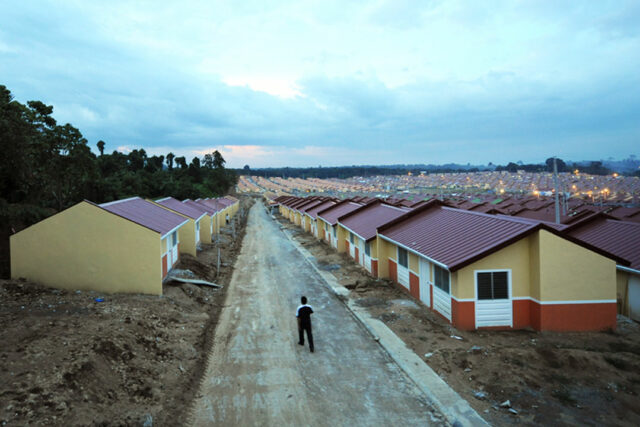
THE PHILIPPINE government should shorten the application process for housing development projects for ease of doing business, according to a stakeholder.

A home developer must go to 27 offices, get 78 permits, 146 signatures and produce 373 documents to start a subdivision housing project, Januario Jesus B. Atencio III, chairman and chief executive of Januarius Holdings, Inc., told a virtual briefing on Wednesday.

“The unintended consequence of all these housing policies is the increased bureaucracies in getting licenses and permits,” he said.

“The housing imbalance we experience is a supply-side issue,” Mr. Atencio said. “If it’s a supply-side issue, then we can go back to what we know about economics and find out whether it can help us find a way out.”

He said the state should shorten the application for licensing, reduce the required permits and cut the processing time and release of developers’ take-outs or loans. “There should be access to faster, reliable, low-interest loans and credit lines to developers.”

The property developer also cited the need for more skilled workers to stabilize labor supply. The government should likewise allow more foreign workers to offset the emigration of Filipino workers.

Mr. Atencio said that the government should also invest in innovation and technology.

“One thing we should try is to increase our level of technology in the housing industry, particularly in production,” he told the online forum. “We haven’t adopted enough technology. Assuming capital and labor are equal, all growth depends on the level of technology.”

“We can focus on the bureaucracies and shorten the licensing period, which means faster deployment of capital and therefore labor,” he added.

Meanwhile, state think tank Philippine Institute for Development Studies (PIDS) in a statement on Tuesday night said local shelter plans could help address the country’s housing backlog.

These plans could be used as a roadmap to analyze housing affordability and create shelter strategies, PIDS said, citing Rowena P. Dineros, a service director at the Department of Human Settlements and Urban Development who was a panelist at a recent PIDS webinar.

“Local government units with approved local shelter plans can provide funds, do land banking, partner with the private sector for housing projects or tap the programs of housing agencies appropriate for their constituents,” she said in the statement.

As of November, only 311 of 1,634 local government units have approved shelter plans. About 3.7 million of the 6.5 million units of housing shortage are for informal settler families, the state think tank said, citing the Human Settlements department.

University of Asia and the Pacific President Winston Conrad B. Padojinog, another panelist at the PIDS forum, cited the need for private sector investment to cut the local housing backlog.

“Local government units can provide the land, extend tax incentives, identify beneficiaries, conduct social preparation activities and collect housing rent or fees,” he said. “The private sector can undertake the development, construction and management services of the property.” — Luisa Maria Jacinta C. Jocson

US ties up with Lopez-led EDC to study geothermal potential

MINDANAO geothermal facility located in Kidapawan City — EDC

A UNITED States agency is providing Lopez-led Energy Development Corp. (EDC) a grant of $413,120 to do a feasibility study for the development of a geothermal power plant in Mindanao.

In a press release published on its website, the United States Trade and Development Agency (USTDA) said it launched along with US Vice President Kamala Harris the grant — valued at P23.56 million in the local currency — to study the geothermal potential of the southern island’s Amacan area.

It said the power plant, with a potential capacity of 50 megawatts (MW), “will support the Philippines’ clean energy transition and reduce greenhouse gas emissions.”

USTDA Director Enoh T. Ebong said in the release that the agency’s assistance “will catalyze private sector investment in geothermal technologies that US companies are well positioned to supply.”

“The Philippines is already among the world’s renewable energy leaders. Its potential capacity for geothermal, wind, solar, and hydroelectric power is significant,” Ms. Ebong said.

“By partnering with EDC, USTDA is enthusiastic about bringing additional renewable energy resources online so that people across the Philippines have a clean and reliable source of power,” she added.

The agency quoted Richard B. Tantoco, president and chief operating officer of EDC, as saying that the Philippines needs to develop more geothermal energy to ensure its energy security.

“Geothermal energy has been providing the Philippines with baseload renewable energy and helping our country avoid at least a million tons of carbon emissions each year compared to coal,” Mr. Tantoco said.

Alberto R. Dalusung III, the energy transition advisor of non-profit group Institute for Climate and Sustainable Cities, said in a Viber message to BusinessWorld that geothermal energy provides the highest capacity factor of power resources in the Philippines.

“We hope this will lead to a long-term partnership to enhance and expand existing geothermal fields, while developing new geothermal fields,” Mr. Dalusung said.

Gerry C. Arances, executive director of Center for Energy, Ecology, and Development, said in a message: “A transition to 100% renewable energy is urgently needed in our country. Even still, we remain cautious and note that not all forms of renewable energy are created equal.”

Mr. Arances said that while the group welcomes the initiative, it is highly cautious about the impact of bringing in technologies, and prefers the development of sources that are “easily deployable.”

Separately, the USTDA published on its website an invitation from EDC for the submission of proposals from interested US companies that are qualified “on the basis of experience and capability” to execute the feasibility study.

The deadline for submission is set on Dec. 9 at 5:00 p.m. The selected US company will receive the grant provided by the agency.

On its website, EDC said that it has an installed renewable energy capacity of 1,476.59 MW. It also said geothermal energy is the company’s major power source at an installed capacity of 1,181.8 MW or 61.3% of the country’s total. — Ashley Erika O. Jose

Megaworld allots P2B for 12-storey Bacolod hotel

KINGSFORD Hotel

PROPERTY developer Megaworld Corp. is investing P2 billion to build a 12-storey hotel inside the 34-hectare The Upper East township in Bacolod City that it targets to open in 2028.

In a press release on Wednesday, it said the hotel — called Kingsford Hotel Bacolod — will be located between the township’s four residential condominium towers. It will be managed and operated by Megaworld Hotels & Resorts.

“Megaworld is investing P2 billion for Kingsford Hotel Bacolod,” said Cleofe C. Albiso, managing director for Megaworld’s hotels and resorts, in an e-mail.

The hotel will offer around 300 rooms, all with an electronic key card system. Its smallest room is a twin or queen deluxe room at 25 square meters (sq.m.), while its biggest is a curated presidential suite at more than 100 sq.m.

This project is the second hotel under Megaworld’s Kingsford brand and is expected to be an iconic landmark of The Upper East. It will feature four food and beverage outlets — a specialty restaurant, an all-day dining restaurant, a Zabana Bar lounge, and a grill bar.

The hotel will have an executive lounge, which will be exclusive to VIP guests, including those who booked in the higher category rooms.

Kingsford Hotel Bacolod will house a high-ceiling, pillarless grand ballroom that can accommodate 400 people in banquet-style seating. It will also have three smaller function rooms, each with a seating capacity of 80 to 100 persons.

The hotel’s amenities will be on its third floor and will include swimming pools with a pool deck, outdoor lounge areas, a fitness and contemplation deck, a fitness center, sauna and steam rooms, and a kid’s club with activity areas.

“We are bringing the best to Bacolod because we have a very sophisticated market here. More so, we want to help boost Bacolod’s position as a very attractive MICE (meetings, incentives, conferences, and exhibitions) location,” Ms. Albiso said.

On the stock market on Wednesday, shares in Megaworld climbed by three centavos or 1.33% to P2.29 apiece. — Justine Irish D. Tabile

PLDT gives DITO more time to settle P430-million obligation

PHOTO FROM JGSUMMIT.COM.PH

THE PLDT group said it is giving DITO Telecommunity Corp. more time to settle its unpaid contractual obligation of P430 million.

“We’re being as patient as we can. We just want to make sure that it’s done properly. We’re still claiming what they owe us,” PLDT Inc. and Smart Communications, Inc. President and Chief Executive Officer Alfredo S. Panlilio told reporters on Tuesday.

“We’re giving them more time, and I think our teams continue to work with them to see what’s the best settlement,” he added.

In October, PLDT warned that “in case DITO does not remedy its material breach by Nov. 4,” it might look into “legal options, including suspension or termination of services.”

Listed DITO CME Holdings Corp. has said its telecommunications subsidiary DITO Telecommunity would “thresh out and exhaust all available remedies.”

“DITO Telecommunity believes that there is no material breach,” DITO CME said in a recent statement.

On Oct. 7, the Pangilinan-led PLDT said it had served DITO with a notice of material breach and demand for payment “as a result of its refusal to pay the amount of P429.73 million for contracted services which PLDT has fully performed and delivered, relating to the building and provisioning of transmission facilities that DITO required and is using for the delivery of telecommunication services.”

For its part, DITO said it was “compelled to enter into an agreement” with PLDT for the provisioning of the transmission facilities to allow DITO to interconnect with the subscribers of PLDT’s Smart Communications, Inc. “for the purpose of supporting the parties’ obligations under their interconnection agreement.”

The third telco player said Smart’s refusal to augment DITO’s capacity to interconnect with the latter’s subscribers “has to no small degree compromised DITO-Smart voice traffic, adding to the underutilization of the initial bandwidth capacity provided by Smart to DITO.”

“DITO, in a series of letters to PLDT and prior to the delivery of the subject transmission facilities, informed the latter that the same are no longer needed,” it added.

According to PLDT, its demand has nothing to do with the interconnection capacity issue.

“PLDT understands that [Smart Communications] is unable to give DITO any additional bandwidth until DITO agrees to compensate Smart for illegal overseas call traffic that is coming from DITO and which defrauds Smart and the government of legitimate income,” PLDT said in a separate statement.

“This has nothing to do with DITO’s refusal to pay an overdue obligation to PLDT for transmission facilities that DITO has asked PLDT to build and which DITO has leased from PLDT and which, to repeat, DITO continues to use,” it added.

Hastings Holdings, Inc., a unit of PLDT Beneficial Trust Fund subsidiary MediaQuest Holdings, Inc., has a stake in BusinessWorld through the Philippine Star Group, which it controls. — Arjay L. Balinbin

Ortigas Land plans to double property business in 5 years

ORTIGAS Land, The Galleon

ORTIGAS Land Corp. is targeting to double its property business in the next five years after returning to pre-pandemic values in the third quarter as the market’s recovery increased take-up from buyers.

“We are very encouraged with the recovery this year. Overall, we are already in the pre-pandemic levels — all of our business segments: residential, office and the mall,” said Jose Emmanuel H. Jalandoni, president and chief executive officer of Ortigas Land, in a media briefing on Wednesday.

Asked about the company’s target, he said, “We want to double our business within five years, all of our business segments.” The target includes adding two more estates to its portfolio and doubling revenues in the next five years.

According to Mr. Jalandoni, what helped the market’s recovery are the remittances from overseas Filipino workers (OFW), the contribution of the business process outsourcing (BPO) industry, and workforce demographics.

“I think the country is very resilient in terms of its economic drivers basically coming from OFW remittances. Pre-pandemic, pandemic, post-pandemic, it’s there and contributes at least around $30 billion every year in the inflows and the BPO also is at that level,” he said during the briefing.

“And we have to remember the demographics of the Philippines. I think 67% are below 30 years old, so we have the best demographics globally,” he added.

Mr. Jalandoni said he is particularly optimistic about the take-up of Ortigas Land’s latest two-tower offering, The Galleon.

The Galleon is a mixed-use development in the Ortigas central business district with various components, including residential, retail, and office spaces.

To date, Ortigas Land recorded a 70% take-up in the office segment of The Galleon and a 50% take-up in its residential segment.

For the retail segment, the company is looking for tenants that will complement the needs of the project’s residents, Mr. Jalandoni said.

“We’ll have to plan the tenanting of the retail area to complement the needs of our luxury market and the fact that there’s also an office building on the next tower, completes the whole positioning of The Galleon,” he said.

The project was launched in 2019, but its progress was hampered by the pandemic, moving completion targets to 2025 for the office and retail segments, and 2026 for the residential segment.

“We have internal [financial] targets. Overall, we are happy with our performance this year. We just came from a pandemic. The market reopened just this April, so people were not expecting that we would recover this fast,” he said.

Ortigas Land has four estates: Ortigas East, Capitol Commons, Greenhills Center, and Circulo Verde. — Justine Irish D. Tabile

Nurture vs Nature

SHORT Loin — PHOTO FROM RANGERS VALLEY

SCIENTISTS debate on whether nature or nurture (genetics versus a person’s environment) plays a more important role in developing a person. Toddlers and troubled adults aside, we got a taste of what both nature and nurture can do with a dinner with Rangers Valley, an Australian beef producer.

Rangers Valley, along with its Philippine distributor Oleo-Fats, Inc. (primarily an oil and fats manufacturer, but with interests in sauces and dairy, and now, meat), hosted a dinner on Nov. 10 at chef Josh Boutwood’s Rockwell restaurant, Test Kitchen.
Rangers Valley purchases Black Angus Steers and Japanese Wagyu crossbreeds, resulting in beef that combines the best of both East and West genetics (both breeds are particularly known for excellent marbling; that is, meat flecked with fat).

Trevor Sticklen, Business Development Manager for Rangers Valley said, “It’s everything,” referring to genetics.

“We’re looking for a lot of marbling. Marbling is flavor, juiciness, tenderness. Every time somebody eats it, the quality is the same.”

The meal started with French toast and foie gras, as well as the House Sourdough — we’d have to commend Mr. Boutwood for the bread. It tasted like bread would have tasted like in a fairy tale, and Hansel and Gretel would have eaten it as a great last meal, instead of crumbling it to find their way home.

When the beef did arrive at the tables, we sure felt its presence. There was something like Steak Tartare, with Raw Black Market Rump and boneless Black Tyde Topside 5+ and raw egg yolk. Black Market is a line by Rangers Valley, featuring 100% Purebred Angus fed on grain for 270 or more days, while Black Tyde is Pure Angus fed on grain for more than 150 days. It had a really fine texture, the power of the beef turned mild by the egg emulsion.

A striploin with Jerusalem Artichoke from the Infinite line (Purebred wagyu fed grain for 500 days) had a melt-in-the-mouth texture and a velveteen quality one expects from wagyu, and a run with a knife felt like cutting through butter.

Even the palate cleanser, a calamansi sorbet, wasn’t “safe”: it was dusted with flaked and braised Black Tyde boneless knuckle.

A Black Onyx (100% Angus fed on grain 270 days) flank steak was served with Gochujang Kimchi Jam had a full meaty flavor, and an unexpected tenderness.

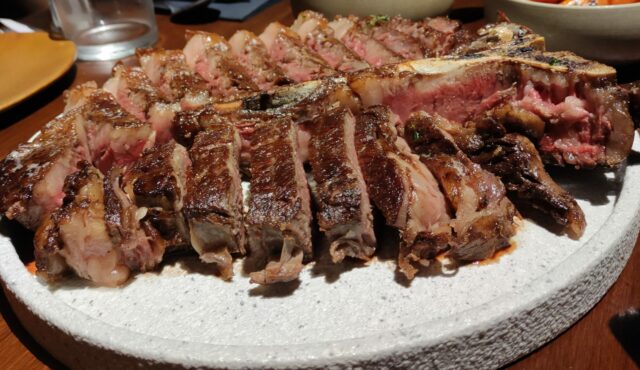
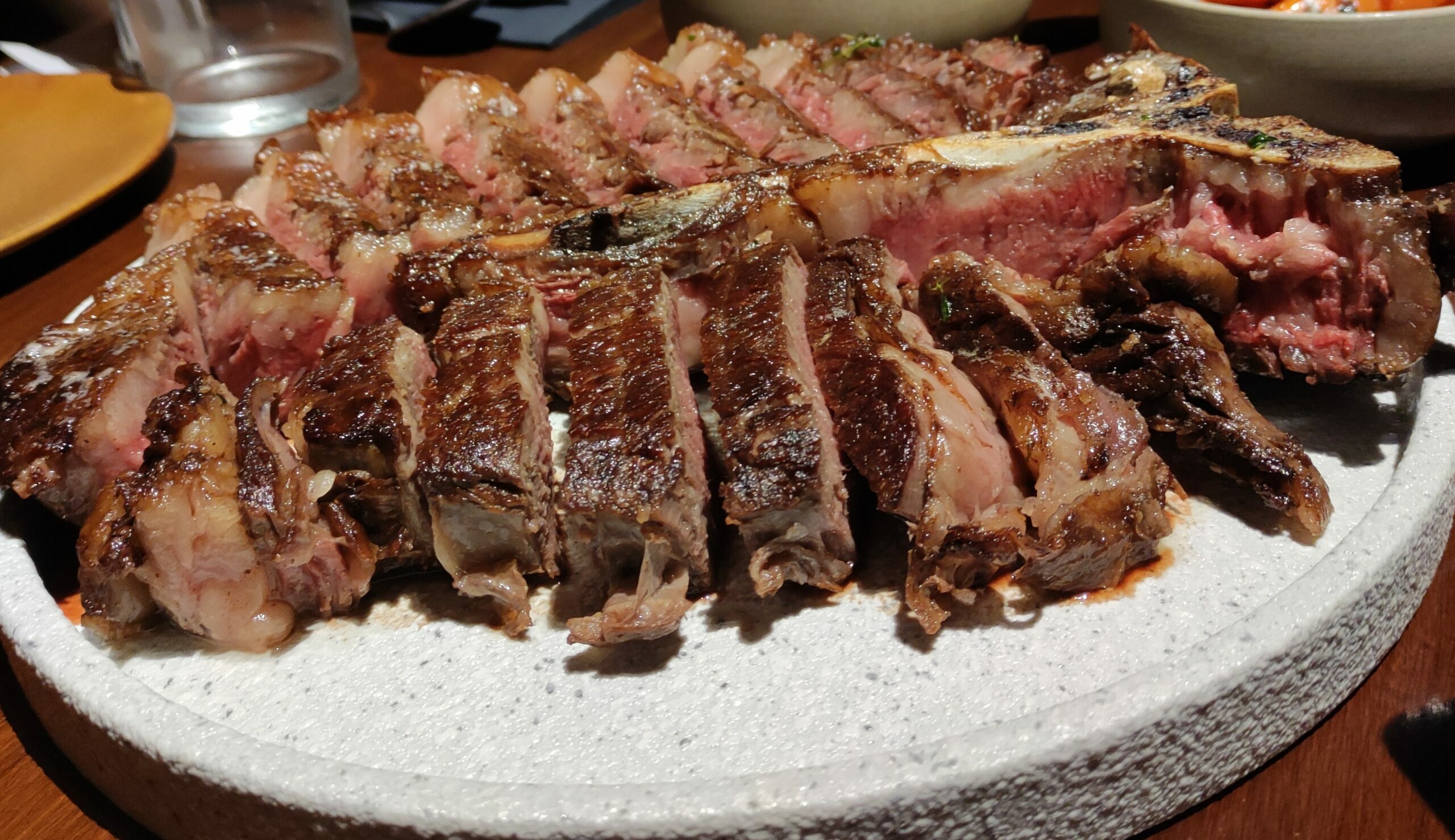
The star of the show was the WX Wagyu Cross (fed almost a whole year on grain) Short Loin with glazed carrots, perfectly and simply grilled, with an in-your-face flavor the way beef should be. Juicy, straightforward, with a chewiness (sans the toughness) that lets one savor and fully explore each bite.

As one can see, it wasn’t just the cow’s parents that made it so excellent. In making perfect cows, Mr. Sticklen said, what is important is “Where it is, the climate.” Rangers Valley is situated at the New England Tablelands at an altitude of 3,300 feet. It’s cooler than many areas of Australia, with a climate akin to wagyu’s Japanese homeland. “It’s not stressful on them,” he said. “Or it could be our feeding, as well.” While not giving out their trade secrets, he did say that the cows are fed on white grain and fermented corn silage.

“One thing we’ve always been [keen] on is a clean and green environment. Fresh air, blue skies, clean water,” he said. “The farmers are very, very conscious of that as well.” — Joseph L. Garcia

Aboitiz Equity Ventures secures permit to sell P20-B bonds

ABOITIZ Equity Ventures, Inc. (AEV) received a permit on Tuesday from the Securities and Exchange Commission (SEC) to sell fixed-rate retail bonds worth P20 billion.

The permit will allow the holding firm to issue a base offer of P7.45 billion bonds from its P30-billion shelf registration in 2019 and a base offer of P550 million bonds under its P30-billion shelf registration program in 2022.

AEV will also offer an oversubscription option of up to P12 billion, which will also come from its P30-billion shelf registration program in 2022. The base offer and the oversubscription option are set to be issued on Dec. 7 with the offer period starting on Nov. 22 until Nov. 28.

AEV tapped BDO Capital & Investment Corp., BPI Capital Corp., China Bank Capital Corp., and First Metro Investment Corp. as the offer’s joint issue managers, bookrunners and underwriters.

It also tapped BDO Unibank, Inc.-Trust and Investments Group as its trustee, while Philippine Depository & Trust Corp. was appointed as the registrar and paying agent.

AEV said it intends to list the 2022 bonds — the P550 million base offer plus the P12 billion oversubscription option — with the Philippine Dealing and Exchange Corp.

According to a press release from the SEC, proceeds from the offer are expected to amount to P19.76 billion if the oversubscription option is fully exercised.

The company intends to use the funds for the acquisition by its wholly owned subsidiary, Aboitiz InfraCapital, Inc., of GMR-Megawide Cebu Airport Corp.

A portion of the proceeds will also be used to refinance the company’s maturing debt, the company added.

Previously, the bond issuance received the highest issue credit rating of PRS Aaa with a stable outlook from the Philippine Rating Services Corp.

A rating of PRS Aaa means that the issuance is of the highest quality and has minimal credit risk. It also means that the obligor has the capacity to meet its financial commitment on the obligation.

Meanwhile, a stable outlook means that the rating is likely to be maintained in the next 12 months.

On the stock market on Wednesday, shares in AEV lost P1.45 or 2.54% to P55.55 apiece. — Justine Irish P. Tabile

Samsung, Huawei units are top 5G devices in the country — Ookla

ANH NHAT-UNSPLASH

MOBILE and broadband network intelligence company Ookla said consumers in the Philippines have a handful of top fifth-generation (5G) devices they can upgrade to, including Samsung and Huawei handsets.

Ookla, the network testing company behind Speedtest, said there is no statistical winner for the fastest 5G device in the Philippines for the third quarter, but there are many 5G devices that Filipinos can upgrade to.

“The Samsung Galaxy A53 had a median 5G download speed at 199.90 Megabits per second (Mbps), the Huawei Nova 7 5G was at 192.80 Mbps, the Huawei Nov 7 SE 5G at 188.32 Mbps, the Xiaomi Redmi Note 11 Pro 5G at 185.85 Mbps, and the Samsung Galaxy A52s 5G at 183.54 Mbps,” Ookla said in an e-mailed statement.

Ookla said it used Speedtest Intelligence to look at 5G performance data in 10 countries, including the Philippines, with the highest number of connected mobile devices.

Market intelligence firm International Data Corp. (IDC) announced recently that smartphone shipments to the Philippines significantly declined in the third quarter of the year as a result of inflation and recent typhoons.

Shipments “declined by 8% quarter on quarter and 6.8% annually, bringing in 3.9 million units in the third quarter,” IDC said in its report.

Recent typhoons and inflation hurt both consumers and vendors, according to the market intelligence firm.

The top five smartphone brands in the Philippines in terms of market share in the third quarter were realme (23.4%), Transsion (15.8%), Samsung (15.6%), OPPO (15.5%), and vivo (13.2%).

“Vendors took a more conservative approach by clearing inventories, maintaining prices of existing models, and sustaining momentum by bringing in more affordable smartphones,” IDC Philippines Market Analyst Angela Jenny V. Medez noted.

Inflation accelerated to 7.7% in October, the fastest pace in nearly 14 years, as the prices of food and utilities continue to rise. In the first 10 months, headline inflation averaged 5.4%, faster than the central bank’s 2-4% target but below its 5.8% forecast for the year.

“The last quarter of the year is the peak sales period for smartphones, buoyed by holiday buying,” Ms. Medez said.

“But as inflation is expected to linger and peak towards the end of year, we anticipate an annual shipment decline towards the end of 2022,” she added. — Arjay L. Balinbin

Yields on term deposits rise after BSP tightening

BW FILE PHOTO

YIELDS on the Bangko Sentral ng Pilipinas’ (BSP) term deposits continued to rise on Wednesday following last week’s aggressive tightening, with market players anticipating more rate hikes to temper elevated inflation.

The central bank’s term deposit facility (TDF) fetched bids amounting to P278.916 billion on Wednesday, below the P360-billion offer as well as the P336.551 billion in tenders recorded for the P350 billion on the auction block last week.

Broken down, tenders for the six-day papers reached P142.235 billion, below the P200 billion auctioned off by the central bank and failing to beat the P195.418 billion in bids for a P210-billion offering a week ago.

Banks asked for yields ranging from 5.1% to 5.825%, wider than the 5% to 5.55% band seen a week ago. This caused the average rate of the one-week deposit to rise by 21.34 basis points (bps) to 5.4921% from 5.2787% previously.

The tenor was shorter than the usual seven-day deposits offered by the BSP due to a holiday on Nov. 30 in observance of Bonifacio Day.

Meanwhile, bids for the 14-day term deposits amounted to P136.681 billion, lower than the P160 billion auctioned off by the BSP and the P141.133 billion in tenders for the P140-billion offer on Nov. 16.

Accepted rates for the tenor were from 5.15% to 6%, higher than the 4.95% to 5.625% margin seen a week ago. With this, the average rate for the two-week paper increased by 19.73 bps to 5.6635% from 5.4662% logged in the previous auction.

The central bank has not offered 28-day term deposits for more than a year to give way to its weekly offering of securities with the same tenor.

The term deposits and the 28-day bills are used by the BSP to siphon off excess liquidity in the financial system and to better guide market rates.

“The BSP increased the offer volume in the TDF auction to P360 billion from P350 billion in the previous week. The volume was allocated between the 7-day and 14-day tenors at P200 billion (from P210 billion) and P160 billion (from P140 billion), respectively,” BSP Deputy Governor Francisco G. Dakila, Jr. said, adding that both tenors were undersubscribed.

“The results of the TDF auction reflected the partial pass-through of the BSP policy rate hike last week. Going forward, the BSP’s monetary operations will remain guided by its assessment of the latest liquidity conditions and market developments,” Mr. Dakila said.

The BSP last week delivered a jumbo rate hike to rein in rising prices. The Monetary Board increased the overnight reverse repurchase or policy rate by 75 bps to 5%, the highest in nearly 14 years. The rates on the central bank’s overnight deposit and lending facilities were also increased to 4.5% and 5.5%, respectively.

The central bank has now hiked rates by 300 bps since May in its battle against elevated inflation.

Headline inflation in October accelerated to 7.7%. For the first 10 months, inflation averaged 5.4%, higher than the central bank’s 2-4% target but below its 5.8% forecast for the year.

Yields on the term deposits were also higher as the market expects the BSP to continue matching the US Federal Reserve’s policy move next month, Rizal Commercial Banking Corp. Chief Economist Michael L. Ricafort said in a Viber message.

BSP Governor Felipe M. Medalla on Tuesday ruled out further outsized or off-cycle increases, but said they will need to keep on raising borrowing costs as the Fed’s own tightening cycle continues.

The Monetary Board’s next review will be held on Dec. 15.

Meanwhile, the US central bank has hiked rates by 375 bps since March, bringing the fed funds rate at the 3.75-4% range. It is expected to begin considering smaller increases as early as its Dec. 13-14 meeting. — Keisha B. Ta-asan

How medieval Catholic traditions shaped the Pilgrims’ Thanksgiving

ARBAZ KHAN-PIXABAY

US PRESIDENT Abraham Lincoln instituted the celebration of Thanksgiving as a national holiday in 1863 after the Union victory at the battle of Gettysburg, during the American Civil War. It was not a new idea — in 1789, President George Washington had proposed a yearly presidential proclamation of each annual Thanksgiving holiday, but President Thomas Jefferson refused to issue one after he was elected, as he considered it a religious event. Later presidents followed his example, and the holiday was effectively discontinued on the national level until Lincoln’s declaration.

Today, Thanksgiving Day has come to be celebrated every year on the fourth Thursday of November. As a specialist in Catholic history and worship, I am aware that behind the history and legend of the first Thanksgiving lies a rich story that illuminates the medieval Christian roots of the holiday.

Since the beginning of Christianity, the Eucharist, also called Holy Communion or the Lord’s Supper, has been the primary worship service for Christians all over the world. The name itself comes from the ancient Greek word for thanksgiving, eucharistia, although in part of the New Testament it is also called “the breaking of bread.”

The service came to be called the Mass in Western Europe, derived from the Latin dismissal rite at the conclusion of the ceremony: Ite missa est — “Go, it is the dismissal.” The term is still used by Roman Catholics today.

One of the most important medieval Catholic rituals, the Eucharist involves a special blessing, called a consecration, of bread and wine. This consecration is rooted in what Jesus Christ did during the ritual meal he shared with his apostles before his arrest and crucifixion — the Last Supper. The ritual as a whole is a thanksgiving to God for the offer of salvation from sin in the crucifixion and resurrection of Jesus Christ. From at least the 4th century, Christians were expected to attend Mass every Sunday, with a few exceptions, and to rest from work.

But Catholics expressed thanksgiving in other ways, too. One hymn’s first line, “Te deum” — which says, “You, God, we praise” — has been used for centuries in Catholic worship, frequently on occasions calling for celebration and thanksgiving.

Legend has it that the text was composed by St. Ambrose, a famous theologian and Doctor of the Church. It is sometimes referred to as the “Ambrosian hymn” in medieval sources.

An early reference to the hymn is in a 6th-century book, The Rule of St. Benedict, a collection of regulations for monks and nuns. It is listed as one of the prayers to be recited or sung at Matins, their daily morning communal prayer service.

The Te Deum was often followed by another short hymn: “Non nobis Domine.” Taken from the first line of Psalm 115, “Not to us, Lord, not to us but to your name give glory,” it is another brief expression of thanksgiving to God for whatever event was being celebrated.

Catholics sang the Te Deum as a private or public way to offer thanks to God in a number of situations for centuries. King Philip II of Spain, a devout Catholic, ordered it sung after hearing of the victory of a Catholic fleet against the Ottoman Turks at sea off the shore of Greece. This Battle of Lepanto in 1571 stopped a Muslim advance into Catholic Europe.

Medieval England was a Catholic country, and the public religious rituals celebrated in churches were much the same as those celebrated in Rome and the rest of Catholic Europe, with some local differences. Many of these rituals involved the theme of giving thanks.

In addition, the practice of blessing people, animals, or crops was also an important part of medieval Catholic liturgy. Many of these blessing prayers included the theme of thanksgiving as well. One set of blessing prayers dealt with the blessing of ordinary bread.

Across Catholic Europe, bread might be blessed on certain feast days, but in the British Isles, a special ceremony would take place on Aug. 1, when the first of the wheat crop was harvested. This date was called Lammas Day, from the Anglo-Saxon words for “loaf” and “Mass.” From at least the 9th century on, bread from these first grains would be baked into intricate shapes and brought to church for a special blessing.

However, this blessing of the first loaves only marked the beginning of the harvest. It was also customary in England, as well as in other parts of Europe, to hold a public festival when the harvest was done, the “gathering-in” or “harvest home.” Dancing, eating, drinking, and other forms of entertainment were featured. This was originally a secular festival, although other festivals of this kind could also be held on other occasions, like weddings.

Public liturgies of thanksgiving could also be proclaimed on other occasions. For example, the English victory over the French at the battle of Agincourt in 1415 was celebrated in London by the mayor and populace with the singing of the Te Deum and the ringing of bells at the city’s churches. Later, a prayer service in Westminster Abbey was held, attended by the mayor and members of the royal family.

After King Henry VIII broke away from Rome in 1534, the English sovereign became by law the Head of the Church in England. After his death, a reformed English-language liturgy, compiled in the Anglican Book of Common Prayer, was used throughout the country.

Public worship services of thanksgiving were held annually on certain specific occasions, like the anniversary of the sovereign’s accession to the throne. As in the medieval period, the sovereign could also proclaim a day of thanksgiving, complete with the singing of the Te Deum in Latin, to celebrate other important events, like the birth of a royal heir — in this case, the birth of Prince Edward, the future King Edward VI, to King Henry VIII and his third wife, Jane Seymour, in 1537. King James I was the first King of England to be crowned in an English-language ceremony.

However, not every Christian in England was happy with the Book of Common Prayer, finding it still too influenced by Catholic practice. The Pilgrims were among the English Protestant groups who rejected the Church of England’s more moderate reforms completely and wished to separate from it to form their own church communities — separatists — as opposed to the Puritans, who desired further reforms within the Church of England to “purify” it.

Because of increasing legal persecution of “non-conformists” — those who did not attend or belong to the Church of England — in the early 17th century, they at first left England for a country where they might practice their beliefs freely. In Holland, they settled in the town of Leiden, and lived there for several years. But the Pilgrims faced other problems there — they worked at low-paying jobs and they worried that their children were becoming more Dutch than English.

Eventually, they joined a group of other travelers on a ship called the Mayflower to travel to the New World. There, in 1620, they landed a little farther north than their original destination — Virginia — settling at Plymouth on the coast of what is today Massachusetts in December 1620.

The Pilgrims faced a hard struggle to survive that first winter and many died. But after a good harvest the next year, they celebrated. They may not have sung a Catholic or Anglican Te Deum or danced in the street, but they held a Thanksgiving in their own way following the customs they had grown up with in England: with prayer and feasting. — The Conversation via Reuters Connect


Joanne M. Pierce is a Professor Emerita of Religious Studies, College of the Holy Cross

DMCI Mining posts 56% profit drop

DMCI Mining Corp. reported a 56% decline in net income for the third quarter on the back of fewer shipments.

In a stock exchange disclosure on Wednesday, DMCI Mining’s parent firm DMCI Holdings, Inc. reported that the unit’s net income reached P80 million in the third quarter, down from P181 million previously.

It cited the “combined effect” of a 50% fall in shipments, a flattish 1% decline in nickel grade sold, 31% higher selling prices, and a 10% rise in average foreign exchange rates.

For the nine months ending September, DMCI Mining’s net income dropped 17% to P1.17 billion from P1.41 billion due to lower nickel ore shipments and nickel grade sold.

“We expected a severe profit decline because of the depletion of our Berong mine late last year. Fortunately, the bullish nickel market allowed us to ship even the low-grade inventory of Berong,” DMCI Mining President Tulsi Das C. Reyes said.

“Strong nickel prices and local currency weakness also moderated the impact of lower shipments on our bottom line,” he added.

Overall shipments dropped during the January-to-September period as its Berong mine “did better than expected in the first half.”

The company said consequently, nickel ore shipments fell by only 25% to 1.09 million wet metric tons (WMT) from 1.45 million WMT. It added that in end-September, total inventory plunged by 76% to 109,000 WMT from 450,000 WMT, of which 81% came from Zambales.

DMCI Mining said that despite a 4% drop in the average nickel grade sold to 1.33% from 1.38%, it posted a 16% improvement in the nine-month average selling price to $50 from $43.

It said the impact of higher selling prices was magnified by a 10% increase in foreign exchange rates to P53 from P49 per US dollar. — Revin Mikhael D. Ochave