Home Blog Page 5209

Deepening the strategic value of the CHRO

(Second of two parts)

Chief Human Resources Officers (CHROs) have always been crucial to the success of an organization. However, as a result of current events, they may now be just as valuable to CEOs as the Chief Financial Officer (CFO). As such, it is imperative to deepen their strategic value.

In order to better understand why the connection between the board and the CHRO is becoming more crucial, insights from EY thought leaders and clients were gathered to fuel strategies to improve the board and CHRO dynamic along with the ways of working. Instead of merely reducing potential risks, organizations can find opportunities in current, unheard-of labor trends to gain a competitive advantage.

The first part of this article discussed challenges in talent, perception gaps identified with employees, and considerations for boards to make. This second part will discuss three strategies that boards and CHROs can implement to help each other succeed: strengthening and enabling the CHRO role, re-examining the risk framework to support the talent agenda, and supporting CHROs in developing a human-centric strategy and employee value proposition.

STRENGTHEN, SUPPORT, AND ENABLE THE CHRO ROLE
Organizational culture, which includes purpose, well-being, and social inclusion, has emerged as a critical factor in motivating present employees and attracting potential hires. Therefore, choosing who oversees this crucial sector is the first step for the board and the executive team.

Once roles are defined, the board should challenge the CHRO (or an equivalent role) on matters that are now within their purview. These include corporate activism and reputational talent risks. Boards must also communicate the significant financial value of having a strong employer brand to investors and other external stakeholders to support the CHRO role.

In addition, boards should inquire about whether the HR team has the right qualifications, experience, and support of top management. The CHRO should be subject to the same accountability standards as the other C-Suite members. The CHRO is responsible for engaging the board in important discussions about important issues that include the external market environment and an internal perspective that covers determining what talent the organization has, how to retain key personnel, understanding critical current and future skills, and how to address gaps in talent.

They should also draw attention to and thoroughly evaluate the significant developments that have an impact on the firm, and they should exhort the board to adopt fresh and unusual perspectives. In order to accomplish this, the CHRO needs early access to the board so they can establish and show their credibility, trust, and transparency. They will then be able to present innovative, game-changing ideas with assurance when the time is right.

And last, the board and the CHRO should keep putting first-class oversight of executive remuneration and C-suite succession planning at the top of their list of priorities. When properly implemented, the former ensures that rewards correspond to the cultural practices the organization wants to promote. Additionally, debates in boardrooms are showcasing the latter more prominently than ever due to evolving talent dynamics.

RE-EXAMINE THE RISK FRAMEWORK TO SUPPORT THE TALENT AGENDA
Talent is frequently at the top of risk agendas for organizations worldwide. However, because risk profiles vary by industry, organization size, and various other criteria, each organization handles its talent differently. In order to determine what is best for them, boards should consult with their respective CEOs and CHROs. These conversations do not have to wait until board meetings; they can take place during routine check-ins with other board members.

To avoid the temptation to micromanage, the board should discuss and decide what role it should play in supervising talent concerns as well as determine the best governance structure to support the CHRO. The board will also have to think about how to include the voice of the employees in the governance structure. They must pay attention to what employees want, even if not all requests can be granted.

Executive learning is also a key area. Historically, board members tended to have extensive backgrounds in more traditional fields such as law and finance. However, the board will need to supplement these skills with new perspectives in light of new risks and difficulties. By ensuring that the board has access to and is learning from industry best practices, the CHRO can support these initiatives, helping the organization become more performance-driven and purpose-led as a result.

SUPPORT CHROS IN DEVELOPING A HUMAN-CENTRIC STRATEGY AND EMPLOYEE VALUE PROPOSITION
In order to balance the demands of the people strategy and the business strategy, as well as to create and sustain the culture of the organization, boards must narrow their focus on their people, and look more closely into what the employees need from their organization as well as what the organization needs from them.

These discussions must be incorporated into the broader strategic talent plan to attract, nurture, and retain the talent required to carry out the organization strategy. The board can help the CHRO carry out this strategy by ensuring that each individual feels heard, appreciated, and supported.

Board members do not need to know the specifics of employee insights, but they should be made aware of any potential risks, opportunities, and impact. They can then ensure that the organizational employee value proposition, culture, and overarching strategy all take into account the needs of various employee groups while allowing for customization where appropriate. Culture is a particularly significant factor as well; research shares that businesses which thoroughly understand and reflect their cultures outperform their competitors by a factor of three, while those with serious cultural problems falter or even fail.

Boards should ensure that the cultures of their particular organization are in sync with their talent and retention strategies as they assume increased responsibility in managing this vital area. In exchange, the CHRO must thoroughly assess the organization’s employee value proposition with the board and assist in filling in any knowledge gaps.

All of these discussions should be supplemented by an effective use of data. It will be easier to engage the board and win their support if they are presented with clear, succinct, and well-researched recommendations.

COLLABORATING TO NAVIGATE THE TALENT LANDSCAPE
The constant disruption in recent years has only exacerbated the war for talent, requiring the CHRO role to be even more strategic as people-related risks rise to the top board agendas across the globe. In order to overcome challenges in talent, CHROs and boards must collaborate to enhance the CHRO role, supporting as well as challenging each other to navigate the talent landscape and remain competitive.

This article is for general information only and is not a substitute for professional advice where the facts and circumstances warrant. The views and opinions expressed above are those of the author and do not necessarily represent the views of SGV & Co.


Lisa Marie T. Escaler is the People Advisory Services Workforce Advisory (PAS WFA) leader of SGV & Co.


Gilas Pilipinas braces for Jordan to end the qualifier with a bang

PHILIPPINE STAR/JUN MENDOZA

Game Monday
(Philippine Arena, Bocaue)
6 p.m. — Philippines vs Jordan

THERE’S something visiting Jordan is carrying into today’s FIFA World Cup Asian Qualifiers’ sixth window windup match that Gilas Pilipinas finds all too familiar and to an extent, worrisome.

It’s that burning desire to exact revenge on an old tormentor.

Having used this very motivation to get back at fourth-window conqueror Lebanon, 107-96, last Friday, the Filipinos (15 points on a 6-3 record) know perfectly well how driven the Falcons (14 points on 5-4) will be to make this a “payback game” for themselves.

Gilas beat Jordan in Amman in their Window 5 faceoff back in November, 74-66.

“Obviously Jordan’s going to come in with a lot of energy and motivation to bounce back, because we beat them in their home court,” Gilas guard Kiefer Ravena said.

Then there’s the importance of ending the Qualifiers with a bang for the two World Cup-bound sides and building momentum for the actual campaign in August.

Against Lebanon, Gilas was at its finest in terms of offense. Not only have coach Chot Reyes’ undersized troops scored their highest output of the Qualifiers, they also matched the single-game high of 17 three-pointers.

For the 6 p.m. home duel with Jordan at the Philippine Arena, the Pinoy dribblers want to crank it up in defense, too.

“Very good performance on the offensive end (versus Lebanon). However, there’s still a lot of things left to be desired on our defense,” noted Mr. Reyes.

“We gave up almost 100 points to a team without (Wael) Arakji, (Ali) Haidar, and even their naturalized player (Jonathan Alredge)…It’s a learning experience for us, We need to be able to play better defense to come out and have a better performance against Jordan,” he added.

On the heels of his rousing debut, Justin Brownlee is expected to lead the veteran-youth combo of June Mar Fajardo, Scottie Thompson, Jamie Malonzo and Mason Amos, among others.

“Offensively, everyone is clicking and the chemistry seems really well. But defensively, we got to get better. I think we could come out and defend better next game after we see things to adjust and do better,” said the newly-minted Pinoy Mr. Brownlee. — Olmin Leyba

Lady Pirates down Lady Bombers to share NCAA lead with 2 others

NCAA/SYNERGY-GMA

Games Tuesday
(San Andres Complex)
9 a.m. — EAC vs Letran (M/W)
2 p.m. — CSB vs UPHSD (W/M)

Lyceum of the Philippines University (LPU) continued its fairy tale run as it downed Jose Rizal University (JRU), 22-25, 25-17, 25-22, 17-25, yesterday to snare a share of the lead with two others in NCAA Season 98 women’s volleyball at the San Andres Complex.

It took the Lady Pirates though an opening-set defeat to wake up from their deep slumber as they pillaged the Lady Bombers with their relentless attacking game to nail the former’s third win in row.

It also catapulted LPU back on top alongside reigning champion College of St. Benilde (CSB) and University of Perpetual Help (UPHSD).

The merry Cromwell Garcia-mentored women from Muralla, Intramuros have been playing the game of their lives as they have now slaughtered two teams that made the Final Four a season ago including the San Sebastian Stags, 25-14, 25-16, 25-21, Friday.

And three games into the season, LPU is fast becoming a team of destiny as it has closed in a spot at a place where it has never gone before since joining the league 12 years ago — the Final Four.

Joan Daguna paced LPU with 19 points including 16 on spikes while Janeth Tulang’s blocking wax poetic as she swatted away six and finished 17 hits.

Johna Denise Dolorito joined the barrage and scattered 14 points herself for the Lady Pirates, whose best finish here was fifth twice.

JRU dropped to 0-3. — Joey Villar

GM-candidate Quizon rules Kamatyas FIDE-rated event

NATIONAL CHESS FEDERATION OF THE PHILIPPINES

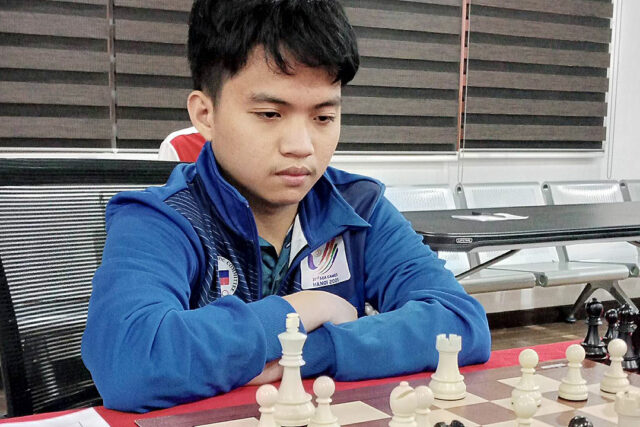
GRANDMASTER (GM)-candidate Daniel Quizon is on a roll.

Fresh from his magnificent AQ Prime ASEAN Chess Championships conquest a week ago, the 19-year-old International Master (IM) added another jewel to his growing list of triumphs after he topped the 7th Kamatyas FIDE-rated event at the SM Sucat in Parañaque over the weekend.

It was another spectacular show of force for the World Cup veteran from Dasmariñas, Cavite as he scored 25 points out of a possible 27 on eight wins and a draw in a tournament that gave three points for a win and a point for a draw.

It was the fourth title by Mr. Quizon in Kamatyas and second of the year following his feat at AQ Prime where he earned the second of the three required norms to become a grandmaster.

Mr. Quizon capped his amazing performance with a masterful win over Alfred Rapanot in the ninth and final round of this event bankrolled by David Almirol and organized by Kamatyas Chess Club President IM Roderick Nava.

His other wins came at the expense of Allan Gabriel Hilario, Francis Talaboc, Richard Villaseran, Kevin Mirano, Grandmaster Darwin Laylo, Mark Jay Bacojo and IM Michael Concio, Jr. while his lone draw was with IM Jan Emmanuel Garcia.

For his feat, Mr. Quizon pocketed P30,000, a trophy and 40.5 FIDE rapid rating points.

IM Ronald Dableo wound up second with 24 points while Mr. Concio was third with 22 points.

Rounding out the top 10 were FIDE Master Randy Segarra, Christian Mark Daluz, Christian Gian Karlo Arca, Bob Jones Liwagon, Alfredo Rapanot, and Mark Gerald Reyes. — Joey Villar

Team Cebu CC just misses putting ‘icing on the cake’

CEBU CC receives the Founders division trophy and vows to bounce back next year. — ALAN TANGCAWAN

CEBU — Carl Almario and the rest of the Cebu Country Club squad won’t be going home empty-handed after falling short in the overall race of the Philippine Airlines Senior Interclub “Back to Ignite” tournament on Saturday.

“We’re happy winning the Founders (division),” Almario who tallied 95 of Cebu CC’s 564 points for the week, said during the awarding ceremony. “But of course, it (overall title) would have been the icing on the cake. But you know, in golf, you cannot win them all.”

The Cebuanos were in control of the overall race for two days starting the second round, only to falter on the final day at Alta Vista by tallying just 141 points as Luisita completed a rally by pooling 151 that easily erased a two-point Cebu CC lead at the start of the day.

Cebu CC was just eight points shy of Luisita’s Championship division-winning total of 572 points.

It would have been the second time in recent history that the club would have pulled off the feat, doing it, also on home soil, in the Regular Men’s division which Mr. Almario was also a member of.

“I just wished we could have played better,” Mr. Almario said. “That’s how the cookie crumbles, I guess. Luisita played well. They shot decent scores and they deserved to win.”

Cebu CC won the Founders by 34 points over Orchard, their division decided as early as the third round after a 133 at Club Filipino in Danao.

Eric Deen shot a five-over-par 77 worth 49 points to lead Cebu CC in the final day, even as Kenneth Kim fired 55 to lead Orchard’s closing 140 for second place, four points better than Riviera Golf, which fired 137.

Mimosa, meanwhile, hung on to rule the Aviators class after firing a final round 97 led by the 36 of Dominico Hermoso over at Club Filipino. Mimosa finished with a 471 total, nipping SF Maharlika by three points even after shooting a 132 on the final day.

Zamboanga was another six points behind in finishing third after a 120.

Club Filipino (CF) was victorious in the Sportswriters bracket, winning it by 43 points over MSU Marawi Golf and Country Club with a 457 total. CF totaled a final round 114 at Alta Vista after getting 48 points from Nilo Seno, 36 from Leonard Arevalo and 30 from Elias Espinosa.

San Juanico Golf and Country Club was third another 13 points adrift, even as Malaysian Eagle Hunters ruled the Friendship division by 27 points over Canphil Golf Association with a 408 tally. The annual event, considered the country’s unofficial national team championship, was shelved for two years due to the coronavirus pandemic.

Ten-man Atletico hold defending champs Real Madrid to a 1-1 draw

MADRID — Ten-man Atletico Madrid dealt a blow to Real Madrid’s LaLiga title hopes when they held the defending champions to a 1-1 draw at their Santiago Bernabeu stadium on Saturday.

Real are second in the league standings on 52 points, seven behind leaders Barcelona who face lowly Almeria on Sunday and could extend their lead to 10 points with a win. Atletico are fourth on 42 points.

“I see (winning) the league as a very difficult task. It was before today’s game and now it’s got even tougher,” Real manager Carlo Ancelotti told DAZN.

“Today we lacked a bit of mental freshness, more than physical. Especially when they were down to 10 men, we allowed them to score and struggled to reposition ourselves.

The match started slowly on a freezing afternoon, with light snow falling on the Spanish capital and Real Madrid dominating play but unable to turn their superiority into scoring opportunities.

Diego Simeone, who equaled Luis Aragones as the manager with the most games in the history of Atletico in all competitions (612), had to make an early substitution when left fullback Reinildo Mandava was carried off on a stretcher with a left knee injury.

The club later said in a statement that the Mozambique defender had torn a ligament while Mr. Simeone said he would miss the rest of the season.

Karim Benzema, Vinicius, Jr. and Marco Asensio were erratic up front and could not find a way to break the deadlock as Atletico held fast with a five-man defense, with substitute Jose Maria Gimenez coming on as third centre-back.

After substitute Angel Correa got a straight red card in the 64th minute for an elbow to the chest of defender Antonio Ruediger, Real still struggled to create chances.

Atletico ended up taking the lead when Mr. Gimenez scored with a header from an Antoine Griezmann free kick in the 78th minute.

The last time Atletico Madrid scored in a LaLiga match at Santiago Bernabeu was in April 2018, when Griezmann scored in a 1-1 draw.

The goal woke up Real and their 18-year-old forward Alvaro Rodriguez leveled the match seven minutes later with a clever header in traffic from a Luka Modric corner. — Reuters

Snakebitten Nets

Are the Nets snakebitten? The question has been posited time and again, and more frequently of later in light of the 44-point shellacking they received at the hands of the supposedly dysfunctional Bulls the other day. Significantly, the final score deficit wasn’t even their worst this season, or this month. Not that they had anything to be proud of relative to their setback against the Celtics to start February; they were down by a whopping 50 at one point in the final period, and only an easing on the gas pedal by the hosts did they escape setting an embarrassingly new low.

For those who refuse to see any silver linings to the Nets’ plight, recent developments reflect their struggle for respect and respectability since they moved to Brooklyn in 2012. A year into their tenure at the Barclays Center, they swung for the fences to claim marquee names Kevin Garnett and Paul Pierce; they cast moist eyes on the hardware with the trade, which, on paper, bolstered a roster that already had Joe Johnson and Deron Williams. Instead, the gamble had them peaking with a semifinal round appearance alongside frequent bouts with mediocrity. If there was anything the experience should have proven, it’s that fit and future are just as important as premise and promise.

To be sure, the Nets absolutely had to spread the welcome mat for Kevin Durant and Kyrie Irving in 2019, and then James Harden a year later. They had a bone fide Big Three with a solid supporting cast. Unfortunately, staying on the court was a problem; between injuries and self-inflicted wounds, they struggled to have their All-Stars burn rubber together. The result was theory not meeting reality, and three-plus tumultuous seasons later, all they have to show for their efforts is a shaky prognosis with Ben Simmons.

Not everything is clouded in black, though. The Nets are currently fifth in the Eastern Conference, and may yet have enough of a reserve to claim a playoff berth. The so-called Love Month hasn’t been kind to them; three victories in nine set-tos don’t lend well to optimism. That said, they’re determined to show that, with nothing to lose, they’re capable of exceeding themselves. Not all successes have to end with a title. Even if they won’t have the privilege of wrapping their arms around the Larry O’ Brien Trophy when their 2022-23 campaign is done, they can at least be able to hold their head high in the knowledge that they tried their best against the odds.


Anthony L. Cuaycong has been writing Courtside since BusinessWorld introduced a Sports section in 1994. He is a consultant on strategic planning, operations and human resources management, corporate communications, and business development.

Friend to all, enemy to none

(I am pleased to share with readers a post that Christine Tang and I wrote for Globalsource Partners subscribers [globalsourcepartners.com], released Jan. 11. Globalsource Partners is a New York based network of independent analysts providing macro and political risk analysis to subscribers, mostly international banks and fund managers.)

Ever since Ferdinand Marcos, Jr. came into office in July last year, his foreign affairs team has been busily working at re-centering Philippine foreign policy after the extreme pro-US then pro-China stances of the previous two administrations. In his words, President Marcos defined his foreign policy as one where the Philippines is “a friend to all and an enemy to none.”

To recall, the Aquino administration (2010-16) brought China to international arbitral court in 2014 over disputed waters in the West Philippine Sea/South China Sea (WPS/SCS). Although the Philippines won the case, the Duterte administration (2016-2022) opted to set the issue aside in its desire to encourage more Chinese investments in the country, especially in infrastructure. Nonetheless, this has not stopped government from issuing hundreds of diplomatic protests against Chinese activities in the WPS/SCS.

So far, the Marcos administration is managing well the difficult balancing act of reestablishing close ties with the US, including strengthening the two countries’ military alliance, while reassuring China that it continues to value its relationship which, both countries have emphasized, goes beyond maritime issues.

At the topmost level, President Marcos has met with US President Joe Biden at the sidelines of the UN General Assembly in New York in September last year and with Chinese President Xi Jinping at the sidelines of the Asia-Pacific Economic Cooperation (APEC) Summit in Thailand in November. Last week, he embarked on a state visit to China, his first outside ASEAN, describing the trip as a “good start” and the discussions “fruitful.” The President brought back with him 14 signed “cooperation documents” covering a broad range of sectors from agriculture, education, energy, environment, infrastructure, science and technology, trade, to people-to-people exchanges. He reported securing $22.8 billion worth of investment pledges and $2.1 billion worth of trade purchase intentions.

Will the Marcos administration, caught between two powers suspicious of each other, be able to get what it wants, i.e., on one hand, US protection against Chinese aggression in the WPS/SCS, and, on the other hand, expanding trade and investment flows with China? For now, the hope is that heightened US-China tensions do not escalate to the point that they compel small countries in the region to a “somos o no somos” (as the Trump Administration was starting to do with its 5G telco/security strategy) which would be most costly especially for the Philippines in many ways.

In the meantime, playing the “friend to all” card could bring not only direct economic gains in the short-term but, through higher level communication lines, avoid more untoward incidents in the disputed waters and in time, bring discussions on joint oil and gas development projects in the WPS/SCS beyond the drawing board. Too, following China’s reopening and exit from zero COVID policy, the Philippines stands to benefit from (1.) an expected resurgence in Chinese tourists, (2.) improved supply chains, and, (3.) a likely revival/continuation of projects, both public and private, that were interrupted by the pandemic.

Unclear yet are prospects for the online gaming industry (POGO) which China frowns on. Locally, the sector has come under heightened scrutiny recently due to related kidnap-for-ransom and human trafficking crimes as well as suspicions of money laundering activities and associated risk of blacklisting by the Financial Action Task Force’s (FATF), with calls for government to ban the activity coming from some senators, finance officials, civil society, and the business sector.

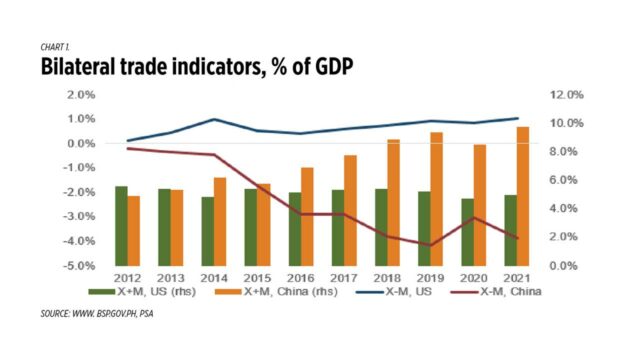
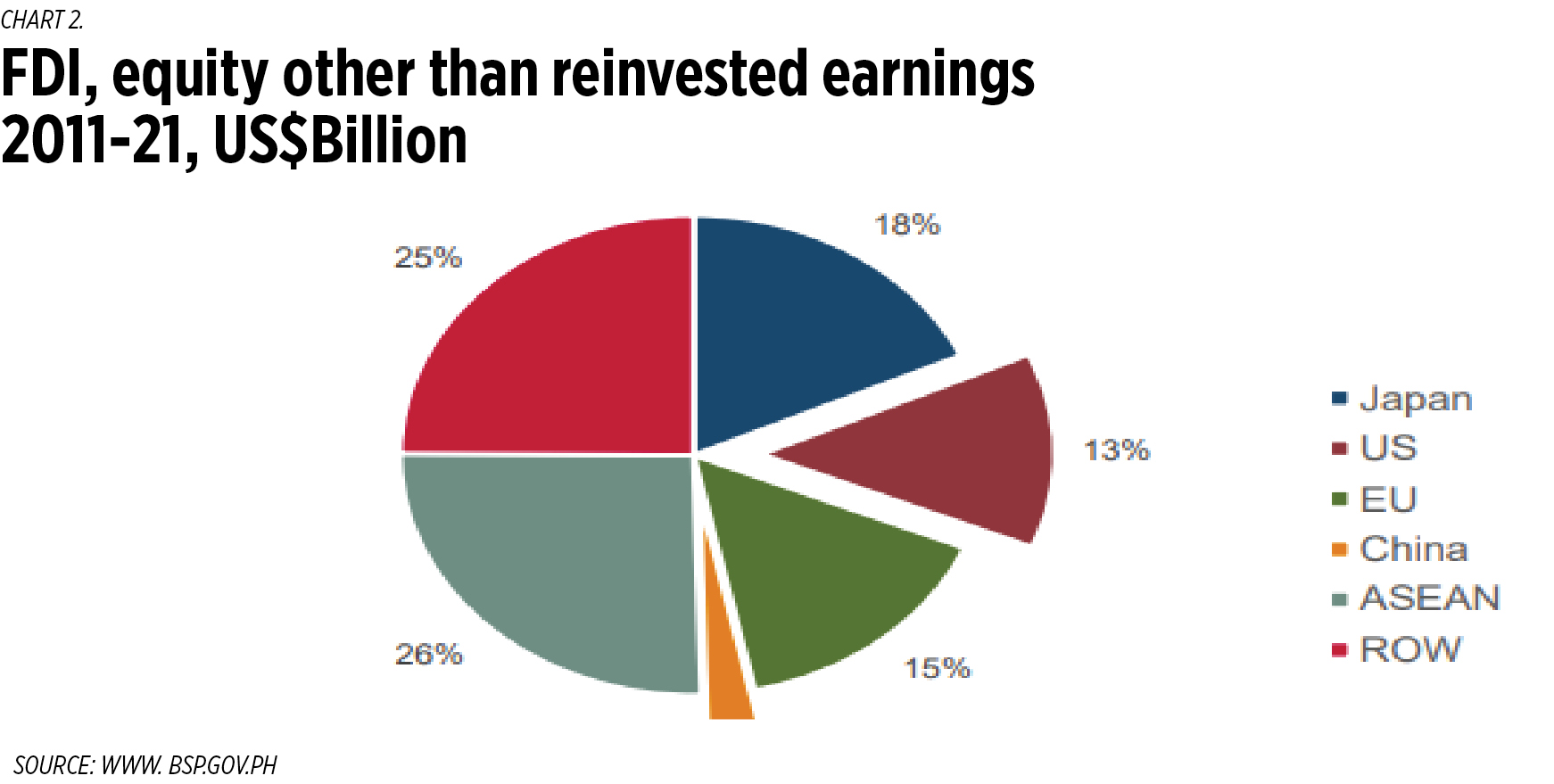
Below we see in charts the economic relations between the Philippines and the US and China.

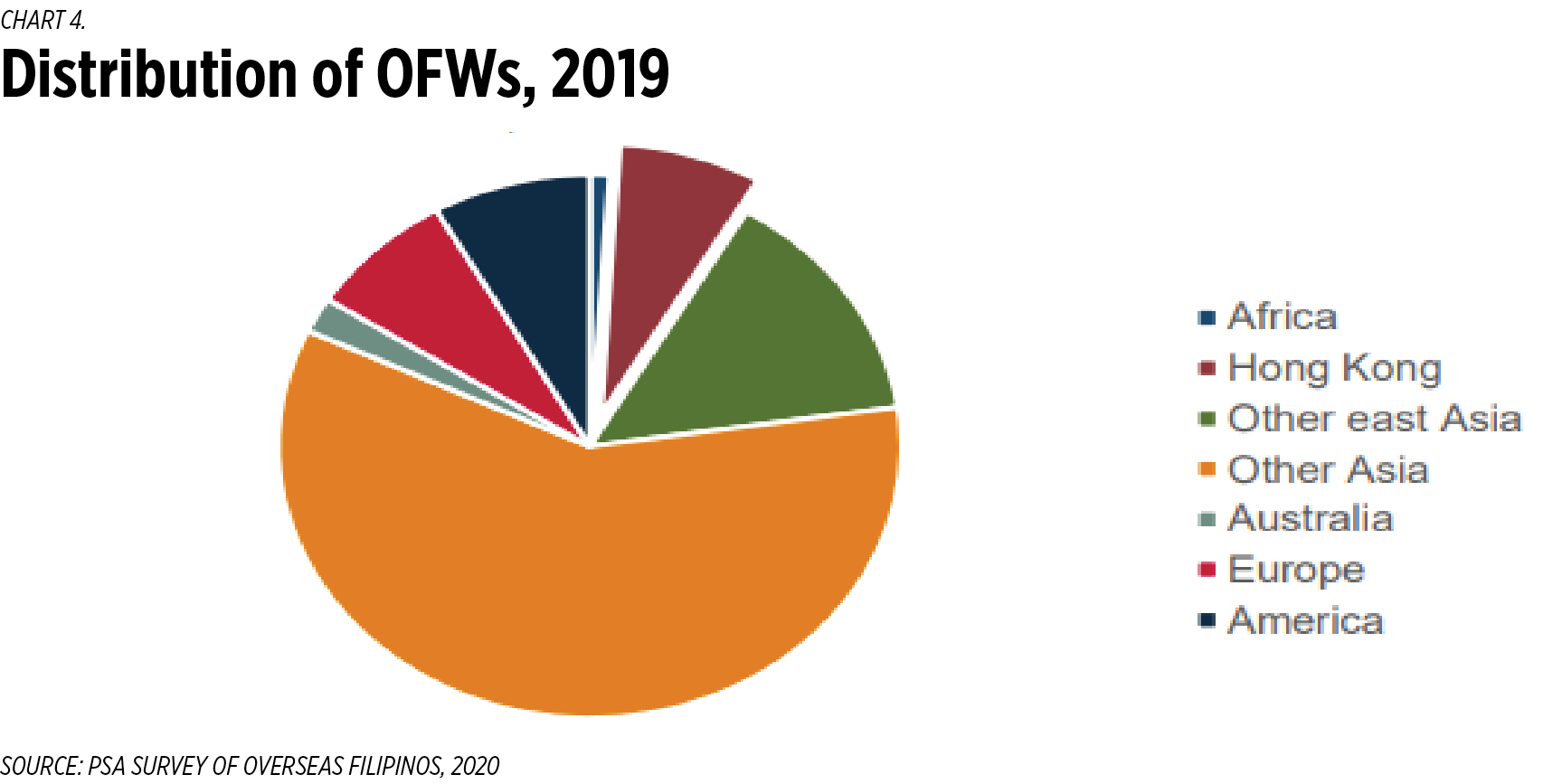
Because of limitations in recording sources of remittances, BSP (Bangko Sentral ng Pilipinas) data show the US accounting for around 40% of the annual inflows. Survey data nevertheless show the importance of Asian countries as destinations for overseas workers, accounting for over 70% of cash remittances in the 2019 survey. Hong Kong is the third largest employer in the region, accounting for 7.4% of the 2.2 million workers surveyed in 2019.


Romeo L. Bernardo was finance undersecretary from 1990-96. He is co-founder, trustee/director of the Foundation for Economic Freedom. He also serves as a board director in leading companies in banking and financial services, telecommunication, energy, food and beverage, education, real estate, and others.

globalsourcepartners.com

romeo.lopez.bernardo@gmail.com

Being praiseworthy

TINGEY INJURY LAW FIRM-UNSPLASH

Rare is the policymaker, much less a politician, who would defy popular prejudice and resist powerful vested interests. The very nature of politics compels the typical Filipino politician and policymaker to court the support of voters and, at the same time, be in the good graces of the elite for election financing.

Long ago, we had statesmen-politicians whose primary concern was the public good or national interest even if their actions could be politically costly to their being elected. Think of the late Senators Claro M. Recto, Jose W. Diokno, Jovito Salonga, and Aquilino Pimentel, Jr.

Some got entangled with traditional politics, but this did not diminish their stature as champions of worthy but difficult causes (like the termination of the US military bases agreement).

In recent years, we saw the emergence of cabinet secretaries who adopted broad, expansive development agenda, and boldly asserted the reforms despite the political troubles they brought. I cite Butch Abad, the Budget Secretary during the administration of Benigno Aquino III, and Sonny Dominguez, the Finance Secretary during the Rodrigo Duterte administration.

Mr. Abad, who was also a former congressman, did not limit himself to doing reforms related to government expenditures and budget management. He was instrumental in other substantial reforms including the historic Sin Tax Reform Law and the Reproductive Health Law. He tried to reform the pork barrel. But the public, the media, and the Supreme Court did not grasp the complexity and nuances of the issue, and severely but wrongly criticized Abad.

Mr. Dominguez, with able support from Undersecretary Karl Chua and his team, was successful in passing of a series of hard tax reforms. These included the unpopular fuel tax (actually, a good progressive tax based on the over-all design), the further increase in sin taxes, the removal of unnecessary value-added tax exemptions, and the rationalization of fiscal incentives, which some powerful business interests resisted. Further, he did not limit his pursuit of reforms within the strict confines of the Department of Finance. He was decisive in the passage of the Rice Tariffication Act and laws that have eased the entry of foreign direct investments in critical sectors.

In a word, the economic reforms that Messrs. Abad and Dominguez, with the backing of their respective principals, shepherded have been transformative. Philippine economic history will affirm these reforms of signal importance.

Legislators are a different breed. The motivation to get re-elected makes politicians in Congress vulnerable to both populist pressure and private lobby pressure. Thus, the main tendency of most politicians is to avoid sponsoring the hard reforms. Yet, we can name a few brave souls.

Representative Isidro Ungab (current Deputy Speaker) should be cited for his gallantry and strategic acumen in securing the passage of Aquino’s sin tax reform in Congress despite the mighty industry lobby. Another legislator who has consistently fought for health taxes and regulation of harmful products is Senator Pia Cayetano. Sometimes, she fought lonely battles and lost, but she carries on.

And there’s Representative Joey Salceda who is also credited for championing past and present economic reforms. Mr. Salceda has the unique quality of being heard by any political administration. He was a firm supporter of Leni Robredo in the 2022 election campaign. Yet the coalition of President Ferdinand Marcos, Jr. awarded him the chairmanship of the Lower House’s Ways and Means Committee.

This is an acknowledgement of his economic and technocratic expertise and his political skills. He certainly knows how to play the game of traditional politics and compromise even as he advances a reformist agenda.

We need a Joey Salceda in the current context where policy on key issues is unpredictable and wavering. The example is how the Marcos Jr. administration has handled food shortages, resulting in unacceptably high inflation.

One challenge confronting the administration is preserving, if not broadening, the fiscal space We cannot be complacent despite the gains from previous reforms. The fact is that the large deficit incurred during the height of the pandemic must be significantly reduced. But at the same time, government must keep a high level of spending for infrastructure, for pandemic and climate change resiliency, and for protection from global shocks.

Simply put, government needs to boost revenues at present. Finance Secretary Ben Diokno would like to focus on tax administration. But tax administration as envisioned by Diokno is insufficient to significantly increase tax effort, and its benefit is for the longer term. Further, underlying institutional reasons obstruct tax administration measures like digitization and audit.

By focusing on tax administration, Mr. Diokno has set aside some of the main recommendations to further increase smart, efficient taxes in the fiscal consolidation program that Dominguez’s Department of Finance crafted.

The Executive thus will be reactive in addressing the financial challenges. This is where the leadership and activism in Congress will play a role. Let Congress take the lead, and Salceda, being Chair of the Ways and Means, is up to the task.

After all, even President Ferdinand Marcos, Jr. will seriously listen to him. Recall that the President endorsed the proposal of Salceda for a tax on luxurious consumption.

Let’s cite a recent speech delivered by Salceda for a forum organized by the Philippine Legislators’ Committee on Population and Development. I quote a portion of that speech:

“In other words, if we want to crisis-proof the Medium-Term Fiscal Framework’s assumption of an annual 0.3 percentage point increase in tax effort, we need tax policy reforms, especially on the health front.

xxx

“We are lawmakers, in charge not just of tax policy, but of the entire common good. That is our sworn constitutional duty. As such our modelling must account for the entire public welfare.

“If for example, a tax causes a significant drop in consumption resulting in low or negative incremental revenues, that should still be good news overall, even when that is bad news from a purely revenue standpoint. That will likely be the case for high-enough taxes on beer, and to some extent on lower-priced tobacco.

“But our measure of the total public welfare should be wholistic and accurate. How, for example, do we measure the effect of lower sin product consumption on productivity, on health expenditures, and on improvements in quality of life?”

Salceda provokes. Probably, the Finance Secretary, many conventional economists (especially finance economists), the owners of industries, and fellow legislators will challenge his view. Yet, there is no denying that he has an all-encompassing view of development.

Salceda is perhaps guided by the prayer of St. Ignatius: “To give and not to count the cost…. To give of myself and not ask for a reward.” (Salceda is a product of the Jesuits, and so are Abad and Dominguez.)

Yet, this is not just about Jesuit influence. Economics itself is anchored on moral sentiments. It is appropriate to quote Adam Smith. In The Theory of Moral Sentiments (Part III, Chapter II), Smith discussed the relationship as well as the distinction between praise and praise-worthiness. For Smith, the focus is not on receiving praise but on being praiseworthy. Such virtue is accomplished through impartiality and reason.

Smith wrote: “The love of praise-worthiness is by no means derived altogether from the love of praise. Those two principles, though they resemble one another, though they are connected, and often blended with one another, are yet, in many respects, distinct and independent of one another.”

Moreover: “But this desire of the approbation, and this aversion to the disapprobation of his brethren, would not alone have rendered him fit for that society for which he was made. Nature, accordingly, has endowed him not only with a desire of being approved of but with a desire of being what ought to be approved of, or of being what he himself approves of in other men. The first desire could only have made him wish to appear to be fit for society. The second was necessary in order to render him anxious to be really fit. The first could only have prompted him to the affectation of virtue, and to the concealment of vice. The second was necessary in order to inspire him with the real love of virtue, and with the real abhorrence of vice. In every well-formed mind this second desire seems to be the strongest of the two.”

To conclude, Salceda’s statement above won’t earn praise from his profession. But it is something that is praiseworthy. For that praise-worthiness, Salceda deserves our praise.


Filomeno S. Sta. Ana III coordinates the Action for Economic Reforms.

www.aer.ph

Climate needs an ally like Sultan Al Jaber

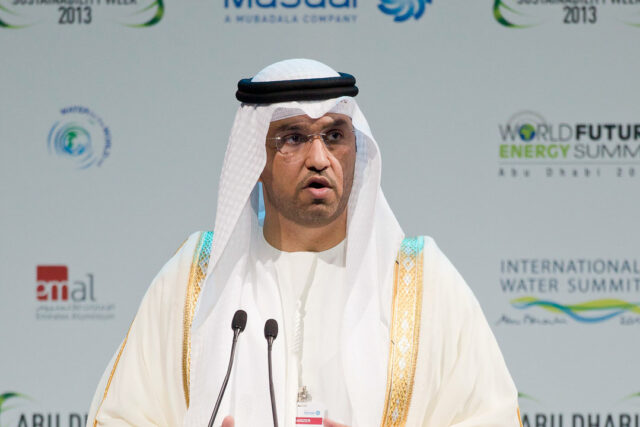
SULTAN AHMED AL JABER CEO of Masdar and chairman of the Abu Dhabi Ports Co. (ADPC), gives a welcoming speech at the Opening Ceremony of World Future Energy Summit, part of Abu Dhabi Sustainability Week 2013, at the Abu Dhabi National Exhibition Centre. — FLICKR.COM/MASDAR CORPORATE

WHEN the United Nations announced that the United Arab Emirates (UAE) would host its 2023 climate summit, known as COP, many environmentalists scoffed. A climate conference in an oil state? When the UAE announced that the president would be the head of its national oil company, Sultan Al Jaber, the scoffing only grew louder. The activists should stop griping: Al Jaber is precisely the kind of ally the climate movement needs.

During a recent visit to India, Al Jaber outlined the gravity of the challenge ahead. He conveyed the UAE’s desire to help India meet its ambitious clean energy goals. He called for more investment in decarbonization technology, including nuclear and hydrogen power. And he endorsed an all-of-society approach that mobilizes every sector and asks more of development banks and financial institutions.

He also addressed the elephant in the room: the need to mitigate the climate impact of fossil fuels during the global transition to clean energy. “It is not a conflict of interest,” he said, alluding to his critics; “it is our common interest to have the energy industry working alongside everyone.”

There’s no escaping the fact that the world still needs oil and gas and will for some time, a reality that Al Jaber’s critics tend to ignore. Fighting climate change is not a question of ending all oil and gas production immediately, but of developing sufficient clean power to phase it out as quickly as possible — and doing so in a way that strengthens economies and lifts living standards, through policies that are “pro-growth and pro-climate at the same time,” as Al Jaber put it.

To be sure, Al Jaber has a financial interest in oil production, but he has a stake in the clean-energy industry, too. He’s the founding CEO and current chair of Masdar, which aims to generate 100 gigawatts of renewable power by the end of the decade, a goal that exceeds those set by some larger European nations. If every nation aimed to produce as much per-capita renewable power over the next seven years as the UAE, the fight against climate change could be transformed.

To their credit, most global leaders have supported Al Jaber’s appointment and the UN’s decision to host this year’s COP in the UAE, including President Joe Biden’s special climate envoy, John Kerry. But skepticism is inevitable, which puts an extra burden on Al Jaber to deliver.

As he prepares for November’s summit, it’s critical that Al Jaber ramp up pressure on rich countries to honor their financial commitments to the developing world; push development banks and sovereign-wealth funds to expand their ambitions; and help overcome barriers to greater private-sector investment in clean-energy projects, especially in the developed world.

He can also dispel some of the public skepticism about his appointment by taking aim at the biggest obstacle standing in the way of major climate progress: coal-fired power plants. Clean energy is now cheaper than coal power in much of the world, and where coal still has a price advantage (often because of subsidies), new public-private partnerships — like the one the G-20 forged with Indonesia last year — can help nations speed the transition.

There is a difference, of course, between giving a good speech and rallying the world to act. And so it was encouraging to hear Al Jaber stress in his speech that this year’s summit must be “a COP of action,” one that moves the world “from talking about goals to getting the job done.”

Environmental activists will rightly hold Al Jaber accountable for translating words into actions, but they should also recognize that far more can be accomplished by accepting him as an ally than dismissing him as a foe.

BLOOMBERG OPINION

Ashes to ashes

PHILIPPINE STAR/MICHAEL VARCAS

It was Ash Wednesday when news broke of a third big earthquake in Turkey. The first devastating earthquake of 7.8 on the Richter scale hit in the early hours of Feb. 6 (4:17 a.m.), with the epicenter in the Pazarcık district of Kahramanmaras province. According to the World Health Organization (WHO), 41,156 people lost their lives and 108,068 people were injured in the panicked 17 days of the calamity. Damage surveys indicate that 139,000 buildings in 11 provinces collapsed or are heavily damaged. Four million people have left the earthquake-affected area (reliefweb.int, Feb. 23, 2023).

Dust to dust, ashes to ashes. Fate and destiny have allowed Nature to run its cycle of Life and Death. Yet in the sobering slowdown of the Christian Lenten season, one might wonder — why does Man seem to hurry and accelerate these natural cycles by killing each other and by destroying Nature and the structures of humankind? The great temptation to this most grievous sin is Man’s obsession for money, power and glory.

The war on Ukraine has been going on for a year now, since Russian President Vladimir Putin first sent up to 200,000 soldiers into Ukraine on Feb. 24, 2022 in the biggest European invasion since the end of World War Two. The attack started in the thick of the COVID pandemic, which contagion has killed 6.87 million people worldwide to date. The mayor of the Ukrainian city of Mariupol, where the Russian troops were concentrated, estimated last April that 21,000 people had died there alone. Russia and Ukraine have each seen at least 100,000 of their soldiers killed or injured, according to the US military. More than 13 million people were made refugees abroad or displaced inside Ukraine (BBC News, Feb. 23, 2023). Russia’s invasion of Ukraine has caused $108.3 billion in damage to the country’s infrastructure, according to a study from the Kyiv School of Economics (Forbes Magazine, Aug. 2, 2022).

“Vladimir Putin has described the Soviet disintegration in the early 1990s as one of the greatest catastrophes of the 20th century, and one that robbed Russia of its rightful place among the world’s great powers” (nytimes.com, Feb. 21, 2023). That the Baltic republics of Lithuania, Latvia, and Estonia, once parts of the Soviet Union, joined the North Atlantic Treaty Organization (NATO), as did Poland, Romania and others, heightened his paranoia that “the West,” meaning basically the US and its allies, was surrounding Russia and stifling its competitive strength politically and militarily, and cornering vital economic supply sources.

“In December 2021, months before invading Ukraine, Russia presented NATO and the United States with a set of written demands that it said were needed to ensure its security but were impossible for the West to meet. Foremost among them were a guarantee that Ukraine never join NATO, and that NATO draw down its forces in the Eastern European countries that had already joined” (Ibid.).

This drove Putin to attack Ukraine, which he believes is fundamentally part of Russia, culturally and historically — after so easily grabbing back Crimea (which is part of Ukraine) in March 2014. Analysts point out, “Ukraine is not a member of the NATO alliance and does not come under its commitment to collective defense, and (US President Joe) Biden wants to avoid direct conflict between Russian and American forces, which he has warned could lead to world war” (Ibid.).

A world war is what the world prays will not happen. In these perilous times, weapons of mass destruction (nuclear, biological, chemical) in the hands of ruthless world leaders can maim and kill most of humankind.

On Feb. 20, North Korea had launched four intercontinental ballistic missiles (ICBMs) off the east coast of the Korean Peninsula towards the Sea of Japan. It was the third such “super-large multiple rocket launcher exercise, which is a means of tactical nuclear attack,” as North Korea unabashedly acknowledged it to be — and followed through with a fourth “target practice” the day after. Kim Yo-jong, one of the country’s top officials and sister of North Korean Leader Kim Jung Un said “the frequency of using the Pacific Ocean as our shooting range depends on the nature of the US military’s actions,” according to a statement posted on the state-run Korean Central News Agency (KCNA) (cnn.com, Feb. 20, 2023).

South Korea’s military said it “strongly” condemned the ICBM launches as an act of “significant provocation”; Japan lodged a strong protest and forcefully condemned North Korea (Aljazeera.com, Feb. 20, 2023). But North Korea said it was a defensive reaction to the ongoing joint US-South Korea military drills that augmented the 28,500 US troops already stationed in South Korea in the settlement of the 1950-1953 Korean War.

Moscow’s state-owned nuclear-power firm Russian State Atomic Energy Corp. (Rosatom) is building a nuclear-power plant on Turkey’s Mediterranean coast that the Russian company will own and operate. A second plant on the Black Sea is planned for this year. Russia transferred $5 billion to Turkey for the construction of the first power plant and is expected to spend another $10 billion more (wsj.com, Dec. 24, 2022). Today Rosatom holds first place in terms of the number of simultaneously implemented nuclear reactor construction projects, with two units in the Russian Federation and 35 abroad at various implementation stages (cnpp.iaea.org, updated 2021). Russia owned 40% of the total uranium conversion infrastructure in the world in 2020, and 46% of the total uranium enrichment capacity in the world in 2018, according to a Columbia University report (cnbc.com, May 23, 2022).

In October 2022, Russia proposed establishing a hub for Russian natural gas in Turkey. The plan is being finalized — representing the completion of a long-held Turkish ambition to become a hub for gas exports to Europe. Gas and alternative energy sources: that would explain why Turkey, a NATO nation with recent history of contentious relations with Russia (in wars in Syria, Libya, and the South Caucasus region), would break away from the EU and NATO hardline protests and economic sanctions on the Russian aggression in Ukraine. G-7 countries and the EU have largely stopped importing Russian crude. Turkish imports of the much-cheaper Russian crude oil more than doubled in the months after the Ukraine invasion. Turkey has also stepped in to supply Russia with goods that Moscow can no longer import from Europe. Some say goods from the EU to Russia have been rerouted through Turkey to circumvent G-7, EU and other countries’ trade restrictions and economic sanctions on Russia (wsj.com, Dec. 24, 2022).

“Ukraine has stopped seeing its relationship with Turkey as part of its partnership with the West. In a way, this is what Turkish President Recap Tayyip Erdogan had long been trying to achieve: to become more self-sufficient on the global stage, and stand between the West and the non-Western world,” some political observers say (carnegieendowment.org, July 10, 2022).

Just like Russian President Vladimir Putin obsesses with Russia regaining its former position as a world power and its territory before the dissolution of the USSR. Just like North Korean Supreme Leader Kim Jong Un, who is so determined to be a feared world leader, that he threatens with his ICBM target-practices. Do the vanities of leaders ever justify the means to an end?

An earthquake says No.


Amelia H. C. Ylagan is a doctor of Business Administration from the University of the Philippines.

ahcylagan@yahoo.com

Chinese invasion of Taiwan may test US resolve

REUTERS/U.S. NAVY VIA EYEPRESS

By Kyle Aristophere T. Atienza, Reporter

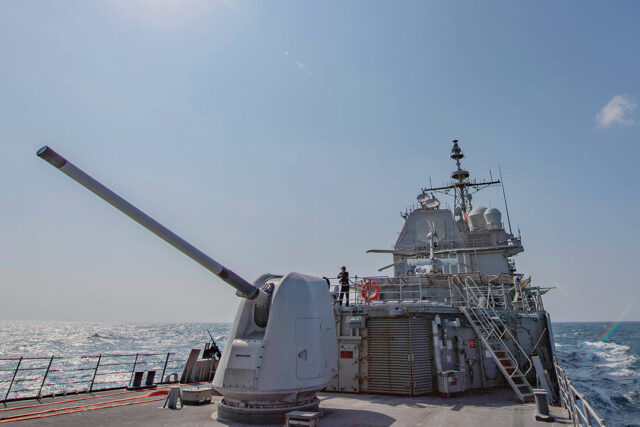
A POSSIBLE Chinese invasion of self-ruled Taiwan would be a litmus test for US commitment to its security allies including the Philippines, according to experts.

“The Taiwan Strait conundrum would challenge the regional interoperability and deterrence posed by the US and its allies including the Philippines to China,” said Chester B. Cabalza, founding president of Manila-based International Development and Security Cooperation.

“It is a litmus test of the heightened power competition between China and the US,” he said in a Facebook Messenger chat. 

The Philippines has a 1951 Mutual Defense Treaty with the US, which has vowed to defend Taiwan in the event of an attack by China.

China claims Taiwan as a province and Xi Jinping, who secured a historic third term as Chinese president in October, has not ruled out the use of force regarding the self-ruled island.

Washington is expanding its training of Taiwanese forces, planning to deploy more American troops to the island-nation.

Earlier this month, President Tsai Ing-wen told visiting US lawmakers Taiwan would “cooperate even more actively” with Washington and other democratic partners, on issues such as authoritarian expansionism and climate change.

“If tensions escalate in Taiwan, the Philippine-US Mutual Defense Treaty could be invoked, since Filipinos in Taiwan will become vulnerable,” Mr. Cabalza said. 

He added that military bases in northern Luzon would play “pivotal roles” in Washington’s prepositioning of military equipment, aircraft and vessels.

“The simulated operations of evacuating Filipinos from Taiwan conceived in military exercises should be realized.”

The government of President Ferdinand R. Marcos, Jr. has given the US access to four more military bases under their Enhanced Defense Cooperation Agreement (EDCA).

The two countries have yet to disclose the locations of the new EDCA sites but last year, a former Philippine military chief said Washington had requested access to bases on the northern land mass of Luzon, the closest part of the Philippines to Taiwan, and on the island of Palawan, facing the disputed Spratly Islands in the South China Sea.

Once China invades Taiwan, “all the American treaty allies in the Asia Pacific will be embroiled in the war in different degrees of influence, including the Philippines,” said Emerson De-Yi Zhou, a research assistant at the Center for Foreign Policy Studies at the National Chengchi University in Taiwan.

‘ROPED INTO ALLIANCES’
“The US will respond first and possibly send troops to intervene, and require its allies such as the Philippines to provide military support, mainly on the logistical side,” he said via chat.

The potential war could indirectly affect the Philippine economy,” he said, citing a war simulation conducted by American think tank Center for Strategic and International Studies in January.

Chinese threat to the Philippines’ national security would be more alarming if China wins the war and manages to control Taiwan, Mr. Zhou said.

If tensions escalate, the US could impose economic sanctions  on China, and the Philippines would likely be required to do so too, he added.

Still, Mr. Zhou thinks Chinese invasion of Taiwan is “unlikely in this decade.” He expects the Marcos government to continue calling for a peaceful settlement of the China-Taiwan conflict.

Mr. Marcos would probably hedge its foreign policy strategy by boosting security ties with the US while keeping economic relations with China, he said.

The US has no formal diplomatic ties with Taiwan, but the two countries have “a robust unofficial relationship,” according to the US Department of State. Washington supplies arms to Taiwan.

The Philippines still adheres to the One China policy, which China has used to assert that Taiwan is part of its territory, Mr. Marcos said on the sidelines of the United Nations General Assembly in New York in September.

He urged “all parties involved to exercise maximum restraint.” “Dialogue and diplomacy must prevail.”

“The Biden administration will be OK with the Marcos government’s stance,” Mr. Zhou said. “After all, the national security strategy report of the Biden administration mentions that the US will support its allies’ sovereign decision-making capabilities based on their own interests and value.”

He also said US Secretary of State Anthony Blinken had said the US would not force its allies to take sides.

If China becomes more aggressive in the Taiwan Strait, the Philippines would likely be “roped into alliances,” said Hansley A. Juliano, a political economy researcher studying at Japan’s Nagoya University’s Graduate School of International Development.

“You can either see the US increasing its presence or it will pressure allies such the Philippines to invest more in defense,” he said in a Messenger chat.

“The high risk here is it will likely enlarge US foreign military engagement abroad, which is already causing headaches with Joe Biden’s recent engagement in Ukraine.” 

He said worsening tensions between China and Taiwan would probably result in supply chain disruptions, which might force the Philippines to enter into “unequal economic ties with Beijing.”

ADVERTISEMENT
ADVERTISEMENT