Home Blog Page 5204

Legislators laud DHSUD on its 4th anniversary, brand secretary ‘extraordinary’

In celebrating the 4th anniversary of the Department of Human Settlements and Urban Development (DHSUD), Senators Joseph Victor “JV” G. Ejercito and Ana Theresia “Risa” N. Hontiveros-Baraquel described DHSUD Secretary Jose Rizalino L. Acuzar as “extraordinary” for his innovative concepts as the country’s housing czar on Tuesday.

Recognizing the country’s housing woes, Sen. Ejercito commended Sec. Acuzar’s leadership of President Ferdinand R. Marcos, Jr.’s flagship housing program, the Pambansang Pabahay Para sa Pilipino Housing (4PH) Program.

“We have a very daunting task ahead, a very gargantuan task of producing one million houses every year… We need to think outside the box and be extraordinary,” Mr. Ejercito said in his message.

“Sec. Jerry (Acuzar) is a very simple person and a self-made man. I think he is ‘the X factor’ that we need for the Department of Human Settlements,” he said in mixed English and Filipino.

For her part, Sen. Hontiveros emphasized the role of DHSUD in curbing the 6.5 million housing backlog through the Pambansang Pabahay program and vowed support toward achieving its goals.

“There is much work and challenges DHSUD needs to face. You can be assured that we will continue to join you in your fight for proper housing for every family. We will not stop, we will not get tired, and we will not give up in this fight,” Ms. Hontiveros said.

The lady senator added she will continuously push for funding support for the realization of the Pambansang Pabahay as vice-chairperson of the Senate Finance Sub-Committee that tackles the budget of DHSUD.

4th anniversary celebrations

The two legislators served as guests during the opening ceremony of this year’s celebration with the theme, “Tahanang sapat para sa lahat (Adequate homes for all)” at the DHSUD Central Office in Quezon City. They were recognized, together with Bacolod Mayor Alfredo Abelardo Benitez, former Rep. Jose Christopher “Kit” Belmonte, former House Speaker Feliciano “Sonny” Belmonte, Jr. and other sectoral stakeholders, for their significant contribution in the creation of DHSUD.

Led by Sec. Acuzar, the celebration highlighted the milestones achieved by the housing agency in the past year, particularly in leading the Pambansang Pabahay.

Under the program, the DHSUD is set to build and dispense one million housing units every year until the end of the current regime. So far, the department has broken ground in 17 areas and has signed 70 memorandums of understanding with local government units for the construction and development of housing projects.

“We are strongly confident that we will really fulfill the objectives of the 4PH. In the year that passed, we accelerated and intensified the housing program of the national government, with the help of our key shelter agencies and other partners,” Mr. Acuzar said in his keynote message.

The three-part celebration also witnessed the launching of the Philippine Urban Forum (PhUF) 2023, which was organized by the DHSUD’s Environmental Land Use and Urban Planning and Development Bureau, in coordination with the United Nations Human Settlement Program or UN-Habitat.

The forum serves as a platform of cross-sectoral government and nongovernment agencies to discuss their roles and commitments in refining and implementing good governance, security of tenure, environmental protection, and disaster preparedness and mitigation in the country.

The event witnessed the first time Mr. Acuzar and the newly appointed DHSUD executives celebrated the department’s anniversary.

In his message, the secretary thanked the officials and staff of the DHSUD and its key shelter agencies (KSAs) for “wholeheartedly” accepting him as their chief and closely working with him since his appointment in July 2022.

“I would like to thank every official and staff of DHSUD and our KSAs, whatever your level may be. The success of the 4PH depends on your capable hands and, so far, the results you have achieved are impressive. Thank you as well for wholeheartedly accepting me to the DHSUD family. It is a pleasure working with you every day,” he told the department’s workforce.

Hence, the third part of the celebration was dedicated to the DHSUD workforce as service and loyalty awards were presented to employees who rendered years of continuous and exemplary service in the government.

Mr. Acuzar stressed that in spite of the DHSUD’s achievements in the past year, it would persist in its thrust to maintain and improve the vibrancy of the housing and urban development sector in the country.

Especially with “effective leaders at the helm and a committed workforce by their side,” the secretary added, “the DHSUD will, no doubt, be moving mountains in the years to come.”

“There may be great challenges ahead of us, but greater opportunities are likewise awaiting us on the horizon. And so, I enjoin everyone to hang tight and soldier on as we improve the lives of Filipino families one adequate, resilient and sustainable house at a time,” he said.

BSP hikes rates, signals more to come

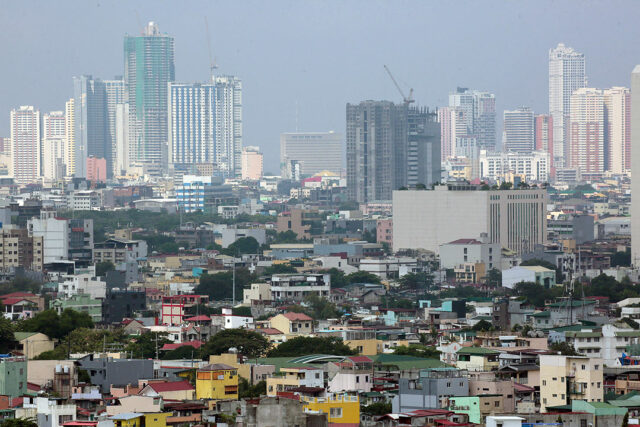
A view of Makati skyline seen from EDSA, Sept. 24, 2022. — PHILIPPINE STAR/MICHAEL VARCAS

By Keisha B. Ta-asan, Reporter

THE PHILIPPINE central bank on Thursday raised its benchmark interest rate by 50 basis points (bps) for a second straight meeting, and signaled more tightening to tame red-hot inflation.

The Monetary Board (MB) increased its overnight borrowing rate by 50 bps to 6% as predicted by nine out of 18 analysts in a BusinessWorld poll last week.

This brought the policy rate to 6%, the highest in nearly 16 years or since May 2007 when it stood at 7.5%.

The rates on the overnight deposit and lending facilities were also increased to 5.5% and 6.5% respectively.

The BSP’s aggressive rate hike came after inflation accelerated to a 14-year high 8.7% in January, from 8.1% in December. January also marked the 10th consecutive month inflation was above the BSP’s 2-4% target range and its 7.5% to 8.3% forecast range for January. 

“The Monetary Board deems a strong follow-through monetary policy response as necessary to reduce the risk of a breach in the inflation target in 2024. An upward adjustment in the policy interest rate would also prevent inflation expectations from drifting further away from the target band,” BSP Governor Felipe M. Medalla said at a briefing after the MB meeting.

The central bank raised its average inflation forecast for 2023 to 6.1% from 4.5% previously. This is beyond the BSP’s 2-4% target range, and faster than the 5.8% full-year inflation in 2022.

The BSP also hiked its 2024 inflation projection to 3.1% from 2.8% previously.

Mr. Medalla said the inflation forecasts were upwardly adjusted after the faster-than-expected inflation in January and “the continued stronger rebound in domestic demand and (7.2%) gross domestic product (GDP) growth in Q4 2022.”

The economy grew by 7.6% in 2022, exceeding the government’s 6.5-7.5% target, and the fastest growth since 1975.

“Both headline and core inflation measures have also continued to increase, indicating a further broadening of price pressures, particularly in services. Meanwhile, inflation expectations have likewise risen further, underscoring the need to preempt the emergence of further second-round effects,” Mr. Medalla said.

Core inflation, which excludes volatile prices of food and fuel, jumped to 7.4% in January from 6.9% in December and 1.8% in the same month in 2022. This is the fastest core inflation print in more than two decades or since 8.2% in December 2000.

BSP Director Dennis D. Lapid of the Department of Economic Research said headline inflation will likely average 7.7% in the first half this year before decelerating to 5.4% in the third quarter and 3.8% by fourth quarter. 

Inflation is projected to ease to within the 2-4% target by early next year due to dissipation of supply-side pressures on commodities and negative base effects, Mr. Lapid said. 

However, upside risks may continue to weigh on inflation outlook due to rising global food uncertainties, continued domestic shortages in supply, additional fare hikes amid elevated oil prices, and the higher-than-expected wage adjustments this year, Mr. Medalla said.

The BSP chief said he expects inflation to be near 4% by November or December this year.

MORE RATE HIKES
Since May 2022, the BSP has raised policy rates by a total of 400 bps.

Mr. Medalla said he expects economic growth to remain strong this year, adding that a 50-bp increase in policy rates would only reduce GDP growth by 0.04%.

The government targets 6-7% GDP expansion this year, slower than the 7.6% in 2022.

“Fortunately, the economy is quite strong. Maybe, we all underestimated pent-up demand,” he said.

The BSP chief also signaled another rate hike at its next meeting on March 23.

“It is unlikely we won’t increase the rate at the next meeting,” Mr. Medalla said, adding that he cannot rule out a “third” or “maybe a fourth” hike.

He also ruled out a 75-bp rate increase this year, unless it would be necessary to match the US Federal Reserve.

“The need for extraordinarily high interest rate increases like 75 (bps) was largely because inflation was also coming with a very weak and rapidly depreciating peso (last year)… So unless another large change in monetary policy happens somewhere else, I think we have done enough 75 (bps),” he added. 

The US Federal Reserve raised borrowing costs by 25 bps earlier this month, with a promise of more increases as it continues to fight against inflation. The rate hikes delivered by the Fed since March 2022 have now totaled 450 bps to a range of 4.5-4.75%.

Following the BSP’s policy announcement, the peso closed at P55.12 versus the greenback on Thursday, inching up by five centavos from Wednesday’s P55.17 finish, Bankers Association of the Philippines data showed.

According to analysts, the BSP will continue to deliver more rate increases at its next meetings to ensure inflation falls within target and inflation expectations will be managed.

“BSP’s latest inflation forecast and admission that price pressure has broadened could open the door for additional rate hikes in the coming months,” ING Bank N.V. Manila Senior Economist Nicholas Antonio T. Mapa said in a note.

“Given this new information and the obvious shift in tone from Governor Medalla, we now expect a 25-bp rate hike by the BSP at the March meeting with our forecast for BSP’s terminal rate at 6.25%,” Mr. Mapa said. 

For Gareth Leather, senior Asia economist of Capital Economics, said inflation may peak this month and drop steadily throughout the year as energy and food prices ease and growth slows.

“But inflation is unlikely to return to target before the end of the year, much later than in other parts of the region. As such, we think the central bank still has more work to do. We are raising our interest rate forecast, and now expect two more 25-bp rate hikes this year,” Mr. Leather said.

Meanwhile, Pantheon Macroeconomics Chief Emerging Asia Economist Miguel Chanco said rate hikes are not enough to address inflation.

“While we now see at least an additional 25-bp interest rate increase in March, we are also sticking to our view that a partial rollback of this tightening cycle will start before the end of this year, to the tune of at least 50 bps in cuts in fourth quarter,” Mr. Chanco said.

“By then, we expect headline inflation to have returned comfortably within the 2-4% target range, while the economy will have shown a more noticeable loss in momentum,” he added.

The Monetary Board is next set to review policy on March 23 and on May 18.

Meanwhile, Mr. Medalla also added that a cut in big banks’ reserve requirement ratio (RRR) is “still feasible” at the end of first semester. However, he emphasized that he didn’t want to confuse markets by increasing policy and cutting the RRR at the same time.

Philippine consumption likely to slow this year

Customers look for cheap clothes at a market in Taytay, Rizal. — PHILIPPINE STAR/ MICHAEL VARCAS

CONSUMPTION in the Philippines will likely slow down the most among Southeast Asian countries this year, as households struggle with rising prices and interest rates, HSBC Global Research said.   

In a note on Thursday, HSBC said inflation remains a key concern among consumers as most policy makers in the Association of Southeast Asian Nations (ASEAN) member countries are unlikely to implement consumer-friendly measures in battling inflation.    

“We think consumption in ASEAN will slow in 2023 but in varying degrees; consumption in the Philippines will likely slow down the most, while Vietnam, Malaysia and Singapore may show some resilience,” HSBC said.   

HSBC noted the Philippines saw the prices of goods and services rise faster than wages in 2022, which eroded purchasing power and may curb consumption in the near future.

“Inflation usually works with a lag and households will likely continue to readjust their expenditure throughout the year in consideration of the steep rise in the cost of living,” HSBC said.   

Inflation remained elevated in the Philippines, averaging 5.6% in 2022. In January, headline inflation further accelerated to 8.7% from 8.1% in December, in contrast to downward trend in most ASEAN countries.

“Fortunately, most ASEAN economies passed the peak of inflation, though the Philippines and Vietnam have continued to see intensifying price pressures,” HSBC added.

The Bangko Sentral ng Pilipinas (BSP) revised its annual average inflation forecast to 6.1% this year from 4.5% previously.

“The Philippines saw the purchasing power of its wages decline significantly, wherein the rise in the cost of living almost doubled compared to the rise in wages. This deterioration will likely take a toll on consumption in 2023 as households find their way around to make ends meet amid the squeeze in household budgets,” HSBC said.   

This year, HSBC noted central banks in ASEAN may continue to hike rates to curb demand-driven inflation.

“The Philippines and Thailand will likely take the biggest hit as their central banks are taking a relatively hawkish stance to bring the economy-wide saving rate back up, striking a balance between consumption and macroeconomic stability,” it said.

HSBC expects the BSP to raise rates as high as 250 basis points (bps) above pre-pandemic levels, which may hurt borrowing and consumption.

The benchmark interest rate stood at 4% in 2019 before the Monetary Board cut rates by 200 bps in 2020 to support the pandemic-hit economy. Since May 2022, the BSP has raised rates by 400 bps to curb inflation.

“High interest rates will deter consumers from borrowing, while it promotes saving since interest income from savings increases. Given this dynamic, the Philippines and Thailand will likely see the largest adjustment in economy-wide savings,” it said.   

Domestic consumption remained strong as the economy reopened. It expanded by 7% in the fourth quarter, slightly slower than 8% in the third quarter and 7.5% a year earlier. For the full year, household consumption rose by 8.3% from a year earlier.   

“All data point to the Philippines slowing down the most — not favorable news for an economy so driven by private consumption. Nonetheless, its fundamentals too should help smooth household consumption or at least put a floor on how much it could slow,” HSBC said.   

“For instance, the Philippines has one of the most favorable demographic profiles. The fertility rate in the Philippines is the highest in ASEAN at 2.7, while the median age is only 25 years. Therefore, consumption will likely slow but not free-fall due to a rising working age population,” it said.   

HSBC also said remittances can help smooth out incomes and consumption to some extent, and money sent home to the Philippine rise during hard times.   

Money sent by OFWs through banks jumped by 3.6% to $32.54 billion last year, according to data released by the BSP. It exceeded the previous record of $31.42 billion in 2021. — Keisha B. Ta-asan

Youth may lose up to 10% of future earnings due to learning losses

PHILIPPINE STAR/ WALTER BOLLOZOS
Students are seen outside Marikina High School, Nov. 2, 2022. Full face-to-face classes resumed for public and private schools in the Philippines last November. — PHILIPPINE STAR/ WALTER BOLLOZOS

MILLIONS OF CHILDREN around the world could lose up to 10% of their future average annual earnings due to “education shocks” during the height of the coronavirus pandemic, a new World Bank report showed.

In the report “Collapse and Recovery: How COVID-19 Eroded Human Capital and What to Do About It,” the World Bank said the pandemic damaged the cognitive development and lifetime earnings of young people.

The decline in the cognitive and social-emotional development of toddlers due to the pandemic could also lead to a 25% reduction in future earnings as adults, it added.

“The pandemic and school closures threatened to wipe out decades of progress in building human capital. Targeted policies to reverse the losses in foundational learning, health, and skills are critical to avoid jeopardizing the development of multiple generations,” World Bank Group President David Malpass said in a separate statement.

The World Bank’s report was the first analysis of global data on young people who were under the age of 25 at the start of the pandemic in 2020. These young people will make up 90% of the “prime-age workforce” in 2050, it added.

When the pandemic hit in March 2020, widespread lockdowns were implemented to curb the spread of the coronavirus disease 2019 (COVID-19). This prompted school closures in 180 countries including the Philippines.

Around 1.3 billion children in low- and middle-income countries missed at least half a year of school, 960 million missed at least a full year and 711 million missed a year and a half or more, the World Bank said.

Between April 2020 and March 2022, Philippine schools were closed for 510 days, one of the longest school closures in the world. The Philippines only resumed full face-to-face classes for public and private schools in November 2022.

The World Bank noted these long school closures have led to deep learning losses. For every 30 days of school closures, students lost an average of about 34 days of learning. There was also a decline in enrollment even after schools reopened, it added.

“Learning losses can derail not only students’ learning trajectory but also their lives by diminishing their economic prospects, lifetime earnings, and chances of escaping poverty. If swift and effective actions are not taken, the pandemic-related schooling shock could leave students and economies permanently scarred,” the World Bank said.

The World Bank said there was an increase in learning poverty rates in low- and middle-income countries to 70% in 2022 from 57% in 2019.

“World Bank projections suggest that, globally, pandemic-related learning losses will lead to between $23,514 and $31,800 in lost earnings over a typical student’s lifetime. Overall, without urgent policy action, today’s students could lose as much as 10% of their future average annual earnings due to COVID-related learning losses. In terms of present value, these earnings could amount to $21 trillion — equivalent to 17% of today’s global GDP,” it said.

The pandemic also caused deep employment losses for the youth, the World Bank said.

“In most countries, youth employment (ages 15-24) fell sharply at the beginning of the pandemic. These declines were particularly pronounced in the Philippines, with a decline of 11 percentage points,” it added.

The World Bank said the number of hours worked by employed young people in the Philippines fell by 20 hours to just 19 hours a week during the pandemic. 

“Adult employment has recovered, but youth employment has not. In the Philippines, the recovery of employment has also been larger among adults than youth,” it added.

The World Bank said that the government should implement policies and systems that can reverse learning losses.

“Reversing the pandemic’s impact on them and investing in their future should be a top priority for governments. Otherwise, these cohorts will represent not just a lost generation but rather multiple lost generations,” Norbert Schady, World Bank chief economist for human development, said.

The World Bank emphasized the need to keep schools open, increase instructional time, assess learning and match instruction to students’ learning level, implement targeted catch-up policies such as tutoring for children who have fallen behind, and streamline the curriculum to focus on foundational learning.

The government should also adopt measures to alleviate financial constraints to mitigate dropouts and encourage attendance.

The World Bank cited conditional cash transfers such as those in the Philippines, which were found to improve school enrollment and attendance.

It also noted adapted training, job intermediation, entrepreneurship programs, and new workforce-oriented initiatives to help boost youth employment. — Luisa Maria Jacinta C. Jocson

PCC looks into possible cartel behind high onion prices

A vendor shows off a basket of red onions in Manila. — PHILIPPINE STAR/WALTER BOLLOZOS

THE PHILIPPINE Competition Commission (PCC) has been looking into the possibility that a cartel has been behind the recent spike in onion prices.

“Since November 2022, the PCC has been investigating the high prices of onion for possible cartel or abuse of dominance conduct, consistent with the probe prompted by House Speaker Rep. Martin G. Romualdez and House Resolution No. 681 filed by Rep. Stella A. Quimbo,” the competition watchdog said in a statement.

The PCC said it launched a market assessment after observing an “unusual high range” of onion retail prices, which peaked at P600 per kilogram (/kg) in December last year.   

“As prices are seen to stabilize due to the imports and the SRP1 set last Feb. 6, the PCC is looking into the cause of such market anomaly in coordination with the sector regulators and other law enforcement agencies,” it said.

Legislators and agriculture industry stakeholders have raised concern over the surge in onion prices, citing importation issues, price manipulation and smuggling.

The PCC warned that businesses found to have taken advantage of the situation may face fines of up to P100 million and jail time of up to seven years.

It noted that fines for violators could be tripled if the trade of basic necessities, including agricultural items covered by the Price Act, are found to have violated cartel or abuse of dominance.   

Earlier this month, the Department of Agriculture (DA) set a suggested retail price (SRP) of P125/kg for imported red onions sold in Metro Manila following consultations with agricultural stakeholders.   

In January, the DA approved the importation of 21,060 metric tons (MT) of onions to mitigate surging retail prices. This consists of 17,100 MT of red onions and 3,960 MT of yellow onions.   

As of Feb. 15, DA price monitoring data showed the retail price of local red onion in Metro Manila markets ranges from P180 to P300 per kilo. Medium-sized imported red onions are priced from P100 to P125 per kilo, while big red onions are priced at P110 to P180/kg.   

The retail price of local white onion ranges between P100 and P180 per kilo. Prices of medium-sized white onions range from P140-P250 per kilo, while big ones are between P120 and P180 per kilo. — R.M.D.Ochave

LNG users risk reliance on volatile prices – IEEFA

REUTERS

THE Philippines may be forced to rely on volatile spot market prices as long-term liquefied natural gas (LNG) contracts with shipments before 2026 are reportedly sold out globally, the Institute for Energy Economics and Financial Analysis (IEEFA) said on Thursday.

“A recent survey of LNG buyers in Japan suggests that there are no long-term contracts available for shipments until 2026. As a result, Vietnam and the Philippines may be forced to rely solely on volatile spot markets for several years,” it said.

IEEFA identified both countries as having LNG-related projects that have experienced repeated delays, not currently importing LNG, and are without a long-term LNG supply contract as of November 2021.

Policy responses may limit the role of LNG for countries like the Philippines, which favors renewables over natural gas, said the global research institute that examines issues related to energy markets, trends, and policies.

The Philippine Energy Plan, as crafted by the Department of Energy (DoE), focuses on developing renewable energy (RE). The agency targets a 50% RE share in the country’s power generation mix by 2040 under a clean energy scenario, surpassing traditional coal, natural gas and oil-based power sources.

Last year, the government opened the renewable energy sector to full foreign ownership after Energy Secretary Raphael P.M. Lotilla signed a circular amending the implementing rules and regulations (IRR) of the Renewable Energy Act of 2008.

Rino E. Abad, director of the DoE’s Oil Industry Management Bureau, told reporters at an energy conference last week that proponents of LNG terminals should secure LNG contracts as soon as possible.

He said now is the best time to negotiate an LNG supply contract while the price is “relatively low.” He added that the Philippines accounts for only a small portion of global LNG demand.

To date, seven proponents of LNG terminal projects have been approved by the DoE for development, two of which are expected to come online in the first semester of 2023.

Linseed Field Power Corp., a unit of Atlantic Gulf & Pacific Co., said that it had completed the conversion of a vessel into a floating storage unit for gas. The company is expected to start taking delivery of gas by March.

First Gen Corp., through its subsidiary FGEN LNG Corp., said its LNG terminal will also be completed by the first quarter. First Gen’s gas-fired power plants currently run on indigenous gas from the Malampaya-Camago reservoir, which is expected to start depleting next year.

The other LNG terminal projects are led by Samat LNG Corp.; Luzon LNG Terminal, Inc.; Energy World Gas Operations Philippines, Inc.; Shell Energy Philippines, Inc.; and Vires Energy Corp.

“Southeast Asia’s demand growth faces challenges related to high prices, limited LNG contract availability and infrastructure constraints. Long-term contracts with deliveries before 2026 are reportedly sold out globally, meaning price-sensitive Southeast Asian buyers risk high exposure to volatile, expensive spot markets,” IEEFA said. — Ashley Erika O. Jose

Alternergy sets P1.87-B maiden listing in March

RENEWABLE energy company Alternergy Holdings Corp. targets to hold on March 24 an initial public offering (IPO) of shares from which it expects to raise up to P1.87 billion to fund ongoing and prospective projects.

According to the company’s amended preliminary prospectus, the maiden listing covers the sale of up to 1.15 billion common shares, with an overallotment option of up to 115 million.

The shares will be sold at an offer price of up to P1.48 apiece, with the company expecting gross proceeds of up to P1.70 billion from the sale of firm shares.

The common shares to be sold are lower than the number previously set by the company in June last year at 1.28 billion with an overallotment option of up to 192.22 million.

Alternergy’s updated prospectus dated Feb. 14, 2023 set the listing of shares on the main board of the Philippine Stock Exchange (PSE) on March 24 under the ticker symbol ALTER.

The offer period for the IPO is expected to run from March 13 to 17 subject to the approval of the PSE and the Securities and Exchange Commission.

Under its previous prospectus, the company scheduled the IPO’s offer period from Nov. 11 to Nov. 17, 2022, with listing and trading on the main board set on Nov. 25, 2022.

The company received PSE approval of its listing on Feb. 7, 2023. It expects a post-IPO market capitalization of up to P5.82 billion.

Alternergy tapped Investment & Capital Corp. of the Philippines as sole issue coordinator, and as joint issue manager and lead underwriter together with BDO Capital & Investment Corp., while Unicapital, Inc. was assigned as the offering’s co-lead underwriter.

The company expects to use an estimated P564 million or 35% of the P1.62-billion net proceeds for the construction of projects under development, while around P522.19 million or 32% for the payment of acquired Kirahon Solar Energy Corp. shares.

Alternergy will also be using 21% of the net proceeds or P340 million for the pre-development expenses of projects in the pipeline.

For projects under development, the company plans to break ground for its Solana solar project and to start early works on its Lamut hydropower project in the first quarter of 2023.

Meanwhile, it is planning to finance through its IPO the pre-development works on its Ibulao hydropower project, Tanay wind project, Alabat wind project, and offshore wind projects estimated to have a capacity of 1,000 megawatts.

Alternergy is led by Vicente S. Perez, Jr., a former secretary of the Department of Energy. — Justine Irish D. Tabile

Pinoy pro-wrestling goes digital-first

PHOTO BY LUIS DEL ROSARIO

By Joseph L. Garcia, Reporter

A WRESTLING ring stands in the abandoned ballroom of a Quezon City dimsum house. This ring, with the sounds of its slams rumbling throughout the building, is the centerpiece of the wrestling academy of Filipino Pro Wrestling (FPW), the first day of which was held on Feb. 4.

“This is the only training facility — well, we call it a facility; it’s barely a facility now — but it’s the only place where you can train in wrestling in an actual wrestling ring in the Philippines,” said standup comedian Red Ollero, who is also president of FPW in an interview at the sidelines of the training session.

FPW comes at the heels of PWR (Philippine Wrestling Revolution), which closed during the pandemic. “Offshoot ba siya? Parang hindi eh (Is it an offshoot? It doesn’t look like it),” said Mr. Ollero. He was also president there, and he discussed the various reasons as to why the former wrestling promotion had to be closed. Aside from administrative issues, the pandemic’s restriction on live events meant a loss of ticket sales, despite having to pay for storage for their equipment. “It’s a completely new wrestling promotion,” he said of FPW.

WRESTLING, ONSCREEN
He talks about resurrecting wrestling, albeit in a different format. “Live events are back,” he said, but FPW will bring back wrestling in a digital-forward format. “The business model is going to be primarily digital. The live events, they just exist so we can tape content. It’s going to be primarily, a content creation house.” They have partnered with Transcend Studios, and they see the events in shows being released as weekly episodes on YouTube. “PWR before was primarily focused on live events. When we upload anything digitally, we just uploaded whatever live event we had. Or best matches.”

FPW’s episodic format will include extras like interviews, backstage drama, promos, and all the other things that make pro-wrestling such a compelling, theatrical watch. “We’ve come to an understanding that this needs to be developed, and this needs years of work in it,” said Mr. Ollero. Many of the present wrestlers in FPW’s roster were former PWR players, numbering about 16.

Going digital has its seeds in the pandemic, from Mr. Ollero’s own standup career, which saw him transitioning from live events to holding Zoom comedy shows, and regularly updating his social media sites. “When I was forced to upload digital content, it really not only boosted my content creation side, or my social media sites, but it also drove ticket sales to the live events,” he said. “Before, my thinking was, if I upload sh*t, nobody will watch live anymore — not thinking that if you upload sh*t, more people will watch… I wanted to apply the same learnings to FPW.”

WRESTLING TRAINING
When BusinessWorld arrived at the training academy, the aspiring pro-wrestlers (about 14 of them), were dropping on the mats and practicing how to roll artfully, and, more importantly, safely. These were just one of the drills that day, which saw cardio, with an emphasis on breathing and energy, basic wrestling moves, and ropework. “We’re training for everything to be second nature,” said Mr. Ollero. “If you’re not tired in the ring, you have more control with what you do. At the same time, we want to train you to think and work even if you’re tired. When you’re performing, you never know.”

Speaking of the ring, Mr. Ollero emphasizes why having their own ring is important. In the old days, they once trained on mats and an old boxing ring, which is constructed differently from a wrestling ring. “The boxing ring is not meant for you to fall on,” he said. Wrestling rings are made of wood, and shocks, and about an inch of rebonded foam. “When you take those bumps… a lot of the shock is absorbed,” he said. “It’s built for you to slam on. A boxing ring, no.” The structure of the ropes is also important: in wrestling rings, the ropes are pulled taut, to serve as springs to execute moves. “That’s one of the things that we couldn’t practice on when we were in a boxing ring, because those ropes were soft.”

CHILDHOOD DREAMS AND PUSHING LIMITS
We interviewed some of the aspiring wrestlers in the ring. An 18-year-old girl, still in college, was practicing flips. “It’s been my childhood dream,” said Raichel Mendoza. “It’s satisfying for me. It’s healing my inner self.”

Training will be difficult. They will have to do this every week: besides the physical aspect of it, they will spend workshops building their character and ring persona, until they are deemed to be ready for the ring by the wrestlers and trainers. “It looks easy, but when you’re doing it, it’s hard. You also have to be careful.” said Ms. Mendoza.

Meanwhile, 20-something Quito Castro, who works as a department manager in sports retail, had been playing varsity baseball since he was a boy — and watching wrestling, too. “Test the limits of my body,” he said, when asked about his reasons for joining the academy. “I’ve been fascinated about the physical component of wrestling.”

A lawyer, Nik Gutierrez, would take off his glasses occasionally during workouts, blurred as they were with his sweat. “I’ve been a fan all my life,” he told BusinessWorld. “I grew up in the ’90s. I grew up in the Attitude Era. The Rock, Stone Cold, DX.” One of his friends from grade school went on to become a PWR wrestler, Evan Carleaux. “It was just a dream that someday, one of us would be a wrestler,” he said.

“Personally, I just wanted to try something new. I badly need to exercise,” he said. He said that before entering law school, he had been quite fit, but the demands of a law career made fitness goals less of a priority. “I had the hardest workout in years,” he said about his first day in training. “But it was great. I’m the (least-fit) person here. And I had fun.”

Pro-wrestling’s demanding schedule might see only three or four people remaining from the class by the end of the academy’s run, by Mr. Ollero’s count. “Even if I don’t make it… at least I tried to do something that was impossible during my childhood,” said Mr. Gutierrez. “I was able to do it.”

“There are people who think that you have to be super athletic,” said Mr. Ollero, recalling his own time in the ring as PWR’s Rederick Mahaba. “I came in with a torn knee, and I was like 300+ lbs., and I made it.”

“I think it’s really persistence. You’ve got to have the heart to want it,” he said on what makes a pro-wrestler. “There are people who get impatient. And it hurts. If you train for a long time, and you don’t see the fruits of your labor; if you’re not booked as a wrestler, you will quit. But other people, I think, enjoy it.”

“You just don’t quit.”

FPW’s next show, Astig: The Pilot Taping, will be on Feb. 19 at the Power MAC Center. Tickets are available at ticket2me.net, at P750 (from Feb. 13 to 18) and P1,000 on the day itself.

PLDT to expand its largest data center by 12 MW, build 11th facility

BW FILE PHOTO

THE data center arm of PLDT, Inc. will be expanding the capacity of its largest operational data center by 12 megawatts (MW) to power an additional 1,600 racks.

In a press release, ePLDT, Inc. said it will be increasing the capacity of VITRO Makati 2 (VM2) to 3,360 racks — the framework that houses computing equipment — running on 20 MW total power capacity.

“The expansion of VM2 will enable ePLDT to accommodate additional requirements of existing customers and to keep up with the country’s ever-increasing data center demands,” ePLDT President and Chief Executive Officer Victor S. Genuino said.

“We take pride in the standards and reach we have achieved with our data centers. We will continue to scale and push boundaries to maintain ePLDT’s position as the premier data center hub in the Philippines,” Mr. Genuino added.

The increased capacity is expected to be ready by March to accommodate the surging data center demand in the country, the company said.

“VM2 connects directly to major international cable landing stations in the country, directing massive global data into VITRO’s network,” the company said.

Meanwhile, the company said that it will be building its 11th data center in the Philippines at a 5-hectare lot in Sta. Rosa, Laguna.

The new data center, VITRO Sta. Rosa, will have an initial power capacity of 14 MW in early 2024, which ePLDT said will further increase to 50 MW once it is fully operational.

The company described VITRO Sta. Rosa as “the largest and most advanced data center in the country.”

ePLDT is said to operate the widest data center network in the country. It offers a total rack capacity of nearly 10,000 to meet the requirements of local and global enterprises across various key industries. — Justine Irish D. Tabile

New Ant-Man technology transports moviegoers to vivid world

A SCENE from Ant-Man and the Wasp: Quantumania

LOS ANGELES — Scott Lang, a.k.a. Ant-Man, and his allies return to the big screen on Friday, years after the origin story in 2015’s Ant-Man, cameos in other Marvel films, and the 2018 sequel Ant-Man and the Wasp.

Ant-Man and the Wasp: Quantumania is the first movie in phase five of Disney’s Marvel Cinematic Universe. It takes the superhero and his resizing powers into the Quantum realm, a subatomic world where he meets new challenges.

Directed by Peyton Reed of The Mandalorian fame, the film stars Paul Rudd as Scott/Ant-Man, Evangeline Lilly as Hope van Dyne/The Wasp, Michelle Pfeiffer as Janet van Dyne, and Michael Douglas as Hank Pym. The third installment adds Jonathan Majors as the new antagonist, Kang the Conqueror.

Ms. Lilly’s face lit up when asked about her first time seeing the film set in a circular studio with high-definition panels.

“When we were in the Volume, suddenly there were thousands of LED screens building the world for us, creating the characters for us,” she said.

Reality melted away and brought her into the fantasy world that many children grew up reading about in the Marvel comic books, she noted.

The Volume technology used to bring the set to life is like an LED screen that wraps around an entire soundstage where anything can be projected, Mr. Rudd said.

“It was the most elaborate, unbelievable thing I’ve ever seen, and it does help because it gives you a sense, especially with something like this, where the environment is so specific and so imaginative and unfamiliar.”

Disney artists assembled new environments, creatures, buildings, and an entire internal history and logic to make the Quantum realm come to life.

It was key for Mr. Reed to be able to look at old science fiction books, comic books, heavy metal magazines, movies and things that he loved as a kid and as an adult to populate the Quantum realm.

Mr. Reed told the team’s artists that no idea was too crazy because “anything can happen in the subatomic world.”

At the center of the immersive world, Mr. Majors believed Kang’s role was to inform Scott of what was at stake in the Quantum realm “as well as what they’re really up against.”

Despite the eye-catching technology, most critics have given the film mediocre reviews, resulting in a “rotten” rating of 55% on Rotten Tomatoes.

Nick Schager, entertainment critic for The Daily Beast, wrote that “Rudd gets swallowed up by the consuming CGI insanity of his latest comic book extravaganza,” referring to computer generated imagery. — Reuters

Citicore Holdings subscribes to Megawide capital hike

MEGAWIDE Construction Corp. said on Thursday that its parent firm Citicore Holdings Investment, Inc. is subscribing to at least 25% or P9 million of the listed infrastructure firm’s increased capital stock.

In a regulatory filing, Megawide said that the subscription will be through the execution of a subscription agreement dated Feb. 15.

“[A] payment of 25% of such subscription, amounting to P2.25 million was received by the Company on December 23, 2022,” the construction company said.

This subscription follows the approval by the Securities and Exchange Commission of the increase in Megawide’s total authorized capital stock to P5.116 billion.

According to the company, it received both the certificate of approval of the increase in capital stock and the certificate of filing of amended articles of incorporation from the SEC on Wednesday.

The increase allows the company to issue an additional 36 million cumulative, non-voting, non-participating, non-convertible, perpetual preferred shares at one peso apiece, from the previous 150 million non-voting shares.

On Nov. 4, 2022, the board of directors of Megawide approved the increase in the company’s authorized capital stock and the amendment of article seven of its articles of incorporation.

On the stock exchange on Thursday, shares in Megawide increased by nine centavos or 2.18% to P4.22 apiece. — Justine Irish D. Tabile

1960s-70s screen siren Raquel Welch, 82

RAQUEL WELCH in 1966’s One Million Years B.C.

LOS ANGELES — Actress Raquel Welch, who helped reshape the traditional image of the Hollywood sex symbol in an era when the movie industry was still overtly defining an idealized version of sensuality for mass consumption, died on Wednesday at age 82.

Her death following a brief illness was confirmed in a statement released by her Los Angeles-based manager.

Ms. Welch first grabbed the public’s attention with her role in the 1966 sci-fi adventure Fantastic Voyage, playing a member of a miniaturized medical team injected into the body of an injured diplomat and memorable for the skin-tight diving suit she wore in a scene where she was attacked by antibodies.

Her success in that film was followed by an iconic appearance later the same year in the prehistoric fantasy drama One Million Years B.C. depicting cavemen and women coexisting with dinosaurs.

Although Ms. Welch had just a few lines of dialogue in B.C., still photos of her appearance in a deer-skinned bikini made her a best-selling pinup and a global symbol.

Other screen credits in the late 1960s and early ’70s included starring roles in Bedazzled, Bandolero!, 100 Rifles, and the title roles in Myra Breckinridge and Hannie Caulder.

She won a Golden Globe Award for best actress in a musical or comedy for her performance in the 1973 swashbuckling romp The Three Musketeers.

Her portrayal of strong, willful characters was credited with helping break down stereotypes at a time when the sexual revolution and changing attitudes toward gender roles converged to empower women on screen, even if their looks remained objectified.

“Raquel Welch enters into the arena of the American culture industry in a time when one of the products that rolled off the assembly line of that industry was sex symbol,” said Robert Thompson, a media scholar at Syracuse University and founding director of the Bleier Center for Television and Popular Culture.

“She came to represent a certain kind of sensuality for this culture that Aphrodite did for classical culture,” Mr. Thompson said, adding that Ms. Welch had also been “an accomplished actor … who helped to define the kinds of roles that women could play in a society that had some highly compromised ideas about gender.”

‘BEYOND CLEAVAGE’
Playboy magazine once ranked Ms. Welch No. 3 in its “100 Sexiest Stars of the 20th Century,” and though she posed for the magazine in 1979, she never did a fully nude photo shoot.

In a 2010 memoir and self-help guide titled Raquel: Beyond the Cleavage, she wrote: “I’ve definitely used my body and sex appeal to advantage in my work, but always within limits.”

She added: “I feel strongly that a woman’s mystery is part of her appeal; and the power of the imagination is more potent and provocative than graphic on-camera sex or explicit nudity.”

She played a tough frontier wife out for revenge in Hannie Caulder, a Native American revolutionary with a vendetta in 100 Rifles, and a dressmaker to the queen in The Three Musketeers.

Her title role in the 1970 comedy film Myra Breckinridge, based on the Gore Vidal novel of the same name, stirred controversy around Ms. Welch’s portrayal of a transgender woman who undergoes sex-change surgery and later forcibly sodomizes a man with a strap-on dildo.

The film, a box office flop lambasted by critics and disavowed by Mr. Vidal as “an awful joke,” also featured John Huston, Mae West, Farrah Fawcett, and Rex Reed, among others.

She was born Jo Raquel Tejada in Chicago. Her father was an aeronautical engineer from Bolivia. Her family moved to California when she was young. She later studied ballet before entering a series of beauty contests.

She briefly earned a living as a model and cocktail waitress before applying for film roles and breaking into the movie business with small 1964 roles in the drama A House Is Not a Home and the Elvis Presley musical Roustabout.

She went on to a career spanning more than half a century, appearing in more than 30 films and 50 television series, and as an entrepreneur was involved in a successful line of wigs, HairUWear, as well as a collection of jewelry and skin-care products. — Reuters