Home Blog Page 5174

Hyundai Motor PHL prioritizing customer satisfaction

The Hyundai Mobility Adventure display afforded Ayala Center mallgoers a closer look at the Hyundai vehicle lineup. — PHOTO BY KAP MACEDA AGUILA

HMPH President Dong Wook Lee also says to expect new vehicles this year

Interview by Kap Maceda Aguila

HYUNDAI MOTOR Philippines, Inc. (HMPH), which now controls the local passenger car distributorship of the Korean automotive giant, recently brought its vehicles even closer to where people converge.

The company’s lineup was on display at the Hyundai Mobility Adventure (HMA) showcase held in the Glorietta Activity Center, Ayala Center, Makati City. The theme was derived from the Roblox game platform, where Hyundai holds fort in the metaverse space. Three dedicated virtual zones — Global Driving Center, Philippine Driving Studio, and Philippine Local Culture Zone — were featured there in February until March 1.

“Hyundai Motor is proud to be the first global automotive company to offer such an innovation. For the brand, there are no limits to mobility which is why it equally devotes time and effort toward linking human beings in the real world with objects and tasks in the digital space or metaverse,” said HMPH Managing Director Cecil Capacete in a release. “At HMPH, we embrace this way of thinking as it reminds and encourages us to live out our local tagline of ‘Innovate Everyday.’ Our special feature in HMA helps us not only reassure the local market that Hyundai is and will continuously be a leader in future mobility but also ignite inspiration and aspiration among a younger audience.”

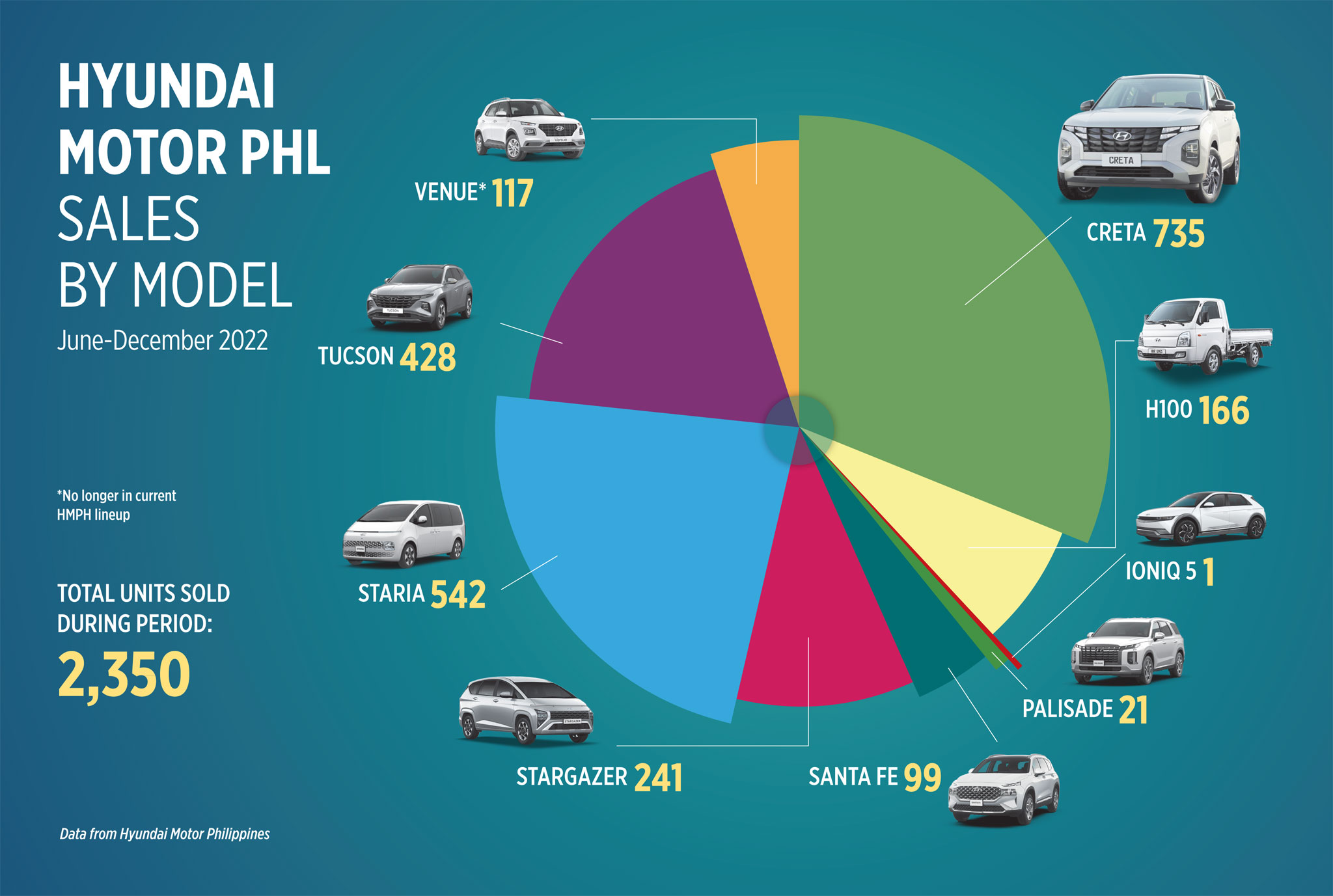
On the sidelines of the event, “Velocity” had a chance to talk exclusively with HMPH President Dong Wook Lee about how the company did in 2022, its plans for the new year, and what its top priorities are. Based on Philippine Automotive Dealers Association data, the company sold 2,595 units in 2022 — peaking in November with 600 vehicles moved. It must be noted that the number includes the months when Hyundai was under the control of Hyundai Asia Resources, Inc. HMPH commenced retail operations in June.

Here are excerpts from our interview.

VELOCITY: How happy are you with the company’s 2022 sales performance?

DONG WOOK LEE: We are satisfied with our 2022 performance, but we’ve just started. In 2022, it was about focusing on consumer confidence. We want them not to worry about the Hyundai brand. This year, we will focus on giving our customers the time and opportunity to enjoy our products, and a chance to understand our products more deeply. The most important thing is our relationship with our customer. Currently, our sales number is a little bit lower than projected, but we anticipate that after more people get a chance to enjoy our product, our sales number will increase continuously. I believe that at the end of this year, we’ll see better performance.
Are we going to see more activities like this mall display?

Yes. For example, this March we want our customers to see our Ioniq 5 on the road. We have already delivered cars to our dealers. Through this kind of event, customers can easily access our products, even enjoy test drives, and explore (vehicle) features. Then we hope our sales number increases.

What are your main goals for the year?

In 2023, we want our customer satisfaction index to increase. We will also launch new models.

Can you tell us what these are?

There will be one totally new model, and an additional variant for the Stargazer. We will be launching at the Manila International Motor Show (MIAS), and in June we will prepare for our anniversary event.

What kind of feedback are you getting from customers?

We’re getting good feedback and comments from customers — especially in the case of the Staria, Tucson, Ioniq 5, and Palisade. So many customers have been waiting for them, so we will increase our supply. We will also prepare worry-free packages. For example, in the case of the Ioniq 5, we will provide free home charging cable installation, a five-year PMS package, and 24-hour roadside assistance by the third quarter. We want to emphasize that worry-free aspect.

How is HMPH doing with regard to unit supply?

Currently, we have challenges regarding supply, but we anticipate it to get better. For example, volume has already been increasing from December to January to February. More customers are enjoying our cars and products. Hopefully, this will continue to improve. Also, our dealership network is preparing for enhanced after-sales service.

When HMPH first took over the business, you promised to put more vehicles in your dealers’ showrooms. Have you kept this promise?

Yes, our customer waiting time is getting shorter and shorter. In the case of the Staria, the wait used to be six months. Now, it’s much, much shorter.

SEC extends submission deadline for annual reports

THE Securities and Exchange Commission (SEC) has extended the deadline for filing annual financial statements (AFS) to allow auditors to finish their work.

“The extension seeks to provide external auditors more time to complete their statutory audits of the financial statements of corporations,” the SEC said in a press release.

Companies whose fiscal year ended on Dec. 31, 2022 are to file their AFS depending on the last digit of their SEC registration or license number.

All corporations’ branch offices, regional headquarters, and regional operation headquarters of foreign corporations must follow the new scheme set in the SEC’s Memorandum Circular No. 1, Series of 2023.

Under the number coding scheme, registration numbers ending in 1 and 2 are to file their reports on May 29 to 31 and June 1 to 2. For those ending in 3 and 4, the filing date is on June 5 to 9. For numbers ending in 5 and 6, the filing date is on June 13 to 16; and for those ending in 7 and 8, the date is on June 19 to 23.

SEC extension offices will also implement the schedule and corporations may submit their report on or before their respective deadlines.

Those not covered by the extension are corporations whose fiscal year ends on a date other than Dec. 31, 2022, corporations whose securities are listed on the Philippine Stock Exchange (PSE), those whose securities are registered but not listed in the PSE, public companies, and entities covered under Sec. 17.2 of Republic Act No. 8799, or the Securities Regulation Code (SRC).

Additionally, corporations whose AFS are being audited by the Commission on Audit (CoA) are also not covered by the extension.

“Such corporations shall provide an affidavit signed by the president and treasurer or chief finance officer attesting to the fact that the company timely provided [CoA] with the financial statements and supporting documents,” the SEC said.

It added that a corporation needs to prove the CoA audit has concluded as well as present a letter confirming the information stated in the AFS.

Additionally, the company’s general information sheet must be filed within 30 calendar days from the date of its annual stockholders’ meeting. — Adrian H. Halili

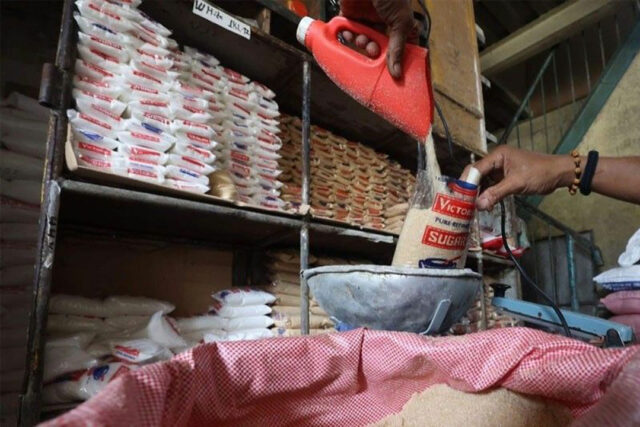
‘No formula’ to trigger sugar reserve releases, but consumption data key

PHILIPPINE STAR/ MICHAEL VARCAS

By Sheldeen Joy Talavera

THE release of reserve sugar from the buffer stock will come after a determination by the Sugar Regulatory Administration (SRA), which is empowered by law to make such a decision, a government researcher said.

“There’s no formula as such (to release sugar from the reserves), although some calculation and estimates might be used as a basis… More of a judgment call,” Roehl M. Briones, senior research fellow at the Philippine Institute for Development Studies (PIDS), told BusinessWorld by phone.

“The charter of the SRA empowers it. So, by law, the SRA is the authority to decide on importing, marketing, and distribution of sugar. That is how broad its regulatory powers are,” he said.

In January, President Ferdinand R. Marcos, Jr., who also serves as the Secretary of Agriculture, ordered the creation of a two-month buffer stock of sugar to deter speculators, who have been blamed for volatile sugar prices.

“If we see the need to release, we will source (sugar) from the buffer,” Pablo Luis S. Azcona, SRA board member and planter’s representative, told BusinessWorld.

“I hope we will not be using the buffer until almost milling season next year,” he added.

Under Sugar Order No. 6, 440,000 metric tons (MT) of refined sugar are authorized for import — of which 200,000 MT will be released to the market and 240,000 kept in reserve.

According to Mr. Azcona, about 17,000 MT of the sweetener have been landed so far. The SRA plans to bring the retail price of refined sugar to P80-P85 upon release of the shipments.

Asked what data the SRA will study before it decides on releasing sugar, Mr. Azcona said: “We actually assume a monthly consumption of anywhere from 120,000-180,000 MT, so once we see (diverge over a two-month period), that’s where the buffer will enter,” he said.

The exact mechanism would involve a reclassification of “C” (reserve) sugar to “B” (domestic market). The power to reclassify lies with the Sugar Board, whose members include the SRA administrator, the millers’ representative, and the planters’ representative. It is headed by the Agriculture Secretary and an Undersecretary.

He said the release order will come in the form of a board resolution spelling out the volume and date of release.

Mr. Briones said that the SRA may request a study or analysis of supply and demand conditions but the board retains the discretion to authorize imports.

The intent is to refresh the buffer stock with domestic sugar as it depletes, he said.

“We will try to always maintain a balance between the retail price and the farmgate price. So, our farmers are happy, and the consumers are also happy,” Mr. Azcona said.

Leonardo A. Lanzona, Jr., an economics professor at the Ateneo De Manila University, said that the SRA has no fixed regulations in deciding how much sugar to import.

He said one of the issues is that certain types of users have different needs in terms of the volume they need to import.

An industrial user that uses standard refined sugar, he said, can import 5,000 MT while those using bottler’s grade sugar can import up to 10,000 MT.

“Allowing one sector to import more creates a barrier to entry for other new sugar users within the same sector,” he told BusinessWorld via e-mail.

Mr. Lanzona said these rules tend to favor the well-connected, keeping the industry from “achieving its full potential.”

“It is best to disband the SRA, and simply let the private sector compete with one another, allowing the market to determine how much to import,” he said.

Lazada marks 11th year as it reaps effect of pandemic

LAZADA is celebrating its 11th anniversary in the Philippines with an ongoing sale and a 20-foot mannequin in BGC’s Market! Market! mall.

During the March 2 launch of the “Epic 11th Birthday” sale, which is ongoing until March 13, the company unveiled the mannequin, to celebrate its Lazlook category, its 11th anniversary, and Women’s Month this March.

“We want to make sure that we empower each and every one,” said Kitty Calderon, Head of Marketing for Lazada Philippines in a speech, acknowledging the women employees, partners, and sellers on the e-commerce platform. “Women are at the core of what we do,” said Carlos Barrera, the CEO of Lazada Philippines.

Shopping platform Lazada was founded in 2012, and from its Singapore headquarters, it services that country, Indonesia, Malaysia, the Philippines, Thailand, and Vietnam. According to a company release, it links 160 million active users to more than one million sellers every month, while aiming to serve 300 million shoppers in the region by 2030.

“It’s been an incredible journey for all of us. I’ve been in the Philippines for over eight years. Many of these brands did not exist. Most of these sellers were starting with a small kiosk in the mall. When we see them today, making billions of pesos and selling nationwide, all our efforts make sense,” said Mr. Barrera.

THE PANDEMIC EFFECT
“We’ve grown so much, we’ve innovated so much as well,” Ms. Calderon told BusinessWorld about their growth over the past 11 years.  “We’re empowering all of the SMEs when it comes to bringing their business up front to the Filipino audience,” she said. “The acceleration of e-commerce and digital was during the COVID season. Right now, if you think about it, we’re still in a pandemic. E-commerce is playing a big role in making sure that we shop safely and conveniently.”

Ms. Calderon discussed the items on the platform that have become popular since the world has reopened after the pandemic lockdowns. Groceries are still a staple, but, “You’d be surprised with the amount of makeup, hair, and personal care products that people are buying, especially now that people are going out,” she said.

With the world’s reopening, will Lazada still be able to maintain its place in the Filipino shopper’s mind? “Even if the pandemic goes away, we’re all so used to shopping online already. The beauty of shopping online is really convenience and safety. I don’t think we’ll go back to those days when you really have to go to a store every single time,” she said. — Joseph L. Garcia

Rates of Treasury bills, bonds to go up on hawkish BSP bets

BW FILE PHOTO

RATES of Treasury bills (T-bills) and Treasury bonds (T-bonds) on offer this week could rise on expectations of faster inflation last month, which could lead to a more aggressive move from the central bank.

The Bureau of the Treasury (BTr) will auction off P15 billion in T-bills on Monday, made up of P5 billion each in 91-, 182-, and 364-day papers.

On Tuesday, it will offer P25 billion in reissued 10-year T-bonds that have a remaining life of nine years and six months.

Rizal Commercial Banking Corp. Chief Economist Michael L. Ricafort said in a Viber message that T-bill and T-bond rates could track the rise in secondary market yields.

“The upcoming Treasury bill yields could be again slightly higher week on week, after the latest weekly increase in the comparable short-term PHP BVAL (Bloomberg Valuation Service) yields after the latest signals of a possible 50-bp (basis point) local policy rate hike on March 23 if inflation goes above 9%,” he said.

A trader said T-bill rates could rise by 10 bps to 15 bps, while the 10-year bond could fetch a yield of 6.5% amid expectations of faster February headline inflation, which could lead to higher benchmark interest rates.

At the secondary market on Friday, the 91-, 182-, and 364-day T-bills went up by 11.82 bps, 3.49 bps, and 16.25 bps week on week to end at 4.617%, 5.1764%, and 5.6089%, respectively, based on the PHP Bloomberg Valuation Service Reference Rates data published on the Philippine Dealing System’s website.

The 10-year bond also saw its yield increase by 13.18 bps week on week to 6.4496%.

Bangko Sentral ng Pilipinas (BSP) Governor Felipe M. Medalla on Friday said the central bank may raise rates by 50 bps at their March 23 meeting if February inflation rises above 9%.

The BSP on Feb. 16 raised benchmark interest rates by 50 bps for a second straight meeting, bringing its policy rate to 6%, the highest in nearly 16 years or since May 2007 when it stood at 7.5%.

It has now hiked borrowing costs by 400 bps since May 2022.

Meanwhile, February inflation likely settled within 8.5% to 9.3%, the BSP said last week. This would follow January’s 8.7% print, which was the quickest since November 2008.

If realized, February would mark the 11th straight month that inflation would exceed the BSP’s 2-4% target range.

The upper end of the forecast would also be the fastest headline print recorded in more than 14 years or since the 9.7% recorded in October 2008.

The Philippine Statistics Authority will release the February consumer price index report on March 7, Tuesday.

Last week, the BTr raised P10 billion from its offering of T-bills, lower than the P15-billion program, as rates climbed across all tenors.

Broken down, the Treasury did not award any 91-day T-bills as tenders reached only P4.12 billion, below the P5-billion program. Had it been awarded, the average rate of the three-month papers would have climbed by 45.10 bps to 4.864%.

Meanwhile, the government made a full P5-billion award of the 182-day securities as demand for the tenor reached P9.46 billion. The six-month T-bill was quoted at an average rate of 5.177%, rising by 11.70 bps, with accepted rates ranging from 5.093% to 5.3%.

The BTr also borrowed P5 billion as planned from the 364-day debt papers as bids reached P9.07 billion. The average rate of the one-year papers climbed by 12.20 bps to 5.577%. Accepted yields were from 5.565% to 5.6%.

On the other hand, the reissued 10-year T-bonds to be auctioned off on Tuesday were last offered on Feb. 21, where the government raised the programmed P35 billion.

The issuance fetched an average rate of 6.258%, with accepted rates at 6.199% to 6.3%.

The Treasury wants to raise P200 billion from the domestic market this month, or P75 billion via T-bills and P125 billion via T-bonds.

The government borrows from local and external sources to finance its budget deficit, which is capped at 6.1% of gross domestic product this year. — A.M.C. Sy

‘Crossover specialist’ Jetour girds for PHL debut

Jetour Dashing — PHOTO FROM JETOUR

By Kap Maceda Aguila

THE CAT is out of the bag. Another automotive marque has just thrown its hat in the already uber-competitive local market. That means even more options for a market already spoiled for choice.

To be formally launched at the Manila International Auto Show this summer is Jetour, which (for now, at least) exclusively makes crossovers of various sizes. The brand is controlled by Chery Holdings Group which, of course, also owns Chery Automobile Co., Ltd. On its global website, Jetour explained its name thus: “JET + TOUR, meaning convenient + travel, translate literally as ‘convenient travel.’ (This) corresponds to (its) Chinese name.”

Jetour’s Philippine operations will be spearheaded by a couple of young mavericks: 31-year-old Yves Jovicci Licup as president, and Michael Goho (aged 33) as vice-president. Their surnames are definitely familiar to automotive observers as these are attached to multi-brand empires Autospeedygo and the Gateway Group.

“It was offered to us, so we called on a few investors and collaborators,” said Mr. Licup to “Velocity.”

Meanwhile, Jetour Managing Director Miguelito “Lito” Jose, an industry veteran with more than three decades of experience, revealed that three products will be initially made available at launch. We have confirmed that one of these will be the Jetour Dashing, the brand’s flagship product, powered by 1.5-liter engine and highlighted by a 2.7-meter-long wheelbase, futuristic styling, and tech accoutrements.

“Jetour prides itself in having a “travel-plus-leisure-plus-tech” concept. Our unique value propositions include very competitive pricing which will see our comfortable crossovers priced as, say, a subcompact sedan,” continued Mr. Licup.

Asked about the confirmed dealership locations, Mr. Jose revealed, “As of now, Alabang, Quezon Avenue, Cebu City, General Santos City, and Davao City are shoo-ins. But after news leaked about our launch, many parties — even non-automotive groups — have signified their intent to apply for a franchise. They want in because both Autospeedygo and the Gateway Group are known dealers/retailers, and that our way of going about this distribution business will have these dealers’ perspective.”

Mr. Goho also shared that Jetour Philippines is working to finalize a deal with brand ambassadors. “We are focusing on the concept of traveling or journeys. That’s all we can say for now,” he said.

For more information, follow the brand’s Facebook page (Jetour Auto Philippines).

PPA guidelines receive greenlight from ARTA

THE Philippine Ports Authority (PPA) said the Anti-Red Tape Authority (ARTA) had approved its policy on the registration and monitoring of containers that will help address the problems of port users and truckers.

In a press release, the PPA said ARTA had acknowledged the port agency’s trusted Operator Program-Container Registry and Monitoring System (TOP-CRMS) as a “good practice.”

“This is a welcome development, considering the concerns raised about the program, but the green light of ARTA means TOP-CRMS is the best option to solve the current problems,” PPA General Manager Jay Daniel R. Santiago said.

“ARTA acknowledged the problem on container deposits and empty container returns and recognized that the PPA through TOP-CRMS is providing the solution to the long-time problems of the port users and truckers,” the agency said.

PPA quoted ARTA as saying that the TOP-CRMS met the criteria for cost-saving mechanisms including the fee on container deposits and port access roads, and has reduced the dwell time of empty container returns to less than 72 hours.

TOP-CRMS is also said to be economical with a net benefit of P470.73 billion compared with the P472.04 billion of the Container Ledger Account and P471.89 billion of the Electronic Tracking of Containerized Cargo system of the Bureau of Customs under the 10-year implementation period.

“To break it down, TOP-CRMS aims to lower logistics cost by replacing the status quo of container deposit that amounts to P10,000-P30,000 with a P250 container deposit insurance and P730 container monitoring fee,” the PPA said.

The PPA system is also expected to reduce the empty container handling costs by lowering the existing charge of P6,400 to P3,520.

Mr. Santiago said that the PPA will continue to fine-tune the program and monitor its implementation so that the necessary adjustments will be done as necessary.

“TOP-CRMS seeks to remove the payment of container deposits and to efficiently manage the return of empty containers. In fact, there have been a series of public consultations and we have adjusted based on the need of the stakeholders,” said Mr. Santiago. — Justine Irish D. Tabile

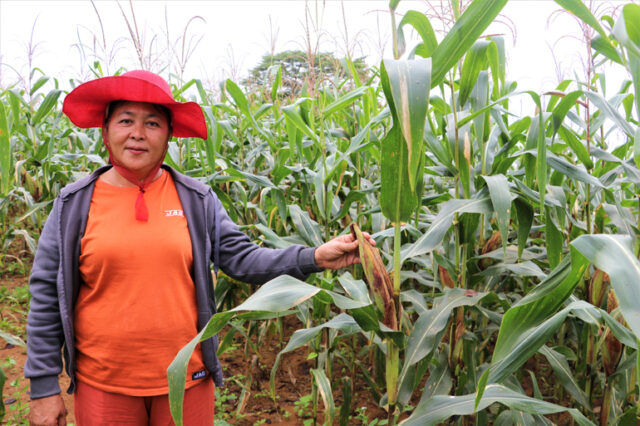
Isabela corn farmer enjoys bountiful harvest with LANDBANK’s aid

LANDBANK helped Isabela corn farmer Levy Mateo turn down private lenders with unfair terms. She now enjoys an affordable interest rate of only 2% per annum under the ACEF Lending Program, allowing her to save for the future and provide a more comfortable life for her family.

Born to a family of farmers in the remote barangay of Sindun Bayabo, corn farmer Levy Mateo learned about the value of hard work at a young age.

Levy started helping out in their corn fields as a young student and eventually became a full-time farmer. She relied on the three-hectare corn field she inherited from her parents as a means to support her own family, especially in raising her three children.

But despite Levy’s diligence over the years, she struggled to enjoy her earnings and save for her family’s future, as she had to allocate a large portion of her income to pay the hefty interest from loans she regularly availed from a private lender.

For 12 years, Levy turned to a nearby rice and corn mill that offered loans to farmers in order to sustain her corn production. The mill charged an interest rate of 30% per annum, and as a condition to avail of a loan, required borrowers to sell all of their produce to the mill at a low price — leaving Levy and other farmers with little profit.

“’Yung panggastos sana para sa pangangailangan ng aming pamilya, ibabayad pa namin sa napakalaking porsyento ng interes. Pati ang presyo ng mais na ibebenta, sila [rice mill] rin ang nag-didikta,” said Levy.

At the height of the COVID-19 pandemic in 2020, Levy’s income decreased further due to the limited movement of goods and strict imposition of lockdowns in the area. She was then faced with a grim circumstance: if she continued to avail of high-interest loans from the mill, there will be almost nothing left for her family and their daily expenses.

LANDBANK support

It was during this time that Levy was encouraged by a fellow farmer to avail of a loan under the Agricultural Competitiveness Enhancement Fund (ACEF) Lending Program offered by the Land Bank of the Philippines (LANDBANK) and the Department of Agriculture (DA).

Nung nakahiram ako sa LANDBANK, hindi na ako lumipat sa iba. Sa LANDBANK na ako laging lumalapit para sa aming mga pangangailangan sa sakahan. Napakaganda talaga dahil ang baba ng interes ng ACEF,” said Levy.

Under the Program, Levy availed of an initial loan for working capital amounting to P120,000 — which has since grown to P600,000 — for the purchase of farm inputs such as seedlings and fertilizers.

With the Program’s affordable interest rate of only 2% per annum, Levy was able to provide a more comfortable life for her family while repaying her loan on time. She was also free to choose a buyer in the market who can offer the best price for her produce, which can reach as high as P1,000 per cavan, multiplied by Levy’s average yield of 400 cavans per harvest.

Banking on her good experience as a borrower, she has encouraged fellow farmers to seek assistance from LANDBANK to finance their production, including her own daughter, who likewise ventured into farming.

Ang laki ng pasasalamat ko sa LANDBANK dahil talagang umunlad at guminhawa ang aming pamumuhay. Hindi na kami nagigipit sa pagbabayad ng interes,” she added.

Under the ACEF Lending Program, farmers, fishers, their cooperatives and associations, as well as micro and small enterprises (MSEs) can borrow funds from LANDBANK to boost their agricultural productivity.

Farmers and fishers can borrow up to P1 million while cooperatives, associations, and MSEs may avail of loans up to P5 million for the purchase of farm inputs and equipment, as well as the acquisition or establishment of agri-based production and processing machineries, equipment and facilities, among others.

LANDBANK has released a total of P9.2 billion in loans under the ACEF Lending Program in support of over 38,900 borrowers composed of small farmers and fishers, cooperatives, and MSMEs nationwide.


Spotlight is BusinessWorld’s sponsored section that allows advertisers to amplify their brand and connect with BusinessWorld’s audience by enabling them to publish their stories directly on the BusinessWorld Web site. For more information, send an email to online@bworldonline.com.

Join us on Viber at https://bit.ly/3hv6bLA to get more updates and subscribe to BusinessWorld’s titles and get exclusive content through www.bworld-x.com.

At the home of Zara, fast and slow fashion collide

MARIAN Fernandez, 56, a former employee of Inditex, rearranges clothes at the store window display of her fashion shop Maazi in downtown A Coruna, in northern Spain, Nov. 18, 2022. — REUTERS/MIGUEL VIDAL

A CORUNA, Spain/LONDON — In Spain’s A Coruna, two contrasting fashion business models collide — pitching the growing demands for the clothing industry to become more sustainable against the constant need to drive sales.

This rainy, windswept city on the rugged Atlantic coast is the unlikely headquarters of Zara-owner Inditex — the world’s biggest fast fashion retailer.

It also hosts small boutiques offering high quality, durable products that consider themselves an alternative to the fast and affordable fashion propelling Inditex’s annual sales of 28 billion euros ($30 billion).

Inditex’s massive output of garments was a factor behind the European Union’s (EU) pledge last year to reverse the “overproduction and overconsumption of clothing.” It wants all clothes sold in the bloc to be “long-lived and recyclable” by 2030.

The EU will announce its most significant proposals for the industry yet at the end of March, environment commissioner Virginijus Sinkevičius told Reuters on the sidelines of an event in Portugal last week.

The European Commission wants to ensure companies only manufacture the number of products they need. It will stop short of imposing restrictions, instead asking firms to police themselves to be called sustainable, Mr. Sinkevičius said.

“If you release tons and tons of clothes, textiles, shoes into the market, you will have to collect it,” he said.

Around 5.8 million tons of textile products are discarded every year in the EU, equivalent to 11 kg per person. A truckload of textile products is landfilled or incinerated somewhere in the world every second, according to EU figures.

Inditex had 565,027 tons of garments on the market in 2021, more than the 528,797 tons in 2018, according to its annual report. The company may disclose a further increase when its 2022 annual report is published next month.

So far, Inditex shows no sign of slowing production. But it is changing some processes, aiming to reduce its environmental impact while sticking to its strategy of regular new ranges.

Central to that plan is using recycled materials and cutting water, energy, and raw material usage, Inditex told Reuters in emailed responses to questions.

“We believe that it is not a question of how much (is manufactured), but of how,” the company said.

Half of Inditex’s garments were produced in a more sustainable way in 2021 — by for example using organic cotton or fibers that do not pose a risk to endangered forests — compared with 9% in 2018, the company said in its annual report, without giving specific data on how these materials reduce its environmental impact.

Inditex adjusts production to match customer demand and only 2% of stock needs to be recycled or donated, it said in its e-mailed responses to questions.

The company is targeting net zero emissions by 2040, and its strategy has been approved by the Science Based Targets Initiative (SBTi), a body which scrutinizes companies’ sustainability policies.

LEAVING LITTLE TRACE
Some of A Coruna’s smaller boutiques are run by former Inditex designers or sales staff who left to set up their own operations, emulating Inditex founder Amancio Ortega who established his first Zara store in A Coruna in 1975.

Among them are Jorge Toba, 37, and Antia Montero, 31, who worked at Inditex in purchasing and design. They launched children’s clothing brand The Campamento in 2018, producing just two, made-to-order collections a year, mostly with organic fibers.

They don’t add new products mid-season and they charge online shoppers for returns to encourage conscientious shopping.

“This is a very polluting industry, so we try to leave as little trace as possible,” Montero said at a warehouse in the heart of the city from which the business is run.

‘A DROP IN THE OCEAN’
Inditex, itself, is working with more than 100 startups specializing in recycling fibers.

Circ, a US company focusing on textile-to-textile recycling in which Inditex invested last year, is developing new technologies to separate cotton and polyester blended in most clothes, the first step to produce clothing from used or waste textile materials, its president Peter Majeranowski said.

But Circ and its competitors are only capable of producing 1% of the textiles needed to make the 109 million tons of clothes per year that the global fashion industry churns out.

“It’s really a drop in the ocean,” Mr. Majeranowski said. The goal is to recycle 10% of annual production by 2030, he said.

Marian Fernandez, 56, spent 25 years at Inditex, rising to become one of the top managers of its luxury brand Uterque before setting up her own fashion shop, Maazi, in downtown A Coruna. She posts weekly videos on social media teaching customers how to build a “responsible” wardrobe with dresses that can be used for multiple occasions and seasons.

Boutique labels in A Coruna could show the way to others.

“It’s in new and smaller companies where innovation starts,” said Achim Berg, a senior partner at global firm McKinsey & Co. — Reuters

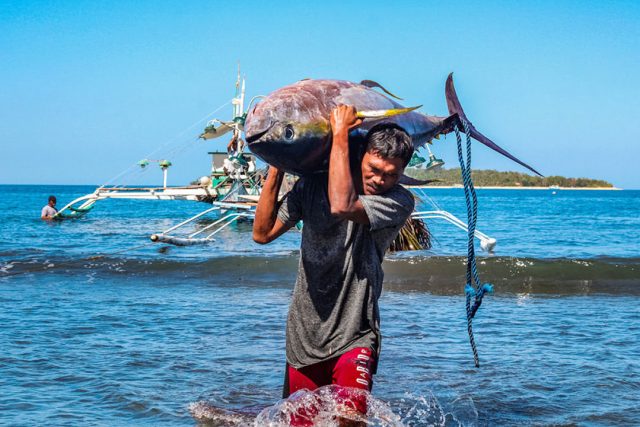
Sustainability certification gains favor with fisherfolk

PHOTOGRAPH © ALO LANTIN/WWF-PHILIPPINES/ WWF.ORG.PH

By Patricia B. Mirasol, Reporter

FISHERFOLK said they are working towards a Marine Stewardship Council (MSC) certification following initiatives being pursued by the tuna industry to ensure that its operations adhere to international best practices.

Kami ngayon is nasa proseso pa lang (We’re still in the process of getting the certification),” Suzette B. Villano, an official of the Sagnay Tuna Fishers Association in Sagnay, Camarines Sur, said.

The Philippines Tuna Handline Partnership (PTHP) was granted a 5-year certification in October 2021. PTHP is composed of the Gulf of Lagonoy Tuna Fishers Federation, Inc., the Occidental Mindoro Federation of Tuna Fishers Association, and the Philippine Association of Tuna Processors, Inc.

What they are all shooting for is the blue MSC label applied to wild fish or seafood from fisheries that meet international norms for sustainable fishing. The label signals to consumers the fish they purchase comes from a sustainable source.   

Ms. Villano told BusinessWorld via Zoom that one of the certification requirements is the use of handlining, a method that involves a handheld line with one or more baited hooks attached to the end.   

The requirements for fisherfolk participating in the initiative include registration with the Department of Agriculture and the licensing of their equipment. 

Marami pa kaming inaasikaso [We’re still working on the requirements],” added Ms. Villano. “Bawat huling isda, dapat naka-record (Each catch has to be recorded).”

Ms. Villano said the changes in fishing conditions, possibly the result of climate change, include Sagnay’s receding shoreline and the growing difficulty of finding fish.

Dati sa lugar namin, kahit hindi ka na pumunta sa malayo, may isda (You didn’t have to venture far to fish before),” she said. “Ngayon hinahanap na ang isda (Nowadays, you have to look for the fish).”

Handline fishing is sustainable, she said, because it does not negatively affect the ecosystem.

STRINGENT PROCESS
“Our partner small-scale fisherfolk are already able to export their products to the international market,” said Raisa D. Pandan, World Wide Fund for Nature (WWF)-Philippines’s technical operation manager of Sustainable Tuna Partnership (STP) 2.

“WWF-Philippines works closely with the PTHP to ensure that fisherfolk are represented at the negotiating table with processors and exporters,” she said via Messenger.

The global conservation group facilitates the tuna fishery improvement project (FIP), a program that aims to establish sustainable fishing practices and improve the livelihoods of fisherfolk, such as Ms. Villano’s group and others in the PTHP.

The fisherfolk have decided to shoot for MSC certification on their own, with guidance from the WWF-Philippines, which runs the STP.

It took PTHP ten years to get its MSC certification, according to Joann P. Binondo, WWF-Philippines’ overall program manager for STP 2. “We started in 2011 with the Tuna FIP.”

“MSC is really difficult and expensive to obtain and maintain, especially for small-scale handline fisheries from a developing country,” Ms. Binondo said via Messenger.

“I salute the tuna fishers from Lagonoy and Mindoro (who) committed to continue over the years despite the stringent process,” she said.

REIGNITED INTEREST
The Lagonoy Gulf and Mindoro Strait fisherfolk MSC certification has “reignited the interest” of securing the certification among General Santos City’s tuna fishing industry, Ms. Pandan said.

In 2021, she added, the Fresh Frozen Seafood Association of the Philippines and the Socsksargen Federation of Fishing and Allied Industries, Inc. signed a partnership with the SARGEN Fish Port Tuna Handline Fishing Association, Inc. with the aim of establishing a Fisheries Improvement Project (FIP) in General Santos.

“The FIP is a precursor to their goal to achieve an MSC certification, an undertaking we support and welcome,” she told BusinessWorld.

Ms. Pandan added that it’s “not only about how to make our fishers more competitive, but also how to ensure that they reap the benefits that they should rightly be receiving as producers of export commodities at the international scale.”

Tuna and tuna-like species account for 20% of the entire value of the world’s marine capture fisheries, per the Food and Agriculture Organization of the United Nations. Worldwide demand for sustainably sourced fish has been rising in recent years, including in the UK and US.

Ms. Villano, who estimates that it might take her group five more years to get MSC-certified, says they expect their catch to command higher prices at the conclusion of the process.

The current price of tuna, she said, is P280-P300 per kilo during the lean months of April to July.

Sana mabigyan pansin ’yung mga maliliit na mangingisda, para matanggal ang mindset na ang mga fisherfolk poorest among the poor (I hope small-scale fisherfolks get more attention, to eliminate the mindset that fisherfolk are among the poorest of the poor),” she added.

Fed’s Daly says more hikes needed to cool inflation

FEDERAL RESERVE Bank of San Francisco President Mary Daly said policy makers will likely need to raise interest rates higher and maintain them at elevated levels for a longer period of time.

“It’s clear there is more work to do,” Ms. Daly said in a speech Saturday at Princeton University in New Jersey. “In order to put this episode of high inflation behind us, further policy tightening, maintained for a longer time, will likely be necessary.”

Ms. Daly said inflation remains high in each sector — goods, housing and other services — and that the bumpy nature of incoming data paints an unclear picture for disinflation momentum. While Daly doesn’t vote on policy this year, she is a participant in Federal Open Market Committee meetings and discussions.

The Fed has tightened aggressively in the last 12 months, lifting its benchmark policy rate from nearly zero to a target range of 4.5% to 4.75%, though policymakers have recently slowed the pace of rate increases. They downshifted to a quarter-percentage-point move on Feb. 1 after hiking by a half point in December, which followed four consecutive 75-basis-point (bp) increases.

“This tightening, while pronounced, was and remains appropriate given the magnitude and persistence of elevated inflation readings,” Ms. Daly said.

During a post-speech question and answer session she discussed the potential impact of lags but made clear that the Fed could not afford to pause with inflation still too high.

“In my judgment it would be a mistake to say we’ve done all we need to do, it’s all going to be working down the road,” she said. “That’s where you have to think about continuing tightening.”

In a call with reporters following the speech, Ms. Daly repeated that she supports raising rates to somewhere between 5% and 5.5%, roughly in line with the December dot plot median of 5.1%.

Inflation, which reached a 40-year high last year, fell in the last three months of 2022, but ticked back up in January. That month’s data also showed strong consumer demand and blockbuster hiring by firms.

Ms. Daly said while it’s important to recognize the recent reversal “it is not an indicator, necessarily, that the trend has changed.”

Several of her colleagues have since said that interest rates may need to go higher than they previously thought, and investors are now betting on a peak around 5.45%. That level could be achieved by 25-bp hikes at each of the three following meetings. Ms. Daly did not specify in Saturday’s speech nor in a call with reporters afterward how much more tightening she thinks is appropriate, but told reporters that she is focused on more on the level the rate needs to get to than the pace.

“It would be enough of a preponderance of evidence that the economy is on a track that is going to require significantly more tightening that would lead me to say that we should change the pace,” Ms. Daly said. “Most of my energy right now is focused on thinking about the level at which we’ll hold.”

Policy makers will update their economic projections at their March 21-22 meeting.

Ms. Daly also spoke about the uncertainty of what will most drive future inflation. Before the pandemic, Fed officials struggled for years to get prices up to the central bank’s 2% target as an aging workforce and sluggish productivity growth weighed on inflation.

Now, new factors including the reshoring of production, a domestic labor shortage, the need for increased investment in technology and infrastructure amid a transition to greener sources of energy, and a potential change to inflation expectations could all pressure inflation upward. How these forces interact with the disinflationary ones of the past remains to be seen, Ms. Daly said.

“We don’t know what the trend will be,” Ms. Daly said. “But we do know that, while we continue to diffuse the ongoing inflation shock, we need to be working to gather data and research that illuminates the likely path forward.” — Bloomberg

Mitsubishi eyes extension of CARS program

At the 60th anniversary celebration of Mitsubishi Motors Philippines Corp. (MMPC) held in Sta. Rosa, Laguna are (from left): MMPC President and CEO Takeshi Hara, Philippine Economic Zone Authority Zone Manager Mary Jane Sanchez, Mitsubishi Motors Corp. (MMC) President and CEO Takao Kato, Sta. Rosa Mayor Arlene B. Arcillas, and MMC Executive Vice-President for Sales Yoichiro Yatabe. — PHOTO FROM MITSUBISHI MOTORS PHILIPPINES CORP.

By Revin Mikhael D. Ochave, Reporter

AUTOMOBILE MANUFACTURER Mitsubishi Motors Corp. (MMC) is eyeing a three-to-five-year extension of its commitment to the country’s Comprehensive Automotive Resurgence Strategy (CARS) program, citing the effects of the COVID-19 pandemic.

“Let’s say (a) three-to-five-year (extension) — something like that,” MMC President and Chief Executive Officer Takao Kato said after being asked for an update during an ambush interview on the sidelines of the 60th anniversary celebration of MMC’s local unit, Mitsubishi Motors Philippines Corp. (MMPC), in Sta. Rosa City, Laguna last Friday.

Mr. Kato said the company aims to add a new model for local production at its Sta. Rosa manufacturing plant once the extension request is approved by the Philippine government, along with other locally produced models such as the Mirage hatchback, Mirage G4 sedan, and the L300 utility vehicle.

“If (the) government can think about CARS program extension, we would be very happy. In that case, we definitely want to introduce another new model to this MMPC manufacturing plant. That is my plan. In 2023, I would like to decide (on) that,” Mr. Kato said.

The P27-billion CARS program, signed in 2015, grants fiscal incentives and budgetary support to MMPC and Toyota Motor Philippines Corp. (TMP). The two car manufacturers are required to produce 200,000 units over a six-year period.

Under the program, MMPC produces the Mirage and G4 while TMP manufactures the Vios subcompact sedan. However, both car manufacturers have asked for an extension from the Philippine government due to the effects of the pandemic on their manufacturing operations. TMP has requested for a three-year lengthening. MMPC’s participation in the program is set to end this year while TMP’s will end in 2024.

Asked on the planned new model to be produced at MMPC’s Sta. Rosa plant, Mr. Kato said that he has yet to reach a final decision.

Previously, the Department of Trade and Industry (DTI) said it is hoping that MMC would consider the local production of its Xpander multipurpose vehicle (MPV) model. “I have not decided yet. But not only Xpander… we now have a lot of plans to introduce new models. Definitely, some of those new models will come to this MMPC manufacturing plant. I have not decided yet. But probably, in the next couple of months, I’d like to decide,” Mr. Kato said.

“Last time, we had a meeting with President Marcos. We have requested to extend our CARS program more because during the COVID (pandemic), we (could not) operate… very well because as everybody knows, (the) pandemic was terrible, and economic activity was almost stopped,” he added.

The executive said that Mr. Marcos is “very positive” about providing an extension to MMPC’s CARS program commitment. “He completely agrees with my opinion and he agrees that during the pandemic, economic activity almost stopped.” Mr. Kato said, and maintained that MMC remains committed to the Philippines following the celebration of MMPC’s 60th anniversary.

“I am very happy, and very proud that MMPC can celebrate the 60th anniversary here in the Philippines because, for Mitsubishi Motors, the Philippines is one of the most important markets. I know that Filipino people love Mitsubishi Motors very much,” Mr. Kato said.

MMPC President Takeshi Hara said that the company remains committed to the Philippine market, moving forward. “We have successfully surpassed all the challenges over a period of time, and we will remain steadfast and strong. We will continue to work as a team to further achieve our goals,” he explained.

ADVERTISEMENT
ADVERTISEMENT