Home Blog Page 5081

Powerful tornado batters Mississippi

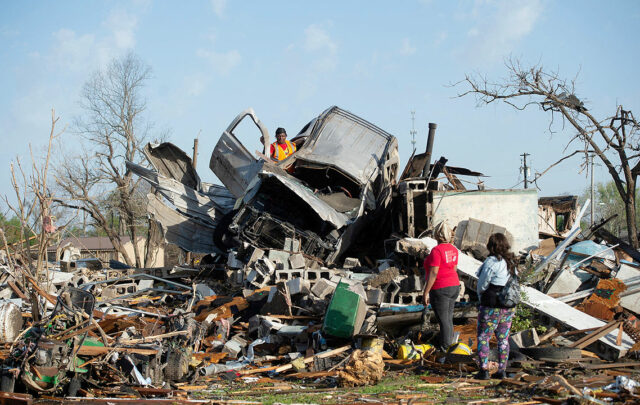
A MAN tries to salvage what he can from a vehicle after a tornado cut through their small Delta town the night before in Rolling Fork, Mississippi, US, March 25, 2023. — REUTERS

SILVER CITY — Rescuers combed through rubble on Saturday after a powerful storm tore across Mississippi late on Friday, killing at least 25 people there and one person in Alabama as it leveled hundreds of buildings and spawned at least one devastating tornado.

The tornado stayed on the ground for about an hour and cut a path of destruction some 170 miles (274 km) long, according to Nicholas Price, a meteorologist with the National Weather Service in Jackson, Mississippi.

In Rolling Fork, a town of around 1,900 in western Mississippi that was hit the hardest, homes were reduced to rubble, tree trunks snapped like twigs and cars were tossed aside like toys. The town’s water tower lay twisted on the ground.

Michael Searcy, a storm chaser who saw the tornado approach Rolling Fork, spent hours helping to rescue trapped people.

“As soon as we would go from one vehicle to the next vehicle or from building to building, we could hear screams and we could hear cries for help,” he told Reuters. “And we were just basically in small groups, digging through the rubble, trying to find and extricate people.”

Members of one family narrowly escaped by taking shelter in a bathroom; the rest of the house collapsed around them, and the high winds dropped a van on top of the home, Mr. Searcy said.

In Silver City, a rural community of around 300, residents described locking themselves in interior rooms and cowering inside bathtubs as the tornado swept through.

“I thought about God,” said Katherine Ray. “I just started saying, ‘I followed the Ten Commandments, Lord, it’s just me at the house,’ and I just said, ‘Just take care of me.’”

Her prayer was answered, she said; her trailer was damaged but still standing, while many of her neighbors saw their trailers completely destroyed.

Governor Tate Reeves, who visited Silver City on Saturday, declared a state of emergency in the affected areas.

“The scale of the damage and loss is evident everywhere affected today,” he wrote on Twitter. “Homes, businesses … entire communities.”

In Alabama, which was also struck by the same storm system, rescuers pulled a man from the mud when his trailer was overturned, but the man later died from his injuries, according to the Morgan County Sheriff’s Office. That appeared to be the only reported death in that state as of Saturday evening.

US President Joseph R. Biden described the images from Mississippi as “heartbreaking” and said in a statement that he had spoken with Mr. Reeves and offered his condolences and full federal support for the recovery.

“To those impacted by these devastating storms, and to the first responders and emergency personnel working to help their fellow Americans, we will do everything we can to help,” Biden said. “We will be there as long as it takes. We will work together to deliver the support you need to recover.”

Mississippi officials set up three emergency shelters, including at the National Guard Armory in Rolling Fork. Federal Emergency Management Agency (FEMA) Director Deanne Criswell will travel to Mississippi on Sunday, the White House said.

Parts of Mississippi and Alabama could face damaging winds, hail and possible tornados again on Sunday, the National Weather Service’s Storm Prediction Center said.

About 26,000 customers remained without power as of Saturday evening in Mississippi, Alabama and Tennessee due to the storm, according to the website PowerOutage.us.

Mississippi’s emergency management agency said on Saturday afternoon that the death toll had risen to 25, with dozens more injured. Four people who had been reported missing earlier have been located, the agency said.

At least 12 of those deaths occurred in Rolling Fork, its mayor, Eldridge Walker, told CNN earlier in the day. The city is 75% Black, and about one-fifth of the population lives below the federal poverty line, according to US Census data.

“My city is gone, but we are resilient,” Walker said on CNN. “We are going to come back strong.” — Reuters

Putin says Moscow to place nuclear weapons in Belarus

RUSSIAN PRESIDENT VLADIMIR PUTIN — KREMLIN.RU-COMMONS.WIKIMEDIA.ORG

RUSSIA will station tactical nuclear weapons in Belarus, President Vladimir Putin said on Saturday, sending a warning to NATO over its military support for Ukraine and escalating a standoff with the West.

Although not unexpected and while Putin said the move would not violate nuclear non-proliferation promises, it is one of the Russia’s most pronounced nuclear signals since the beginning of its invasion of Ukraine 13 months ago.

The United States — the world’s other nuclear superpower — has reacted cautiously to Mr. Putin’s statement, with a senior administration official saying there were no signs Moscow planned to use its nuclear weapons.

Mr. Putin likened his plans to the US stationing its weapons in Europe and said that Russia would not be transferring control to Belarus. But this could be the first time since the mid-1990s that Russia were to base such weapons outside the country.

“There is nothing unusual here either: firstly, the United States has been doing this for decades. They have long deployed their tactical nuclear weapons on the territory of their allied countries,” Mr. Putin told state television.

“We agreed that we will do the same — without violating our obligations, I emphasize, without violating our international obligations on the nonproliferation of nuclear weapons.”

Tensions have grown over the war in Ukraine after heavy supplies of Western weaponry to Kyiv and Moscow shifting its rhetoric on its military operation away from “demilitarization” of its neighbor to fighting “the collective West” there.

Some hawkish Russian politicians and commentators have long speculated about nuclear strikes, saying Russia has the right to defend itself with nuclear weapons if it is pushed beyond its limits.

“Tactical” nuclear weapons refer to those used for specific gains on a battlefield rather than those with the capacity to wipe out cities. It is unclear how many such weapons Russia has, given it is an area still shrouded in Cold War secrecy.

Experts told Reuters the development was significant, since Russia had until now been proud that unlike the United States, it did not deploy nuclear weapons outside its borders.

The senior US administration official noted that Russia and Belarus had been speaking about the transfer of nuclear weapons for some time.

“We have not seen any reason to adjust our own strategic nuclear posture nor any indications Russia is preparing to use a nuclear weapon. We remain committed to the collective defense of the NATO alliance,” the official said.

NATO’S THRESHOLD
Mr. Putin did not specify when the weapons would be transferred to Belarus, which has borders with three NATO members — Poland, Lithuania and Latvia. He said Russia would complete the construction of a storage facility there by July 1.

“This is part of Putin’s game to try to intimidate NATO … because there is no military utility from doing this in Belarus as Russia has so many of these weapons and forces inside Russia,” said Hans Kristensen, director of the nuclear information project at the Federation of American Scientists.

It was also unclear where in Belarus the weapons would be stationed. The transfer would expand Russia’s nuclear strike ability along NATO’s eastern border.

Although the Kremlin has never publicly confirmed it, the West has long been saying that Russia keeps nuclear-capable missiles in Kaliningrad, its Baltic coast exclave between NATO and European Union members Poland and Lithuania.

The International Campaign to Abolish Nuclear Weapons called Putin’s announcement an extremely dangerous escalation.

“In the context of the war in Ukraine, the likelihood of miscalculation or misinterpretation is extremely high. Sharing nuclear weapons makes the situation much worse and risks catastrophic humanitarian consequences,” it said on Twitter.

Mr. Putin said that Belarusian President Alexander Lukashenko had long requested the deployment. There was no immediate reaction from Mr. Lukashenko.

While the Belarusian army has not formally fought in Ukraine, Minsk and Moscow have a close military relationship. Minsk allowed Moscow to use Belarusian territory to send troops into Ukraine last year and the two nations stepped up joint military training.

“We are not handing over (the weapons). And the US does not hand (them) over to its allies. We’re basically doing the same thing they’ve been doing for a decade,” Mr. Putin said. “They have allies in certain countries and they train … their crews. We are going to do the same thing.” Russia has stationed 10 aircraft in Belarus capable of carrying tactical nuclear weapons, Mr. Putin said, adding that it had already transferred to Belarus a number of Iskander tactical missile systems that can launch nuclear weapons.

“It’s a very significant move,” said Nikolai Sokol, a senior fellow at the Vienna Center for Disarmament and Non-Proliferation.

“Russia had always been very proud that it had no nuclear weapons outside its territory. So, now, yes, they are changing that and it’s a big change.” — Reuters

China opens ties with Honduras, Taiwan decries monetary demands

BEIJING/TEGUCIGALPA/TAIPEI – China established diplomatic ties with Honduras on Sunday after the Central American country ended its decades-long relationship with Taiwan, while Taiwan’s foreign minister accused Honduras of demanding exorbitant sums before being lured away by Beijing.

The ending of ties with Taiwan had been expected after the Honduran foreign minister traveled to China last week to open relations and President Xiomara Castro said her government would start ties with Beijing.

China said its foreign minister, Qin Gang, and Honduran Foreign Minister Eduardo Enrique Reina signed the deal on diplomatic recognition in Beijing, ending relations with Taiwan dating back to the 1940s.

In a brief statement late on Saturday, the Honduran foreign ministry said it recognized the People’s Republic of China as the only legitimate government that represents all of China and that Taiwan is an “inseparable part of Chinese territory”.

China claims democratically ruled Taiwan as its own territory with no right to state-to-state ties, a position Taipei strongly rejects. China demands that countries with which it has ties to recognise its position.

Speaking in Taipei, Taiwan Foreign Minister Joseph Wu said Ms. Castro, who took office early last year, and her government had “always had illusions” about China and China’s “luring” had never stopped.

“The foreign ministry and embassy grasped the relevant information and handled it carefully. However, the Castro government also asked us for billions of dollars in huge economic assistance and compared prices for assistance programmes provided by Taiwan and China,” Mr. Wu said.

Taiwan President Tsai Ing-wen, in a video statement, said Taiwan will not compete with China in “meaningless” dollar diplomacy.

“Taiwan’s people have proved to the world that we never cower from threats. Taiwan’s cooperation and links with allies and like-minded countries to jointly promote international well-being and security will only increase, not decrease,” she said.

Neither the Chinese nor the Honduran statements made mention of aid.

Mr. Wu said Mr. Reina wrote to Taiwan on March 13, the day before Ms. Castro’s original announcement, demanding a total of $2.45 billion in aid, including the construction of a hospital and a dam and to write off debt. “It felt like what they wanted was money, not a hospital,” Mr. Wu said.

Ms. Reina told Reuters last week the $2.5 billion figure was “not a donation” but rather “a negotiated refinancing mechanism”.

PROMISES
Ms. Tsai is due to depart on a sensitive visit to the United States, Guatemala and Belize on Wednesday. She is expected to meet US House Speaker Kevin McCarthy in Los Angeles at the end of the trip.

Mr. Wu said he was “highly suspicious” of the timing of the Honduran decision so close to Ms. Tsai’s overseas tour. “China seems to be doing this intentionally,” he said.

The United States has been watching with concern as China expands its footprint in its backyard by taking away Taiwan’s Central American allies, and has repeatedly warned countries not to believe China’s promises of aid.

The US State Department said while the Honduran action was a sovereign decision, it was important to note China “often makes promises in exchange for diplomatic recognition that ultimately remain unfulfilled”. 

“Regardless of Honduras’ decision, the United States will continue to deepen and expand our engagement with Taiwan,” it said in a statement.

Relations between Honduras and Taiwan date back to 1941 when the government of the Republic of China, which remains Taiwan’s official name, was still in China before it fled to the island in 1949 after losing a civil war with Mao Zedong’s communists.

Taiwan now only has formal diplomatic relations with 13 countries, mostly poor and developing countries in Central America, the Caribbean and the Pacific. — Reuters

Ready, set, roll! Thai man wins fastest joint rolling in Phuket

REUTERS

PHUKET, Thailand — With nimble fingers and years of practice, Ativat Janmuangthai beat other cannabis enthusiasts to roll a perfect, one-gram joint in 43 seconds on Saturday, becoming the fastest joint-roller in Thailand’s Phuket.

“He’s been rolling joints for five years, he can even roll joints blindfolded. He’s very fast,” said Saksorn Sotornkittirat, friend of Mr. Ativat who accompanied him at the first Phuket Cannabis Cup competition.

Apart from the title and trophy, the winner, in his 30s, was also awarded a cash prize of 5,000 baht ($146.37).

The contest was part of an inaugural event where enthusiasts and experts could gather and exchange opinions and knowledge with the aim of helping set a standard for Thailand’s fledgling cannabis industry.

An international panel of judges was also invited to evaluate various cannabis strains, taking into consideration elements, such as appearance, Tetrahydrocannabinol (THC) levels, terpenes, flavour and genetic profiles.

Thailand became the first Southeast Asian country to decriminalize cannabis last year, but within a week of the move issued a raft of rushed piecemeal regulations to curb its potential unchecked use, including by children.

Last month, the parliament failed to endorse a cannabis draft bill before an election, set for May 14, leaving Thailand without an umbrella law to regulate the use of the substance.

Cannabis advocates in Phuket recently formed the Phuket Cannabis Association to create a stronger voice for the industry, with over 1,000 licensed dispensaries now on the island.

Poonwarit Wangpatravanich, the group president, hopes laws to regulate cannabis use will be hastened after the election.

“Imagine what’s going to happen if people fly right to Thailand just because of that (cannabis use). We’re going to increase such a large amount of GDP in tourism for the whole (of) Thailand,” he said. “The government should be very, very happy!” — Reuters

Ancient Egypt excavation uncovers 2,000 mummified ram heads at Abydos

CAIRO — At least 2,000 mummified ram heads dating from the Ptolemaic period and a palatial Old Kingdom structure have been uncovered at the temple of Ramses II in the ancient city of Abydos in southern Egypt, antiquities officials said on Saturday.

Mummified ewes, dogs, wild goats, cows, gazelles, and mongooses were found in the temple along with the ram heads, which are thought to be votive offerings indicating continuing reverence for Ramses II at the site about 1,000 years after his death, a statement from the tourism and antiquities ministry said.

It added that the discoveries would expand knowledge of the site over a period of more than two millennia up to the Ptolemaic period. The Ptolemaic period spanned about three centuries until the Roman conquest in 30 B.C.

Abydos, located in the Egyptian governorate of Sohag about 270 miles (435 km) south of Cairo, is one of Egypt’s major though lesser visited archaeological sites.

It was a necropolis for early ancient Egyptian royalty and a pilgrimage centre for the worship of the god Osiris.

Excavations were carried out by a mission from New York University’s Institute for the Study of the Ancient World.

Alongside the mummified animal remains, the team uncovered a large palatial structure with walls approximately five meters thick from the Old Kingdom’s sixth dynasty, in addition to several statues, papyri, ancient tree remains, leather garments and shoes.

The structure could help “reestablish the sense of the ancient landscape of Abydos before the construction of the Ramses II temple,” the head of the mission, Sameh Iskander, was quoted as saying. — Reuters

It’s the ecology, stupid!

The Cha-cha train continues to chug confidently along even after President Ferdinand “Bongbong” Marcos, Jr. (BBM) confessed disinterest. The bone of contention is the lifting of the constitutional restriction on foreign ownership which, advocates loudly claim, will open the floodgates to foreign investment. Congress, it seems, is betting that when presented with a prospect of gratuitous tenure extension, President BBM would not veto the prospective Cha-cha (charter change) law. For one, there is no foolproof guarantee that only the foreign ownership restriction will be lifted; two, why only the foreign ownership restriction? The farm size ownership restriction to five hectares and to the tradability of farm lands associated with CARP (Comprehensive Agrarian Reform Program) and the Constitution are just as, or even more deleterious, to overall investment than foreign ownership restriction. And overall investment, not just foreign investment, should be our concern.

Our overall investment record is tawdry. That metric of concern is the investment rate — the share of investment (GDCF) in GDP. GDP finances both consumption and investment. Investment is what finances a better tomorrow. For 2022, we juxtapose the Philippines’ investment rate with selected nearest rivals (see table).
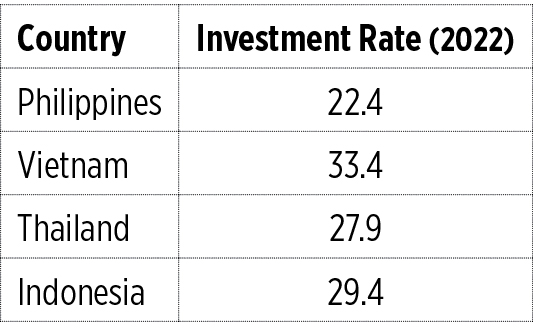
Two years after we passed the CREATE 2 Law (Package 2 of Corporate Recovery and Tax Incentives for Enterprises Act) in 2020 ostensibly to incentivize investment by corporations, the Philippine investment rate remains the lowest among our nearest rivals. We prefer to consume now rather than build up our children’s future. Our annual investment rate has not breached the 25% annual standard which separates the thoroughbreds and the laggards in the development highway. CREATE 2 was sold to the Filipinos as a “game changer” adding to the litany of many game changers in the past: the capital account liberalization, the World Trade Organization accession, the retail trade liberalization, etc. But our investment rate has stubbornly remained between 20-24%.

Why has our investment rate and our share of foreign investment in the ASEAN remained impervious to these so-called “game changers”? Why have the promised tsunamis failed to roll to our shores?

COMPETITIVE ECOLOGY
The reason is that investment responds not to piecemeal policy changes but to drastic changes in the investment ecology. By investment ecology I mean a battery of policies (fiscal, monetary exchange rate, regulatory policies, and quality of the rule of law), all supporting the same general direction. Stable macro will get you nowhere if many sectors are closed to investors (say, the farm sector or mining). CARP sees to it that large capital investors will keep clear of farm and food production.

Where contracts are not enforced and/or property rights are undefined, thus, unprotected, investors go elsewhere. The industry-scale swine project of San Miguel Food Corp. in Sumilao ran into a firestorm of indigenous rights and CARP rules in 2007 that only the enormous resources of San Miguel Corp. could afford to navigate. The message for potential food investors was “Beware!”

Where the rule of law is weak, the appetite to investment sours. But even if the rule of law is adequate, investment in power-intensive activities will shy away if the cost of power is prohibitive.

To be dead-shot competitive, one’s investment ecology must exhibit a modicum of all the requisite features. Improvements in some while other features remain below modicum will harvest only the dregs: the least beneficial types of foreign investment.

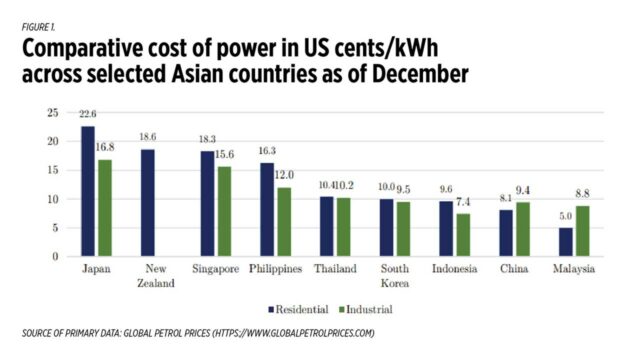
And power in the Philippines is indeed very costly relative to rivals. Figure 1 shows the comparative cost in US cents/kWh (kilowatt hour) across the selected Asian countries as of December 2021 (lifted from Ravago, 2023).
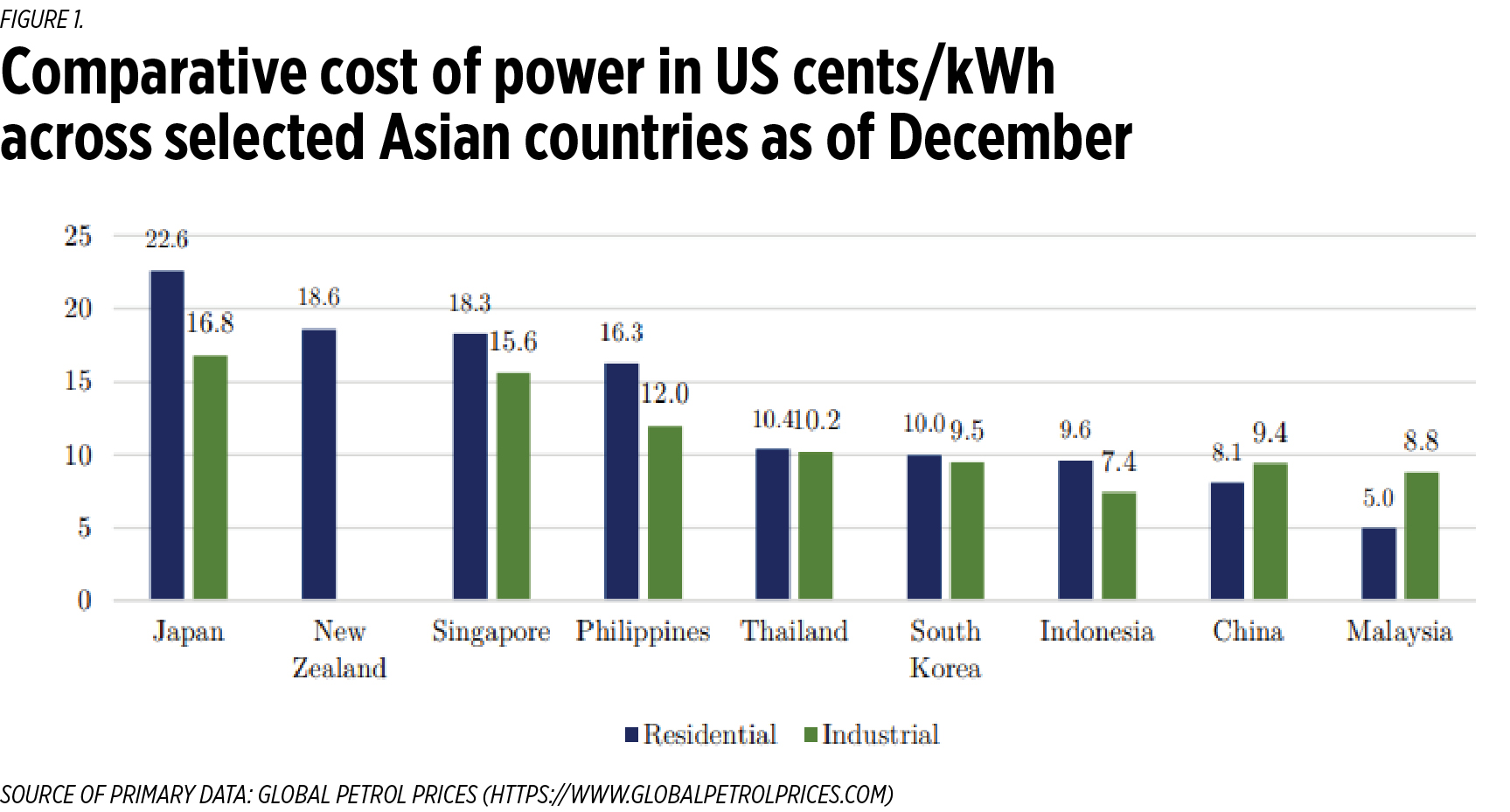
The Philippines has the highest power cost both for Industrial and Residential in the ASEAN barring Singapore. If reliability is factored in, the Philippines’ tariffs may exceed that of Singapore. The difference between Industrial and Residential tariff is highest in the Philippines (4%). In Malaysia and China, residential tariff exceeds industrial tariff! We have the lowest per capita generation of electricity (885 kWh 2020 vs. Thailand’s 2,531 kWh, Indonesia’s 1,004 kWh, and Malaysia’s 4,695 kWh), resulting in our per capita consumption (which is megawatts/cap or mWh/cap = 0.90) being the lowest in the region and below the notional power poverty threshold (1 mWh/cap). The periodic red and yellow alerts and/or actual rolling brownouts in the summer months shows that our power reserve is too thin. These disruptions raise the nominal and effective price of electricity.

Power is a very important — for some the most important — feature of the investment ecology. Investors in manufacturing and platform exports especially look at relative power cost. Asian economies falling flat on power cost will fall flat on investors. That is the Philippines’ sad plight.

In the Philippines, our lawmakers are feverishly wasting time arguing over Cha-cha and the Maharlika Investment Fund as attractions for foreign investment, while power cost and the rule of law far outweigh these as standard operating procedures for investment, both local and foreign.

Of course, foreign investment is of many varieties, not all of them healthy for the economy. Some don’t care for power cost and hardly for the rule of law. In the 1990s, we liberalized our capital account (made bringing in and out of capital easier) ostensibly to attract more foreign investment. We had some flocking but what variety did we get? Not of Direct Foreign Investment (DFI) that generates long-term employment and income, but of portfolio investment in pursuit of arbitrage — vulture capital, which are here-today-gone-tomorrow after they clean up. The ratio of portfolio to DFI is highest in the Philippines (up to 120% vs. 25-50% in the Asean in some years).

How about local capital? The high cost of power sent them taking cover in the non-traded goods sector (property, CBD, retailing) where they do not compete with the global rivals. So, what are we doing to lower our power cost?

Among others, the Nuclear Energy Program (NEP). The government and Department of Energy are seeking relief from nuclear fission technology to augment our baseload capacity. But the price outlook is not good for nuclear power vs. other fuels. It is especially inferior to renewables (five times cheaper than nuclear according to Lazard Investment Bank). If the NEP target is 600 megawatts of additional power in nine years at the cost of $1 billion, renewables especially solar, can easily deliver that at much lower cost.

How about the elephant in the room called intermittency? The “blended price” of solar power or the price of “solar plus battery storage” power, meaning “baseload solar” is now still lower (Lazard Investment Bank, LCOE July 2022) than nuclear. Nuclear plants can increase power supply but if at a higher cost, our power cost may rise. Furthermore, solar photovoltaic-generated power can start flowing in six months, not six years.

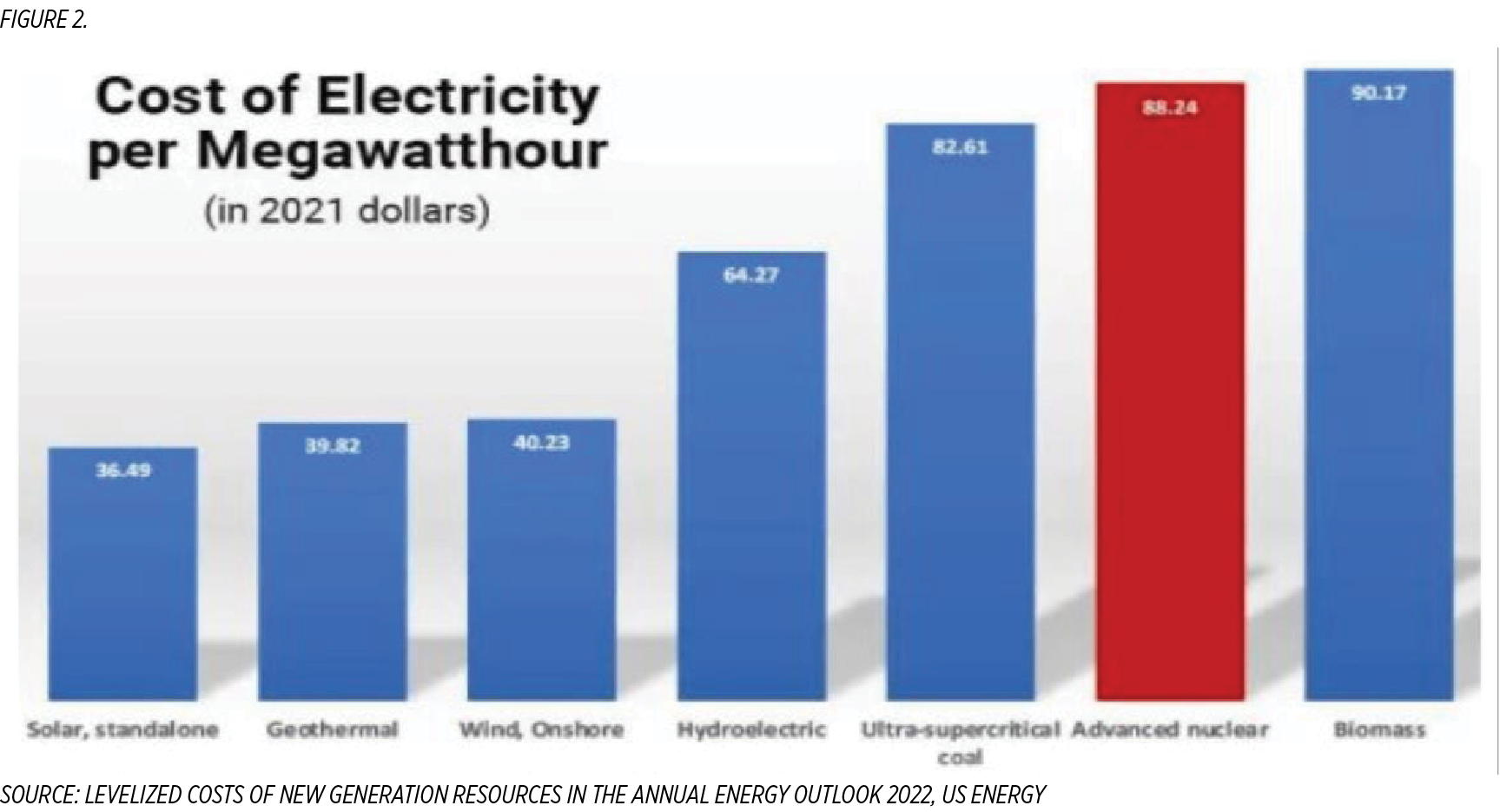
The urgency of lowering power cost in our investment ecology is not debated. But additional supply will not lower the power cost if the cost is prohibitive. Nuclear is not cost-competitive; renewables-plus-storage is, and with the prospect of rapid further decline. Figure 2 (from Mathews, 2022) shows that the LCOE (levelized cost of electricity, or the average cost in currency per energy unit) of nuclear in 2022 is way higher than solar and wind. It could only worsen, not solve the problem.
But even more auspiciously cheaper is the solar photovoltaic generation mounted on idle rooftops owned by large corporations — no NIMBY (not in my back yard) problems, no transmission and distribution charges, no missionary and universal charges, since the power is not going to the grid. It is modular and can start small. Kudos to the Gokongwei Group for realizing this, becoming a power company from solarized roofs (31-megawatt capacity).

The country gave Philippine corporations a tax break (to 25% from 30% corporate income tax) in the hope that they would deploy the savings for new investments to speed up economic recovery. They did not. It was just a massive transfer of resources to the rich, the big capital owners. Our investment rate has remained below 25%.

Congress should consider passing a “contingent idle rooftop tax”: a nominal tax of x% per m2 on idle rooftops owned by top 1,000 corporations which tax is lifted automatically once the company generates 20% plus of its total consumption by rooftop-mounted solar PV. And while at it, Congress may also consider lifting the universal and FIT charges from Manufacturing the way Germany does.

Let’s get our investment ecology air-born.


Raul V. Fabella is a retired professor of the UP School of Economics, a member of the National Academy of Science and Technology, and an honorary professor of the Asian Institute of Management. He gets his dopamine fix from bicycling, assiduously wooing the guitar despite meager success, and tending flowers with wife Teena.


Do not outlaw, just outdate

PHILIPPINE STAR/ MIGUEL DE GUZMAN

On March 6, a group of traditional jeepney drivers, which claims to have over 40,000 members, staged a nationwide strike to protest the government’s modernization program that would practically outlaw the public utility vehicles (PUVs) by yearend.

The government’s intention is legitimate: It wants to phase out polluting old jeepneys and replace them with more environmentally friendly PUVs called “e-jeepneys.” The government’s implementing prescription is to cease the issuing of franchises, and have drivers join cooperatives towards pooling their resources to purchase and operate more ecofriendly but more expensive PUVs.

In phasing out traditional ways in favor of modern ones more suited to the times, and outlawing the traditional ways, the government creates push back, resentment, and militancy. Human nature embraces the old ways of doing things. Changes come with great effort. It is also possible that the traditional jeepney drivers are right that the modernization program will strike a blow at their livelihoods, given that the alternative minibuses and e-jeeps cost millions of pesos.

Hence, it is not surprising that jeepney drivers staged a nationwide strike, and continue their resistance. As government pushes through with the plan to phase out old jeepneys, some drivers will lose their livelihoods, other drivers might follow the new law with resentment, and the rest can become “outlaws” by driving their banned vehicles in illegal routes.

There is an alternative way to outlaw something, and that is to outdate it. In the classic book Capitalism, Socialism, and Democracy (1942), Austrian economist Joseph Schumpeter argues that the nature of capitalism is not static, and that competition, together with the profit motive, creates an environment conducive for “creative destruction.” Such creative destruction produces new and better ways to supplant the outdated.

Those who lived the early 1980s may remember the cassette tape. The government did not outlaw them, but they disappeared. Always innovating, the private sector invented the compact disc (CD), making the cassette outdated. The millennials may remember that CDs, which, like the cassette tapes, were not outlawed by government. But CDs started vanishing as the private sector innovated and came up with the USB (universal serial bus technology). And at present, the USB is becoming a relic though it is not outlawed. Making it outdated is cloud technology, which is revolutionizing how we store data.

So, how come the traditional jeepneys have not been creatively destroyed? Here are some explanations.

First, the government has not been able to modernize the infrastructure for mass transit. Neither has it been able to adopt the proper strategy. Not only is infrastructure in trains and subways lagging, but the strategy is biased towards building infrastructure that allows for the movement of private vehicles and not for the movement of people and goods. Because the focus has been on the movement of private vehicles that usually service less people, and less on public transport, then many people still take traditional PUVs, making traditional jeepneys useful.

Second, although government can innovate, it must accept its role of being more of a facilitator of private innovation, rather than being the innovator itself. The government’s prescription to have drivers join cooperatives so that they can pool their resources to purchase and operate more environmentally friendly PUVs is a good idea. But the fact is that no private sector entity has taken the lead to create corporations or cooperatives because of the lack of enabling positive conditions. The government plan is thus not innovative enough. Remember that it is the profit motive that drives private innovation. If there is profit, the government need not use a heavy hand; the private sector and the drivers themselves will initiate the creative destruction.

Similarly, the government has not successfully created an environment where private sector innovators can strive sustainably and fairly. For example, the entry of Uber and Grab taxis into the market was a way to creatively destroy the traditional taxi. But as Uber started to grab a significant market share through uncompetitive means, the promise of what Uber had to offer disappeared, and the old traditional taxi remains in place. The government can learn from this experience in dealing with innovation plans to address the issue of traditional jeepneys.

The motivation behind the government’s modernization program is to adopt to more environmentally friendly ways of providing mass transportation. And by outdating, the government creates the condition for traditional jeepneys to be “creatively destroyed.”

Is this issue framed as a mutually exclusive choice between environment and livelihood? Not so. In the creative destruction of the USB by the cloud, people producing USBs lost jobs, but others gained jobs in the cloud industry while making consumers’ lives better. In the creative destruction of the traditional jeepney through innovation, the worst that can happen is that drivers of traditional jeepneys would lose their old livelihood, but this would be offset by the production of new and better jobs.

Further, the new innovation and new jobs improve the commuters’ experience and the environment. In this case, the government must provide support to the affected drivers through subsidies and technical training.


Luis F. Dumlao is a senior research fellow at the Ateneo Center for Economic Research and Development and occasionally writes columns for Action for Economic Reforms.

Fake AI photos are coming to a social network near you

VIEWED more than 3 million times, a tweet by No Context French showing AI-generated photos of French President Emmanuel Macron sprinting between riot police and protesters were fake.

ON TUESDAY in Paris, a popular Twitter user posted three images of French President Emmanuel Macron sprinting between riot police and protesters, surrounded by billows of smoke. The images, viewed more than 3 million times, were fake. But for anyone not following the growth of AI-powered image generators, that wasn’t so obvious. True to the user’s handle, “No Context French” added no label or caption. And as it turned out, some people believed they were legit. A colleague tells me that at least two friends in London who worked in various professional jobs stumbled across the pictures and thought they were real photos from this week’s sometimes-violent pension reform strikes. One of them shared the image in a group chat before being told it was fake.

Social networks have been preparing for this moment for years. They’ve warned at length about deepfake videos and know that anyone with editing software can manipulate politicians into controversial false photos. But the recent explosion of image generating tools, powered by so-called generative AI models, puts platforms like Twitter, Facebook, and TikTok in unprecedented territory.

What might have taken 30 minutes or an hour to conjure up on Photoshop-style software can now take about five minutes or less on a tool like Midjourney (free for the first 25 images) or Stable Diffusion (completely free). Both these tools have no restrictions on generating images of famous figures.1

Last year I used Stable Diffusion to conjure “photos” of Donald Trump playing golf with North Korea’s Kim Jung Un, none of which looked particularly convincing. But in the six months since then, image generators have taken a leap forward. Midjourney’s latest version of its tool can produce pictures that are very difficult to distinguish from reality.

The person behind “No Context French” handle told me they used Midjourney for their Macron images. When I asked why they didn’t label the images as fake, they replied that anyone could simply, “zoom in and read the comments to understand that these images are not real.”

They stood firm when I told them some people had fallen for the images. “We know that these images are not real because of all these defects,” they added, before sending me zoomed-in screenshots of their digital blemishes. When I asked about the minority of people who don’t look at such details, especially on the small screen of a mobile phone, they didn’t reply.

Eliot Higgins, the co-founder of the investigative journalism group Bellingcat, took a similar line when he tweeted fake images on Monday that he’d generated of Donald Trump getting arrested, playing off widespread expectations for his detention. The images were viewed more than 5 million times and weren’t labeled. Higgins subsequently said he’d been banned from using Midjourney.

While Twitter sleuths have pointed to the warped hands and dodgy faces of AI-generated pics, plenty of mainstream users are still vulnerable to this kind of fakery. Last October, WhatsApp users in Brazil found themselves flooded with misinformation about the integrity of their presidential election, leading many to riot in support of losing ex-president Jair Bolsonaro. It’s much harder to spot blemishes and fakery when someone you trust has just shared an image, at the height of the news cycle, on a tiny screen. And as a fully encrypted messaging app, there’s little WhatsApp can do to police fake images that go viral through constant sharing between friends, families, and groups.

Higgins and “No Context French” were just trying to create a stunt, but their success in getting multiple people to believe their posts were real illustrates the scale of a looming challenge for social media and society more widely.

TikTok on Tuesday updated its guidelines to bar AI-generated media that misleads.2 Twitter’s policy on synthetic media, last updated in 2020, says that users shouldn’t share fake images that may deceive people, and that it, “may label tweets containing misleading media.” When I asked Twitter why it hadn’t labeled the fake Trump and Macron images as they went viral, the company helmed by Elon Musk replied with a poop emoji, its new auto reply for the media.3

Some Twitter users who framed the Trump images as real with attention-grabbing hashtags like “BREAKING,” have been flagged by the site’s Community Notes, which lets users add context to certain tweets. But Twitter’s increasingly laissez faire stance towards content under Musk suggests fake images could thrive on its platform more than others.

Meta Platforms, Inc. said in 2020 that it would completely remove AI-generated media aimed at misleading people, but the company hadn’t taken down at least one “Trump arrest” image posted as real news by a Facebook user on Wednesday.4 Meta did not respond to a request for comment.

(Facebook has since fact-checked and removed the fake Trump photo. A spokesman said the company takes down manipulated content that meets specific criteria, including those that would “mislead an average person.”)

It’s clearly going to get harder for people to discern fake from reality as generative AI tools like Midjourney and ChatGPT flourish. The founder of one of these AI tools told me last year that the answer to this problem was simple: We have to adjust. I already find myself looking at real photos of politicians on social media, half wondering if they are fake. AI tools will make skeptics of many of us. For those more easily persuaded, they could spearhead a new misinformation crisis.

BLOOMBERG OPINION

1 OpenAI’s competing image-generation tool, DALL-E, restricts users from generating images of famous figures and war.

2 This is somewhat ironic considering TikTok’s own AI filters make users look like fake supermodels.

3 Musk emphasized his disdain for the press recently by auto-replying to all media enquiries with a poop emoji. Twitter, which aims to save free speech and become the world’s new digital town square, has no press office.

4 Many commenters have debunked the images on the premise that Trump can’t run.

This thing called GDP

CREATIVEARTS-FREEPIK

“After beating their growth target for 2022, the Philippine economic team headed by Secretary of Finance Diokno pegged the 2023 growth aspiration at 6.5%. Meanwhile, President Marcos believes early signs point to GDP growth settling even higher, at 7% YoY (year-on-year),” ING Bank analysts said in February (think.ing.com, Feb. 8, 2023). “However, given all the multiple challenges faced by the economy, we believe our 5% YoY growth forecast can be considered quite respectable against the backdrop of a likely global recession.”

A number of analysts expect 2023 growth to hit the lower end or the midpoint of the government target. “Of course, there are disagreements on what the growth rate will be this year,” Bangko Sentral ng Pilipinas (BSP) Governor Felipe Medalla told legislators at an economic briefing. “The most pessimistic is the IMF (International Monetary Fund) at 5%. “Our own forecasts are quite consistent… we should be between 6% and 7% this year,” the central bank governor added, as quoted in manilatimes.net (March 3, 2023).

Why is there such jealous insistence by government on higher percentage-point differences from desk-top GDP analyses which are lower and perhaps more cautious? Surely, if there was an outside prognosis higher than that of government’s, the government projection would immediately adjust upwards. What is this thing called Gross Domestic Product, GDP, and what does it really show?

“GDP is how we rank countries and judge their performance. It is the denominator of choice. It determines how much a country can borrow and at what rate… Fast growth, as measured by GDP, has been considered a mark of success,” David Pilling of the Financial Times says (weforum.org, Jan. 17, 2018). “The GDP measures the monetary value of final goods and services — that is, those that are bought by the final user — produced in a country in a given period of time (say a quarter or a year). The international standard for measuring GDP is contained in the System of National Accounts, 1993, compiled by the International Monetary Fund, the European Commission, the Organization for Economic Cooperation and Development, the United Nations, and the World Bank (imf.org, “Gross Domestic Product: An Economy’s All”).”

Right there, we can see the main problem of the GDP growth marker — how to measure it. There is much subjectivity in the factors considered, as to the choices and weight, with omissions of unpaid labor and non-material benefits that contribute immensely to the quality of life. For the GDP is more than a wealth measure, it is a gauge of well-being. Standard of living and income distribution call for attention in the computations. The statistics are hard to hold down — is the data in the proper time frame? And the comparative foreign exchange conversion must standardize the GDP figure presented to the world (based on the US dollar).

And then there is this ubiquitous starting assumption in economic analysis: “All things being equal…” Ceteris paribus, meaning that all conditions remain the same so that the one variable in the mathematical equation can be analyzed towards a conclusion of its behavior. This would help the “apples to apples” cardinal rule in comparing growth rates “year-on-year,” for example:

GDP growth rate for 2021 was 5.70%, a 15.22% increase from 2020, according to macrotrends.net.

For 2020 it was -9.52%, a 15.64% decline from 2019.

For 2019 it was 6.12%, a 0.22% decline from 2018.

For 2018 it was 6.34%, a 0.59% decline from 2017.

And for 2022, GDP growth rate was 7.6%, an increase of 1.9% from 2021 (psa.gov.ph).

But “all things were NOT equal” through the last five years, not since 2020 when the COVID-19 pandemic entrenched itself and inflicted more than physical harm to the whole world. The constraints of survival supplanted the complacent “subject to all things being equal” and the wealth and assets of production were necessarily diverted to humanitarian urgencies.

The catastrophic decline of -9.52% in GDP growth in 2020 because of the first year of coping with COVID was exacerbated by natural catastrophes — the eruption of the Taal volcano in January, the Masbate earthquake in August, and three super-typhoons. The government had to buy expensive vaccines, set up medical facilities, arrange for relocation and rehab of disaster victims, give massive dole-outs to the people, and source food and basic needs (through import or by gathering donations).

The shutdowns and strict confinement and isolation imposed in COVID practically stilled the forces of production. Jobs declined. No work, no pay. And natural disasters caused loss of income from personal injury or death, and from building, lifeline, and infrastructure damage. The domestic consumer market shrank, and foreign direct investments shied away from the increased risks.

Analysts note that the easing of COVID restrictions during 2022 has allowed the rebound of household consumption spending, which helped to drive strong economic growth. Statistics showed that items with inflation above the central bank’s target tolerable inflation band of 2%-5% comprised a significant 72% of the Consumer Price Index (CPI) basket that determined inflation. “Revenge travel” and “Revenge spending” were the release from the shackling restrictions, and the self-gratifying alternatives for the lack of investment opportunities and the absurdly low bank savings rates. It is observed that “when inflation is increasing, people will spend more money because they know that it will be less valuable in the future. This causes further increases in GDP in the short term, bringing about further price increases,” according to Indiatimes.com (Aug. 8, 2010).

There are the sticky fuel price increases — bite the bullet, we need energy to run our cars, homes, and industry!

The peso depreciated so low during the three-year punishment of the pandemic. Is it our fault that the US dollar becomes more handsome as the most reliable run-to currency in this time of global economic crisis, and that the Philippine Peso must shrink in helpless comparison? What the heck, our government just needs to borrow more and import more for the unserved demand for goods and services in these trying times. “The Marcos administration inherited a hefty debt stock (P13.5 trillion) after the previous administration dealt with the economic fallout from the COVID-19 pandemic. Currently, the debt-to-GDP ratio stands at 63.5% and the fiscal consolidation plans call for this ratio to fall below 60% by 2025, three full years from now,” the ING Bank experts say (think.ing.com op. cit.). Let the next generation worry about foreign debt repayment.

“Inflation is high because it’s high and it will be higher,” Bangko Sentral ng Pilipinas (BSP) Governor Felipe Medalla tersely said, as quoted by manilatimes.net (March 3, 2023). A few days later, the BSP clarified that inflation could have gone as high as 9.3% in February, with any easing from January’s 14-year high of 8.7% to be just a few points to 8.5%. The BSP had hiked rates by 350 bp in 2022 to ease price pressures. More BSP adjustments amid more inflation are expected.

National Economic and Development Authority (NEDA) Secretary Arsenio Balisacan said: “Inflation is the most crucial issue that the government must address.” The BSP expects inflation to average 6.1% this year, way above the 2% to 4% band set for 2022 (bworldonline.com, March 3, 2023). The Inter-agency Committee on Inflation and Market Outlook was set up last month to focus on taming inflation and working on raising the GDP growth marker for 2023 and the succeeding years.

To the government planners: Please think long-term, for the sake of the Filipino people, especially the younger generation.


Amelia H. C. Ylagan is a doctor of Business Administration from the University of the Philippines.

ahcylagan@yahoo.com

Deutsche Bank tumbles as jittery investors seek safer shores

REUTERS

Shares of Germany’s largest bank Deutsche Bank plunged on Friday as investors fretted that regulators and central banks have yet to contain the worst shock to the sector since the 2008 global financial crisis.

Wider indicators of financial market stress were also flashing, with the euro falling against the dollar, euro zone government bond yields sinking and the costs of insuring against bank defaults surging despite assurances from policymakers that the global banking system is safe.

In the latest effort to reassure investors, the US Treasury said the Financial Stability Oversight Council – which comprises the heads of various US regulators – agreed at a Friday meeting that the US banking system is “sound and resilient.”

The meeting was chaired by US Treasury Secretary Janet Yellen, whose comments are being closely watched by markets for an indication of how far authorities are willing to go to shore up the banking sector after the collapse of Silicon Valley Bank and Signature Bank earlier this month.

Earlier in the day, Germany’s Deutsche Bank was thrust into the investor spotlight and slumped 8.5% alongside a sharp jump in the cost of insuring its bonds against the risk of default. The index of top European bank shares ended down 3.8%.

“The market is suspicious, or weary is maybe a better way to put it, that there are more problems out there that have come forth,” said Joseph Trevisani, senior analyst at FXstreet.com.

“It takes time. It’s going to have to be weeks without any problems in the banking system before markets will be convinced that it’s not a systemic problem.”

Banking analysts stressed the difference between Credit Suisse AG CSGN.S – which needed a rescue by bigger Swiss peer UBS AG – and Deutsche Bank, saying the German bank boasted strong fundamentals and profitability.

The research firm Autonomous said it was “crystal clear” Deutsche is “NOT the next Credit Suisse,” while JPMorgan analysts wrote “we are not concerned” and that Deutsche’s fundamentals were “solid”.

Paul van der Westhuizen, senior strategist at Rabobank, cited Deutsche’s profitability as the “fundamental difference” between the two European banks, given Credit Suisse did not have a profitable outlook for 2023.

“It’s a very profitable bank. There’s no reason to worry,” German Chancellor Olaf Scholz also said.

Still, shares in Germany’s largest bank have lost a fifth of their value so far this month and the cost of its five-year credit default swaps (CDS) DB5YEUAM=MG – a form of insurance for bondholders – jumped to a four-year high on Friday, based on data from S&P Market Intelligence.

Short sellers have made a profit of over $100 million on paper betting against Deutsche Bank stock over the last two weeks, financial data company Ortex said on Friday.

Deutsche Bank declined to comment.

Worries in Europe spilled over to the United States before some bank stocks bounced back. JPMorgan Chase & Co. ended down 1.5%, while Bank of America climbed 0.6%.

The S&P 500 regional banks index recovered 1.75%, with PacWest Bancorp rallying more than 3% and First Republic Bank falling 1.4%.


DILUTION CONCERNS

European banks’ Additional Tier 1 (AT1) debt – a $275 billion market of bonds that can be written off during rescues to prevent the costs of bailouts falling onto taxpayers – also came under further selling pressure.

As part of the deal with UBS, the Swiss regulator determined that Credit Suisse’s AT1 bonds with a notional value of $17 billion would be wiped out, stunning global credit markets.

Although authorities in Europe and Asia have said this week they would continue to impose losses on shareholders before bondholders, unease has lingered.

“The developments in the AT1 market mean that most European banks are incentivized at this point to issue common equity, which is diluting for shareholders and also the reason why banking stocks are being reset lower,” said Peter Garnry, head of equity strategy at Saxo Bank.

In a bid to show it has ample capital while keeping funding costs in check, Italy’s UniCredit is leaning towards repaying a perpetual bond at the earliest opportunity in June, a source close to the matter told Reuters. A spokesperson for UniCredit declined to comment.

Amid the market volatility, European policymakers voiced support for their continent’s banks, with Germany’s Scholz, French President Emmanuel Macron and European Central Bank chief Christine Lagarde all saying the system was stable.


UBS CHALLENGES

Policymakers have stressed the turmoil is different from the global financial crisis 15 years ago, saying banks are better capitalized and funds more easily available.

But the worries spread quickly, and on Sunday UBS UBSG.S was rushed into taking over Credit Suisse after its Swiss rival lost the confidence of investors.

Brokerage group Jefferies said the deal would change an equity story for UBS which was based on a lower risk profile, organic growth and high capital returns.

“All these elements, which is what UBS shareholders bought into, are gone, likely for years,” it said. – Reuters

Biden, Trudeau united against authoritarian regimes after China-Russia summit

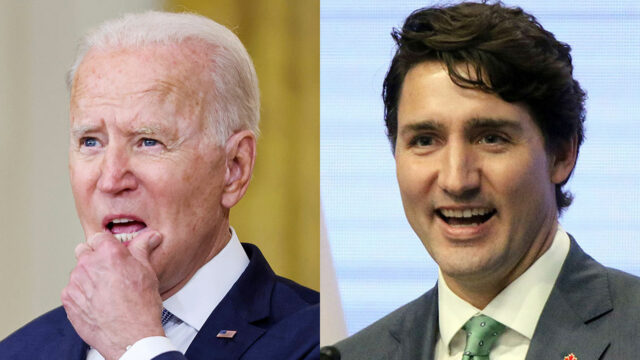
US President Joseph R. Biden (left) and Canada Prime Minister Justin Pierre James Trudeau (right) | original images from Reuters

 – US President Joe Biden and Canadian Prime Minister Justin Trudeau presented a united front on Friday against authoritarian regimes as Biden visited the Canadian capital days after the leaders of China and Russia held a Moscow summit.

Images of Mr. Biden and Mr. Trudeau standing side by side in Ottawa announcing agreements including on semiconductors and migration represented a counter point to the scene in Moscow days ago.

There, Chinese President Xi Jinping and Russian President Vladimir Putin professed friendship and pledged closer ties as Russia struggles to make gains in what the West considers an unjust invasion of Ukraine.

At a joint news conference with Mr. Trudeau, Mr. Biden questioned the level of China and Russia’s cooperationnoting that China has not provided weapons to Russia for use against Ukraine.

Mr. Biden said the US had expanded alliances includingwith NATO, the G7, South Korea and the Quad nations of the US, Australia, India and Japan.

“We have significantly expanded our alliances,” said Mr. Biden. “Tell me how in fact you see a circumstance where China has made a significant commitment to Russia. What commitment can they make?”

Addressing Canada’s parliament, Mr. Biden said that, as NATO members, the two countries would “defend every inch of NATO territory.”

Mr. Trudeau told the news conference that Ukraine was a top issue.

“Today we reaffirmed our steadfast support for the Ukrainian people as they defend themselves against Putin’s brutal and barbaric invasion,” Mr. Trudeau said.


SEMICONDUCTORS, EVS

At the news conference, Trudeau announced the two leaders had signed an agreement with IBM to develop semiconductor capacity and ease reliance on foreign makers after supply-chain problems bedeviled both countries.

The US Defense Production Actwill give $250 million, Biden said.

Canada has an abundance of the critical minerals used to produce batteries and electric vehicles (EVs), but China currently dominates the global market.

Trudeau is preparing a budget to be published on Tuesday aimed at scaling up critical mineral and clean tech production.

“With growing competition, including from an increasingly assertive China, there’s no doubt why it matters that we turn to each other now to build up a North American market on everything from semiconductors to solar panel batteries,” Mr. Trudeau said.

Mr. Biden announced $50 million to incentivize US and Canadian companies to invest in packaging semiconductors and said Canada would provide up to C$250 million ($182 million) for semiconductor projects in the near term, according to a joint statement.

The two countries also agreed on an energy transformation task force focusing on clean power and vowed to cooperate on a “North American critical minerals supply chain,” the statement said.

Michael Spavor and Michael Kovrig, two Canadian men that China had detained for more than 1,000 days until 2021, attended the speeches. Both leaders addressed the men, who had been at the centre of a dispute between Washington and Beijing.

“They’re not diplomatic leverage. They’re human beings with lives and families that must be respected,” Mr. Biden said.

Ahead of their meetings, the two leaders had already struck a deal aimed at stopping asylum seekers from traversing the shared US-Canada land border via unofficial crossings.

“The United States and Canada will work together to discourage unlawful border crossings and fully implement the updated Safe Third Country Agreement,” Mr. Biden said of the deal. Canada agreed to take in 1,500 migrants from countries in the “Western Hemisphere” as part of the deal. – Reuters

Antibiotics may not help survival of patients hospitalized with viral infections -study

STOCK PHOTO | Image by F1 Digitals from Pixabay

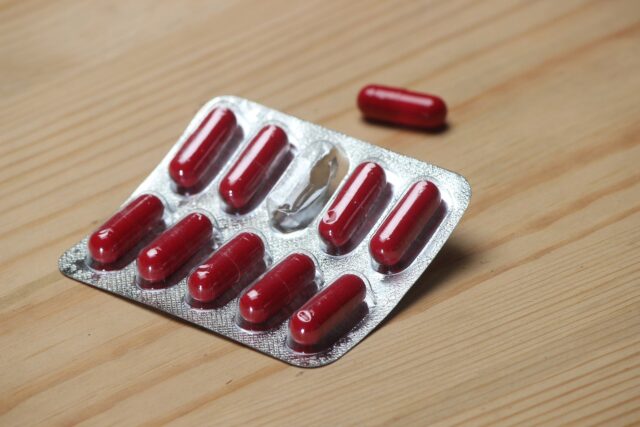
 – Most patients admitted to hospitals with acute viral infections are given antibiotics as a precaution against bacterial co-infection, but this practice may not improve survival, new research suggests.

Researchers investigated the impact of antibiotic use on survival in more than 2,100 patients in a hospital in Norway between 2017 and 2021 and found that giving antibiotics to people with common respiratory infections was unlikely to lower the risk of death within 30 days.

At the height of the pandemic, antibiotics were prescribed for around 70% of COVID-19 patients in some countries, potentially contributing to the scourge of antibiotic-resistant pathogens known as superbugs.

This new data, which has not been published in a medical journal, suggests there is “a huge overuse of antibiotics,” said lead author Dr. Magrit Jarlsdatter Hovind from Akershus University Hospital and the University of Oslo, Norway.

The overuse and misuse of antibiotics has helped microbes become resistant to many treatments, a development scientists consider one of the greatest threats to global health, given the pipeline of replacement therapies in development is alarmingly sparse.

This latest research, which will be presented at next month’s European Congress of Clinical Microbiology & Infectious Diseases in Copenhagen, involved patients who tested positive via nasal or throat swab for viral infections such as the flu, RSV or COVID-19. Those with confirmed bacterial infections were excluded from the analysis.

In total, 63% of the 2,111 patients received antibiotics for respiratory infection during their hospital stay. Overall, 168 patients died within 30 days, of which only 22 had not been prescribed antibiotics.

After accounting for factors including sex, age, severity of disease and underlying illnesses among patients, the researchers found those prescribed antibiotics during their hospital stay were twice as likely to die within 30 days than those not given antibiotics.

The research team noted that the sicker patients and those with more underlying illnesses were both more likely to get antibiotics and to die. Other factors such as patients’ smoking status could have also played a role, they said.

“Doctors have to dare to not give antibiotics, instead of doubting and giving antibiotics just in case,” Ms. Hovind said.

Given the limitations of a retrospective study such as this one, a clinical trial, which Ms. Hovind and colleagues recently initiated, is necessary to determine whether patients admitted to hospital with common respiratory infections should be treated with antibiotics, she said. – Reuters