Home Blog Page 5

Filinvest unit secures ERC nod for Mindanao solar project

STOCK PHOTO | Image by JCOMP/FREEPIK

FDC GREEN ENERGY Corp., a wholly owned subsidiary of Filinvest Group’s utility arm, FDC Utilities, Inc., has secured government approval to connect its solar project in Mindanao to the grid, allowing it to begin commercial operations.

In a statement on Thursday, FDC Utilities said it received a certificate of compliance from the Energy Regulatory Commission (ERC) for its 20.774-megawatt-peak ground-mounted solar facility to be built at the PHIVIDEC Industrial Estate.

The company said the certificate confirms that the facility has met technical, safety, and regulatory requirements, allowing it to operate commercially.

The solar project is expected to generate about 30.2 million kilowatt hours of electricity annually.

FDC Utilities said the project will add capacity to the Mindanao grid once operational.

“The ongoing energy crisis has underscored the need for reliable and sustainable power solutions,” said FDC Utilities President and Chief Executive Officer Juan Eugenio L. Roxas.

“In an environment where global fuel markets are increasingly unpredictable, projects like this highlight the importance of investing in indigenous and renewable energy sources,” he added.

In 2024, FDC Utilities said it plans to triple its generating capacity to 1,350 megawatts by 2033, with most of the expansion coming from renewable energy. — Sheldeen Joy Talavera

Going energy local

THE 60-kilowatt-peak (kWp) On-Grid Hybrid Solar Photovoltaic (PV) System installed on the municipal hall rooftop of Guiuan, Eastern Samar done in partnership with the Philippine-based NGO Institute for Climate and Sustainable Cities (ICSC).

The tide is rising on all fronts in the democratization of energy. In the global stage, among states, the ongoing disruption in the global supply of petroleum products has re-ignited talks about energy sovereignty. Countries are urgently pursuing diversification of energy sources and, more importantly, accelerating the exploration and use of indigenous resources, particularly renewable energy (RE). At the level of the consumer in the Philip-pines, energy democracy is also gaining ground as more end-users are discovering and engaging in the various consumer choice programs that allow them to contract directly with suppliers and negotiate rates for generation and supply of power to their homes and offices. Cost-competitive RE technologies, such as solar PVs, empower consumers to produce their own power leading to the emergence of the category of “prosumers” — producers/consumers of electricity.

Over the last few years, however, there has also been momentum building between the levels of states and end-users. Quietly yet firmly, local governments, together with electric cooperatives (ECs), are now taking a more active role in shaping the energy destiny of their provinces and municipalities.

Founded on the principles of local autonomy under the Constitution and Republic Act No. 7160 or the Local Government Code of 1991, fueled by decades of frustration over persistent energy poverty or unaffordable power rates in their communities, various local government units (LGUs) are now drawing up local energy plans that are intended to address the specific needs in their areas and fuel the developmental aspirations of their respective regions. The plans are not just technical and economic checklists; these are roadmaps that form practically an energy liberation agenda.

EVOLVING ROLE OF ELECTRIC COOPERATIVES
Last week, I was fortunate to join the 2026 EC Summit co-organized by the National Electrification Administration (NEA) and Climate Smart Ventures (CSV). I was invited to moderate the panel on Day 1 of the two-day event on the topic “From State Assistance to Self-Reliance: Leveraging Innovative Finance for a More Resilient EC While Upholding the Non-Stock Non-Profit Spirit of Rural Electrification.” Despite the rather intimidating title for the panel, the discussions were quite down-to-earth, realistic, and encouraging, with panelists from CSV, the Department of Energy (DoE) and the Romblon Electric Cooperative (Romelco). Among our off-grid areas, the story of Romelco is quite unique and inspiring.

Rene Fajilagutan, the General Manager (GM) of Romelco, shared how the cooperative started their journey to energy security by directly investing in and developing their own RE plants. By introducing RE into their supply mix, the goal was primarily to reduce the reliance on expensive and imported diesel fuel, and to manage the risk of power interruptions caused by diesel delivery disruption.

Romelco today has wind, mini-hydro, solar hybrid, solar rooftops, and biogas facilities supplying 107 barangays in its franchise area. With the integration of RE, the cooperative is able to manage its costs and reduce the rates paid by their end-users as well as their need for subsidies under the Universal Charge-Missionary Electrification (UCME). It is also able to achieve full electrification of its franchise areas with the deployment of small-scale RE solutions to the last-mile barangays.

“While Romelco was able to manage the rates charged to consumers with RE adoption and hybridization, how did RE integration impact the reliability of your network?,” I asked Mr. Fajilagutan. His response, to my mind, should have made the headlines in the next day’s papers: “RE has made our system more reliable,” he said. He explained that the installation of small-scale RE and energy storage solutions where these were needed by the system allowed them to manage load and voltage dropping in certain areas. The use of multiple and strategically located generation facilities, instead of singular or few large-scale generators, likewise gave greater ability to the EC to contain or isolate outages, minimizing the risk of a system-wide blackout resulting from generator fault or issues.

The story of Romelco presents many valuable lessons on RE project development, financing, and EC governance, among others, but two stand out in the context of the ongoing energy crisis: 1.) ECs, particularly in the off-grid areas, can break out of their traditional role of network operation and successfully address the unique energy requirements, including steady and affordable power supply, of their localities, within the limits of law and regulation, and, 2.) the deploy-ment of RE facilities, when strategically sited for operations and appropriately structured for financing, can be a viable solution for network reliability issues and the challenge of total electrification.

FROM BUTUAN TO GUIUAN, ILOILO TO MARAWI
After the EC Summit last week, I joined the energy planning workshop in Tacloban organized for the Municipality of Guiuan by the Institute for Climate and Sustainable Cities (ICSC). Guiuan is a second-class municipality in Eastern Leyte, located in the southernmost tip of Leyte Island. The municipality occupies a special place in history as it includes the island of Homonhon where Ferdinand Magellan is said to have landed in 1521. Homonhon is one of the two off-grid islands that belong to Guiuan, both of which do not have a steady supply of electricity, the residents there enjoying only up to eight hours a day of power supply.

During the four-day workshop, what struck me was the level of engagement and preparedness exhibited by the LGU officials of Guiuan. There were no passive members of the audience — everyone paid attention to the learning ses-sions and asked insightful questions that showed their ability to connect the concepts with on-the-ground realities of their constituents. Tangible and workable outputs were produced by the working group activities, with metrics and timelines set out. For instance, there were exhaustive discussions on the adoption of a sustainable livelihood model for off-grid areas like Homonhon and Suluan that would involve the bundling of an electrification solution for the is-lands together with a catalytic livelihood project, such as an ice plant or cold storage facility which is crucial for the fishing communities. The vision for Guiuan was also clearly articulated: energy self-sufficiency, RE-literate, and RE-skilled Guiuananons; solar-powered households; dynamic tourism and industries; and, ultimately, Guiuan as a model RE-powered city.

Representatives from Butuan City were also present to share their own energy security journey. In August 2025, the city adopted the Butuan City Energy Development Plan (BEDP) for 2023-2050. Butuan City, along with the rest of the CARAGA Region, has enjoyed rapid economic growth over the last few years, with the region’s growth rate at around 7%. This growth in demand, as well as the desire to secure clean energy resources and mitigate the price vola-tility of imported fuel, compelled the LGU to craft its own energy development plan to meet its economic ambitions.

With the support of various organizations, including the World Wide Fund for Nature Philippines, the International Climate Initiatives, and the University of the Philippines, the LGU was able to develop the long-term plan that serves as the basis for development of resources located locally, siting of projects, provision for local incentives, and modernization of government facilities and properties for energy efficiency and full fleet transition to electric mobility by 2050.

Earlier in March, I also witnessed this synergy of interests among LGUs in a workshop in Marawi City, organized by the United Nations Development Program (UNDP), for the energy planning of the province of Lanao del Sur.

The power situation in the province has always been problematic and complex, characterized by unreliable power supply and the EC (Lanao Del Sur Electric Cooperative or LASURECO) burdened by billions of pesos in debt and governance issues. The LGU currently has taken a firm stance to find a permanent and long-term solution to these persistent problems. In the workshop, representatives from the province of Iloilo shared their journey that led to the adoption by the Sangguniang Panlalawigan of the Iloilo Provincial Ordinance for Renewable Energy (I-PORE). The ordinance is the first in the country that allocates a portion (1/2 of 1%) of the annual provincial budget for RE projects.

Immediately following the workshop, on March 24, the Provincial Governor of Lanao Del Sur issued Executive Order No. 009 creating the Provincial Renewable Energy (RE)/Energy Efficiency (EE) Program Management Coun-cil (PMC) to “function as the primary coordinating, planning and oversight body for all renewable energy and energy efficiency initiatives of the Provincial Government.” The PMC is also tasked to develop the Provincial Re-newable and Energy Efficiency Development Plan. The Executive Order also mandated the adoption of EE measures in all government buildings and procurement of appliances and equipment.

LOCALIZATION OF ENERGY
While the support of local governments in energy projects has always been recognized by the National Government, that role is evolving today to a more central and leading actor in shaping the energy landscape. Technology has been enabling more small-scale, tailor-fit solutions that allow for the adoption of decentralization and localization of energy projects. The active engagement of LGUs in the adoption of local energy plans, particularly those that involve local incentives and out-of-the-box solutions for distinct issues of their communities, inspires hope that solutions can be incubated and deployed at the grassroots level.

There is no doubt that local energy planning exercise increases the chances of achieving energy security from the ground up. Fundamentally, it also strengthens democracy as citizens become more active and discerning par-ticipants in decision-making with a long-term perspective.


Monalisa C. Dimalanta is a senior partner at Puyat Jacinto & Santos Law (PJS Law). She was the chairperson and CEO of the Energy Regulatory Commission from 2022 to 2025, and chairperson of the National Renewable Energy Board from 2019 to 2021.


Is your cat or dog overweight? Why simply feeding less doesn’t always help

OVERWEIGHT and obesity are among the most common conditions veterinarians see in both dogs and cats. Yet weight-loss plans for pets are frequently unsuccessful, with a high drop-out rate. In one study, over half of participating dogs actually gained weight. In a new study published in the journal Animals, we argue weight management in pets often fails because we view it too narrowly — as a nutritional problem that can be solved simply by feeding the animals less.

Yet evidence suggests to manage weight in pets, we also need to attend to animal behavior, and human-animal interactions are a huge part of that. Body condition scoring is the most common method vets use to classify animals as underweight, ideal weight, or overweight. The Global Pet Obesity Initiative uses a scale of one to nine, with a body condition score of five representing ideal body weight.

Each category between one and nine represents a 10% difference in weight. For example, an animal with a body condition score of six out of nine is 10% overweight, while a score of seven out of nine means the pet is 20% overweight. Obesity is defined as having a body condition score of eight out of nine (30% overweight) or above.

HOW COMMON ARE OVERWEIGHT AND OBESITY IN PETS?
Globally, about half of the pet dog and cat population is overweight or obese, with middle-aged pets most commonly affected. The largest study (conducted in the United States), comprising almost 5 million dogs and more than 1 million cats, reported excess weight and obesity in 50% and 13% of adult dogs respectively, and in 45% and 22% of cats. High rates of overweight and obesity have been reported in Australia, New Zealand, Europe, and China. Overweight and obesity are more common in animals who are highly motivated by food, those with reduced physical activity (including indoor-housed cats) and, in some studies, those who’ve been desexed. Some breeds, such as Labra-dor retrievers, have a genetic predisposition to obesity. Owner activity levels, lifestyle, and the nature of their bond with pets also influence the pets’ risk of obesity. When it comes to animals they love, many owners have “weight blindness” — they don’t even see their pets as over-weight.

WHY SHOULD WE WORRY ABOUT OVERWEIGHT AND OBESE PETS?
Just like for humans, overweight and obesity in pets are associated with increased risk of diseases such as diabetes, heart disease, skin disease, and cancer. Excess weight exacerbates conditions like osteoarthritis, and increases the risk of heat stroke. Lifespan is reduced in obese dogs and cats. Carrying excess weight can prevent animals from engaging in behaviors like exercise, play, and interaction with other animals and people. The World Small Animal Veterinary Association describes obesity as the most important global animal welfare issue.

WHY DOES TRADITIONAL WEIGHT MANAGEMENT FAIL?
The standard approach to help your pet lose weight involves calorie restriction, increased exercise, and regular weighing. It sounds so simple. And yet this approach often fails.

Pets who are fed less show hunger and increase their food-seeking behavior, making owners feel guilty. They eat their reduced portions quickly, using the additional time to look for or demand more food. Animals accustomed to receiving treats or scraps from the family dinner table may protest their exclusion from familiar routines. Such behavior is difficult to resist — many owners succumb and provide treats.

Caloric restriction alters metabolism, which can initially increase weight gain, and the lack of progress can be demotivating. Some dogs and cats are fearful in veterinary settings, and owners find regular weigh-ins too traumatic.

All these factors can put owners (and animals) off sticking with the weight-loss plan.

HOW TO HELP YOUR PET LOSE WEIGHT SUCCESSFULLY
1. Use accurate information to formulate a weight management plan. All pets should be regularly weighed and scored on their body condition. Pet owners can use body condition scoring sheets for dogs and cats to do this at home.

Fearful pets who don’t like being weighed at the vet can be weighed on home scales. Importantly, take note of what your pet eats (including treats and scavenged foods) and share this information with your vet.

A complete dietary history helps in planning a diet compatible with your pet’s preferences. High-calorie foods could be substituted for ones with fewer calories, for example.

2. Diets should be low calorie, high satisfaction. Weight-loss diets should be nutritionally complete. The best diets are those that are reduced in calories, but still leave animals feeling satisfied after a meal.

Low-calorie treats can be factored into the daily ration so that animals don’t miss out.

3. Provide opportunities to hunt, find and forage food. Feeding the daily ration in multiple smaller meals can burn additional calories and increase time spent eating. Allowing animals to “hunt” for food by providing food in puzzle feeders, scatter feeding, or setting up “treasure hunts” allows them to express natural behaviors. Animals may use up more calories and experience more pleasure from foods they can chew. They may also spend less time “asking” owners for food.

4. Be prepared for begging. Animals used to receiving table scraps will dial up their attention-seeking behavior in an increased effort to be rewarded. It can be hard to resist such antics, but rewarding begging with a food mor-sel will only encourage pets to intensify their efforts.

Instead, try to preempt them by providing a rewarding alternative activity (such as giving a dog a toy to chew on their bed) while you eat your meal in peace. Non-food related activities, including sensory gardens and digging pits, climbing opportunities or interactive toys may also provide suitable distractions.

Weight loss in pets is about giving them more years of good-quality life. With the right tools — not just calorie counting — we can keep our pets happy and healthy. — The Conversation via Reuters Connect

ANNE QUAIN is a Senior Lecturer at the Sydney School of Veterinary Science, University of Sydney. She has been a consultant or volunteer for a range of organizations including Animal Management in Rural and Remote In-digenous Communities (AMRRIC) iCatCare, the Cat Protection Society of NSW, the Royal Agricultural Society and RSPCA Australia. She has donated to several charities including Animals Australia, AMRRIC, the Cat Protection Society of NSW, RSPCA NSW and VALE. She is a member of the Australian Veterinary Association and the Australian and New Zealand College of Veterinary Scientists, and a Diplomate and Subcommittee Chair of the European College of Animal Welfare and Behavior Medicine in Animal Welfare Science, Ethics and Law. She has been a recipient of an Australian Companion Animal Health Foundation Grant, and has undertaken two project-based resi-dencies at The Ethics Center.

RIMINI QUINN is a PhD Candidate at the School of Veterinary Science, University of Sydney. She is a member of the Australian and New Zealand College of Veterinary Scientists (Veterinary Behavior Chapter), the Pet Profession Guild and is a Fear Free certified professional. She donates to Vets against live export (VALE) and Animals Australia.

PHL jobs vulnerable to GenAI estimated at 28%

STOCK PHOTO | Image by VECTORJUICE/FREEPIK

NEARLY 28% of jobs in the Philippines are now exposed to generative artificial intelligence (GenAI), placing the country at the upper end of the exposure scale across the Association of Southeast Asian Nations (ASEAN) region.

Research by the International Labour Organization (ILO), released this week, found that the Philippine ranking was due to its service-oriented economy and its established global leadership in the information technology and business process management industry.

The findings point to a transformation of work rather than a total elimination of positions, the ILO said.

ILO employment specialists Phu Huynh and Felix Weidenkaff noted that only 3-4% of the total Philippine workforce falls into the highest exposure category, with an elevated risk of job displacement.

Clerical support roles are the most affected, with 93.7% of these jobs exposed to GenAI and 37.8% facing the highest automation risk. In the finance and insurance industries, nearly nine in 10 jobs are currently exposed, according to ILO.

“The vast majority face partial task automation, meaning work will evolve rather than disappear,” the ILO said.

The ILO noted that women face substantially higher exposure due to their concentration in clerical and administrative roles, with 5.85% of female employment in the Philippines in the highest risk category compared to 2.15% for men.

Education levels also determine exposure, as 10.4% of tertiary-educated workers face the highest automation risk, yet the risk for those with basic education is less than 1%.

The ILO added that these findings align with the national agenda set by President Ferdinand R. Marcos, Jr., who launched the Philippines’ ASEAN 2026 Chairmanship with plans to use AI ethically and responsibly to support economic integration, digital transformation, and inclusive growth.

To manage this transition, the ILO recommends human-centered policies that ensure AI governance promotes better jobs and adheres to international labor standards.

“GenAI across ASEAN will likely transform occupational roles and tasks, critical measures including upskilling and reskilling initiatives, employment facilitation services, career development support, and the provision of timely, robust labor market intelligence are needed for targeted support,” the ILO said.

“Finally, these transitions cannot be managed without tripartite cooperation. Social dialogue between governments, employers, and workers will be essential in shaping how GenAI transforms workplaces in ASEAN,” it added. — Erika Mae P. Sinaking

Chinabank Q1 net profit climbs to P6.8 billion

BW FILE PHOTO

CHINA BANKING Corp.’s (Chinabank) net profit increased by 4% to P6.8 billion in the first quarter, backed by strong growth in its core businesses and stable asset quality.

This translated to a 14.2% return on equity and a 1.5% return on assets, it said in a disclosure to the stock exchange on Thursday.

The bank’s net interest income jumped by 14% year on year to P19.5 billion as it saw higher topline revenues and lower interest expenses.

As a result, its net interest margin improved by 12 basis points to 4.61%.

Meanwhile, Chinabank’s operating expenses climbed by 5% to P8.8 billion. It attributed the increase to its ongoing investments in human capital and digital transformation.

Its cost-to-income ratio was at 49%, which it said is “healthy… despite higher spending on technology and initiatives aimed at driving revenue growth.”

The bank’s gross loans grew by 16% year on year to P1.1 trillion at end-March amid strong demand across its consumer and corporate segments.

Its nonperforming loan (NPL) ratio was at 1.6%.

“Despite steady asset quality,… Chinabank remained committed to prudence, increasing loan loss provisions to P684 million, resulting in an NPL coverage ratio of 110%,” it said.

Meanwhile, total deposits rose by 13% to P1.5 trillion, with low-cost checking and savings accounts (CASA) rising by 20%. As a result, its CASA ratio improved to 48% from 46% previously.

Chinabank’s assets expanded by 12% year on year to P1.9 trillion at end-March, “driven by the strategic buildup of high-quality earning assets.”

Total equity went up by 10% to P192.3 billion.

Chinabank shares closed unchanged at P64 apiece on Thursday. — BVR

Tiong Bahru Singapore Flavours expands footprint in PHL

The Gateway Mall 2 branch in Cubao, Quezon City — Tiong Bahru Singapore Flavours

TIONG BAHRU Singapore Flavours said it is continuing to expand its presence in the Philippines, adding new locations as it builds its network across Metro Manila and nearby areas.

The Singaporean franchise entered the Philippine market in 2019 with its first branch at MetLive Mall in Pasay. It has since opened stores in key commercial areas, including Bonifacio Global City, Estancia Capitol Commons, Eastwood, Alabang Town Center, SM North EDSA, Greenhills, One Ayala, TriNoma, Robinsons Antipolo, Mitsukoshi BGC, and Gateway Mall 2.

More recent branches in UP Katipunan and Landmark by the Bay in Parañaque have brought its total to 16 locations.

During the pandemic, the restaurant chain opened additional branches in Makati and Quezon City and expanded its takeaway and delivery services.

“Our journey reflects more than expansion — it’s a testament to resilience and passion. Even during the pandemic, we never stopped serving authentic Singaporean cuisine to every Filipino,” said Kathryna Yu-Pimentel, co-owner and director of Tiong Bahru Singapore Flavours.

The company serves Singaporean dishes such as Hainanese chicken rice, bak kut teh, and laksa. — ALB

Converging evidence for monetary policy tightening

By the time this column comes out Friday morning, the Bangko Sentral ng Pilipinas (BSP) must have acted, and acted correctly, by tightening monetary policy by at least 25 basis points (bps). At this stage, the question is no longer whether to move, but whether policy will move fast enough to stay ahead of the curve.

The evidence is not just compelling; it is converging.

What began as a supply shock from geopolitical tensions in the Middle East has now metastasized into an increasingly generalized inflation problem. Higher fuel prices have already worked their way through transport, freight, and logistics, raising the cost structure of virtually all goods and services. Utility price increases are imminent. The restoration of rice tariffs this month, given rice’s nearly 9% weight in the consumer price index, adds a direct and immediate source of upward pressure. These are not temporary disturbances. They are the channels through which supply shocks become embedded in the broader price system.

And that is precisely what is happening.

Evidence shows that indeed second-round effects are no longer a risk, they are underway. Businesses are adjusting prices not just to reflect higher input costs, but in anticipation of further increases. Workers, seeing their purchasing power erode, will soon demand wage adjustments. Once this wage-price dynamic sets in, inflation becomes more persistent and far more difficult to reverse. The window for preemptive action is rapidly closing. This is cause for serious concern.

Expectations are already shifting. Business and consumer sentiment surveys point to weakening outlooks even as prices continue to rise. For both households and business, this is the worst possible combination: slowing growth alongside rising inflation. If inflation expectations become unanchored, the BSP will be forced into a much more aggressive tightening cycle later, one that could impose far greater costs on growth and employment. This is where these recent talks about stagflation are coming from.

For those who would not act unless they see proof, an early warning signal is unmistakable: core inflation. In the first quarter of 2026, core inflation rose from 2.4% to 3%. This is not noise. It is a signal that inflation is broad-ening beyond volatile components and taking root in the underlying structure of prices. Households are spending more not because they are better off, but because everything costs more. This is the anatomy of demand de-struction — an erosion of real incomes that will eventually force consumption to contract.

The uncomfortable truth is that policy has lagged these developments.

The BSP maintained an easing bias in February and paused in March despite the announcement of a 5.1% inflation forecast for 2026 and escalating geopolitical risks. While it is true that monetary policy cannot directly offset supply shocks such as higher oil prices, it is equally true that it must prevent these shocks from spilling over into expectations, wages, and broader price-setting behavior. That spillover is now evident.

Not a few would deny this, but compounding the problem is impaired monetary transmission. In theory, lower policy rates should stimulate borrowing and spending. In practice, banks behave pro-cyclically. In periods of un-certainty like the pandemic of 2020, banks actually tightened credit standards, shortened loan maturities, and demanded stronger collaterals. The result is a paradox: policy rates fell, but effective financial conditions did not ease. Under these conditions, further easing risks fueling inflation without delivering meaningful support to economic growth.

This is not conjecture; it is textbook adverse selection and moral hazard at work. When information is imperfect and risks are elevated, lenders pull back. As a result, the central bank cannot assume that lower rates will translate into higher lending or investment. If anything, the imbalance between liquidity and risk aversion can distort markets further.

At the same time, external constraints are tightening. The interest rate differential with the US Federal Reserve has narrowed following successive BSP rate cuts, increasing pressure on the peso and raising the risk of capital outflows. With inflation forecasts for 2026 rising and remaining elevated into 2027, the room for policy accommodation has effectively been exhausted.

As expected, financial markets have already internalized this reality. Indicators such as credit default swaps suggest rising risk perceptions and a growing expectation of tighter policy. Economists and forecasters, once divided, are now tilting toward rate hikes. The signal is clear: policy credibility is on the line.

The BSP’s mandate for promoting price stability is straightforward. It has already done its part in supporting growth through earlier, successive easing. Even the reserve requirement ratios have been brought down to a single digit, delivering additional liquidity into the system. But the environment has changed, and policy must change with it. Governance issues, fiscal constraints, and global volatility may be outside the BSP’s direct control, but they amplify the consequences of delayed action. In such an environment, anchoring expectations becomes even more critical.

A 25-basis-point increase is therefore not just appropriate, it is necessary. But it must also be understood as only the beginning of a tightening cycle, not a one-off adjustment. The BSP must signal clearly that it is pre-pared to act further if inflation pressures persist.

The geopolitical backdrop reinforces this need for forward-looking policy. The range of possible outcomes, from a relatively short conflict to a prolonged disruption, differs in magnitude but not in direction. Even under a “benign” scenario, oil prices are likely to remain elevated and supply chains disrupted. A more adverse scenario of prolonged conflict, and sustained oil prices above $100, peso depreciation would intensify inflationary pressures and complicate policy choices further.

In other words, uncertainty is not an argument for caution; it is an argument for preparedness.

Monetary policy cannot wait for clarity that may never come. It must act on probabilities, not certainties.

To be sure, the current predicament also reflects deeper structural weaknesses. Overreliance on fossil fuels, the absence of a robust strategic petroleum reserve, limited diversification of trade and investment flows, and per-sistent governance challenges have all increased the economy’s vulnerability to external shocks. Fiscal space remains constrained, not least because of widespread inefficiencies and unprecedented leakages in public spending through unmitigated corruption. These are long-standing issues that require sustained reform, but they also heighten the urgency of credible monetary policy today.

Inflation targeting and central bank independence have served the country well. But they are only as effective as the willingness to act decisively when conditions demand it.

That moment is now.

The BSP must move — not cautiously, not hesitantly, but with clear intent. Tighten today, and be prepared to tighten further if needed. The cost of acting too little, too late will be far greater than the cost of acting early and decisively.

In the end, credibility is the most powerful instrument of monetary policy. It must be used.

Diwa C. Guinigundo is the former deputy governor for the Monetary and Economics Sector, the Bangko Sentral ng Pilipinas (BSP). He served the BSP for 41 years. In 2001-2003, he was alternate executive director at the International Monetary Fund in Washington, DC. He is the senior pastor of the Fullness of Christ International Ministries in Mandaluyong.

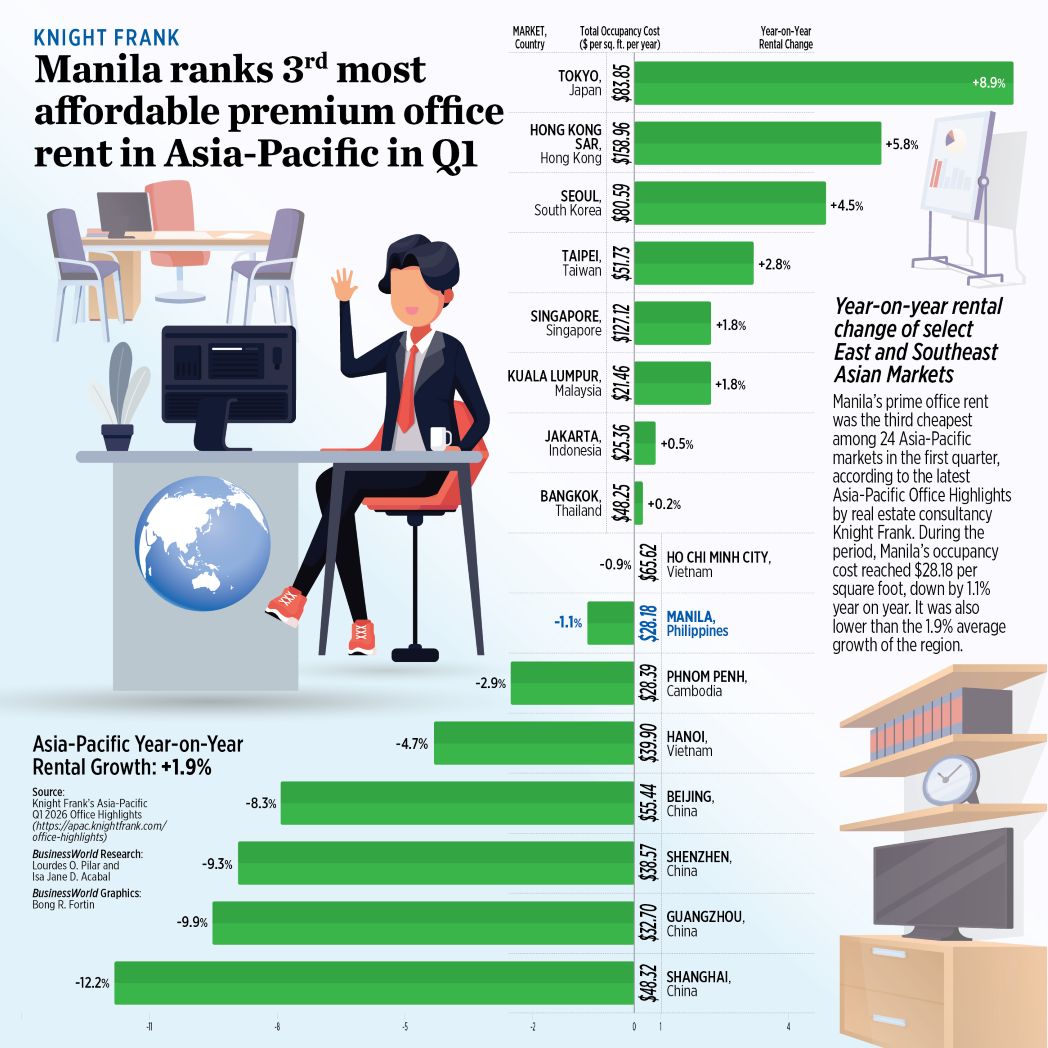
Knight Frank: Manila ranks 3rd most affordable premium office rent in Asia-Pacific in Q1

Discovery and nostalgia

OFFICIAL PHOTO BY MAKY SALAMAT

Orange & Lemons looking to attract old fans
and new while embarking on Europe tour
and readies all-English album

OPM band Orange & Lemons (O&L) released their new single, “Too Young To Be Old,” and are getting ready for their European tour that will run from May to June.

Known for hits like “Hanggang Kailan (Umuwi Ka Na Baby)” and “Heaven Knows – This Angel Has Flown,” the group teased the new track in a press event on April 16 in San Juan City. It is set to be part of an upcoming album, VI-SIONS OF AMBER, their first all-English body of work.

The band was founded in 1999 and was a staple in the Pinoy rock scene until they disbanded in 2007. Since their return in 2017, they’ve been composed of vocalist, guitarist and O&L founding member Clem Castro, drummer Ace del Mundo, bassist JM del Mundo, and keyboardist Jared Nerona who joined the band when it was reconstituted.

NEW MUSIC
While the 2022 album La Bulaqueña saw the band take inspiration from artist Juan Luna and champion local kundiman sounds, O&L’s new track takes a more global tack.

“We decided to go back to a ’60s and ’70s-influenced album. True original indie pop is inspired by the ’60s, even the ’50s, and we wanted to do it all in English,” he said at the press event.

“There’s a certain resurgence of the old sound even among new artists,” Mr. Castro said. “We did this just to see how it will travel.”

“Too Young To Be Old” explores the complexities of transition and self-awareness, according to Mr. Castro, who is the chief songwriter. Though it is inspired by a relationship experienced differently by two people, he described the song as depicting “the strange middle space where you’re no longer reckless, but not quite settled either.”

The track was produced at his hybrid studio, LILYPOD AUDIO, and serves as O&L’s first release mixed in Dolby Atmos, surround sound technology that creates an immersive sonic experience.

For keyboardist Mr. Nerona, has his first songwriting credit on the album, there is a “good vibe” that fans can look forward to.

“It’s very ’60s,” he said. “We have a song that I co-wrote with Clem about a car and about my daughter as well. There’s an overall modern vintage quality to it.”

As for their expectations for how the new songs will be received, Mr. Castro explained that they are at the stage where they are simply doing what they want.

“It’s not about instant success. It took ‘Heaven Knows’ 20 years before it became a hit. It’s about the legacy of the band, what we leave our families and fans, how we want to be remembered,” he said.

EUROPE TOUR
The group will be embarking on their European tour next month, with stops in major cities like London, Milan, Madrid, Paris, and Amsterdam. The first stop will be Dublin on May 14.

“A lot of OPM acts are touring Europe now, but it isn’t as convoluted as the scene in the US,” Mr. Castro said of their venture. “There are already so many concert producers in the US.”

The tour, aside from being geared towards the Filipino community abroad, is meant to attract new listeners from varying backgrounds and ethnicities.

“What excites us most is the contrast — you’re playing for people who may be hearing you for the first time, alongside Filipinos who’ve carried the music with them wherever they are,” said Mr. Castro. “There’s something spe-cial about that mix. For Filipinos abroad, the songs become a connection to home. For new listeners, it’s a fresh introduction.”

As for the set list, O&L emphasized that it will be a balance of essential songs and newer material, with the two-pronged goal of “discovery and nostalgia.”

“We were kids from Bulacan who rose from nowhere and couldn’t handle the fame and money. That’s what showbiz did to O&L, and we don’t regret that because it’s a very expensive lesson in life,” Mr. Castro explained, when asked about how they see their fame.

While the Europe tour represents O&L at the stage of being young enough to “just have fun with it,” they are also already old enough to be wiser.

“All of that has made us aware that music is a business, and we’re now mindful of how we preserve our legacy, how we control our songwriting and masters,” he said, adding half-jokingly that there could be enough material for a tell-all au-tobiography.

“We even have a legacy contract. We’re forward thinkers now!”

O&L’s “Too Young To Be Old” is available on all digital music platforms worldwide. Their Europe tour runs from May 14 to June 7. — Brontë H. Lacsamana

Old-school vs process-oriented hiring

I’ve been promoted to oversee recruiting after a major reorganization, even if I don’t have the experience other than hearing oft-repeated interview questions. What’s the first thing to do? — Northern Bridge.

The first thing to do is to treat recruitment like a production line. Recruitment is often less about finding talent and more about creating a dynamic process to get maximum results at minimum cost. Any step that doesn’t add value to the hiring process is wasteful and should be eliminated or reduced.

You can do this by reviewing the current process and adjust the policy with management approval. That’s the essence of Lean HR, which applies waste elimination techniques. As a neophyte on the job, I recommend you follow the first few critical steps:

One, review the job description. Analyze and compare it with model form and substance you can find on the internet. Don’t just dust off an old description. Be critical about the role by asking the following questions: Could you outsource the job?

What are the “must-have” technical skills and the “nice-to-have” attributes? What are the key performance indicators? What important things should be done in the first 45 to 60 days?

Two, create a process map. Draw the simplest workflow of the screening process. Focus on digital review of every CV and do online interviews of candidates who passed it. Not every applicant deserves to be interviewed face-to-face.

Limit asking for a truckload of certificates only from shortlisted candidates. Then, define the general timeline when the “time-to-hire” is to be made.

Three, maximize the current manpower structure. When somebody resigns, becomes seriously ill or decides to retire, be the first one to look for an internal replacement. Spread the gospel of “promotion from within.”

Without you knowing it, there could be high-potential people ready for promotion. If none, then that’s the only time to tap outsiders.

Four, reflect on every candidate’s experience. Treat applicants like the company’s valuable customers. In a competitive market, your function is as important as those of sales and marketing. Respect applicants by ensuring they receive a timely response, even if it’s a rejection.

If you can’t do it manually, include a disclaimer in your job ad or use a free version of applicant tracking systems like Dover, BreezyHR, and Giig Hire.

Five, be transparent about the salary range. This saves you and the applicants a lot of time. Not only that, be open about your company’s background, its people, and the process. Include them in the job ad as well.

Clarity builds trust, filters mismatched expectations early, and attracts candidates who value honesty over guesswork and corporate mystery.

SOME OLD-SCHOOL
INTERVIEW QUESTIONS

Now that we’re done with the hiring process, be mindful of oft-repeated but are now considered ineffective or outdated interview questions and the reasons why modern HR professionals avoid them. Here are some:

One, “tell me something about yourself.” This is too broad and vague. It invites candidates to talk about irrelevant life stories and creates imbalanced answers across all candidates. If you want to establish rapport, the best option is to talk about neutral topics like the weather, sports or traffic.

Two, “what is your greatest weakness?” Almost all applicants have already memorized their script on this. Besides, that question encourages exaggerated performance rather than the applicant’s honesty. It’s better to ask the applicant’s recent mistakes, lessons learned, and how they overcame such adversity.

Three, “where do you see yourself in five years?” Nearly all people don’t know their future plans and programs, except when you’re interviewing executive applicants. One approach is to ask about skills they want to develop, problems they want to solve, or milestones they want to achieve.

Four, “why should we hire you?” It encourages scripted sales pitches. Even if you ask follow-up questions, some candidates may resort to strong self-promotion that could overshadow quiet but talented applicants. One solution is to ask for specific examples of results achieved and the reward they got from their employers.

DYNAMIC HIRING PROCESS

Modern hiring processes focus on behavioral and evidence-based interviewing. Instead of asking hypothetical or self-promotional questions, companies these days ask candidates to describe actual past behavior, show measurable results, and demonstrate potential ability.

Look for past work behavior that could predict future performance better than scripted answers. Past behavior predicts future performance better than rehearsed answers.

To do this, dynamic hiring managers use the STAR (Situation, Task, Action, Result) model to measure the applicants’ response. Ditch rehearsed brilliance; only proven behavior separates real performers from polished but empty interview talk.


Consult REY ELBO for his free insights on people management. Send your workplace questions to elbonomics@gmail.com or DM him on Facebook, LinkedIn, X or https://reyelbo.com.

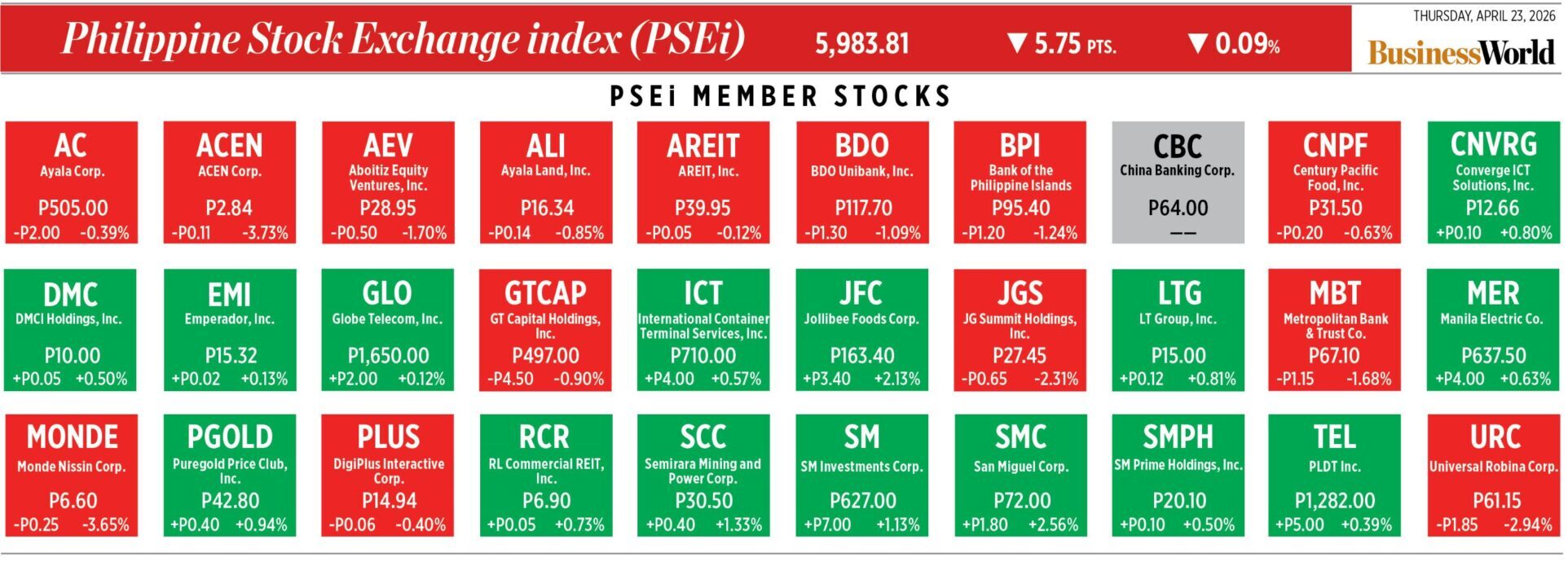
How PSEi member stocks performed — April 23, 2026

Here’s a quick glance at how PSEi stocks fared on Thursday, April 23, 2026.


Economic target adjustments likely due to energy shock, Balisacan says

OFFICIALGAZETTE.GOV.PH

THE GOVERNMENT will adjust its economic targets due to inflationary and growth pressures stemming from the Middle East war, Economy Secretary Arsenio M. Balisacan said.

“Definitely, yes,” Mr. Balisacan said when asked if the Development Budget Coordination Committee (DBCC) will have to recalibrate economic targets at its next meeting.

“But of course it will depend on the first quarter (growth data). So that will of course help inform our decision. Those disruptions will certainly lead us to revisit the assumptions that we had about the economy moving forward,” he told BusinessWorld on the sidelines of a SEAMEO INNNOTECH seminar.

The DBCC usually meets after every release of quarterly gross domestic product (GDP) growth data, with first quarter economic data scheduled to come out on May 7.

It last met on Dec. 9, 2025 to lower economic targets to reflect the impact of the flood control scandal on business sentiment.

The government last year lowered its GDP growth targets to 5%-6% for 2026 and to 5.5%-6.5% for 2027. The previous setting had been 6-7% for 2026-2028.

Mr. Balisacan said the government is focusing on implementing measures for addressing the oil crisis.

“That’s our focus, to make sure that the assistance is provided, the support for the transport sector, vulnerable farmers and fisherfolk, for the poor and near-poor households.”

However, these measures add to the government’s burden in addressing governance issues and repairing sentiment following the flood control scandal last year, Mr. Balisacan said.

“What’s really complicated the issue, of course we are still trying to emerge from the scandal when the Middle East crisis [started]. So that adds to the challenge,” he said.

“We hope that these are temporary disruptions and we have learned clear lessons from the (flood control) scandal. We have to strengthen our governance and that’s what we’ve been pushing now. We have to ensure that the public trusts the government again.” Mr. Balisacan.

Mr. Balisacan has said that inflation could exceed 7% and slow economic growth by as much as 0.3 percentage points this year if the oil price crisis escalates further. — Aaron Michael C. Sy