Home Blog Page 4964

Second wind

JAVIER ALLEGUE BARROS-UNSPLASH

If you’re into running or marathons, you most likely have experienced extreme exhaustion at some point during a run and the need to catch your breath. You close your eyes for a few seconds, take a deep breath, and then suddenly you find the strength to press on at top performance with less exertion. This phenomenon is called “second wind,” which is the result of the body finding the proper balance of oxygen to counteract the build-up of lactic acid in the muscles, or due to endorphin production, or even just a purely psychological effect.

But whatever its cause may be, it is the moment of finding renewed energy to perform again. That is why we use the term “second wind” as a metaphor to describe the moment of revitalization to continue past the point one is thought to be at one’s prime or an abject failure, whether in sports, career, one’s business, or life in general.

Extraordinarily successful entrepreneur Elon Musk experienced his second wind in business long after he invested in Tesla Motors, the automotive company that produces electric cars, in 2004. The struggling company nearly collapsed in 2008 during the financial crisis. In February 2010, Musk filed for bankruptcy amid an emotional divorce and had been living off personal loans from friends since October 2009. Tesla had been losing money such that Musk needed to throw everything he had into keeping the company alive.

In the first quarter of 2013, Tesla posted profits for the first time in its history. Now, Musk’s net worth is $187.9 billion, with the stellar performance of Tesla shares. His recent investments include Twitter, apart from his privately held spacecraft-maker SpaceX, which has a $1.15-billion contract with NASA for a second Artemis lander mission.

Second wind also happens in one’s career. An example is Nancy Berk of Pittsburgh, as told in Forbes. She left her stable job as a clinical psychology professor in a university when she was 45 to pursue her second-wind career as a stand-up comedian and humor writer.

Her first career was due to her interest in medicine, but the use of humor in her day-to-day life led her to an “emotionally, financially, and creatively profitable” career. She combined her years of experience in examining and learning about the human mind with her love for humor. Nowadays, she writes for Forbes.com Hollywood & Entertainment, and has contributed to PARADE, the Huffington Post, and MORE Magazine.

Tremendous changes in one’s life — may it be a career shift or a prolonged business downturn — can be risky, if not outright scary, because of unforeseen consequences. But understanding how a second wind works can shed light on how to successfully manage the transition and ultimately experience it.

A second wind starts with a clear vision and the passion to do and act on something. Musk had a laser-focused vision and goal of creating a zero-emissions form of transport and revolutionizing inter-planetary travel. Nancy Berk had her passion for comedy and humor which she showed while practicing clinical psychology. Vision and passion fuel the renewed energy to go on.

A second wind also requires a sense of urgency to pursue that vision or passion. Musk took loans from banks and investors to continue funding his ventures. He hired experienced executives to help run the different functions in his automotive startup. Berk continuously writes day and night to perfect her new-found craft in humor writing.

Lastly, a second wind entails unwavering determination to do what you love doing. Lack of experience in technical know-how in the automotive industry, and even bankruptcy, did not stop Musk from achieving what he has today. Berk took the risk of leaving her stable job and pursued her new career, even accepting a cut in income at the start because she was resolute in doing what she loves to do.

A second wind can also happen in one’s life in general, may it be pursuing a new hobby, experiencing a new relationship, or undertaking a social cause. It starts with renewed energy from a vision or passion and resolutely acting on realizing your goals.


Reynaldo C. Lugtu, Jr. is a member of the MAP ICT Committee. He is founder and CEO of Hungry Workhorse, a digital and culture transformation consulting firm. He is a fellow at the US-based Institute for Digital Transformation. He teaches strategic management in the MBA Program of De La Salle University.

map@map.org.ph

rey.lugtu@hungryworkhorse.com

Ambassador Huang Xilian’s message: loud and clear

PHILIPPINE Air Force personnel view the US Air Force air assets displayed at Subic airport as part of Balikatan 2023 exercises in Subic, Zambales on April 23, 2023. — PHILIPPINE STAR/WALTER BOLLOZOS

At the forum organized by the Association for Philippine-Chinese Understanding, Mr. Huang Xilian, China’s ambassador to the Philippines, declared:

“Some tried to find excuses for the new EDCA [Enhanced Defense Cooperation Agreement — Ed.] sites by citing the safety of the 150,000 overseas foreign workers in Taiwan. While China is the last country that wishes to see conflict over the Strait because people on both sides are Chinese. But we will not renounce the use of force, and we reserve the option of taking all necessary measures. This is to guard against external interference and all separatist activities. The Philippines is advised to unequivocally oppose ‘Taiwan independence’ rather than stoking the fire by offering the US access to the military bases near the Taiwan Strait if you care about the 150,000 overseas foreign workers.”

The statement incensed Senator Risa Hontiveros, prompting her to call on President Ferdinand Marcos, Jr. to ask Beijing to recall its ambassador for his “distasteful statements.” I find strange the silence of the other senators, notably Senator Bato dela Rosa, and high-ranking officials over Ambassador Huang’s overbearing advise when they are so adamant in asserting our sovereignty when the International Criminal Court persists in investigating President Rodrigo Duterte’s war on drugs. But intriguing is the absence of an official statement from Foreign Affairs Secretary Enrique Manalo on the monumental diplomatic gaffe.

The Chinese Embassy in the Philippines claimed its envoy was misquoted or misinterpreted. “It is appreciated that there was extensive coverage on Ambassador Huang Xilian’s speech at the 8th Manila Forum. Unfortunately, some misquoted or misinterpreted Ambassador Huang’s remarks or simply took part of the Ambassador’s words out of context,” the Embassy clarified. It provided a transcript of the speech “to set the record straight.” It turned out Mr. Huang’s spoken words were no different from those in the transcript.

Neither were the remarks at issue taken out of context. They were consistent with the theme of the entire speech. Here are excerpts from the transcript of Mr. Huang’s speech:

“Peace across the Taiwan Strait is under threat and faces severe challenges. The root cause of the tensions across the Taiwan Strait is the ‘Taiwan independence’ forces colluding with the US. The US has obdurately attempted to contain China by exploiting the Taiwan question and breaking its commitments of maintaining only unofficial relations with Taiwan. It has been crossing the line and acting provocatively on issues such as US-Taiwan official exchanges, arms sales to and military dealings with Taiwan and creating chances for Taiwan to expand its so-called ‘international space,’ and kept fudging and hollowing out the one-China principle.

“Likewise, it should not be hard to understand why the announcement of the four additional EDCA sites has caused widespread and grave concern among Chinese people.”

President Ferdinand Marcos, Jr., played down the faux pas instead of reacting strongly to the arrogant statements of the Chinese ambassador. He surmised that all the fuss might have been caused by a translation problem, noting that English is not the ambassador’s first language. “We were all a little surprised, but I just put it down to difference in language,” he told reporters. The President was unduly deferential to the Chinese envoy.

Mr. Huang was not speaking extemporaneously when he made those remarks. He was reading aloud a prepared speech. Not only was the speech written in clear and grammatically correct English, it was crafted skillfully as to be forthright in its message. There was absolutely no cause for mistranslation.

Ambassador Huang has valid reasons to be concerned at the Philippines offering American troops access to more military bases near the Taiwan Strait. His mistake was publicly advising his host country what its foreign policy should be. That is not the function of an ambassador. His role is to convey through the proper diplomatic channels his country’s stand on his host country’s foreign policy.

Mr. Huang’s imperious posture is a carryover of the high and mighty stance of his predecessor, Ambassador Zhao Jianhua. Whenever Mr. Zhao spoke, he sounded like he was the Chinese prefect of the Philippines. That attitude was fostered by then President Duterte who fawned all over President Xi Jinping. Mr. Duterte once called, facetiously, the Philippines a province of China. Mr. Huang was named ambassador to the Philippines during President Duterte’s incumbency.

If President Marcos Jr. giving the US access to four military bases under EDCA in addition to the five existing sites is cause of concern to Mr. Huang, it is as much a cause of concern to the Filipino people. Many are asking if opening more military bases to visiting American troops is in the best interests of the country.

The National Security Council (NSC) said that the sites were chosen in accordance with the Strategic Basing Plan of the Armed Forces of the Philippines. NSC Assistant Director General Jonathan Malaya elaborated, “The development of these bases will enable the government to further strengthen the AFP to enable it to defend and protect the country. By developing our military and base infrastructure, we are pursuing our national interest and actually contributing to regional peace and stability.”

Defense Secretary Carlito Galvez said the instruction from President Marcos Jr. was to prepare for external defense, citing that the northern part of the country is the most vulnerable. Three of the four new sites are in northern Philippines — Naval Base Camilo Osias and La-lo Airport which are both in Cagayan, and Camp Melchor dela Cruz in Isabela. Cagayan is about 1,000 kilometers from Taiwan.

People are wondering why three of the new EDCA sites are near Taiwan if the new EDCA sites are for the defense of the country. They do not see Taiwan as a threat to our security. No Taiwanese fishing vessel has made any incursion into Philippine waters, much less rammed a Filipino fishing boat like what a Chinese vessel did.

President Marcos Jr. ruled out the use of Philippine military bases to launch offensives. During the commemoration of World War II heroes the other week, he said, “We will not let our bases be used for whatever offensive actions.” But in a Senate hearing a few days after that, Armed Forces of the Philippines (AFP) Chief of Staff General Andres Centino told senators that he is deploying the marines from the south to the north. Marines are generally associated with amphibious assaults. At about the same time, AFP spokesman Colonel Medel Aguilar said in a news briefing that EDCA facilities will be made available during “emergency situations” for combined use by the US and Philippine military. That statement implies “emergency situations” are apart from military defense of the country.

People are asking what “emergency situations” could require the use of the new EDCA sites by US and Philippine military forces there. Many are inclined to think “emergency situations” refer to the outbreak of conflict between China and the US over Taiwan.

Ambassador Huang was wrong in conveying the message publicly but that is the clear message of the ruling party of China to the Philippines: If you allow the US to use your bases as launching pads in its defense of Taiwan, you risk the lives of the Filipinos in Taiwan.

President Marcos Jr. and Foreign Affairs Secretary Manalo got the message. That is why President Marcos Jr. took Mr. Huang’s warning calmly and Secretary Manalo reacted to it reflectively.


Oscar P. Lagman, Jr. is a retired corporate executive, business consultant, and management professor.

High inflation in the Philippines could be due to dynamic domestic economy

Last week, on April 20, the Inter-Agency Committee on Inflation and Market Outlook (IAC-IMO) led by the Department of Finance and the National Economic and Development Authority (NEDA) held a principals level (Secretaries and Undersecretaries only) meeting to tackle persistent high prices in the Philippines.

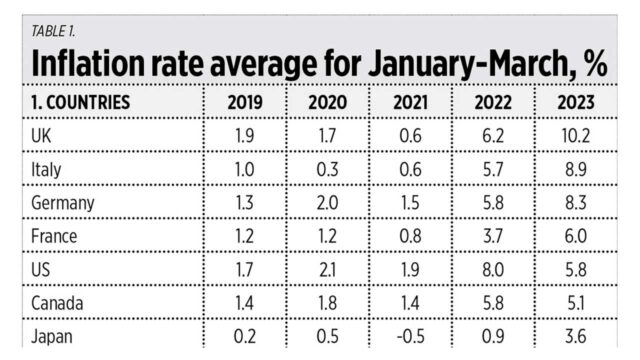
Based on first quarter (Q1) or January-March 2023 average inflation rate, the Philippines has the highest level of inflation in East Asia at 8.3% while Singapore had the highest jump, from only 0.7% in Q1 2021 to 6.5% in January-February 2023. There is no March data yet as of this writing. In Europe, the UK, Italy and Germany are still worse off (see Table 1).

The main sources of the Philippines’ high inflation in Q1 were alcoholic beverages and tobacco due to the continued rise in sin taxes; food and non-alcoholic beverages due to some supply disruption plus the sugar tax; transport due to still high prices of oil products; and water-electricity-gas-other fuels due to high oil and coal prices until late February. The high inflation in restaurants and accommodation/hotels could be related to “revenge spending” that started in Q4 2022.

The IAC-IMO proposed short-term solutions that include to “fill the domestic supply gap through timely and adequate importation based on ex-ante supply-demand analysis.” Over the medium- to long-term, the IAC wants to ensure “water and energy security.” This is a better goal than ensuring water and energy affordability. The most expensive, the most non-affordable situations for the consumers are no water and no electricity (blackout).

From this policy direction, I constructed this table of charts of selected commodity prices. Row 1 is energy: WTI crude in $/barrel and Coal (Newcastle) in $/ton. Row 2 is industrials: urea fertilizer in $/ton and steel rebar in CNY/ton. Row 3 is agricultural: corn and wheat in $/bushel. Row 4 is also agricultural: rice in $/cwt and sugar in $/lb.

Energy prices are declining — especially coal that fell below $200/ton since around Feb. 27 — so we should expect electricity prices to decline starting April for May billing. Fertilizer and steel bar prices are also declining, meaning lower cost of farming and construction. The price of corn has stabilized while that of wheat (for bread, pasta, noodles, etc.) is at a low 2021 level. Rice and sugar prices are high or rising so their importation can be minimized if domestic output is good (see Table 2).

Looking at the quarterly growth of GDP in 2022, the Philippines has had the most consistent fast growth at 7.2% to 8.2% per quarter, with full year growth of 7.6% which was third fastest growth in East Asia next to Malaysia with 8.8% and Vietnam with 8.1% (they had outlier quarterly growth of 13%-14% and moderate growth of 5%).

Then there is the labor and employment data for February 2023, released by the Philippine Statistics Authority. The data seems good, very good to me. One, the labor force participation rate (LFPR) is high at 66.6% — it was only 63.8% in February 2022 and 63.3% full year 2021. High LFPR means people are optimistic that they can find good paying jobs, or they can employ themselves via entrepreneurship. Two, the unemployment rate is low, only 4.8% vs. 6.4% in February 2022 and 7.8% full year 2021. Three, the underemployment rate is also low, only 12.9% vs. 14.0% in February 2022, and 15.9% in the full year 2021.

So, both quarterly GDP in 2022 and employment data in February suggest that the Philippines now has a dynamic domestic economy that can sustain growth even if the external and global economy would worsen again like what happened in Q1 and Q2 of 2022. Thus, the persistent high inflation could be due mainly to high domestic consumption, and the high interest rates of the Bangko Sentral ng Pilipinas have not dissuaded many people from parking their money in the banks and opting to spend more instead.

If people can create more jobs for themselves, then government — especially the economic team — can step back from creating new subsidies or expanding existing ones, maybe even stop some subsidies and focus on having a fiscal balance, if not a fiscal surplus, without raising existing tax rates.

The economic team should also resist many groups’ “tax-free” lobbies and, if possible, amend some laws that create double standards in taxation. Like zero tax (import tax, excise tax, VAT, etc.) for intermittent renewables but high excise tax and VAT payment for conventional fuel sources like coal that provides baseload 24/7 electricity to people and businesses.

Finally, the National Government should remind local governments that they should be more business-friendly and not bureaucracy-oriented. I hear more and more stories of city and provincial governments making the extractive sectors (like mining, quarrying and landfilling) get more expensive, more bureaucratic. When land prices are rising fast, this means new land should be created via land reclamation in the sea and land filling of less productive fishponds.

Rising land area coupled with a rising population — which means more producers and consumers, more entrepreneurs and workers — should work to our economic advantage.


Bienvenido S. Oplas, Jr. is the president of Bienvenido S. Oplas, Jr. Research Consultancy Services, and Minimal Government Thinkers.

minimalgovernment@gmail.com

Mosquitoes are poised to swamp health systems

LUCAS VAN-OORT-UNSPLASH

WHEN you think of dangerous animals, the ones that typically spring to mind have teeth or claws. But what about wings and a proboscis?

In many countries, mosquitoes are nothing more than a nuisance. But in others, they spread tropical diseases that kill at least 700,000 people a year — more than any other animal, according to estimates from the World Health Organization (WHO). Unfortunately, they’re likely to get deadlier. As greenhouse-gas emissions make our planet hotter and wetter, disease-spreading mosquitoes are thriving.

With nations in South America battling some of the worst outbreaks of mosquito-borne disease in decades, the case of a British woman who caught dengue while on holiday in France last summer has sparked warnings about similar outbreaks in countries where insect-carried pestilence hasn’t previously been endemic. Climate change is making tropical diseases everybody’s problem.

Take dengue — sometimes known as “break-bone fever,” which gives you some idea of its symptoms — which has exploded over the past few decades. Cases reported to the WHO increased to 5.2 million in 2019 from just more than 500,000 in 2000. In the 1970s, dengue was endemic in nine countries. Nowadays, about 140 countries deal with outbreaks of dengue regularly. And those outbreaks are getting larger and more severe. The virus and associated mosquitoes — Aedes aegypti and Aedes albopictus, or the yellow fever and Asian tiger mosquitoes — are not only booming in endemic countries, they’re also pushing into higher altitudes and latitudes. In Europe, the Asian tiger mosquito is now established in all of Italy, much of southern France and eastern Spain. Where the mosquito is, the virus is likely to follow: Sudan has reported dengue cases in the capital city for the first time, and France saw a chain of locally transmitted cases last summer.

Judging by what’s happening in Latin America, 2023 could be even worse. In a WHO press conference at the start of April about the worrying dengue and chikungunya (a related virus spread by the same mosquitoes) epidemics there, Raman Velyayudhan, head of the WHO global program on the control of neglected tropical diseases, said that trend could continue around the world this year.

It’s not just mosquitoes that are enjoying the warmer temperatures, but a whole host of disease-spreading vectors, including ticks (which carry encephalitis and Lyme disease) and even freshwater snails (schistosomiasis). Higher temperatures and increased humidity and rainfall boost the biting proclivities, reproductive rates and spatial distribution of these hosts.

It’s a problem that’s top of mind for the Wellcome Trust, a global charitable foundation focusing on health. It’s investing in research around climate-change and vector-borne diseases, and has provided £22.7 million ($28 million) for 24 research teams developing digital tools to better predict when infectious disease outbreaks might occur. One such project is E-Dengue in Vietnam, designed to help health systems prepare for dengue outbreaks up to two months in advance by collating local data. Dung Phung, the lead scientist on the project, said that currently dengue prevention and control is mostly reactive, limiting the effectiveness of measures to combat its spread. An early warning system would help address that.

There’s been some progress with vaccines. Nigeria and Ghana have provisionally approved a new malaria vaccine developed by scientists at the University of Oxford, and Japanese drugmaker Takeda Pharmaceutical Co.’s dengue shot is being steadily rolled out around the world.

Another promising tool is a bacteria called Wolbachia. Found in about 50% of insects, it’s been shown to outcompete viruses like dengue, Zika, and chikungunya in yellow fever mosquitoes, making them less likely to pass on the disease to humans. One study in Indonesia showed that introducing mosquitoes infected with Wolbachia reduced dengue cases by 77%. The method is now being rolled out nationwide for the first time in Brazil.

But early warning systems and virus-blocking bacteria won’t be magic bullets alone. “The combination of both is what is going to drive the change,” Felipe Colón-González, technology lead at the Wellcome Trust, told me. “To be able to apply Wolbachia more effectively, you need to identify hotspots, and it’s through the usage of early warning systems and risk metrics that you can identify them.”

There are plenty of challenges ahead. Colón-González stressed the need for better collaboration between researchers and policy makers, more data collection, and sharing and talent development, especially in low-income countries, which bear the brunt of climate change and tropical disease.

With COVID still fresh on our minds, the obvious question is: “What’s the pandemic risk?” The answer to that is shrouded in uncertainty — viruses are unpredictable — but Diana Rojas Alvarez, co-lead of the WHO’s global arbovirus initiative, noted in a press conference that whenever a vector is present and there is a susceptible population, then there is a risk of large epidemics, if not a pandemic.

A widespread outbreak, especially of a disease that hasn’t historically been endemic, would certainly be enough to overwhelm even the health systems of high-income countries, as the COVID-19 pandemic demonstrated with tragic consequences. As Colón-González says: “If we don’t pay attention, it will happen again.”

BLOOMBERG OPINION

Return to pandemic hunger levels could signal economic fragility

CORPORATE.WALMART.COM

ATLANTA — As economists and investors scour data on inflation, jobs, housing, banking and other bellwether indicators to determine whether the United States is headed for a recession, a visit to the nation’s largest food-bank warehouse offers some ominous clues.

More than half of the shelves at the Atlanta Community Food Bank are bare, in part because of supply-chain issues, but mostly because demand for food assistance is as high as it was during the COVID-19 pandemic, the nonprofit’s executives said. They said two in five people seeking food assistance in the Atlanta region this year have not done so before.

“Nobody anticipated this,” said Debra Shoaf, chief financial officer of the private charity, which relies on corporate and individual donations, as well as government grants, to distribute food to the hungry in 29 Georgia counties. Ms. Shoaf, who also serves on the finance steering committee for the national charity Feeding America, says she’s hearing similar reports across the United States. “We’re back up to pandemic levels,” she said.

In some regions, demand is exceeding even the starkest days of the COVID pandemic. In central Ohio, the local food bank says the number of households seeking aid has increased by nearly half since last year.

More than 11.4 million households collected free groceries in early April, up 15% from a year ago, according to data from the Census Bureau.

“Food banks have been around for 50 years, but this is the first time we are seeing unprecedented high food demand combined with historically low unemployment rates,” said Vince Hall, chief government relations officer for Feeding America, which supports 60,000 food pantries.

The sustained demand comes as most government pandemic emergency aid ends — notably, temporary COVID-related increases to the Supplemental Nutrition Assistance Program (SNAP), formerly known as food stamps, a federal program that provides debit cards to directly purchase food at stores.

Inflation is a major factor, too: Grocery prices have increased 23% since March 2020, when the pandemic began, according to the US Bureau of Labor Statistics.

Such post-COVID demand for free food is “not a good signal” for the economy “and perhaps an indicator of an impending recession,” said John Lowrey, a business professor at Northeastern University whose research focuses on food bank management and public health.

“The fact that we have a lot of first-time users who are no longer concerned about the stigma of going to a food pantry — and actually see value in it because they can no longer afford retail food — is a reasonable proxy for the health of the economy and consumers,” Mr. Lowrey said.

Craig Gundersen, a Baylor University economics professor who is a prominent researcher for Feeding America, said that food banks experiencing spikes above COVID levels are outliers. It is not surprising, he said, to see an increase in demand this year because the government provided so much assistance during the pandemic emergency. He also noted that SNAP benefits, adjusted upward following a mandated review in 2021, remain higher now than they were four years ago. 

“We had the stimulus checks, for a long time people didn’t have to pay their rents and unemployment benefits were higher than wages,” said Mr. Gundersen.

Michael McKee, CEO of the Blue Ridge Area Food Bank, which serves 25 counties astride the Appalachian Trail in Virginia, said COVID emergency assistance masked underlying economic realities. According to the latest available figures from the Bureau of Labor Statistics, inflation has outpaced wage gains since March 2020.

“What’s happening now reveals the scope, scale and pervasiveness of food insecurity in this country and the effects of inequality, not just more recently from inflation, but the inability of wages to keep up with the cost of living,” Mr. McKee said.

‘UNCHARTED TERRITORY’
A complicating factor: the issue of government food assistance has become entangled in the debate among lawmakers about whether to raise the country’s borrowing limit.

Republicans in Congress have proposed limiting food assistance as part of a package of measures to combat what US House Speaker Kevin McCarthy said was President Joseph R. Biden’s “reckless spending.”

President Biden has slammed the Republican proposal and argued it would harm low-income Americans. Anti-hunger advocates told Reuters that policies that make it more difficult for people to access SNAP could put further strain on food banks and other emergency food providers.

The SNAP government program is by far the largest method of feeding the hungry in the United States. Food banks and pantries account for about a tenth as many meals distributed, but they are still the second-largest provider and therefore serve as a critical part of the social safety net.

As temporary COVID-era supplements to SNAP have ceased, food banks from Georgia to Colorado to Virginia say demand for their services has grown.

The Mid-Ohio Food Collective, which operates in 20 counties, reported a roughly 45% increase in household pantry visits in the first three months of this year, compared to last year — from about 270,000 to about 390,000.

“We’re in uncharted territory,” said the charity’s spokesman Mike Hochron. “Household budgets are tight and more people than ever are turning to the emergency system to stave off hunger.”

Houston Food Bank Chief Executive Brian Greene, who has worked in the industry since 1988, said it is difficult to make comparisons over time because demand has historically outstripped supply. He said the Houston Food Bank, the nation’s largest by volume, is distributing less food this year than last but that is because cash and food donations are down.

“If we had as much food as we had during the pandemic, we would distribute it,” he said.

Pantries supplied by the Blue Ridge food bank in Virginia also reported recent spikes. In April 2021, the Dulles South Food Pantry served 109 families a week. In April of last year, it helped 147. This month, the figure is 183 families a week.

The Highland Food Pantry in Winchester, Virginia, said it served about 90 families a week during the pandemic. This month, it’s serving about 135. Among the new clients is Haywood Newman, a 47-year-old handyman, who made it through COVID without assistance but says he’s struggling now.

“You’ve got to pay your water, trash, electric, car and rent — those companies aren’t going to help you out,” Mr. Newman said.

RAZOR-THIN MARGINS
In Atlanta, the nation’s largest food-bank warehouse sprawls over four acres. Supply director Michelle Grear said it was designed to store about 5 million pounds of food, much of which is donated on pallets by food manufacturers and grocery stores. Last month, the inventory average was just 1.8 million pounds, she said.

The food that arrives is flying off the shelves, in many cases claimed by street-level pantries within hours. In March, the warehouse received 9.8 million pounds and distributed 9.6 million pounds, a razor-thin margin, according to Ms. Grear.

Sharawn White, a 31-year-old single mother who earns about $18 an hour at a property company, visited an Atlanta-area pantry for the first time this month. After paying daycare, rent and utility bills, Ms. White said she has about $300 left a month for food, gas and unexpected expenses.

In early April, White visited a community center to donate old clothes and noticed a line for the food pantry. “It ended up being a huge blessing,” she said.

Like most regional food banks, the one in Atlanta relies on government-funded programs and corporate and manufacturer product donations to obtain their food — they try not to spend cash to procure food on their own, except in crisis. In Atlanta, product donations from corporations and farmers have remained largely steady, accounting for more than half of the food distributed, according to the food bank’s records. But the ratio of government funding has changed dramatically.

Pre-pandemic, government-funding provided about 27% of the goods the Atlanta charity distributed, the food bank’s records show. At the height of the pandemic, in fiscal 2021, the government provided nearly 44%. This year, government funds will account for only about 13%.

To make up the difference, the Atlanta food-bank warehouse’s CEO Kyle Waide said his nonprofit will spend $18 million in cash reserves this fiscal year. Five years ago, the charity’s purchased food represented about 5% of the food it distributed to the community. This year, it accounts for 25%.

“We can do this for a while,” Mr. Waide said. “But it’s not sustainable.” — Reuters

Americans set to spend more than Brits at UK hotels for coronation

KING CHARLES III is set to be crowned on May 6 at Westminster Abbey. — BLOOMBERG

WHEN King Charles III is crowned May 6 at Westminster Abbey, royal-watching analysts say American tourists will celebrate by outspending his British subjects at London’s top hotels.

According to research conducted by AI hotel booking platform Allora.ai, US-based travelers will account for 32% of all booking revenue in four- and five-star hotels, more than usual for this time of year. Americans typically make up 24% of revenue and domestic travelers 34%, according to the platform.

“The fact that the coronation has really caught the imagination of visitors from the US is a real added bonus for London hoteliers, as they are far more likely to make use of the hotel’s facilities, such as the restaurant or spa,” says Michael De Jongh, chief commercial officer of Allora.ai. “US guests spend a good deal more than domestic ones.”

There will be plenty of opportunities for visitors who have traveled across the pond to splash cash at luxury hotels on everything from coronation-themed high teas and cocktails to Michelin-starred dinners and a $25,000 whisky for the occasion.

Some of the more exciting recent announcements include 5-star hotel The Londoner opening a pop-up royal martini bar. The Dorchester is reopening its rooftop on coronation day to let guests watch the Red Arrows pass overhead while enjoying a three-course lunch, starting at £165 per person ($205). But hotels in all corners of London are cashing in on the occasion.

Patricia Yates, chief executive officer of VisitBritain, the UK’s national tourism agency, told Bloomberg last month that the coronation has global appeal, especially for Americans, who are the key drivers behind the country’s tourism recovery after pandemic restrictions lifted. Americans shelled out $5.2 billion in the UK in 2019, and spending so far this year is already up 40%, according to VisitBritain.

This all comes after a YouGov poll said that most Brits just don’t care much about the coronation. Apathy is highest among younger people, with 75% of 18- to 24-year-olds who were polled saying they care “not very much” or “not at all” about the king’s big day.

Many Brits said they are looking to get out of town entirely during the festivities. Expedia search data showed that British travelers have been searching for flights to Amsterdam, Paris and even New York, while the top hotels in London are being booked by Americans. — Bloomberg

China, Singapore plan military drills as Beijing forges defense ties

REUTERS

BEIJING — China and Singapore will hold a joint military exercise as soon as this week, their first combined drills since 2021, as Beijing deepens its defense and security ties with Southeast Asia, a region with strong existing US alliances.

The Chinese navy will deploy a missile-bearing frigate, the Yulin, and a mine-hunting ship, the Chibi, to the joint maritime exercise which will last from late April to early May, the Chinese defense ministry said in a statement on its website on Monday, without specifying the location.

Two years ago, China and Singapore held a combined military drill in international waters at the southern tip of the South China Sea, following the upgrade of a bilateral defense pact in 2019 to include bigger-scale exercises among their army, navy and air force.

The deeper China-Singapore military cooperation comes as a time of heightened tensions in the South China Sea, an area spanning 3.5 million square km (1.4 million square miles) that is often traversed by Western navies including US vessels conducting freedom of navigation operations. Such passages annoy China, which lays claims to nearly all of the South China Sea despite an international ruling to the contrary.

In August last year, the US military conducted an expanded Super Garuda Shield exercise with Indonesia that saw the participation of Singapore, Japan and Australia for the first time.

Around the same time, China sent fighter-bombers to Thailand in joint air force drills code named Falcon Strike 2022. Both countries say the exercises, in northeast Thailand near the border with Laos, were defensive in nature.

The drills last summer also took place against the backdrop of elevated tensions in the Taiwan Strait following the visit of former US House Speaker Nancy Pelosi to the democratically governed Taiwan, which China claims as its own.

China’s increased military engagement in Southeast Asia is widely expected to challenge the influence that the United States has shaped with countries including Singapore and Indonesia in coming years. — Reuters

Pag-IBIG home loan releases reach record-high P27.57B in Q1 2023, up 14%

Pag-IBIG Fund released a record-high P27.57 billion in home loans during the first quarter of 2023, an increase of P3.36B or 14% compared to the P24.21 billion released during the same period in 2022, its top officials announced on April 24.

“We are happy to report that we have started the year strong by posting a new record-high in home loan releases for the first three months of 2023. This means that more Filipino workers have been helped by Pag-IBIG Fund in acquiring their own homes. All these are part of our efforts under President Marcos’ Pambansang Pabahay para sa Pilipino Housing or 4PH Program to move forward in solving the housing backlog of our country,” said Secretary Jose Rizalino L. Acuzar, who heads the Department of Human Settlements and Urban Development and the 11-member Pag-IBIG Fund Board of Trustees.

Acuzar added that the amount of home loans released by the agency during the first quarter enabled 21,870 members to acquire their own homes. He further noted that out of this total number, 2,968 or 14% are Pag-IBIG Fund members from the minimum-wage and low-income sectors who were able to secure a total of P1.26 billion in socialized home loans.

Meanwhile, Pag-IBIG Fund Chief Executive Officer Marilene C. Acosta noted that the agency’s performance at the start of the year shows that it has sustained the momentum of its record-high achievement in 2022, when it released a record-high P117.85 billion in home loans for the year and surpassed the one-trillion peso level in total home loan releases since its inception.

“After coming off our best-performing year in 2022, we have yet again set another record-high in housing loan takeout for the first quarter of 2023. Our strong performance in the housing loan front is an indication of the trust of our members in our programs. More importantly, our record-high numbers reflect the increasing number of Filipino workers we have enabled to gain new or better homes. Our members can rest assured that we shall do our best to make our housing loan programs, as well as all our other services, continuously accessible so that they may fully enjoy their benefits as Pag-IBIG Fund members,” Acosta said.


Spotlight is BusinessWorld’s sponsored section that allows advertisers to amplify their brand and connect with BusinessWorld’s audience by enabling them to publish their stories directly on the BusinessWorld Web site. For more information, send an email to online@bworldonline.com.

Join us on Viber at https://bit.ly/3hv6bLA to get more updates and subscribe to BusinessWorld’s titles and get exclusive content through www.bworld-x.com.

[B-SIDE Podcast] Shoppertainment: The rise of livestreaming commerce

https://open.spotify.com/episode/09yeiRi4DovT17Z0NhzhUj?si=rpQ7-VV5QT2GpnfbCUvmVA

Follow us on Spotify BusinessWorld B-Side

Shoppertainment is seen as a more authentic form of advertising, as it provides a personal touch and allows businesses to interact with consumers in real time, according to an expert.

In this B-Side episode, Pierre Faucher, country manager of Intrepid Philippines, talks to reporter Patricia Mirasol about the opportunities in shoppertainment.

This trend originated with a change in consumer behavior, Mr. Faucher said. “The consumers are fed up with TV (television) commercials; they prefer storytelling.”

Shoppertainment is a convergence of content and commerce that offers a $1 trillion opportunity in the Asia Pacific by 2025, according to the Boston Consulting Group.

“It is (content that) provides entertainment…,” Mr. Faucher noted. “What counts is that the shopper feels entertained.”

Examples include the use of augmented reality, such as when people use an app to check what a couch looks like in their living room before buying it, or the use of gamification elements, such as when people are rewarded for achieving their fitness milestones through leaderboard rankings and physical prizes.

It also includes livestreaming shopping, where products are promoted by brand representatives through a livestream event.

Each platform plays a different role, Mr. Faucher said. The social networking site Facebook is for product discovery, whereas Shopee is for product awareness within the shops on its e-commerce website.

In the Philippines, microvlogging platform TikTok has by far gained the most interest for shoppertainment purposes, Mr. Faucher said.

“One best practice is to not go for scripted livestreaming, so people can feel the host is authentic…You don’t want to script your influencer,” he added.

Recorded remotely on April 18, 2023.

Follow us on Spotify BusinessWorld B-Side

South Koreans tap cash-giving apps to help offset rising living costs

STOCK PHOTO | Image by Pexels from Pixabay

 – Throngs of people have been milling seemingly aimlessly around the forecourt of a museum in central Seoul, brushing silently past each other with heads bent toward smartphones while fingers frantically tap screens – in the latest money-making trend.

Walking 10,000 steps, completing tasks such as subscribing to social media, or just tapping the screen when other users are nearby can generate up to 10 cents a time for users of financial services app Toss from South Korean startup Viva Republica.

The viral campaign has seen Toss become a frontrunner in a trend where businesses win users through cash– and points-offering loyalty apps, which have risen in popularity in an economy with high youth unemployment and surging inflation.

As many as three in four adults earn cash through such applications, showed a recent survey by job portal Incruit.

“I’ve only made 150 won ($0.11) so far, but I plan to continue so I can buy coffee or pay for something using the app,” said 27-year-old office worker Baek Na-young.

Some 4.4 million users have used Toss’ cashgiving in-app feature since its January launch, and the number of times people open the app on handsets has increased 30%, Viva Republica said.

Retiree Han Sun-jae, 77, said he had made some 50,000 won ($37.91) so far through the Toss app.

“My daughter works nearby and told me many people were gathering here, and that I could make more money here,” he said outside the Seoul Museum of Art, where office workers gathered at lunchtime based on rumour and grapevine chitchat.

The trend shows people are going the extra mile to help overcome an increasingly dire economic situation, experts said.

The consumer inflation rate hit 5.1% in 2022, the highest since 1998, with food and transport prices up 5.9% and 9.7% respectively.

Some 497,000 people aged 15 to 29 in February said they were on a break from employment and not actively seeking work, showed Statistics Korea data, the most since records began in 2003.

Some experts cautioned that exchanging data for the opportunity to earn pennies could involve sensitive personal information being shared with third parties.

“While the effort to make pocket money is commendable, it could also leave people vulnerable to personal data use,” said Lee Eun-hee, a consumer studies professor at Inha University. “It would be wise to consider both sides of the coin.” – Reuters

Flu or COVID? You can now test for both at home with a single swab. Here’s what you need to know

STOCK PHOTO | Image by Willgard Krause from Pixabay

Source: The Conversation

If you have respiratory symptoms as we head towards winter and flu season, could it be COVID or the flu? Or something else entirely?

Now, we have a range of home tests that can distinguish between flu and COVID with one swab. They use technology you might be used to. They’re rapid antigen tests or RATs.

Here’s what you need to know about the tests, why they might be useful, and what they don’t tell us.

Most people were introduced to RATs while testing at home for COVID.

But RATs to detect the flu have been available for years, albeit used by health workers to test patients.

The latest RATs are different for two reasons. One, they detect both COVID and flu with one swab (a “combo” test). Two, they can be used at home.

The first of these combo home tests for flu/COVID was approved in September 2022. Now several are on the market.

These tests let you check, with one test kit, if you are infected with two types of flu (influenza A and B) and SARS-CoV-2 (the virus that causes COVID).

These RATs contain antibodies that can detect influenza A, influenza B, and SARS-CoV-2.

Some kits have a test cassette with one well to add drops to and one window labelled: C (control), A (influenza A), B (influenza B) and T (test for COVID).

Some tests have two wells and two test windows. You view the influenza results in one window and the COVID results in the other.

In the influenza window you will see markings C, A and B. If a line becomes visible at A (and C), you have tested positive for influenza A. If a line becomes visible at B (and C), you are positive for influenza B. If lines are visible at A, B and C you have tested positive for both influenza A and B.

If either A or B has a line but not C, or if none of them do, the test is invalid and you will need to take a new one.

The COVID window works the same way as in a standard RAT for COVID. If a line becomes visible at C and T, you are COVID-positive. If there is a line at C but not T, you are COVID-negative. If there is no line at C the test is invalid.

If you have respiratory symptoms, there are some practical reasons for knowing whether you are positive for COVID or flu.

One, if you know you have COVID, this will affect the timing of your booster vaccine. The Australian Technical Advisory Group on Immunisation recommends adults wait six months after a COVID infection to get a booster to increase the time you have protective immunity. So it helps to know if you have been infected.

Two, if you need antiviral treatment, the medications differ depending on whether you have flu or COVID.

Three, knowing you have flu or COVID means you can take steps to protect others. This could mean working at home, avoiding contact with vulnerable people, and wearing a mask in company.

The Therapeutic Goods Administration (TGA) lists approved tests on its website. Type the term “combination” in the search box. All combo tests currently listed use nasal swabs to collect the sample.

Most are listed as “very high sensitivity”. This means they get the same result in detecting positive cases as the gold standard PCR test 95% of the time. The others have “high sensitivity” (90% agreement with a PCR).

The best time to take the test is within four days of developing symptoms, as this is when it is easiest to detect both flu and COVID. The tests are more reliable if you have symptoms.

One possibility is that your viral load was not high enough to be detected. You could take another test a day or so later to check again.

Another is you may have a different virus. Viruses that cause respiratory symptoms include rhinoviruses, adenoviruses, respiratory syncytial virus and common cold coronaviruses.

Other pathogens (disease-causing microorganisms) or health conditions can also cause respiratory symptoms. If you are concerned, consult your doctor for medical advice.

As each test differs, make sure you follow the instructions for that specific test.

The price of combo kits advertised online varies from A$8.95 to $59 (excluding delivery) so it pays to shop around. – Reuters

Foreign states evacuate citizens from Sudan

The Republic of Sudan as seen in a screenshot from Google Maps.

 – Sudan‘s sudden slide into conflict between the army and a paramilitary group called Rapid Support Forces (RSF) has stranded thousands of foreigners, including diplomats and aid workers, and countries are working to evacuate their nationals.

Several evacuations are by air. Others are via Port Sudan on the Red Sea, which is about 650 km (400 miles) northeast of Khartoum, but is about 800 km (500 miles) by road.

This is the status of some evacuations:


UNITED STATES

US special forces evacuated all US government personnel and their dependents, along with a few diplomats from other countries, from the embassy on Saturday using helicopters that flew from a base in Djibouti and refueled in Ethiopia. They were not fired on during the evacuation.

Washington does not plan to coordinate an evacuation of other Americans but is looking at options to help them leave.


BRITAIN

British armed forces staged a “complex and rapid evacuation” of all diplomatic staff and their families from Sudan, Prime Minister Rishi Sunak said on Sunday.

He said the government was pursuing every avenue to end the bloodshed and ensure the safety of British nationals there. The Foreign Office urged nationals to shelter in place and let it know where they were.

The defense minister said British troops undertook the operation alongside the United States, France, and other allies.


FRANCE

A French plane carrying about 100 people left Khartoum on Sunday for Djibouti with a second plane carrying a similar number preparing to take off, France said, adding that operations would resume on Monday.

The plane also carried the European Union delegation along with some other nationalities.

Earlier, the warring army and RSF each accused the other of attacking a French convoy. The army said the RSF had fired on the convoy, wounding a French national.

The RSF said it had been attacked by aircraft during the evacuation, leading to a French national being wounded, and it had returned the convoy to its starting point.

France’s Foreign Ministry has not commented on the reported attack or injury.


GERMANY

Germany said a first military plane evacuated 101 citizens to Jordan, with two more aircraft still in Sudan. Germany had earlier said it had roughly 200 citizens in the country.


ITALY

Italy said its nationals would be taken out of Sudan on Sunday night along with some people from Switzerland, Vatican City and other European countries.

Italy’s foreign minister said some 140 Italians would be evacuated, plus around 60 people from other countries.


EGYPT

Egypt said it evacuated 436 of its nationals out of about 10,000 in neighbouring Sudan.

It said one of its diplomats had been wounded by gunfire, without giving details.


SAUDI ARABIA AND GULF STATES

Saudi Arabia on Saturday took 91 Saudis and about 66 people from other countries out from Port Sudan by naval ship to Jeddah, across the Red Sea.

Kuwait said all citizens wishing to return home had arrived in Jeddah.

Qatar thanked Saudi Arabia for helping evacuate Qatari citizens. Sudan‘s army accused the RSF of attacking and looting a Qatari embassy convoy heading to Port Sudan. Neither the RSF nor Qatar have commented on that and it was not clear if it was the same group that left for Saudi Arabia.


RUSSIA

Moscow’s ambassador in Khartoum told Russian state media that 140 out of roughly 300 Russians in Sudan had said they wanted to leave. Evacuation plans were made but were still impossible to implement because they involve crossing frontlines, the ambassador said. He added there were about 15 people, including a woman and child, stuck in a Russian Orthodox church close to heavy fighting in Khartoum.


OTHER COUNTRIES

Jordan said four planes carrying 343 people, including Jordanian nationals and residents of Palestine, Iraq, Syria and Germany, had departed Sudan.

Libya’s embassy in Khartoum said 83 Libyans including diplomats and their families, students and airline and bank employees had reached Port Sudan for onward travel home.

Spain said it evacuated diplomatic personnel and citizens, as well as others from Europe and Latin America. Five Mexicans and two family members were aboard that flight, according to Mexican Foreign Minister Marcelo Ebrard.

India said it had sent a naval ship to Port Sudan and two military planes to Jeddah as part of its preparations and was telling citizens to avoid unnecessary risks.

Tunisia said it would start evacuating citizens on Monday from Khartoum.

Lebanon said it was working to evacuate 51 citizens from Port Sudan.

South Korea said on Friday it was sending a military aircraft to evacuate its 25 citizens in Sudan.

Japan said three planes had arrived in Djibouti to transport Japanese nationals.

Canada said it was suspending operations in Sudan and had extracted its diplomats.

Ghana and Kenya said they were working to help their nationals get out.

Nigeria said had asked for a safe corridor to evacuate 5,500 nationals, mostly students.

Sweden, Norway and Ireland also each said they were involved in efforts to evacuate citizens. The Netherlands said a handful of its 150 nationals in Sudan had left on the French plane.

ADVERTISEMENT
ADVERTISEMENT