Home Blog Page 4921

Dealing with a bully

MORGAN-UNSPLASH

Finally, seven years after the Hague UN Arbitral ruling denying China’s claimed ownership of part of the South China Sea (now the West Philippine Sea), Senator Risa Hontiveros has publicly advocated a multilateral approach to dealing with China’s increasing aggressiveness and outright assertiveness in waters that belong to us.

We have lost seven years because Rodrigo Duterte, our president for six years, chose the lame-brained “bilateral” approach favored by China, for what reason other than personal matters, it is hard to believe. After all, Duterte’s acknowledged “economic adviser” who lived in Davao was no less than a Chinese citizen. And Duterte constantly talked and behaved like a lackey to Xi Jinping whom he openly idolized.

China is a permanent member of the United Nations Security Council, along with other winners in World War II (including the USA and Russia), so, there is a limit to what the UN can do to discipline it. Japan and Germany, both losers in that war, are not in the council.

Better late than never. We must now single-mindedly mobilize a broader alliance with other nations interested in protecting sovereignty and respect for the international rule of law, notably the United Nations Convention on the Law of the Sea (UNCLOS) and the Arbitral Ruling in The Hague. Because it was our country that filed and won the case in The Hague, the Philippines has the moral authority to mobilize an alliance to ensure The Hague ruling is respected.

There are clearly neighboring countries that would be easy to mobilize: Vietnam, which has admirably asserted itself versus China on its territorial waters; Indonesia, whose female cabinet member threw a bomb at Chinese ships trespassing on its marine territories; and Malaysia which has territorial claims in the area. The ASEAN has been inhibited by Cambodia’s support for China’s claims, and, incredibly enough, of our own President Duterte’s down-playing of our victory in The Hague. The USA has made its position clear and its Balikatan exercises and the joint military bases here are indications of where it stands. Japan, Korea, and Australia should not be difficult to invite. Very likely the European Union would be interested in supporting an alliance for the rule of international law in the seas. The bigger and more powerful the alliance we can mobilize, the more likely we can inhibit China’s bullying. As long as we stand alone as a small and poor country, we are likely to get more and more bullied by an increasingly powerful and huge nation.

We cannot underestimate the harm that our passivity and inaction can cause to our country. Our fisher folk are already suffering from being banned from harvesting in our own waters, even having their lives threatened. Let us not forget the time when it was the Vietnamese who rescued our fishermen who almost drowned in our own waters when the Chinese ship bumped their boat and abandoned them when it sank.

The West Philippine Sea is believed to be rich in natural resources, including gas and oil. The Chinese are certainly interested in owning these. They have already taken much of the richness of our coral reefs, thus damaging our marine environment. For political security reasons, in order to control the sea lanes, they have already turned many islets into military bases, with nary a complaint from our former president whose behavior I consider no less than treasonous. He even stated that he hoped we could become a province of China!

We have certainly lost much steam. But again, better late than never. We cannot waste any more time. We have too much to lose. In fact, we have already lost so much of our territorial rights.

Beyond making statements, we need to proceed to action. Sadly, the patriot, former Foreign Affairs Secretary Albert del Rosario, who with full support from President Benigno “Noynoy” Aquino led the legal team that won at The Hague, has passed away. In addition to his colleague Justice Antonio Carpio, we need more leaders to push our National Government to mobilize our alliances. It is necessary for our survival as a sovereign nation.

Let us hope that President Marcos Jr. will have the wisdom, courage, and sense of urgency and purpose to pursue these initiatives, sooner rather than later. We have already lost too much time and access to our precious resources.


Teresa S. Abesamis is a former professor at the Asian Institute of Management and fellow of the Development Academy of the Philippines.


tsabesamis0114@yahoo.com

Insurance Commission releases guidelines to institutionalize consumer protection

EDUARDO SOARES-UNSPLASH

To further strengthen the consumer protection framework, the financial regulators under Republic Act No. 11765 or the “Financial Products and Services Consumer Protection Act” (FCPA) took turns releasing the rules to effectively carry out the provisions of the law.

Early this year, the Securities and Exchange Commission published its draft rules on the financial consumer protection law and asked all interested parties to submit their comments. In March, the Bangko Sentral ng Pilipinas (BSP) issued BSP Circular No. 1169 or the Rules of Procedure for the Consumer Assistance Mechanism, Mediation and Adjudication of Cases in the BSP. In the same month, the Insurance Commission issued, adopted, and promulgated the Implementing Rules and Regulations (IRR) of the FCPA through Insurance Memorandum Circular No. 2023-01.

Under the FCPA and according to its mandate to safeguard the rights and interests of the insuring public, the Commission formulated its standards and rules applicable to specific financial products and services within its jurisdiction. Such financial products and services include insurance, pre-need, Health Maintenance Organizations (HMOs), and digital financial products and services offered and delivered by financial providers and regulated entities.

Termed Insurance Commission-Regulated Entities (ICRE) under the IRR, appropriate mechanisms are imposed on these entities with the aim of reinforcing consumers’ confidence in the financial market and fostering the stability of the Philippine financial system. Towards this end, measures are in place to protect the following rights of financial consumers:

Right to fair and equitable treatment. To ensure every financial consumer is treated fairly, honestly, and professionally at all stages of the transaction, ICREs shall conduct suitability and affordability assessments and ensure fairness of terms and conditions of the financial products and services offered. Moreover, ICRES must evaluate the products and services to make sure that they are appropriately targeted to consumers’ needs, understanding, capacity, and risk appetite.

Right to disclosure and transparency. Among the objectives of the IRR is to ensure adequate consumer protection against unfair business practices. Hence, every financial consumer must have the right to receive clear, concise, and full disclosure of all information relative to a financial product or service that is being offered to them — starting with advertising materials.

ICREs shall ensure that their advertising materials are not false, misleading, or contain deceptive statements or omit key information that may materially and/or adversely affect the decision of the consumer to avail themselves of a service or acquire a product. Regardless of whether it is prepared by them or by their intermediaries, ICREs shall be bound by all statements made in the marketing and sales materials relative to their offered products and services.

Further, all the significant terms and conditions of a financial product or service shall be disclosed by the ICRE to the consumers, as may be applicable: a.) information on risks, return, or possible warnings, b.) any waiver of rights and limitations of liabilities, c.) consumer’s rights and responsibilities, d.) consequences of failure to meet obligations, e.) rights and responsibilities of ICREs, f.) involvement of authorized agents, g.) cancellation of financial product or service, and h.) full price or cost of the financial product or service including all interest, fees, charges, and penalties, and whether they can change over time. The consumers shall be notified of any changes in key features, terms and conditions previously approved by the Commission, at least 30 days before its implementation. Moreover, financial products or services with a coverage period longer than 30 days are required to have a cooling-off or free-look period which enables the consumers to return or cancel the policy or contract.

The financial consumers shall be provided with a copy of each of the documents signed by them immediately after the transaction has been completed. For products or services offered through digital means, ICREs shall provide printed copies of records upon their request.

Right to privacy and protection of client data. Financial transactions and personal data disclosed shall be kept confidential and secured consistent with the provisions of the Data Privacy Act of 2012, its IRR, and other issuances of the National Privacy Commission. ICREs shall also adopt and implement information security standards to ensure the safety and protection of the confidentiality, integrity, availability, authenticity, and non-repudiation of clients’ information and financial transactions.

Right to protection of consumer assets against fraud and misuse. ICREs must provide clear information on the action taken or to be taken about a complaint, inquiry, or request from a financial consumer involving fraud and unauthorized transactions.

Right to timely handling and redress of complaints. In addition to the preceding right, ICRES are required to establish their Consumer Assistance Management System (CAMS) to receive, record, evaluate, resolve, and monitor consumer complaints, inquiries, or requests. A range of consumer assistance channels such as walk-in or personal visits, centralized web portals, mobile applications, social media, letters, e-mails, and telephones must be always made available.

While ICRES may provide for their own periods for addressing consumer concerns, response to inquiries should not be later than the next business day. For complaints or requests, acknowledgment must be made within two working days from receipt. Processing (assessment and investigation) and resolution as well as the communication of the said resolution to the requesting consumer must then be made within nine to 47 working days from receipt of the complaint or request depending on its difficulty or complexity.

As part of the transitory clause, ICREs shall be given a reasonable period to conduct a gap analysis of their current consumer protection practices vis-a-vis the IRR provisions and create an Action Plan duly approved by the ICREs’ Board of Directors to achieve full compliance with the said rules. In no case, however, will the compliance process be longer than one year and six months from the effectivity of the IRR.

Otherwise, failure to comply with the FCPA, its IRR, and other relevant laws and regulations will warrant enforcement and administrative sanctions on ICREs and their directors, trustees, officers, employees, or agents.

The views and opinions expressed in this article are those of the author. This article is for general informational and educational purposes only and not offered as and does not constitute legal advice or legal opinion.


Gillian Ruth A. Grancho is an associate of the Angara Abello Concepcion Regala & Cruz Law Offices (ACCRALAW), Davao Branch.

(6382) 224-0996

gagrancho@accralaw.com

Hollywood writers go on strike as streaming shift upends TV business

AHMET YALÇINKAYA-UNSPLASH

LOS ANGELES — Thousands of film and television writers went on strike starting Tuesday, throwing Hollywood into turmoil as the entertainment business grapples with seismic changes triggered by the global streaming TV boom.

The Writers Guild of America (WGA) called its first work stoppage in 15 years after failing to reach an agreement for higher pay from studios such as Walt Disney Co. and Netflix, Inc. The last strike lasted 100 days and cost the California economy more than $2 billion.

“The companies’ behavior has created a gig economy inside a union workforce, and their immovable stance in this negotiation has betrayed a commitment to further devaluing the profession of writing,” the WGA said in a statement on its website.

The Guild represents roughly 11,500 writers in New York, Los Angeles and elsewhere. Members were scheduled to start picketing outside of Hollywood studios starting Tuesday afternoon.

The Alliance of Motion Picture and Television Producers (AMPTP), which represents the studios, said late on Monday it had offered “generous increases in compensation” to writers but the two sides were unable to reach a deal.

Media companies are facing a tough economic backdrop. Conglomerates are under pressure from Wall Street to make their streaming services profitable after investing billions of dollars in programming to attract subscribers.

The rise of streaming has led to declining television ad revenue, as traditional TV audiences shrink, and advertisers go elsewhere. On top of that, the threat of a recession in the world’s biggest economy also looms.

The last WGA strike, in 2007 and 2008, cost the California economy an estimated $2.1 billion as productions shut down and out-of-work writers, actors and producers cut back spending.

STICKING POINTS
Producers were prepared to increase their offers of higher pay and residuals, the AMPTP said, but were “unwilling to do so because of the magnitude of other proposals still on the table that the Guild continues to insist upon.”

The primary sticking points, the group said, were proposals that “would require a company to staff a show with a certain number of writers for a specified period of time, whether needed or not.”

The WGA countered that the studios’ responses to its proposals “have been wholly insufficient, given the existential crisis writers are facing.”

“The companies have broken this business. They have taken so much from the very people, the writers, who have made them wealthy,” the Guild added.

Writers say they have suffered financially during the streaming TV boom, in part due to shorter seasons and smaller residual payments.

Half of TV series writers now work at minimum salary levels, compared with one-third in the 2013-14 season, according to Guild statistics. Median pay for scribes at the higher writer/producer level has fallen 4% over the last decade.

Artificial intelligence (AI) is another issue at the bargaining table. The WGA wants safeguards to prevent studios from using AI to generate new scripts from writers’ previous work. Writers also want to ensure they are not asked to rewrite draft scripts created by AI.

Until the conflicts are resolved, some TV programming will be disrupted.

Late-night shows such as Jimmy Kimmel Live and The Tonight Show with Jimmy Fallon, which use teams of writers to pen topical jokes, are expected to immediately stop production.

That means new episodes will not be available during their traditional TV time slots or on the streaming services that make them available the next day.

Further ahead, the strike could lead to a delay of the fall TV season. Writing for fall shows normally starts in May or June. If the work stoppage becomes protracted, the networks will increasingly fill their programming lineups with unscripted reality shows, news magazines and reruns.

Netflix may be insulated from any immediate impact because of its global focus and access to production facilities outside of the US. — Reuters

Jared Leto wears giant ‘Choupette’ costume to Met Gala

JARED LETO poses at the Met Gala, an annual fundraising gala held for the benefit of the Metropolitan Museum of Art’s Costume Institute with this year’s theme ‘Karl Lagerfeld: A Line of Beauty,’ in New York City, May 1, 2023. — REUTERS

NEW YORK — An enormous fluffy, white, blue-eyed Burmese cat mascot ascended the Metropolitan Museum of Art steps on Monday in homage to Karl Lagerfeld’s beloved pet “Choupette,” who later revealed himself as actor Jared Leto, bringing a whole new meaning to this year’s Met Gala dress code “in honor of Karl.”

In another homage to the famous feline, American rapper and singer Doja Cat wore a prosthetic cat nose and a hooded Oscar de la Renta gown fitted with cat ears.

The invitation-only Met Gala, famed for its A-list celebrities and extravagant outfits, is a benefit for New York’s Metropolitan Museum of Art and marks the opening of the Costume Institute’s annual fashion exhibit.

The upcoming exhibit, “Karl Lagerfeld: A Line of Beauty,” celebrates the work and life of the late German designer who was creative director for fashion houses including Chanel and Fendi as well as his namesake brand. This year’s guests were told to dress “in honor of Karl.” “Karl loved romantic, but he also loved something a little edgy and nasty,” said American fashion designer Michael Kors.

Many celebrities opted for looks that were très romantique and ancien, with no shortage of pastel vintage Chanel gowns, pearl necklaces and Camellias, the official flower of Chanel, on the red carpet.

There was also no shortage of bling.

Met Gala co-chair Dua Lipa wore a vintage 1992 Chanel Haute Couture Fall cream tweed gown and paired it with a never before seen 100 karat Tiffany & Co. diamond necklace.

American Rapper Lil Nas X brought the edge arriving covered head to toe in metallic silver body paint, crystals and pearls along with a bejewelled cat mask.

Met Gala co-chair and Ghanaian-British screenwriter and actress Michaela Coel wore a nude semi-sheer long sleeve Schiaparelli gown encrusted with 130,000 crystals, straight back corn rows and gold statement accessories including a diamond-and-gold turtle-neck necklace.

Vogue Editor Anna Wintour, who has organized and presided over the event since 1995, told Ms. Coel that she selected her to be a co-chair because she is unafraid to be herself and felt Karl’s journey was to try to learn to be unafraid of being himself, the actress told Vogue.

The so-called Oscars of the East Coast this year is also co-chaired by Spanish actress Penelope Cruz, Swiss tennis great Roger Federer and Ms. Wintour.

“(Lagerfeld) has been naughty and fun and has just given us such brilliant fashion for his entire life,” American fashion designer Marc Jacobs told reporters on the carpet.

American basketball star Brittney Griner stepped onto the red carpet dressed in a champagne Calvin Klein suit and said it feels “crazy” to be in the spotlight at an event like the Met.

Singer Rihanna was the last to saunter up the stairs telling reporters that she was feeling “expensive” in an all-white, hooded Valentino gown covered in extra large Camellias. — Reuters

[B-SIDE Podcast] Romualdez on expanding PHL-US economic ties 

Follow us on Spotify BusinessWorld B-Side

At a time when the US Congress is not keen on any kind of free trade agreement (FTA) with the country, the Philippine Embassy in the United States is working on alternative measures to expand the country’s economic ties with the world’s biggest economy.

In this B-Side episode, Jose Manuel “Babes” D. Romualdez, Philippine ambassador to the United States, explains to BusinessWorld reporter Keisha B. Ta-asan how crucial it is to renew the country’s participation in the US Generalized System of Preferences (GSP) trading scheme.

“We’re working on the GSP as a priority, and the FTA will be a continuing effort on our part to see how we can get one done,” he said.

The Philippines has been pushing for the reauthorization of its GSP eligibility after it expired in 2020. The program allowed duty-free entry of more than 5,000 Philippine products into the US, including electronics and agricultural products.

The US is also pushing for the Indo-Pacific Economic Framework for Prosperity (IPEF) as an alternative to FTAs. But the US-led trade framework would focus on wider trade agreements with multiple countries.

Launched in May 2022, the IPEF pushes for resilience, sustainability, inclusiveness, economic growth, fairness, and competitiveness among the 14 participating nations. This includes the US, Australia, Brunei, Fiji, India, Indonesia, Japan, South Korea, Malaysia, New Zealand, the Philippines, Singapore, Thailand, and Vietnam.

The ambassador also noted that US companies are more interested in investing in the Philippines, especially after the economic team visited Washington D.C. and presented the country’s stronger-than-expected economic growth.

The Marcos administration’s economic team touted the Philippine economy’s gains during an April 12 briefing attended by around 180 representatives from US companies and industry groups.

Many businesses also consider the Philippines a “safe place” to invest amid tensions between the US and China, Mr. Romualdez said.

Recorded physically on April 14, 2023.


Related stories:

https://www.bworldonline.com/top-stories/2023/04/25/518791/us-firms-interested-in-phl-but-want-more-conducive-environment-romualdez/

https://www.bworldonline.com/top-stories/2023/04/20/517939/phl-envoy-prioritizes-gsp-renewal-bid-in-us/

Amid China pressure, US and Philippines recommit to security alliance

PHILIPPINESTAR/ WALTER BOLLOZOS

 – President Joe Biden told his counterpart Ferdinand Marcos Jr. on Monday that the US commitment to the defense of its ally was “ironclad,” including in the South China Sea where Manila is under pressure from China.

Mr. Marcos, on the first White House visit by a Philippines leader in 10 years, stressed the importance of the United States as his country’s sole treaty ally in a region with “arguably the most complicated geopolitical situation in the world right now.”

The two countries reaffirmed their decades-old security alliance in a trip that marks a dramatic turnaround in US-Philippine relations as both countries seek ways to push back against what they see as China‘s increasingly aggressive actions near Taiwan and in the South China Sea.

US officials said the leaders would agree new guidelines for stronger military cooperation, as well as stepped up economic cooperation.

“The United States remains ironclad in our commitment to the defense of the Philippines, including the South China Sea,” Biden told Marcos in the Oval Office.

A joint statement said this meant that any armed attack on Philippine armed forces, public vessels or aircraft in the Pacific, including in the South China Sea, would invoke US mutual defense commitments under a 1951 Mutual Defense Treaty.

Washington sees the Philippines as key to any effort to counter an invasion of Taiwan by China, which claims the self-ruled island as its own territory. Manila recently agreed to allow the United States access to four more of its military bases under an Enhanced Defense Cooperation Agreement, but the two sides have not said what U.S. assets will be stationed at those.

The joint statement said the leaders “affirm the importance of maintaining peace and stability across the Taiwan Strait as an indispensable element of global security and prosperity.”

Under Rodrigo Duterte, Marcos’ predecessor, US relations soured as he turned the Philippines sharply away from its former colonial ruler and built closer ties with China.

Mr. Biden has invested in courting Marcos, who still faces a US court judgment connected with $2 billion of plundered wealth under his father’s rule.

US officials said the new guidelines focused on military coordination across land, sea, air, space and cyberspace, while the US administration would also transfer three C-130 aircraft and look to send additional patrol vessels to the Philippines.

“It is only natural for the Philippines to look to its sole treaty partner in the world to strengthen and to redefine the relationship that we have and the roles that we play in the face of those rising tensions that we see now around the South China, Asia Pacific and Indo-Pacific region,” Mr. Marcos said.

The summit is the centerpiece of a four-day US visit by Marcos that started on Sunday.

Mr. Marcos has sought warm relations with both the United States and China, who are vying for influence in the Indo-Pacific. The Biden-Marcos joint statement did not name the Chinese government.

Experts say Washington considers the Philippines a potential location for rockets, missiles and artillery systems to counter a Chinese amphibious assault on Taiwan.

However, Mr. Marcos told reporters on his plane China had agreed to discuss fishing rights in the South China Sea and also that he would not allow the Philippines to become a “staging post” for military action.


TRADE MISSION

The joint statement said Mr. Biden would send a Presidential Trade and Investment Mission to the Philippines to enhance investment in clean energy transition, the critical minerals sector, and food security.

The two countries would also co-host in Manila the 2024 Indo-Pacific Business Forum – the marquee US commercial event in the region – which would further establish the Philippines as a key hub for regional supply chains.

The statement also said the countries looked forward to establishing trilateral cooperation with Japan and Australia.

With many Filipinos frustrated by China‘s actions in the South China Sea, including the harassing of Philippine ships and fishermen in parts that both countries claim, popular support has grown in the Philippines for a tougher stance toward Beijing.

Mr. Biden was the first official to reach out to Marcos after his election and has made strengthening economic and military ties in the Indo-Pacific region a cornerstone of his foreign policy.

Before the summit, US lawmakers sent a bipartisan letter to Biden calling on him to raise what they called the worsening human rights “crisis” in the Philippines.

They said there were well-documented violations under Duterte but recent reports showed “ongoing impunity.” They cited reports from the Karapatan Human Rights Alliance of 17 extrajudicial killings, 165 illegal arrests from July to December 2022, and a total of 825 political prisoners. A White House summary said human rights were among the topics being discussed by the two countries. – Reuters

Japan, South Korea hold first finance leaders’ meeting in 7 years

– Japan and South Korea held their first bilateral finance leaders’ meeting in seven years on Tuesday, a sign relations between the two are thawing as they confront shared challenges from geopolitical tensions and slowing economic growth.

The two countries agreed to resume regular finance dialogue “at an appropriate timing,” Japanese Finance Minister Shunichi Suzuki told reporters after the meeting.

The dialogue will likely be held on an annual basis, Suzuki said.

The resumption of bilateral financial discussions comes ahead of Japanese Prime Minister Fumio Kishida’s planned visit to South Korea next week for talks with President Yoon Suk Yeol.

Japan and South Korea are important neighbours that must cooperate to address various challenges surrounding the global and economy, as well as the regional and international community,” Suzuki said at the meeting with his South Korean counterpart Choo Kyung-ho.

“As for geo-political challenges, we’re experiencing incidents like North Korea‘s nuclear missile development and Russia’s invasion of Ukraine. Japan sees these as unacceptable, and something the two countries must address together,” he said.

Choo said the two countries can strengthen private and government partnerships in high-technology industries such as semiconductors and batteries.

In the meeting held on the sidelines of the Asian Development Bank (ADB) gathering this week, Choo also urged Japan to swiftly restore South Korea back to a “white list” of countries with fast-track trade status.

Choo is expected to visit Japan this year for another meeting with Suzuki, South Korea‘s finance ministry said.

Regular annual dialogue between the two countries’ finance ministers has been suspended since 2016 due to disputes over wartime history.

But ties between the U.S. allies have improved in recent months in the face of North Korea‘s frequent missile launches and China’s more muscular role on the global stage.

In a landmark summit in Tokyo last month, Kishida and Yoon agreed to put aside their difficult shared history and pledged to work together to counter regional security challenges.

Suzuki said he hoped Japan and South Korea can continue with bilateral financial dialogue and that doing so would contribute to improving relations between the two countries. – Reuters

US to end COVID vaccination requirements on May 11 for foreign travelers, federal workers

The United States will end its COVID-19 vaccination requirements for international travelers and federal workers on May 11, when the coronavirus public health emergency ends, the White House said on Monday.

In February, the US House of Representatives voted to lift the requirement that most foreign air travelers be vaccinated against COVID-19, one of the few remaining pandemic travel restrictions still in place.

The Biden administration last June dropped its requirement that people arriving in the US by air must test negative for COVID but kept in place Centers for Disease Control and Prevention (CDC) vaccination requirements for most foreign travelers.

The rules barred Serbian tennis star Novak Djokovic from taking part in some U.S. tournaments because he is not vaccinated against COVID-19, but from May 12 he could freely enter and play in major American tournaments like the U.S. Open.

The Homeland Security Department also said Monday starting May 12 it will no longer require non-US travelers entering the United States via land ports of entry and ferries to be vaccinated against COVID-19 and provide proof of vaccination upon request.

The Biden administration’s rules imposed in September 2021 requiring about 3.5 million federal employees and contractors to be vaccinated or face firing or disciplinary action have not been enforced for over a year after a series of court rulings.

A federal appeals court in March upheld a decision blocking enforcement of the employee vaccine requirement.

The White House told federal agencies in October 2022 not to enforce the contractor vaccine requirements even after a nationwide injunction was lifted.

The Health and Human Services Department said it will start the process to end vaccination requirements for Head Start educators and government-certified healthcare facilities. – Reuters

US may default on June 1 without debt ceiling hike; Biden, McCarthy to meet

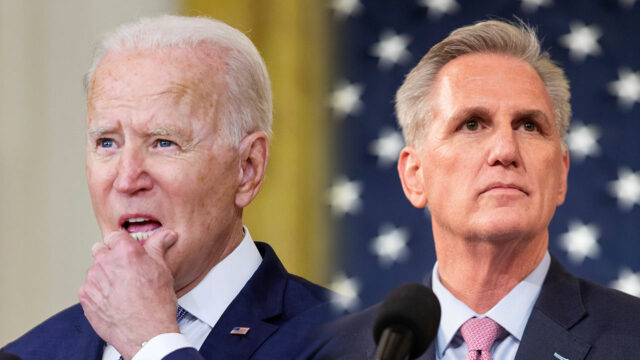
US President Joseph Biden, Jr. (left) and Republican House Speaker Kevin Mccarthy (right)

 – US President Joe Biden on Monday summoned the four top congressional leaders to the White House next week after the Treasury warned the government could run short of cash to pay its bills by June.

Treasury Secretary Janet Yellen said in a letter to Congress that the agency will be unlikely to meet all US government payment obligations “potentially as early as June 1″ without action by Congress.

The estimate raised the risk that the United States is headed for an unprecedented default that would shake the global economy, adding new urgency to political calculations in Washington, where Democrats and Republicans were girding for a months-long standoff.

Mr. Biden called Republican House Speaker Kevin McCarthy in Jerusalem, where he is on a diplomatic trip, to invite him to a May 9 White House meeting. The two leaders haven’t sat down to discuss the issue since February.

Mr. Biden also extended invitations to House Democratic leader Hakeem Jeffries, Senate Majority Leader Chuck Schumer and Republican leader Mitch McConnell. McConnell, whose fall in March sidelined him for weeks, said he and Biden had a “good conversation” today, adding: “I’m sure we’ll be speaking again.”

House Republicans passed a bill to raise the debt limit last week that includes steep cuts to spending from healthcare for the poor to air-traffic controllers, which the Democratic-controlled Senate and Biden say they will not approve.

Mr. Biden has steadfastly said he will not negotiate over the debt ceiling increase, but will discuss budget cuts after a new limit is passed. Congress has often paired debtceiling increases with other budget and spending measures.

A White House official said Mr. Biden, who had previously said he wouldn’t meet McCarthy at all to discuss the debt limit, would “stress that Congress must take action to avoid default without conditions” on May 9.

The new potential “X-date,” which takes in to account April tax payments, is largely unchanged from a previous estimate, issued in January, that the government could run short of cash around June 5. But Yellen added some wiggle room, noting federal receipts and outlays are “inherently variable.” The actual date that Treasury exhausts extraordinary measures “could be a number of weeks later than these estimates,” she wrote.

“It is impossible to predict with certainty the exact date when Treasury will be unable to pay the government’s bills,” she wrote.

After hitting the $31.4 trillion borrowing cap on Jan. 19, Ms. Yellen previously told Congress that Treasury would keep up payments on debt, federal benefits and make other spending by using extraordinary cash management measures. One such step Treasury is taking is suspending the sales of securities that state and local governments use to temporarily hold cash.

In 2011, a similar debt ceiling fight took the country to the brink of default and prompted a downgrade of the country’s top-notch credit rating. This time, negotiations may be even more difficult, veterans of 2011’s face-off say.


SPENDING CUT DEMANDS

The April 26 bill passed by the Republican-led House would slash tax incentives for solar energy and implement $4.5 trillion in spending cuts – or about 22% – in exchange for a $1.5 trillion increase in the US debt limit.

The bill has no chance of passing the Democrat-controlled Senate and the White House has said Mr. Biden would veto the legislation if it did.

Budget analyst Shai Akabas at the Bipartisan Policy Center said the short deadline underscored the urgency of finding a solution to the bitter standoff, and that it dashed hopes that the Congress could negotiate through the late summer months.

A potential default within weeks “is not a position befitting of a country considered the bedrock of the financial system, and only adds uncertainty to an already shaky economy,” he added.


BREATHING ROOM

Ms. Yellen’s vagueness on the actual default date is due to some fiscal events in June that could buy some breathing room.

If Treasury can make it past early June benefit payments, it could take in significant cash from quarterly estimated tax payments due on June 15, analysts say. Then Treasury could float until June 30, when it would be able to tap $143 billion in borrowing by suspending reinvestment of maturing securities held by the government retirement funds.

Along with tax receipts, that borrowing would allow it to pay bills well into July.

Nonetheless, the US’s debt ceiling battles are likely to persist for years to come, with benefit programs like Social Security and Medicare accounting for the largest category of the budget and projected to grow dramatically as the population ages.

As the current debate heats up, Mr. Biden, who is seeking re-election in 2024, is using the House Republican proposal to tag his opposition as an economic threat to local economies.

China’s exit bans multiply as political control tightens under Xi

PEXELS-LARA JAMESON

 – China is increasingly barring people from leaving the country, including foreign executives, a jarring message as the authorities say the country is open for business after three years of tight COVID-19 restrictions.

Scores of Chinese and foreigners have been ensnared by exit bans, according to a new report by the rights group Safeguard Defenders, while a Reuters analysis has found an apparent surge of court cases involving such bans in recent years, and foreign business lobbies are voicing concern about the trend.

“Since Xi Jinping took power in 2012, China has expanded the legal landscape for exit bans and increasingly used them, sometimes outside legal justification,” the Safeguard Defenders report reads.

“Between 2018 and July of this year, no less than five new or amended (Chinese) laws provide for the use of exit bans, for a total today of 15 laws,” said Laura Harth, the group’s campaign director.

The group estimates “tens of thousands” of Chinese are banned from exit at any one time. It also cites a 2022 academic paper by Chris Carr and Jack Wroldsen that found 128 cases of foreigners being exit-banned between 1995 and 2019, including 29 Americans and 44 Canadians.

Attention on the exit bans comes as China-US tensions have risen over trade and security disputes. This contrasts with China’s message that it is opening up to overseas investment and travel, emerging from the isolation of some of the world’s tightest COVID curbs.

The Reuters analysis of records on exit bans, from China’s Supreme Court database, shows an eight-fold increase in cases mentioning bans between 2016 and 2022.

China last week beefed up its counter-espionage law, allowing exit bans to be imposed on anyone, Chinese or foreign, who is under investigation.

Most of the cases in the database referring to exit bans are civil, not criminal. Reuters did not find any involving foreigners or politically sensitive subversion or national security issues.

By comparison, the US and European Union impose travel bans on some criminal suspects but generally not for civil claims.


DUE DILIGENCE

China’s Ministry of Public Security did not respond to Reuters requests for comment on exit bans, including inquiries on how many individuals, including foreigners, are subject to them.

One person prevented from leaving China this year is a Singaporean executive at the US due-diligence firm Mintz Group, according to three people familiar with the matter.

The company, the executive and China’s Public Security Bureau did not respond to requests for comment.

Mintz said in late March the authorities had raided the firm’s China office and detained five local staff. The foreign ministry said at the time Mintz was suspected of engaging in unlawful business operations. Police visited Bain & Co’s office in Shanghai and questioned staff, the US management consultancy said last week.

“Because of rising tensions between the US and China, the salience of this (exit ban) risk has risen,” said Lester Ross, a veteran lawyer in China who has handled exit ban cases.

“I’ve seen a rise in companies and entities being concerned about this and asking for our advice on how to prepare and reduce risks” of exit bans, said Ross, the head of the American Chamber of Commerce’s China policy committee.


‘UNCERTAINTY IS HUGE’

Foreign businesses are concerned about the heightened scrutiny and the vague wording of the counter-espionage legislation, which says exit bans can be imposed on those who cause “harm to the national security or significant damage to national interests”.

“The uncertainty is huge,” said Jorg Wuttke, head of the European Union Chamber of Commerce in China. “Can you do due diligence? Clarity has to come.”

The EU chamber told Reuters in a statement: “At a time when China is proactively trying to restore business confidence to attract foreign investment, the exit bans send a very mixed signal.”

People barred from leaving China include regular Chinese embroiled in financial disputes as well as rights defenders, activists and lawyers, and ethnic minorities such as Uyghurs in China’s northwestern Xinjiang region, according to the Safeguard Defenders report.

It cites a Chinese judicial report saying 34,000 people were placed under exit bans between 2016 and 2018 for owing money, a 55% rise from the same period three years earlier.

Some activists say the wider use of exit bans reflects tighter security measures under President Xi.

“They can find any reason to stop you from leaving the country,” said Xiang Li, a Chinese rights activist who was denied exit for two years before escaping from China in 2017 and later receiving asylum in the United States.

“China doesn’t have the rule of law,” she told Reuters by phone from California. “The law is used to serve the purposes of the Chinese Communist Party. It’s very effective.” – Reuters

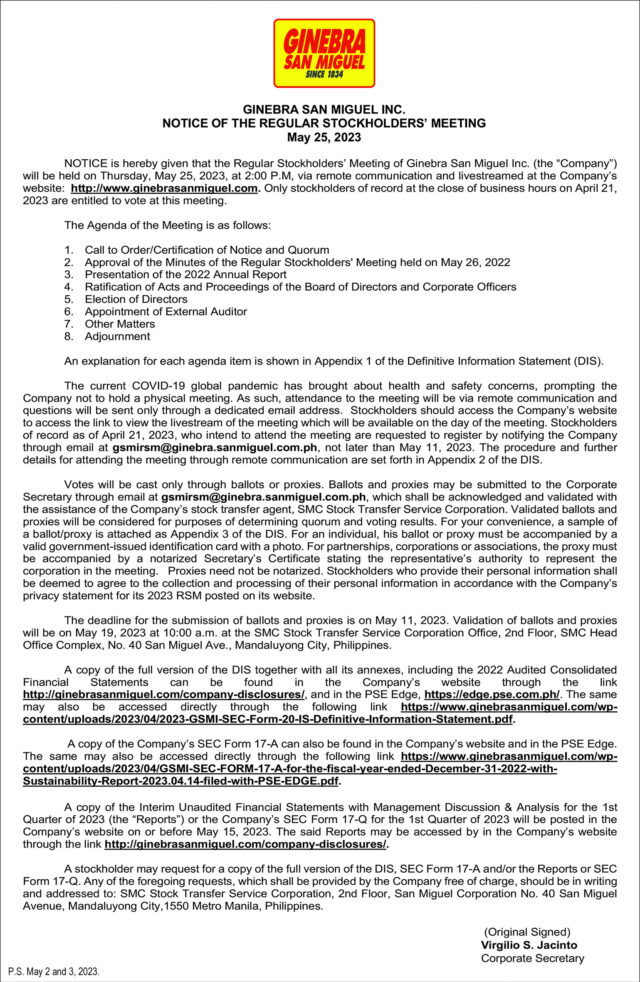
Ginebra San Miguel, Inc. to conduct regular stockholders’ meeting on May 25


Spotlight is BusinessWorld’s sponsored section that allows advertisers to amplify their brand and connect with BusinessWorld’s audience by enabling them to publish their stories directly on the BusinessWorld Web site. For more information, send an email to online@bworldonline.com.

Join us on Viber at https://bit.ly/3hv6bLA to get more updates and subscribe to BusinessWorld’s titles and get exclusive content through www.bworld-x.com.

Inflation likely eased in April — poll

A woman shops for snacks at a supermarket in Quezon City, Jan. 16, 2023. — PHILIPPINE STAR/MIGUEL DE GUZMAN

By Keisha B. Ta-asan, Reporter

INFLATION likely further eased in April amid lower food prices, electricity rate cuts, and favorable base effects, analysts said.

However, still-elevated inflation may prompt the Bangko Sentral ng Pilipinas (BSP) to continue hiking interest rates at its policy meeting later this month, despite earlier signals of a pause.

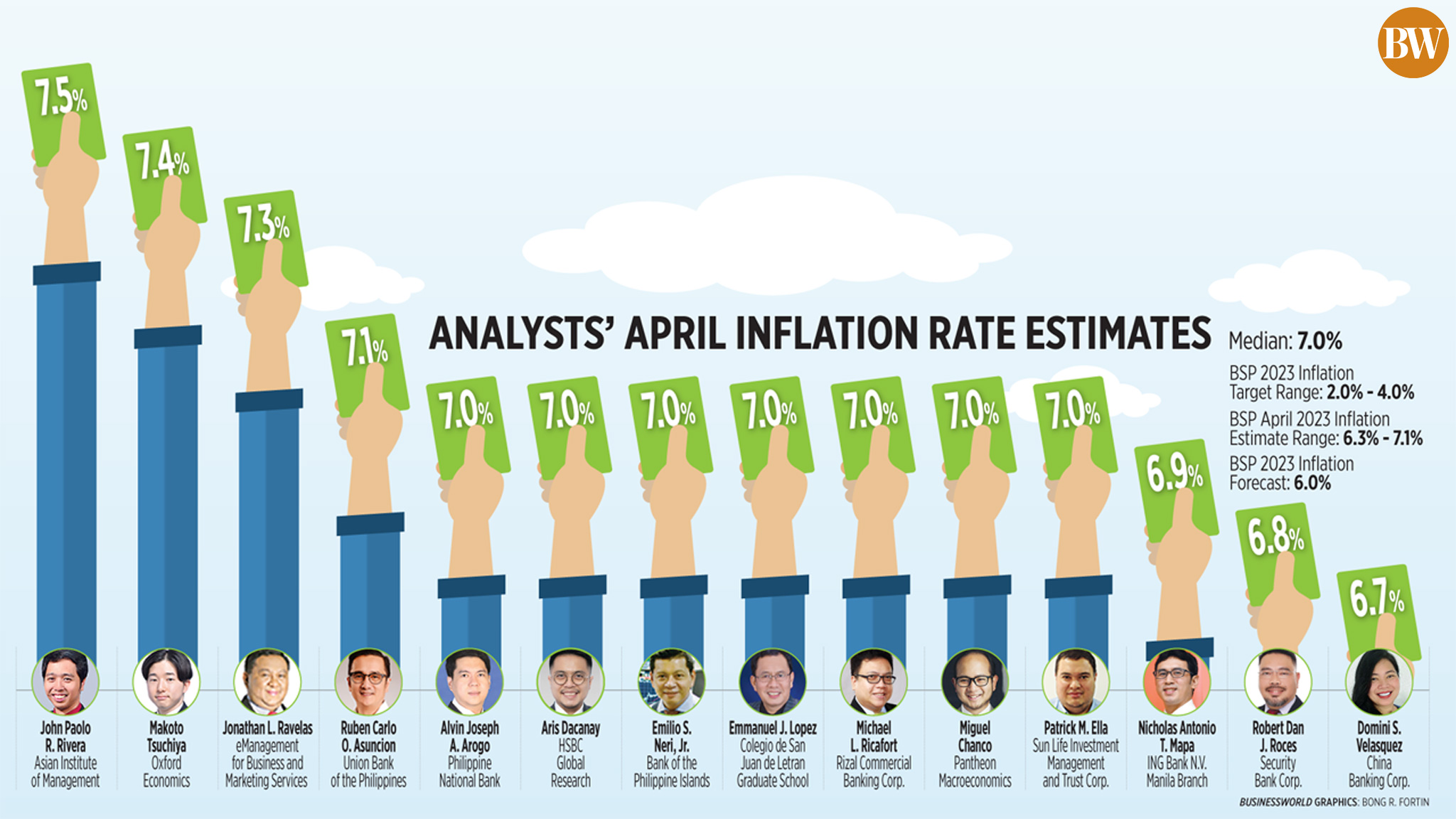
A BusinessWorld poll of 14 analysts yielded a median estimate of 7% for April inflation, settling near the upper end of the 6.3-7.1% forecast range by the BSP for the month.

Analysts’ April inflation rate estimates

If realized, this would be slower than the 7.6% in March, but faster than the 4.9% in April 2022. It will also be the slowest rise in prices in seven months, or since the 6.9% inflation rate in September last year.

However, April inflation would surpass the BSP’s 2-4% target range for the 13th consecutive month.

Consumer price index (CPI) data for April will be released on May 5.

“Although oil prices have increased and the longer-lasting effects from last year’s supply shocks are still prevalent, the headline inflation print will likely be lower than March’s 7.6% due to favorable base effects,” Philippine National Bank economist Alvin Joseph A. Arogo said.

In April alone, pump price adjustments stood at a net increase of P2.90 per liter for gasoline, P1.10 per liter for diesel, and P2 per liter for kerosene.

“The prices of numerous food items also moderated but a few continue to be very elevated. In particular, sugar and onion prices continue to soften with supply augmented from the government’s emergency importation of these goods whereas egg and oil prices are still high,” Hongkong and Shanghai Banking Corp. economist for the Association of Southeast Asian Nations (ASEAN) Aris Dacanay said.

The average price of local red onions went as high as P180 per kilogram by end-April, while the price of refined sugar ranged from P86 to P110 per kilo during the month, data from the Department of Agriculture showed.

Oxford Economics assistant economist Makoto Tsuchiya said despite a year-on-year slowdown in inflation, momentum likely picked up month on month largely due to food prices, particularly meat.

“But a high base a year ago likely exerted downward pressures on both fuel and headline CPI,” Mr. Tsuchiya said in an e-mail.

Prices of pork kasim ranged from P310 to P365 per kilo at end-April, higher than the P290 to P350 range at end-March. Prices of whole chicken also rose to P150-P220 per kilo from P150-P200 a month ago, while prices of beef rump were unchanged at P395-P550.

“Possibly higher prices of fish, meat, rice, hotel accommodations and restaurant services, housing rentals were drivers for a return to month-on-month CPI increases,” Bank of the Philippine Islands (BPI) Lead Economist Emilio S. Neri, Jr. said.

China Banking Corp. Chief Economist Domini S. Velasquez noted liquefied petroleum gas prices and electricity rates in Manila Electric Co.’s (Meralco) service areas were also lower in April.

Fuel retailers cut prices of cooking gas by around P9.18 to P9.20 per kilogram in April, while Meralco also slashed the overall rate for a typical household by P0.1180 to P11.3168 per kilowatt-hour (kWh) in April.

“Nonetheless, there are upside risks to the forecast with the peso depreciating against the dollar in the second half of April,” Mr. Dacanay said.

The peso returned to the P55-a-dollar mark in April. The local unit closed at P55.38 on Friday, down by P1.02 or 1.84% from its P54.36 finish on March 31.

Meanwhile, Ms. Velasquez also said core inflation may have eased to 7.7% in April, from 8% in March, “which is sufficient to show that inflation is on a sustained downward trajectory.”

March was the fastest core inflation since December 2000.   

ONE MORE RATE HIKE?
According to analysts, the BSP may still hike rates by 25 basis points (bps) this month, bringing the benchmark interest rate to 6.5%, before pausing its tightening cycle.

The Monetary Board has raised borrowing costs by 425 bps since May last year, bringing the key policy rate to 6.25%, its highest in nearly 16 years. The BSP will again meet on May 18 to discuss policy.

Mr. Neri said strong gross domestic product (GDP) growth in the first quarter, another rate hike by the US central bank, and still-elevated core inflation may affect the BSP’s decision on May 18.

The Philippine Statistics Authority is set to release first-quarter GDP data on May 11.

“While BSP may decide to pause, this could erode some of the confidence it has regained in recent months,” Mr. Neri said.

“A follow-through hike seems more prudent at this point since these tightening actions can be dialed back later on. After back-to-back misses in 2022 and 2023, it’s best to pause when it’s clearer that we will meet the inflation target in 2024,” he added.   

BSP Governor Felipe M. Medalla earlier said the Monetary Board may consider keeping policy rates at 6.25% at its meeting this month if inflation further slowed down in April.

“Although year-on-year figure will likely slow down, the sequential pickup should keep the BSP on the cautious side, opting for a 25-bp hike. That said, given the generally downward trend of prices, the 25-bp hike in May will likely be the last hike in the current hiking cycle,” Mr. Tsuchiya said.

The BSP sees full-year inflation at 6%, before easing to 2.9% in 2024. Mr. Medalla also said inflation will go back within the 2-4% target by the fourth quarter this year.   

Miguel Chanco, chief economist for emerging Asia at Pantheon Macroeconomics, said if inflation in April falls within the BSP’s forecast range, the Monetary Board will be in a more comfortable position to pause.

“A further drop to 7% should give them more confidence that the Philippine economy has passed the January peak in inflation,” Mr. Chanco said.

ADVERTISEMENT
ADVERTISEMENT