Home Blog Page 490

Relaxing foreign currency deposits secrecy may boost investor confidence, analysts say

US DOLLAR and euro banknotes are seen in this illustration taken on July 17, 2022. — REUTERS/DADO RUVIC/ILLUSTRATION

By Katherine K. Chan, Reporter

ALLOWING authorities to scrutinize foreign currency deposits when investigating illegal financial transactions is a “welcome move” and could help the Philippines attract more investments if implemented properly, analysts said.

“Overall, this is a constructive step if implemented carefully,” SM Investments Corp. economist Robert Dan J. Roces told BusinessWorld in a Viber message. “Limited, court-supervised access to foreign currency deposits linked to clearly defined offenses strengthens the fight against corruption and aligns the country with global anti-money laundering standards.”

Republic Act No. 6426 or the Foreign Currency Deposit Act of the Philippines requires all foreign currency deposits to be treated with absolute confidentiality, except if the depositor provides a written permission to access their account or records.

It also exempts said funds from attachment, garnishment, or any other order or process of any court, legislative body, government agency or any administrative body.

Such tight regulations were part of the government’s efforts to spur the economy by boosting lending and investment activity using foreign currency deposits in the country.

However, lawmakers last month filed House Bill No. 6902 seeking to allow authorities to probe foreign currency deposit accounts linked to cases of impeachment, bribery or dereliction of duty of government officials, or where the funds are the subject of court proceedings.

This came after the House of Representatives approved on third and final reading another measure pushing to ease the decades-old bank secrecy law and allow the central bank to access the bank accounts of bank officers and employees suspected to be involved in financial crimes.

Analysts noted that the bill’s clear line of exemptions allows it to be an effective measure against illicit financial activities.

“Allowing scrutiny of foreign currency deposits only in clearly defined cases like impeachment, bribery, or court proceedings helps close a major loophole used to hide illicit funds, strengthens investigations, and aligns (the Philippines) more closely with global AML/CFT (anti-money laundering and countering the financing of terrorism) standards,” John Paolo R. Rivera, a senior research fellow at the Philippine Institute for Development Studies, told BusinessWorld via Viber.

“Access must be risk-based, court-authorized, and case-specific, not blanket,” he added.

Renielle Matt M. Erece, an economist at Okonomia Advisory and Research, Inc., said the measure should only authorize access to foreign currency deposits upon formal and legally obtained court orders.

“If it does, then it can improve efficiency and growth,” he said.

Meanwhile, Jonathan L. Ravelas, a senior adviser at Reyes Tacandong & Co., said the government must ensure its implementation will be anchored in transparency for accountability to avoid tainting investors’ confidence.

“The key is balance: transparency for accountability, but not a free-for-all that could erode trust,” he said in a Viber message.

FDI IMPACT
Analysts also said that exempting suspicious foreign currency deposits from confidentiality could boost investors’ confidence in the financial system in the long run.

“The impact on FDI (foreign direct investments) should be modest, as serious investors value predictability and rule of law more than absolute secrecy,” Mr. Roces said. “The key is strong safeguards — clear scope, judicial oversight, and protection from political misuse — so the measure targets illicit activity without undermining confidence in the financial system.”

Rizal Commercial Banking Corp. Chief Economist Michael L. Ricafort also said that introducing such reforms could improve the Philippine government’s rating, which could be manifested in foreign investments.

“This would help increase the country’s governance rating or ranking that would help attract more international investments into the country,” he said in a Viber message.

Latest central bank data showed that FDI net inflows into the country slumped to its lowest in over five years at $320 million in September, falling by 25.8% from $432 million a year ago.

Still, Bangko Sentral ng Pilipinas Governor Eli M. Remolona, Jr. said that the economy may begin to recover later this year as the local investment climate improves.

“Serious, long-term investors value clean governance and predictable rules more than absolute secrecy,” Mr. Rivera said.

“As long as legitimate deposits remain protected and due process is clear, reform can actually improve the investment climate by lowering corruption and reputational risk rather than deterring capital.”


Accelerating Asia’s Cohort 12 to showcase South and Southeast Asian startups in Singapore

Accelerating Asia Ventures will hold the Demo Day for its 12th startup cohort in Singapore on Jan. 15, bringing together early-stage companies from South and Southeast Asia and a group of regional and international investors.

The in-person event will mark the culmination of the cohort’s accelerator program, following a final week of activities that include master classes, pitch reviews, and investor preparation sessions. A virtual edition of the Demo Day is scheduled for Jan. 22, allowing global participants to view company presentations and engage with founders remotely.

According to Accelerating Asia, Demo Day is designed to emphasize substance over spectacle, with participating startups expected to present clear business fundamentals, customer traction, and realistic scaling strategies. The accelerator said the event focuses on founders who demonstrate a strong understanding of their financials and operational challenges, rather than promotional pitches.

Cohort 12 consists of eight startups operating across fintech, artificial intelligence, insurtech, education technology, and consumer sectors. These include Chamak, a Bangladesh-based trade finance platform providing working capital through invoices and purchase orders; and Biniyog.io, a shariah-compliant SME financing marketplace also based in Bangladesh. Indonesia-based Fineksi is developing an automated credit analysis platform for banks; while InsureCow, another Bangladesh startup, provides digital insurance infrastracture for livelihood and crop protection.

The cohort also includes India-based Kustodian, which focuses on helping individuals recover funds tied up in pensions and banking systems; and InLustro, an AI-powered education technology platform offering job simulation tools for workforce readiness. Singapore-based Podium operates a peer discovery platform for working women; while Wellspring, a Bangladeshi consumer and social enterprise, distributes affordable food and beverage products through more than 6,000 retail outlets. 

Accelerating Asia said Demo Day will bring together investors aligned with its long-term approach to company building, emphasizing sustainable growth and ongoing engagement rather than short-term outcomes. Attendance for the in-person event is limited, with priority given to investors and strategic partners.

Separately, Accelerating Asia announced that applications are now open for Cohort 13. The accelerator said its portfolio includes around 100 startups, with a combined valuation exceeding $1.1 billion and total capital raised of more than $152 million.


SparkUp is BusinessWorld’s multimedia brand created to inform, inspire, and empower the Philippine startups; micro, small and medium enterprises (MSMEs); and future business leaders. This section will be published every other Monday. For pitches and releases about startups, e-mail to bmbeltran@bworldonline.com (cc: abconoza@bworldonline.com). Materials sent become BW property.

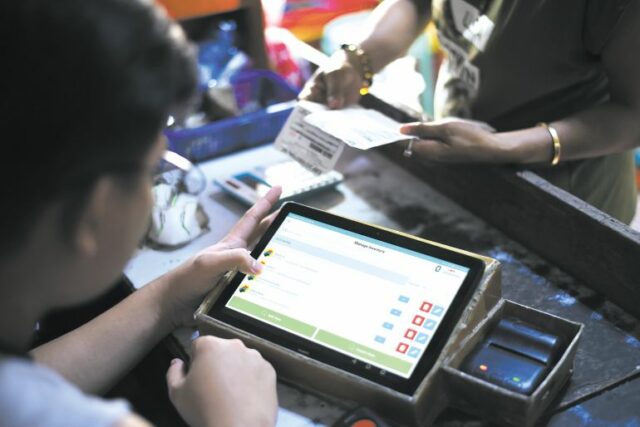
Sari-sari stores using artificial intelligence see 46% sales jump — Packworks report

Artificial intelligence (AI) is beginning to reshape how local sari-sari stores operate, helping small retailers make smarter decisions and improve profitability through practical, data-driven insights.

New findings from tech startup Packworks.io show that AI is no longer a distant concept for microenterprises but is becoming a tool that directly supports day-to-day store management and sales performance for neighborhood stores.

Packworks analyzed more than 300 stores in its network over a two-week period following data collection in September 2025 and recorded a 46% increase in daily gross merchandise value (GMV). This increase highlights substantial gains in overall store efficiency, resulting in a 17% rise in total sales for stores during the same period.

Packworks also found that stores that applied AI-driven recommendations earned higher revenue despite operating on 20% fewer active selling days — dropping from five to four days over two weeks. This indicates how AI can guide store owners in managing inventory, improving product mix, and planning demand more efficiently, enabling owners to maximize sales during their operating hours.

The insights come from Packworks’ analysis of sari-sari stores that accessed its Store Insighting Project (SIP) document, a personalized report that turns each store’s transaction history into actionable recommendations powered by AI. By reviewing pre- and post-performance across stores, Packworks quantified the impact of engaging with the SIP document on business outcomes for its partner stores. The analysis also showed that the increase in sales was driven by underperforming products identified by the AI tool, giving store owners insight into which stock to move to maintain operational efficiency.

Packworks’ AI-powered precision marketing tool was developed with DoST-PCIEERD’s Startup Grant Fund (SGF) Program, awarded in 2024 to support wider AI adoption in the country’s microretail sector. The company also partnered with ST Telemedia Global Data Centres (Philippines) (STT GDC Philippines) to access its AI Synergy Lab to run large-scale machine learning models, and with Ateneo’s Business Insights Laboratory for Development (BUILD) to build a comprehensive data warehouse and business intelligence tools.

“Even at this early stage of adoption, we’ve recorded increased sales and enhanced operational efficiency from stores by using the AI tools we’ve developed with support from DoST and through our collaborations with STT GDC and Ateneo BUILD. As stores learn to leverage the recommendations from the AI-driven insights they can access through SIP, microretailers can make smarter decisions that translate into higher sales and more efficient operations,” Packworks Chief Data Officer Andoy Montiel said.

Packworks’ mission to bring AI into micro retail stores aligns with the Philippine Development Plan 2023-2028, which recognizes the role of digital transformation and emerging technologies like AI in increasing efficiency and revitalizing industries and services.


SparkUp is BusinessWorld’s multimedia brand created to inform, inspire, and empower the Philippine startups; micro, small and medium enterprises (MSMEs); and future business leaders. This section will be published every other Monday. For pitches and releases about startups, e-mail to bmbeltran@bworldonline.com (cc: abconoza@bworldonline.com). Materials sent become BW property.

Lost glamor

A SCALE MODEL of the Manila Metropolitan Theater — JOSEPH L. GARCIA

AUTHOR Carmen Guerrero Nakpil was supposed to have been the one who coined the phrase “300 years in a convent and 50 years in Hollywood” as a description of Philippine history under Spanish and American colonial rule. For half that time under the Americans, the Philippines was clothed in the beauty that was the Art Deco style.

The design style originated in the Exposition internationale des arts décoratifs et industriels modernes in Paris in 1925 (thus it just celebrated its centennial). To mark the occasion, the National Museum of the Philippines opened an exhibition of Art Deco in the Philippines in November last year, running until May 31 of this year.

The exhibition, titled Art Deco: Modernity and Design in the Philippines 1925-1950, collects examples of Art Deco and emphasizes its pervasiveness. It’s easy to think of its popular design styles as influencing architecture (seen in photographs and scale models in the exhibit) but the style is also seen in stationery, furniture, clothes — and even in the way we approach religion.

For example, the exhibition greets visitors with bas-reliefs taken from the facade of the Capitol Theater, built in 1935. A timeline also establishes the arrival of Art Deco in the Philippines. While arriving to the rest of the world via Paris, it reached our shores secondhand through our colonizers. While Art Deco as a style, as we mentioned, began in 1925 and was overtaken by other styles by the end of the 1930s, the timeline in the National Museum of Fine Arts extends before and after the heyday of Art Deco. It extends farther back in time to reflect American laws and policies that made it possible to build, import, and manufacture in the style that dominated its home base, while the timeline extends after to reflect a nation scarred by war, building with the bones it had been left with.

The exhibit cites the first expression of Art Deco in the Philippines as The Chapel of the Crucified Christ at St. Paul College in Manila, featuring hints of Art Deco juxtaposed with tropical-Gothic themes. Prominently featured in the exhibition is the Manila Metropolitan Theater, built in 1931. It survives today as one of the finest examples of Art Deco architecture in the Philippines — a fate not shared by many buildings built in the period. For example, while the exhibition also celebrates the Manila Jai Alai building, it did not survive to the present day — not due to the Second World War (the exhibition notes the wartime damage taken by other Art Deco landmarks such as the aforementioned theater, the Rizal Sports Complex, Quezon Bridge, and the Crystal Arcade shopping center), but due to bureaucracy and the passage of time — the building was demolished in 2000 by then Manila Mayor Lito Atienza, despite an intense effort to save it, to make way for a new Manila Hall of Justice (which was never built).

Another gallery housing the exhibit (which takes up galleries VII and X) moves past architecture and goes on to show the design style in everyday life. Ternos and Filipiniana dress show the bold, vibrant patterns that made Art Deco distinct. The dresses from the collections of prominent women of the period: think ternos worn by Aurora Quezon, the country’s First Lady then.

Everybody has a little piece of Art Deco in their homes apparently: more than the items from prominent people of the era (check the dressing table owned by Aurora Aquino, the mother of politician then hero Benigno “Ninoy” Aquino, Jr.), some of the items are on loan from regular Filipinos like writer Jose “Butch” Dalisay, Jr., for example, who lent pens and stationery indicative of the period.

Notes at the exhibition said, “Art Deco flourished at a crossroads of history when Filipinos were longing for asserting a nationalist identity while embracing modernity in a Western colonial milieu.” Erased by war, it bore witness to new styles: mid-century modern became popular here too, but it could be argued that in architecture, the next most prominent style in the Philippines was Marcos-era Brutalism. The exhibit thus gains a sort of wistfulness: more than showing what the Philippines was, there’s almost a sigh in thinking what else it could have been, before the glamor of that era was lost to war, then successive generations of corruption. — Joseph L. Garcia

EDC plans up to P100-B Leyte geothermal upgrade

ENERGY DEVELOPMENT CORP.

LOPEZ-LED Energy Development Corp. (EDC) plans to invest up to P100 billion to expand and upgrade its Leyte geothermal power complex.

EDC is proposing several modifications to the Tongonan Geothermal Project (TGP) that would raise its total rated capacity to 967.224 megawatts (MW) from 637.21 MW, according to a filing with the Department of Environment and Natural Resources (DENR).

The proposed works include the construction of a new Upper Mahiao Power Plant, the upgrade of the Mahanagdong Power Plant, the drilling of additional wells, the upgrading of existing well pads, the expansion of the battery energy storage system, and further exploration drilling.

“The planned modifications at the TGP will secure long-term production, sustain supply to the Visayas grid, and improve efficiency by generating more power from the same steam resource,” EDC said.

The company plans to decommission the existing 30-year-old Upper Mahiao Power Plant and replace it with a new facility with a capacity of 450 MW, or more than three times its current output.

The existing 136.5-MW Upper Mahiao plant, which EDC took over in 2006, began commercial operations in 1996 and was the country’s first geothermal project developed under a build-operate-transfer scheme.

EDC is also proposing to upgrade the 180-MW Mahanagdong Power Plant through the deployment of modular binary units, a move aimed at improving efficiency without expanding the plant’s footprint.

To increase steam supply, the company plans to drill 172 additional wells within the existing project block and to upgrade current well pads to improve safety and reliability while minimizing additional land use.

Adjacent to the existing 10-MW Tongonan battery energy storage system, EDC plans to expand capacity to 30 MW to provide additional grid support.

Separately, the company is targeting the start of drilling activities at Alto Peak, which is expected to contribute steam equivalent to about 30 MW of additional generating capacity.

Construction and commissioning of the new facilities are expected to begin this year, with all proposed modifications targeted to be operational by 2029.

“Once operational, the additional output will reinforce Leyte’s position as a major energy supplier and help meet the power needs of Eastern Visayas and the national grid,” EDC said.

EDC, the renewable energy subsidiary of First Gen Corp., has a total installed capacity of 1,480.19 MW, accounting for about 20% of the Philippines’ total renewable energy capacity.

Since 1976, the company has developed geothermal facilities across Bicol, Leyte, Negros Island, and Mindanao. — Sheldeen Joy Talavera

Saks woes cloud cashmere king Cucinelli’s department store bet

SAKS Fifth Avenue flagship store in Toronto, Canada. — CAN PAK SWIRE/FLICKR

MILAN — Italian luxury brand Brunello Cucinelli, known for its $3,000 cashmere sweaters, bet big on department stores, a strategy now in the spotlight as iconic US High Street retailer Saks struggles to pay back debts.

Saks Global, created after Saks Fifth Avenue parent Hudson’s Bay Company bought rival Neiman Marcus, saw its chief executive officer (CEO) depart this month, amid reports it was preparing for bankruptcy after missing an over $100-million interest payment.

That’s put a harsh spotlight on the strategy of firms like Cucinelli that have bet heavily on high-end department stores, whose future is more uncertain in a weak global luxury market where many brands have shifted towards their own outlets.

The firm, however, is doubling down.

Brunello Cucinelli, founder and chairman of his namesake firm, told Reuters that the company was sticking with its strategy, which gives a strong emphasis to the wholesale channel.

He said that so far it had only faced a one-month delay in payments from Saks Global, and at the operational level had not had any issues with the retailer.

“We don’t foresee any economic risks, except for extremely limited ones,” Mr. Cucinelli told Reuters by phone.

“And bear in mind, they would be the first (losses) in 45 years of business. Every year, we lose 0.1% from our multibrands, which is practically nothing.”

CUCINELLI RELIES MORE THAN PEERS ON WHOLESALE
Cucinelli is, however, more exposed than most.

Co-CEO Luca Lisandroni in December lauded the cashmere king’s ties with Saks and heralded some of its “best results ever” in its stores around the United States, “demonstrating the great centrality of this client in the global luxury landscape.”

The Italian firm makes some 36% of its revenues from the wholesale channel and around 64% from its own retail outlets, relying more heavily on multi-brand distribution than some key luxury peers, according to data compiled by Reuters.

Over the past decade, luxury groups have shifted toward their own retail networks, giving them more control over pricing, inventory and margins. Retail now accounts for some 90% of sales by Prada, 81% at Moncler, 87% at Zegna, and 75% at Gucci-owner Kering.

Cucinelli, which targets some of the highest-end wealthy customers, has proved to be among the most resilient brands in the industry hit by lower demand.

Sales in both the wholesale and retail channel grew in the first nine months of 2025 and the brand raised its full-year revenue growth forecast to 11-12% in December.

Morningstar analyst Svetlana Menshchikova said that a possible Saks bankruptcy or restructuring could lead to “delayed payments, limited bad-debt exposure and maybe some lost sales if the department stores would fail to replenish their stock.”

“The company has consistently highlighted the US wholesalers as key clients and an integral part of its brand image and business model,” she said. “Although we do not expect a severe impact on the company given Cucinelli’s global footprint and strong balance sheet.”

‘HYPOTHETICALLY SPEAKING, I WOULD BUY SAKS GLOBAL TOMORROW’
Saks Global’s financial troubles reflect wider challenges in the $417-billion global luxury market, which is battling to emerge from years of stalling sales.

The US luxury retailer, which operates Saks Fifth Avenue, Neiman Marcus, and Bergdorf Goodman, missed an interest payment due at the end of December and it is preparing to file for bankruptcy, the Wall Street Journal reported last month.

Founder Mr. Cucinelli credited department stores in part for that and said he had faith in Saks and the 400 multibrand stores he said the brand worked with worldwide.

“We do 40% of our business with multibrands and I’m absolutely delighted,” he said, calling department stores the “true custodians of the brand.”

“To make it even clearer how much we believe in multibrand (stores), hypothetically speaking, I would buy Saks Global tomorrow if I were an interested investor.” — Reuters

Rates of Treasury bills, bonds may drop on BSP policy bets

BW FILE PHOTO

RATES of the Treasury bills (T-bills) and Treasury bonds (T-bonds) on offer this week could end lower as investors price in their bets for the Bangko Sentral ng Pilipinas’ (BSP) next policy move.

The Bureau of the Treasury (BTr) will auction off P27 billion in T-bills on Monday or P9 billion each in 91-, 182-, and 364-day papers.

On Tuesday, the government will offer P30 billion in reissued seven-year T-bonds with a remaining life of five years and four days.

Yields on the T-bills and T-bonds placed on the auction block could go down and track the week-on-week decline seen at the secondary market on signals from the BSP Governor Eli M. Remolona, Jr. that another rate cut remains on the table next month, Rizal Commercial Banking Corp. Chief Economist Michael L. Ricafort said in a Viber message.

This came as headline inflation picked last month but remained below target, which would support further easing, he said.

A trader said in an e-mail that the reissued seven-year bonds could see good demand and fetch rates of 5.675% to 5.725%.

“The government securities (GS) market will likely be stuck in a range until we get more traction on the potential 25-basis-point (bp) rate cut in February,” the trader added.

At the secondary market on Friday, yields on the 91-, 182-, and 364-day T-bills went down by 5.38 bps, 6.72 bps, and 6.29 bps week on week to end at 4.8009%, 4.9097%, and 4.9746%, respectively, based on PHP Bloomberg Valuation Service Reference Rates data as of Jan. 9 published on the Philippine Dealing System’s website.

Meanwhile, the seven-year bond’s rate eased by 5.69 bps week on week to 5.884%, while the five-year paper, the tenor closest to the remaining life of the T-bonds on offer this week, declined by 6.91 bps to yield 5.7273%.

Last week, Mr. Remolona said a rate cut is “on the table” at the Monetary Board’s Feb. 19 meeting, but could be “unlikely” even as inflation remains benign.

“I can say that we’re very close to where we want to be in terms of policy,” he said. “There’s a chance that we may cut some more, and there’s also a chance that we may not move at all. But there’s not a lot of probability that we will raise in 2026.”

The Monetary Board ended last year with a fifth straight 25-bp cut at its Dec. 11 meeting, bringing the policy rate to 4.5%. It has delivered 200 bps in reductions since it began its rate-cut cycle in August 2024.

The BSP chief has signaled since December that their easing cycle was nearing its end, with further cuts — if any — likely to be limited and data-dependent.

Meanwhile, analysts have said that the central bank could still ease further to help support domestic demand as growth prospects have weakened due to a wide-ranging corruption scandal that has stalled both public and private investments, dragging economic growth.

Last week, the BTr raised P34.2 billion via the T-bills it auctioned off, higher than the P27-billion plan, as the offer was more than four times oversubscribed, with total tenders reaching P108.1 billion.

The BTr doubled its acceptance of noncompetitive bids for the 91- and 182-day T-bills to P7.2 billion each due to strong demand and as average yields were all lower than secondary market rates, it said.

Broken down, the government awarded P12.6 billion in 91-day T-bills, above the P9-billion plan, as demand for the tenor reached P36.235 billion. The three-month paper fetched an average rate of 4.755%, up by 2.4 bps from the previous auction. Yields accepted were from 4.69% to 4.78%.

The Treasury also increased the award for the 182-day debt to P12.6 billion from the P9-billion program as tenders hit P41.15 billion. The average rate of the six-month T-bill was at 4.895%, down by 0.8 bp from the previous week. Tenders awarded carried yields from 4.83% to 4.923%.

Lastly, the BTr sold P9 billion as planned in 364-day securities as the tenor attracted bids totaling P30.715 billion. The one-year paper’s average yield was at 4.937%, up by 1.3 bps from the previous auction. Accepted rates were from 4.875% to 4.937%.

Meanwhile, the reissued seven-year T-bonds to be offered on Tuesday were last auctioned off on April 2, 2024, where the government raised P30 billion as planned at an average rate of 6.299%, above the 6.125% coupon rate.

The BTr is looking to raise P180 billion from the domestic market this month, or P110 billion via T-bills and P70 billion through T-bonds.

The government borrows from local and foreign sources to help fund its budget deficit, which is capped at P1.647 trillion or 5.3% of gross domestic product this year. — Aaron Michael C. Sy

Upstream oil, gas sector upbeat as work programs start

BW FILE PHOTO

By Sheldeen Joy Talavera, Reporter

THE upstream oil and gas sector is starting the year on an optimistic note, with industry players set to begin their work programs after securing new petroleum service contracts from the government.

“The year 2026 marks a new era for the Philippines’ upstream oil and gas industry — one of renewed exploration, energy innovation, and investor confidence,” Edgar Benedict C. Cutiongco, president of the Philippine Petroleum Association, told BusinessWorld.

He said newly awarded onshore and offshore petroleum service contracts are expected to begin their approved exploration and development activities this year, “bringing in vital investments and reinforcing the country’s role in regional energy security.”

Last year, the government awarded eight new petroleum service contracts, representing potential investments of about $207 million over seven years of exploration.

Areas with identified potential petroleum and hydrogen resources include the Sulu Sea, Cagayan, Cebu, Northwestern Palawan, Eastern Palawan, and Central Luzon.

Under their service contracts, companies may undertake work programs that include geological and geophysical studies, seismic surveys, and drilling activities, as appropriate, to assess resource potential.

The government has also recently granted a new contract to PXP Energy Corp. and its partners, allowing them to continue production at the Galoc Oil Field off northwest Palawan.

The new contract replaces Service Contract 14C-1, which expired on Dec. 17 and covered the exploration, development, and production of petroleum resources in the Galoc field.

Since the issuance of Presidential Decree (PD) No. 87 in 1972, which promotes the discovery and development of the country’s indigenous petroleum resources, a total of 65 million barrels of oil have been discovered from various oil fields, Mr. Cutiongco said.

“PD 87 remains a cornerstone of fiscal stability for the upstream sector. Any future adjustments to PD 87 will be carefully considered to enhance incentives and maintain the Philippines’ competitiveness as an investment destination,” he said.

He added that the awarding of the development and production petroleum service contract for the Galoc field ensures that remaining reserves are developed and resources are not stranded.

“Fiscal stability remains the bedrock of growth. Strong interest in recent bidding rounds signals renewed confidence, even as global risks persist,” Mr. Cutiongco said. “The shift from globalization to regionalism will define energy strategies — and the Philippines is ready.”

There is always hope

Will 2026 finally be the year the local auto industry breaks the 500,000-unit sales mark? — PHOTO BY JOYCE REYES-AGUILA

A confluence of natural events and government misadventures tampered with 2025

LET THE NEW YEAR begin. Before anything else, though, allow me to take this opportunity to wish everyone a meaningful and hopeful 2026. Though anxieties are running high, I am reasonably optimistic that the year ahead will bring some welcome respite from the body blows that pummeled the Philippine economy in the second half of 2025.

The past year started on a very confident note on the back of supply chain stabilization and rising consumer spending. It turned guarded in the third quarter due to disruptions wrought by natural calamities. And then things turned downright wobbly in the last quarter as significant irregularities in government spending surfaced. While the economic numbers tumbled, the country still fared better than other economies in the ASEAN region. As they say, we got knocked down, but not knocked out. The final numbers are yet to be reported but, in all likelihood, GDP will fall short of 5%, probably closer to Singapore’s higher-than-expected 4.8% growth rate that was buoyed by exports of semiconductors due to exceedingly strong artificial intelligence (AI)-related demand.

The Philippine automotive industry was counting on another banner year in 2025. To be sure, it will get one. Yearend estimates place auto industry sales between 490,000 to 495,000 vehicles, likely beating 2024 sales of 475,000 units, and chalking up a new record high. This includes sales of non-affiliated auto companies of the Chamber of Automotive Manufacturers of the Philippines, Inc. (CAMPI), Truck Manufacturers Association (TMA), and Association of Vehicle Importers and Distributors, Inc. (AVID). Having said that, the industry was looking to break the 500,000 sales level last year. It came within clear reach but will have to wait another day for that milestone to be achieved. To get to 500,000, the total sales volume in December should be 56,000 units, which is not likely.

So as we look ahead to 2026 and beyond, I decided to look back. Interestingly, I found an article from The Philippine STAR dated Dec. 27, 2015. The headline: “Philippines to become major car market by 2020.” It paraphrased Dante Santos, then Mitsubishi Motors Philippines Corp. (MMPC) First Vice-President and Corporate Secretary as saying, “The Philippines… will become an important automotive market growth area in the region as volume of vehicles sold is expected to zoom to 500,000 units by 2020.” At that time, the market had only broken the 300,000-unit mark. To project 67% growth in five years seemed pretty audacious. Yet, by 2017, the industry recorded sales of 473,000 units and was within 5% of that 500,000 mark. And then COVID happened and the figure was scaled back to 240,000 units — a seriously major setback in the country’s trek to motorization.

But the mobility needs of the country would not be denied. It seems that the projection of the MMPC executive to break 500,000 unit sales within five years was just reset to 2020 instead of 2015. Indeed, five years hence, the Philippine automotive market is on the verge of crossing 500,000. Therefore, the prospects for 2026 are tantalizing.

As mentioned, I have a reasonably optimistic outlook for the industry this year. Overall, I think that the first half of the year will be dominated by supply-side growth with the various auto brands resorting to new model introductions, marketing events, and sales promotions to keep units moving off the showroom floor. The second half, on the other hand, will be more demand-led, resulting from a regularization of government spending and a restoration of consumer confidence.

My source of optimism is that the Philippine auto market continues to expand despite the dizzying domestic economic tremors and even as sales in perennial ASEAN large markets — Thailand and Indonesia — continue to languish. To underscore this, I estimate average monthly vehicle sales in Q4 of 2025 to be around 42,000 units, higher than in any of the three quarters before it. Of course, seasonally, the last quarter usually sees the highest volume, but given the extraordinary downward macro pressures, the auto industry seems to have climbed the down staircase, so to speak. This fuels my constructive confidence in the outlook for the new year.

There is good reason to believe that the recent political brouhaha hounding the halls of government will not completely undermine the strong economic fundamentals of the country. Reforms in the bureaucracy are in the making, the 2026 Government Appropriations Act has been signed into law, inflationary pressures have stabilized, interest rates continue to lower, employment remains high and rural development is strong. All this on top of the fact that the business sector is wanting to do business. This is a fairly strong recipe for growth. Indeed, I would be so bold as to venture that the Philippine economy will grow faster this year than last.

Granted, the volume ramp-up for vehicles in the first quarter may be lukewarm versus the high base of 2025. I suspect the second quarter will be more vibrant with auto retailers dialing up their sales deals. In the third quarter, accelerated government spending from the first half will hopefully flow into the economy, leading to a rise in demand for vehicles, though the weather will remain a significant variable. Barring any further political turmoil, 2026 should see a strong sales finish, including the return of capital expenditure spending by corporate fleet accounts.

My only caveat: We will have a more steady social and political environment.

Some would say that the wind has been taken out of our sails; I say the winds of growth remain strong. We just need to reposition our sails so we can catch those winds and sail ahead to better days. This might be the year the Philippine automotive market finally breaks the 500,000 mark. I hope I do not jinx it.

The teachings of Warren Buffett

STOCK PHOTO | Image by Vectorjuice from Freepik

At the end of last year, Warren Buffett retired as the Chief Executive Officer of Bershire Hathaway after 60 years of service. His record as an investment manager has not been and may never be equaled.

Over 60 years, Berkshire Hathaway’s compounded growth was nearly double that of the S&P 500, with a 19.9% annual return compared to the S&P 500’s 10.4%. This resulted in a vastly greater total return for Berkshire Hathaway stockholders, growing 5,502,284% versus the S&P 500’s 39,054% from 1965 to 2024. This means that $1,000 invested in Bershire Hathaway in 1965 would amount to $55,000,000 in 2024 while the same amount invested in S&P 500 stocks would amount to only $390,000.

Outstanding though this was, we would argue that the greater legacy of Warren Buffet would be as a teacher. A teacher has been defined as a person who believes that imparting knowledge is not a zero-sum game where the gain of the pupil is the loss of the teacher. A teacher sees the imparting of knowledge not only as a gain for the student but also for the teacher, his knowledge not lost but even enhanced and expanded, a win-win situation.

Unlike most investment managers who prefer to keep their winning strategies secret, Buffett has been the most open in sharing his knowledge, in the annual letters he sent to his stockholders, in the answers he gave during the question period at the stockholders meetings, in the speeches he delivered, and in the interviews he gave.

Encouraged by his example, we are sharing the lessons we have learned from the teachings of Warren Buffett.

Buffet’s first lesson is to explain why we should have an investment portfolio:

“If you don’t find a way to make money while you sleep, you will work until you die.”

The idea is that if you are a professional, you will stop earning when you retire. Thus, you must have an investment portfolio so that when your professional income stops, you can then draw on the income from your investment. Thus, you will not suffer a loss in your financial standing.

Moreover, Buffett suggests that when young you can be more aggressive and concentrate in a few stocks in investing your portfolio given that you need to speedily build up your investment. And being young you can still have time to recover from your investment mistakes. However, as you near retirement age, you have to start being conservative and diversify from stocks to bonds such that the sure income from the interest from the bonds will allow you to achieve your desired portfolio size upon retirement. Again, from Buffet, “Diversification may preserve wealth, but concentration builds wealth.”

The next lesson is when to sell your stock. This is based on the principle that one should have an exit strategy when one wages war, sets up a business, or invests in a stock. After all, only when you have exited from these endeavors can you judge if they were successes or failures.

The conventional wisdom is one sells a stock to lock in profits, i.e., sell the stock above acquisition cost; cut losses, i.e., sell the stock below acquisition cost or to exit from a stock which does not move at all.

Buffett argues that this is the wrong approach as the decision is determined by your acquisition cost. And the market does not care at what cost you bought a stock.

Instead, Buffet suggests answering two questions. The first: If I did not own the stock, would I still buy it? This raises the question of whether the conditions which initially led to buying the stock have changed. These could be changes in the industry structure, changes in management, or arrival of strong competition. For example, Buffett divested his investment in the media company, The Washington Post when he realized the rise of the internet posed a risk to the traditional newspaper.

The second question, especially applicable to small portfolios: Is there another stock which has better prospects than the stock I currently own? If so, I would sell the stock I own and use the proceeds to buy the more attractive stock. Technically, this is called rebalancing your portfolio.

We now come to stocks that Buffett is not interested in. He does not want to invest in assets which generate income only when sold, more specifically commodities. For example, when you buy gold, you do not generate income until you sell the gold. Moreover, as you do not physically hold the gold, you have to pay for somebody to have custody of your gold.

Related to this is the “greater fool” theory. I may be a fool to buy this asset but a greater fool will come along and buy it from me at a higher price. The problem with the theory is that you could be the greater fool buying from the lesser fool.

With respect to buying stocks, Buffets follows certain rules.

The first and foremost rule is “never invest in a business you do not understand.” This simply means knowing why or how a business makes money. A simplified approach would say “Coca Cola is a company selling sugared water at a price much higher than the combined price of the water and the sugar.” And then proceed to understand how it does so, i.e., adding a secret ingredient, carbonizing the drink, attractive packaging, and a vast distribution system.

From understanding the business logic, Buffett then examines how the company defends itself from others copying its successful formula. Buffet looks for “economic moats” in companies.

Buffett views a business as an “economic castle.” The value within the castle represents the company’s profits and market share, which are constantly under “siege” from competitors. The moat acts as a protective barrier, making it difficult for rivals to erode the company’s position. A wider, deeper, and more durable moat signifies a stronger business.

Buffett elaborates, “We’re trying to find a business with a wide and long-lasting moat around it, surrounding and protecting a terrific economic castle — with an honest lord in charge of the castle… For one reason or another, it can be because it’s the low-cost producer in some area. It can be because it has a natural franchise or because of its service capabilities, its position in the consumer’s mind, or because of a technological advantage. For any kind of reason at all, it has this moat around it.”

If based on the above, Buffet concludes that it is an excellent company, he then proceeds to determine the value of the stock. As he says, “Price is what you pay; value is what you get.”

There are two basic approaches to determining the value of a company, the Price/Earnings approach and the Discounted Cash Flow approach which we will not discuss here.

Assuming the value of a stock has been determined, then Buffett argues, “It’s far better to buy a wonderful company at a fair price, than a fair company at a wonderful price.” In short, look for wonderful companies to invest in and be satisfied with buying the stock at a fair price.

Moreover, Buffett times the buying of these stocks. He is a contrarian or, as he says, “Be fearful when others are greedy. Be greedy when others are fearful.” What this means is that while others (the greedy) aggressively buy when the market is at its peak (a bull market), thus depleting their cash reserves, Buffet (the fearful) refrains from buying. Instead, he starts building up his cash position.

With his large cash position, Buffett (now greedy) starts buying his selected stocks when the market goes down (a bear market) while the others (now fearful) start selling. This is difficult to execute but highly rewarding. As Buffett says, “Cash combined with courage in a time of crisis is priceless.”

We end with one final teaching which relates not to investing but in leaving a legacy: “Someone is sitting in the shade today because someone planted a tree a long time ago.”

Warren Buffet could be referring to the hundreds of thousands of stockholders of Berkshire Hathaway who benefitted immensely from their investment in the company. We would argue that it should also refer to the millions of investors who followed the teachings of Warren Buffet and so invested wisely and well.


Dr. Victor S. Limlingan is a retired professor of AIM and is a fellow of the Foundation for Economic Freedom. He is presently chairman of Cristina Research Foundation, a public policy adviser, and Regina Capital Development Corp., a member of the Philippine Stock Exchange.

City Savings Bank and Khan Academy empower Filipino teachers through AI-powered tools

Over 300 participants from DepEd Sta. Rosa and Calamba completed the Khan Academy Philippines training program in partnership with City Savings Bank on Nov. 28 and Dec. 4.

City Savings Bank (CitySavings) has officially partnered with Khan Academy Philippines to strengthen professional development for teachers across the country.

The initiative is intended to provide educators with access to digital learning tools, including artificial intelligence-powered resources available through the Khan Academy platform. The partnership attempts to address the gaps in learning, particularly in remote communities.

The program aligns with the Department of Education’s (DepEd) education initiatives, including Brigada Eskwela and Brigada Pagbasa. CitySavings has previously supported DepEd through donations of learning equipment and technology to schools and regional divisions.

“Our partnership with Khan Academy Philippines is a significant step in CitySavings’ commitment to elevating the Philippine education sector. By providing teachers with AI-powered resources like Khanmigo, we are not just supporting their current professional development, but actively co-creating a sustainable, future-ready learning environment where both educators and students can thrive and lead in the digital age,” CitySavings Assistant Vice-President for Reputation and Brand Management Head Paula Ruelan said.

Under the initiative, teachers are given access to Khanmigo, which is designed to assist with lesson planning, generate assessments, and provide real-time instructional support. The platform allows students to engage with learning materials at their own pace, while teachers are able to focus more on instruction and mentoring, according to the organizers.

Training sessions held on Nov. 28 and Dec. 4, 2025, were attended by more than 300 teachers from the Sta. Rosa and Calamba school clusters in Laguna.

CitySavings said the partnership forms part of its broader community development efforts, following earlier programs that included the donation of laptops and school equipment to public schools. The bank said it aims to continue supporting initiatives that expand access to education and technology for teachers and students.


SparkUp is BusinessWorld’s multimedia brand created to inform, inspire, and empower the Philippine startups; micro, small and medium enterprises (MSMEs); and future business leaders. This section will be published every other Monday. For pitches and releases about startups, e-mail to bmbeltran@bworldonline.com (cc: abconoza@bworldonline.com). Materials sent become BW property.

ADVERTISEMENT
ADVERTISEMENT