Home Blog Page 4876

Proton Therapy: How it works and helps cancer patients

Mount Elizabeth Proton Therapy Center

Among the most common treatments for cancer patients, radiation therapy or radiotherapy uses ionizing radiation, typically x-rays, to damage the DNA of cancer cells. When radiated, these cancer cells would gradually be killed. But conventional X-ray radiotherapy has side effects. Proton therapy, another type of radiotherapy, is said to be less damaging, which makes this treatment especially beneficial for certain patients.

While not really a new development in radiation oncology, proton therapy machines have been getting better in the past few years, according to Dr. Lee Kuo Ann, a senior consultant and radiation oncologist at Mount Elizabeth Novena Hospital in Singapore.

X-rays have to traverse normal tissues from the skin to reach the tumor. After passing through the tumor, X-rays continue on till they exit the body on the other side, causing radiation injury to normal tissues on both sides of the tumor.

“Proton therapy is like playing basketball or golf. By shooting the proton particle at the correct direction and speed, it will land in the tumor and stop there, with no radiation coming out the other side. So we reduce radiation injury to the normal tissues on the way in and especially on the way out,” Dr. Lee explained.

“So that’s the main attraction to proton therapy. It effectively reduces the radiation exposure to the patient maybe by about a third. And that’s expected to reduce side effects both in the short term as well as in the long run,” he added.

Arguably, almost any patient undergoing radiotherapy can receive a proton therapy treatment as well, according to Dr. Lee. But the benefits would differ from one patient to another. “Some patients will expect to see more benefit than others,” he said.

Dr. Lee considered that children and young adults generally, can benefit more from proton therapy, as many of the side effects such as radiation-induced malignancy could appear late or years after.

Proton therapy can also be helpful for patients with large tumors, said Dr. Lee. Treating large tumors with radiotherapy would involve large radiation fields, thus side effects could be worse. Whereas, with proton therapy, given it reduces exposure of normal tissues to radiation, patients with large tumors can expect less side effects.

The treatment could also help patients with a tumor located within sensitive organs like the liver. Dr. Lee shared that for patients with large liver tumors, it is hard to deliver a large dose of x-rays without unacceptable injury to the organ. “But with proton therapy, we are now able to give that same dose of radiation safely,” he said.

Dr. Lee also said that proton therapy could potentially be beneficial to patients who already went through radiation. “If we give a second round of radiation, the injury to the tissues would exceed what is safe. With proton therapy, we might be able to reduce radiation exposure to nearby tissues,” he said.

“Having said that, proton therapy for re-radiation cases still has to be very carefully done, and not everyone is a candidate,” Dr. Lee also noted. “Because if the recurrence is located in a critical organ, you have to deliver the high dose to the tumor at the critical organ. And no matter what radiation technique you’re using, including proton therapy, there will be a high dose to that organ and hence will still be risky and dangerous.”

Mount Elizabeth now has a newly available Proton Therapy Centre added to its array of machines for cancer treatments.

“This is the newest state-of-the-art compact proton radiotherapy machine, and it will be installed at Mount Elizabeth Novena Hospital,” Dr. Lee said. “The cases that we’ll be allowed to treat will be dictated and guided by the Singapore Ministry of Health rules, which are actually online.”

“We are quite excited to be able to firstly, have all the tools at our disposal. Previously, with the highest-end x-ray radiotherapy machines, and now our newest addition of a proton therapy machine,” he added.

Mount Elizabeth Novena Hospital’s Proton Therapy Centre has started operations this month.

For inquiries, please contact our patient assistance center located at G/F-B, Marco Polo Hotel, Meralco Avenue and Sapphire Street, Ortigas Center, Pasig City 1600; e-mail manila.ph@ihhhealthcare.com. or call 0917-526-7576. Follow us at facebook.com/MountElizabethHospitalsSGPhilippinesOffice.


Spotlight is BusinessWorld’s sponsored section that allows advertisers to amplify their brand and connect with BusinessWorld’s audience by enabling them to publish their stories directly on the BusinessWorld Web site. For more information, send an email to online@bworldonline.com.

Join us on Viber at https://bit.ly/3hv6bLA to get more updates and subscribe to BusinessWorld’s titles and get exclusive content through www.bworld-x.com.

Analysts’ expectations on policy rates (May 2023)

THE BANGKO SENTRAL ng Pilipinas (BSP) is widely expected to maintain the key benchmark interest rate at 6.25% on Thursday, amid easing inflation and slowing economic growth. Read the full story.

Analysts’ expectations on policy rates (May 2023)

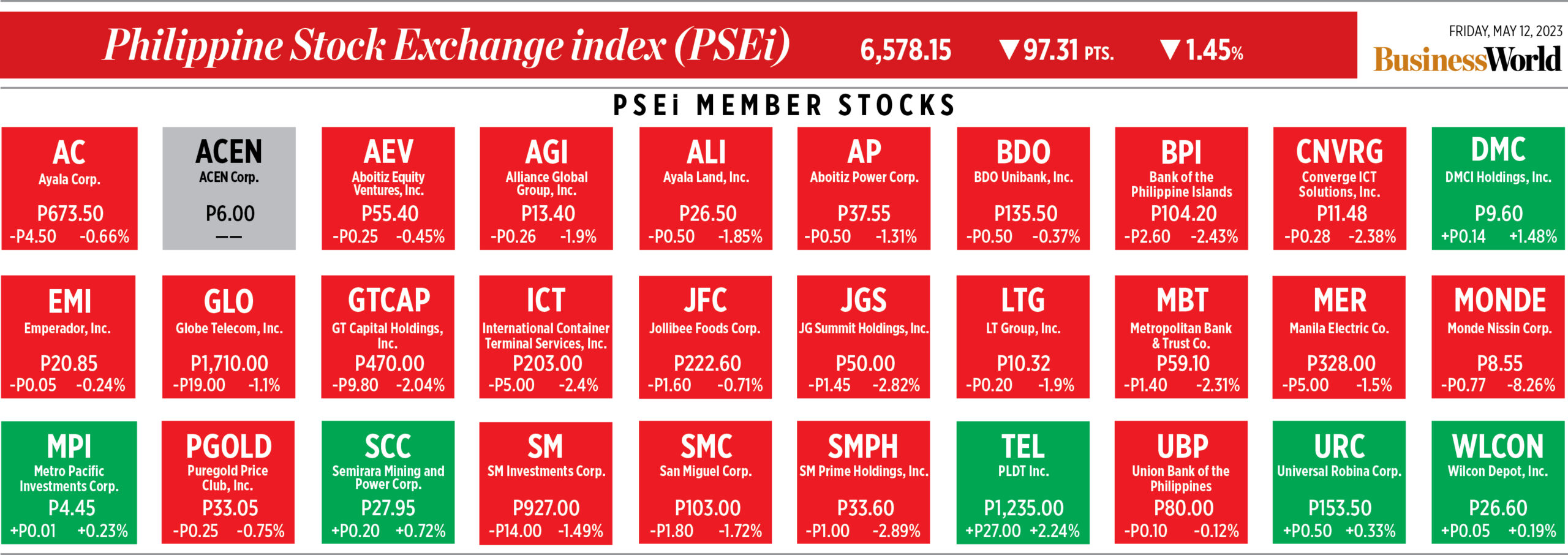
How PSEi member stocks performed — May 12, 2023

Here’s a quick glance at how PSEi stocks fared on Friday, May 12, 2023.


Peso may move sideways versus the dollar on BSP, Fed move bets

BW FILE PHOTO

THE PESO is expected to trade sideways against the dollar this week amid bets on the next policy moves of the Bangko Sentral ng Pilipinas (BSP) and the US Federal Reserve.

The local currency closed at P55.79 versus the dollar on Friday, down by four centavos from Thursday’s P55.75 finish, data from the Bankers Association of the Philippines’ website showed.

Week on week, however, the peso weakened by 49 centavos from its P55.30 finish on May 5.

The peso opened Friday’s session at P55.86 versus the dollar. Its worst showing was at P56.02, while its intraday best was at P55.65 versus the greenback.

Dollars traded rose to $1.488 billion on Friday from the $1.29 billion seen on Thursday.

The peso declined against the dollar on Friday due to a possible pause in the Fed’s rate hike cycle after US weekly jobless claims jumped to a one-and-a-half-year high, Rizal Commercial Banking Corp. Chief Economist Michael L. Ricafort said in a Viber message.

The number of Americans filing new claims for unemployment benefits jumped to a one-and-a-half-year high last week, pointing to cracks in the labor market as demand slows, potentially giving the Fed room to halt further interest rate increases next month, Reuters reported.

With demand cooling, inflation pressures are subsiding. Producer prices rebounded modestly in April, leading to the smallest annual increase in wholesale inflation in more than two years, other data from the Labor department showed on Thursday. The reports were seen as consistent with most economists’ expectations of a recession by the end of the year.

Initial claims for state unemployment benefits increased 22,000 to a seasonally adjusted 264,000 for the week ended May 6, the highest reading since October 2021. Economists polled by Reuters had forecast 245,000 claims for the latest week.

The four-week moving average of claims, considered a better measure of labor market trends as it strips out week-to-week volatility, rose 6,000 to 245,250, the highest level since November 2021.

Economists say claims in a 270,000-300,000 range would signal a deterioration in the labor market. The week’s surge could mark the start of an upward trend as the cumulative and lagged effects of the Fed’s rate hikes broaden out in the economy. Layoffs, which were initially concentrated in the technology and housing sectors, appear to be spreading to other industries as companies gear for weak demand.

The US central bank raised borrowing costs by 25 basis points (bps) for a 10th straight time at its May 2-3 meeting, bringing the fed funds rate to 5% to 5.25%.

The Fed has hiked borrowing costs by 500 bps since March 2022.

Its next policy meeting is on June 13-14.

For this week, the peso is expected to move sideways as dollar weakness is expected to persist amid a possible pause in the Fed’s rate cycle, Union Bank of the Philippines, Inc. Chief Economist Ruben Carlo O. Asuncion said in a report.

“Broad dollar weakness may be expected in the FX (foreign exchange) space as the market has started to price in a Fed pause,” Mr. Asuncion said.

He added that the Bangko Sentral ng Pilipinas (BSP) is likewise expected to pause this week as inflation has shown sustained easing.

BSP Governor Felipe M. Medalla last month said the Monetary Board could consider holding rates steady at their May 18 meeting if inflation eased further in April.

The BSP has raised benchmark interest rates by 425 bps since May 2022 to help bring down elevated inflation, with its policy rate at a 16-year high of 6.25%.

Headline inflation eased to 6.6% in April, the slowest in eight months or since the 6.3% print in August 2022, data from the Philippine Statistics Authority showed.

For the first four months, inflation averaged at 7.9%, still above the BSP’s 2-4% target and 6% forecast for the year.

“Concerns of a persistent trade deficit overhang further compounded by solid growth numbers should keep the peso under pressure,” Mr. Asuncion added.

The country’s trade balance amounted to a $4.93-billion deficit in March, widening from the $3.91-billion shortfall recorded in February and the $4.59-billion deficit in March last year, preliminary data from the Philippine Statistics Authority showed.

Meanwhile, GDP growth slowed to 6.4% last quarter from 7.1% in October-December 2022.

This was also below the 8% expansion seen in the first quarter of 2022.

Still, this was faster than the 6.1% median estimate in a BusinessWorld poll of 23 analysts conducted last week.

The government targets 6-7% GDP growth for the year.

For this week, Mr. Asuncion expects the peso to trade between P55.30 and P56 per dollar, while Mr. Ricafort sees it moving from P55.70 to P55.90. — A.M.C. Sy with Reuters

Shares to trade sideways ahead of BSP decision

BW FILE PHOTO

LOCAL EQUITIES are expected to trade sideways this week ahead of the policy meeting of the Bangko Sentral ng Pilipinas (BSP).

The Philippine Stock Exchange index (PSEi) declined by 97.31 points or 1.45% to end at 6,578.15 on Friday, while the all shares index fell by 40.53 points or 1.14% to 3,510.95.

Week on week, the PSEi shed 107.51 points or 1.61% from its close of 6,685.66 on May 5.

“On the last trading day of the week, the market failed to hold its ground above the 6,600 support level. The sentiment was dampened by the uncertainties surrounding the US debt ceiling,” Philstocks Financial, Inc. Research Analyst Claire T. Alviar said in a Viber message.

US President Joseph R. Biden said on Saturday that talks with Congress on raising the US government’s $31.4-trillion debt limit were moving along and more will be known about their progress in the next two days, Reuters reported.

Ms. Alviar said the higher debt-to-gross domestic product (GDP) ratio as of end-March also weighed on sentiment on Friday.

Data from the Bureau of the Treasury showed the national government’s outstanding debt as a share of the GDP rose to 61% as of end-March from the 60.9% seen at end-December.

Local shares went down on selling pressure following the quarterly MSCI rebalancing, China Bank Securities Corp. Research Associate Lance U. Soledad said in an e-mail.

For this week, the PSEi is expected to retest the 6,600 level, but investors are expected to tread cautiously ahead of the BSP’s policy meeting on Thursday, Philstocks Financial, Inc. Senior Research Analyst Japhet Louis O. Tantiangco said.

“A pause in the BSP’s monetary tightening may help the market end this week on a positive note, but another rate hike may keep the market moving on a downward bias,” Mr. Tantiangco said.

A BusinessWorld poll conducted last week showed 13 out of 18 analysts expect the Monetary Board to keep rates on hold this week.

Meanwhile, the remaining five see it hiking borrowing costs by 25 basis points (bps) at this meeting before pausing in the meantime.

The BSP has raised borrowing costs by 425 bps since May 2022, bringing its key rate to 6.25%, the highest in nearly 16 years.

“While investors would certainly welcome a strong indication of an end to the BSP rate hike cycle and a path for rate cuts in the second half of the year, it is likely for our central bank policy makers to be reserved in their outlook until they see a continued drop in inflation,” China Bank Capital Corp. Managing Director Juan Paolo E. Colet added.

For this week, Philstocks Financial’s Mr. Tantiangco placed the PSEi’s support level at 6,400 and resistance at 6,600 if the market fails to return to its 6,600-6,800 trading range, while China Bank Securities’ Mr. Soledad put support at 6,500. — Ashley Erika O. Jose with Reuters

PHL international visitor arrivals breach 2 million level as of May 12, on track to beat 2023 target

REUTERS

INTERNATIONAL visitor arrivals breached the 2 million level as of May 12, well ahead of the year-earlier pace and on track to beat the 2023 target of 4.8 million, the Department of Tourism (DoT) said.

In a statement on Sunday, the DoT said international arrivals totaled 2,002,304 in the year to date. 

For 2023, the DoT has set a target of 4.8 million international arrivals, against the 2.65 million actual arrivals logged last year.

South Korea accounted for 487,502 visitors, or 24.35%, followed by the US with 352,894 (17.62%), Australia 102,494 (5.12%), Canada 98,593 (4.92%), and Japan 97,329 (4.86%).

Other top countries of origin were China with 75,043, Taiwan 62,654, the UK 62,291, Singapore 53,359, and Malaysia 36,789.

The DoT said that inbound visitor receipts — a measure of visitor spending — rose 782.59% year on year to P168.52 billion in the four months to April.

The United Nations World Tourism Organization (UNWTO) has said that global international arrivals hit 80% of pre-pandemic levels in the first quarter, with 235 million traveling internationally during the period.

The UNWTO added that international arrivals in the Asia and Pacific region were at 54% of pre-pandemic levels in the first quarter, lagging the international average but projected to close the gap after China’s easing of coronavirus disease 2019 (COVID-19) restrictions in January.

“The start of the year has shown again tourism’s unique ability to bounce back. In many places, we are close to or even above pre-pandemic levels of arrivals,” UNWTO Secretary-General Zurab Pololikashvili said. — Revin Mikhael D. Ochave

Subdivision association seeking to increase price threshold for affordable housing units

PHILSTAR FILE PHOTO

THE Subdivision and Housing Developers Association (SHDA) is asking the Board of Investments (BoI) to declare more expensive housing units as eligible for incentives, pressing to raise the threshold for homes classified as low-cost housing to P4.2 million to P4.4 million.

Leonardo B. Dayao, Jr., SHDA national president, said at a briefing in Pasay City last week that the BoI has been receptive to the group’s proposal to review the price threshold for affordable housing.

“Right now, the price ceiling for incentives for housing is at P2 million, but we are proposing a much higher price ceiling at around P4.2 [million] to P4.4 million, driven by data,” Mr. Dayao said.  

“The markets have shifted. (Their intent was to) incentivize affordable housing. At that time, affordable housing was capped at P1.7 million. But just recently, the affordable housing ceiling was also increased to P2.5 million. There needs to be a review. We are also proposing to conduct a review every three years for the housing price ceiling,” he added.  

Mr. Dayao said the SHDA is also proposing to extend the period covered by incentives because project proponents typically do not recognize sales in the first 12 to 18 months.  

“We are also proposing the extension of the incentive period from four years to as much as six years. We are praying that the BoI will grant that. So, let’s wait and see,” Mr. Dayao said.

“During a four-year incentives period, essentially the first 12 to 18 months, you don’t get any sales. You don’t get any recognized sales because you’re still doing your land development, you’re still building your houses…” he added.

Incentives for mass housing are considered part of Tier 1 of the 2022 Strategic Investment Priority Plan (SIPP). Some of the incentives offered under the SIPP, depending on the tier, as provided by Republic Act No. 11534 or the Corporate Recovery and Tax Incentives for Enterprises (CREATE) Act, include income tax holidays, enhanced deductions, and lower corporate income tax rates.  

Mr. Dayao said the Marcos administration’s goal of building one million housing units annually until 2028 is a “very difficult target.”

“One million (units) is very ambitious considering that the past two years, we’ve only been able to do 2,000 (units) per annum. And out of that 2,000, SHDA developers are responsible for 80%,” Mr. Dayao said.

“Within our membership, we do have the biggest developers in the country, and we are really excited and really like to participate in nation building,” he added.

SHDA, established in 1970, is the largest industry group for housing and urban development. The group has 350 members across eight regional chapters.  — Revin Mikhael D. Ochave

Budget hike of 9.2% to P5.75T proposed for 2024

BW FILE PHOTO

THE proposed 2024 national budget has been set at P5.75 trillion, up 9.2%, the Department of Budget and Management (DBM) said.

In a National Budget Memorandum, the DBM said that next year’s spending plan includes carryover items from previous years.

“The total disbursement program for 2024 is pegged at P5.55 trillion. Of this amount, an estimated P553.6 billion is attributed to prior years’ obligations which are set to be paid in 2024, while P4.99 trillion is intended for projected current-year disbursements,” the DBM said.

“Considering the P756.9 billion obligations to be paid in the succeeding year, the total cash-based budget for 2024 is, thus, set at P5.75 trillion, equivalent to 21.6% of gross domestic product (GDP)” it added.

Assumptions of government revenue for next year have been set at P4.18 trillion, or 15.7% of GDP. The projection represents a 12.2% increase from the P3.729 trillion projection for this year.

“The government will actively pursue several measures to further support revenue growth,” the DBM said.

It cited priority measures such as the Passive Income and Financial Intermediary Taxation Act (PIFITA) and the value-added tax (VAT) on digital service providers, among others.

Meanwhile, the P5.55-trillion disbursement program will account for 20.8% of GDP and is up 6.1% from this year’s disbursements, which are set at P5.23 trillion.

“Given the tight fiscal space amid fiscal consolidation and competing priorities, including mandatory expenses, such as personnel services expenditures and the National Tax Allotment of local government units, budgetary priorities shall be strictly aligned with the medium-term fiscal framework and the Philippine Development Plan,” it added.

According to the DBM, forward projections for succeeding budgets are P5.9 trillion in 2025, P6.4 trillion in 2026, P7.15 trillion in 2027, and P7.88 trillion in 2028.

The memorandum also emphasized the intention to keep infrastructure investment a medium-term priority.

“Notwithstanding the deficit decline in the coming years, the government will invest heavily in the public infrastructures. Infrastructure investment is targeted to reach between 5-6% of GDP within the six-year plan period, and will reach P2.28 trillion by 2028,” the DBM said.

“This amount is nearly twice as much as the deficit by 2028, indicating that borrowings are being maximized for expenditures which have higher multiplier effects on growth,” it added.

The DBM said that agencies must “ensure that proposed programs, activities, and projects (PAPs) are implementation-ready and can be completed within the fiscal year or until the allowable implementation period pursuant to the applicable general and special provisions of the General Appropriations Act.”

“Agencies are therefore expected to undertake measures to improve spending efficiency to be able to fully deliver their proposed PAPs during the budget year,” it added.

Government agencies must also prioritize the completion of ongoing PAPs.

“Those with substantial unutilized appropriations are enjoined to focus on fast-tracking program/project implementation in order to reduce spill-over PAPs,” it added.

The proposed 2024 national budget is due to be submitted to Congress on July 24. — Luisa Maria Jacinta C. Jocson

Government urged to consider inflation impact of new taxes

Marketgoers purchase fresh vegetables at the Marikina Public Market, Oct. 10, 2022. — PHILIPPINE STAR/WALTER BOLLOZOS

By Beatriz Marie D. Cruz

THE National Government must consider the inflationary impact of any new taxes, analysts said, noting the heavy tax burden on the middle classes.

John Paolo R. Rivera, an economist at the Asian Institute of Management, said by phone that many “are still recovering in terms of their income generating prospects.”

Calling for greater efficiency in collecting existing taxes, he pointed to the need for “being mindful of taxation’s impact on those people who are actually driving the economy like the middle classes because (they’re the) heavily taxed portion of society,” he said.

“It is important for government to ensure that additional taxes do not hit the same group of people every time,” Eleanor L. Roque, tax principal of P&A Grant Thornton, said in a Viber message.

Ms. Roque said that the government should also “prioritize bills which improve taxpayer services or make paying taxes easier such as the bill on ease of paying taxes.”

Senator Sherwin T. Gatchalian, who chairs the Senate Ways and Means panel, said last month that the proposed Ease of Paying Taxes Act may be given committee approval before year’s end. A similar bill seeking to modernize tax administration and improve collection efficiency was approved by the House of Representatives last year.

Mr. Gatchalian also told DZBB radio on Sunday that the Senate is working on a measure allowing faster payment of real property taxes. The proposed Taxpayers’ Bill of Rights is currently being deliberated at the Senate, he added.

The senator also pointed to the need to address tax evasion via smuggling.

“Before we talk about increasing taxes, we must first discuss reforms that curb smuggling and easing payment of taxes,” he said.

Ms. Roque also called for measures that protect taxpayers from harassment or unnecessary hardship during the assessment or refund process.

The Development Budget Coordination Committee (DBCC) last month said it is pushing for three additional tax reforms to boost revenue, specifically an excise tax on sweetened beverages, the motor vehicle road user’s tax, and the mining fiscal regime.

“I agree in principle,” House Ways and Means Committee Chairman and Albay Rep. Jose Ma. Clemente S. Salceda said, referring to the proposed excise tax on sweetened beverages.

“I intend to file the administration version as soon as (the Finance department is) ready with it,” he said via Viber.

Finance Secretary Benjamin E. Diokno said an excise tax on sweetened beverages is expected to generate P53.7 billion in revenue in its first year of implementation.

Mr. Gatchalian said the tax would help fund health programs.

Ms. Roque added that “it is still a move in the right direction to tax unhealthy products to dissuade people from indulging in them.”

Mr. Rivera, however, noted that taxing a product in high demand, especially sweetened beverages, might fuel inflation further.

“(Sweetened beverages are actually) in demand… so it might fuel inflation because people would still buy it,” he said.

Mr. Diokno said that a modern vehicle road user’s tax will generate P15.8 billion in revenue during its first year and up to P48.6 billion by the third year.

“We will look into the impact on logistics and how to mitigate the price effects, since the highest increases in rates will be for trucks,” Mr. Salceda said, noting that motorcycles-for-hire and tricycles could be exempt from the motor vehicle charge.

Mr. Rivera said that a motor vehicle tax can help mitigate the road congestion problem.

“Traffic especially in urban areas is driven by the flow of and volume of vehicles and one way to curb this is through taxation,” he said.

The DBCC is also seeking approval of a new mining fiscal regime, which is set for discussion at the House Ways and Means panel this week. The proposed regime for the mining sector is expected to yield P12.4 billion in 2025, P12.9 billion in 2026, P13.4 billion in 2027, and P13.9 billion in 2028.

Rizal Commercial Banking Corp. Chief Economist Michael L. Ricafort said that tax and other fiscal reform measures, alongside faster economic growth would help ease the Philippines’ debt-to-gross domestic product (GDP) ratio “to below the international threshold of 60% in the coming years and would help maintain or support the country’s relatively favorable credit ratings of 1-3 notches above the minimum investment grade rating.”

The Bureau of the Treasury puts the debt-to-GDP ratio at 61% as of the first quarter, higher than the 60.4% ratio at the end of 2021. The 60% threshold is the rule-of-thumb ceiling on debt levels considered manageable by developing countries.

“New taxes and higher tax rates need to be fair, equitable, and progressive, especially targeted to those that can afford them or those from the higher income brackets or at least prevent adding to the burden of the poor, the most vulnerable sectors, and/or those hit hard by the pandemic,” Mr. Ricafort said.

Rice inventory down 5.4% in early February

PHILIPPINE STAR/ MICHAEL VARCAS

THE rice inventory as of Feb. 1 fell 5.4% year on year to 1.52 million metric tons (MT), the Philippine Statistics Authority (PSA) said.

“Relative to their respective levels from the same period of last year, decrements in rice stocks were noted in all sectors,” the PSA said in a report.

Rice held by households fell 0.6% to 887.03 thousand MT, accounting for 57.6% of the total inventory.

Inventory held in commercial warehouses decreased 0.7% to 541.21 thousand metric tons, equivalent to 35.5% of the rice stock.

Rice stored in National Food Authority (NFA) depositories, which accounts for 6.9% of the total, fell 42.2% to 104.79 thousand metric tons.

On a month-on-month basis, the national rice inventory fell 17.7%.

“Compared with their record in the previous month, rice stocks in all sectors for February 2023 contracted by 19.1% in the household, 17% in commercial sector, and 8.8% in NFA depositories,” the PSA said.

In the same report, the PSA said the corn inventory declined 22.5% year on year to 336.40 thousand MT.

Household corn stocks, which accounted for 20.5% of the total, decreased 20.2% to 75.12 thousand MT.

Corn stored in commercial warehouses, which accounted for 79.5% of the total, fell 23% to 291.28 thousand MT.

Compared to a month earlier, the corn stockpile fell 10.5%.

“Of this month’s corn inventory, household stocks displayed a downturn of 4.7% from the previous month’s inventory level,” the PSA said.

“Consistently, a month-on-month decrement of 11.9% was observed in commercial stocks,” it added. — Sheldeen Joy Talavera

NGCP warns RE intermittency could pose grid integration issues

JEROME CMG-UNSPLASH

THE National Grid Corp. of the Philippines (NGCP) said renewable energy (RE) projects about to become operational will have to be integrated onto the grid with an eye towards the intermittency of their power generation.

“While we support all kinds of technology when it comes to supply, we also have to look at each of those technologies and how responsive our current regulatory measures are to address certain nuances of the sector,” Cynthia P. Alabanza, spokesperson of NGCP, said in a virtual briefing on Friday.

Ms. Alabanza was responding to a question on how the NGCP will address the intermittency of renewables as projects falling under Green Energy Auction Program (GEAP) start operating.

The Department of Energy (DoE) is set to offer 11,600 megawatts worth of RE in GEAP-2 in June.

“The influx of a lot of variable technologies will need a lot of upgrades from the grid and these should be considered in terms of whether the quickest and easiest solution is from the grid’s perspective or perhaps looking at technologies coming in and ensuring these harmonizes with the existing development plan of the transmission system,” she said.

Meanwhile, Ms. Alabanza said that NGCP has committed to finish the company’s priority transmission projects within the year.

“We committed to finish these within the next few months, so we can help strengthen the power system. But again, we can only commit to developing our part, but the whole energy supply chain needs to be resilient,” she said.

Ms. Alabanza was referring to the Hermosa-San Jose transmission project, Cebu-Negros-Panay interconnection and the Mindanao-Visayas Interconnection Project (MVIP).

The Department of Energy (DoE) has cited the delay in NGCP’s transmission projects as a factor in the tightness of power supply.

Last week, the Luzon power grid was placed under red and yellow alerts, with over 300,000 consumers within Metro Manila and nearby provinces experiencing rotational brownouts.

The red and yellow alerts were traced to the tripping of transmission lines which caused two power plants to go into forced outage.

“The projects really could have improved the system but again it is only one part of the supply chain, it’s three components — generation, transmission, distribution. But, yes, there are delays in our projects and there are many factors that contributed to this delay,” Ms. Alabanza said.

She said right-of-way issues contributed to the delay, while permit acquisition and the pandemic also affected timelines.

“We are grateful for the support of the DoE. We felt the support. In 2022 permitting was expedited. We hope that continues,” Ms. Alabanza said. —  Ashley Erika O. Jose

ChatGPT: A versatile AI model

(Second of two parts)

When ChatGPT 3.5 was released last year, it made global headlines for its ability to perform tasks such as analyzing professional contracts and complex spreadsheets. ChatGPT is a rapidly evolving text-based artificial intelligence (AI) that facilitates “human” interactions via its natural language responses. Despite its nascency, ChatGPT has already solidified its presence in various industries. Its myriad of functions (e.g., content creation, data analysis, and code generation) can help organizations enhance their products and services, streamline work processes, and refine customer service.

However, many are also deeply concerned about its use in business, education and various other sectors. In the first part of this article, we discussed the science behind Generative Pre-Trained Transformer (GPT), hot topics regarding its human aspect, its response biases, and potential business applications. In this second part, we discuss the practical ways ChatGPT can be used in business and the potential risks it presents.

PRACTICAL BUSINESS USE CASES
With the ability of AI to automate several tasks, businesses can reduce their labor costs while simultaneously enhancing workflows. ChatGPT’s flexibility can support and possibly even enhance various corporate functions such as customer service, data analytics, sales and marketing, and finance.

Customer service. Given its text-based nature, ChatGPT can leverage its ability to customize responses based on user prompts to facilitate a seamless user experience. The program’s versatility means that it can be incorporated into different platforms such as chatbots, e-mail, and SMS. ChatGPT can provide round-the-clock support, potentially becoming instrumental in the banking, healthcare and information technology (IT) industries. Small- and medium-sized enterprises (SMEs) can capitalize on AI by setting up a chatbot that can interface with customers without needing human moderation. Since the AI will continue to evolve through repeated customer interactions, the company can make use of the data for continuous improvement.

Data analysis. ChatGPT has a wealth of information to draw on, potentially making it an asset for tasks such as market research, research and development, and financial forecasts. Businesses will be able to analyze data more efficiently given its comprehensive set of information. A practical example would be ChatGPT’s capacity to break down complex code and generate bug fixes.

Sales and marketing. Sales and marketing are corporate functions that require a more personalized approach, and ChatGPT can address this by utilizing its natural language model to create bespoke solutions. Apart from generating SEO-friendly keywords to outlining drafts, ChatGPT can also produce personalized e-mails, blogs and video ideas.

BUSINESS RISKS
Despite ChatGPT’s potential for streamlining operations, it can pose risks for organizations. Given the nature of this AI and how it can evolve (i.e., it analyzes large data sets on the internet before generating a response based on the user prompt), security, accuracy and fairness are paramount concerns.

A potential pitfall for the AI lies in its primary competency — that it can facilitate more “human-like” interactions since humans are prone to error and subject to different biases. Its very strength can prove to be its weakness, since the conveniences it affords can also facilitate the spread of disinformation, ethical issues and copyright disputes.

Data accuracy. OpenAI, the company behind the program, acknowledged that the software produced erroneous and/or biased content. One of the program’s limitations is that its learning model was programmed in 2021, which means that it has little-to-no knowledge of developments since then. It is also worth mentioning that not all online information is accurate, proving to be a substantial constraint for ChatGPT. People have even claimed that the AI can “hallucinate” because it has populated user queries with false information, such as listing down incorrect credentials for public individuals.

Cybersecurity and data privacy. Its online nature makes ChatGPT vulnerable to cybersecurity attacks that make it a potential risk to businesses. The program can endanger one’s privacy because it can sift through a vast range of data accessible online. Businesses will have to deliberate whether the technology’s benefits outweigh its potential security risks. They must also be vigilant when it comes to the security of both themselves as well as their clients.

Bias. In the first part of the article, we discussed how ChatGPT has a category of answers that consists of subjective responses. This inherent bias may deter corporations from assimilating it into their established work systems. There was a case wherein ChatGPT was asked which airline passengers could pose a risk, and it asserted that individuals who traveled to North Korea, Afghanistan, Iraq and Syria were the more prominent dangers. The learning model is continuously evolving, but it still needs some form of arbitration to avoid ethics and bias-related issues.

Ethics. In academia, there have been longstanding, divergent opinions when it comes to technological advancements, ranging from the archaic decision of whether smartphones should be allowed in class, to more current concerns, such as the ethics of using AI to accomplish assignments and/or examinations. The jury is still out as institutions have varied responses, with some universities mandating the return of in-person exams to safeguard against cheating, whereas others have started to delineate AI-specific guidelines. Plagiarism, however, remains a principal concern. The convenience of AI may exacerbate issues when it comes to the originality of work, whether in academia or corporations.

Intellectual property and copyright. In light of ongoing discussions that ChatGPT can replace, or at the very least, assist with certain types of work, it is vital to understand the legal repercussions. With copyright protection, the US Copyright Office will not register work that was generated by an AI. In accordance with US law, AI-generated output will either be a claimless work available in the public domain or considered a derivative work of the tools that the AI was developed upon. This raises the question as to who the true owner is — the creators of ChatGPT or the user for whom the output was generated.

AI IS HERE TO STAY
As one of many developing AIs, ChatGPT offers advantages and risks for personal users and organizations. It is also apparent that human intervention is necessary to truly leverage its benefits and mitigate its intrinsic shortcomings.

With the current technological climate though, it seems that businesses will no longer be able to turn a blind eye to the program. Similarly, OpenAI is not the only company making headlines when it comes to artificial intelligence as other companies are racing to develop their own versions. One thing is clear — AI is here to stay.

Technology is at the forefront of business change and learning how to leverage it is critical. ChatGPT has jolted the corporate landscape, presenting both challenges and opportunities for organizations. For companies considering the use of AI, it is vital to evaluate its role in their respective ecosystems. Ultimately, the biggest question is whether hypothetical returns will be enough to mitigate the potential risks.

This article is for general information only and is not a substitute for professional advice where the facts and circumstances warrant. The views and opinions expressed above are those of the author and do not necessarily represent the views of SGV & Co.


Randall C. Antonio is a technology consulting partner of SGV & Co.

ADVERTISEMENT
ADVERTISEMENT