Home Blog Page 4868

US, South Korea issue fresh North Korea sanctions on ‘illicit’ IT workforce

WASHINGTON – The United States and South Korea on Tuesday announced new North Korea sanctions related to thousands of IT workers, many operating in China and Russia, whose labors allegedly help fund weapons of mass destruction and missile programs, they said.

One individual, Kim Sang Man, and the North Korea-based Chinyong Information Technology Cooperation Company were sanctioned jointly by the United States and South Korea in relation to their IT worker activities, U.S. Treasury Department said.

South Korea’s foreign ministry separately announced new sanctions on seven individuals and three entities, including Kim and the IT company, Chinyong.

North Korea oversees thousands of IT workers around the world, primarily located in China and Russia, Treasury said. These workers “generate revenue that contributes to its unlawful WMD and ballistic missile programs.”

The workers hide their identities, locations, and nationalities and use forged documentation to apply for jobs, it said. They have secretly worked in a variety of positions and industries, including the fields of “business, health and fitness, social networking, sports, entertainment, and lifestyle,” the Treasury Department said.

In the past, the U.S. State Department has warned that hiring North Korean IT workers could also lead to incidents of intellectual property theft.

Three other groups – the 110th Research Center, Pyongyang University of Automation and Technical Reconnaissance Bureau – had been previously sanctioned by South Korea for engaging in cyber operations and illicit revenue generation that support North Korea’s weapons of mass destruction programs, Treasury said.

“Today’s action continues to highlight (North Korea’s) extensive illicit cyber and IT worker operations, which finance the regime’s unlawful weapons of mass destruction and ballistic missile programs,” Brian Nelson, Under Secretary of the Treasury for Terrorism and Financial Intelligence, said in a statement.

South Korea’s foreign ministry said the latest announcement demonstrates joint efforts with the U.S. to block North Korea’s malicious revenue generation through illicit cyber activities.

In its announcement, the Treasury Department noted that the Technical Reconnaissance Bureau currently leads North Korea’s offensive cyber efforts and oversees staff affiliated with the infamous Lazarus hacking group.

Lazarus has been accused of carrying out some of the largest virtual currency heist to date. In March 2022, for example, they allegedly stole about $620 million in virtual currency from a blockchain project linked to the online game Axie Infinity. – Reuters

Choice Hotels looking to buy Wyndham Hotels & Resorts -source

Choice Hotels International is seeking to buy Wyndham Hotels & Resorts in a deal that would create a US budget hotel giant, a person familiar with the matter told Reuters on Tuesday.

The talks between the companies are at an early stage and it is not clear whether Wyndham is interested in pursuing a tie-up with Choice, the source said, requesting anonymity as these discussions are confidential.

If Wyndham decides not to proceed with a deal, Choice Hotels could choose to go hostile and take an offer directly to Wyndham’s shareholders, the source said.

News of the potential deal comes at a time when high inflation and recession risks could sap consumer spending on travel and drive up demand for affordable hotels such as Choice and Wyndham.

The news was first reported by the Wall Street Journal on Tuesday, after which shares of Wyndham Hotels closed 5.1% higher, while Choice Hotels ended about 4.6% lower.

“We don’t comment on rumors. We are focused on business as usual, driving value for our franchisees, team members, guests and stakeholders,” Wyndham said in an emailed statement.

Wyndham had a market value of $5.9 billion as of Monday’s close, while Choice has a market capitalization of $5.8 billion. Wyndham, whose brands include Days Inn and Travelodge, operates and franchises a hotel portfolio of 24 brands that are primarily located in secondary and tertiary cities, according to its annual filing.

Wyndham was formed in 2018. Wyndham Worldwide spun off its $11 billion hotel business to create two separate publicly-traded hospitality companies. Wyndham Worldwide is now known as Travel + Leisure and focuses on timeshare resorts.

Choice Hotels, which operates brands like Econo Lodge, Quality Inn and Clarion, franchises more than 7,000 hotels and caters to customers in the mid-scale to upscale range.

The company did not immediately respond to a request for comment. – Reuters

Netflix expands password sharing crackdown around the world

REUTERS

Netflix Inc on Tuesday expanded its crackdown on password sharing to the United States and more than 100 other countries, alerting users that their accounts cannot be shared for free outside of their households.

The streaming video pioneer has been looking for new ways to make money as it faces signs of market saturation, with efforts including limits on password borrowing and a new ad-supported option.

Netflix on Tuesday said it was sending emails about account sharing to customers in 103 countries and territories, including the United States, Britain, France, Germany, Australia, Singapore, Mexico and Brazil.

The emails state that a Netflix account should only be used in one household. Paying customers can add a member outside of their homes for an additional fee. In the United States, the fee is $8 per month.

Members can also transfer a person’s profile so the user can keep their viewing history and recommendations.

Netflix last year said it was going to limit account sharing and was testing various approaches in some markets.

The company had estimated that more than 100 million households had supplied their log-in credentials to friends and family outside their homes. As of the end of March, Netflix’s paying customers totaled 232.5 million globally.

Under the new policies, people within the same household can continue sharing a Netflix account and can use it on various devices when traveling, the company said. — Reuters

‘Mild’ economic slowdown seen in Q2

A worker carries a sack of rice in Tondo, Manila. — PHILIPPINE STAR/EDD GUMBAN

PHILIPPINE ECONOMIC growth may slow to below 6% in the second quarter, as elevated inflation continues to dampen consumer spending, First Metro Investment Corp. (FMIC) and the University of Asia and the Pacific (UA&P) said in a joint report.

“We expect only a mild slowdown in Q2 by around 0.5 percentage points or slightly below 6% year on year, as the elevated inflation rate eats in consumers’ purchasing power,” they said in the May issue of The Market Call.

The Philippine economy grew by 6.4% in the first quarter, slower than the revised 7.1% growth in the previous quarter, and the 8% expansion in the first quarter of 2022. This was also the slowest growth rate in eight quarters or since the 3.8% contraction in the first quarter of 2021.

Economic managers are still confident of meeting the 6-7% gross domestic product (GDP) growth target for 2023.

“The downward trend will likely bottom in the second quarter as inflation eases and more employment and the income tax cut boost consumption spending,” FMIC and UA&P said.

However, they expect the economy to recover in the second half thanks to “muscular growth” in key services sub-sectors such as transport and storage, and accommodations and food services as tourism recovers.

The construction sub-sector is also expected to contribute to economic growth, thanks to flagship infrastructure projects such as the Metro Manila Subway, North-South Commuter Rail, and the South Expressway Extension.

“These large contributors to employment and slower inflation should combine to power more robust consumer spending, heretofore hindered by elevated inflation,” they added.

FMIC and UA&P now expect inflation to ease to an average of 6.3% in the second quarter, from 6.6% previously. Inflation is seen to further decelerate to an average of 5.1% in the third quarter, and 3.3% in the fourth quarter.

“The supply response to higher food prices earlier in the year appears to gain traction, while crude oil prices remain weak due to the global economic slowdown,” they said.

Headline inflation slowed to 6.6% in April, from 7.6% in March. For the first four months of the year, inflation averaged 7.9%, higher than 3.7% seen a year ago.

The BSP sees inflation settling within the 2-4% target band by September, and averaging 5.5% this year. It projects inflation to ease to 2.8% in 2024.

As inflation continues to slow, FMIC and UA&P said the BSP may be done with its tightening cycle.

“BSP has kept policy rates unchanged at 6.25% in its May 18 meeting, and we think it will have ended its policy rate hiking cycle, unless a major spike in inflation occurs or the exchange rate again rises too fast,” it said.

To tame inflation, BSP raised borrowing costs by 425 basis points (bps) since May last year, bringing the benchmark rate to 6.25%.

FMIC and UA&P also noted the peso may further depreciate against the dollar due to the country’s large trade deficits.

“The peso will likely remain under pressure due to elevated trade deficits and higher policy rates in the US by another 25 basis points in June,” they said.

‘READY TO USE ALL TOOLS’
At the same time, the Bangko Sentral ng Pilipinas (BSP) stands ready to use its tools to manage elevated inflation and maintain price stability, its governor said.

BSP Governor Felipe M. Medalla said on Monday that the central bank’s aggressive monetary tightening has not negatively affected the stability of the financial system.

“With the Philippine banking sector being liquid and well-capitalized, the central bank stands ready to use all the tools at its disposal to preserve price stability,” he said in a statement after Fitch Ratings affirmed the Philippines’ investment-grade credit rating.

Fitch maintained the Philippines’ long-term foreign currency issuer default rating at “BBB,” but upgraded its outlook to stable from negative.

A “BBB” rating indicates low default risk and adequate capacity to pay, although some unfavorable economic conditions could impede said capacity.

A stable outlook indicates that the country’s rating is likely to be maintained rather than lowered or upgraded in the medium and long terms or over the next 18-24 months.

Fitch downgraded the Philippines’ outlook to negative in July 2021 amid the pandemic.

In a statement released on Monday, Fitch cited the credibility of the BSP’s inflation-targeting framework and flexible exchange rate regime.

“Last year’s interventions to mitigate peso volatility have been reversed. Monetary financing to the government during the pandemic was more limited and was reversed more quickly than in some peers. The government’s response to the commodity price shock has been measured, for example in resisting calls to introduce fuel subsidies,” the credit rater said.

In an e-mail, ING Bank N.V. Manila Senior Economist Nicholas Antonio T. Mapa said Fitch’s decision to upgrade the outlook to stable was due to the country’s strong economic performance following the pandemic.

Fitch expects the Philippine economy to grow by above 6% in the medium term, which is “considerably stronger” than the “BBB” median of 3%.

“Better credit ratings help the Philippines finance expenditures at a lower cost as borrowers will be more reassured of getting paid back on time. A lower credit rating could translate to higher borrowing costs,” Mr. Mapa said.

However, he noted that it is crucial for the Philippines to maintain its current growth momentum.

“Robust growth delivers fresh revenues which in turn improves fiscal balances while faster growth helps dilute the above threshold debt-to-GDP ratio,” he said.

At the end of March, the National Government’s debt as a share of GDP stood at 61%. This is still above the 60% threshold considered manageable by multilateral lenders for developing economies.

The government aims to trim the debt-to-GDP ratio to less than 60% by 2025 and to 51.5% by 2028.

Mr. Mapa added that a large deterioration in the country’s external balances could weigh on the outlook moving forward, while sustaining growth and improving governance standards could support a ratings upgrade.

The country has maintained the same investment-grade credit rating from Fitch since December 2017. — K. B. Ta-asan


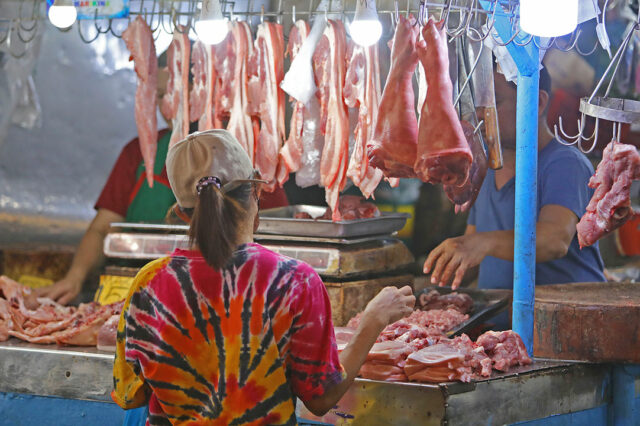
MITA urges gov’t to further lower pork tariffs

CUSTOMERS shop for pork meat at the Marikina Public Market, March 14. — PHILIPPINE STAR/ WALTER BOLLOZOS

LOCAL MEAT IMPORTERS are urging the government to further lower the tariffs on imported pork and maintain these for the next five years, in order to ensure adequate supply amid a possible pork shortage in the coming months.

This as the executive order (EO) on the current tariff rates for imported pork is set to expire by yearend.

In a May 22 letter, the Meat Importers and Traders Association (MITA) asked National Economic and Development Authority (NEDA) Secretary Arsenio M. Baliscan to clarify if the current tariff rates will be “reduced, maintained or revert to the higher rates.”

The current tariff rate is 15% for in-quota imports, and 25% for out-quota, as per the EOs issued by then-President Rodrigo R. Duterte and President Ferdinand R. Marcos, Jr.

The latest EO, which was signed by Mr. Marcos, expires by end-2023, which means pork meat would revert to the original tariff rates of 30% in-quota and 40% out-quota.

“The EOs were issued to address the high price of pork that resulted from the hog shortage caused by African Swine Fever (ASF). Needless to say, reversion to a higher duty rate will further raise the cost of imported pork meat and discourage imports,” MITA said in the letter signed by its president Sherwin Choi and president emeritus Jesus C. Cham.

The group also reiterated its proposal that all meat and edible offal imports be imposed a 5% tariff rate across the board. It also pushed for another five years of lower duties for pork meat imports to ensure the industry recovers from ASF, which first appeared in 2019.

“We are now in the fourth year, and the (Department of Agriculture) has just forecast a pork shortage for the coming months. Clearly the hog recovery is not going well. It is timely to now maintain low tariff for the next five years,” MITA said.

Amid the rise in global pork prices, the group said the Philippines should follow its neighbors in cutting tariffs and diversifying sources of pork imports.

“As pork meat is a crucial part of the Filipino diet, it is necessary to maintain its availability and affordability. Unfortunately, the uncertainty on whether the tariffs would revert to the previous rates hangs over our heads,” it added.

However, Jayson H. Cainglet, executive director of Samahang Industriya ng Agrikultura, said that reverting back to previous tariff rates for pork meat may actually help the local hog industry recover.

“Tariffs protect the local industry because of the low cost of production as a source of imports as they are heavily subsidized by their respective governments,” he said in a Viber message. “In the absence of comprehensive government support, tariffs are the industry’s last refuge.”

Mr. Cainglet also noted that the reduction in tariffs did not result in lower retail prices.

Rizal Commercial Banking Corp. Chief Economist Michael L. Ricafort said in a Viber message that lowering tariffs on pork meat would be “part of the non-monetary measures to help bring down prices.”

“This would help increase local supply and lower prices of pork/meat products, in view of reduced local supplies due to the ASF that hit some provinces/regions in Southern Philippines in recent months,” he said.

Mr. Ricafort warned that lower tariff rates may hurt the local industry amid increased competition from imports. — Sheldeen Joy Talavera

Gov’t budget utilization rate at 90% as of end-April

BW FILE PHOTO

THE CASH utilization rate of government agencies stood at 90% as of end-April, slightly slower than a year ago, data from the Department of Budget and Management (DBM) showed.

The National Government, local governments and state-owned companies used P1.18 trillion of the P1.3 trillion worth of notice of cash allocation (NCA) issued in the first four months.

As of end-April, unused allocations stood at P128.07 billion.

The April cash utilization rate was a tad lower than the 92% a year ago.

NCAs are a quarterly disbursement authority that the DBM issues to agencies, allowing them to withdraw funds from the Bureau of the Treasury to support their spending needs.

Line departments used 86% or P779.9 billion of the total P907.1 billion allotments released as of end April. This left P127.2 billion in unused NCAs.

At end-April, only the Commission on Audit recorded a 100% utilization rate.

Other offices that had high utilization rates were the Department of Energy (99%), Commission on Elections (98%), Office of the Press Secretary (96%), and the Department of Interior and Local Government (95%).

The Department of Transportation recorded the lowest rate at 63%.

Meanwhile, budgetary support to government-owned companies as well as allotments to local government units were 100% used.

“The slightly faster utilization rate a year ago may have to do with election-related rush, especially the need to expedite completion by some incumbent officials back then. Also, some speeding up the utilization of funds before the election ban last year,” Rizal Commercial Banking Corp. Chief Economist Michael L. Ricafort said in a Viber message.

A public works ban for the May national elections ran from March 25 to May 8 last year. Aimed at preventing politicians from using public resources for their election campaigns, the ban covers disbursement and spending as well as construction activity.

“There may also be some adjustment or transition towards greater fund allocation for local government units vis-à-vis the National Government,” Mr. Ricafort said.

However, Mr. Ricafort noted the fast approval of the 2023 national budget and reopening of the economy also supported the agencies’ use of funds.

“The need to speed up utilization of funds may also have to do with the urgency in recent years, for any delay in utilization could be forfeited,” he added.

Budget Secretary Amenah F. Pangandaman earlier signaled that the DBM would cut the budgets of agencies with a low utilization rate.

The DBM released 85.8% or P4.52 trillion of the 2023 national budget at the end of April, leaving P749.85 billion for the remainder of the year.

The release rate was slightly ahead of the year-earlier pace of 85.6%. — Luisa Maria Jacinta C. Jocson

ABS-CBN ends news channel, forges joint venture

PHILIPPINE STAR/ MICHAEL VARCAS

By Justine Irish D. Tabile, Reporter

ABS-CBN Corp. is ceasing the operations of TeleRadyo starting on June 30 as the news channel has been incurring losses since 2020, the listed media company told the stock exchange on Tuesday.

“Since ABS-CBN can no longer sustain TeleRadyo’s operations, ABS-CBN is left with no choice but to cease the operations of TeleRadyo to prevent further business losses,” it said in a statement.

“The company is deeply saddened by this closure and having to part ways with the many passionate and committed people who have made TeleRadyo an important source of news and information for many Filipinos,” it added.

Following the announcement, ABS-CBN said it will be entering a joint venture with Prime Media Holdings, Inc.

“The new company will produce various programs, which will be supplied to broadcasters and other third-party platforms including Philippine Collectivemedia Corp.,” ABS-CBN said.

Under the agreement, Prime Media will be the majority stakeholder of the joint venture, while ABS-CBN will have a minority stake.

“This gives some of our former personnel a chance to find job opportunities. It is also a way to continue providing accurate and balanced news and information to the country,” ABS-CBN said.

Prime Media is a listed holding company that aims to hold investments in the media industry. It has been generating meager revenues and incurring losses.

“The agreement is in line with Prime Media’s strategic plan to venture into media and entertainment by securing partnerships for content development, production, and distribution to expand its business,” Prime Media said.

The venture formalizes the agreement between the two media organizations to develop, produce, and finance content for distribution to local and international broadcast networks, channels and platforms.

“This will expand Prime Media’s business segments and provide streams of revenue such as equity investment and share in future projects,” the holding firm said.

ABS-CBN did not officially disclose in its filing whether it will be laying off employees but hinted that it will be parting ways with some. TeleRadyo is a pay-television channel under the network’s News and Current Affairs brand.

The National Union of Journalists of the Philippines (NUJP) said it hopes that the company will assist its media workers affected by its corporate decisions.

“While it is still unclear how these decisions will affect our colleagues, we note that many of them stayed with the company despite uncertainty and pay cuts,” NUJP said in a statement.

“They should not be abandoned now as the network seeks ways forward from the franchise troubles that it has been weathering since 2020,” it added.

During the Duterte administration, ABS-CBN was denied a new franchise, forcing it to stop its broadcast operations in May 2020.

Since then, the company has been entering partnerships to keep its operations alive such as forging deals with Gozon-led GMA Network, Inc. for international streaming and joint production, and with TV5 Network, Inc., raising opposition from legislators and leading to the partnership’s pause.

“It is saddening, while also enraging, that the effects of the rejection of ABS-CBN’s application for a new franchise are still being felt more than three years later, long after the end of the term of the president who made it known that he wanted the network off the air,” NUJP said.

In the first quarter, the company suffered an attributable net loss of P1.16 billion, narrowing the P1.38-billion loss it incurred a year ago. Its top line reached P4.26 billion, down 8.3% from P4.65 billion previously. Advertising and subscription revenues still accounted for the largest portion.

ABS-CBN’s advertising revenues reached P2.34 billion, up 57.8% from P1.48 billion, while subscription revenues declined 42.6% to P1.48 billion from P2.57 billion.

On Tuesday, ABS-CBN shares closed 37 centavos or 5.31% higher at P7.34 each, while Prime Media shares declined by 18 centavos or 6.27% to P2.69 apiece.

Villar companies post positive results in Q1

BW FILE PHOTO

VILLAR-LED COMPANIES AllHome Corp. and AllDay Marts, Inc. turned in profits in the first quarter of this year to reverse the previous year’s net loss, while their affiliate Golden MV Holdings, Inc. recorded higher earnings during the period.

In separate regulatory filings, the three companies reported a positive bottom line despite one of them recording lower revenues during the quarter.

AllHome booked a net income of P212.28 million in the first quarter, turning around from a P27.91-million net loss the previous year. Its top line during the quarter fell by 9.9% to P2.92 billion from P3.24 billion because of a shift in consumer spending — to travel, leisure, food, and entertainment — to address pent-up demand during the pandemic.

“Our [first quarter] shows signs hallmarks of the key strengths of AllHome. Our soft categories — where we have a clear advantage — continue to generate the lion’s share of our revenue,” AllHome President Benjamarie Therese N. Serrano said in a statement on Tuesday.

AllHome offers products for home improvement and construction.

Supermarket operator AllDay reported a first-quarter net profit of P88.57 million, a reversal of the P75.58-million net loss reported in the same period last year. Its sales went up by 6.6% to P2.44 billion from P2.29 billion mainly due to the sales growth of existing stores and the revenue contribution of new stores.

“Our first-quarter performance in 2023 is pleasing in the regard that we have validation of our capability to sustain exceptional results driven by the extraordinary behaviors and circumstances of the pandemic,” AllDay President and Chief Executive Officer Frances Rosalie T. Coloma said in a separate statement.

“Now that the country has returned to normal, we look to our now 36 locations across the country and the many operational opportunities we can harness to deliver efficiency, and ultimately value, to our stakeholders,” Ms. Coloma added.

Meanwhile, property developer Golden MV posted a 10.5% jump in net income during the first quarter to P473.04 million from P428.18 million in the same period last year, driven by higher revenues.

Its top line in the three-month period rose 3.9% to P1.61 billion from P1.55 billion in the prior year, mainly after an increase in real estate sales during the period.

Real estate sales increased by 4.7% to P1.55 billion from P1.48 billion on the back of sales growth for both residential units and memorial lots.

Also on Tuesday, Vistamalls, Inc. reported an attributable net income of P1.42 billion during the first quarter, up 13.6% from P1.25 million the previous year.

Its top line for the period inched up by 0.8% to P2.65 billion from P2.63. Vistamalls has units that operate and develop mass market retail malls. Rental revenues rose 12.2% to P2.57 billion from P2.29 billion previously. The increase was mainly due to “higher occupancy and the increase in rates for the period including the upside from the higher sales of variable rental-based tenants.”

During the first quarter, a new mall, Vista Mall Davao, was opened and contributed to the rise in revenues.

The four companies are all chaired by billionaire Manuel B. Villar, Jr. — Adrian H. Halili

Megawide cuts loss  to P7.12 million as revenues increase 11% to P4.4 billion

MEGAWIDE CONSTRUCTION CORP. narrowed its attributable net loss to P7.12 million in the first quarter from P60.75 million a year ago after recording higher revenues.

In its financial report filed on Tuesday, the company showed its revenues keeping an upward trend to reach P4.36 billion in the first three months, up by 11% from the P3.92 billion booked last year.

Revenues from construction operations accounted for P4.27 billion of the company’s top line, 12.5% higher than the P3.79 billion recorded previously.

“The construction segment has maintained its momentum in delivering projects on time at the start of the year,” the company said.

Megawide’s order book includes the following: Suntrust Home Developers, Inc.’s Suncity West Side City project; 8990 Holdings, Inc.’s Urban Deca Ortigas and Cubao; Megaworld Corp.’s Gentry Manor; and the first phase of the Department of Transportation’s Malolos-Clark Railway project.

Meanwhile, revenues from the land-port segment declined 31% to P90.16 million in the January-to-March period from P130.77 million in 2022.

“Occupancy rates continue to be depressed due to the oversupply in the market, resulting in lower lease income compared to the first quarter of 2022,” Megawide said.

“The company however is confident that it will be able to lease out the spaces gradually during the course of the year as the environment continues to improve and the Team extensively explores alternative schemes,” it added.

Direct costs were higher, amounting to P3.95 billion during the quarter, a 20.4% increase from the P3.29 billion incurred in the previous year. Costs of construction operations accounted for most of it after reaching P3.86 billion, while costs of land port operations were P88.77 million.

“The movement was mainly related to rising prices of raw materials, services and higher labor costs, along with higher fixed-costs and depreciation expenses associated with capacity building,” the company said.

Earlier this month, Megawide said that it had agreed to sponsor a P3-billion loan for its subsidiary to finance the Carbon Market mixed-use development in Cebu City. The company said that it had executed on May 10 an omnibus loan and security agreement with its unit, Cebu2World Development, Inc., and bank lenders.

The Carbon Market development is a 50-year joint venture with the Cebu City government for the modernization of a 100-year-old farmer’s market into “a commercial, heritage, and cultural district.”

On Tuesday, shares in Megawide dipped 46 centavos or by 12.14% to P3.33 each. — Justine Irish DP. Tabile

Holcim partners with South Korea’s Sungshin to supply infra projects

HOLCIM PHILIPPINES FACEBOOK PAGE

LOCAL cement manufacturer Holcim Philippines, Inc. has partnered with South Korean cement and concrete producer Sungshin Cement Co. Ltd. to supply the country’s infrastructure projects.

In a statement on Tuesday, Holcim Philippines said that it had signed a memorandum of understanding with Sungshin on March 28 to work together on Philippine infrastructure projects in which the latter is bidding to participate as a concrete supplier.

“Holcim Philippines will serve as the priority supplier of cement and aggregates for Sungshin’s ready-mix concrete batching plants,” the local cement producer said.

The Holcim-Sungshin agreement came after the Philippines and South Korea forged an agreement in December last year that allows Manila to access up to $3 billion worth of official development assistance loans from Seoul for infrastructure and green projects.

In 2021, South Korea was the sixth-largest provider of official development aid to the Philippines. Some of the infrastructure projects that were funded by South Korea are the Jalaur River Multipurpose Dam in Iloilo, the expansion of the Cebu International Port, and the Panguil Bay Bridge connecting Misamis Occidental and Lanao del Norte.

“This strategic partnership is aligned with our goal to increase our participation in important infrastructure projects that advance the country’s development,” Holcim Philippines Senior Vice-President and Head of Infrastructure and Industrial Sales Ram Maganti said.

“With our combined expertise in innovative and sustainable building materials, we are confident in helping clients build lasting structures that uplift lives in the Philippines,” he added.

Sungshin has businesses in cement, ready-mixed concrete, construction materials, transportation, trading, and distribution in South Korea. Aside from the Philippines, it also has a presence in Vietnam, China, Singapore, Bangladesh, and Saudi Arabia.

Holcim Philippines, a member of the Holcim Group, has cement manufacturing facilities in La Union, Bulacan, Batangas, Misamis Oriental, and Davao City. The company is also engaged in aggregates and dry mix business, as well as technical support facilities for building solutions.

On Tuesday, Holcim shares at the local bourse rose two centavos or 0.52% to end at P3.89 apiece. — Revin Mikhael D. Ochave 

Jollibee Foods opens 150th CBTL store in Malaysia

LISTED food service company Jollibee Foods Corp. on Tuesday said that it had opened its 150th The Coffee Bean & Tea Leaf (CBTL) location in Selangor,  Malaysia.

“The opening of our 150th café in Malaysia, which adds to the brand’s expanding footprint of over 1,000 cafés across 20 plus countries globally, signifies Jollibee Group’s commitment to the accelerated growth of The Coffee Bean & Tea Leaf brand,” Jollibee Foods President and Chief Executive Officer Ernesto Tanmantiong said in a statement.

The new café location features a 2,800 square feet floor area, which houses large seating areas that can accommodate 110 people per day. It also has a community table that can seat eight customers.

The company said the new location features contemporary interiors with an open space concept, with prominent arches.

“A nod to the brand’s roots, South Californian motifs adorn the new café, while sunshine-like lighting evokes a warm and inviting ambiance,” it said.

CBTL launched its first café in Malaysia in 1997 and has steadily expanded its presence in the country, Jollibee Foods said.

“The brand’s success underscores its steadfast focus on serving authentic, diverse flavors of coffees and teas from different parts of the globe — using only ingredients of the highest quality — and elevating the customer experience through constant innovation,” it added.

CBTL Malaysia will further expand its reach through customer accessibility by expanding its drive-thru services, as it aims to provide a better on-the-go experience for its customers.

The expansion is part of Jollibee Foods’ goal to be one of the top five restaurant companies in the world.

“This is an exciting time in our growth story as we build on our strong legacy to become a modern global coffee [and] tea house that allows people to see the world in new ways through new flavors and experiences,” CBTL Chief Executive Officer John in de Braekt said.

“Asia remains a focus for our expansion where we continue to see strong demand for specialty coffee and tea,” Mr. de Braekt added.

On Tuesday, Jollibee Foods’ shares fell by 1.12% or P2.60 to close at P229 each. — A. H. Halili

A home for printmakers

ART ENTHUSIASTS during the launch of Bulwagang Roberto Chabet

By Giselle P. Kasilag

ACKNOWLEDGED as the father of Philippine conceptual art, the late Roberto Chabet’s contribution to the visual arts landscape changed the conversation not only in the Philippines but spilled over to Asia and the rest of the world. Thus, it was a much-lauded tribute when the Cultural Center of the Philippines (CCP) decided to name its latest gallery space on the third floor of the Tanghalang Ignacio Gimenez after the man that the artistic community remembers with respect and fondness.

“We have named the third floor in honor of Roberto Chabet who was one of our first museum directors,” explained Mauro Ariel Yonzon, department manager of the CCP Production and Exhibition Department, at the opening ceremony. “He was actually one of the founders of the Thirteen Artists Awards and, initially, sinimulan nila iyung (they started the) exhibition programs ng (of the) Cultural Center of the Philippines as curatorial projects. That said, we felt that it was befitting to name the space on the third floor of this building in honor of Mr. Chabet.”

The honor of holding the very first exhibition in the space went to the Association of Pinoyprintmakers (AP) which also marked their first show since the pandemic began. The exhibition, entitled “Space/Place,” featured the works of 37 printmakers. The artform, heavily supported by the CCP since the institution was established in 1966, is well-entrenched in the Center especially in its visual arts collection, earning it the first pick for an exhibition in the new gallery.

“It is important to note that the CCP has the best collection of fine prints,” asserted Virgilio “Pandy” Aviado, board member and President Emeritus of the Association of Pinoyprintmakers. “It’s, pardon the pun, an impressive one. And an important one to my mind, it is a treasury of important fine prints which includes both local and international printmakers.”

In the 1990s, the CCP opened its doors to the local printmakers groups, providing a space to hold workshops as well as a headquarters where they may hold office. It attracted artists not just from the regions but from all over the world. Printmakers from Australia to Sweden held lectures and exchanged knowledge with their local counterparts.

The CCP, itself, has a long history with printmakers. Four of its visual arts directors were practitioners of the artform: Ray Albano, Jo Layug, Nonon Padilla, and Mr. Aviado.

“Several years ago, when the lockdown started, the CCP launched its second important portfolio of prints,” he explained. “That publication somehow gave local printmakers and artists an opportunity to make art, and to make the world a better place in spite of what is happening. Tonight, we open the show and it’s a partnership between the CCP and the Pinoyprintmakers.”

Affirming the ties that bind, Benjie Torrado Cabrera, president of the Association of Pinoyprintmakers, announced that the CCP has granted the AP an associate partner member status, bringing the organization officially under the umbrella organization of the Center as a visual arts group.

Given these developments, it is appropriate that the theme of the first exhibition delves into the artists’ definition of space and place. Inspired by Michel Foucault’s Heterotopia, the printmakers were given 20 inches by 20 inches of printable surface to define their concept and understanding of space. The result is a collection of stunning pieces that offer deeply personal and sometimes challenging descriptions of what constitutes one’s defined area.

Participating artists include Marz Aglipay, Leonardo Aguinaldo, Psalm Astejada, Jose Santos Ardivilla, Melai Arguzon, Virgilio Aviado, Luigi Azura, Mars Bugaoan, Elmer Borlongan, Benjie Torrado Cabrera, Kristen Cain, Jandy Carvajal, Salvador Ching, Joey Cobcobo, Salvador Convocar, Noell EL Farol, Jess Flores, Annatha Lilo Gutierrez, Tish Hautea, Eugene Jarque, Villia Jefremovas, Carmel Lim Torres, Little Wing Luna, Angelo Magno, Hershey Malinis, Fara Manuel-Nolasco, Gabi Nazareno, Jamel Obnamia, Samm Occeno, Kr Rodgers, Angela Silva, Jone Sibugan, Jun-Jun Sta. Ana, Suchin Teoh, Wesley Valenzuela, and Anton Villaruel.

“We wish to express our gratitude to the Cultural Center of the Philippines for recognizing printmaking as a major art medium,” Mr. Aviado stressed with much appreciation. “It recognizes the importance of printmaking in nation-building.”

“Space/Place” is ongoing until June 18.