
Auto sales
NEW VEHICLE SALES rose by an annual 21.8% in April, but a month-on-month decline in sales may reflect slowing consumer demand. Read the full story.
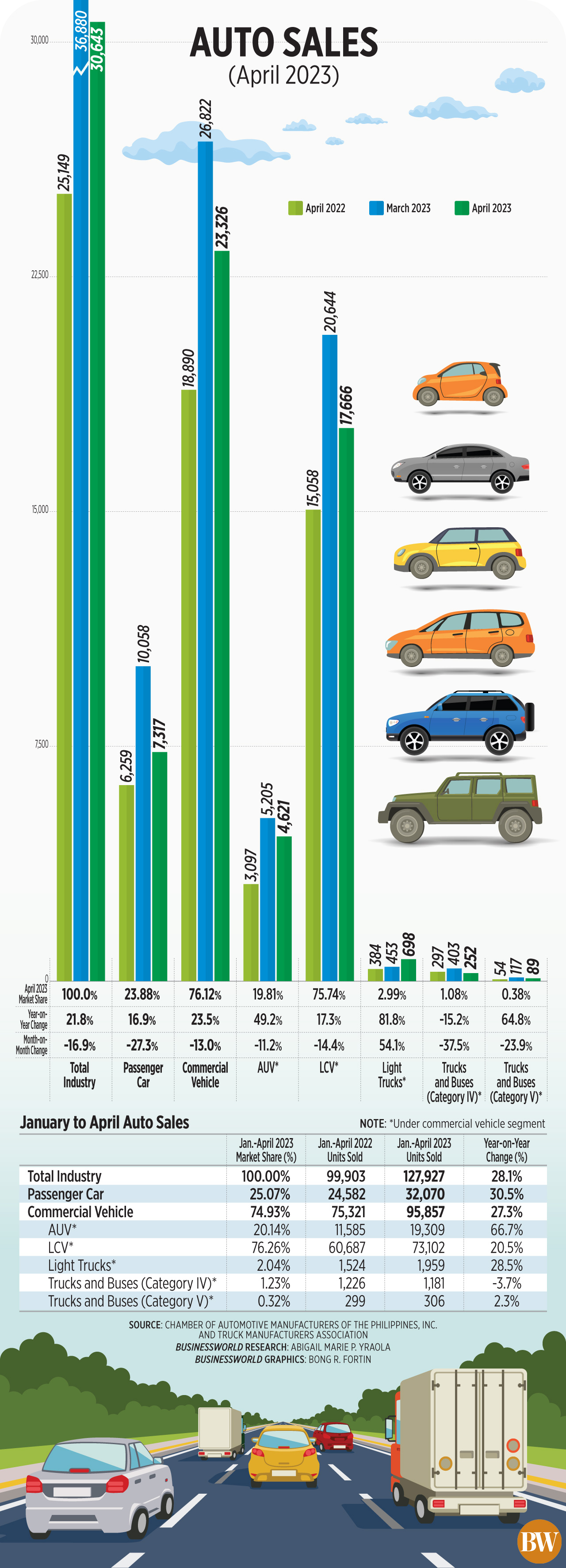
NEW VEHICLE SALES rose by an annual 21.8% in April, but a month-on-month decline in sales may reflect slowing consumer demand. Read the full story.

Globe Telecom, Inc. targets to register 100% of its revenue-generating customer base within the 90-day extension period, as it has now registered around 85% of active users of subscriber identity modules (SIM).
“We intend to have 100% of our revenue-generating base fully registered within the 90-day extension. We are confident that we can achieve this with the initiatives that we are taking,” said Darius Jose Delgado, head of Globe’s consumer mobile business, in a statement.
Republic Act No. 11934 or the SIM Registration Act requires all SIM users to register their SIMs under their name until April 26, or risk SIM deactivation. The deadline has since been extended.
Globe said that it noticed a slowdown in SIM registration volume after the announcement of the 90-day extension.
“Our SIM registration volume has indeed decreased since the announcement of the extension a few weeks back and we see that phenomenon actually being consistent across all players in the market,” he said during the company’s online first-quarter briefing.
The latest data from the National Telecommunications Commission show that as of May 13, a total of 95.71 million subscribers have already registered. This is 56.96% of the 168.02 million total subscribers nationwide.
Around 45.29 million of the total SIMs registered are from Smart Telecommunications, Inc., 44.01 million from Globe, and 6.4 million from DITO Telecommunity Corp.
Smart still leads in terms of the percentage of SIMs registered at 68.31%, followed by Globe at 50.74%, and DITO at 42.76%.
Meanwhile, Mr. Delgado said that the company is still seeking for conditional registration from the NTC and the Department of Information and Communications Technology.
“We applaud the government for extending the SIM registration deadline, as this gives millions of our unregistered customers more time to comply with the law,” he said.
“But we continue to ask for conditional registration that will allow us to accept other forms of identification such as school IDs and company IDs. This will help our customers who do not yet have a government ID to register across our channels,” he added.
Mr. Delgado previously said that Globe saw lower registrations in the rural areas of Visayas and Mindanao, to which it is planning to scale up registration sites together with local government units. — Justine Irish DP. Tabile

NEW YORK — For his armies of fans, Michael J. Fox will always be the eternal teenager, the 1980s heartthrob, the fresh-faced star of Family Ties and Back to the Future.
Looking back on his long career, he sees himself more as a cockroach.
“You can’t kill a cockroach,” the 61-year-old told Reuters in the run-up to the release of the new documentary Still, an unsparing portrait of his life with Parkinson’s disease.
“I say in the movie I’m a tough son of a bitch. I can get through anything I face.”
The Canadian-American actor has had to face a lot from his early career scrabbling around for roles, negotiating his terms over a payphone outside a fast food restaurant, to the diagnosis he kept secret for seven years.
Still tells his tale through a mix of interviews, home movies, archive footage, and scripted scenes.
“It’s a lot about the experience of living with a chronic disease and finding a way to do it successfully and in a way that … gives you room to be who you are and who you want to be,” Mr. Fox said.
The film begins with a re-enactment of him waking after a night out, his little finger trembling.
He recalls turning to alcohol and doing his best to mask the shaking in his left hand while filming the hit comedy show Spin City.
In 1998, he announced he had the condition and began campaigning for finding a cure.
In the film he makes no attempts to hide his symptoms. Producers offered him a chance to make edits, to cut some of the worst stumbles and shakes. But he turned them down.
They “said you have … three things you can knock out of the film … I said I don’t want any of that, go make the movie,” he said.
Born in Edmonton, Alberta, Mr. Fox moved to Los Angeles aged 18.
“People always ask me when I run across an episode of Family Ties or a scene from Back to the Future, how do I feel about seeing myself young and healthy. And it made me think of (late boxer) Muhammad (Ali who also had Parkinson’s)… how did he deal with it when he’d see himself so pretty and articulate, funny and alive and strong,” Mr. Fox said.
“I called Lonnie, his wife, and I said you’ve got to tell me about when he saw himself on television… Was he upset, did he feel like he missed it? She said he loved it, he’d watch it all day long. And I thought, well that’s good because he owns it.”
Asked what it meant to him to be still, Mr. Fox said: “Sometimes in meditation I can find a place where I’m just in that perfect place of serenity and peace and not questioning anything.
“I couldn’t do that (before). That’s where the title of the movie comes from. I had written in one of my books I couldn’t be still until I could no longer be still.”
In the film Mr. Fox also says he has “a chip and a chair.”
“What it means is … you got a stake in the (poker) game, you won’t last long but you got a shot theoretically.
“I’m better than that … because I found a way to beat the house.” — Reuters

Presello House Tours premiered its new season on One News channel last May 13.
The new season will feature exclusive tours of some of the most luxurious properties in Metro Manila.
“At Presello, we believe that a home is not just a structure made of bricks and mortar. It’s a place where memories are made, families are raised, and dreams are created. That’s why we’re passionate about showcasing homes that not only offer stunning architecture and design but also embody the unique personalities and stories of the people who may one day call them home,” Julia Richards, host of Presello, said in a statement.
Presello House Tours airs every Saturday at 6 p.m., with re-runs on Sundays on Cignal Ch. 250 HD and Ch. 8 SD, and on the Cignal Play app.
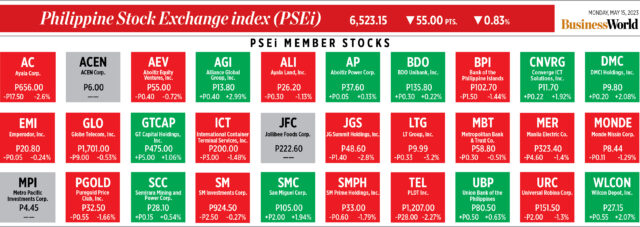
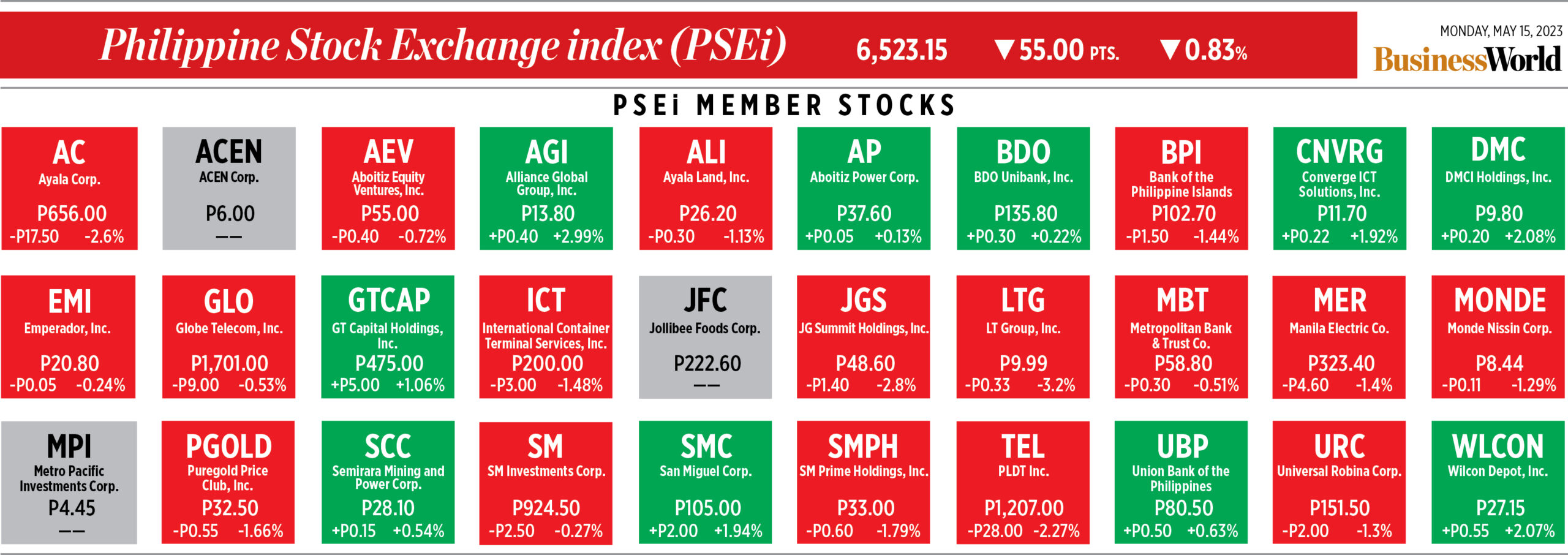
Here’s a quick glance at how PSEi stocks fared on Monday, May 15, 2023.


THE PESO weakened to a near one-month low against the dollar on Monday ahead of the central bank’s policy review this week.
The local currency closed at P56.07 versus the dollar on Monday, depreciating by 28 centavos from Friday’s P55.79 finish, data from the Bankers Association of the Philippines’ website showed.
This was the peso’s worst finish in nearly a month or since its P56.21-per-dollar close on April 19.
The local unit opened Monday’s session weaker at P55.95 per dollar. Its worst showing for the day was at P56.09, while its intraday best was at P55.90 versus the greenback.
Dollars traded went down to $1.28 billion on Monday from the $1.488 billion recorded on Friday.
The peso weakened on Monday on signals of a pause in Bangko Sentral ng Pilipinas (BSP) rate hikes at their May 18 meeting, Rizal Commercial Banking Corp. Chief Economist Michael L. Ricafort said in a Viber message.
“The peso weakened to breach the P56 level after BSP Governor Medalla hinted that the central bank might keep local policy rates unchanged in its policy meeting this week,” a trader likewise said in an e-mail.
The central bank is likely to leave its key interest rate unchanged at its policy meeting this week, BSP Governor Felipe M. Medalla said on Monday, possibly hitting the pause button after its most aggressive tightening cycle in two decades, Bloomberg reported.
A pause is the “most likely result” at the May 18 meeting, he said on the sidelines of a forum of the central bank and the International Monetary Fund in Cebu on Monday.
The BSP has raised borrowing costs by 425 basis points (bps) since May 2022 to help bring down elevated inflation, bringing its policy rate to a 16-year high of 6.25%.
A BusinessWorld poll last week showed 13 out of 18 analysts see the Monetary Board pausing its tightening cycle at Thursday’s meeting.
If realized, this would be the first time the BSP will leave interest rates untouched since it began hiking in May 2022.
For Tuesday, the trader said the peso could continue depreciating amid expectations of a potential rebound in US retail sales in April.
The trader sees the peso trading between P55.95 and P56.20 per dollar, while Mr. Ricafort sees it moving from P55.95 to P56.15.

PHILIPPINE SHARES declined on Monday ahead of the Bangko Sentral ng Pilipinas’ (BSP) monetary policy meeting this week, where the market expects a pause in rate hikes.
The benchmark Philippine Stock Exchange index (PSEi) fell by 55 points or 0.83% to close at 6,523.15 on Monday, while the broader all shares index went down by 19.85 points or 0.56% to 3,491.10.
“Shares on the Philippine Stock Exchange started off the week on a cautious note as investors await the Philippine central bank’s interest rate decision. It is widely expected to maintain the key benchmark interest rate at 6.25% on Thursday amid easing inflation and slowing economic growth,” Globalinks Securities and Stocks, Inc. Head of Sales Trading Toby Allan C. Arce said in a Viber message.
“The lagged effects of the central bank’s cumulative rate increases will be fully felt this year, as the impact of policy tightening is usually seen in 12 months. Hence, the central bank may want to keep interest rates at a level supportive to economic growth to help reach the government’s 6-7% target this year,” Mr. Arce said.
Regina Capital Development Corp. Head of Sales Luis A. Limlingan likewise said in a Viber message that investors are looking ahead to the BSP’s rate decision.
“Philippine shares plunged steeply as concerns around US economy resurfaced and dampened investor sentiment,” Mr. Limlingan added.
The BSP is widely expected to keep its benchmark interest rates unchanged on Thursday amid easing inflation and slowing economic growth.
A BusinessWorld poll last week showed 13 out of 18 analysts see the Monetary Board pausing its rate hike cycle at its May 18 review.
If realized, this would be the first time the BSP will leave interest rates unchanged since it began hiking in May 2022.
Meanwhile, five economists see the central bank raising borrowing costs by 25 basis points (bps) for a third straight meeting and to pause starting from its June 22 review.
The central bank has raised benchmark interest rates by 425 bps since May 2022 to help bring down elevated inflation, bringing its policy rate to a 16-year high of 6.25%.
All sectoral indices declined on Monday, except for mining and oil, which rose by 46.09 points or 0.44% to 10,337.44.
Meanwhile, property dropped by 31.76 points or 1.17% to 2,683.39; services declined by 15.88 points or 1.01% to 1,553.50; holding firms fell by 49.15 points or 0.75% to 6,487.80; industrials decreased by 62.22 points or 0.65% to 9,375.75; and financials went down by 9.41 points or 0.5% to 1,842.26.
Value turnover fell to P4.14 billion on Monday with 1.65 billion shares changing hands from the P5.51 billion with 610.93 million issues traded on Friday.
Decliners outnumbered advancers, 106 versus 86, while 42 names closed unchanged.
Net foreign selling stood at P7.64 million on Monday versus the P63.43 million in net buying recorded on Friday. — A.H. Halili

THE PHILIPPINE Coast Guard on Monday said it had not seen any aggressive action from its Chinese counterpart in the South China Sea after setting up five navigational buoys in the disputed water to assert its sovereignty.
“Our personnel on the ground have not been challenged by Chinese vessels yet, other than a few reports of voice communication challenges from them, based on our aerial surveillance,” Coast Guard Vice Admiral Joseph M. Coyme told a televised news briefing in mixed English and Filipino.
“We cannot avoid these voice challenges and we responded by saying that we were conducting a routine surveillance activity.”
He said the coast guard regularly conducts surveillance to verify the locations of five other buoys that the Philippines installed last year. These have remained untouched.
The Chinese Embassy in Manila did not immediately reply to a Facebook Messenger chat seeking comment.
“The buoys would show our strong presence and control over areas within our exclusive economic zone,” Mr. Coyme said. Filipino fishermen would also be protected, he added.
The coast guard set up five buoys carrying the national flag on May 10 to 12 in five areas within its 200-mile (322 km) exclusive economic zone, including at Whitsun Reef, where hundreds of Chinese maritime vessels moored in 2021, spokesman Jay T. Tarriela tweeted.
He said the move would protect Philippine maritime borders and raise the safety of maritime trade.
Mr. Coyme said it took them about a week to set up the buoys near Flat Island, Irving Reef, Loaita Island Lankiam Cay and Whitsun Reef.
In May 2022, the Philippine Coast Guard installed five navigational buoys on four islands in the Spratlys.
He said the coast guard records aggressive maneuvers by Chinese vessels against Philippine ships in the South China Sea.
Over the years, China has deployed hundreds of coast guard and fishing vessels in disputed areas.
The South China Sea is subject to overlapping territorial claims involving China, Brunei, Malaysia, the Philippines, Taiwan and Vietnam. It is a key global shipping route that is believed to be rich in fish and gas.
A United Nations-backed international tribunal in 2016 voided China’s claim to more than 80% of the sea based on a 1940s map.
Last week, President Ferdinand R. Marcos, Jr. pushed a code of conduct for the South China Sea at the Association of Southeast Asian Nations (ASEAN) Summit in Indonesia amid worsening tensions from China’s increased assertiveness at sea.
In January, the Philippine leader met with his Chinese President Xi Jinping in Beijing. He said the Chinese leader had promised to find a solution to avoid tensions at sea. The two leaders signed bilateral deals covering agriculture, energy, maritime security and tourism.
The Philippine Coast Guard in February released a video showing the Chinese Coast Guard’s use of a military-grade laser to harass a Philippine ship supporting a resupply mission at the Second Thomas Shoal, which is within the Philippines’ exclusive economic zone.
The coast guard has called China’s use of laser a “clear violation of Philippine sovereign rights.” China has rejected the claim, saying the use of laser was meant to “ensure navigation safety.”
The incident drew a sharp response from various countries including the United States, Australia, Japan, Canada, Germany, Denmark and United Kingdom.
‘MARITIME SAFETY’
The Philippines is eyeing security partnerships with other countries, including a three-way security pact with Japan and the US. It is also in talks to include Australia and Japan in planned joint South China Sea patrols with the US.
The Department of Foreign Affairs (DFA) in April said the Philippines and China would hold preparatory talks in May ahead of expected discussions on joint oil and gas exploration in the South China Sea.
“We need to bolster the enforcement activities of the Philippine Coast Guard pertaining to maritime safety in the West Philippine Sea,” Mr. Coyme said, referring to areas of the South China Sea within the country’s exclusive economic zone.
The Philippines in February gave the United States greater access to its military bases under their 2014 Enhanced Defense Cooperation Agreement (EDCA).
China has criticized the EDCA expansion, accusing the US of endangering regional peace and stability.
Three of the four new EDCA locations will be in northern Philippines — Naval Base Camilo Osias in Sta Ana, Cagayan; Lal-lo Airport, also in Cagayan; and Camp Melchor Dela Cruz in Gamu, Isabela.
Cagayan is about 1,000 kilometers away from self-ruled Taiwan, which is being claimed by China. Balabac Island in Palawan, which is facing the South China Sea, is also on the list.
Philippine Defense spokesman Arsenio R. Andolong earlier said the Philippines aimed to finish the construction of the five existing EDCA sites by 2024. Washington has allotted more than $83 million (P4.7 billion) for the approved projects at these sites.
EDCA, a supplementary deal to the 1999 visiting forces agreement, allows the US to rotate its troops in the Philippines and build and operate facilities on agreed locations for both their military forces.
Filipino troops and their American counterparts hold annual military drills in Philippine territories that are called “Balikatan” (shoulder-to-shoulder) exercises. — John Victor D. Ordoñez
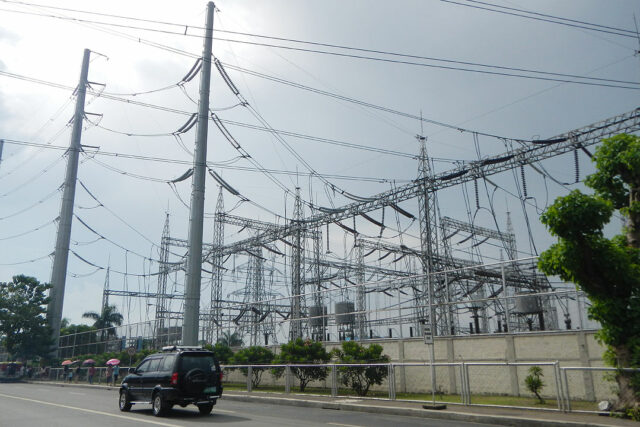
PHILIPPINE lawmakers on Monday sought an investigation of recent blackouts on the main island of Luzon.
“These successive transmission system disturbances caused inconvenience to communities and losses to businesses,” Senator Sherwin T. Gatchalian said in Senate Resolution 607.
“The National Grid Corp. of the Philippines (NGCP), as the operator of the transmission system in the country, should be held to account for the root cause of these disturbances,” he added.
The island experienced rotational blackouts on May 8 after the Luzon Grid was placed under red and yellow alerts by the NGCP due to the tripping of the Bolo-Masinloc 230-kilovolt (kV) Line 2.
The alerts also affected the transfer of generated supply from the Luzon Grid to the Visayas Grid. On May 9, Manila Electric Co. also reported power supply cuts due to a “temporary system imbalance.”
Senator Ana Theresia “Risa” N. Hontiveros-Baraquel cited the need for the government and local enterprises to regain full ownership of the NGCP.
“Chinese state-owned enterprises that have corporations in other countries are obligated under Chinese laws to collect information or intelligence for their government,” she told a news briefing.
“Based on expert testimony submitted during earlier Senate investigations, China acquired the upper hand in regulating the system functioning of the grid because it owns 40% of the consortium,” she said in a separate statement.
China, which claims more than 80% of the South China Sea, has ignored a 2016 ruling by a United Nations-backed arbitration court that voided its claim based on a 1940s map.
The Philippines, which is being backed by the United States, has been unable to enforce the ruling and has since filed hundreds of protests over what it calls encroachment and harassment by China’s coast guard.
Ms. Hontiveros said they were studying how the government could best regain 100% ownership of the NGCP.
Senator Mary Grace S. Poe-Llamanzares said her committee on public services is open to reviewing the NGCP’s congressional franchise, adding that power failures “should not be the norm.”
“We must also exercise vigilance when it comes to our power lines, to ensure that electricity running from Luzon to Mindanao remains under the control of Filipinos amid security concerns raised by senators,” she said in a separate statement.
At the House of Representatives, opposition lawmakers filed a House resolution for a separate probe of the blackouts.
Albay Rep. Jose Ma. Clemente S. Salceda asked the Energy Regulatory Commission to conduct a performance audit of the NGCP by August.
“The NGCP is supposed to complete the Bataan-Hermosa line, the Cebu-Negros-Panay connection and the Mindanao-Visayas interconnection by August 2023,” he said in a statement. “I strongly urge an audit by the ERC by then. If not, we in Congress will do it.”
He also questioned the NGCP’s 3% gross tax rate given its “extreme profitability and laxity of performance.”
“In terms of national income taxes foregone, you are looking at a foregone revenue of around P4-5 billion every year,” said the congressmen, who heads the ways and means committee.
“That does not include foregone value-added tax on the national side, and foregone local business taxes on the local side.” — B.M.D. Cruz

CANADIAN Minister of Foreign Affairs Mélanie Joly is coming to Manila this week to enhance bilateral relations with the Philippines and in pursuit of Canada’s Indo-Pacific Strategy.
During her May 18-21 visit, Ms. Joly will meet with her Philippine counterpart Foreign Affairs Secretary Enrique A. Manalo to discuss regional security and stability as well as partnership with the Association of Southeast Asian Nations, according to a press release from the Canadian government.
The Canadian diplomat will also meet with academics and non-government organizations, and civil society leaders.
“Building on the strong people-to-people ties between the two countries, she will seek ways to enhance cooperation under Canada’s Indo-Pacific Strategy to confront malign influence, combat climate change, protect maritime environments and build more resilient, inclusive and prosperous societies,” the Canadian Global Affairs Department said.
Canada’s Indo-Pacific Strategy, launched in November 2022, aims to “advance and defend Canada’s interests by supporting a more secure, prosperous, inclusive, and sustainable region while protecting Canada’s national and economic security at home and abroad.”
Ms. Joly will also visit Seoul, South Korea to discuss similar issues such as economic and security cooperation.
“The Indo-Pacific is the global center of economic dynamism and is of strategic importance to our security,” she said.
“What brings our countries together is our unwavering commitment to democracy, prosperity, and a free, open and sustainable Indo-Pacific, rooted in the rule of law. Canada continues to deepen relationships in the region with key partners, including Korea and the Philippines.” — John Victor D. Ordoñez
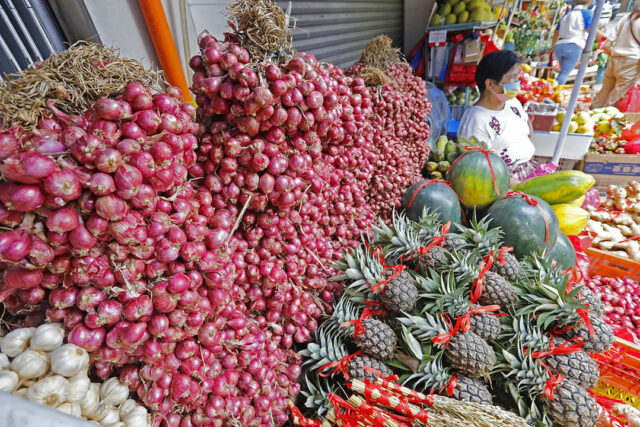
THE AGRICULTURE department is closely monitoring the movement of traders for possible hoarding of onion supply after the recent renewed spike in prices in retail markets, an official said on Monday.
“We are looking at the selling of our farmers. Who buys, how long, and how the traders release their stocks from the cold storage facility,” Department of Agriculture (DA) Spokesperson Kristine Y. Evangelista said in Filipino in a media briefing.
“For us to see that the amount of onions in the market might be dependent on the release of traders of their onions in cold storage and at the same time, the price in the market,” she said.
Ms. Evangelista said Agriculture Assistant Secretary for Inspectorate and Enforcement James A. Layug is coordinating the tracking of inflow and outflow in cold storage facilities.
She said they will also look into onion farmgate price, currently ranging between P100 to P120 per kilogram, higher than the P60 in the same period last year.
“It all goes back to the farmgate price. We cannot say simply that the price is so high and blame it on one specific sector in the value chain, so we want to go back to our farmer.”
“Now, how will we help our farmers bring down the farmgate price? That is another issue that we have to discuss,” she added.
Further, as the harvest season is about to end, she said the department will evaluate the “bottlenecks” in the value chain.
Jayson H. Cainglet, executive director of farmers’ group Samahang Industriya ng Agrikultura, said the retail price of onion in the market should not exceed P200 per kilogram.
“If the [retail price] exceeds P200, it is not the farmer who is earning but others in the value chain of the onion industry,” he told reporters via Zoom.
IMPORTATION
Ms. Evangelista said that they plan to first import white onions based on data provided by the Bureau of Plant Industry (BPI).
BPI Spokesman Jose Diego E. Roxas said in a Viber message last week that the country’s supply of white onions as of April was at 12,843.35 metric tons (MT), which will last until September.
The supply of red onions, on the other hand, was 98,393.86 MT “which may be sufficient to cover local demand until November.”
Mr. Cainglet said they are waiting for the BPI’s total inventory of supply from local harvests and cold storages to determine the needed volume of onions to be imported.
He said initial estimates indicate the country needs to import at least 7,500 MT of white onions based on their proposal last year, while it may not be necessary to import red onions.
“There is an assumption of shortage as the end users such as restaurants used [red onions] as substitute to white [onions] last year that’s why there seem to be a shortage,” he said.
Ms. Evangelista said the volume and type of onion to be imported will be discussed with stakeholders.
The DA is also still assessing the need to impose a new suggested retail price (SRP) for onions.
“Now that the players seem to be clearer, maybe we don’t have to have an SRP but as part of discussions, we will explore every avenue,” she said.
As of Friday, the prevailing price of both local red and white onions stood between P150-P200 per kilogram, according to the DA’s price watch.
There was no monitoring for imported red and white onions in Metro Manila markets. — Sheldeen Joy Talavera

DAILY coronavirus (COVID-19) infections in the Philippines went up 31% in the past week to 1,773 from a week earlier, according to the Department of Health (DoH).
The country posted 12,414 from May 8 to 14, the DoH said in a bulletin. There were 53 severe and critical cases.
About 18.8% or 394 out of 2,093 of the country’s intensive care unit (ICU) beds for coronavirus patients were occupied, while 3,791 or 21.7% of 17,454 non-ICU beds were used.
There were no deaths logged from May 1 to 14, the agency noted.
The DoH said about 78 million of the population have been vaccinated against the coronavirus, with 23 million people receiving booster shots.
As of May 14, the country logged 436 severe and critical cases, or 8.8% of total coronavirus admissions.
The World Health Organization (WHO) earlier this month declared the COVID-19 pandemic was no longer a global health emergency.
More than 2.7 million new cases and over 17,000 deaths were reported globally from April 10 to May 7, a decrease of 14% and 17%, respectively, compared to the previous 28 days, the WHO said.
As of May 7, more than 765 million cases and over 6.9 million deaths have been reported globally. — John Victor D. Ordoñez
