Home Blog Page 4764

Central bank launches commemorative coins

THE CENTRAL BANK has launched a new commemorative coin set for the 125th Anniversary of Philippine Independence and Nationhood.

On Monday, the Bangko Sentral ng Pilipinas (BSP) issued the coin set with 100-Piso, 20-Piso and 5-Piso denominations.

The 100-Piso coin celebrates the declaration of Philippine independence in 1898, while the 20-Piso coin commemorates the birth of the country’s first republic at the Barasoain Church in Malolos, Bulacan.

Meanwhile, the 5-Piso coin honors the Filipinos who fought in the Philippine-American War in 1899 for the country’s sovereignty.

The central bank used the latest digital printing technology in creating the coin set, which features the first colored, non-circulation, commemorative coins developed by the BSP.

The BSP will announce when the coin set will be available for sale.

In his speech during the launch event with President Ferdinand R. Marcos, Jr. in Malacañan Palace, BSP Governor Felipe M. Medalla said the three colors on the coins represent aspirations: the blue color for kapayapaan (peace), red for kagitingan (valor), and yellow for kalayaan at soberanya (freedom and sovereignty).   

“As such, we are issuing these commemorative coins as part of BSP’s effort to preserve the cultural heritage and promote pride in our shared history,” Mr. Medalla said. — Keisha B. Ta-asan

Federal judge rejects Tennessee drag show ban as unconstitutional

FREEPIK

WASHINGTON — A federal judge has ruled that Tennessee’s law restricting drag performances in public or where children were present was unconstitutional, striking a blow to efforts in US states to regulate LGBTQ conduct.

Tennessee Governor Bill Lee in February had signed the bill passed by the state’s assembly that aimed to restrict drag performances, putting the state at the forefront of a Republican-led effort to limit drag in at least 15 states in recent months.

US District Judge Thomas Parker, an appointee of former Republican President Donald Trump, ruled late on Friday that the law was “both unconstitutionally vague and substantially overbroad.” The First Amendment to the Constitution commands that laws infringing on freedom of speech must be narrow and well defined, Mr. Parker said in the 70-page ruling.

“Simply put, no majority of the Supreme Court has held that sexually explicit — but not obscene — speech receives less protection than political, artistic, or scientific speech,” Mr. Parker said in the ruling.

Under the law, offenders could face fines and up to a year in prison and repeat offenders could have faced prison sentences of up to six years.

Ahead of the 2024 elections, Republican lawmakers across the country have introduced more than 500 bills this year regulating the conduct of gay and transgender people, ranging from what can be taught in schools to bathroom use and medical care. At least 48 of those have passed, according to the Human Rights Campaign, an advocacy group.

Mr. Parker had temporarily blocked the law on March 31, just before it was set to go into effect, siding with Friends of George’s, a Memphis-based LGBTQ theater group that filed suit against the state.

GLAAD, an LGBTQ advocacy group, praised Mr. Parker’s decision. “This ruling is a turning point and we will not go back,” GLAAD said in a release.

“Every anti-LGBTQ elected official is on notice that these baseless laws will not stand and that our constitutional freedom of speech and expression protects everyone and propels our culture forward,” the group said. — Reuters

D&L considers new product offerings

D&L INDUSTRIES, Inc. is developing new products and considering new industries for product expansion, its top official said on Monday.

“We do have a lot of new plans and new industries that we are targeting… but they are still very new,” said D&L President and Chief Executive Officer Alvin D. Lao in a media briefing.

Mr. Lao declined to disclose the products being developed by the company, saying its competitors might copy them.

“We are always exploring new products and new industries, and our [research and development] is very busy because they are constantly coming up with new formulations and solutions for our customers,” he added.

Also on Monday, the company’s board of directors appointed former National Economic and Development Authority (NEDA) Director-General Karl Kendrick T. Chua as its new independent director.

“He brings a fresh perspective with his distinguished experience as an economist, working for the World Bank for over a decade and serving the government in various strategic leadership roles thereafter,” Mr. Lao said in a statement.

“With independent directors continuing to hold a majority of our Board, the company remains committed to upholding good governance and transparency,” he added.

Mr. Chua was previously with the World Bank as an economist, NEDA secretary, and undersecretary for strategy, economics, and results at the Department of Finance.

Meanwhile, the company declared a cash dividend of P0.30 per share, which consists of a regular cash dividend of P0.24 per share and a special cash dividend of P0.06 per share, to shareholders of record as of June 20.

The company’s dividends for the year amount to P2.14 billion, up 25% from the P1.71 billion issued the previous year.

D&L Industries is engaged in product customization and specialization for industries such as food, chemicals, plastics, and consumer product original design manufacturing.

The company’s principal business activities include manufacturing of customized food ingredients, specialty raw materials for plastics, and oleochemicals for personal and home care use.

On Monday, its shares rose by 2.29% or 16 centavos to P7.15 apiece. — Adrian H. Halili

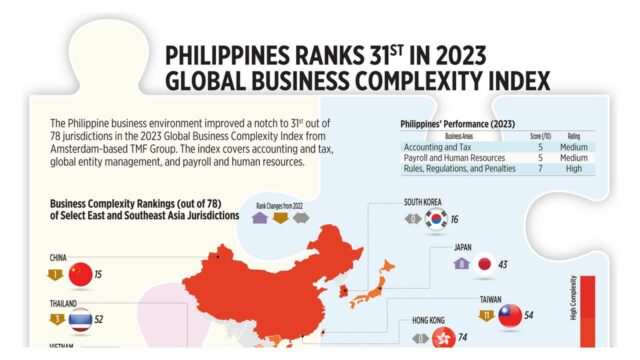
Philippines ranks 31st in 2023 Global Business Complexity Index

The Philippine business environment improved a notch to 31st out of 78 jurisdictions in the 2023 Global Business Complexity Index from Amsterdam-based TMF Group. The index covers accounting and tax, global entity management, and payroll and human resources.

Philippines ranks 31<sup>st</sup> in 2023 Global Business Complexity Index

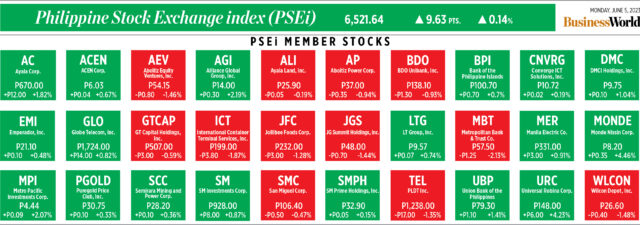
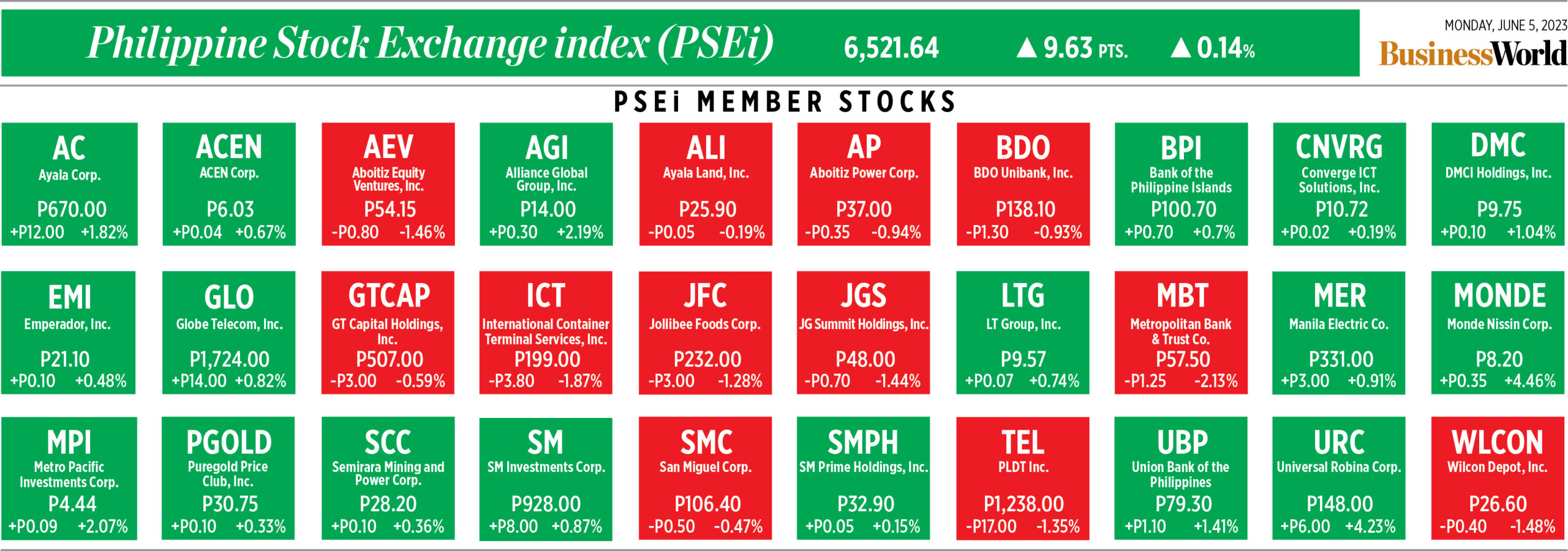
How PSEi member stocks performed — June 5, 2023

Here’s a quick glance at how PSEi stocks fared on Monday, June 5, 2023.


PHL shares climb as Biden signs debt limit deal

REUTERS

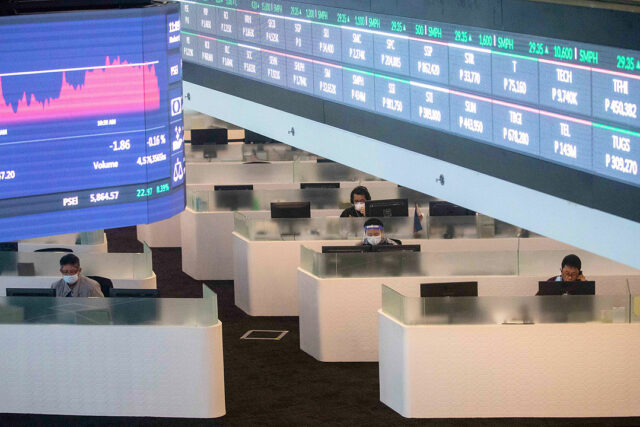
LOCAL EQUITIES rose on Monday as investors remained cautious ahead of the release of May consumer price index (CPI) data and after US President Joseph R. Biden signed the debt ceiling deal over the weekend.

The benchmark Philippine Stock Exchange index (PSEi) went up by 9.63 points or 0.14% to 6,521.64 on Monday, while the broader all shares index rose by 11.46 points or 0.33% to close at 3,486.33.

“The local bourse gained by 9.63 points to 6,521.64 after US President Joe Biden signed into law a debt ceiling bill, erasing the worries among investors,” Philstocks Financial, Inc. Research Analyst Claire T. Alviar said in a Viber message.

“However, market participation remained weak… Many were still on the sideways as they await May’s inflation rate to be released [on Tuesday],” Ms. Alviar added.

Value turnover declined to P3.36 billion on Monday with 1.7 million shares changing hands from the P4.88 billion with 1.21 billion issues traded on Friday.

Unicapital Securities, Inc. Senior Equity Research Analyst Carlos Angelo O. Temporal likewise said that investors remained cautious ahead of the release of May CPI data.

“Investors are likely weighing the positive resolution of the US debt ceiling last Saturday against these uncertainties,” Mr. Temporal added.

Mr. Biden on Saturday signed a bill that suspends the US government’s $31.4-trillion debt ceiling, averting what would have been a first-ever default with just two days to spare, Reuters reported.

The House of Representatives and the Senate passed the legislation last week after Mr. Biden and House of Representatives Speaker Kevin McCarthy reached an agreement following tense negotiations.

The Treasury department had warned it would be unable to pay all its bills on Monday if Congress had failed to act by then.

Meanwhile, a BusinessWorld poll of 15 analysts yielded a median estimate of 6.1% for May headline inflation, near the lower end of the Bangko Sentral ng Pilipinas’ (BSP) 5.8-6.6% estimate for the month.

If realized, this would be slower than 6.6% in April but quicker than the 5.4% print in the same month a year earlier.

The May CPI would also exceed the BSP’s annual 2-4% target range for the 14th consecutive month.

The majority of sectoral indices went up on Monday except for services, which declined by 14.22 points or 0.91% to 1,536.32, and financials, which went down by 6.92 points or 0.37% to 1,829.17.

Meanwhile, industrials increased by 125.12 points or 1.35% to 9,334.02; holding firms rose by 31.49 points or 0.48% to 6,514.49; property went up by 7.92 points or 0.29% to 2,658.26; and mining and oil inched up by 10.03 points or 0.1% to 10,049.17.

Advancers outnumbered decliners, 114 versus 64, while 37 names closed unchanged.

Net foreign selling stood at P108.35 million on Monday versus the P218.62 million in net buying seen on Friday. — A.H. Halili with Reuters

Peso down on strong US data

BW FILE PHOTO

THE PESO weakened against the dollar on Monday due to better-than-expected US labor data and higher global oil prices.

The local currency closed at P56.24 versus the dollar on Monday, dropping by 35 centavos from Friday’s P55.89 finish, data from the Bankers Association of the Philippines’ website showed.

The local unit opened Monday’s session at P56.01 per dollar. Its weakest showing was at P56.245, while its intraday best was at P56 against the greenback.

Dollars traded rose to $1.078 billion on Monday from the $898.5 million recorded on Friday.

“The peso weakened after the US economy added more jobs beyond market expectations last May 2023,” a trader said in an e-mail.

US job growth accelerated in May, but a jump in the unemployment rate to a seven-month high of 3.7% suggested that labor market conditions were easing, which could give the US Federal Reserve cover to forgo an interest rate hike this month, Reuters reported.

The increase in the unemployment rate from a 53-year low of 3.4% in April reported by the US Labor department on Friday was mostly driven by Blacks. It was also partly the result of more people entering the labor force, an increase in supply that is reducing pressure on businesses to raise wages.

The survey of establishments showed nonfarm payrolls rose by 339,000 jobs last month. Economists polled by Reuters had forecast payrolls increasing by 190,000. The economy created 93,000 more jobs in March and April than previously estimated.

The peso was also dragged down by higher crude oil prices recently, Rizal Commercial Banking Corp. Chief Economist Michael L. Ricafort noted in a Viber message.

Oil prices were up $1 a barrel on Monday after top global exporter Saudi Arabia pledged to cut production by another 1 million barrels per day from July, Reuters reported.

Brent crude futures were at $77.15 a barrel, up by $1.02 or 1.3% at 0645 GMT after earlier hitting a session-high of $78.73 a barrel.

US West Texas Intermediate crude climbed by $1.02 or 1.4% to $72.76 a barrel, after touching an intraday high of $75.06 a barrel.

For Tuesday, the trader said the peso could depreciate further due to a likely robust Institute for Supply Management US manufacturing report.

The trader sees the peso moving from P56.20 to P56.40 a dollar on Tuesday, while Mr. Ricafort expects it to trade between P56.15 and P56.35. — AMCS with Reuters

ASF vaccine subsidy program for hog farmers not yet funded

FREEPIK

THE Department of Agriculture said it is still looking for funding sources for the program to subsidize vaccines for African Swine Fever (ASF).

“We are discussing this with the Bureau of Animal Industry (BAI) the possibilities to subsidize but we cannot commit as to whether there will be subsidies bago lumabas ang presyo (before knowing what the price will be),” Agriculture Assistant Secretary Rex C. Estoperez told reporters on Monday.

Hog industry groups earlier called on the government to provide subsidies for the ASF vaccines, after the industry endured a severe downturn since the outbreak began in 2019.

The BAI has said that it has completed the clinical trials for a ASF vaccine manufactured in Vietnam and known as AVAC ASF LIVE.

The AVAC vaccine is the third vaccine to undergo clinical trials. The manufacturer is ready to supply 600,000 doses.

Mr. Estoperez said that the price has not yet been set  as the proposed vaccine is still being assessed by the Food and Drug Administration pending the issuance of a certificate of product registration.

“For now, wala pa tayong alam kung saan ang (we don’t know where the) funds will come from, but we are looking at whether there are excess funds in our other programs,” he said.

Mr. Estoperez said that the agency may seek help from legislators and the Department of Budget and Management.

As of June 1, 15 provinces have active ASF cases, according to the BAI. — Sheldeen Joy Talavera

Napocor exploring hydrogen, fuel cell tech for off-grid use

REUTERS

THE National Power Corp. (Napocor) said it has signed a partnership with the German-Philippine Chamber of Commerce and Industry (GPCCI) to study the feasibility of green hydrogen and fuel cell technologies in off-grid areas.

“Napocor is excited to partner with GPCCI in exploring the potential of green hydrogen and fuel cell technologies,” Fernando Martin Y. Roxas, Napocor president, said in a briefing on Monday. 

Napocor and GPCCI were announcing the signing of a memorandum of understanding for a feasibility study, to address “the limitations of existing fossil fuel power generation capacity.”

“We believe the solution lies in embracing innovative and sustainable technologies,” GPCCI President Stefan Schmitz said.

The Department of Energy has said that it is seeking to introduce emerging technologies to the power mix.

Green hydrogen is produced with zero-carbon renewable energy instead of fossil fuels and has the potential to provide clean power for manufacturing and transportation, with only water as a byproduct. 

Mr. Schmitz said that the feasibility study aligns with the urgent need to reduce greenhouse gas emissions, as the Philippines transition to a more sustainable energy mix.

Napocor currently operates 281 power plants under its Small Power Utilities Group (SPUG), mostly powered by diesel.

Mr. Schmitz said pilot areas are being considered for the feasibility study.

“We are probably going to look a little bit further south because these are mainly SPUGs. Probably, we’ll focus on the central and southern Philippine area,” he said.

In a statement, Napocor said the project’s success will depend on renewable resource availability, economic factors, accessibility, and community support.

“With our mandate to provide electricity to rural areas and our commitment to optimizing power generation assets, this collaboration presents an opportunity to modernize power systems and reduce emissions. We believe this feasibility study will pave the way for a sustainable and climate-friendly energy transition in the Philippines,” Mr. Roxas said. — Ashley Erika O. Jose

Israel working on Tel Aviv-Manila direct flights

REUTERS

ISRAELI Foreign Minister Eliyahu Cohen said his country’s tourism ministry is seeking to arrange direct air links between Tel Aviv and Manila to boost visitor exchanges and trade.

“Direct flights would be good for business and would be beneficial for both our peoples,” he said at the Israel-Philippine Business Forum held at the New World Hotel in Makati City.

Mr. Cohen’s two-day visit to the Philippines is the first by a foreign minister in 56 years.

“My goal today is to build a bridge for the business community to increase the trade volume between our countries and embrace prosperity for both of us,” Mr. Cohen added.

Ilan Marciano, deputy director-general of the Israel Ministry of Tourism, told reporters during the event that he was set to meet with executives from airlines in the Philippines and with the Department of Tourism to discuss proposals for more airline connectivity between the two countries.

Mr. Cohen said Israel has much to offer in terms of “innovation and finding solutions for complex challenges, often applying out-of-the-box types of ingenuity… Being a small economy, Israeli entrepreneurs are always looking for new partners outside of Israel.”

Mr. Cohen is also due to meet with Foreign Affairs Secretary Enrique A. Manalo.

The Philippine Exporters Confederation, Inc., Israel Export Institute, and the Israel-Asia Chamber of Commerce signed a trade cooperation agreement during the forum, which featured networking opportunities for agricultural technology, water, and cybersecurity companies from both countries.

National Economic and Development Authority Secretary Arsenio M. Balisacan said at the event that the government expects any resulting partnerships to support the growth of key Philippine industries and expand export opportunities.

“I invite (Israeli businesses) to invest in our growth drivers, water, agriculture, transportation, agribusiness, and manufacturing,” he said in a speech.

In February, the head of Israel’s Economic and Trade Mission to the Philippines Tomer Heyvi told BusinessWorld editors and reporters in a roundtable discussion that Israeli firms are interested in investing in Philippine infrastructure, agriculture, water, and business process outsourcing industries.

Israel’s Ambassador to the Philippines Ilan Fluss has called it an Israeli priority to expand relations via economic development and innovation.

Trade between Israel and the Philippines totaled $534 million in 2022, a 70% increase, according to the Israel Economic and Commercial Mission to the Philippines website.

It added that demand is growing for Israeli products in the Philippines in industries like agriculture and water technology, cybersecurity, and healthcare.

In September, Mr. Fluss said Israel is seeking tie-ups with information communications technology firms to bolster cooperation in innovation.

“Together, we can elevate our bilateral trade volume to new heights, strengthening our economies and improving the lives of our citizens,” Mr. Cohen said. — John Victor D. Ordoñez


Low registration rates reported for EPR law

PHILIPPINE STAR/ MICHAEL VARCAS

ONLY 15% or about 600 out of 4,000 obliged companies have registered in compliance with a law holding companies responsible for the proper disposal of their products’ plastic packaging, according to the Department of Environment and Natural Resources.

Registration is required under Republic Act (RA) No. 11898 or the Extended Producer Responsibility (EPR) Act of 2022, which lapsed into law on July 23, 2022. It amends RA 9003 or the Ecological Solid Waste Management Act of 2000.

“So far, we have counted 4,000 obliged enterprises. Unfortunately, we only have had around 600 that have actually registered. Some of those 600 have fully complied with what is required for the registration; the rest are still in the process,” Environment Secretary Maria Antonia Yulo-Loyzaga said at a news conference on Monday.

Ms. Loyzaga signed the law’s implementing rules and regulations (IRR) in January. The IRR makes companies with assets of over P100 million to recover their own plastic packaging waste.

“We will be jumpstarting our communications program and education program for the EPR law this month in order for us to begin meet our targets,” Ms. Loyzaga said. 

She said the goal is to sign up at least 1,000 registrants this year.

The EPR law lays down fines of P5 million to P20 million for failure to comply with the law and meet targeted recovery rates.

The Environmental Management Bureau estimates that solid waste produced daily was 61,000 metric tons per day, with plastic waste accounting for about 12%, Undersecretary Jonas R. Leones said.

“We are not winning the war against single-use plastics,” Ms. Loyzaga said. “There is a huge social dimension that needs to be addressed and there must be replacement for single-use plastics. If we cannot replace single-use plastics, we will not be able to actually address the problem,” she added.

In a statement, environmental group Oceana reiterated its call to ban single use-plastics, citing recent studies confirming the presence of microplastics in the environment.

“Microplastics are in the air we breathe and, in the soil, freshwater, and our seas. Our exposure to the dangers brought about by plastic pollution cannot be overemphasized,” Oceana Acting Vice-President and Legal and Policy Director Rose Liza Eisma-Osorio said. — Sheldeen Joy Talavera

Tax system being outmaneuvered by digital companies

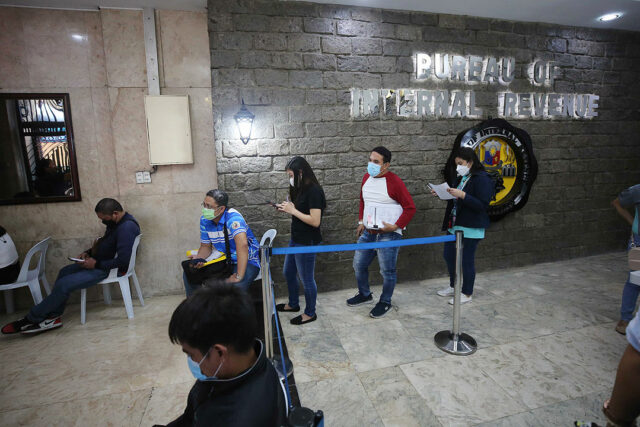
People line up to file their income tax returns at the Bureau of Internal Revenue office in Intramuros, Manila, April 18, 2022. — PHILIPPINE STAR/ RUSSELL A. PALMA

TAX administrators need to adapt to digital platform use by their taxpayers to enhance their ability to capture revenue, the Philippine Institute for Development Studies (PIDS) said.

“In a virtual cross-border world, the effectiveness of existing tax measures is limited. The ease through which online accounts can be set up and deployed as digital storefronts, often anonymously by users operating from homes, which are not tax-mapped, and through platforms that operate abroad, limits the Bureau of Internal Revenue’s (BIR) enforcement powers,” PIDS consultant and assistant professor at the University of the Philippines College of Law Emerson S. Bañez said in a statement.

Mr. Bañez said that the current tax system was “developed for bricks-and-mortar or traditional businesses with a physical location.”

“This is not wholly applicable to e-commerce as not all digital businesses have physical stores or offices where they sell their goods and services and where the same is consumed,” he said.

Tax Management Association of the Philippines President Suzette A. Celicious-Sy noted that no laws currently govern foreign businesses that provide digital goods and services in the Philippines.

A bill that seeks to impose a value-added tax on digital service providers is currently pending in the Senate at committee level.

If signed into law, it is expected to generate up to P18.2 billion in revenue by 2028.

“There are provisions in the bill that might be difficult to enforce, such as requiring nonresident digital service providers to designate a representative office or agent and suspend business operations for failure to register as taxpayers in the Philippines,” Ms. Celicious-Sy said.

“Overall, there needs to be a law to govern the taxation of nonresident foreign corporations and capture allocated taxes for income sourced within the Philippines,” she added.

Mr. Bañez recommended using payment systems and platforms as withholding agents.

The government’s tax administration efforts must also be digital-ready through “procuring the right technology, hiring individuals with the right skills, and reskilling the tax workforce.”

The BIR recently announced that it is looking into a proposed creditable withholding tax on the income payments made by online platform providers to their partner sellers. — Luisa Maria Jacinta C. Jocson

ADVERTISEMENT
ADVERTISEMENT