Home Blog Page 4761

Village garbageman helped unearth ancient bronze statues in Tuscany

Ancient Roman baths of hot water, San Casciano Dei Bagni, Tuscany, Italy - San Casciano dei Bagni —WIKIPEDIA

SAN CASCIANO DEI BAGNI, Italy — One of Italy’s most remarkable archaeological finds in decades goes on show this month — Etruscan and Roman statues pulled from the mud in Tuscany thanks in part to the intuition of a retired garbage man.

About two dozen bronze statues from the third century BC to the first century AD, extracted from the ruins of an ancient spa, will go on display in Rome’s Quirinale Palace from June 22, after months of restoration.

When the discovery was announced in November, experts called it the biggest collection of ancient bronze statues ever found in Italy and hailed it as a breakthrough that would “rewrite history.”

The statues were found in 2021 and 2022 in the hilltop village of San Casciano dei Bagni, still home to popular thermal baths, where archaeologists had long suspected ancient ruins could be discovered.

Initial attempts to locate them, however, were unsuccessful.

Digging started in 2019 on a small plot of land next to the village’s Renaissance-era public baths, but weeks of excavations revealed “only traces of some walls,” San Casciano Mayor Agnese Carletti said.

Then former garbageman and amateur local historian Stefano Petrini had “a flash” of intuition, remembering that years earlier he had seen bits of ancient Roman columns on a wall on the other side of the public baths.

The columns could only be seen from an abandoned garden that had once belonged to his friend, San Casciano’s late greengrocer, who grew fruit and vegetables there to sell in the village shop.

When Mr. Petrini took archaeologists there, they knew they had found the right spot.

“It all started from there, from the columns,” Mr. Petrini said.

‘SCRAWNY BOY’ PULLED FROM MUD
Emanuele Mariotti, head of the San Casciano archaeological project, said his team was getting “quite desperate” before receiving the tip that led to the discovery of a shrine at the center of the ancient spa complex.

The statues found there were offerings from Romans and Etruscans who looked to the gods for good health, as were the coins and sculptures of body parts like ears and feet also recovered from the site.

One of the most spectacular finds was the “scrawny boy” bronze, a statue about 90 cms (35 inches) high, of a young Roman with an apparent bone disease. An inscription has his name as “Marcius Grabillo.”

“When he appeared from the mud, and was therefore partially covered, it looked like the bronze of an athlete … but once cleaned up and seen properly it was clear that it was that of a sick person,” said Ada Salvi, a Culture Ministry archaeologist for the Tuscan provinces of Siena, Grosseto and Arezzo.

Ms. Salvi said traces of more unusual offerings were also recovered, including egg shells, pine cones, kernels from peaches and plums, surgical tools, and a 2,000-year-old lock of curly hair.

“It opens a window into how Romans and Etruscans experienced the nexus between health, religion, and spirituality,” she said. “There’s a whole world of meaning that has to be understood and studied.”

MORE TREASURES TO BE FOUND
The shrine was sealed at the beginning of the fifth century AD, when the ancient spa complex was abandoned, leaving its statues preserved for centuries by the warm mud of the baths.

Excavation will resume in late June. Mariotti said “it is a certainty” that more will be found in the coming years, possibly even the other six or 12 statues that an inscription says were left behind by Marcius Grabillo.

“We’ve only just lifted the lid,” he said.

After the Rome exhibition, the statues and other artefacts are to find a new home in a museum that authorities hope to open in San Casciano within the next couple of years.

Mr. Petrini hopes the treasures will bring “jobs, culture and knowledge” to his 1,500-strong village, which is struggling with depopulation like much of rural Italy.

But he is reluctant to take credit for their discovery.

“Important things always happen thanks to several people, never thanks to only one,” he said. “Never.” — Reuters


Beyond our noses

YOGENDRA SINGH-UNSPLASH

It’s hard to believe, but yes, there it is again: We’re short of supplies for license plates and driver’s licenses! Why do these things happen regularly? Don’t we have a way of forecasting volumes that will be needed? Surely the automotive industry has predictions? The Land Transportation Office (LTO) just has to make effective planning assumptions when it prepares its annual budget, and order more than expected. Drivers’ licenses and license plates don’t expire yearly anyway.

This lack of foresight seems to be endemic in our government. Recently, the Civil Aeronautics Administration got caught flatfooted when its monitoring system failed, and the NAIA had to close. Flights had to be canceled all over the country, and thousands of passengers were inconvenienced. The price in personal and business concerns must have been heavy for many. Airlines must have lost a lot of money! It turns out that the system had not been properly maintained. Some crucial equipment was way past its productive period!

The stoppage of operations of overhead trains is also a recurrent phenomenon. And spare parts are often difficult to procure!

The Commission on Election’s decision to purchase rather than lease the Smartmatic equipment is still another case of shortsightedness. Information technology keeps evolving and systems and equipment become obsolete in a couple of years! Buying the equipment also requires renting warehousing for years! Because the equipment is sensitive to heat, the warehouses had to be air-conditioned! And even then, it did not ensure that the counting machines did not deteriorate. Or become obsolete! This shortsightedness was truly irresponsible.

A classic case of idiocy is the so-called Dolomite Beach. When the Department of Environment and Natural Resources (DENR) decided to build it, did they consider our regular exposure to typhoons and heavy rain? Didn’t they know that the “fake” sand would be swept over by nature and the waves? Did they not anticipate the messy crowd scenes and the need to hire security personnel to ensure a sense of order? Besides, what business did the DENR have providing a fake beach that actually destroyed corals? So now, the government has to provide funds for the regular rehabilitation and security system for this lame-brained idea! They might as well cut our losses and abandon the ill-conceived and unnecessary project.

An incredible irresponsibility now confronting our Finance and Budget departments is former President Rodrigo Duterte’s impulsive decision to double the pay of our cops and soldiers. This has become a serious concern for the near future as the government has to fund the retirement pay of uniformed personnel who do not have to make any contributions to their pension funds. This is exacerbated by the policy of giving soldiers a pension a rank above their last posting. Why then-Budget Secretary Benjamin Diokno did not openly object to Duterte’s decision makes him a party to the problem which he is now complaining about. Meanwhile, our nurses, who risk their lives daily taking care of more patients than the military claims is the total size of the insurgency, are paid about half of the average soldiers’ pay. No wonder we are running short of nurses who prefer to accept better paying overseas jobs.

We must raise consciousness about our government’s endemic shortsightedness and install reporting systems that require predictions of what can go wrong. Our bureaucrats must learn to plan ahead and to budget for regular maintenance of systems; to predict unintended consequences over the long term and provide preventive measures as part of the plans.

Now both houses of Congress have passed the Maharlika Investment Fund deal. It is a major commitment of funds from key government financial institutions: No less than half a trillion pesos (P500 billion). All investments, public or private, carry risks. Have our policy makers considered them? There are opportunity costs. For example, LANDBANK will not be able to earn its average of 8% per annum on loans it grants. Meanwhile, it may even have to pay interest on deposits of the MIC (Maharlika Investment Corp.) which may not yet get placed in money-making projects. The MIC’s advocates seem to estimate average earnings of 8% per annum on its investments. Isn’t this ridiculous? The LANDBANK does not have to place investments through another entity. It can earn directly on its own without additional administrative and operational overhead.

Here we are, a country carrying huge deficits, placing some of its precious assets at risk in projects not yet clear. It will take time for the MIC to get its act together. Meanwhile, it will place its sleeping funds in government banks that have invested in it!

How will the MIC, a government corporation, generate income from its infrastructure projects? Will it charge toll fees to its users? Isn’t this a form of double taxation? How will taxpayers respond? Unless it plans to go into PPPs (public-private partnerships)? With all the controls and “safeguards” provided in the Bill, will private sector investors care to go into these partnerships?

The members of the Board are majority government officials. The executives, including the CEO, will be appointed by the President. Where is he going to find these talented geniuses? And will they be willing to work for a government corporation with so much equity that it will be too much of a challenge to deliver a decent ROI? In choosing the executives, will the President be able to resist political pressures or motives? Keep in mind that the President does not seem to have experience in running for-profit enterprises other than those protecting his family’s assets.

Will the automatic transfer of the Central Bank’s dividends (100% for years 1 and 2, 50% thereafter) not weaken this critical institution that has been central to our economic survival?

There are too many unexplained factors in this huge undertaking using the peoples’ money.

Let’s hope this does not become, as it seems possible, another sad case of not looking beyond our noses.


Teresa S. Abesamis is a former professor at the Asian Institute of Management and fellow of the Development Academy of the Philippines.

tsabesamis0114@yahoo.com

Large US banks face capital jump with more lenders roped in to comply

LARGE US BANKS may have to boost their capital by an average 20% and a broader swath of lenders would face strict requirements for setting aside money under a draft plan from US regulators to bolster the financial system.

Specific increases will depend on a lender’s business model, and banks with at least $100 billion in assets may have to adhere to the new requirements, according to people familiar with the proposals. That’s far lower than the existing $250-billion threshold where many of the toughest rules kick in, which means dozens of regional US banks might have to meet the new standard.

The actual bump in capital requirements, which may be proposed this month, will vary based on the range of banks that will be affected by the changes to key capital rules, said the people, who asked not to be identified before the plans were made public.

The long-awaited changes are part of an international overhaul of capital rules that started more than a decade ago in response to the financial crisis of 2008. The issue became more stark this year with the collapse of several banks in the US.

BANK TURMOIL
The havoc they caused reignited debate on whether the largest regional banks should face tougher standards, while the biggest US lenders argue that capital rules that go too far will hinder economic growth. 

“Higher capital requirements are unwarranted,” said Kevin Fromer, chief executive officer (CEO) of the Financial Services Forum, an advocacy group whose members are the CEOs of the eight largest financial institutions headquartered in the US. “Additional requirements would mainly serve to burden businesses and borrowers, hampering the economy at the wrong time.”

JPMorgan Chase & Co. Chief Financial Officer Jeremy Barnum said late last month that the firm was expecting the proposals on implementing new standards “any day now” and anticipated increased capital requirements for trading businesses and so-called operational risk. He said that while the firm would push back on calls for more capital, it was preparing for its requirements to rise.

The changes are part of the international regulatory effort known as Basel III. Citigroup, Inc. CEO Jane Fraser said last week that her bank was holding off on anything beyond modest buybacks until it had more clarity on the Basel changes and the Federal Reserve’s separate “holistic” review of capital requirements.

“It’s the lever that regulators think about when they want to impose a bit more conservativism on the industry,” said Ken Achenbach, a partner at law firm Bryan Cave Leighton Paisner who focuses on bank regulation and corporate risk. “A 20% hike would be a very, very significant increase.”

The Federal Reserve, the Federal Deposit Insurance Corp. and the Office of the Comptroller of the Currency declined to comment. The Wall Street Journal earlier reported the average expected impact from the proposals.

Michael Barr, the Fed’s vice chair for supervision, has previously said that US officials are reviewing bank capital requirements and committed to putting in place strictures that align with Basel III. Mr. Barr, who took over as the Fed’s top bank watchdog in July 2022 and an architect of the Dodd-Frank Act of 2010, has also signaled that he supports tougher restrictions for bigger, systemically important lenders than smaller institutions.

Yet the recent US bank failures were firms with smaller balance sheets than such global systemically important lenders. The biggest banks have argued that their steadiness in the recent turmoil showed their strength and that they already have more than enough capital. The six biggest US firms have added more than $200 billion to their capital reserves in the last decade, and JPMorgan said last month that its total loss-absorbing capacity now exceeds the loan losses that all US banks had during the financial crisis.

JPMorgan CEO Jamie Dimon has been among critics blasting more cumbersome capital requirements, calling the upcoming increase “bad for America” last year ahead of a pair of congressional hearings.

The top US banks are already subject to higher requirements than their European peers, according to the European Central Bank (ECB), which oversees lenders in the euro area. Despite that disadvantage, US securities firms were able to win market share from European competitors in previous years.

The tighter rules could mean that more business flows to private lenders, such as alternative asset managers, that aren’t subject to the same federal oversight. “Right now, this in some sense is a golden moment for private credit because the banks have pulled back, and with these regulations, that may continue or extend the period through which the banks sit on the sidelines,” said Peter Antoszyk, a partner in the private credit group at law firm Proskauer.

One potential downside, Mr. Antoszyk said, is that the new constraints imposed on banks make them less active and thus “make it harder for companies to deal with situations in which they’re experiencing stress and need additional liquidity.” 

While Europe applies Basel standards to all banks, the US distinguishes more on which rules it applies to large and small banks. Excluding mega banks, euro area lenders would face lower requirements if they were based in the US, according to the ECB.

Other jurisdictions are also working on their own implementation of the final Basel III standards. The European Union is trying to water down its version after the industry warned that a strict approach would risk choking off the supply of credit to the bloc’s economies.

JPMorgan said at its investor day that while the final pieces of Basel III capital rules — which some investors have referred to as Basel IV because they could be so extensive — may be proposed soon, they’re unlikely to be implemented before early 2025. — Bloomberg

How PSEi member stocks performed — June 6, 2023

Here’s a quick glance at how PSEi stocks fared on Tuesday, June 6, 2023.


Stocks fall on weak volume as market awaits leads

BW FILE PHOTO

PHILIPPINE SHARES closed lower on Tuesday amid weak trading volume as investors look for fresh leads.

The Philippine Stock Exchange index (PSEi) declined by 41.71 points or 0.64% to 6,479.93 on Tuesday, while the broader all shares index went down by 16.86 points or 0.48% to close at 3,469.47.

“This Tuesday, the local market dropped 41.71 points (0.64%) to 6,479.93 despite the slowdown in the country’s inflation to 6.1% in May. The market heavyweight SM (SM Investments Corp.) dropped more than 2% in Tuesday’s session, which also dragged the index down,” Philstocks Financial, Inc. Research and Engagement Officer Mikhail Philippe Q. Plopenio said in a Viber message.

“Many are still on the sidelines while waiting for a catalyst to emerge. As a result, market participation remained weak,” Mr. Plopenio added.

Shares in SM sank by 2.48% or P23 to close at P905 apiece on Tuesday.

Value turnover rose to P3.88 billion on Tuesday with 1.8 billion shares changing hands from the P3.36 billion with 1.7 million issues traded on Monday.

Regina Capital Development Corp. Head of Sales Luis A. Limlingan said investors sold shares as inflation eased as expected in May.

“With little impetus locally, movements were mainly influenced regionally by the news that regulators are contemplating increasing capital requirements for large banks,” Mr. Limlingan said in a Viber message.

Headline inflation slowed to 6.1% in May from 6.6% in April, preliminary data from the Philippine Statistics Authority showed. Still, this was faster than the 5.4% print in the same month a year ago.

The May print matched the 6.1% median in a BusinessWorld poll conducted last week. It was also within the 5.8-6.6% forecast of the Bangko Sentral ng Pilipinas (BSP) for the month.

For the first five months, headline inflation averaged 7.5%, still well above the BSP’s 2-4% target and 5.5% forecast for the year.

Meanwhile, US banks could face capital hikes of as much as 20% under new rules being prepared by US regulators as part of a global effort to harmonize capital requirements, a person familiar with the matter said on Monday, Reuters reported.

The proposal is expected to implement a final batch of global bank capital rules laid out by the Basel Committee of banking regulators that are due to take effect at the beginning of 2025.

The majority of sectoral indices went down on Tuesday, except for property, which rose by 24.75 points or 0.93% to 2,683.01, and mining and oil, which went up by 12.74 points or 0.12% to 10,061.91.

Meanwhile, holding firms fell by 86.26 points or 1.32% to 6,428.23; industrials decreased by 84.25 points or 0.9% to 9,249.77; financials went down by 13.97 points or 0.76% to 1,815.20; and services shed 1.31 points or 0.08% to close at 1,535.01.

Decliners outnumbered advancers, 109 versus 70, while 49 names closed unchanged.

Net foreign buying stood at P104.02 million on Tuesday versus the P108.35 million in net selling seen on Monday. — A.H. Halili with Reuters

Peso climbs as inflation eases further in May

BW FILE PHOTO

THE PESO inched up against the dollar on Tuesday after inflation eased further in May.

The local currency closed at P56.22 versus the dollar on Tuesday, rising by two centavos from Monday’s P56.24 finish, data from the Bankers Association of the Philippines’ website showed.

The local unit opened Tuesday’s session at P56.19 per dollar. Its weakest showing was at P56.27, while its intraday best was at P56.15 against the greenback.

Dollars traded dropped to $917.45 million on Tuesday from the $1.078 billion recorded on Monday.

The peso was supported by data showing that inflation slowed to a one-year low last month, Rizal Commercial Banking Corp. Chief Economist Michael L. Ricafort said in a Viber message.

“The peso appreciated from local optimism after domestic inflation continued to decline in May 2023 at 6.1%, matching market expectations,” a trader likewise said in an e-mail.

May headline inflation slowed from the 6.6% print in April but was faster than the 5.4% in the same month a year ago.

This was also the 14th straight month that the consumer price index (CPI) was above the Bangko Sentral ng Pilipinas’ (BSP) 2-4% target for the year.

The May print matched the 6.1% median estimate in a BusinessWorld poll last week and was within the central bank’s 5.8-6.6% estimate for the month.

For the first five months, the CPI averaged 7.5%, still above the BSP’s 5.5% forecast for the year.

Mr. Ricafort added that the peso appreciated amid expectations of steady borrowing costs from both the US Federal Reserve and the BSP.

The US central bank raised borrowing costs by 25 basis points (bps) at its May 2-3 meeting, bringing its target interest rate to 5% to 5.25%.

The Fed has hiked rates by 500 bps since March 2022.

It will hold a policy meeting on June 13-14.

Meanwhile, the BSP on May 18 kept its policy rate unchanged at 6.25% for the first time after nine meetings.

Since it began its aggressive monetary tightening cycle in May 2022, the central bank had raised borrowing costs by 425 bps.

Its next review is on June 22.

For Wednesday, the trader said the peso could appreciate further due to potentially hawkish statements from European Central Bank officials.

The trader sees the peso moving between P56.10 and P56.35 versus the dollar on Wednesday, while Mr. Riocafort expects it to trade from P56.12 to P56.32. — AMCS

SRA lowers refined sugar output estimate for 2023 crop season

FACEBOOK.COM/VICTORIASMILLINGCOMPANY

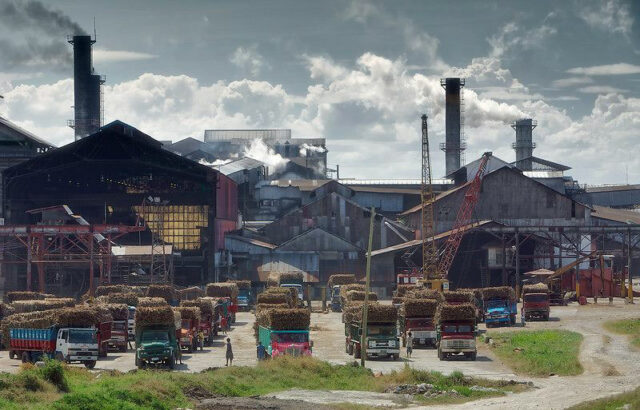
REFINED SUGAR output is now estimated to have dropped by 110,000 metric tons (MT) compared to production levels in the previous crop season to about 640,000 MT, with yields affected by early milling as well as unfavorable weather.

Sugar Regulatory Administration (SRA) Acting Administrator Pablo Luis S. Azcona said in a briefing that milling output will fall by a “significant amount.”

“Since the raw sugar mills closed early, the refineries that rely on the raw mills for fuel also closed early, so that’s where our significant drop came from. I estimate almost a 100,000 metric tons drop in refined production,” he said.

Mr. Azcona said sugar refiners require bagasse — a byproduct of sugarcane crushing — to run their equipment. Bagasse was in short supply because the cane harvest was disrupted by bad weather.

“Every time a sugar mill restarts, malaki ang nawawala (much is lost). When they run out of sugarcane, there’s nothing to mill and they have to stop. They (cannot keep) consuming fuel,” he said.

Actual sugar production was 750,000 MT in the previous crop year.

Mr. Azcona said a decision to further import sugar will await validation of sugar inventory levels.

“We are thinking of new imports. However, as promised to the President, we will conduct all the necessary inventories first and find out if our computations are accurate,” he said.

President Ferdinand R. Marcos, Jr., who is also the Secretary of Agriculture, has approved a recommendation by the SRA to import about 150,000 MT at most in response to forecasts of a supply shortfall.

Mr. Azcona said the supply of sugar is good until the end of August if no imports come in.

Separately, Mr. Azcona said he wants to impose a suggested retail price (SRP) for sugar, noting that some outlets are still retailing refined sugar for  P110 per kilogram, beyond the SRA’s target range of between P85 and P90.

“Personally, I’ve been suggesting an SRP. Even our superiors are saying that it should be P85,” he said.

As of Tuesday, the prevailing price of refined sugar in Metro Manila was between P86 and P110 per kilo. Brown sugar was between P82 and P95, and washed sugar P78 and P90. — Sheldeen Joy Talavera

Community opposition cited as top hurdle to starting energy projects

REUTERS

ENERGY executives in the Philippines cited “community opposition” as a major hurdle to implementing energy projects and expressed concerns that such frictions could potentially hinder the country’s transition to greener energy.

Research firm GHD, citing the results of a study, said 76% of Philippine energy industry leaders identified community opposition as among the “biggest barriers” in pursuing energy projects.

About 82% said energy security is their top concern, higher than the global average of about 75%, the study found.

The inability to initiate energy projects without encountering opposition at the project site may slow the transition to greener forms of energy, Lucas Blight, GHD’s technical director and Future Energy coordination lead for Asia-Pacific, said in a statement.

“The Philippines is facing a rapid energy transition and is charting a course into new energy territories with changing energy blends. As a net importer of energy, the Philippines is vulnerable to supply shocks.”

“Philippine leaders point to community opposition as being one of the biggest barriers to getting new energy projects that could help tackle the crisis approved and off the ground,” the report said.

It said any disruption to the global energy supply would leave many countries with over two months’ supply of fuel on average.

“There is a need for integrated solutions that provide energy security and reduce emissions at the same time as generating low-cost power to fuel continued economic growth. For example, many of the country’s islands are dependent on diesel generators — which can be progressively replaced with renewable micro-grids,” Mr. Blight said.

Recently, the National Power Corp. signed a partnership with the German-Philippine Chamber of Commerce and Industry to study the feasibility of green hydrogen and fuel cell technologies in off-grid areas. 

The study also found that half of the world’s energy industry executives consider their net-zero goals to have been delayed by about six years on average.

GHD said the study was based on a survey of 450 respondents who are senior energy industry decision-makers, with input from interviews of 10 industry thought leaders. — Ashley Erika O. Jose

DoE calls for fair treatment of poor countries in transition to green-energy technology

REUTERS

ENERGY Secretary Raphael P.M. Lotilla called on developed countries to ensure a “just” transition to green technology for poorer countries, citing the need for low-cost financing and technology transfers.

“We hope our development partners and countries like Sweden would assist us not only in making the private sector share technology and access to innovation, but also to assist the Philippines in terms of securing favorable financing that would allow us to build the necessary infrastructure,” Mr. Lotilla said at an energy forum the Department of Energy (DoE) co-organized with the Embassy of Sweden.

Mr. Lotilla said technology is constantly developing, leaving the government the task of selecting which tech is most suitable for the Philippines’ green energy transition.

“First of all, green transition for a developing country like the Philippines must be a just transition; it must be a fair transition and therefore we must avoid transferring the burden of climate transition to an already overburdened Philippine population,” he said. 

Mr. Lotilla said that aside from harnessing indigenous renewable energy resources, the Philippines must also turn to liquefied natural gas (LNG) as a transition fuel while evaluating the various forms of technology available.

“We have to take full advantage of all sources of energy that are currently in place and to use them in a wise manner. At the same time, we need to be able to transition to a cleaner environment. And this we address by making sure that the additional capacities that we need will be sourced from renewable and greener sources of energy,” Mr. Lotilla said. 

He said that the Philippines cannot as yet transition away from coal-fired power plants, though the government must prepare for coal-fired energy to be phased out eventually.

“There is no denying that we need them still. But we have placed them in a trajectory (in which), clearly, over time, they are going to be replaced.,” Mr. Lotilla said. — Ashley Erika O. Jose

Bain cites PHL potential as renewable leader given its rich resources

REUTERS

THE PHILIPPINES can become a leader in developing renewable energy (RE) due to the resources it has at its disposal, openness to foreign investment, and flexible grid network, consulting firm Bain & Co. said.

“We are seeing countries like Vietnam and the Philippines lead the way in deploying renewable energy and transforming their power generation systems in parallel,” it said in its Southeast Asia’s Green Economy 2023 report.

The report noted the Philippines’ “abundance of natural resources” for solar, wind resources, and battery components like nickel.

“Countries like Indonesia, Vietnam, the Philippines, and Thailand all have high energy demand and acceptable offtaker quality compared to less-developed SEA countries where local offtaker risk is high due to poor credit history,” Bain & Co. said.

The Philippines’ open market structure will also work in its favor, Bain & Co. said.

Last year, the government allowed 100% foreign ownership in renewable energy projects.

Bain & Co. also noted the Philippine grid’s flexibility in terms of accommodating renewable energy.

The report also noted that the Department of Energy is working on streamlining approvals for renewable energy permits, which would improve the ease of doing business.

On the other hand, Bain & Co. said that Southeast Asia remains “heavily dependent” on fossil fuels.

“Indonesia, Brunei, Malaysia, and the Philippines still subsidize some fossil fuel use,” it added.

Archipelagoes like the Philippines also face “complicated interconnection challenges.”

Bain & Co. estimated that under 3% of the Philippine and Indonesian populations still lack access to electricity.

The higher cost of capital will also make it difficult to bring in renewable energy projects, it said, noting that banks in the Philippines do not finance renewable energy projects from smaller developers.

Meanwhile, Bain & Co. said that the Philippines is “unlikely to be on track” to deliver its 2030 climate targets.

“(There is) some progress in decarbonization supported by the right incentives and regulatory frameworks,” it said.

“Nationally determined contribution (NDC) commitments are modest, the government supports grid infrastructure development, but more needs to be done for electric vehicles and nature,” it added.

It also noted the need for more inter-island grid connectivity and investment in renewables. — Luisa Maria Jacinta C. Jocson

Energy dep’t clarifies on-grid rollout procedures for renewables

THE Department of Energy (DoE) has issued new procedures to increase the share of renewable energy (RE) in on-grid facilities under the Renewable Portfolio Standards (RPS) scheme starting this year.

In separate department circulars, the DoE issued amendments to the RPS for both on-grid and off-grid areas, which were signed on May 23.

“This RPS, for on-grid, clarifies the implementation and then the enhancement… For off-grid, we totally revised the earlier version we issued in 2018,” Mylene C. Capongcol, Energy assistant secretary, told reporters on the sidelines of an energy forum on Tuesday.

Last year, the Energy department said on-grid power suppliers must expand the share of RE in their output to 2.5% starting in 2023 from the current 1%. 

The DoE also required off-grid participants to accelerate their green energy transitions by reducing their dependence on fossil fuels by hybridization or use of alternative technology.

For off-grid areas, Ms. Capongcol said the off-grid order covers Small Power Utilities Group (SPUG) facilities, new power providers, and qualified third parties.

“More than 90% (of off-grid facilities) are conventional diesel… by implementing the RE Act we will eventually reduce the subsidies from the universal charge for missionary electrification (UCME) and volatility in supply and prices,” Ms. Capongcol said. 

The National Power Corp. and the DoE have proposed raising the UCME to sustain off-grid services as diesel prices increase. 

Republic Act No. 9136 or the Electric Power Industry Reform Act authorizes the collection of UCME to fund Napocor’s operations, including those of its SPUG unit, which serves remote areas not connected to the grid.

Napocor said that to date SPUG currently operates 281 power plants which are mostly powered by diesel. — Ashley Erika O. Jose

Philippines stays off European IP watch list

PHILIPPINE STAR/JONATHAN ASUNCION

THE PHILIPPINES has stayed out of the European Commission’s intellectual property rights (IPR) watch list since last being listed in 2019, with officials touting the achievement as a mark of the country’s attractiveness as a potential investment destination.

“Our exclusion from the list from 2019 signifies that we remain an attractive investment destination to trade partners. We have come a long way in maintaining a safe IP climate in tune with global economic standards,” Rowel S. Barba, director general of the Intellectual Property Office of the Philippines (IPOPHL), said. 

The watch list is a biennial publication that identifies countries that pose a high level of concern to IP rights holders in the European Union.

Topping the list was China which was the sole country listed as “priority one” due to the “persistence of IP rights violations through piracy and counterfeiting, paired with inconsistent IPR law enforcement and application.”

In the priority two category are India and Turkey, while the priority three countries are Argentina, Brazil, Ecuador, Indonesia, Malaysia, Nigeria, Saudi Arabia and Thailand.

“We acknowledge that there is much more work to be done to ensure a clean and reliable marketplace for IP rights owners across all nations. Since our last mention as a priority three (country), we have doubled down our efforts to safeguard our investment attractiveness,” Mr. Barba said.

The IPOPHL reported a 40% decrease in reports and complaints on counterfeiting and piracy it received in the 11 months to November 2022. — Justine Irish D. Tabile