Home Blog Page 47

Philippines’ dollar reserves fall to 7-month low in March
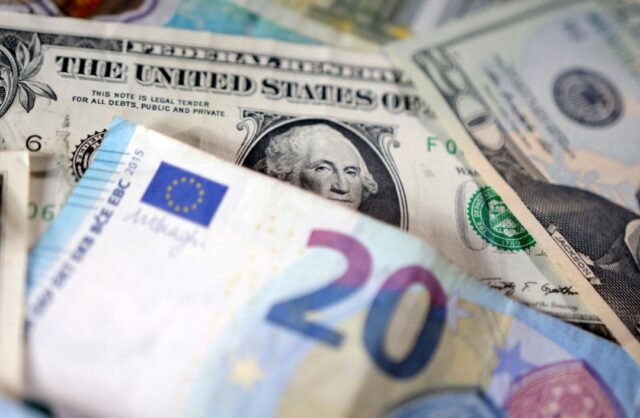
US dollar and euro banknotes are seen in this illustration taken May 4, 2025. — REUTERS/DADO RUVIC/ILLUSTRATION/FILE PHOTO

By Katherine K. Chan, Reporter

THE PHILIPPINES’ dollar reserves fell to a seven-month low at end-March as its gold holdings and foreign investments declined, preliminary Bangko Sentral ng Pilipinas (BSP) data showed. 

As of end-March, the country’s gross international reserves (GIR) stood at $107.512 billion, declining by 5.08% from the record-high $113.264 billion posted a month ago. 

This was the lowest GIR level in seven months or since the $107.098 billion seen in August last year.

However, this was 0.79% higher than the $106.67 billion recorded at end-March 2025. 

Still, the BSP said the end-March GIR level “provides a robust external liquidity buffer” as it equates to 7.1 months’ worth of imports of goods and payments of services and primary income, exceeding the three-month standard.

It could also cover about 4.1 times the country’s short-term external debt based on residual maturity, according to the BSP.

“The latest GIR level ensures availability of foreign exchange to meet balance of payments financing needs, such as for payment of imports and debt service, in extreme conditions when there are no export earnings or foreign loans,” the BSP said in a statement late on Tuesday.

Dollar reserves are the central bank’s foreign assets held mostly as investments in foreign-issued securities, foreign exchange and monetary gold, among others.

These are supplemented by claims to the International Monetary Fund (IMF) in the form of reserve position in the fund and special drawing rights (SDRs).

The country’s foreign reserves fell month on month in March as market volatility amid the Middle East war dampened foreign investments and as lower gold prices decreased the value of the gold holdings, Rizal Commercial Banking Corp. Chief Economist Michael L. Ricafort said.

“The monthly decline (was) largely due to lower foreign investments due to market volatility that reflected the adverse effects of the war on Iran (and) Middle East since Feb. 28, 2026 and also lower world gold prices that reflected the decline in gold holdings,” he said in a Viber message.

Based on BSP data, its gold holdings amounted to $20.177 billion at end-March, falling by 12.49% from the $23.057 billion at end-February as world gold prices edged down by 11.6% last month. Year on year, it jumped by 58.09% from $12.763 billion.

Its foreign investments also slipped by 3.92% to $80.9 billion from $84.205 billion in the previous month and by 9.02% from $88.924 in the same period last year.

Meanwhile, the Philippines’ reserve position in the IMF slid to $714.3 million as of end-March, 1.67% lower than the $726.4 million logged in the prior month. However, it edged up by 9.39% from $653 million a year earlier.

SDRs — or the amount the Philippines can tap from the IMF’s reserve currency basket — were unchanged month on month at $3.964 billion. It climbed by 4.18% annually from $3.805 billion a year ago.

Central bank data also showed that the country’s foreign exchange holdings reached $1.757 billion during the period, up by 33.93% from $1.312 billion at end-February. It more than tripled (234.64%) from $525.1 million as of end-March 2025.

In the coming months, GIR could rise as global gold prices climb and market conditions recover, especially if the Middle East war continues to de-escalate, Mr. Ricafort said.

He added that the peso’s recent rebound from record lows last month could also support the GIR as it “could reduce the need for intervention in the local foreign exchange market.”

In March, the local unit touched the P60-a-dollar level for the first time. It closed at a new all-time low of P60.748 against the greenback on March 31.

The BSP has said that it remains present in the foreign exchange market to prevent sharp movements that could be inflationary.

It uses the country’s foreign reserves by releasing US dollar liquidity when intervening in the foreign exchange market amid episodes of peso depreciation.

The BSP expects foreign reserves to settle at $111 billion by end-2026.
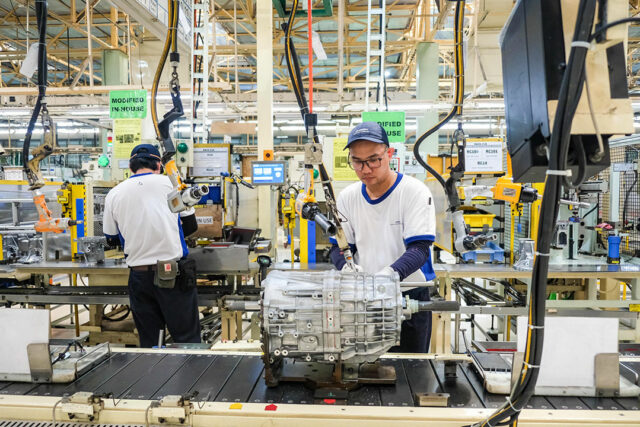
RACE program abandoned; incentive focus shifts to EVs

PHILSTAR FILE PHOTO

By Beatriz Marie D. Cruz, Senior Reporter

THE Department of Trade and Industry (DTI) said it is dropping the Revitalizing the Automotive Industry for Competitiveness Enhancement (RACE) program to focus its efforts on providing incentives to electric vehicles (EV) makers.

“The CARS (Comprehensive Automotive Resurgence Strategy) program is already finished, so we focused on EVs,” Trade Secretary Ma. Cristina A. Roque told reporters on the sidelines of the DTI National Food Fair on Wednesday.

RACE had sought to provide fiscal support of P9 billion for the domestic manufacture of three specific four-wheel models powered by internal combustion engines (ICE) if the makers produce 100,000 units each. They represented an easing of the quota from the 200,000-unit quota of CARS.

The DTI had expressed hopes to release the Electric Vehicle Incentives Strategy by the second quarter. The program seeks to allow the government to provide competitive fiscal and non-fiscal support to boost the EV supply chain.

“We’re still trying to fix everything but we’re hoping to release it soon, especially with the situation today,” Ms Roque said.

The government is looking to focus on attracting EV manufacturers to the Philippines as rising oil prices caused by the Iran war boost the attractiveness of EVs as an alternative to ICE vehicles.

The Department of Finance said on Monday that Mitsubishi Motors Corp. is planning to establish a dedicated hybrid electric vehicle manufacturing facility within the Mitsubishi Motors Philippines Corp. plant in Santa Rosa, Laguna.

“For now, wala nang RACE,” Ms. Roque said.

Launched in 2015, the CARS program sought to provide tax incentives to three car companies that domestically produced at least 200,000 units between 2018 and 2024.

President Ferdinand R. Marcos, Jr. vetoed P4.32 billion in unprogrammed appropriations meant for the CARS program and P250 million for the RACE program.

Car sales are expected to breach 500,000 units this year, featuring strong demand for EVs and multi-purpose vans, the Chamber of Automotive Manufacturers of the Philippines, Inc. said in January.

Jobless rate declines to 2-month low in Feb.

PHILIPPINE STAR/EDD GUMBAN

By Pierce Oel A. Montalvo, Researcher

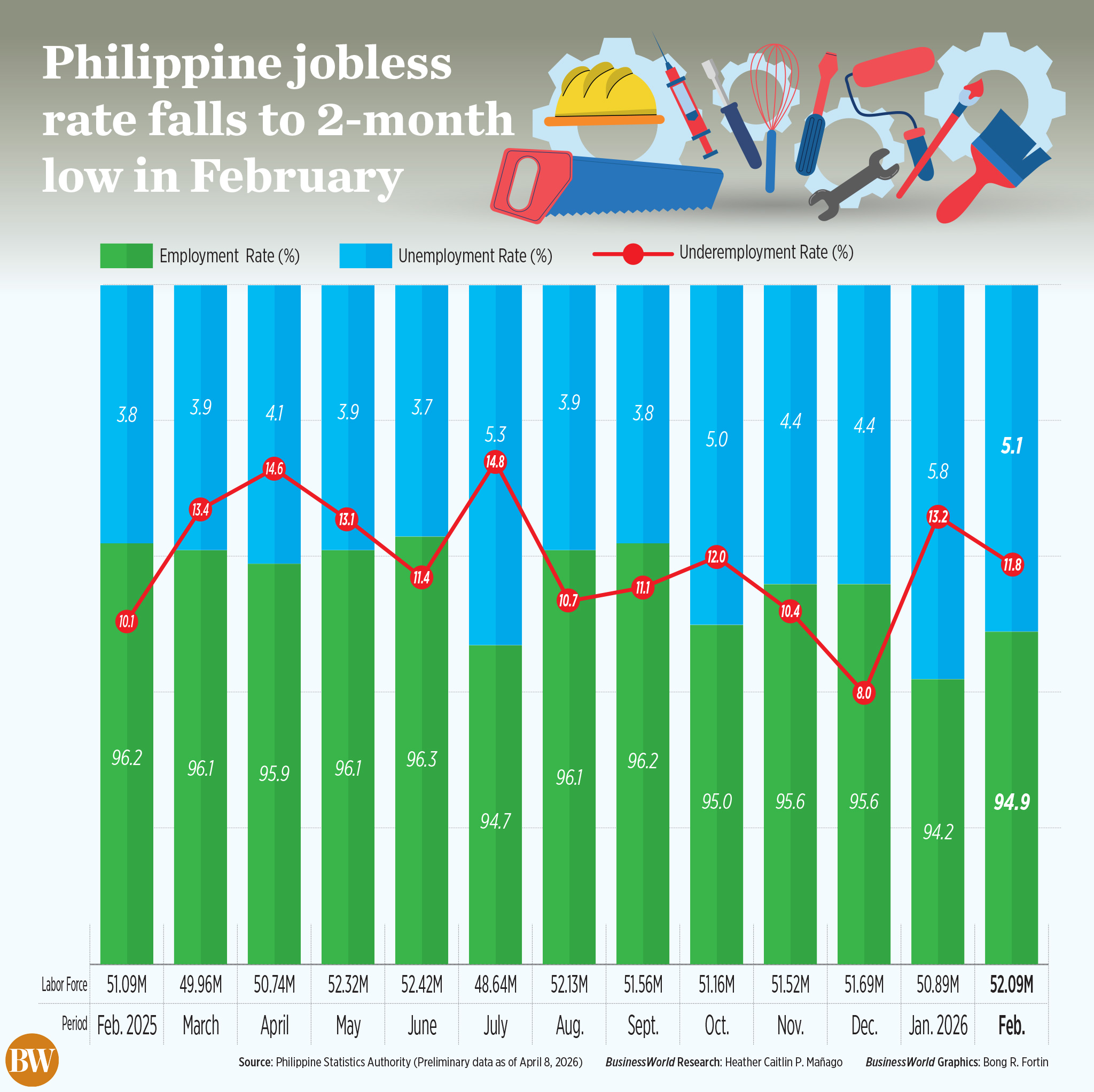
THE unemployment rate fell to a two-month low of 5.1% in February, reflecting the seasonal first-quarter trend of workers re-entering the labor market, the Philippine Statistics Authority (PSA) said on Thursday.

Citing preliminary data from the Labor Force Survey, the PSA said the jobless rate was down from the 5.8% rate posted a month earlier but exceeded the 3.8% reading in the same period last year.

February unemployment was the lowest  since the 4.4% reported in December. This was equivalent to 2.66 million jobless in February.

National Statistician Claire Dennis S. Mapa said that the increase in the labor force caused unemployment to inch down on a month-on-month basis, as more applicants found work during the period.

“For the first two months, our average is at 51.49 million versus 50.87 million. So, it’s roughly 600,000. There’s an increase if you’re talking about the first two months of 2026, compared to the first two months of 2025,” Mr. Mapa said at a briefing.

A total of 52.09 million workers aged 15 and up were in the labor force during the month, against the 51.09 million a year earlier and the 50.89 million a month earlier.

This translates to a labor force participation rate of 63.8%, lower than the 64.5% posted in February 2025 but higher than the 62.3% million in January.

“February historically sees labor market re-entry as Q1 economic activity resumes — early construction projects, inter-island trade, and government disbursements pick up,” Leonardo A. Lanzona, an economics professor at Ateneo de Manila, said via chat.

He added that the headline jobless rate should be read cautiously with respect to job quality.

The underemployment rate — the share of workers with jobs but are seeking more hours — was at 11.8%, up from the 10.1% in the same month last year, but lower than the 13.2% in the previous month.

“Notably, the underemployment rate in January stood at 13.2%… suggesting that part of the February improvement may reflect people moving from ‘unemployed’ to ‘underemployed’ rather than securing full, quality employment,” Mr. Lanzona added.

About 5.84 million individuals were considered underemployed in February 2026, higher than the 4.96 million a year earlier, but lower than the 6.35 million in January 2026.

The employment rate was 94.9%, lower than the 96.2% posted in February 2025, but higher than the 94.2% in January.

Jobholders numbered 49.43 million during the month, higher than the year-earlier 49.16 million and the 47.94 million in January.

Year on year, the wholesale and retail trade lost 725,000 jobs, the most among subsectors during the month, ahead of agriculture and forestry (-523,000) and construction (-484,000).

Benjamin B. Velasco, an assistant professor at the University of the Philippines Diliman School of Labor and Industrial Relations, said the decline in agriculture and construction is a result of the headwinds posed by climate change and the flood control corruption scandal.

He added that the rise in unemployment in wholesale and retail is “worrying,” given how it typically absorbs workers easily.

“If Filipinos are unable to find livelihood in a sub-sector with low barriers to entry, then it is a symptom of economic malaise,” Mr. Velasco said via chat.

The administrative and support activities subsector meanwhile led all sectors in job growth, adding 572,000 jobs, followed by transportation and storage (486,000) and accommodation and food service activities (357,000).

Month on month, public administration and defense lost 336,000 jobs in February, followed by professional, scientific and technical activities (-97,000) and administrative and support activities (-69,000).

On the other hand, wholesale and retail trade gained 658,000 jobs, with agriculture and forestry (380,000) and accommodation and food service activities (361,000) close behind.

63.8% of the employed are wage and salary workers, followed by the self-employed without paid employees (27.4%). Among wage and salary workers, 50.1% were employed by private establishments, while the government employed 8.9%.

“The labor market has begun to show early signs of weakness at the start of 2026, reflecting the lingering effects of last year’s economic slowdown,” Chinabank Research said in a research note.

It added that the impact of the recent oil price shock has yet to be captured, with conditions expected to deteriorate from March onward as transport and logistic workers remain vulnerable to the effects of the Persian Gulf conflict.

Any oil price drops in the wake of the recent two-week ceasefire declared by the US could alleviate job losses.

“If this price decline persists, alongside a strengthening peso, domestic pump prices could ease as well, providing some relief to business and consumers alike.”

Mr. Velasco said the impact of the US-Israel war on Iran will be a crucial factor in employment challenges in the next few months.

“For example, jeepney drivers and operators may stop working which will have multiplier effects on street vendors and small shops which cater to them.”

However, he said that a crisis can be turned into an opportunity.

Meanwhile, Josua T. Mata, secretary-general of Sentro ng mga Nagkakaisa at Progresibong Manggagawa, said via Viber that the conflict could have direct consequences to the job economy, “even if the ceasefire holds.”

“Today’s crisis makes such action not just necessary, but urgent — an essential pillar of any serious economic response. Yet the government continues to stonewall. “

Economy Secretary Arsenio M. Balisacan said that the conflict will continue to affect global economic conditions and disrupt labor markets.

He said “recent developments highlight the urgency to strengthen the resilience of our labor market.”

“We must ensure that our policies and programs respond effectively to rapidly changing global conditions, especially for affected and displaced Filipino workers here and abroad,” Mr. Balisacan said.

Mr. Lanzona said that in the following months, unemployment could drift to the 7-9% range, “above the post-pandemic recovery floor of roughly 5%.”

“For context, even at the height of COVID lockdowns in February 2021, unemployment stood at 8.8%, or 4.2 million people. The current external shock would have to escalate substantially beyond its present state to reach even that level.”

Elevated fuel prices seen remaining after US pauses hostilities in Iran

PHILIPPINE STAR/BOY SANTOS

By Sheldeen Joy Talavera, Reporter

THE two-week truce initiated by the US in its conflict with Iran could help ease global oil prices, but the impact is unlikely to be felt at the Philippine pump-price level anytime soon, as market volatility is expected to persist, analysts said.

“The de-escalation of the tensions arising from the ceasefire in the Middle East will  result in a significant unwinding of the war premium that was incorporated into prices and has built up due to the conflict,” Leo P. Bellas, president of Jetti Petroleum, Inc., told BusinessWorld.

Mr. Bellas said the potential de-escalation can lead to a sharp decline at the crude oil and refined fuel levels, but added that prices “will likely remain elevated because the supply situation has not changed.”

He said that next week, pump prices could take a break from their run of increases, and might instead stay level or even fall following the decline in the Mean of Platts Singapore, a benchmark for Singapore-refined petroleum products.

“But markets may bounce back in day or two after digesting the extent of the current damage to infrastructure and lead time to restore production and exports, and after an assessment of the strength or fragility of this declared ceasefire,” Mr. Bellas said.

In a social media post on Tuesday, US President Donald J. Trump said he has agreed to suspend attacks against Iran for two weeks after talks with Pakistan Prime Minister Shehbaz Sharif and Field Marshal Asim Munir, who help mediate the ceasefire.

This superseded Mr. Trump’s deadline for Tehran to reopen the Strait of Hormuz, a strategic waterway and critical chokepoint that handles a significant share of global crude shipments.

“Hopefully the market will quickly react positively to lower the price,” Jose M. Layug, a former Energy undersecretary and executive board member of the Philippine Energy Research & Policy Institute, told BusinessWorld.

“WTI (West Texas Intermediate) and Brent benchmarks are now below $100/bbl after the announcement. I am hoping Dubai crude oil will also go down from its current level,” he added.

Bri-gitte Car-mel C. Lim, senior vice-pres-id-ent and chief oper-at-ing officer of Top Line Busi-ness Devel-op-ment Corp., a Cebu-based fuel distributor, said that while the ceasefire can help ease global oil prices, it could be temporary and volatility will likely remain.

Ms. Lim said global price movements will likely be reflected at the pumps after one to two weeks.

“Prices will still depend on how the situation develops in the coming weeks,” she told BusinessWorld.

In a briefing on Tuesday, Energy Secretary Sharon S. Garin said she does not expect oil prices to go down anytime soon even if the Strait of Hormuz is reopened as the war already has done extensive damage to energy infrastructure in the Middle East.

“The speed of the increase in pump prices will not be the same as the drop in prices. In fact, it will be way, way slower because the damage caused goes beyond the war,” she said.

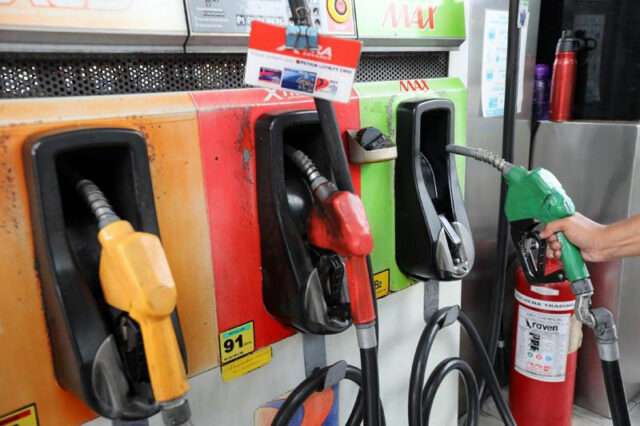
For this week, oil companies have implemented another set of fuel price increases at the pumps, ranging from P15-P19.80 per liter for diesel and P1.50-P5.90 per liter for gasoline.

Since the US and Israel attacked Iran on Feb. 28, the increases in diesel prices have totaled P100.05 per liter, while gasoline and kerosene surged by around P52.30 and P82.40 per liter, respectively.

“This is by far the fastest and the highest increase of our oil prices and that’s due to the war in the Middle East,” Ms. Garin said.

Common Station completion target set at Q2 2027

DEPARTMENT OF TRANSPORTATION

THE Department of Transportation (DoTr) said it hopes to complete the Unified Grand Central Station at North Avenue-EDSA in Quezon City by the second quarter of next year, with negotiations progressing with the Light Rail Manila Corp. (LRMC).

“Once this common station becomes operational, we are expecting 1.5 million passengers daily. We are hoping to have this finished by the second quarter of 2027,” Transportation Acting Secretary Giovanni Z. Lopez told reporters on the sidelines of Management Association of the Philippines (MAP) General Membership Meeting on Wednesday.

Last year, the DoTr issued a notice  of termination to the contractors of the Unified Grand Central Station, also known as the common station for the Metro Rail Transit (MRT) and Light Rail Transit (LRT) lines and the Metro Manila Subway.

The contractors — BF Corp. and Foresight Development and Surveying Co. (BFC-FDSC) — were handed termination notices due to excessive delays.

“There was a delay here in the common station. So we have to talk to LRMC and Sumitomo Corp. to take over the construction of the common station,” Mr. Lopez said. 

LRMC had submitted an unsolicited proposal to finish the terminated contract.

The DoTr is now working with the Department of Economy, Planning, and Development-Investment Coordination Committee (DEPDev-ICC) on the new costing of the project.

“We are really targeting (to finish) this by the second quarter of 2027. For the simple reason that the partial operations of MRT-7 will start by the second quarter of next year,” Mr. Lopez said, adding that the common station project is now 67.98% complete.

The BFC-FDSC consortium signed a P2.8-billion agreement with the government in 2019 for the construction of Area A of the Unified Grand Central Station project.

It was initially targeted for completion in the first quarter of 2021 and was designed to have three sections, each built separately: Area A by BFC-FDSC, Area B by Ayala Corp., and Area C by San Miguel Corp., the concessionaire for the MRT-7 project.

LRMC is a joint venture of Ayala Corp., Metro Pacific Light Rail Corp., and Macquarie Infrastructure Holdings (Philippines) Pte Ltd. Metro Pacific Light Rail is a unit of Metro Pacific Investments Corp., one of three Philippine subsidiaries of Hong Kong’s First Pacific Co. Ltd., the others being PLDT Inc. and Philex Mining Corp. — Ashley Erika O. Jose

WESM spot prices rise in March

BW FILE PHOTO

PRICES on the Wholesale Electricity Spot Market (WESM) rose in March, with Luzon experiencing a surge of over 50% due to eroding supply margins, according to the Independent Electricity Market Operator of the Philippines (IEMOP).

The IEMOP reported that the average WESM price rose 23% month on month to P4.31 per kilowatt-hour (kWh).

There was a “slight decrease in the overall system supply and an increase in the system demand,” Arjon B. Valencia, manager for corporate planning and communications at IEMOP, said at a briefing on Wednesday.

Between Feb. 26 and March 25, the available supply decreased 1.3% to 14,103 megawatts (MW). Demand increased 4.7% to 13,383 MW.

Luzon was the only region posting increase, with spot prices rising 52.5% to P4.10 per kWh, following forced plant outages that dried up supply, which fell 1.3% to 14,103 MW. Demand rose 4.7% to 9,016 MW.

WESM prices in the Visayas declined 5.4% month on month to P5.08 per kWh.

Supply rose 10.4% to 2,492 MW, outpacing the 3% increase to 1,885 MW in demand.

Despite the decline in the Mindanao supply of 3.8% to 3,318 MW, imports of electricity from other grids led to a lower spot price average of P4.43 per kWh, against P5.25 per kWh a month earlier.

IEMOP operates the WESM, where energy companies can purchase power when their long-term contracted power supply is insufficient for customer needs.

The market operator previously projected WESM prices to climb to as high as P9 per kWh as a result of the Middle East conflict.

Isidro E. Cacho, Jr., IEMOP vice-president for trading operations, said the potential increase had been mitigated by the WESM suspension and the modified administered pricing mechanism implemented by the Energy Regulatory Commission on March 26.

“I think it’s a very good policy action from our regulator and policymakers to help avert issues and essentially stabilize market prices, which will eventually be reflected in the price we see on our electricity bills,” Mr. Cacho said.

In a statement, the Energy Regulatory Commission (ERC) said the modified administered pricing will remain in effect until its lifts the WESM suspension.

Under the modified administered pricing mechanism, prices will be based on prevailing fuel costs, replacing the use of historical market prices that do not reflect current conditions marked by geopolitical tensions and fuel supply constraints.

“We will continue to closely monitor market conditions and implement timely measures to protect consumers while ensuring the stability and adequacy of our power supply,” ERC Chairman and Chief Executive Officer Francis Saturnino C. Juan said. — Sheldeen Joy Talavera

EO authorizing P50 cap on imported rice pending

REUTERS

THE Department of Agriculture (DA) said it is awaiting an executive order (EO) that will impose a P50-per-kilo price cap on imported rice, and hopes it will be issued before the end of the month.

Agriculture Secretary Francisco P. Tiu Laurel, Jr. said President Ferdinand R. Marcos, Jr. has expressed support for the proposed measure.

“I am hopeful that before the end of the month, (the EO) will be issued,” Mr. Laurel told reporters on the sidelines of the Department of Trade and Industry’s (DTI) National Food Fair in Mandaluyong City on Wednesday.

He said the proposal “took time” as it had to go through the National Price Coordinating Council (NPCC) and several consultation rounds.

Mr. Laurel said the DTI is currently working on a final proposal and will transmit it to the Palace by Monday at the latest.

The DA said the proposed price intervention is limited to imported rice for now, citing evidence of profiteering in the import trade.

“For other commodities, it will depend. If there is profiteering, then yes, we will implement a price cap. If there is no profiteering and that is the actual value along the supply chain, we will not impose a price cap,” he said.

The NPCC earlier endorsed the DA’s proposal to set a P50-per-kilo ceiling on imported rice for an initial 30-day period.

Last month, the council said it will recommend the issuance of an executive order to “ensure affordable rice for consumers while maintaining market stability.” — Vonn Andrei E. Villamiel

PHL 2025 GDP growth left unrevised at 4.4%

PHILIPPINE STAR/JOHN RYAN BALDEMOR

ECONOMIC GROWTH in 2025 was left unrevised at 4.4%, the Philippine Statistics Authority (PSA) said on Wednesday.

It said the gross domestic product (GDP) was as initially reported on Jan. 29.

It was the weakest reading since the 9.5% contraction in 2020, at the height of the pandemic.

The 2024 GDP growth estimate was also unrevised at 5.7%.

The PSA said the fourth quarter 2025 GDP growth reading remained at 3%.

The fourth quarter reflected the full impact of the infrastructure corruption scandal, which had bogged down government spending because of extensive reviews on project disbursements. A year earlier, growth had been 5.3%, while the third-quarter reading was 4%.

The PSA also maintained its estimate for growth in gross national income (GNI), the sum of the nation’s GDP and net primary income from the rest of the world, at 6.1% in 2025 and 7.7% in 2024.

For the fourth quarter of 2025, GNI was raised to 4% from the 3.9% preliminary estimate.

In 2025, estimates for agriculture growth were left unrevised at 3.1%.

The industry sector’s expansion was upgraded to 1.7% from the 1.5% preliminary figure.

On the other hand, growth on the services sector was revised downwards to 5.8% from the 5.9% initially reported.

“Upward revisions for 2025 were noted in: construction (0.1% from minus 0.2%), electricity, steam, water and waste management, (0.8% from 0.2%), and information and communication, (4% from 3.6%),” the PSA said.

Downward revisions were recorded in public administration and defense; compulsory social security, (6.8% from 8%), education, (7.8% from 8.4%) and transportation and storage (6.7% from 6.8%).

For the fourth quarter,  growth of the industry sector was revised to a 0.3% decline from the 0.9% drop previously reported.

During the same period, the PSA downwardly revised the growth of the services sector to 4.9% from the 5.2% preliminary estimate.

Agriculture growth, on the other hand, was maintained at 1%.

The PSA upwardly revised the growth rates of the following industry subsectors: manufacturing (1.8% from 1.6%), construction (minus 6% from minus 7.1%), and electricity, steam, water and waste management (0.8% from minus 1.6%).

The estimate for mining and quarrying, on the other hand, was lowered to 5.1% from 5.3%.

On the expenditure side, the estimate for growth in government spending was lowered to 8.4% in 2025 from the 9.1% preliminary reading.

Household consumption growth was also revised downwards to 4.5% from the 4.6% initially reported on Jan. 29.

For the last three months of 2025, the household consumption estimate was unchanged at 3.8%. Meanwhile, government spending growth was lowered to 0.7% from the 3.7% initially reported.

For the trade in goods and services, the PSA revised import growth in 2025 to 5% from the 5.1% preliminary reading.

Export growth was raised to 8.2% from the initially reported 8.1%.

For the fourth quarter, export growth was upwardly revised to 13.3,%from the 13.2% preliminary estimate.

Import growth, on the other hand, was downwardly revised to 3.2% from 3.5% initially.

Gross capital formation, the investment component of the economy, fell 1.7% against the decline of 2.1%  estimated initially.

For the fourth quarter, investments dropped 9.4%, against the previously reported 10.9% decline. — Abigail Marie P. Yraola

Supply diversification must continue even after pause in Iran fighting — MAP

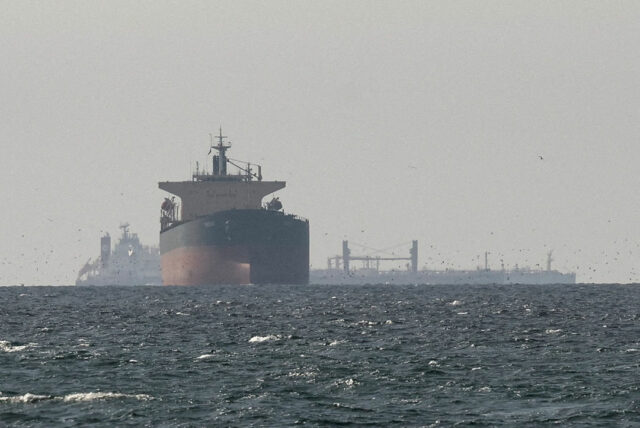
Tankers sail in the Gulf, near the Strait of Hormuz, as seen from northern Ras al-Khaimah, near the border with Oman’s Musandam governance, amid the US-Israeli conflict with Iran, in United Arab Emirates, March 11, 2026. — REUTERS

PHILIPPINE ORGANIZATIONS should continue diversifying their sources of supply and improving their energy efficiency following the US declaration of a ceasefire in Iran, the Management Association of the Philippines (MAP) said.

“MAP welcomes the temporary ceasefire among the US, Israel, and Iran, as any easing of tensions in the Middle East is positive for global markets and for Philippine businesses,” MAP President Donald Patrick L. Lim said via Viber.

“The immediate effect may be some relief in oil prices, the peso, and business sentiment, which could help moderate inflationary pressures and reduce uncertainty for companies,” he noted.

Despite this, business must remain ready for volatile fuel and logistics costs going forward, Mr. Lim said.

“For Philippine firms, this is a reminder to strengthen contingency plans, diversify supply sources, and improve energy efficiency while the situation remains fluid,” Mr. Lim said.

The US declared a two-week ceasefire Tuesday, which is expected to reduce the risks associated with transiting the Strait of Hormuz.

According to the Department of Energy, the price of diesel and gasoline could hit P172 per liter and P120 per liter, respectively, after major oil companies on Monday announced a fresh round of hikes beginning April 7. — Beatriz Marie D. Cruz

Foreign chambers bat for cloud-computing investment to facilitate e-government 

FREEPIK

THE Joint Foreign Chambers (JFC) of the Philippines called for increased investment in cloud computing  to further streamline the delivery of public services.

In a statement on Wednesday, the groups said they support the shift to e-governance to modernize public administration and boost the Philippine competitiveness.

They expressed support for the Department of Information and Communications Technology (DICT) following the newly-issued Implementing Rules and Regulations (IRR) of Republic Act No. 12254, or the E-Governance Act of 2025.

They noted that investing in cloud-driven governance would align with the goals of the IRR.

“While we foresee positive outcomes, one area that could benefit from further strengthening is with respect to cloud computing,” the groups said.

Cloud computing to facilitate the delivery of information technology (IT) services like software, analytics, and database, would form the “backbone” of digital transformation, the JFC said.

“Building on the foundations laid out in the newly issued IRR, there are opportunities to further strengthen cloud-enabled governance in ways that also support ease of doing business, reduce administrative burdens, and enhance regulatory predictability,” they noted.

“We view these areas as opportunities to enhance legal certainty and the durable implementation of the law,” the groups added.

The Philippine cloud services market is projected to hit $7.88 billion in value by 2032, according Data Bridge Market Research.

The JFC is composed of the American Chamber of Commerce of the Philippines, Australian-New Zealand Chamber of Commerce of the Philippines, Canadian Chamber of Commerce of the Philippines, European Chamber of Commerce of the Philippines, Japanese Chamber of Commerce and Industry of the Philippines, Inc., Korean Chamber of Commerce Philippines, Inc., and the Philippine Association of Multinational Companies Regional Headquarters. — Beatriz Marie D. Cruz 

Gulf situation still unpredictable; no certainty fuel prices will fall, DoE’s Garin says

Smoke rises after reported Iranian missile attacks, following strikes by the United States and Israel against Iran, in Manama, Bahrain, February 28, 2026. — REUTERS/STRINGER TPX IMAGES OF THE DAY

THE situation in the Persian Gulf remains unpredictable despite the US ceasefire declaration, with no certainty that fuel prices will stop rising, Energy Secretary Sharon S. Garin told House legislators.

Ms. Garin said at a joint committee meeting on Wednesday that while a two-week ceasefire is in place, it is highly conditional, making it less certain it will be honored.

“Will (fuel prices) go up to (P200 per liter)? Honestly, I don’t know and I don’t think anybody knows yet because like mentioned earlier, there was a pronouncement of a ceasefire, but threats (continue to) go back and forth,” Ms. Garin said.

“Whenever oil infrastructure is destroyed in whatever country, the price spikes… We don’t have any visibility on where this will go. Unfortunately, we are so dependent on what’s happening there,” she said.

She added that even if the war were to stop immediately, it might be several months before Gulf supply resumes its regular flow because of destruction to infrastructure, including liquefied natural gas facilities (LNG) in Qatar — and structural changes in the industry.

Economy Secretary Arsenio M. Balisacan has projected a severe, prolonged-conflict scenario that could elevate inflation to between 5.9% and 6.8% in 2026.

To mitigate these impacts, legislators are pressing for the suspension of fuel excise taxes, which Ms. Garin noted accounts for approximately 20% of the total pump price when combined with value-added tax.

Excise tax adjustments are a pillar of the UPLIFT framework (Unified Package for Livelihoods, Industry, Food and Transport) laid down in Executive Order No. 110, issued to guide the government’s crisis response .

Finance Undersecretary Karlo Fermin S. Adriano confirmed that a recommendation on excise tax relief has been submitted to the President but awaits approval.

“With regard to the suspension or reduction of excise taxes, I cannot discuss it yet because it’s still subject to Presidential approval,” Mr. Adriano said.

As the crisis evolves, energy officials are advocating for a “hybrid” approach to oil deregulation.

Ms. Garin told legislators that while deregulation may work in normal times, “a certain degree of regulation when it is needed, I think it is necessary.”

Proposed amendments to the Oil Deregulation Law would grant the government authority to cap profits or intervene during national emergencies when global oil reaches specific “triggers,” such as an $80 per barrel threshold. — Erika Mae P. Sinaking

Ban on poultry imports from US state of Illinois reimposed

TAWATCHAI07-FREEPIK

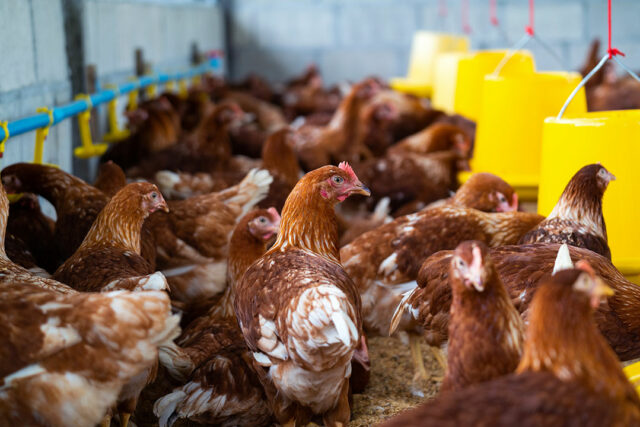
THE Department of Agriculture (DA) said it has reimposed a ban on poultry and poultry-product imports from the US state of Illinois following confirmed outbreaks of avian influenza.

In Department Circular No. 15, the DA said an official report submitted by the Animal and Plant Health Inspection Service on March 9 confirmed multiple outbreaks of H5N1 highly pathogenic avian influenza (HPAI) affecting domestic birds in Illinois.

“The rapid spread of HPAI in the US in a short period of time since its first laboratory detection necessitates a wider coverage of trade restriction to prevent the entry of the HPAI virus and protect the health of the local poultry population,” the DA said.

The ban covers domestic and wild birds and their products, including poultry meat, day-old chicks, eggs, and semen from Illinois.

It also suspended the processing and issuance of sanitary and phytosanitary import clearances for these commodities and revoked previously approved permits for live-bird imports.

The DA said a 2016 agreement between Philippine and US veterinary authorities allows a state-wide ban on poultry imports to be triggered if at least three counties in a state are affected by HPAI.

The DA had lift the temporary ban on Illinois poultry imports in February, after animal health reports at the time indicated that the state no longer met the threshold for state-wide trade restrictions. — Vonn Andrei E. Villamiel

ADVERTISEMENT
ADVERTISEMENT