Home Blog Page 4676

Dutch court rules sultan’s heirs cannot seize Malaysian assets

 – A Dutch court of appeal dismissed on Tuesday a bid by eight descendants of a former sultanate to enforce a $15-billion arbitration award against the Malaysian government, which hailed the decision as a “landmark victory”.

Prime Minister Anwar Ibrahim said the government was confident it was “closer than ever to completely nullifying” the award after the decision.

“Malaysia trusts that today’s decision … will put an end to the frivolous attempts of the claimants to enforce the purported final award in other jurisdictions,” Anwar said in a statement.

Last year, a Paris arbitration court awarded $14.9 billion to the Filipino heirs of the last sultan of Sulu, in a long-running dispute with Malaysia over a colonial-era land deal.

They have since sought to seize Malaysian government assets in France, Luxembourg and the Netherlands, in a bid to enforce the award.

Malaysia, which did not participate in the arbitration, says the process is illegal. It secured a stay on the award in France but the ruling remains enforceable overseas under a UN treaty on arbitration.

In September, the heirs sought permission from a Dutch court to enforce the award in the Netherlands, Reuters reported.

However, Dutch judges sided with Malaysia, saying the original pact lacked a clause binding parties to arbitration and the French stay meant the claim was not enforceable in the Netherlands, the court said on its website on Tuesday.

Lawyer Paul Cohen, acting for the Sulu heirs, said they were disappointed with the court decision. He would not say if they would lodge an appeal against the ruling.

The dispute stems from an 1878 deal between European colonists and the Sultan of Sulu for use of his territory, which spanned parts of the southern Philippines and present-day Malaysia on the island of Borneo.

Independent Malaysia paid a token sum annually to the sultan’s heirs to honor the agreement but stopped in 2013, after supporters of the former sultanate launched a bloody incursion to reclaim land from Malaysia.

The heirs say they were not involved in the incursion and sought arbitration over the suspension of payments.

This month, a Paris court upheld the Malaysian government’s challenge against enforcing a partial award to the heirs. Malaysia said the decision implied the final arbitration award would be annulled. – Reuters

Over $200 billion potentially stolen from US COVID relief programs, watchdog says

STOCK PHOTO | Image by Isabella Fischer from Unsplash

– Over $200 billion from the US government’s COVID-19 relief programs were potentially stolen, a federal watchdog said on Tuesday, adding that the US Small Business Administration (SBA) had weakened its controls in a rush to disburse the funds.

At least 17% of all funds related to the government’s coronavirus Economic Injury Disaster Loan (EIDL) and Paycheck Protection Program (PPP) schemes were disbursed to potentially fraudulent actors, according to a report released Tuesday by the SBA’s office of inspector general.

Over the course of the pandemic, the SBA disbursed about $1.2 trillion of EIDL and PPP funds.

The SBA disputed the more than $200 billion figure put forward by the watchdog and said the inspector general’s approach had significantly overestimated fraud.

The agency said its experts put the potential fraud estimate at $36 billion and added that over 86% of that likely fraud took place in 2020, when the administration for former President Donald Trump was in office. President Joe Biden took office in January 2021.

The fraud estimate put forward by the inspector general for the EIDL program stood at more than $136 billion while the PPP fraud estimate was $64 billion.

The United States is probing many fraud cases pegged to US government assistance programs. In May 2021, Attorney General Merrick Garland launched a COVID-19 Fraud Enforcement Task Force.

Last year, the US Justice Department tapped federal prosecutor Kevin Chambers to lead its efforts to investigate alleged fraud schemes intending to bilk government pandemic assistance programs.

In September 2022, the inspector general for the US Labor Department said fraudsters likely stole $45.6 billion from the United States’ unemployment insurance program during the coronavirus outbreak by applying tactics like using Social Security numbers of deceased individuals.

Also in September, federal prosecutors charged dozens of defendants, who were accused of stealing $250 million from a government aid program that was supposed to feed children in need during the pandemic.

Earlier this year, a separate watchdog report said the US government likely awarded about $5.4 billion in COVID-19 aid to people with questionable Social Security numbers. – Reuters

Hong Kong film-makers say censorship law spooks investors, actors

STOCK PHOTO | Image by Marko Bukorovic from Pixabay

 – Two years after screening an internationally acclaimed documentary on the democracy movement in Hong Kong, director Kiwi Chow has been forced to complete a new movie with fresh financing after political concerns scared off some investors.

The fears spiked after Hong Kong adopted a new censorship law in October 2021 to bar films that “might endanger national security”, but directors say they now face difficulties lining up funding and even actors, while others have shifted overseas.

Actors under the Hong Kong film companies are very afraid, and this fear shadows everything,” said Chow, who felt the situation had made performers, and investors, apprehensive about crossing ill-defined “red lines” concerning national security.

“This is what makes it scary, it doesn’t need to suppress you directly, but it has already made all these people scared,” he added.

Chow, feted at the Cannes film festival in 2021 for his documentary, “Revolution of Our Times”, said it was clear when the new law came in that film makers would have to steer clear of political topics.

But he did not realize then that people would be so risk-averse, even if he had not been found guilty of anything.

The censorship measure, which follows a national security law China imposed on the Asian financial hub in 2020, means directors now need to steer clear of some topics to avoid putting investors and actors at risk, some filmmakers said.

At least 21 movies and short films have had scenes cut or their release blocked by Hong Kong‘s Office for Film, Newspaper and Article Association (OFNAA) since October 2021, a Reuters tally showed.

In an email statement, the office said it had processed about 5,000 applications for film classification since January 2021, denying approval for public exhibition to six of them.

But it declined to comment on individual films.

Since 2005, the former British colony has injected HK$1.54 billion into the Film Development Fund. But in February, its culture secretary, Kevin Yeung, warned that funds would not be allocated to film projects that might infringe the 2020 law.

It is not immediately clear how much censorship measure has affected such funding.

Replying to a Reuters query, Hong Kong‘s Film Development Council, which is mainly responsible for government funding of the industry, said in an email it would have to look into the matter before responding.

Yet filmmakers see little room for maneuver.

Chow scrambled to complete his new film after investors pulled 80% of its HK$8 million ($1 million) funding and the main actor withdrew.

Although his film, “Say I Do To Me”, a love story about a young woman who embarks on a journey of self-discovery, is far from political, Chow said investors told him they could not take the risk as they still had to do business with China.

“For them, ‘Revolution of Our Times’ is a very sensitive movie,” Chow added. “They think they have business with China, so even if there is little risk, they all find it unacceptable, not to mention that in their eyes, this is a very high risk.”

In response to a Reuters query, a police spokesman declined to clarify whether watching or downloading the film was illegal, however.


FRESH FUNDING

About 40 to 50 supporters injected fresh funding to help him complete it, he added.

“‘Revolution of Our Times’ made me lose a lot of things, but it has also attracted some other new funding.”

Some actors who wanted to participate in the new film were either pressed not to do so by their management companies, or told by producers that scenes featuring them would be cut from other movies, Chow said.

Some told Chow they had signed contracts barring them from making speeches that violate the national security law or co-operating with people considered a political risk.

“These contracts use economic pressure to restrain them, so that they cannot speak up,” he said.

The makers of three short films screened at the Fresh Wave International Film Festival in June “had chosen to replace the deleted parts with black images and muted sound” after they were censored, organizers said.

Rex Ren and David Chan, co-founders of independent production group Phone Made Good Film, said they had no plan to seek government funds and would keep to small budgets instead.

“It’s because we need to create, so we persist in Hong Kong,” Mr. Ren said.

The day before their Loose Narratives short film festival began in April, censors denied approval for their short film “Wake in Silence”, citing “possible seditious intentions”.

The scene in question showed a flag of the now disbanded pro-democracy party Demosisto with the slogan, “100% Freedom”.

The tale of a girl who misses her boyfriend after he left the city was the third film censored in the festival.

“I already feel that the need to be safe has increased a lot, and there are some topics that have become taboo,” said Ho Cheuk-Tin, adjudged Best New Director at this year’s Hong Kong Film Awards for his film, “The Sparring Partner” .

Ho, who has been busy promoting his second movie, “Over My Dead Body”, a comedy about the frenzied real estate market, has chosen to stay on, however.

“I consider myself more commercial, but I still hope to have lots of Hong Kong elements in my movies,” he said.

Others, in contrast, have moved abroad to take Hong Kong films to the diaspora communities and global audiences in Britain, Canada and the United States.

“We are scared of the disappearance of the culture and arts of Hong Kong,” said Ching Wong, who founded Hong Kong Film Festival UK along with director Ng Ka Leung in 2021. It held more than 60 screenings across seven British cities in March.

Still, for those at home, the scenario remains bleak.

“At this moment, the chance of me finding funds in the Hong Kong market and the Hong Kong government seems to be close to zero,” film-maker Chow said. –  Reuters

Google aims to avoid ‘perverse’ regulation in Brazil, says executive

REUTERS

 – The top executive of Google Brazil said on Tuesday the company encourages greater dialogue around regulating digital platforms in the country, in order to change a bill that might turn out to be “perverse” for everyone.

Nearly two months ago, country’s top court ordered an investigation into executives at social messaging service Telegram and Google who were in charge of a campaign criticizing a proposed internet regulation bill.

Bill 2630, also known as the Fake News Law, would put the onus on internet companies, search engines and social messaging services to find and report illegal material, and charge hefty fines for failures to do so.

Fabio Coelho, vice president of Google Inc. and Google Brazil director, told reporters during an event that the company is in dialogue with Brazilian authorities and “is not against” the regulation of digital platforms.

Google is always in the position of dialogue, the dialogue is to improve a regulation, so that it is not falsely good and turns out to be perverse for everyone,” he said, suggesting that all actors involved in the regulation should be taken into account.

Google is owned by Alphabet Inc..

According to Coelho, the company is in discussions with the National Telecommunications Agency (Anatel), and with the rapporteur of the so-called Fake News Law – lawmaker Orlando Silva, who handles the bill’s process in the Congress – and with the federal government over establishing regulation that “will be good to everyone.”

He did not specify what their demands would be or what complaints they have with the proposal.

In April, Google launched a manifesto signed by the company’s country director of government relations and public policy, Marcelo Lacerda, against the approval of “hasty” legislation.

Later the same month, the platform displayed on its search engine home page a message saying such a bill could “worsen your internet.” It redirected users to a blog post of text which was signed by Mr. Lacerda, which made numerous criticisms against the bill.

The bill is yet to be voted on in Congress. – Reuters


EU countries, lawmakers reach data rule deal targeting Big Tech

REUTERS

– EU countries and EU lawmakers on Tuesday agreed on rules that govern how Big Tech and other companies use European consumer and corporate data, with safeguards against non-EU governments gaining illegal access.

The European Commission proposed the Data Act last year to cover data generated in smart gadgets, machinery and consumer products, part of a raft of legislation aimed at curbing the power of US tech giants.

EU concerns about data transfers have grown following revelations by former US intelligence contractor Edward Snowden in 2013 of mass US surveillance.

The agreement was reached after seven hours of talks.

“Tonight’s agreement on the Data Act is a milestone in reshaping the digital space...we are on the way of a thriving EU data economy that is innovative and open — on our conditions,” EU industry chief Thierry Breton said in a tweet.

The new legislation gives both individuals and businesses more control over their data generated through smart objects, machines and devices, allowing them to copy or transfer data easily from across different services.

It also gives consumers and companies a say on what can be done with the data generated by their connected products.

The Act makes it easier to switch to other providers of data processing services, introduces safeguards against unlawful data transfer by cloud service providers and provides for the development of interoperability standards for data to be reused between sectors.

Manufacturers watered down an attempt to force them to share data with third parties to provide aftermarket or other data-driven services. Siemens and SAP had voiced fears about trade secret-related data leaks.

Such data sharing requests can be rejected under exceptional circumstances where operators could face “serious and irreparable economic losses” undermining their economic viability under the new law.

Lawmaker Damian Boeselager said this created a loophole for some companies.

“I find this deeply concerning. But at least a national authority can review and annul such a unilateral decision by the operator in a timely manner,” he said.

Lobbying group The Information Technology Industry Council (ITI) criticized the wide scope of the Act.

“We have ongoing concerns regarding the Act’s broad and ambiguous approach to data sharing, including on the expansion of the products and services originally in scope and the safeguards for trade secrets protection, as well as the rules impacting international transfers of non-personal data,” its director general for Europe, Guido Lobrano, said. – Reuters

US considering new restrictions on AI chip exports to China – WSJ

TRUSTPAIR.COM

The United States is considering new restrictions on exports of artificial intelligence chips to China, the Wall Street Journal reported on Tuesday, citing people familiar with the matter.

Shares of Nvidia fell more than 2%, while Advanced Micro Devices (AMD) fell about 1.5% on the news in extended trading.

The Commerce Department will stop the shipments of chips made by Nvidia and other chip companies to customers in China as early as July, the report said.

Nvidia, Micron, and AMD are among the US chipmakers caught in the crossfire between China and the Biden administration.

In September, Nvidia had said that US officials asked the company to stop exporting two top computing chips for artificial intelligence work to China.

Months later, Jensen Huang-led Nvidia said it will offer a new advanced chip called the A800 in China to meet export control rules. The company also tweaked its flagship H100 chip early this year to comply with regulations.

But the new curbs being mulled by the department would ban the sale of even A800 chips without a special US export license, the report added.

The Commerce Department did not immediately respond to a Reuters request for comment. – Reuters

Budget gap narrows to P122B in May

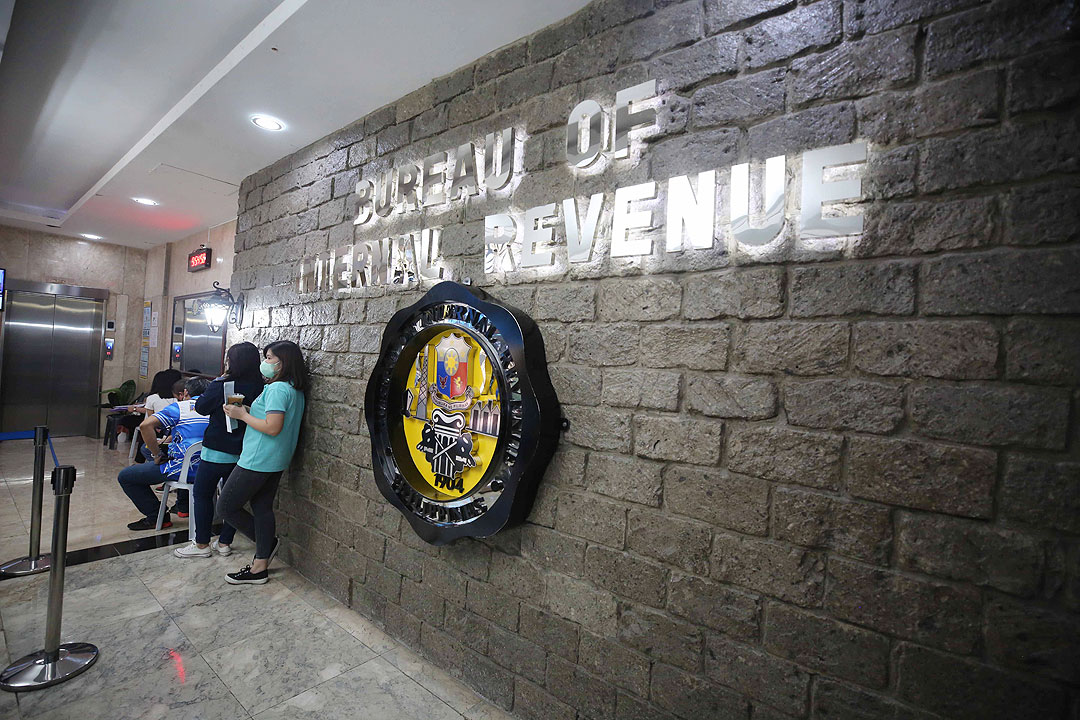
The Bureau of Internal Revenue (BIR) collected P213.3 billion in May, down 1.54%. — PHILIPPINE STAR/RUSSELL PALMA

By Luisa Maria Jacinta C. Jocson, Reporter

THE NATIONAL Government’s (NG) budget deficit narrowed to P122.2 billion in May, as revenue growth continued to outpace spending.

Data released by the Bureau of the Treasury (BTr) on Tuesday showed that the fiscal gap narrowed by 16.73% to P122.2 billion in May from P146.8 billion in the same month last year.

“The lower deficit for the period was brought about by the 9.35% increase in NG receipts overtaking the 0.88% marginal growth in NG expenditures,” the BTr said in a press release.

Month on month, the budget balance reversed to a deficit from the P66.8-billion surplus in April.

In May, government revenues rose by 9.35% to P333.4 billion during the month from P304.9 billion a year ago.

Tax revenues went up by 2.43% to P291.7 billion, despite a  1.54% drop in collection by the Bureau of Internal Revenue (BIR) to P213.3 billion. The Bureau of Customs (BoC) posted a 17.56% increase in collections to P77.9 billion.

Meanwhile, nontax revenues more than doubled to P41.7 billion in May from P20.1 billion a year ago. This was driven by revenues from the BTr, which surged 179.71% to P24.9 billion from P8.9 billion.

“The sharp increase was attributable to higher dividend and Philippine Amusement and Gaming Corp. remittances, investment income, and interest on NG deposits,” the BTr said.

On the other hand, government spending inched up by 0.88% to P455.7 billion in May, from P451.7 billion in the previous year.

“Government spending for May 2023 marginally increased as the lower National Tax Allotment (NTA) shares of local government units and net lending assistance to government corporations weighed down the growth of disbursement,” the BTr said.

Primary expenditures, or spending net of interest payments, slipped by 0.85% to P414.3 billion due to lower NTA releases.

Interest payments rose 22.21% to P41.3 billion.

FIVE-MONTH DEFICIT
For the first five months of 2023, the fiscal deficit narrowed by 28.86% to P326.3 billion from P458.7 billion in the same period a year ago.

Total revenues during the January-to-May period grew by 10.83% to P1.59 trillion from the P1.44 trillion a year ago.

“This growth was attributed to improvements in both tax and nontax collections, which grew by 9.71% and 20.56% year on year, respectively,” the BTr said.

Tax collection increased by 9.71% to P1.41 trillion, as BIR collections rose by 9.95% to P1.05 trillion while Customs collections jumped by 12.1% to P359.3 billion.

Nontax revenues increased by 20.56% to P178 billion, as revenues from other offices went up 48.95% to P95.8 billion. However, BTr revenues slipped by 1.34% to P82.2 billion due to lower dividend remittances.

On the other hand, expenditures at the end of May inched up by 1.22% to P1.92 trillion from P1.9 trillion a year ago.

Interest payments went up by 4.13% to P229.6 billion while primary expenditures increased by 0.84% to P1.69 trillion.

Nicholas Antonio T. Mapa, a senior economist at ING Bank N.V. Manila, said the improvement in revenue collection can be attributed to the uptick in economic activity.

“The narrower budget deficit was due to the combination of improvements in revenue collection and a marginal increase in government expenditure. Revenues are growing more than programmed, possibly both due to better tax administration and resilient economic activities,” China Banking Corp. Chief Economist Domini S. Velasquez said in a Viber message.

Meanwhile, sluggish state spending was likely due to the slow rollout of government projects, analysts said.

Mr. Mapa noted that expenditures were muted “perhaps to help cap the deficit as they chase fiscal consolidation.”

“Although a smaller budget deficit is positive for the government’s fiscal standing, it is negative for economic growth especially if there are delays in infrastructure projects. Absorption capacity among line agencies needs to be improved to push the country’s economic growth to a higher path,” Ms. Velasquez said.

Last week, Finance Secretary Benjamin E. Diokno expressed concern over the underspending of government agencies.

Data from the Department of Budget and Management showed that government agencies’ budget utilization rate was at 91% at end-May, slower than the 93% pace a year earlier.

The government set its deficit ceiling at P1.499 trillion this year, equivalent to 6.1% of gross domestic product.

PHL requires effort to exit FATF ‘gray list’

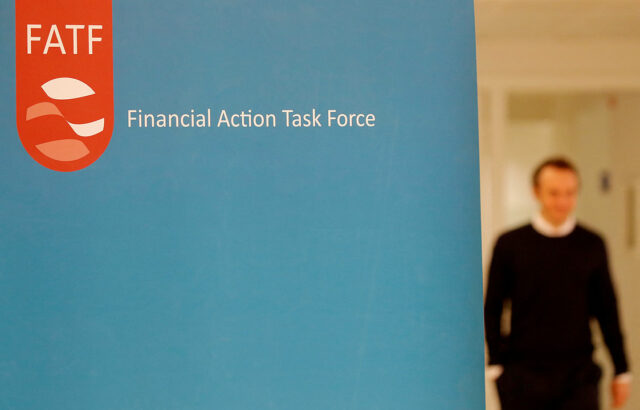
THE LOGO of the Financial Action Task Force (FATF) is seen at the OECD headquarters in Paris, France, Oct. 18, 2019. — REUTERS

By Keisha B. Ta-asan, Reporter

THE PHILIPPINES will require “some effort” to be removed from the Financial Action Task Force’s (FATF) “gray list” by January next year, the central bank governor said on Tuesday.

At the same time, the Anti-Money Laundering Council (AMLC) said it is continuously working with other government agencies to address money laundering and terrorism financing concerns raised by the FATF.

“The government is doing its best to get us out of [the gray list] and unfortunately, a lot of work has to be done for the requirements to be met,” Bangko Sentral ng Pilipinas Governor Felipe M. Medalla told reporters on Tuesday.

He declined to give specific details but said “it will require some effort to get out (of the gray list) by January.”

The Philippines remained under a gray list of countries under increased monitoring for money laundering and terrorism financing risks, despite some progress in implementing measures against such financial crimes, the FATF said over the weekend.

In a statement, the FATF said the Philippines has taken steps to promote the target financial sanctions obligations among financial institutions and Designated Non-Financial Business and Professions (DNFBPs). This would help improve law enforcement agencies’ investigations in cases related to “dirty money,” as well as prioritize asset-tracing and confiscation at the point of conviction in criminal cases.   

However, the FATF said the Philippines needs to address strategic deficiencies. The country should demonstrate effective risk-based supervision of DNFBPs, ensure supervisors are using anti-money laundering and counter-terrorism financing (AML/CTF) tools to mitigate risks, and streamline government access to up-to-date beneficial ownership information.

The anti-money laundering watchdog also said the Philippines should show there has been an increase in the identification, investigation, and prosecution of money laundering and terrorism financing cases.   

The assessment was made during the FATF’s plenary from June 21 to 24.

In an e-mail interview with BusinessWorld, the AMLC said it is continuously working with other relevant government agencies to address the strategic deficiencies identified by the FATF.   

“In particular, the AMLC, Philippine Amusement and Gaming Corp., Cagayan Economic Zone Authority and Aurora Pacific Economic Zone and Freeport are implementing risk-based supervision over the covered DNFBPs,” it said.   

The AMLC also noted that the Securities and Exchange Commission had implemented measures to increase submissions of beneficial ownership declarations by companies.

Earlier in May, the AMLC told financial institutions to strengthen sanction screening systems amid underperformance in testing metrics over the last 12 months.

Sanction screening is used to identify individuals or entities that are subject to economic sanctions. It is a requirement for financial players and other regulated industries.     

In the Philippines, the 2021 Sanctions Guidelines outlines the current requirements and obligations as set out by the AMLC.     

Under current legislation, all covered entities must screen all relevant parties against the Anti-Terrorism Council lists and United Nations Security Council resolutions.     

“The law enforcement agencies, prosecutors and AMLC are continuously coordinating for the investigation and filing of money laundering and terrorism financing cases,” the AMLC said.   

The AMLC also expects more lawyers to report any suspicious transactions or unlawful activities under relevant laws on anti-money laundering as the Supreme Court approved the Code of Professional Responsibility and Accountability in April.    

“With the assured cooperation of all agencies concerned, the AMLC is optimistic that the Philippines can promptly resolve its remaining strategic deficiencies to finally exit the gray list,” the AMLC said.   

The global financial crime watchdog placed the country in its list of jurisdictions under increased monitoring for dirty money risks in June 2021.

Mr. Medalla earlier said officials are hoping the Philippines will be removed from the FATF’s gray list by January 2024, after missing an earlier deadline.

The Philippines and 25 other countries remained in the FATF’s gray list. Meanwhile, North Korea, Iran, and Myanmar were countries in the FATF’s blacklist.

BSP chief sees above 6% growth in second quarter

Vehicles are stuck in traffic in Manila, Philippines, June 20, 2023. — REUTERS

THE PHILIPPINE ECONOMY may have expanded by over 6% in the second quarter, the outgoing governor of the Bangko Sentral ng Pilipinas (BSP) said on Tuesday.

“I think it’s over 6% for this quarter. And for the year, it’s going to be over 6%,” BSP Governor Felipe M. Medalla told reporters on the sidelines of an economic forum in Taguig.

Asked if second-quarter economic growth will be lower than 6.4% in the first quarter, he said “that’s hard to say.”

During his keynote address, Mr. Medalla said the economy appears to be strong this year, but noted it would be harder to post growth “when the base is larger.”

The Philippine gross domestic product (GDP) grew by 6.4% in the first quarter, slower than the 8% expansion in the same period a year ago. The government is targeting 6-7% GDP growth this year.

National Economic and Development Authority (NEDA) Undersecretary Rosemarie G. Edillon said the Philippine economy is projected to outpace many of its regional peers this year despite external challenges.

“We anticipate sustained and robust growth, promising employment figures, and a positive trend towards reaching our inflation target,” Ms. Edillon said, reading the speech for NEDA Secretary Arsenio M. Balisacan.

However, high levels of investment are crucial to sustain the economy’s growth trajectory, she said.

“The Philippines has much to learn from its East Asian neighbors and must catch up with its dynamic Southeast Asian counterparts. Unfortunately, decades of neglect have resulted in significant infrastructure deficits,” she added.

Finance Secretary Benjamin E. Diokno said that productive spending is of “paramount importance.”

“Hence, infrastructure spending must be kept at 5-6% of GDP annually or around P1.3 trillion to P2.3 trillion each year until 2028,” he said in a video presentation at the same forum.

Under the Public Investment Program for 2023-2028, the government identified 3,770 infrastructure priority programs and projects with an indicative investment requirement of about P17.3 trillion.

FED TIGHTENING
Meanwhile, Mr. Medalla said the BSP may find it hard to cut policy rates if there are still risks of further monetary tightening by the US Federal Reserve.

“There are still many risks despite the fact that our forecasts are quite optimistic about [inflation] being below 4% by October or November,” Mr. Medalla said.

Headline inflation slowed to 6.1% in May from 6.6% in April. This marked the 14th straight month inflation was above the central bank’s 2-4% target. Year to date, inflation has averaged 7.5%.

Last week, the BSP extended its policy pause for a second straight meeting, keeping the benchmark rate at 6.25%. The Monetary Board has raised borrowing costs by 425 basis points between May 2022 and March 2023.

“We still have to wait for more data points and the other thing that complicates it is we don’t know what the US is going to do,” Mr. Medalla said.

The Fed paused its tightening at its June meeting but signaled it may still raise borrowing costs this year.

“So clearly it’s very hard to cut if the US is raising rates because for some reasons, the foreign exchange market is very sensitive to the narrowing of the interest rate differential,” Mr. Medalla added.

The Monetary Board will meet next on Aug. 17. — Keisha B. Ta-asan

NG to borrow P180B from domestic market in July

BW FILE PHOTO

THE NATIONAL GOVERNMENT (NG) plans to borrow P180 billion from the domestic market in July, the Bureau of the Treasury (BTr) said on Tuesday.

Next month’s borrowing plan is 2.78% lower than the P185-billion program for June. Actual borrowings for June reached P172.989 billion, which is 6.49% below the program.

Broken down, the government will offer P5 billion worth of 91-day, 182-day, and 364-day T-bills on July 3, 10, 17, and 24.

National Government fiscal performanceFor the long-term tenors, the BTr will auction off P30 billion in nine-year T-bonds on July 4, and P30 billion in 15-year T-bonds on July 11.

It also will offer P30 billion in six-year debt papers on July 18, and P30 billion in seven-year bonds on July 25.

“The lower National Government borrowing plan for July 2023 may reflect the lower amount of maturing government securities/Treasury bonds versus June 2023,” Rizal Commercial Banking Corp. Chief Economist Michael L. Ricafort said in a Viber message. 

He also attributed the slightly lower borrowing plan to the recent improvement in tax revenue collections in recent months, and “more disciplined” spending.

Data from the Department of Finance (DoF) showed revenue collections jumped by 10.83% to P1.59 trillion in the January-to-May period, from P1.44 trillion recorded in the same period a year ago.

Demand for T-bills could be weaker this month as the US Federal Reserve and the Bangko Sentral ng Pilipinas (BSP) have signaled they may not cut rates this year, China Banking Corp. Chief Economist Domini S. Velasquez said in a Viber message.

BSP Governor Felipe M. Medalla on Friday signaled the central bank would probably keep its key policy rate unchanged at near 16-year high for the rest of the year.

“Waiting is the better strategy. Maybe the optimal waiting time is up to January or February if current conditions remain,” he told Bloomberg Television on Friday, a day after the Monetary Board left benchmark interest rates steady.

Fed Chair Jerome H. Powell has also signaled the central bank is not done with its aggressive tightening cycle, after policy makers held rates steady earlier this month. The next Fed meeting will be on July 25-26.

“On yields, we will likely see sideways movement this July with offsetting impact from lower domestic inflation and a possible hike from the Fed at their July meeting,” Ms. Velasquez said.

Headline inflation slowed to 6.1% in May from 6.6% in April. For the first five months, the consumer price index averaged 7.5%, still well above the BSP’s 2-4% target and 5.4% forecast for the year.

The gross domestic borrowing program this year is set at P1.654 trillion, composed of P54.1 billion in T-bills and P1.6 trillion in fixed-rate T-bonds.

The government borrows from local and external sources to help fund a budget deficit capped at 6.1% of the gross domestic product this year. — AMCS

Investors overly optimistic on speed, cost of taming inflation, says IMF

SINTRA, Portugal — The world’s top central banks may need longer to get inflation back down to target and a fresh bout of financial turbulence could make the process even more protracted, the International Monetary Fund’s (IMF) second-in-command said on Monday.

Central banks have raised interest rates at a brisk pace over the past year-and-a-half to fight off a historic surge in prices, but they have persistently underestimated inflationary pressures.

Describing what she called uncomfortable truths, Gita Gopinath argued that the financial community may be too optimistic about the cost and difficulty of taming inflation, which then raises the sort of stability risk central banks might not be equipped to handle.

“Inflation is taking too long to get back to target,” Ms. Gopinath told the European Central Bank’s annual get-together in Sintra, Portugal. “While headline inflation has eased significantly, inflation in services has stayed high, and the date by when it is expected to return to target could slip further.”

Such a delay would be costly, so central banks need to keep policy tight, despite an obvious cost to growth, she said.

The problem is that investors seem overly optimistic about the inflation path and do not see much of a hit to economic growth, an unlikely combination, especially if high rates persist for longer than currently predicted, Ms. Gopinath argued.

“It is useful to bear in mind that there is not much historical precedent for such an outcome,” she said.

Once the reality hits, asset prices could reprice, potentially setting off the sort of financial turbulence seen around the collapse of Silicon Valley Bank and the sale of Credit Suisse earlier this year, she warned.

While central banks have been adamant that they have the tools to manage both price and financial stability risks, the reality is that their powers are limited when financial stress threatens to morph into a systemic crisis, she added.

It is then up to governments to forestall a crisis, but their fiscal capacity is quite limited now, so central banks may need to let inflation come down even more slowly to avoid their own policy triggering a crisis.

“Financial stresses could generate tensions between central banks’ price and financial stability objectives,” Ms. Gopinath said. “While central banks must never lose sight of their commitment to price stability, they could tolerate a somewhat slower return to the inflation target to avert systemic stress.”

Still, for now, policy is not tight enough and central banks need to expect more persistent price pressures than in the past decade, that was characterized by anemic price growth, Ms. Gopinath said.

“Monetary policy should continue to tighten and then remain in restrictive territory until core inflation is on a clear downward path,” Ms. Gopinath said. — Reuters

ACEN steps up expansion with Vietnam acquisition

AYALA-LED ACEN Corp. through its subsidiary in Vietnam has completed the first-phase acquisition of a solar power business in the regional neighbor.

Patrice R. Clausse, chief executive officer (CEO) of ACEN International, said the partnership between ACEN Vietnam Investments Pte. Ltd. and Super Energy Corp. Public Co. Ltd.’s solar power business in Vietnam “marks the beginning of a long-term collaboration.”

He told the stock exchange on Tuesday that the group “will continue to look for new opportunities to grow our portfolio and jointly develop renewable energy projects across ASEAN.”

ACEN said the acquisition will take four phases, with the first phase adding about 141 megawatts (MW) of attributable capacity to the company’s renewable energy portfolio in Vietnam. ACEN will then acquire 49% of the Super Energy platform to bring its renewable energy portfolio in Vietnam-Lao People’s Democratic Republic to 1,200 MW of attributable capacity.

ACEN said the remaining phases of the acquisition are expected to be completed this year at an estimated investment of $165 million.

Super Energy is the operator and owner of 837 MW of solar projects in Vietnam through Solar NT, which is a solar energy platform owned by Super Energy Group Hong Kong Co., Ltd.

Jormsup Lochaya, chairman and CEO of Super Energy, said the groups’ synergy will enhance the foreign firm’s “growth potential and strengthen the renewable energy business structure, which will support our strategic partnership in many areas, including capital, personnel, technology, and networks for additional investment opportunities in the future.”

FORCE MAJEURE FOR ENEX’S OPERATIONS
In a separate regulatory filing, ACEN subsidiary ENEX Energy Corp. said the Department of Energy (DoE) granted the declaration of force majeure for its unit’s drilling operations in Service Contract (SC) 55.

ENEX said the DoE agreed to allow the request of its subsidiary, Palawan55 Exploration and Production Corp., for a force majeure relief due to the “operational and financial risks” associated with drilling operations in the West Philippine Sea (WPS).

It added that the department found a basis to place SC 55 under force majeure starting Dec. 6, 2022 “until such time that a clearance to proceed with exploration activities” in WPS has been issued by the national government. SC 55 is a deep-water block in the southwest Palawan Basin covering an area of 9,880 square kilometers.

At the local bourse on Tuesday, ACEN shares gained four centavos or 0.77% to end at P5.26 apiece, while ENEX shares fell by eight centavos or 0.86% to close at P9.18 each. — Ashley Erika O. Jose

ADVERTISEMENT
ADVERTISEMENT