Home Blog Page 4667

Inflation likely eased to 5.5% — poll
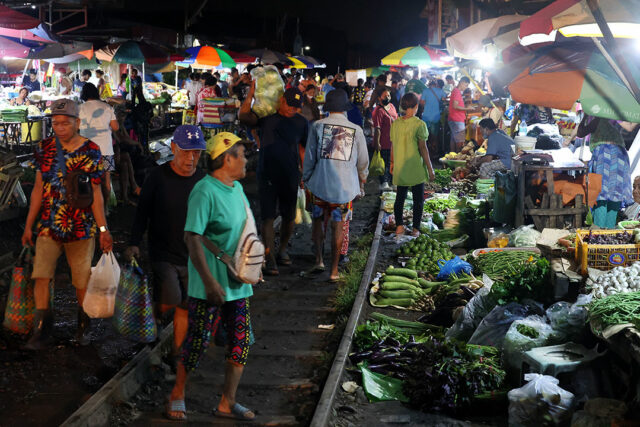
Vendors sell vegetables and other produce at a market along the Philippine National Railways (PNR) tracks in Calamba, Laguna, June 2, 2023. — PHILIPPINE STAR/MIGUEL DE GUZMAN

By Keisha B. Ta-asan, Reporter

HEADLINE INFLATION likely further slowed for a fifth straight month in June, due to stable food prices and high base effects, analysts said.

A BusinessWorld poll of 17 analysts yielded a median estimate of 5.5% for June inflation, within the 5.3% to 6.1% forecast given by the Bangko Sentral ng Pilipinas (BSP) last Friday.

If realized, the median estimate will be slower than the 6.1% print in May 2023 and June 2022. It would also be the slowest since the 5.4% in May 2022.
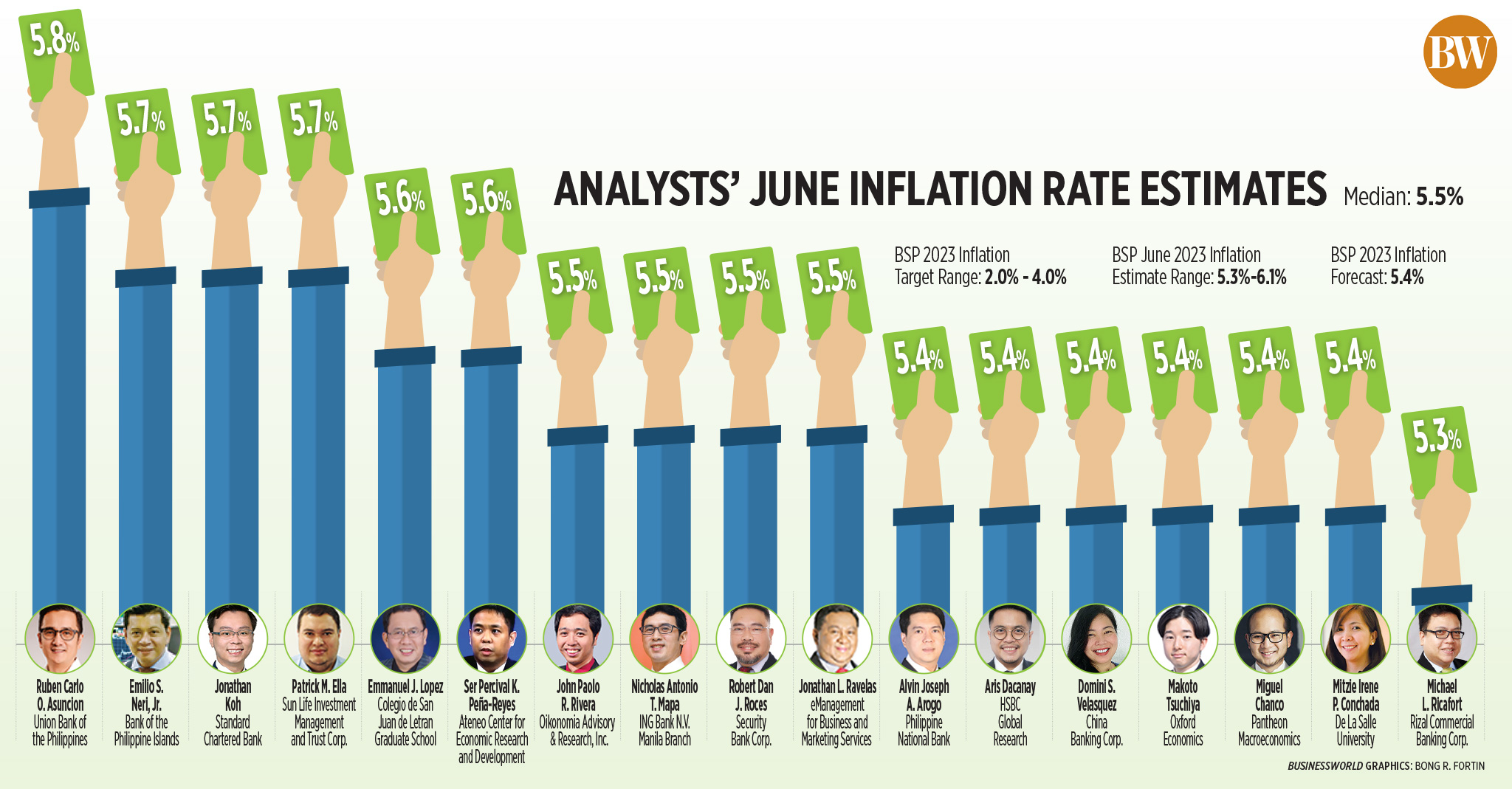
June would mark the fifth consecutive month of slower inflation, and the 15th straight month that inflation surpassed the BSP’s 2-4% target range.

The Philippine Statistics Authority (PSA) will report the consumer price index (CPI) data for June on July 5 (Wednesday).

Standard Chartered Bank economist Jonathan Koh said food and transport inflation may have moderated further in June due to base effects last year.

“Meat and fruit prices have continued to ease in June, while vegetable prices rose in June. Transport prices likely contracted year on year for the second consecutive month on high base effects,” he said in an e-mail.   

In June 2022, food inflation rose to 6.4%, while transport inflation accelerated 17.1% year on year.   

China Banking Corp. Chief Economist Domini S. Velasquez said inflation likely further slowed in June as prices of key food items such as meat, fish and fruits, as well as cooking gas, declined.

Fuel retailers slashed their cooking gas prices by P3.47 per liter to P6.20 per kilogram in June.

“We expect inflation to settle at 5.4% in June, as high base last year pulled down the annual figure. Although sequential growth likely picked up, it is still well below the trend seen last year. We estimate the downtrend was broad-based with both fuel and nonfuel inflation slowing,” Makoto Tsuchiya, assistant economist at Oxford Economics, said in an e-mail.

While fuel prices may have gone up month on month, Mr. Tsuchiya noted prices are much lower compared with the level a year ago.

In June alone, pump price adjustments stood at a net increase of P0.45 per liter for gasoline, P1.7 per liter for diesel, and P1.6 per liter for kerosene.   

“We also observed upward pressures from increases in vegetable and domestic pump prices as well as higher electricity rates of Manila Electric Co. (Meralco) and other regional power distributors. Rice prices have also been consistently rising since February,” Ms. Velasquez said.   

Meralco raised the overall rate for a typical household in Metro Manila by P0.4183 to P11.9112 per kilowatt-hour (kWh) in June. 

OUTLOOK
Analysts said headline inflation is largely expected to further ease to the 2-4% target range before the year ends.

However, upside risks to the inflation outlook includes the El Niño weather event and the minimum wage hike.   

“Moving forward, we expect that the monthly print of the year-on-year consumer price growth will fall below 4% in the fourth quarter of 2023. The main risk against this view is El Niño,” Philippine National Bank economist Alvin Joseph A. Arogo said in an e-mail.   

The local weather agency said the El Niño weather pattern may emerge in the next three months with an 80% probability and will likely persist until the first quarter of 2024. 

The El Niño is a fluctuating weather pattern in the area around the equator in the Pacific. The last time an El Niño weather event hit the Philippines was in 2019, with agricultural damage reaching up to P8 billion. 

ING Bank N.V. Manila Senior Economist Nicholas Antonio T. Mapa said El Niño threatens to affect agricultural output.

“A below-average performance from the agricultural sector will impact the manufacturing sector given the sizable contribution delivered by manufacture of agri-based products,” he said in an e-mail.   

For HSBC economist for ASEAN (Association of Southeast Asian Nations) Aris Dacanay, El Niño remains an upside risk.

“Nonetheless, it remains a risk and not a guarantee that inflation will rise. History shows that policy interventions in the Philippines have been successful in mitigating the impact of El Niño on food prices,” Mr. Dacanay said in an e-mail.   

Ms. Velasquez said inflation may average 5.6% in 2023, above the BSP’s 5.4% forecast.

However, she noted the recent minimum wage hike in Metro Manila has become a key risk in the inflation outlook.   

“A similar increase in the minimum wage in other regions could push up annual inflation by 0.1 percentage point to 5.7% this year. We also expect the impact of the higher minimum wage to be more pronounced in 2024 but lower-than-target inflation projection will likely soften the blow,” she said.   

On Friday, the regional wage board in the National Capital Region (NCR) approved a P40 increase in the minimum wage to P610 a day for non-agriculture workers, effective July 16.    

The Labor department said around 1.1 million minimum wage workers in NCR will benefit from the increase. 

“As to the NCR wage hike, we estimate the impact of the hike to represent an upside risk to both inflation and the policy rate outlook; a policy hike may help offset the inflationary tendency of the wage adjustments and thus the odds of an August policy action have gone up,” Security Bank Corp. Chief Economist Robert Dan J. Roces said.

The Monetary Board has extended its policy pause for a second straight meeting in June, keeping the benchmark rate at a near 16-year high of 6.25%.

Also, Ms. Velasquez said higher toll fees in some expressways may affect food prices as transport costs will likely increase.

Mr. Koh noted that inflation will likely continue to moderate in the second half of the year.

“This should allow the central bank to maintain its pause through third quarter and potentially begin cutting rates in fourth quarter,” he said.

Outgoing BSP Governor Felipe M. Medalla earlier said the BSP may keep rates on hold until third quarter this year and ruled out a rate cut this year due to uncertainty over future policy moves by the US Federal Reserve.   

The BSP sees inflation settling within the 2-4% target by September or October, and averaging at 5.4% this year, before further slowing down to 2.9% in 2024.   

“With inflation firmly on a decline, we think that the BSP will continue to stand pat even if the Fed decides to raise rates further,” Ms. Velasquez said.   

The Fed paused its tightening at its June meeting but signaled it may still raise borrowing costs this year.

“However, there is still a chance that the BSP may be forced to resume hiking if the peso depreciates excessively — which is inflationary — from a narrower interest rate differential with the Fed,” Ms. Velasquez added.   

The peso closed at a near three-month high of P55.20 versus the dollar on Friday, strengthening by 10 centavos from its previous finish, data from the Bankers Association of the Philippines’ website showed. 

The Monetary Board’s next policy meeting is on Aug. 17.
PHL remains a lower middle income economy — World Bank

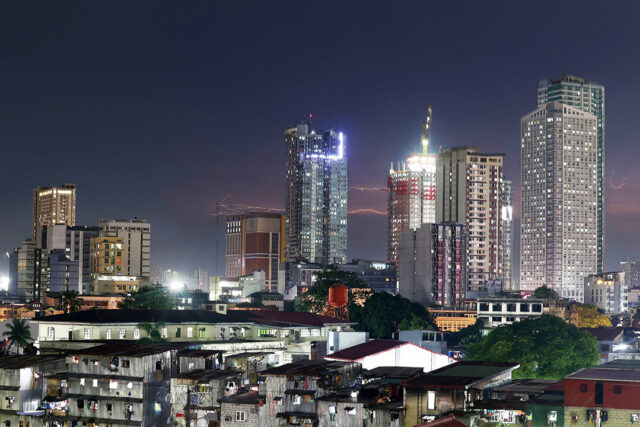
Streaks of lightning strike through the night sky behind condominium buildings in Manila, July 1, 2023. — PHILIPPINE STAR/MIGUEL DE GUZMAN

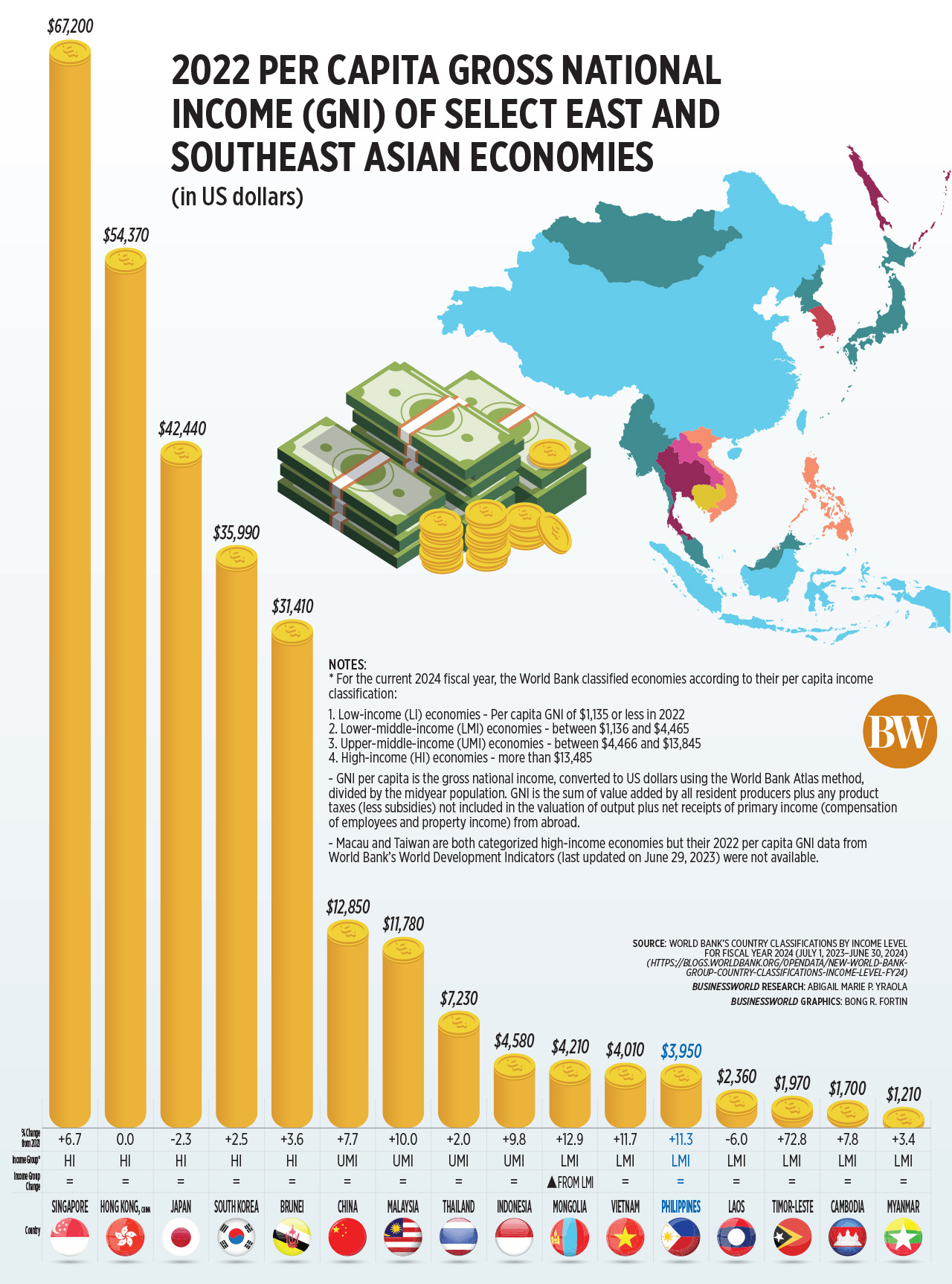
THE PHILIPPINES remained a lower middle-income economy in 2022, according to the World Bank, as its gross national income (GNI) per capita lagged behind most of its Southeast Asian neighbors.

Data posted on the multilateral lender’s website showed the Philippines’ GNI per capita increased by 11.3% to $3,950 in 2022, from $3,550 in 2021.

Despite the increase, the Philippines’ GNI per capita still fell within the World Bank’s bracket for lower middle-income economies of $1,136-$4,465. The income bracket was once again raised from $1,086-$4,255 a year ago.

The Philippines has been classified as a lower middle-income economy since 1987, which is the earliest available data from the World Bank.

In Southeast Asia, the Philippines trailed high-income economies Singapore ($67,200 GNI per capita) and Brunei ($31,410), as well as upper middle-income economies Malaysia ($11,780), Thailand ($7,230) and Indonesia ($4,580).

Aside from the Philippines, other lower middle-income economies in Southeast Asia include Vietnam ($4,010), Laos ($2,360), Timor-Leste ($1,970), Cambodia ($1,700) and Myanmar ($1,210).

The Philippine government is targeting to reach upper middle-income status by 2025. The World Bank raised the bracket for upper middle-income economies to $4,466-$13,845 GNI per capita, from $4,256-$13,205 a year ago.

Rizal Commercial Banking Corp. Chief Economist Michael L. Ricafort said a strong economic performance will help the Philippines achieve its goal to become an upper middle-income economy.

“Philippine gross domestic product (GDP) growth could normalize to around 6% in 2023 and beyond, among the fastest growing economies in Asia, with the stabilization of the GDP base,” he said in a Viber message.

The government is targeting 6-7% growth this year, slower than the 7.6% GDP expansion in 2022.

In the first quarter, the economy grew by 6.4%, slower than the revised 7.1% in the fourth quarter, and the 8% in the first quarter of 2022.

Mr. Ricafort also cited strong remittances, low unemployment, improved infrastructure spending, and the pickup in tourism as factors that will “help reduce poverty and help achieve middle-income status for the country in the coming years.”

In May, the World Bank said the country is “on track” to becoming an upper middle-income economy amid continued recovery and reforms.

The World Bank’s latest update also showed eight countries shifting income classifications. In 2022, Guyana and American Samoa moved to the high-income status, while Indonesia, El Salvador, West Bank and Gaza secured upper middle-income status. Guinea and Zambia are now classified as lower middle-income economies.

However, Jordan was the only country to move down a status. It is now considered lower middle income from its earlier status of upper middle income.

“Not surprisingly, of countries changing income categories in 2022, virtually all moved to a higher category as the recovery from the (coronavirus disease 2019) pandemic continued,” the World Bank said, adding that around 80% of countries improved their GNI per capita versus the 2019 level.

Latest data from the local statistics authority showed that the Philippines’ GNI — the sum of the nation’s GDP and net income received from overseas — rose by 9.9% in the first quarter.

This was slightly lower than the 10.5% a year ago, but higher than the 9.3% in the fourth quarter. — LMJC

May loan growth slowest in over a year

BW FILE PHOTO

BANK LENDING in May grew at its slowest pace in over a year, reflecting the impact of high interest rates, while domestic liquidity expanded by 6.6% in the same month.

Data from the Bangko Sentral ng Pilipinas (BSP) released late Friday showed outstanding loans by big banks, net of reverse repurchase (RRP) placements with the central bank, expanded by 9.4% to P10.9 trillion in May from P9.97 trillion a year ago. 

However, loan growth in May was slightly weaker than the 9.7% expansion in April. This is the slowest credit growth in 15 months or since the 8.9% print in March 2022.

Month on month, outstanding universal and commercial bank loans, net of RRPs, increased by 0.7%, the BSP said.

“The moderation in bank lending activity reflects the impact of the BSP’s cumulative policy rate adjustments,” outgoing BSP Governor Felipe M. Medalla said in a statement.

Since May 2022, the Monetary Board has raised borrowing costs by 425 basis points (bps). The key benchmark interest rate currently stands at 6.25% — the highest in nearly 16 years.

Rizal Commercial Banking Corp. Chief Economist Michael L. Ricafort attributed the weaker growth in lending to higher borrowing costs, as it became more expensive for businesses and consumers to obtain loans. This partly slowed the demand for loans, he added.

“Overall bank lending growth seems pretty modest, currently at high single digit combined with around 11.5% nominal growth for the economy pretty much reduces the probably of a sharp spike in nonperforming loans (NPLs),” Bank of the Philippine Islands (BPI) Lead Economist Emilio S. Neri, Jr. said.

Mr. Neri noted that with high interest rates, “the probability of a surge in NPLs is much lower than when rates were zero or negative.”

The latest central bank data showed the banking industry’s gross NPL ratio increased to 3.41% in April from 3.33% in March, but still lower than 3.93% a year earlier.

“In general, a positive real interest rate environment helps us avoid excessive risk-taking among lenders and borrowers,” Mr. Neri added.

Based on BSP data, outstanding loans to residents, net of RRPs, rose by 9.3% in May, slower than the 9.6% print in April.

Borrowings for production activities rose by 7.9% to P9.5 trillion in May, easing from 8.3% in the previous month.

This was driven by the faster expansion in loans for professional, scientific and technical services (53.8% in May from -40.6% in April), administrative and support services (36.3% from 34.3%), electricity, gas, steam, and air-conditioning supply (14.1% from 12.4%), and real estate activities (5.5% from 4.5%).

Slower month-on-month growth was seen in loans for manufacturing (0.6% in May from 9.4% in April), wholesale and retail trade, repair of motor vehicles and motorcycles (8.6% from 10.3%), information and communication (15.9% from 19%), and agriculture (3.7% from 4.5%)

BSP data also showed a decline in arts, entertainment, and recreation (-7.4% from 4.9 in April) and education (-6.8% from -4.7%).

Meanwhile, consumer loans to residents rose by 22.7% to P1.09 trillion, slightly easing from the 22.3% print in April.

Credit card loans jumped by 29% in May, a tad weaker from the 29.9% in April. Salary-based general purpose consumption loans also eased to 52.9% from the 56.2% in the previous month. 

Borrowings for motor vehicles expanded by 4.1%, improving from the 1.9% seen in April.

Outstanding loans to nonresidents also rose at a faster rate of 13.2% in May from the 2.2% print in the previous month.

Mr. Ricafort said measures to further reopen the economy would boost demand for loans.

“Businesses and industries can also plan better and become more decisive with new investments and expansion plans, which entail more demand for loans and other fund-raising activities,” he said.

Cooling inflation may also spur loan demand, he added, especially if the BSP begins cutting policy rates next year.

STEADY M3 GROWTH
Despite slower credit growth, domestic liquidity rose by 6.6% annually to P16.3 trillion in May, the BSP said in a separate statement.

This was unchanged from the 6.6% expansion in April. Month on month, liquidity rose by about 0.3%.

Money supply, or M3, is considered as the broadest measure of liquidity in an economy.

In May, domestic claims rose by 11.4%, slightly slower than the 11.9% logged in April.

Net borrowings of the central government expanded by 18.3% in May, easing from the revised 20.2% in April.

Net claims on the private sector grew by 9.3% in May, slower than the revised 9.8% in April.

Meanwhile, net foreign assets (NFA) rose by 2.7% in May, a turnaround from the 0.2% contraction in April.

The central bank’s NFA position grew by 4.2% from 2.5% in the previous month, while the NFA of banks declined due to higher bills payable.

“Looking ahead, the BSP will continue to ensure that domestic liquidity conditions remain consistent with the BSP’s price and financial stability objectives,” Mr. Medalla added. — Keisha B. Ta-asan

The 10 best new investment-worthy jewelry watches for 2023

WATCH collectors love to debate the merits of triple-axis tourbillons and high-frequency calibers, but mention a gem-set watch, and their eyes tend to glaze over. Even a masterpiece of jeweling is routinely dismissed as just “a ladies’ watch.” But it’s time jeweled watches got some of the merit they deserve, and these 10 new pieces may be the tipping point.

Their merits are many: Diamonds and gemstones have a high intrinsic value that, when added to watches, renders them automatically investment-worthy. And improvements in gem setting techniques have amped up the dazzle factor. Increasingly, there’s been a greater interest in jeweled watches for men — top brands like Bulgari are now introducing jeweled pieces designed for male consumers.

Setting gems into a timepiece is a task as demanding as any that a master watchmaker faces when assembling a grand complication. Techniques have evolved in recent years, with the aim of creating maximum brilliance when light enters a diamond and bounces off one of the side or lower facets at just the right angle. The more metal that surrounds the stone, the more it will absorb rather than reflect light, so the idea is to minimize the metal, either by using a variation of the raised prong setting or cutting away some of the metal around the gems.

It’s an alternative to the convention of setting gems directly into the case, surrounded by metal on all sides. A jewelry watch can take hundreds of hours to set — it might be easier, and faster, to make a minute repeater.

Jewelry watches hold or appreciate in value because diamonds and gemstones are commodities in their own right that can be sold separately. They add intrinsic value to a watch, giving them an edge on the secondary market. “We are seeing more jeweled timepieces at auction,” says Rémi Guillemin, head of watches for Christie’s Europe. “Many men’s as well as women’s wristwatches are now bejeweled. They are now part of the catalogs of many more manufacturers due to the increasing demand from collectors for these models. As a result, prices are increasing in the secondary market and at auction.”

The following 10 new jewelry watches collectively represent recent innovations in design, cutting, setting and creative color matching. Wear them with jeans for a high-low vibe or on the red carpet with a tux or a gown.

CARTIER BAIGNOIRE JEWELRY
At 17.1mm wide and 24.8mm long, this isn’t a big watch, but every surface is set with gems in a dainty, open arrangement that lets in plenty of light. The double line bracelet includes a strand of diamonds and another of sapphires. The case is set with sapphires, emeralds and tourmalines, framing a dial paved with 130 diamonds totaling 0.64 carats and a small tourmaline. The movement is quartz. It is a numbered edition of 15, priced at $185,000.

PIAGET AURA HIGH JEWELRY
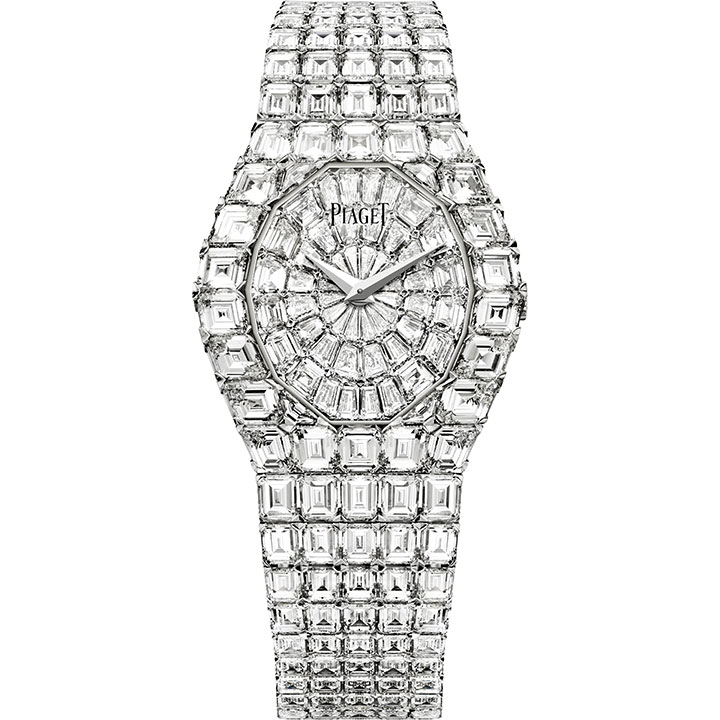
True to its name, the Aura radiates light from every angle. Every gem is individually cut and calibrated to fit together like a seamless puzzle. Piaget says it took eight months to gather the sapphires in the desired graduation of colors. The gem setting took another 260 hours. Ultrathin claws allow the stones to capture maximum light. A unique piece, the Aura contains the Piaget 430P ultrathin hand-wound movement. Price on request.

HARRY WINSTON OCEAN DATE MOON PHASE AUTOMATIC
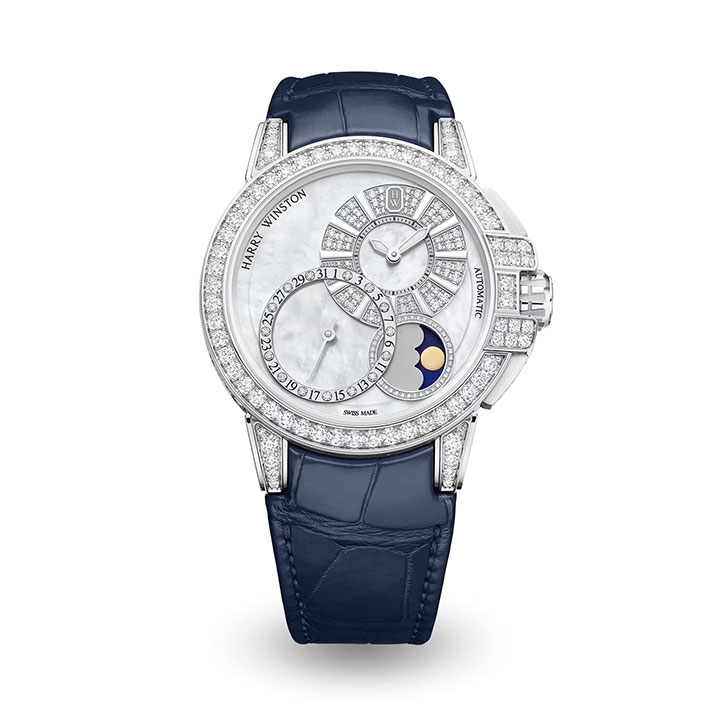
The Ocean is billed as Harry Winston’s sport model, which it describes as suitable for “everyday wear,” but this version is clearly made for days that are more special than others. Every surface but the date index and the moon phase disk is set, for a total of 40 carats of round-brilliant and baguette diamonds. Even the rotor is set with 26 diamonds. Limited to five pieces. Price on request.

CHANEL J12 HYPER CYBERNETIC
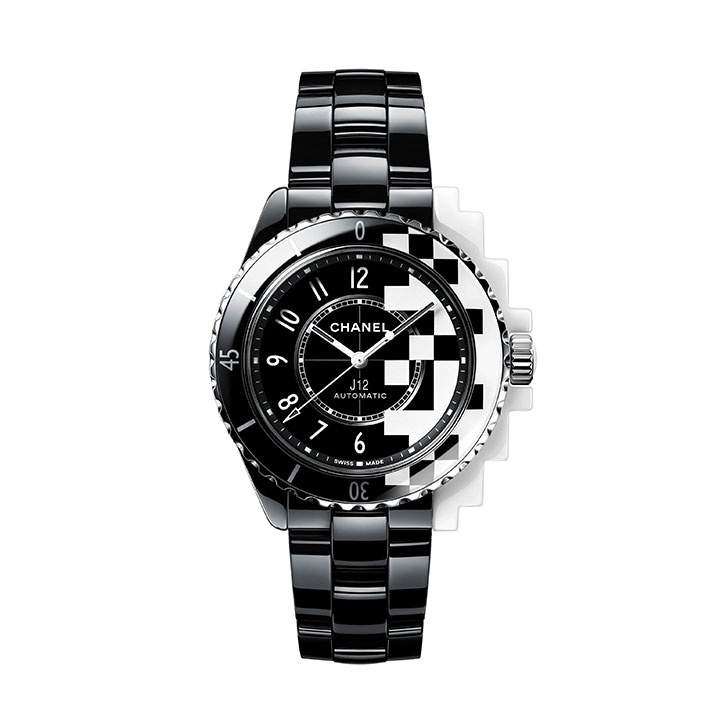
The diamonds on this whimsical watch are snow-set, a type of pavé setting with random sizes on a surface that often creates a specific outline — in this case, a pixelated motif. The case is black ceramic and 18-karat white gold. The watch is set with 240 brilliant-cut diamonds totaling 1.30 carats. It’s part of the J12 Interstellar capsule collection, in a limited edition of 55 pieces. Price on request.

BULGARI OCTO ROMA MEDITERRANEA
This men’s jeweled secret watch is designed in a seascape-with-octopus scene. It’s part of a full high jewelry and watch collection designed to celebrate Mediterranean shorelines, with bright, vibrant gems. The peekaboo cover is set with diamonds, Paraiba tourmalines and sapphires and opens to reveal a watch with the manual BVL 268 SK flying tourbillon. Price on request.

JAEGER-LECOULTRE REVERSO SECRET NECKLACE
This art deco pendant watch reinterprets Jaeger’s flagship collection, the Reverso. It’s set with 3,000 diamonds totaling more than 18 carats set into the chain and case. The supple chain is made of diamond-set links and polished onyx beads. The case and dial are set with onyx and diamonds, front and back. Price on request.

BREGUET REINE DE NAPLES 8918
The Reine De Naples, Breguet’s flagship in its ladies’ collection, is distinctive for its feminine oval shape, and this pink version doubles the vibe. The case is 18-karat rose gold, and the dial is pink grand feu enamel. The diamond application is subtle, with the bezel setting matched by diamonds along the flange. The buckle is set with another 28 diamonds, and an oval diamond at 6 o’clock mirrors the case shape. $38,300

CHOPARD RED CARPET COLLECTION JEWELRY WATCH
A study in pear-shaped diamonds posed as flower petals, this masterpiece is set with 25.87 carats of pears, 21.65 carats of octagon-cut emeralds and 2.43 carats of round brilliant-cut diamonds. The hands are matched to the very clean, high-color emeralds. The movement is quartz. Price on request.

VAN CLEEF & ARPELS PERLÉE PENDANT
For some brands, a jeweled pendant watch would be an anomalous one-off, but for master jeweler Van Cleef & Arpels, it is a full collection with six gem options, including three exotic hardstones: The covers can be set with sapphire, emerald, ruby or a choice of chalcedony, sodalite or rose quartz. Dials are mother-of-pearl surrounded by a ring of diamonds. Prices on request.

VAN CLEEF & ARPELS LUDO HIGH JEWELRY SECRET
Designed after a belt-themed bracelet created by the company in 1934, the Ludo’s buckle-motif case-surround is set with 5.68 carats of perfectly matched pink sapphires, cut to fit. The 18-karat rose gold mesh-style bracelet covers the dial but flips up at the press of a button to reveal the time against a guilloched mother-of-pearl background. $148,000. — Bloomberg

My big blue wedding Trends seen at Conrad’s wedding fair

MAK TUMANG’s creation

ROMANCE, tulle, and feathers were on the mind during Conrad Manila’s Inspired Beginnings, a wedding fair capped off with a fashion show. Judging by what we saw, big weddings are back.

The first day, June 23, saw a concert with Bituin Escalante, Rachelle Gerodias, Ciara Sotto, Quatro, Debonair District, and Ellipsis. The last day, June 24, had a bridal fashion show featuring the collections of Albert Andrada, Jo Rubio, Joe San Antonio, Jazel Sy, Julianne Syjuco, Mak Tumang, and Veluz.

Veluz kicked off the show with a short dress with medieval sleeves, its skirt appearing under the bodice as multiple layers of tulle. A backdrop of a sunset flashed behind the models. This was the only “modern” dress by Veluz, with the rest of the models donning ballgown skirts, while one model wore a white lace long-sleeved blouse over a cream skirt.

Jazel Sy started them young with two child models, one in a gown scattered with crystals; the other in a similarly gem-encrusted number with sky-blue feathers at the skirt. Crystals were seen throughout Ms. Sy’s collection, decidedly romantic with circle skirts. There was even an option for Muslim brides, showing a woman dressed completely in white, with a large encircling skirt and long-sleeves, and a hijab (under a tiara).

Julianne Syjuco had a decidedly young collection, either for a deb or a daring bride. The models walked to FKA Twigs’ song “Two Weeks” with the more explicit lyrics faded out, because this show also opened with young flower girls. Ms. Syjuco’s dresses showed off shoulders and a little bit of cleavage, and lace and crystals went in for dramatic, shimmering looks. For a bride’s something blue, Ms. Syjuco showed a sky-blue dress with feathers on the skirt — but also a big blue boa. This show ended with a model in a great pink dress, with folds and flounces — and feathers.

Blue was also a prominent color in Joe San Antonio’s collection, with one model wearing a shimmering ice-blue number. The rest of the dresses showed the illusion of slinkiness with sequins scattering the light and bodices clinging to the body, but a traditional strapless dress with a sweetheart neckline ended the show.

Miss Universe designer Mak Tumang wasn’t about to get lost in this parade, showing his models in a fantasy forest. Butterflies and flowers were the theme of his collection, opening the show with a woman in a sunshine-yellow dress with a silk butterfly over her mouth. The designer showed fabric folded into flowers, scattered all over a dress, but of note are dresses with a giant rose forming a headdress, while a bridal veil fell over it. Only a very special bride can pull off this look, and we’ll be very glad to meet her.

Jo Rubio seemed inspired by 1950s wedding looks, with models walking in front of a backdrop of a grand gallery, accompanied by French songs. We saw draped bodices, flounced bustles, and a giant bow at the low neckline with a tantalizing effect.

Albert Andrada closed the show, with the backdrop transforming into a pane of solihiya (woven cane). He showed a modern version of the barong, turning the translucent shirt into a suit jacket. Filipiniana techniques were seen throughout the show for the bride looking for something more traditional and nationalistic. There was a terno with a silver skirt, and a cocoon fanning out to cover a bride like a shell or a fan.

Joanne Gomez, Commercial Director of Conrad Manila told BusinessWorld that during the wedding fair, they offered discounts to couples getting hitched in the hotel from this year until June 2024 amounting to up to P100,000. She also offered her own observations about the wedding scene. “I think right after the pandemic, everyone just wants to have a wedding again.”

Pandemic restrictions from 2020 allowed only about 10 people in a room, so couples made do with livestreaming their weddings. The number gradually increased as the pandemic waned, with weddings of up to 50 persons, until the restrictions were finally lifted and people started getting married to pre-pandemic scales again.

Or maybe even better.

“When the government eased out all the restrictions, it was just amazing. Really big. Much bigger than before the pandemic,” said Ms. Gomez. — Joseph L. Garcia

For a touch of luxe, check out this Fabergé auction

LONDON auction house Sotheby’s is accepting online bids until July 11 for a trove of objets d’art from imperial and then revolutionary Russia, with a special focus on Fabergé.

The House of Fabergé gave its name to Fabergé eggs, bejeweled Easter eggs presented to the last two Empresses of Russia: the Dowager Empress Maria Feodorovna (formerly Princess Dagmar of Denmark), and her daughter-in-law, Empress Alexandra Feodorovna (formerly Princess Alix of Hesse-Darmstadt). The first Fabergé egg, a gold egg covered in white enamel, was presented to Maria Feodorovna by her husband, contained a golden hen inside. Upon her husband’s death, her son, Nicholas II, ordered two eggs from Fabergé every year until the Russian Revolution. More than that, the house supplied royal families (connected as they were by blood and marriage to the Romanovs) with several trinkets like jewels, picture frames, boxes, and cigarette cases.

After the revolution, the Fabergé family were first imprisoned, and their workshops turned over to the Soviets. The surviving Fabergés escaped out of Russia, and established their businesses somewhere else, but never again reached the same level of fame as when they supplied the Russian Imperial Court. The name survives today, passing through several hands, and the house makes miniature jeweled eggs. Still, the name still has some pull, if one judges from the thousands of pounds of the estimate prices of the Fabergé items at the auction.

The highest estimate at the auction — which is called “Fabergé, Imperial & Revolutionary Works of Art” — is, however, not for one of the famed eggs, but for a silver-gilt, cloisonné and en plein pictorial enamel casket by Feodor Rückert, with an estimate price between £180,000 to £250,000 (P12,642,093.51 to P17,558,463.20*).

The most expensive Fabergé item in this auction is also not an egg, but rather a gem-set silver imperial presentation casket, dated 1902. The casket is studded with cabochon jewels including rubies, amethysts, garnet, emerald, quartz, moonstone, tourmaline, and mother of pearl. Coming from an American collection, the box was acquired by the grandfather of the present owner in the 20th century. The box itself had been presented by Czar Nicholas II to the former president of France, Emile Loubet, during a 1902 state visit. This lot is estimated to sell for between £100,000 to £150,000 (P7,023,385.28 to P10,535,077.92).

There are quite a few Filipinos with that kind of coin, but for more “budget-friendly” Fabergé pieces, up for auction is a gold-mounted rhodonite egg pendant, valued between £2,000 to £3,000 (P140,467.71 to P210,701.56). There’s also a locket with a lid in gold, covered by Fabergé’s signature guilloché enamel in pale blue, with a rose-cut diamond in the center. This is valued at £3,000 to £5,000 (P210,701.56 to P351,169.26).

To place bids, sign up for an account at https://www.sothebys.com/. — Joseph L. Garcia

* Calculated using an exchange rate of P70.23 to £1.

Cautious, unnerved investors sway shares sideways

BW FILE PHOTO

By Adrian H. Halili

STOCKS have generally moved sideways during the first half of the year due to underlying economic concerns locally and overseas, analysts said.

“Since hitting a low last March, the PSEi (Philippine Stock Exchange index) has been in a sideways movement within the 6,300 to 6,700 area during the first half of the year, China Bank Capital Corp. Managing Director Juan Paolo E. Colet said in a Viber message.

He said the index’s movement reflected a generally cautious mood in the market and a lack of confidence to drive stocks upward.

“Market sentiment turned negative and net foreign outflows escalated after investors were unnerved by hawkish monetary policy and the risk of economic slowdown,” he said.

Carlos Angelo O. Temporal, Unicapital Securities, Inc. senior equity research analyst, said the stock market ended “tepid” during the semester as market participants remained on the sidelines.

“Considering that a lot of investors were in a wait-and-see mode regarding central bank rate hikes and inflation, trading activity ended much more tepid in the first half,” Mr. Temporal said in a Viber message.

During the last trading day of the first half, the PSEi declined by 43.42 points or 0.66% to 6,468.07 on June 30, while the broader all-shares index went down by 12.93 points or 0.37% to close at 3,452.96.

The US Federal Reserve left interest rates unchanged during its June 14 meeting at 5-5.25% but signaled that borrowing costs might still need to rise by as much as half-a-percentage point by year-end. 

The US central bank has increased borrowing costs by 500 basis points (bps) since March 2022.

The Bangko Sentral ng Pilipinas (BSP) likewise kept benchmark interest rates steady for the second straight meeting, with the key policy rate staying at 6.25%.

The BSP raised borrowing costs by 425 bps from May 2022 to March 2023 to tame inflation.

Mr. Temporal said first-quarter earnings and rising rates had bolstered market preference for banks over property companies.

“Banks notably performed well given the uplift in net interest margins and robust loan growths, while property companies saw some underlying weaknesses in their [first-quarter] performance,” he said.

He added that property companies were marred by elevated cancellations and few project launches, which were attributable to concerns over rising rates and elevated inflation.

Headline inflation slowed in May to 6.1% from 6.6% in April. This was the slowest rate seen in a year or since 5.4% in May.

Toby Allan C. Arce, head of sales trading at Globalinks Securities and Stocks, Inc., said sustained efforts to promote economic growth and attract investments will be crucial in maintaining the market’s positive trajectory and fostering long-term investor confidence during the second half of the year.

“Investors remain cautiously optimistic, and the market’s performance in the second half of the year would depend on the continued progress in containing inflation and the pace of economic recovery both domestically and globally,” Mr. Arce said in a Viber message.

Indelible Merc

The sole variant, the GLC 200 4Matic, is priced at P5.19 million. — PHOTO BY KAP MACEDA AGUILA

The best-selling model’s best version yet is now here

THE UPDATED ITERATION of the most successful model from Mercedes-Benz in terms of sales is now in the Philippines. With 2.6 million units sold worldwide over 15 years (if you count its predecessor GLK), the Mercedes-Benz GLC’s upgrade comes on the heels of the C-Class — its mechanical twin — rehash.

No doubt, the most significant change in the GLC refresh is that it is now an EQ Boost mild hybrid. A 48-volt integrated starter generator supplies assistive grunt (20kW of it) alongside the 2.0-liter, four-cylinder internal combustion engine (ICE). Maximum power is 204hp (at 6,100rpm); peak torque of 320Nm can be realized from 2,000 to 4,000rpm. The nine-speed 9G-Tronic transmission allows the driver to access the performance promises. Compared to the outgoing ICE-powered model, the new GLC is five percent more fuel-efficient, said Mercedes-Benz Philippines Assistant Vice-President for Product Planning Benjie Bautista.

In a release, Auto Nation Group, Inc. (local distributor of the Stuttgart-headquartered luxury automaker) said, “The new GLC is a culmination of years of dedication, of passion and innovation by Mercedes-Benz engineers and designers. The new GLC is bigger, sleeker and sportier… (embracing) its rough-and-ready personality in the 4Matic all-wheel drive system, and it promises an unparalleled driving experience, that blends power and efficiency like never before.”

Mercedes-Benz Philippines explained that the “innovative design language” first seen in the new C-Class has been carried and translated into a luxury SUV form in the GLC — “from the exterior design characteristics all the way to the seamless and extensively digitized interior wherein it can bring all these luxurious touches to a wider market.”

The lone variant here, the GLC 200 4Matic, is priced at P5.19 million. Even if it’s still not yet an all-new iteration, there are enough changes to warrant attention — aside from the aforementioned electrification of the power plant.

It boasts an Avantgarde-trim exterior, supplied with high-performance LED headlamps and two-section taillamps. The vehicle rides on 19-inch 10-spoke light-alloy wheels painted in tremolite. There are dimensional changes, too, as the GLC grows longer in wheelbase by 15mm and by 58mm in actual length.

All-digital ease defines the cabin and experiencing it — from the voice-activated MBUX system (just say “Hey Mercedes”) to wireless Apple CarPlay and Android Auto compatibility. Gone are the analog gauges — supplanted by an 11.9-inch central display touchscreen and 12.3-inch instrument cluster. Your content will find expression through the Burmester 3D Surround Sound System, hooked up to 15 speakers boasting total output of 710 watts. Customization of ambient lighting hue is possible, with an array of 64 colors to choose from. Additionally, front occupants can conveniently charge their mobile device wirelessly.

Mercedes-Benz said that “more adventurous” motoring is possible with the Offroad driving mode, or just choose Dynamic Select for worry-free, everyday purposes. Behind the rear seats, the GLC accommodates 620 liters of cargo. With the rear-row seatbacks down, the capacity grows to 1,680 liters.

The GLC receives Active Parking Assist with Parktronic, and Active Brake Assist with Pedestrian Protection for added safety and convenience, while the Guard 360-degrees feature “ensures your vehicle’s security while you’re away.”

When asked about when car buyers here might see the new version of the sibling SUVs of the GLC, namely the GLA and GLB, Auto Nation Group Chief Operating Officer Francis Jonathan Ang teased, “Maybe we’ll announce soon.”

As for electrics? “I’m very excited with the Mercedes-Benz technology in the EQ lineup,” the executive continued, and promised, “We will electrify before the end of the year. We will soon have the relevant models that we see people in the Philippines demanding.”

For more information, visit www.mercedes-benz.ph/glc. The model is available for viewing at the Mercedes-Benz Bonifacio Global City showroom. Other Mercedes-Benz dealerships are in EDSA-Greenhills (02) 8784-5001/0939-937-2009, Bonifacio Global City (02) 8815-7777/0920-974-4575, Alabang (02) 8553-6334/0905-435-2840, and Cebu (32) 260-3333/0917-718-2369.

Fashion industry driving demand for green shipping, Maersk says

MAURO LIMA-UNSPLASH

COPENHAGEN — Fashion brands are a key driver of demand for green shipping fuels, according to shipping group Maersk, as the sector faces pressure from consumers and regulators to reduce their climate footprint.

Retailers ship huge volumes of clothes from production centers in countries such as China, Vietnam, and Bangladesh to consumers around the world, causing carbon dioxide emissions.

Overall, the textile industry is estimated to be responsible for between 2% and 8% of global greenhouse gas emissions, according to a United Nations Environment Program report published last month.

The shipping industry, which itself aims to achieve net-zero emissions by 2050, has begun offering low-emission fuels such as biofuels made from cooking oil and food waste or methanol produced from renewable energy as an alternative to fuel oil.

The fashion industry accounted for 26% of the more than 240,000 containers that Maersk shipped last year using biofuels under its ECO Delivery contracts, making it the biggest sector using the low-emission fuel service, the company said.

“Many of the fashion brands have actually been the ones going for this,” Josue Alzamora, global head of lifestyle vertical at Maersk, told Reuters at last week’s Global Fashion Summit in Copenhagen.

“Of course, fashion companies also feel the pressure from consumers,” Mr. Alzamora said.

Nearly one out of 10 containers Maersk, the number two global ocean container shipping firm, handled for owners of fashion brands last year was shipped using biofuels, he said.

The ECO Delivery contracts are sold at a premium to regular shipping.

METHANOL PUSH
Many fashion brands and other retailers are looking at how they can respond to environmental issues raised by their often young and relatively affluent client bases, with companies pledging to cut emissions and reduce climate impact.

H&M, the world’s second-biggest fashion retailer, said in 2022 that over the past two years it had purchased eco fuel for a “significant share” of its ocean transports. It has stated its ambition to become “climate positive” by 2040.

“H&M was one of the first companies to join the journey with us for biofuel,” Mr. Alzamora said.

Retail giants including Amazon and IKEA have committed to switching fully to zero-carbon fuel shipping by 2040.

Biofuels can reduce emissions in container shipping by more than 80% compared to standard fuel oil. Still, vessels running on biofuels only accounted for around 2% of Maersk’s total seaborne volumes last year.

Interest is also now also growing in methanol as an alternative fuel.

Maersk has ordered 25 such vessels with the first delivery in September.

In total, shipping companies have ordered more than 100 vessels that can operate on both fuel oil and methanol, according to Maersk. However, sourcing greener fuels such as methanol remains a challenge as the industry is still in its infancy.

“The fashion industry helps us to move the needle when it comes to getting more methanol produced,” Mr. Alzamora said, pointing to the demand from the industry for alternatives given it is one of the biggest sectors for container shipping. — Reuters

H&M to grow third-party brand strategy as online rivalry intensifies

STOCKHOLM — H&M plans to sell more third-party brands online and in stores, CEO Helena Helmersson said on Thursday, as one of the world’s top fashion retailers ramps up its effort to take on e-commerce rivals.

Shoppers can already buy sneakers from brands including Adidas and New Balance, and clothes brands like Swedish mountaineering label Klättermusen, via H&M’s Arket, Cos, and & Other Stories stores and websites.

Its marketplace strategy, launched last year, is aimed at challenging online rivals like Zalando, ASOS, and fast-fashion giant Shein as competition intensifies.

It contrasts with the approach of rival Zara, which has been better able to convince shoppers to pay more for clothes despite a cost of living crisis.

Inditex-owned Zara features other brands only for exclusive collaborations, such as with South Korean label Ader Error and British shoemaker Clarks.

H&M now has 70 external brands on its platform in six markets, Ms. Helmersson said in an interview after the Swedish fashion giant reported a stronger-than-expected profit.

“This has been really well received by customers who also complement the H&M assortment with other brands,” Ms. Helmersson said.

“Now we need to focus on making sure that we have the right kind of backbone, for example the right logistics, to really secure profitable growth.”

H&M’s success in driving a marketplace model will rest on its ability to differentiate itself, said Geoff Lowery, partner at Redburn.

“H&M has great customer reach globally and a lot of infrastructure to leverage, but the field of third-party apparel platforms is increasingly crowded from Zalando to Next, both of whom have already built scale,” he said.

H&M also said its Monki brand would launch on Hong Kong e-commerce site Zalora, indicating the company’s willingness to increase its presence on third-party platforms, again in contrast with Inditex’s Zara.

“Inditex’s thinking is focused on its own brands, own stores, and own online,” said Lowery. — Reuters

‘We’ll see a lot more development in electrification toward yearend’

Auto Nation Group, Inc. (Mercedes-Benz Philippines) Chief Operating Officer Francis “Frankie” Jonathan Ang speaks ahead of the unveiling of the new GLC. — PHOTO BY KAP MACEDA AGUILA

Mercedes-Benz Philippines COO on model supply, electrification

Interview by Kap Maceda Aguila

VELOCITY: Is the supply situation back to normal now?

FRANKIE ANG: It’s getting incrementally better. We’re not yet where we were in 2019, but it’s definitely better than last year. We’re not seeing this (improvement) across the board — some production countries are doing better than others — but generally speaking, it’s better than last year.

We hear that the GLC comes from Bremen in Germany.

Yes, the launch had been delayed also because of production problems, so we’re quite happy to finally be able to introduce this car. The stocks are finally starting to come in. We didn’t want to launch a car when we didn’t have the inventory to fulfill the demand of the market.

We also heard that the demand for the GLC is quite good, and the incoming units are already spoken for.

It is the most popular model of Mercedes-Benz globally, with 2.6 million already sold worldwide since its initial release. In the Philippines, we’ve sold just under a thousand cars since we launched the GLC in 2009.

This has a mild hybrid system. Is it the first time for this model to have that? In addition, what are the aspirations of Mercedes-Benz Philippines with regard to hybrids and electrified vehicles in general?

The mild hybrid technology, as usual, first debuted for us in the S-Class, and it’s been several years that the brand has been playing around with various versions of the technology. For the GLC, this is the first time that the mild hybrid technology is being introduced. In terms of overall electrification, I think we’ll see a lot more development toward the end of this year. That’s something to get excited about.

To clarify, when you say “development” that means more models coming in, more electrified models coming in?

More of everything — something to keep the suspense going and to make sure that the brand stays top of mind for more people. We’ll come into the market in a big way before the year ends.

MIAA studies moving foreign flights of AirAsia to Terminal 1

REUTERS

By Justine Irish D. Tabile, Reporter

THE country’s airport operator is considering the transfer of the international flights of low-cost carrier AirAsia Philippines to Terminal 1 of the Ninoy Aquino International Airport but only after the coming peak travel season.

“Together with AirAsia, we are studying how we can fine-tune their schedules. And we are identifying several foreign carriers that we can swap with them from Terminal 1 to Terminal 3,” Bryan Andersen Y. Co, officer-in-charge of the Manila International Airport Authority (MIAA), told reporters on Saturday.

He made the statement after the MIAA implemented over the weekend the final stage of its Schedule and Terminal Assignment Rationalization (STAR) program, which involved the transfer of AirAsia’s domestic flights to Terminal 2 from Terminal 4.

AirAsia previously pointed out the distance between terminals 2 and 3, which is a challenge for the carrier as some of its international and domestic flights share the same aircraft. Its international flights remain at Terminal 3.

According to Mr. Co, AirAsia’s previous request to transfer to Terminal 1, which is closer to Terminal 2, could not be accommodated because of space limitations, especially since the airline has several international flights, some departing at the same time at peak hours.

“Based on our assessment, we can do that in the latter phases but we would also first want to stabilize our operations for peak season,” Mr. Co said.

Under the program, the international flights of Philippine Airlines (PAL) were moved to Terminal 1 to achieve a fully domestic Terminal 2. With PAL in it, Terminal 1 can no longer accommodate the international flights of AirAsia numbering at least 15 daily.

“The STAR program is a product of a thorough study. Based on our assessment, something has to move first,” said Mr. Co.

“We’re still looking into whether we will have the next stage of the STAR program wherein we will have foreign airlines from Terminal 1 moved to Terminal 3 for us to be able to transfer AirAsia’s international flights to Terminal 1,” Mr. Co said.

Mr. Co said that the latter phases of the STAR program won’t be until after December or until the end of the upcoming peak season.

With the transfer of AirAsia to Terminal 2, the MIAA now expects traffic in the terminal to reach 38,000, broken down to 23,000 passengers from PAL and up to 15,000 from AirAsia.

AIRASIA PLANS MORE FLIGHTS
Meanwhile, AirAsia is looking at reopening by the fourth quarter three flights it discontinued during the pandemic when its fleet also fell short, its top official said.

Ricardo P. Isla, president and chief executive officer of AirAsia Philippines, cited a need to increase flights after the transfer of its domestic flights to Terminal 2.

“Of course, we need to give more services to our riding public,” Mr. Isla said on Saturday.

“In terms of destinations, we would like to put back in our route planning our three flights which were discontinued when we had a shortage in aircraft last year,” he said.

The airline is planning to resume flights by the fourth quarter to Zamboanga, which were discontinued during the pandemic, and to General Santos and Dumaguete, which were discontinued last summer.

AirAsia is also planning to open more international flights not only in Manila but also at Clark International Airport and Kalibo International Airport to Japan, South Korea, and Taiwan.

ADVERTISEMENT
ADVERTISEMENT