Home Blog Page 4621

Meet the women pioneers creating green jobs in Arab countries

 – As the co-founder and CEO of a green tech company based in Morocco, Salma Bougarrani said she often finds herself the only woman in the room.

“This isn’t very encouraging. You feel like you’re an extraterrestrial,” said Ms. Bougarrani, 34, whose GREEN WATECH company specializes in using energy efficient techniques to cleanse wastewater as worsening droughts deplete supplies.

Of the 20 firms selected by a business incubator in the North African country last year, Ms. Bougarrani said hers was the only one led by a woman, reflecting women’s limited participation in the job market – especially in leadership roles.

Only 19% of women in Arab countries are part of the labour force – the world’s lowest rate and far below the global average of 48%, according to the International Labour Organization (ILO).

In green jobs, that figure appears to be even lower.

ILO projections suggest that of the 400,000 jobs that could be created for Arab youth as a result of green policy measures less than 10% would be occupied by women, “reflecting the persistent gender inequalities that hamper the region’s progress”, the report said.

Arab women entrepreneurs say gender bias also makes it harder for them to attract investment from regional investors.

In the first nine months of 2022, women-founded businesses in the Middle East and North Africa (MENA) received just 2% of the $2.4 billion in investment channelled into nearly 500 startups, according to a report by Wamda, which advises and invests in regional startups.

More than half of 125 female founders surveyed by Wamda said investors based in the MENA region were less likely to invest in women-led startups compared with international investors.

Almost 66% of the founders said securing investment was the biggest obstacle they faced.

“When you get bigger you have to raise money,” Ms. Bougarrani said, adding that women entrepreneurs are more likely to be rejected when they approach potential investors for financing.

“They think women have more … responsibilities: she will have to take care of children so she won’t be available for work. So, they will prefer … to invest in men,” she told the Thomson Reuters Foundation in a phone interview.


GENDER DISCRIMINATION

Gender bias can make it harder to find clients, too, said Basima Abdulrahman, 37, founder and CEO of KESK, which calls itself the “first Iraqi Greentech company”.

Frustrated that her professional life was not focused on fighting climate change, Ms. Abdulrahman quit her job as a structural engineer with the United Nations and launched KESK.

The company provides solar-powered air conditioning units. They also provide engineering services and equip Iraqi business with solar energy systems.

Despite growing demand for such equipment in a country with strong solar power potential, Ms. Abdulrahman said it had taken her nine months to land her first client.

Convincing buyers, and investors, is a constant battle, she said.

“When I go into a meeting and I know there’s a 99% chance that they’ll say ‘no’ and a 1% chance they’ll say ‘yes’, I’m going to focus on how to convert that 1% to a 100%,” she said.

Besides changing traditional ideas about women’s role, numerous practical hurdles must be overcome for women to have a bigger presence in the labour market – from adequate childcare to parental leave, said feminist researcher Farah Daibes.

A commitment to a more equitable distribution of senior positions among men and women should also include “committing to ending all forms of discrimination and harassment in the work place”, said Ms. Daibes, who works at Friedrich-Ebert-Stiftung, a German political foundation.


MOROCCAN DROUGHT

Ms. Bougarrani’s business plan started off as a childhood dream: she wanted to safely swim in the river that ran through her grandfather’s village of Ait Bouguemez in the Atlas Mountains south of Marrakech.

Growing up, many of the kids around her would get sick with fever and diarrhea after mistakenly drinking while swimming in the waterway.

As climate change fuels more frequent and severe droughts around the world, the low-tech water treatment approach used by GREEN WATECH is helping villagers make better use of limited supplies – for household use, and agriculture.

Last year, the worst drought in decades left Moroccan farmers facing what one industry official dubbed a “catastrophic year” as rainfall was 64% below average, emptying reservoirs that were already depleted.

Since its launch in 2018, GREEN WATECH has installed water treatment systems in 22 Moroccan villages, including Ms. Bougarrani’s grandfather’s.

“The idea was really to listen to the needs of this population and not to import something just to import it,” Ms. Bougarrani said.

Though most of the company’s work is done in the countryside where traditional gender roles tend to be more entrenched, over half of its employees are women – including all of the engineers, Ms. Bougarrani said.

“For women it’s natural to think about the next generation, and this is what we’re doing very well,” she said. – Reuters


Meta tells Australia inquiry it will label government-affiliated accounts

Meta

 – Social media giant Meta Platforms, owner of Facebook and Instagram, plans to label government-affiliated accounts on its new Twitter-like platform Threads, an executive told an Australian inquiry on foreign interference on Tuesday.

“Areas such as labels for state-affiliated media and fact-checking are all areas where we see a lot of value, and it’s our aspiration to build that out expeditiously,” Josh Machin, Meta’s head of public policy for Australia, told the Senate inquiry.

The disclosure comes less than a week after Meta launched Threads, which is widely seen as similar to the microblogging site Twitter.

Twitter has removed tags from government-affiliated accounts since billionaire Elon Musk took it private in 2022, bringing complaints about degrading users’ media literacy.

Asked if Russian state-affiliated broadcaster RT or Chinese government-affiliated publisher Xinhua News Agency would be tagged accordingly on Threads, Mr. Machin said, “that’s our aspiration”.

“To the effect that any state-affiliated media are violating our policies, we would remove them,” he told the inquiry. “Broader functionality around tags… are all top priorities for us as we continue to bring out the product.”

Meta’s Facebook and Instagram platforms already have tags on the RT and Xinhua accounts noting they are state-controlled media from Russia and China, respectively.

RT’s Threads account lacked such a label when Reuters checked on Tuesday, while Xinhua did not appear to have a Threads account.

Australian senator James Paterson, asking Meta about its labelling plans for Threads, told the inquiry Twitter’s removal of foreign government affiliation tags was “extremely concerning from a transparency view”.

Twitter declined to comment. Twitter executives are scheduled to appear at the inquiry later on Tuesday. – Reuters

Yellen says US, China want to ‘stabilize’ relationship

 – US Treasury Secretary Janet Yellen said she believes the United States and China want to stabilize their economic ties with “candor” and “respect.”

Ms. Yellen told American Public Media’s Marketplace in an interview taped shortly before her departure from Beijing on Sunday that she believed her trip, during which both sides discussed “significant disagreements,” had succeeded in putting a floor under the relationship.

“There are challenges, but I believe there is a desire on both sides to stabilize the relationship and to constructively address problems that each of us see in our relationship, to do so frankly, with candor, with respect and to build a productive relationship going forward,” she said.

Ms. Yellen told Marketplace that the visit had been constructive and allowed her to make clear that US export controls and other actions were motivated by national security concerns and to diversify supply chains, not to gain unfair economic advantage.

“I spent many hours with my counterpart going through in detail our concerns and addressing them and making clear that they have an open channel of communication,” Ms. Yellen said.

Both sides, she said, agreed to “maintain open channels of communication and deepen our discussion of concerns that one another have.”

With US-China relations at a low over national security issues — including Taiwan, US export bans on advanced technologies and China’s state-led industrial policies — Washington has been trying to repair ties between the world’s two biggest economies.

Ms. Yellen’s trip followed one by Secretary of State Antony Blinken last month, the first trip by the top US diplomat in Democrat Joe Biden’s presidency. Climate envoy John Kerry is expected to visit China this month.

Ms. Yellen underscored that Washington was not looking to decouple from the Chinese economy, as Beijing fears, and noted that the United States and China would have almost $700 billion in trade this year, benefiting both sides.

She said China has made many advances in recent years, including addressing a serious pollution problem in Beijing.

China, still the world’s largest greenhouse gas emitter, has also invested in technological innovation – in electric cars, electric batteries and renewable energy – that could drive down the cost of reducing greenhouse gas emissions in the United States and around the world.

“This is one of the most important bilateral relationships and economic and financial relationships that we have,” Ms. Yellen said. – Reuters

US lawmakers consider changes to TikTok crackdown bill -senator

 – US lawmakers are considering changes to address concerns about a bill that would give the Biden administration new powers to ban Chinese-owned TikTok, the chair of the Senate Intelligence Committee who has cosponsored the legislation said on Monday.

Democratic Senator Mark Warner told Reuters that aggressive lobbying by the ByteDance-owned short video app TikTok against the Restrict Act “slowed a bit of our momentum” after it was introduced in March.

Mr. Warner said lawmakers have “a proposal on a series of amendments to make it explicitly clear” and address criticisms, including that individual Americans could be impacted or that the bill represents a broad expansion of government power.

“We can take care of those concerns in a fair way,” Mr. Warner said.

The legislation endorsed by the White House would grant the Commerce Department new authority to review, block, and address a range of transactions involving foreign information and communications technology that pose national security risks.

“I will grant TikTok this – they spent $100 million in lobbying and slowed a bit of our momentum,” Mr. Warner said, adding that initially it seemed it would be almost “too easy” to get the bill approved.

TikTok did not immediately respond to a request for comment on Warner’s assessment of its lobbying.

In March, Republican Senator Rand Paul blocked a bid to fast-track a separate bill to ban TikTok introduced by Senator Josh Hawley, who said the Restrict Act “doesn’t ban TikTok. It gives the president a whole bunch of new authority.”

The Biden administration in March demanded TikTok’s Chinese owners divest their stakes or face a US ban. Attempts in 2020 by then President Donald Trump to ban TikTok were blocked by US courts.

Mr. Warner said there are a lot of conversations about the bill, adding it could be attached to an annual defense bill or could be part of a China-related bill that Senate Democratic Leader Chuck Schumer wants.

The need for legislation is clear, he said.

“There have been another three or four apps that have come out that are Chinese controlled so we need a fair rules-based process to deal with this rather than kind of a one-off basis,” Mr. Warner said.

TikTok, which is used by more than 150 million Americans, says it has spent more than $1.5 billion on rigorous data security efforts and rejects spying allegations.

The company is fighting a ban by the state of Montana set to take effect on Jan. 1. A judge has scheduled an Oct. 12 hearing on TikTok’s request. – Reuters

Thailand’s monarchy looms over battle for prime minister

Image by Sasin Tipchai from Pixabay

 – The role of the monarchy in Thailand is at the core of a looming deadlock that could tip Southeast Asia’s second-largest economy into crisis, with reformers once again vying to dislodge the grip on power of the royalist military establishment.

Despite a stunning victory with its allies in a May 14 election over pro-military parties, the progressive Move Forward party led by Pita Limjaroenrat faces an uncertain path to government.

The main reason is that part of Move Forward’s political platform is the once-unthinkable proposal to amend Thailand’s “lese majeste” law, Article 112 of the criminal code that punishes insulting the monarchy with up to 15 years in prison.

In a country where reverence for the monarch has for decades been promoted as central to national identity, the idea is so radical that minority parties and many members of the appointed Senate have vowed to block Pita from becoming prime minister.

“The proposed amendment is disrespectful and is offensive to the monarchy,” Senator Seri Suwanpanon told Reuters.

The military has for decades invoked its duty to defend the monarchy to justify intervention in politics, and used the lese majeste law to stifle dissent, critics say.

In parliament, a giant portrait of King Maha Vajiralongkorn hangs over the chamber where on Thursday members will vote for a prime minister.

But the battle over who gets the job could lead to weeks or even months of deadlock thanks to the votes of a 250-seat Senate, appointed by a junta, that could block the election-winning progressive alliance from securing its choice in a combined vote of both chambers.

The system was set out in a constitution drafted after a 2014 coup led by then-army chief Prayuth Chan-ocha, the prime minister whose party lost badly in the May election.

Much depends on whether Move Forward’s main ally, second-place winner Pheu Thai, sticks with it or seeks other coalition partners if Pita’s bid looks doomed.

King Vajiralongkorn, 70, who has no role in choosing a government, has remained silent on the lese majeste issue since the election. The Royal Palace did not respond to a request for comment.


SWEEPING CHANGE

Move Forward’s proposed amendment reflects cultural changes that have in a few years swept Thailand, where the monarch has for decades been held up as almost semi-divine.

On the surface, much remains the same. The king’s portrait hangs on city streets and buildings. The nightly Royal News airs the royal family’s good deeds.

But subtle changes are evident. In cinemas, many no longer stand for the royal anthem before every film. Satirical memes spring up on social media before the government orders them removed.

The biggest change, however, is political. In the last election in 2019, no party would have dared suggest amending the lese majeste law.

But Move Forward not only dared, it won the most seats in May though the amendment was only one plank of a progressive platform.

The shift emerged with student-led demonstrations in 2020 that began as protests against military rule but evolved into criticism of what the protesters called a military-palace power nexus, and finally into criticism of the king.

Politicians did not lead the protests but Move Forward called for reform of the lese majeste law when activists began to be charged under it.

About 250 of the 1,900 prosecutions linked to the 2020 protests were under Article 112, according to the group Thai Lawyers for Human Rights.

The prosecution of so many under the law pushed the issue into mainstream discourse, analysts say.

“We can now see the real fault line in politics is the role of the monarchy in Thailand’s political order,” said Thitinan Pongsudhirak, a political analyst at Bangkok’s Chulalongkorn University.


NUMBERS GAME

With many senators expected to vote against Pita for prime minister, Move Forward’s 312-seat alliance of eight parties in the 500-seat lower House of Representatives may not be enough to secure him the premiership.

To get to the 376 votes he needs, Move Forward and main partner Pheu Thai need to convince 64 lawmakers from the Senate, or from other parties in the lower house.

If Pita falls short, other scenarios come into play.

Pheu Thai, which has 141 seats to Move Forward’s 151, could nominate its prime ministerial candidate with the eight-party alliance intact.

Loyal to self-exiled former Prime Minister Thaksin Shinawatra who was ousted in a 2006 coup, Pheu Thai has been more careful in its messaging on lese majeste, so one of its prime ministerial candidates could win enough votes.

Another possibility is that Pheu Thai seeks other partners in the lower house for a coalition without Move Forward. Pheu Thai, however, is vowing to stick with Move Forward.

Titipol Phakdeewanich, dean of the faculty of political science at Ubon Ratchathani University, said using the law to crush dissent had backfired.

“By over-using Article 112, the conservatives dragged the royal institution deeper into politics,” he said.

Move Forward says amending the law will prevent its misuse and benefit the monarchy. It wants the penalty reduced to at most a year in prison, and only the Royal Household Bureau to be able to file a complaint instead of anyone.

“Some senators misunderstood … accusing Move Forward of wanting to topple the monarchy,” party executive committee member Amarat Chokepamitkul told Reuters.

“We want to amend it to maintain good relations between the monarchy and the people.” – Reuters

FDI net inflows decline 14% in April   

Net inflows of foreign direct investments declined by an annual 14.1% in April. — PHILIPPINE STAR/MIGUEL DE GUZMAN

By Keisha B. Ta-asan, Reporter

NET INFLOWS of foreign direct investments (FDI) dropped by 14.1% in April as investors remained concerned over an economic slowdown and elevated inflation, the Bangko Sentral ng Pilipinas (BSP) said.   

Data released by the BSP on Monday showed FDI net inflows declined to $876 million in April from $1.02 billion in the same month in 2022.

“The decline in FDI may be attributed to concerns over slowing economic growth and relatively high inflation levels globally,” the BSP said in a statement.   

Net Foreign Direct InvestmentThe Philippine economy slowed to 6.4% in the first quarter, from 8% in the same period in 2022. The government set a 6-7% gross domestic product (GDP) growth target for this year.

Despite the annual decline, April saw the highest monthly net inflow of FDI in two months, or since the $1.05 billion in February.

Month on month, FDI inflows surged by 59.8% from the $548-million FDI net inflows in March.

“The month-on-month increase of FDI in April 2023 can be traced to the perceptible trust and confidence that investors have shown towards the improving macroeconomic environment, particularly aggregate production and prices,” Cid L. Terosa, senior economist at the University of Asia and the Pacific (UA&P), said in an e-mail. 

While economic growth slowed in the first quarter, Mr. Terosa noted it was still above 6%.

“Moreover, I believe investors have noticed the plunge in the inflation rate. The inflation rate was still high, but investors took note of the continuous decline in the inflation rate (8.7%) from January 2023,” he said.   

Headline inflation cooled to 6.6% in April from 7.6% in March. However, April marked the 13th straight month that inflation was above the central bank’s 2-4% target range.

“In addition, institutional factors such as the passage of updated reform measures have generated positive signals of greater market openness and accessibility,” Mr. Terosa added.

These measures include the Corporate Recovery and Tax Incentives for Enterprises Act, the Public Service Act, the Foreign Investment Act, as well as the Retail Trade Liberalization Act.

Data from the BSP showed nonresidents’ net investments in debt instruments of local affiliates fell by 7.7% to $663 million in April, from $719 million in the same month in 2022.

Investments in equity and investment fund shares dropped by 29.3% to $213 million in April, from $301 million a year ago.

Reinvestment of earnings also declined by 19.4% year on year to $77 million in April.

Nonresidents’ net investments in equity capital (other than reinvestment of earnings) fell by 33.8% to $136 million in April, from $206 million in the same month last year.   

Broken down, equity capital placements contracted by 29.2% to $158 million, while withdrawals rose by 24.4% to $22 million.

The equity placements were mainly from Japan, the United States, and Singapore. Most investments were channeled to manufacturing, real estate, and financial and insurance industries. 

“The decline was broad-based, but the decline in equity investment was more pronounced, which better reflects the money coming in from new businesses. Slowing global economy likely kept the investors cautious to make fresh investments into the economy,” Makoto Tsuchiya, assistant economist from Oxford Economics Japan, said.

SLUMP
For the first four months of the year, FDI net inflows slumped by 18% to $2.92 billion from $3.56 billion in the comparable year-ago period.

BSP data showed foreign investments in debt instruments fell by 18.3% year on year to $2.24 billion in the January-to-April period. 

Investments in equity and investment fund shares also dropped by 17% to $676 million.

Net foreign investments in equity capital decreased by 23.1% to $397 million, as equity capital placements slipped by 7.1% to $535 million and withdrawals more than doubled (131%) to $137 million.

Most of these placements were from Japan, Singapore, and the United States.

Reinvestment of earnings slipped by 6.6% to $279 million as of end-April.

Mr. Terosa said foreign investments this year may continue to increase, as Philippine economic growth, slower inflation and improving employment figures will drive positive investor sentiment.

“Additionally, several international agencies and credit rating firms think that the Philippines will be among the pockets of economic boom in the next two to three years in a world economy characterized by intermittent gloom,” he said.

On the other hand, Mr. Tsuchiya said FDI inflows will likely remain tepid for the rest of the year, amid the global economic slowdown.

“That said, the economy is set to regain momentum in late 2024, by when the investors will be more confident in investing in the Philippines,” he said.   

The BSP expects $9-billion FDI net inflows by end-2023.

PEZA approves P80.6-B investments in first half

Workers are seen at an electronics manufacturing assembly plant in Biñan, Laguna, April 20, 2016 — REUTERS

THE PHILIPPINE Economic Zone Authority (PEZA) approved P80.59 billion worth of investments in the first six months, more than double the approvals in the same period in 2022.

In a statement, the PEZA said its board gave the green light for 102 economic zone developer-locator projects worth P80.59 billion in the January-to-June period. This was 258% higher than the P22.49 billion worth of projects approved in the same period in 2022.

“We remain optimistic that we will sustain our positive growth trajectory for the second half of the year, given the notable increase in our (key performance indicators) on investments, jobs and exports from a more aggressive whole-of-government approach in investment promotion,” PEZA Director-General Tereso O. Panga was quoted as saying in the statement.

In June alone, PEZA-approved investments surged by 814% to P32.56 billion from P3.56 billion a year ago.

The 22 projects approved in June are estimated to generate $481.88 million worth of exports and create 3,475 jobs.   

“For the first year of the Marcos administration (July 2022-June 2023), PEZA has by far generated investments of P198.796 billion worth of investments from 206 projects, actual direct jobs of 1,805,770 (cumulative), and actual direct exports of $58.494 billion,” Mr. Panga said.   

He noted the PEZA approved 11 big-ticket projects in sectors such as ecozone development (P119.259 billion), export manufacturing (P33.946 billion), and economic zone facilities (P1.761 billion) during the last 12 months.

The PEZA is eyeing a 10% increase in investment approvals this year. It approved P140.7 billion worth of investments in 2022.     

“With the inclusion of the ecozone development program in the country’s medium-term plan (2023-2028), we aim to develop more ecozones in rural and new growth areas and introduce new frontiers catering to emerging and niche industries,” Mr. Panga said. — RMDO

Meralco implements lower rates this month

Line men fix an electric line in Payatas, Quezon City, March 13, 2022. Manila Electric Co. is implementing lower power rates this month. — PHILIPPINE STAR /MICHAEL VARCAS

RESIDENTIAL CUSTOMERS in areas served by Manila Electric Co. (Meralco) will see lower electricity bills this month due to the decline in generation charges.

In a statement on Monday, Meralco said the overall electricity rate will be reduced by P0.72 per kilowatt-hour (kWh) to P11.18 per kWh in July, from P11.91 per kWh in June.   

Households that consume 200 kWh of electricity will see a reduction of about P144 in their monthly power bills.

Meanwhile, households that consume 300 kWh, 400 kWh, and 500 kWh will see a decrease of P216, P289, and P361, respectively, in their bills.

Meralco attributed this month’s lower power rates to the P0.64 per KWh reduction in the generation charge to P6.61 per kWh. The generation charge accounts for more than half of a consumer’s total monthly electricity bill.

Transmission and other charges, which include taxes and subsidies, also saw a net reduction of P0.08 per kWh, Meralco said.

Joe R. Zaldarriaga, Meralco spokesperson and vice-president for corporate communications, said during an online briefing that power supply agreements (PSA) accounted for 48% of its energy requirements for the month.

Charges from PSAs and independent power producers (IPP) fell by P0.39 per kWh and P0.47 per kWh, respectively, mainly due to lower coal prices.

The peso appreciation against the US dollar also helped bring down power rates, as it affected 20% of PSAs and 97% of IPP costs.

The peso closed at P55.20 against the US dollar on June 30, gaining P0.95 from its close of P56.15 on May 31.

Mr. Zaldarriaga said the Wholesale Electricity Spot Market (WESM) charges, which account for 15% of Meralco’s total requirement, declined by P2.66 per kWh to P8.28 per kWh.

EL NIñO IMPACT
Lawrence S. Fernandez, vice-president and head of utility economics of Meralco, said the El Niño weather phenomenon will not have a significant impact on power rates yet.

“The usual factors that affect power costs mainly affect generation charge, so far, PAGASA (Philippine Atmospheric, Geophysical and Astronomical Services Administration) said that we are still in the weak El Niño although we’ve seen, especially last week, warmer temperatures in Luzon,” he said.

The state weather bureau last week declared the onset of El Niño, which will likely affect power generation due to the expected decline of hydroelectric power plants’ output.

Power demand tends to go up during warmer temperatures causing upward pressure in the electricity spot market, Mr. Fernandez said.

Data provided by the Energy department showed that power demand in Luzon last week was recorded at 12,550 megawatts (MW), the highest so far for the year, surpassing Luzon’s previous high which was recorded at 12,417 MW in May.

“So far, the supply has been sufficient. We have not seen many indications that there are red, yellow alerts forthcoming,” he said.

Given the expected impact of El Niño, Meralco said any competitive selection process (CSP) to be conducted must be in line with the power supply procurement plan which will be approved by the Energy department.

“For the CSP, we are guided by the rules of the Department of Energy (DoE). We submitted our power supply procurement plan to the DoE and are waiting for that approval before we can conduct any new CSP,” Mr. Fernandez said.

LIFELINE RATE DISCOUNT
Meanwhile, the power utility giant urged customers to avail themselves of the lifeline rate discount, following the issuance of rules for eligibility of customers under the program.

Last month, the Energy Regulatory Commission (ERC) together with the DoE and Department of Social Welfare and Development issued an advisory mandating all distribution utilities to implement the revised rules on the lifeline rate.

The lifeline rate is a subsidy provided to customers with a monthly power consumption of 100 kWh and below.

“Only those who are really part of the marginalized sectors will be the ones to enjoy this subsidy,” Mr. Zaldarriaga said.

According to the revised rules, customers living in condominiums, subdivisions, those with net-metering services are no longer qualified for the lifeline rate despite having lower consumption.

Meralco customers who are considered qualified under the lifeline rate will be provided a percentage discount which usually ranges from 20% to 100%, depending on their power consumption, Mr. Zaldarriaga said.

Meralco’s controlling stakeholder, Beacon Electric Asset Holdings, Inc., is partly owned by Philippine Long Distance Telephone Co. (PLDT).

Hastings Holdings, Inc., a unit of PLDT Beneficial Trust Fund subsidiary MediaQuest Holdings, Inc., has a majority stake in BusinessWorld through the Philippine Star Group, which it controls. — Ashley Erika O. Jose

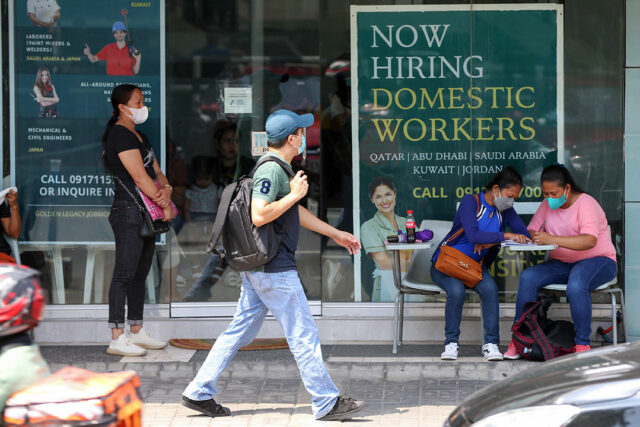
Demand for Filipino migrant workers seen to continue

Applicants are seen outside an employment agency in Manila on Wednesday, June 8, 2022. — PHILIPPINE STAR/KRIZ JOHN ROSALES

DEMAND for Filipino workers is expected to continue, as wealthier countries with aging populations look to fill labor shortages, the World Bank said on Monday.

“Given the need of migrants from other countries, think about nurses, the demand is going to increase. The population of the Philippines is younger and younger. There is an expectation that both the supply of international demand and the supply from the Philippines, the number of migrants, is going to increase,” Quy-Toan Do, lead economist of the World Bank’s Development Research Group, told reporters on the sidelines of a briefing in Bonifacio Global City.

In the World Development Report 2023 released in April, the World Bank noted that wealthy countries will need foreign workers to sustain their economies and “honor their social commitments to older citizens.”

“Many middle-income countries, traditionally the main sources of migration, will soon need to compete for foreign workers — and many are not ready to do so. Low-income countries have large numbers of unemployed and underemployed young people, but many of them do not yet have skills in demand in the global labor market,” it added.

In the Philippines, around two million workers or 5% of the labor force leave for temporary foreign jobs each year, the World Bank said.

In some parts of the Philippines, it noted that the rate of emigration is twice higher than the national average.

“We are comfortable making predictions that in 2050, the Philippines is still an expanding and a young population. The challenge of the (Philippine) demographic is not an aging population, but a young population that needs to find jobs either domestically or internationally. Making the economy of the Philippines productive is the challenge,” Mr. Do said.

The Philippines’ working-age population, covering those 15 years old and over, is estimated at 77.17 million as of May 2023, according to data from the statistics agency.

Mr. Do said that the country is “very much at the forefront” of maximizing the gains of migration, but noted the government should work on improving skills of workers.

“Migration is important both for destination countries and countries of origin. In destination countries, migrants bring relevant skills, dynamism, and diversity. In countries of origin, migrants provide vital support,” World Bank Country Director for the Philippines Ndiamé Diop said.

Digital technology will also make migration more efficient, he added.

“Digital technology allows, for example, a country like the Philippines to tap the talent that exists overseas while they are there. It will allow many workers to provide their services from a distance, in some cases even without leaving the Philippines,” Mr. Diop said.

“There’s a huge potential in the patterns of immigration and the way it contributes to destination countries, but also to home countries. I’m pleased the Philippines has made it a top priority. Digital technology will really be transformational not only for migration policies but in many areas in government,” he added.

Meanwhile, World Bank Senior Economist Soonhwa Yi said that there is a need to ramp up data collection to better manage migration.

“International migration is costly, mainly low skilled migrants incur these costs out of pocket. These may prevent poor, low skilled migrants from opportunities; this may push them to an irregular migration path that may offer cheaper options,” she said.

Ms. Yi also noted the importance of the reintegration of returnee migrants, citing the need for a comprehensive reintegration strategy. This would include support for employment, skills development, and social assistance.

Initiatives to support reintegration include pre-departure counseling and opportunities to develop skills to enhance employability.

The World Bank report also showed that Philippine migrants who have been able to accumulate “sufficient assets” will likely return to the domestic market.

Meanwhile,  Staffhouse International Resources Managing Director Marc Capistrano said one of the challenges that Filipino nurses face is that the education system in the Philippines does not meet the standards of the destination countries.

“The Philippines is widely regarded as the model of managing labor migration. Unfortunately, we are also one of the slowest. We’re all for protective mechanisms, but protection doesn’t mean being a hindrance or making it longer to gain opportunities. As long as the worker is recruited ethically and employers are (reputable), there should be no reason it should be delayed,” he said.

REMITTANCES
With the continued deployment of migrant workers, the Philippines will likely see a steady increase in remittances.

“All the trends seem to suggest that as more people migrate and have better jobs, remittances are going to increase and cost of remittances will drop. We see the increase in the volume of transfers. There are many factors that can change, which adds uncertainty, but remittances over the years have shown to be very stable and resilient,” Mr. Do said.

According to the World Bank report, the Philippines was the fourth top recipient of remittances in 2021.

Bangko Sentral ng Pilipinas (BSP) Deputy Director Mynard Bryan R. Mojica said that finance technology channels can help increase efficiency and lower costs of transactions.

In 2022, cash remittances sent home by overseas Filipino workers jumped by 3.6% to $32.54 billion.

For the first four months of the year, cash remittances increased by 3.2% year on year to $10.49 billion. — Luisa Maria Jacinta C. Jocson

GCash receives Great Place to Work certification

For consistently promoting the values of inclusivity, teamwork, and leadership in the workplace, leading mobile wallet GCash recently earned the Great Place to Work (GPTW) Certification after employees gave high scores to their employer and workplace.

The GPTW annual research represents more than 12 million employees from thousands of organizations in over 50 countries.

“Here at GCash, our goal is not just financial inclusion, but inclusion in every possible way. This certification proves that GCash employees are highly motivated by the company’s ideals. Together, we have created tons of positive impact in the community, but remain humbled as there is always room for growth. A company that nurtures its employees develops a great culture and ultimately, an exceptional business.” says GCash CEO Martha Sazon.

GCash scored highly in the categories of inclusivity, teamwork, and leadership behavior with an impressive 88%, 84%, and 82% respectively. From the three categories, employee sentiment revealed that they trust their leaders, are supportive of each other, and at the same time have the liberty to be themselves.

GCash understands the crucial role that leadership behavior plays in shaping the organizational culture and employee experience. By aligning leaders’ behavior with the company’s strategy and values, GCash inspires and motivates its employees.

Furthermore, the survey revealed that 88% of GCash employees believe that the management promotes inclusive behavior, avoids discrimination, and ensures fair appeals. Notably, 95% of employees stated that people within GCash are treated fairly, regardless of their sexual orientation.

GCash has also recently announced its new Life Partner Benefits program which extends its comprehensive benefits to employees with LGBTQIA+ and domestic partners. Employees will only be required to submit minimal documents to enable them to declare their partners as their dependents, excluding a marriage certificate.

Additionally, 92% of GCash employees expressed satisfaction in their contributions to the community through their work, this reaffirms GCash’s efforts to effectively communicate its vision and values, creating a sense of purpose and direction among employees.

“GCash’s dedication to creating an exceptional workplace goes beyond individual rewards. Rather, it revolves around the trust employees have in their leaders,” said Robert Gonzales, GCash Chief People Officer.

To learn more, visit https://www.gcash.com.


Spotlight is BusinessWorld’s sponsored section that allows advertisers to amplify their brand and connect with BusinessWorld’s audience by enabling them to publish their stories directly on the BusinessWorld website. For more information, send an email to online@bworldonline.com.

Join us on Viber at https://bit.ly/3hv6bLA to get more updates and subscribe to BusinessWorld’s titles and get exclusive content through www.bworld-x.com.

First Gen secures LNG cargo from Shell Eastern

FIRST GEN Corp. has secured a cargo of liquefied natural gas (LNG) from Shell Eastern Trading Pte. Ltd., marking a significant development in its interim offshore terminal project.

In a stock exchange disclosure on Monday, Lopez-led First Gen said the supplier, which trades as Shell Eastern LNG, is set to deliver about 154,500 cubic meters of LNG cargo between August and September to its subsidiary First Gen Singapore Pte. Ltd.

The listed energy company said it had conducted a successful international tender offer on July 7, awarding its first LNG cargo contract to Shell Eastern LNG.

The cargo will be transported by an LNG carrier, which will then handle the gassing-up and cooling-down of the BW Batangas FSRU or floating storage regasification unit at Subic Bay, before transferring the cargo into storage tanks on board.

The BW Batangas is the FSRU of First Gen subsidiary FGEN LNG Corp. and BW LNG. It will provide LNG storage and regasification services to First Gen’s existing and planned gas-fired power plants and third-party terminal users.

After the LNG transfer into the storage tanks, the BW Batangas will then return to FGEN LNG’s terminal in Batangas to complete commissioning activities.

“The LNG to be purchased by FGEN will subsequently be utilized by FGEN’s existing gas-fired power plants in the First Gen Clean Energy Complex in Batangas City,” First Gen said.

First Gen’s four natural gas-fired power plants with a combined capacity of 2,017 megawatts are currently being supplied by the Malampaya gas field.

Meanwhile, FGEN LNG has achieved the mooring and securing of the BW Batangas FSRU at the import terminal in Batangas. The vessel will remain there until it is set to collect the first LNG cargo that will be delivered by Shell Eastern LNG.

“The FGEN LNG Terminal will accelerate the ability to introduce LNG to the Philippines, to serve the natural gas requirements of existing and future gas-fired power plants of third parties and FGEN’s affiliates. FGEN believes the FGEN LNG Terminal will play a critical role in ensuring the energy security of the Luzon grid and the Philippines,” First Gen said.

LNG is being put forward as a solution to the country’s power needs amid a looming power crisis due to the expected depletion of the Malampaya gas field, the country’s only indigenous supply of natural gas.

Separately, Prime Infrastructure Holdings, Inc. and First Gen are jointly working to develop a gas aggregator framework that is expected to streamline the distribution of natural gas from the Malampaya field and imported LNG.

To recall, Prime Infra and First Gen have signed a memorandum of understanding for the proposed lease and operation of the latter’s LNG storage and regasification terminal.

The framework aims to blend Malampaya indigenous gas with imported LNG, which they call a “least-cost solution” to ensure energy security while also providing a competitive power generation market. — Ashley Erika O. Jose

FILRT targets 12,400-square-meter portfolio expansion

FILINVEST REIT Corp. (FILRT) is planning to add a total of 12,400 square meters (sq.m.) to its portfolio as it seeks new revenue sources, the company said on Monday.

In a regulatory filing, the real estate investment trust backed by listed property developer Filinvest Land, Inc., said its portfolio expansion includes new leases and coworking spaces.

FILRT said the addition covers up to 7,000 sq.m. in new leases from co-working facility operators and new business process outsourcing (BPO) tenants. It is also in talks with two major BPO firms that are looking to expand its current leases, it added.

As of the end of the first quarter, It placed its weighted average lease expiry at 7.1 years, which is expected to increase as new leases and renewals for the year begin.

The company said that a New York-based firm is planning to add two floors in one of its 16 buildings in Northgate Cyberzone in Alabang, while another BPO firm based in Europe is expected to add 2,300 sq.m. of office space. FILRT did not give out other details.

“We are glad to announce our fresh wins, as we strive to meet the renewed demand for high-quality office spaces from both new and existing tenants who recognize the value of our sustainability thrust,” FILRT President and Chief Executive Officer Maricel Brion-Lirio said.

“This will allow us to grow and diversify our portfolio of sustainable commercial properties that elevate the lives and well-being of our community,“ Ms. Brion-Lirio added.

The company is accelerating it coworking or flexible office space solutions in partnership with “the largest provider in the Philippines to ably respond to the shifting customer demand brought about by hybrid work setups.”

Its parent firm, Filinvest Land, earlier announced a joint venture agreement with flexible office provider KMC to develop, manage, operate, and maintain flexible workplaces.

“This will not only provide an additional source of revenues but it also balances the office leasing portfolio,” the company said.

FILRT also aims to diversify its office portfolio by reducing the concentration on large BPO names and increasing the share of coworking and traditional tenants in the mix.

It said the company’s strategy is to expand in key central business districts in Metro Manila and toward major regional hubs in the Philippines with high and stable occupancy and deliver added value by driving more efficient and sustainable operations costs.

The company is also planning on expanding its portfolio to other asset classes such as retail, leisure, residential, and industrial properties.

FILRT gained 6.79% or 22 centavos to close at P3.46 per share on Monday. — Adrian H. Halili

ADVERTISEMENT
ADVERTISEMENT