Home Blog Page 4559

ADB sees PHL posting fastest expansion in Southeast Asia this year, 2024

The pale sun casts an orange hue on the morning skies while rising beyond buildings as seen from the Mabini Bridge in Manila on Friday. — PHILIPPINE STAR/MIGUEL DE GUZMAN

THE PHILIPPINE ECONOMY is still expected to post the fastest growth in Southeast Asia this year and in 2024, according to the Asian Development Bank (ADB).

In its Asian Development Outlook (ADO) released on Wednesday, the multilateral lender said it kept the 6% gross domestic product (GDP) growth projection for the Philippines for 2023, and 6.2% for 2024.

This is the fastest growth forecast among Southeast Asian economies this year, followed by Vietnam (5.8%), Indonesia (4.8%), Malaysia (4.7%), Thailand (3.5%) and Singapore (1.5%).

In developing Asia, the Philippines’ growth outlook was the second fastest for 2023, after India’s 6.4%.

The ADB’s 2023 forecast for the Philippines is at the low end of the government’s 6-7% full-year target.

For 2024, the ADB expects the Philippines and Vietnam to expand by 6.2% — the fastest in Southeast Asia. However, this is below than the Philippine government’s 6.5-8% goal for next year.

The ADB said it maintained the growth projections for the Philippines as robust investment and private consumption fueled the 6.4% GDP expansion in the first quarter.

However, the first-quarter GDP print was weaker than the revised 7.1% growth in the previous quarter and 8% in the first quarter of 2022. It was also the slowest economic expansion in two years.

The ADB also noted that improving employment, rising production and retail sales, as well as “brisk” private and public construction supported the Philippines’ growth outlook.

“Tourism bounced back, and growth remained strong for business process outsourcing and information services,” it added.

The ADB kept its inflation forecast for the Philippines at 6.2% this year and 4% in 2024, the highest in Southeast Asia. These projections are above the Bangko Sentral ng Pilipinas’ 5.4% average inflation forecast for 2023 and 2.9% in 2024.

DEVELOPING ASIA
Meanwhile, the ADB kept its 2023 growth forecast for developing Asia at 4.8% but trimmed its estimate for next year to 4.7% from the 4.8% projection given in April.

“Asia and the Pacific continue to recover from the pandemic at a steady pace. Domestic demand and services activity are driving growth, while many economies are also benefiting from a strong recovery in tourism. However, industrial activity and exports remain weak, and the outlook for global growth and demand next year has worsened,” ADB Chief Economist Albert Park said in a statement.

The ADB noted that interest rates in the United States and other advanced economies are “likely to shape regional growth.”

“If inflation is tamed more quickly than currently expected in the advanced economies, the authorities there will likely adopt a more dovish monetary policy, which would support growth in the region,” it said.

On the other hand, the regional growth outlook may face challenges arising from elevated financial stability risks, uncertainty over Russia’s invasion of Ukraine, and the El Niño weather pattern.

“Any escalation (in Ukraine) could renew energy and food security challenges and rekindle inflation,” the ADB added.

For Southeast Asia, the ADB trimmed the 2023 growth forecast to 4.6% from 4.7% in April. It also slightly lowered the 2024 outlook to 4.9%, from 5% in April.

“Weaker global demand for manufactured exports has slowed growth even as domestic demand remained intact. Private consumption continued to be the primary driver of economic growth in the first half of 2023, buoyed by improved labor market conditions and income across Southeast Asia,” it said.

The recovery in the tourism sector and China’s economic rebound would support Southeast Asia’s growth.

The ADB expects inflation in developing Asia to slow to 3.6% this year from its previous forecast of 4.2%, with inflation seen to further decelerate to 3.4% next year.

The multilateral lender also slightly lowered its inflation forecast for Southeast Asia. Inflation is now projected to ease to 4.3% this year from its previous forecast of 4.4%, and to further slow to 3.2% in 2024 from 3.3% previously.

However, the ADB noted that core inflation remained elevated in East and Southeast Asian economies.

“With lower inflation in developing Asia and more moderate monetary tightening in the United States, most central banks in the region have kept policy rates steady this year, with signs emerging of a shift toward easier money,” the ADB said.

The BSP has paused its tightening cycle in June, keeping its policy rate unchanged at 6.25% for two straight meetings. Since May 2023, the BSP raised borrowing costs by 425 bps to tame inflation. — Luisa Maria Jacinta C. Jocson


Q2 GDP growth likely slowed to 5.6%

CONSUMER SPENDING likely remained lackluster in the second quarter amid elevated inflation. — PHILIPPINE STAR/MIGUEL DE GUZMAN

PHILIPPINE economic growth likely slowed to 5.6% in the second quarter, as still-elevated inflation continues to dampen consumer spending, First Metro Investment Corp. (FMIC) and the University of Asia and the Pacific (UA&P) said.

“I do expect a slowdown in the second quarter to 5.6%,” Victor A. Abola, an economist at UA&P, said at a virtual briefing on Wednesday. “It’s really the carryover of inflation to the second quarter, even though it’s lower, people are still a bit more reluctant.”

The 5.6% gross domestic product (GDP) growth projection would be slower than the 7.5% in the second quarter of 2022. It would also be weaker than the first quarter print of 6.4%, which was the slowest in two years.

FMIC and UA&P gave a 6.1% full-year GDP growth forecast for 2023, which is at the low end of the government’s 6-7% target.

Mr. Abola said he expects the economy to bounce back in the second half as inflation is seen to settle within the central bank’s 2-4% by the fourth quarter.

“We’re already seeing a turnaround in inflation rate, that’s why the second-half (growth) will be much more robust compared to what we expect to see in the second quarter,” Mr. Abola said.

Inflation decelerated for the fifth straight month to 5.4% in June. This was the slowest in 14 months or since the 4.9% clip in April last year. Year-to-date inflation settled at 7.2%

“Actually, inflation will touch 3% and even go below 3% year on year by the fourth quarter. That means, interest rates will have to go down because you cannot have a very big gap between your nominal yield and the inflation rate.”

Mr. Abola sees inflation averaging 5.5% this year, a tad higher than the central bank’s 5.4% forecast.

FMIC Executive Vice-President Daniel D. Camacho said the Bangko Sentral ng Pilipinas (BSP) will likely keep policy rates steady at 6.25% for the rest of the year, before it starts its policy easing in 2024.

The Monetary Board kept its key rate at 6.25% for the second straight meeting last month. This was after it raised borrowing costs by 425 basis points (bps) from May 2022.

“We seem to be nearing the end of the tightening cycle. That’s going to help shore up market sentiment,” FMIC Head of Research Cristina S. Ulang said at the same briefing.

Inflation and interest rates are still higher in the Philippines compared with its regional peers, she noted, adding there is a “long way to go” before inflation falls below the BSP’s 2-4% target.

“That is why our recommendation [for market players] is to position while the sentiment is still negative. Eventually there is going to be a turning point, inflation is going to return to 2-4%. The BSP may no longer consider following the Fed hiking some more because the argument for hiking is no longer there,” she said.

Ms. Ulang added that policy easing may start by the first quarter next year.

INFRASTRUCTURE RECOVERY
For 2024, the Philippine economy may grow by 6.5%, mainly driven by the recovery in infrastructure, Mr. Abola said.

He noted that infrastructure spending should focus on addressing the housing backlog. The government is planning to spend 5-6% of GDP on infrastructure until 2028.

President Ferdinand R. Marcos, Jr. earlier issued a directive to implement the “Pambansang Pabahay Para sa Pilipino” program.

“It’s a huge program to address the six-million-unit housing backlog and they’re targeting one million housing units per year compared to the 200,000-300,000 that we produce every year. So, there’s going to be a lot of employment,” Mr. Abola said.

The program focuses on building affordable and accessible homes in selected areas, with the goal of clearing the housing backlog before Mr. Marcos steps down by mid-2028.

Mr. Abola also said that the debt-to-GDP ratio is on track to fall to 60.2% in 2023 and 59.6% in 2024.

As of end-March, the government’s debt-to-GDP ratio stood at 61%, slightly higher than the 60.9% seen as of end-December. This was also still above the 60% threshold considered manageable by multilateral lenders for developing economies.

He also expects gross international reserves to end the year at $102 billion, slightly higher than the BSP’s $100-billion projection.

The dollar buffers stood at $99.8 billion as of end-June. — Keisha B. Ta-asan

PEZA hopes moratorium on NCR ecozones will be lifted within the year

PHILIPPINE STAR/MICHAEL VARCAS

THE MORATORIUM on new economic zones (ecozones) in the National Capital Region (NCR) is expected to be lifted within the year, the Philippine Economic Zone Authority (PEZA) said.

PEZA Director-General Tereso O. Panga said Malacañang appears receptive to lifting the moratorium, which has been in place since June 2019.

“We met with the Presidential Management Staff (PMS) and the Office of the President (OP) and they’re inclined to support our position that the moratorium under Administrative Order (AO) 18 is effectively superseded by the Corporate Recovery and Tax Incentives for Enterprises (CREATE) law,” Mr. Panga told reporters on July 13.

Issued by then-President Rodrigo R. Duterte, AO No. 18 declared a moratorium on the approvals of new ecozones in the NCR in order to boost countryside development.

The PEZA believes the moratorium should be lifted to align policy with provisions of the CREATE law, which makes no distinction between economic zones established in the capital region or elsewhere.

“We hope it could happen within the year since it is in the CREATE law. In the industry and locational tier, it has identified Metro Manila as part of Tier I and then information and communications technology (ICT) eligible activities for Metro Manila locations,” Mr. Panga said.

He noted most developers seeking to establish ecozones in Metro Manila usually focus on information technology (IT) projects. 

Mr. Panga said the PEZA is awaiting Malacañang’s proclamation for the establishment of an IT center in Metro Manila.

PEZA earlier said it had prequalified an ecozone project worth P4.12 billion that would establish an IT center in Makati City.

“Actually, we’re awaiting now the proclamation of an IT center located in Metro Manila. That will now trigger and pave the way for the others to be proclaimed as well. That will now be the precedent,” Mr. Panga said, adding the PEZA has already endorsed 10-20 projects in Metro Manila for the President’s approval.

Mr. Panga said the creation of new ecozones in NCR would address concerns that there is a lack of office space for new players in the IT sector.

“IT locators, especially the new entrants, the preferred location is actually Metro Manila. That’s where they will set up their initial operations, and then later on they will move to provinces for expansion projects,” he said.

“Some of the local government units in Metro Manila are not hosting at all any IT projects. So if they do, they want to take advantage of this lifting of moratorium,” he added.   

Sought for comment, Leechiu Property Consultants Chief Executive Officer David Leechiu said in a Viber message that lifting the moratorium on new ecozones in NCR would be positive for the property sector.

“This is a fantastic development. This move will encourage more business process outsourcing firms to expand in the Philippines and after which they will expand in the provinces. This will encourage more development and improve investor confidence in the Philippines,” Mr. Leechiu said. — Revin Mikhael D. Ochave

United Airlines readies direct Manila-San Francisco flights

UNITED Airlines will be flying a daily service from Manila to San Francisco starting Oct. 30 eastbound, the US carrier said on Wednesday.

Although still subject to government approval, the new flight will be United Airlines’ first trans-Pacific service from Manila since it started its Manila operation in 1982.

“We are excited to launch the new nonstop service from Manila to San Francisco to meet strong requests from our customers on both sides of the Pacific,” said Wally Dias, regional director of sales for Greater China, Korea, and Southeast Asia.

“We have more than 40 years of a long and rich history in the Manila market and the launch of our first trans-Pacific service truly shows our continued strong commitment to the Philippine market,” he added.

Mr. Dias said the new nonstop flight will not only give customers from Manila daily service to San Francisco but also open more than 70 destinations in the mainland US, Canada, and Latin America through the airline’s San Francisco hub.

San Francisco International Airport is United Airlines’ largest airport on the US west coast, which also serves as a gateway to Asia-Pacific.

The airline operates more than 200 daily departures from the San Francisco airport to more than 100 destinations around the globe.

The newly launched flights between Manila and San Francisco are among the Asia-Pacific direct flights the airline will offer this coming winter, which are flights to Auckland and Christchurch in New Zealand; Brisbane, Melbourne, and Sydney in Australia; Haneda, Narita, and Osaka in Japan; Seoul in South Korea; as well as Papeete, Singapore, Shanghai, Hong Kong, and Taipei.

Before the newly launched service, the airline has been operating nonstop service to Guam and Palau from Manila.

Meanwhile, the country’s flag carrier Philippine Airlines (PAL) said on Wednesday that it “welcomes additional competition” on the routes, calling it “a sign of the strength and vitality of the air travel market between the Philippines and the United States.”

“PAL has always embraced healthy competition among different players across our network,” it said in a statement.

PAL said it operates 37 weekly flights on US routes, including double daily flights to Los Angeles, daily flights each to San Francisco and Guam, and several weekly flights to New York and Honolulu.

The Civil Aviation Board (CAB) also welcomed the entry of United Airlines.

“We are also excited to welcome more American travelers as the present administration opens more avenues for foreign investment and tourism,” CAB said in a statement, adding that the US is home to millions of Filipinos and a “vital partner” in nation-building.

“Once the additional route is operated, travelers will have more options, which is very timely since we are riding a wave of increasing demand post-pandemic. While we all know that airline operations are extremely complex and especially at the birthing of a new route, we are hoping for the success of this route, and stand ready to provide the appropriate regulatory atmosphere,” it added. — Justine Irish D. Tabile

Emperador set to expand distillery in Scotland

EMPERADOR, Inc. on Wednesday said that it is set to expand its distillery facility in Scotland to support the listed spirits maker’s long-term growth plans.

In a regulatory filing, the company said the facility which handles production for its United Kingdom-based subsidiary Whyte and Mackay Group Ltd., is expanding the Invergordon Distillery to 92 hectares from an initial 45.4 hectares.

Emperador said the expansion was in response to the growing demand for whisky worldwide.

The company added that the expansion will enable the facility to have additional warehouse space for up to an additional 1.5 million casks of maturing whisky. The facility is set to be built over the coming decades.

“This expansion is part of Emperador’s continuing efforts to strengthen our production in response to growing demands for single malt whisky in various markets worldwide,” said Winston S. Co, its president and chief executive officer.

“We want to address the scarcity of aged liquids globally, and this will allow us to strengthen and support a core segment of our business,” Mr. Co added.

Whyte and Mackay owns four single malt whisky brands in its portfolio: Tamnavulin, Jura, Fettercairn, and The Dalmore.

“Scotch Whisky is a business that requires very long-term planning and the acquisition of this site reflects the scale of our ambition, not just for the next few years but for many decades to come,” said Whyte and Mackay Chief Executive Officer Bryan Donaghey.

Emperador earlier said that it was planning to further expand its whisky business. For the year, it allocated about P6 billion for the business out of the P7-billion capital expenditures for the company.

The company also said that the P6-billion budget for the whisky business will be used to upgrade five facilities in Scotland in line with its goal to achieve double single malt sales.

Emperador is a global spirits conglomerate focused on brandy and whisky. It owns Whyte and Mackay, and other brands such as Fundador Brandy, The Dalmore, Jura, and Tamnavulin single malt Scotch whiskies.

The company is listed on the Philippine Stock Exchange and Singapore Securities Exchange.

At the local bourse, it dropped by 0.48% or 10 centavos to finish at P20.90 per share on Wednesday. — Adrian H. Halili

PLDT gets NTC nod for two cable landing stations

BW FILE PHOTO

PLDT Inc. said on Wednesday that it received provisional authority from the National Telecommunications Commission (NTC) to construct two new cable stations.

The two new stations in Baler, Aurora, and Digos, Davao del Sur will host the Apricot cable system, an intra-Asia submarine cable that faces the Pacific side of the Philippines.

They will give telecommunication companies alternate routes that do not traverse the usual West Philippine Sea waters, PLDT said in a press release.

“The Apricot cable system’s route ensures a significantly higher degree of resilience. When our Baler and Davao cable landing stations are completed, PLDT will have alternate sites facing the Pacific, making it easier to hook up to data offices in the US,” said PLDT President and Chief Executive Officer Alfredo S. Panlilio in a statement.

The new cable landing facilities and the Apricot cable system are expected to be completed by 2025 and will connect the Philippines to Japan, Singapore, Indonesia, Taiwan, and Guam.

The cable system will further augment PLDT’s international capacity and raise it to more than 140 terabytes per second once fully equipped.

It is also expected to help PLDT in delivering higher speeds and lower latency in and out of the Philippines, and add resiliency to its existing landing stations in Batangas, La Union, and Daet in Camarines Norte.

“As we help position the Philippines as the new hyperscaler destination and major transit hub in Asia, we continue to upgrade and build on the foundations of PLDT’s global network infrastructure,” said Mr. Panlilio.

“These investments enable us to provide superior digital services to our consumer and enterprise customers, deliver newer technologies with our 4G, and 5G capabilities, and add value for attracting hyperscalers and investors to expand their cloud in the country,” he added.

As of the end of the first quarter, PLDT’s fiber footprint reached 231,000 kilometers of international fiber and over 874,000 kilometers of domestic fiber, the company said.

At the stock exchange on Wednesday, shares in PLDT climbed P17 or 1.32% to P1,306 apiece.

Hastings Holdings, Inc., a unit of PLDT Beneficial Trust Fund subsidiary MediaQuest Holdings, Inc., has a majority stake in BusinessWorld through the Philippine Star Group, which it controls. — Justine Irish D. Tabile

LRMC to deploy fourth-generation train set for LRT line 1 by July 20

PHILIPPINE STAR/KRIZ JOHN ROSALES

LIGHT RAIL TRANSIT Line 1 (LRT-1) private operator Light Rail Manila Corp. (LRMC) is set to deploy the initial fourth-generation train set by July 20.

“LRMC has remained steadfast in upgrading the commuter experience and committed to our mission of delivering safe and efficient transport since we took over the operations in 2015,” said Juan F. Alfonso, president and chief executive officer of LRMC.

“Today marks another significant milestone in modernizing our train infrastructure with the inauguration of our first new generation-4 train,” he said, adding that the launch is a testament to private-public partnership “successfully working for the Filipino people.”

The generation-4 train set has a total capacity of 1,388 passengers per trip and four light rail vehicles (LRVs) per train set have already completed the required series of safety checks, inspections, trial runs with minimum kilometers and acceptance tests.

In the first year of its full operations, the new generation train sets will increase daily ridership to 300,000 from the existing 280,000 a day.

LRMC started receiving in January 2021 the generation-4 train sets, which were manufactured by Mitsubishi Corp. and Construcciones y Auxiliar de Ferrocarriles.

LRMC will initially deploy the first train set on July 20, which will be followed by the deployment of one train set for each succeeding week after.

At present, 20 fourth-generation train sets are in the Philippines, the company said, adding that the remaining 10 train sets are expected to be delivered between November 2023 and February 2024.

The complete deployment of the 30 train sets on the main line is expected by the fourth quarter of 2024 or when the LRT-1 Cavite Extension Project opens.

Department of Transportation Secretary Jaime J. Bautista expects the new train sets to improve the operational efficiency at the LRT-1.

“These new LRVs, purchased at more than P12.8 billion, are equipped with an advanced passenger information system, a new signaling system and ice-cold air-conditioning — leading to a vastly enhanced passenger experience,” Mr. Bautista said.

“The evolution of LRT-1 is not finished. It will continue to upscale in step with advancements in technology,” he added.

The first phase of the LRT-1 Cavite Extension Project, which is a public-private partnership between LRMC and the government, is currently at an 88% completion rate.

The project involves the extension of the existing LRT-1 line by adding another 11.7 kilometers, eight new stations with a provision for two more future stations plus facilities’ works.

LRMC is the joint venture of Ayala Corp., Metro Pacific Light Rail Corp., and Macquarie Infrastructure Holdings (Philippines) Pte. Ltd.

Metro Pacific Light Rail is a unit of Metro Pacific Investments Corp., which is one of three Philippine subsidiaries of Hong Kong’s First Pacific Co. Ltd., the others being PLDT Inc. and Philex Mining Corp.

Hastings Holdings, Inc., a unit of PLDT Beneficial Trust Fund subsidiary MediaQuest Holdings, Inc., maintains interest in BusinessWorld through the Philippine Star Group, which it controls. — Justine Irish D. Tabile

Private firms’ gas aggregation plan seen as shield vs LNG price spikes

REUTERS

THE PROPOSAL of Prime Infrastructure Capital Inc. and First Gen Corp. for gas aggregation may likely shield the Philippines from the volatility of liquefied natural gas (LNG) prices, the country’s Energy chief said.

“That’s what we are trying to prevent from happening in terms of spikes in the price of imported LNG and the plan is to blend the lower price of Malampaya natural gas with the imported LNG so that we can soften the impact or the volatilities of imported LNG,” said Raphael P.M. Lotilla, secretary of the Department of Energy (DoE), in an interview with One News.

Mr. Lotilla said the companies’ proposal could soften the impact of any unforeseen surges in LNG prices.

Prime Infra and First Gen are jointly working to develop a gas aggregator framework that is expected to streamline the distribution of natural gas from the Malampaya field and imported LNG.

First Gen is one of the seven proponents of LNG terminal projects in the Philippines. The Lopez-led energy company is developing an integrated LNG and regasification terminal. It recently secured a cargo of LNG from Shell Eastern Trading Pte. Ltd.

Prime Infra, through its subsidiary, Prime Energy Resources Development B.V., is a member of the Malampaya consortium, the others being UC38 LLC and state-led PNOC Exploration Corp.

President Ferdinand R. Marcos, Jr. in May signed the extension agreement renewing the service contract for the Malampaya gas field until 2039.

“One of the things that the President did was to extend the service contract of the Malampaya for another 15 years and that’s because the present production from Malampaya has been on the decline as anticipated because it is finite or limited resource,” Mr. Lotilla said.

Mr. Lotilla also said that though the supply from Malampaya is expected to dwindle, it is necessary to extend the contract as it would also encourage the consortium to drill new wells near the Malampaya field.

“Towards 2024, we are going to see the actual drilling in the near fields,” he said.

The Malampaya consortium is expected to spend around $600 million on new drilling within Service Contract 38, including drilling for two new wells at the gas field as part of its commitment under the contract renewal. — Ashley Erika O. Jose

With Flavors of the Orient, chef Jereme Leung gives a taste of summer in China

CONRAD GAROUPA

WHILE Conrad Manila is welcoming chef Jereme Leung as part of its Legendary Chefs series, he is no stranger to the country.

He has been part of the Conrad since it opened in 2016. His China Blue by Jereme Leung restaurant at the hotel ranked ninth in Tripadvisor’s list of Top 10 Fine Dining Restaurants in Asia.

Mr. Leung will have a set menu called Flavors of the Orient as part of the Legendary Chefs promotion at China Blue until July 23 (Sunday).

His menu gives diners as taste of a summer in China, as the dishes included ingredients fit for the season.

The meal starts with two chunks of marinated lobster with coriander-lime jelly nuzzled between sheets of crispy bean curd, strewn with edible flowers. This tasted light, refreshing, and luxurious; a contrast to its more aggressive companion. The lobster shared space with deep-fried seafood kataifi (a Greek pastry resembling threads) with otak-otak (a Southeast Asian fish cake) and a lemongrass skewer. This was definitely more flamboyant with the contrast in textures between the crispy kataifi and the soft fish cake, accompanied by the strong aroma of the lemongrass.

The soup was definitely calmer: it was made of double-boiled merry fruit, peach gum, sea cucumber, dry moon clam and matsusake mushroom, with a single black chicken dumpling. Light and restorative, it was almost medicinal and mystical in taste, while the black chicken dumpling acted like a grounding influence that kept the soup firmly on earth.

Next came a steamed garoupa fish with sun-dried ginger, a sweetish red chili jam, black bean paste, swimming in superior chicken stock (the adjective “superior” comes from its Chinese origins, being made as well with Chinese ham). The fish, with its mild, white, and sweetish flesh, was a willing canvas for the rest of the ingredients, and media guests at the table quietly savored the rich but clean superior stock.

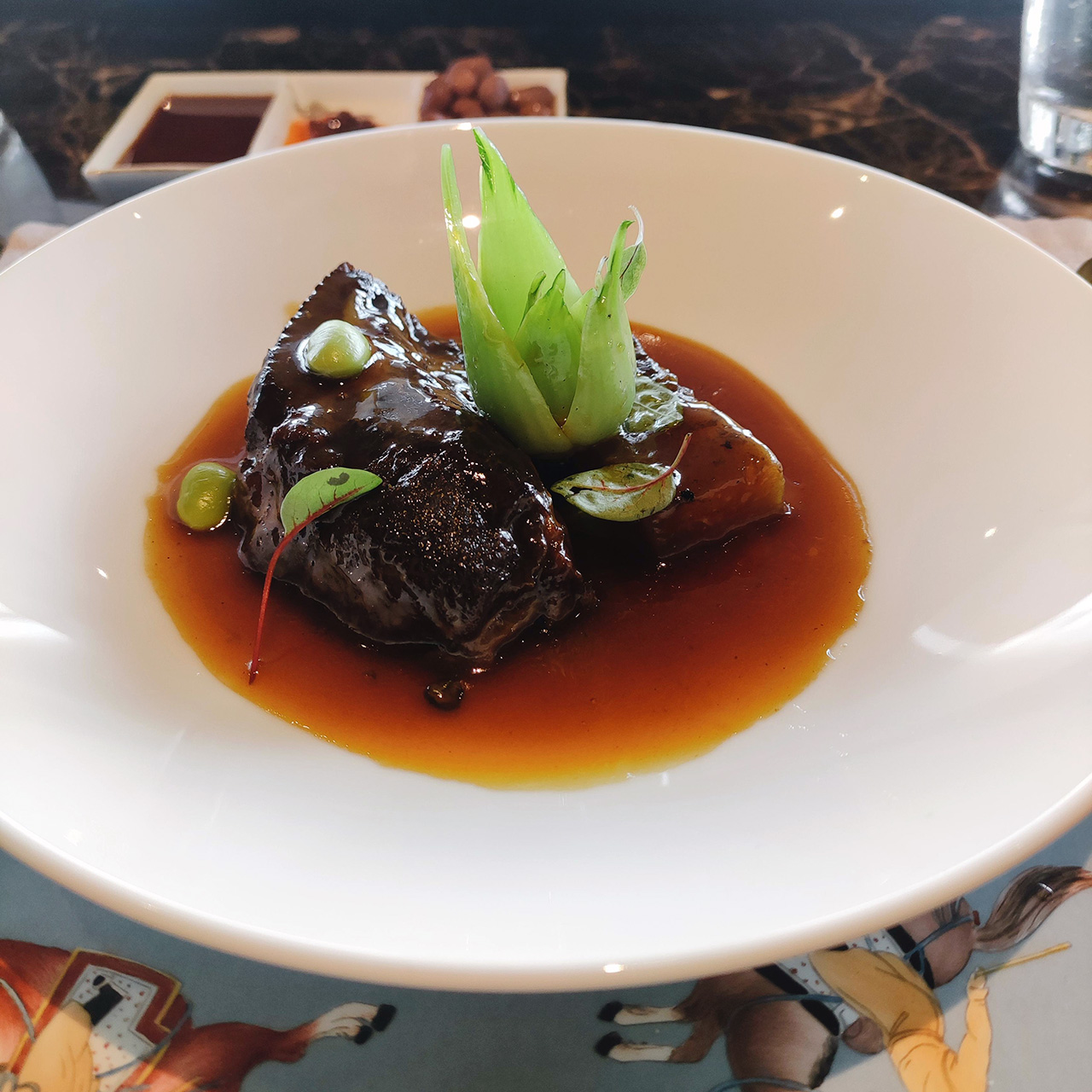
After that, we were served boneless short ribs (slow cooked for 2.5 hours) flavored with green pepper and barbecue sauce, accompanied by a radish marinated in the same sauce. The beef in its tenderness seemed almost liquid as it yielded to the slightest touch of the fork, in contrast to its very powerful beef flavor.

Finally, the main courses were punctuated with black sesame fried rice with dried scallop, seafood, and spring onion egg white “pearls.” This dish had a lovely toasted flavor, and the shrimps and scallops scattered within the rice added a punch.

The meal ended with hawthorn berry ice cream drizzled with Chinese sweet vinegar caramel, with an onion pancake at the side. The ice cream was topped off with a hawthorn syrup disc, made by reducing and cooling the syrup until it was quite solid and sliced into translucent discs. Strangely enough, the ice cream and its syrup disc tasted like its more common sibling, the Chinese candy haw flakes, and it was an experience to nibble at what tastes like a childhood treat in such a luxurious variation.

“Essentially, we still take inspiration from the traditional recipes, and it’s not something out of the blue,” said Mr. Leung when asked how his modern and luxurious interpretations of Chinese cuisine are approached by those more familiar with traditional Chinese food.

Many of the ingredients used in the set menu, such as merry fruit, were not as familiar. This prompted China Blue to show off the fruit in its raw form, resembling a nut.

“Our objective is really to introduce some of the less common ingredients. But while they are less common here, they are not unseen in China,” he said.

While the Legendary Chefs series kicked off last month with Thai chef Juthakorn “Mink” Suraksa and Mr. Leung for July, the series will be rounded out with Italian chef Valerio Pierantonelli from the Conrad Singapore Orchard in August.

Zeny Iglesias, public relations consultant for Conrad Manila, said that the promotion is due to market demand. “People are looking for new things,” she said.

Mr. Leung’s inclusion in the Legendary Chefs series is more than a bit of flattery. He has a Star Diamond Award from the American Academy of Hospitality Science, placing him among the ranks of Paul Bocuse and and Wolfgang Puck.

In an interview with BusinessWorld, he said that he’s about to open five new restaurants this year: two in China; and one each in Taipei, Kuala Lumpur, and Macau.

“If you ask me if I want to retire tomorrow, I don’t. Literally, it’s too late to become a car salesman now. For me, personally, my development and the continuation of opening new restaurants and developing new dishes is not about myself anymore. It’s really about all those people, good people, who have worked with me over the years,” he said.

The Flavors of the Orient set menu is available from July 18 to 23 at China Blue by Jereme Leung at Conrad Manila. The set menu costs P6,588 nett per person. — Joseph L. Garcia

How to be a CEO

RAWPIXEL.COM-FREEPIK

(Part 3)

Given the vertiginous and rapidly changing technological environment in which business and similar organizations have to operate during these times of Industrial Revolution 4.0, we may have to re-examine the traditional route taken by those aspiring to reach top levels of management in the next 20 years or so. There should be an alternative to the practice of college graduates working first for some two to four years before enrolling in an MBA program of some prestigious business school here or abroad before starting in earnest to climb to the top. The name of the game today is continuous retooling, reskilling and upskilling up to the very end of one’s professional life. The sooner one gets into this almost lifetime cycle, the better.

I am glad that the business school in Barcelona where I spent some time in 1963 as a research assistant and case writer and another two years on a sabbatical leave as a visiting professor in 2006 to 2007 has once again pioneered an innovative program that can shorten the period of acquiring an academic training in business and management before one can start joining this lifetime of learning necessary in today’s highly technical and complex environment. Thanks to a recently new program introduced by the IESE Business School in its Madrid campus, any recent college graduate in whatever specialization who has developed critical thinking skills, effective communication and the ability to relate one science to another can enroll in a program that takes only 11 months to complete. IESE, like most other top business schools in the US and Europe, still retains its traditional MBA program that requires about two to four years of work experience before anyone can be admitted to the program. In fact, IESE was No. 1 in the world in 2021 in the quality of its MBA program in the ranking of The Economist and No. 3 in 2023 in that of the Financial Times. What is remarkable is that it has been No. 1 in its Executive Education program year in and year out from 2015 to 2023, according to the Financial Times. It has to be pointed out that executive education programs (whether open or customized) are the ultimate in reskilling, upskilling or retooling of practicing managers or executives. They are taken by those who are already in middle management and are very effective in helping those aspiring to reach the top.

Precisely because a master’s degree in business is not terminal and must be followed up by almost a lifetime of professional learning, the sooner a young college graduate is able to acquire the foundational knowledge and skills needed for this continuous learning process, the better for them, not only in getting settled in a full-time job but to start building a family. I personally find it socially undesirable for those graduating from college to postpone marriage until their early 30s or even 40s because of the amount of time and financial resources it takes to obtain an MBA. That is why I am glad to know some of our graduating students at the University of Asia and the Pacific (as well as other Philippine universities) are taking an interest and enrolling in the Master in Management (MiM) program at the IESE Business School in Madrid.

This MiM is an 11-month program that admits qualified applicants who are fresh graduates from a college program or with 0 to two years of work experience. Thus, the average age of those who have been admitted in the first few years of the program is 23 years, young enough for those belonging to Generation Z to start their full-time job before they are 25 and to think of marriage before the age of 30, thus contributing to avoiding the demographic suicide that many developed countries have already committed (including China). Like all the other programs at IESE, 80% of the curriculum is delivered through the case method, partly making up for the lack of work experience. The program’s core courses build a solid foundation of business management knowledge on key themes ranging from marketing and finance to strategy and economics. Projects allow the participants to integrate, connect and apply what they learn. Practical experience and complementary activity unlock knowledge of how different areas are combined to create both economic and noneconomic value within companies. The entire course lasts 11 months. After the last Core Period (Period 5), students can attend an optional period in some other foreign country. During this period, the MiM students can join a social entrepreneurial project in a developing economy, do their internship in a company of their choice or start working in a full-time job.  In today’s exchange rate, the tuition cost is P2.7 million, which can be covered partially by a student loan or a scholarship for deserving students.

Alternative programs are offered by another top European business school, INSEAD in France, which offers a Master in Management program that lasts 14 to 16 months and requires practically no work experience (average working experience of participants is 0.8 year and the average age is 22). The cost is P2.9 million. Also highly rated is the one-year MBA program of IMD in Lausanne, Switzerland. This requires, however, three to eight years of work experience with the average age of participants at 25 to 34 years. Equivalent programs offered by local business schools are those of the Asian Institute of Management called the International Master in Business Administration, a 12-month full time program, requiring at least two years of work experience and costing about P1.44 million. Also, more traditional MBA programs (requiring work experiences) are those of De La Salle University (two years, P137,000); Ateneo de Manila University (two years and four months, P352,355); the University of the Philippines (one year and eight months full time, P189,000); the University of Sto. Tomas (two years, P98,450); and San Carlos University in Cebu (three years part time, P105,000). As indicated above, the costs of obtaining a masteral degree in business in the top European business schools are prohibitive for most Filipino centennials (the US business schools can be even more expensive). Thus, we can expect most of our young professionals aspiring to rise to top management positions to continue enrolling in the traditional MBA programs that require some years of experience. The only exception is the Master of Science in Management program of the University of Asia and the Pacific, which has been offered since 1989. Those high school graduates entering an undergraduate program in business are given the option of taking a four-year course that culminates with a bachelor’s degree in management or a five-year program, after which they obtain a Master in Science in Management. 

The main message I am sending to Generation Z is to learn the fundamentals of management as early as possible in your professional career because you have no alternative but to continue taking numerous short courses, seminars, workshops and tutorials as you rise the management ladder. Those who specialized in their undergraduate years in subjects directly related to business or management may not even have to take a masteral program. They have enough fundamental knowledge to be able to effectively upskill, reskill and retool themselves along the way. Those who took up engineering , sciences, philosophy, law and other nonbusiness subjects are the ones well-advised to enroll as early as possible in an equivalent Master in Management program that will provide them with the fundamental knowledge and skills in business and management so they can rise to the top of management by constant reskilling and upskilling themselves through the numerous executive education programs that are increasingly being offered by the leading business schools here and abroad.

(To be continued.)


Bernardo M. Villegas has a Ph.D. in Economics from Harvard, is professor emeritus at the University of Asia and the Pacific, and a visiting professor at the IESE Business School in Barcelona, Spain. He was a member of the 1986 Constitutional Commission.

bernardo.villegas@uap.asia

AboitizPower units forge solar supply deal

ABOITIZ Power Corp. (AboitizPower) said its subsidiaries entered into a power supply agreement with Nexif Ratch Energy Investments Pte. Ltd. for the supply of solar energy.

The power supply deal was forged with its retail electricity arm Adventenergy, Inc. and its renewable energy arm AP Renewables, Inc. (APRI), AboitizPower said.

“As an energy retailer, we need to address the needs of our customers, one of which is their interest in knowing where their power comes from, given how more consumers want to take part in the energy transition,” James Byron Yu, first vice-president and head of retail of AboitizPower, said in a media release.

The supply will be sourced from the 74-megawatt-peak solar project of Nexif Ratch in Calabanga, Camarines Sur which is expected to be completed by the second quarter of next year.

“This will further grow [Adventenergy] and APRI’s portfolio of customers from the commercial and industrial market. The partnership amongst the companies is a response to the call to promote the use of renewable energy (RE) and for businesses to adopt sustainable practices in their operations,” AboitizPower said.

Nexif Ratch, a Singapore-based energy company, earlier said that it intends to sell about 85% of the generated energy output of its solar project to subsidiaries of AboitizPower.

“As such, we have made it our mission to expand our RE supply through partnerships such as the supply agreement we’ve recently signed with Nexif Ratch. This way, we can address the demands of our customers and make RE more accessible to those who wish to shift to a more sustainable source of energy,” Mr. Yu said.

Nexif Ratch is a joint venture company of Nexif Energy of Singapore and Ratch Group of Thailand. It manages and owns an energy portfolio with a combined capacity of 4 gigawatts spread across Southeast Asia and Australia.

At the local bourse on Wednesday, shares in AboitizPower gained 80 centavos or 2.35% to end at P34.80 apiece. — Ashley Erika O. Jose

Ikea Philippines introduces new menu items

IKEA Philippines recently introduced new menu items at its bistro and cafe at the Mall of Asia complex in Pasay City.

IKEA introduced plant-based meatballs with a sweet chili sauce, a meatless cutlet with Japanese curry sauce, salted egg chicken wings and a sausage croissant.

Chocolate eclairs, egg tarts, and turon (local banana fritters) were also added to the dessert menu.

Millnaire Ylagan, kitchen production manager for IKEA Philippines, said the meatless cutlets are made of apples and pea protein to mimic the taste of meat. The plant-based options are also in line with Ikea’s sustainability goals.

“We have this goal set by global (headquarters). As IKEA, one of our core values is caring for people and planet. We have a goal that by 2030, all our menus should be 50% plant-based,” he said in a mix of English and Filipino.

The cutlets and the turon are Mr. Ylagan’s recipes but had to be approved by the IKEA headquarters before its rollout.

Some of the dishes, such as the sweet chili sauce and the salted egg wings are regional delights that are being introduced to the local market. “If it performs well, we carry it,” said Mr. Ylagan.

Alexander Busa, manager for IKEA Philippines’ Swedish Food Market, Bistro, and Cafe, said local relevance is one of the priorities for the Swedish giant here in the Philippines.

Mr. Ylagan said diners can expect new dishes like pares (beef stewed in a sweet brown sauce) and lechon (roast pig) later this year. — Joseph L. Garcia