Home Blog Page 4556

Travel BPO Philippines: Cynergy BPO — How Cutting-Edge Tech is Revolutionizing Outsourcing and Customer Experience (CX)

The fevered tempo of the 21st century continues to quicken, demanding an evolution in travel industry standards, particularly in customer experience (CX). In the tropical enclave of the Philippines, a profound transformation is taking place. A symbiotic blend of technology and travel business process outsourcing (BPO) is propelling a seismic shift in CX. The fulcrum for this revolution is Cynergy BPO, a pioneering advisory firm linking global travel enterprises with the dynamic, tech-savvy BPO landscape of the Philippines.

“At the heart of this paradigm shift is technology,” notes Cynergy BPO’s CEO John Maczynski. “Emerging technologies are rewriting the rules of engagement in BPO, infusing our approaches with innovative strategies that drive efficiency, reduce costs, and enhance customer experience and loyalty.”

So, what are these groundbreaking technologies shaping customer experiences in the travel industry? Let’s delve deeper.

Artificial Intelligence (AI) and Machine Learning (ML) have swiftly moved from being sci-fi buzzwords to integral components of the modern BPO infrastructure. They imbue automated processes with intelligence, driving efficiency in virtual assistants and predictive analytics. These advancements pave the way for more responsive self-service options and present a treasure trove of actionable insights into customer behaviors.

The advent of Robotic Process Automation (RPA) has brought further sophistication. Through the application of “bots,” rule-based tasks are swiftly and accurately completed, optimizing efficiency, minimizing errors, and unshackling human agents to devote their energies to value-added tasks requiring the warmth of human interaction.

On the data front, cloud computing and cloud-based CX platforms offer game-changing advantages. These powerful tools provide flexible, cost-effective solutions for data storage and management, and security, all while facilitating seamless access to customer data and enhancing cross-platform support. Then, there’s the magic of advanced analytics, capturing the minutiae of customer interactions and feedback, painting a vivid picture of customer needs and behavior patterns. This level of understanding brings forth personalized and effective service, serving as a lodestone for customer loyalty.

In our increasingly interconnected world, ensuring consistent and seamless customer experiences across all channels — be it voice, social media, email, or chat — is paramount. Here, omnichannel solutions serve as the linchpin, ensuring customers receive the same high-quality service regardless of their chosen platform. “In the Philippines, we’re witnessing a harmonious melding of human talent and technology,” says Ralf Ellspermann, CSO of Cynergy BPO. “Artificial Intelligence is augmenting, not replacing, human capabilities, enabling Filipino agents to deliver empathetic, personalized, and responsive service, and elevating CX to unparalleled heights.”

While the promise of these technologies is exhilarating, their successful integration demands strategic planning, robust infrastructure, and a keen understanding of the industry — elements firmly in the wheelhouse of the outsourcing advisory firm. “With our expertise and connections, we not only foster strategic partnerships, but also guide travel firms through the intricacies of tech-infused outsourcing,” says Mr. Ellspermann. “Our primary goal is to ensure that the integration of these technologies aligns with the company’s vision, enhances CX, and delivers operational efficiency and cost reduction.”

In the dawning age of tech-driven outsourcing, the Philippines, under the watchful eye of Cynergy BPO, stands at the forefront. With their successful integration of cutting-edge technologies into everyday operations, Philippine BPOs are redefining industry benchmarks in efficiency, cost-effectiveness, and CX, heralding a bold new era for the global travel industry.


Spotlight is BusinessWorld’s sponsored section that allows advertisers to amplify their brand and connect with BusinessWorld’s audience by enabling them to publish their stories directly on the BusinessWorld website. For more information, send an email to online@bworldonline.com.

Join us on Viber at https://bit.ly/3hv6bLA to get more updates and subscribe to BusinessWorld’s titles and get exclusive content through www.bworld-x.com.
IMF edges 2023 global economic growth forecast higher, sees persistent challenges

A participant stands near a logo of the International Monetary Fund at the annual meeting in Nusa Dua, Bali, Indonesia, Oct. 12, 2018. — REUTERS/JOHANNES P. CHRISTO/FILE PHOTO

WASHINGTON — The International Monetary Fund on Tuesday raised its 2023 global growth estimates slightly given resilient economic activity in the first quarter, but warned that persistent challenges were dampening the medium-term outlook.

The IMF in its latest World Economic Outlook said inflation was coming down and acute stress in the banking sector had receded, but the balance of risks facing the global economy remained tilted to the downside and credit was tight.

The global lender said it now projected global real GDP growth of 3.0% in 2023, up 0.2 percentage point from its April forecast, but left its outlook for 2024 unchanged, also at 3.0%.

The 2023-2024 growth forecast remains weak by historical standards, well below the annual average of 3.8% seen in 2000-2019, largely due to weaker manufacturing in advanced economies, and it could stay at that level for years.

“We’re on track, but we’re not out of the woods,” IMF chief economist Pierre-Olivier Gourinchas told Reuters in an interview, noting that the upgrade was driven largely by first-quarter results. 

“What we are seeing when we look five years out is actually close to 3.0%, maybe a little bit above 3.0%. This is a significant slowdown compared to what we had pre-COVID.”

This was also related to the aging of the global population, especially in countries like China, Germany and Japan, he said. New technologies could boost productivity in coming years, but that in turn could be disruptive to labor markets.

The outlook is “broadly stable” in emerging market and developing economies for 2023-2024, with growth of 4.0% expected in 2023 and 4.1% in 2024, the IMF said. But it noted that credit availability is tight and there was a risk that debt distress could spread to a wider group of economies.

The world is in a better place now, the IMF said, noting the World Health Organization’s decision to end the global health emergency surrounding COVID-19, and with shipping costs and delivery times now back to pre-pandemic levels.

“But forces that hindered growth in 2022 persist,” the IMF said, citing still-high inflation that was eroding household buying power, higher interest rates that have raised the cost of borrowing and tighter access to credit as a result of the banking strains that emerged in March.

“International trade and indicators of demand and production in manufacturing all point to further weakness,” the IMF said, noting that excess savings built up during the pandemic are declining in advanced economies, especially in the United States, implying “a slimmer buffer to protect against shocks.”

While immediate concerns about the health of the banking sector – which were more acute in April – had subsided, financial sector turbulence could resume as markets adjust to further tightening by central banks, it said.

The impact of higher interest rates was especially evident in poorer countries, driving debt costs higher and limiting room for priority investments. As a result, output losses compared with pre-pandemic forecasts remain large, especially for the world’s poorest nations, the IMF said.

LOWER INFLATION
The IMF forecast that global headline inflation would fall to 6.8% in 2023 from 8.7% in 2022, dropping to 5.2% in 2024, but core inflation would decline more gradually, reaching 6.0% in 2023 from 6.5% in 2022 and easing to 4.7% in 2024.

Gourinchas told Reuters it could take until the end of 2024 or early 2025 until inflation came down to central bankers’ targets and the current cycle of monetary tightening would end.

The IMF warned that inflation could rise if the war in Ukraine intensified, citing concern about Russia’s withdrawal from the Black Sea grain initiative, or if more extreme temperature increases caused by the El Nino weather pattern pushed up commodity prices. That in turn could trigger further rate hikes.

The IMF said world trade growth is declining and will reach just 2.0% in 2023 before rising to 3.7% in 2024, but both growth rates are well below the 5.2% clocked in 2022. 

The IMF raised its outlook for the United States, the world’s largest economy, forecasting growth of 1.8% in 2023 versus 1.6% in April as labor markets remained strong.

It left its forecast for growth in China, the world’s second-largest economy, unchanged at 5.2% in 2023 and 4.5% in 2024. But it warned that China’s recovery was underperforming, and a deeper contraction in the real estate sector remained a risk.

The fund cut its outlook for Germany, now forecast to contract 0.3% in 2023 versus a 0.1% contraction in April, but sharply upgraded its forecast for the UK, now expected to grow 0.4% versus a 0.3% contraction forecast in April.

Euro zone countries are expected to grow 0.9% in 2023 and 1.5% in 2024, both up 0.1 percentage point from April.

Japan’s growth was also revised upward by 0.1 percentage point to 1.4% in 2023, but the IMF left its outlook for 2024 unchanged at 1.0%.

INTEREST RATES STILL RISING
The rise in central bank policy rates to fight inflation continues to weigh on economic activity, the IMF said, adding that the US Federal Reserve and the Bank of England were expected to raise rates by more than assumed in April, before cutting rates next year.

It said central banks should remain focused on fighting inflation, strengthening financial supervision and risk monitoring. If further strains appeared, countries should provide liquidity quickly, it said.

The fund also advised countries to build fiscal buffers to gird for further shocks and ensure support for the most vulnerable.

“We have to be very vigilant on the health of the financial sector … because we could have something that basically seizes up very quickly,” Gourinchas said. “There is always a risk that if financial conditions tighten, that can have a disproportionate effect on emerging market and developing economies.”

The IMF said unfavorable inflation data could trigger a sudden rise in market expectations regarding interest rates, which could further tighten financial conditions, putting stress on banks and nonbank institutions – especially those exposed to commercial real estate.

“Contagion effects are possible, and a flight to safety, with an attendant appreciation of reserve currencies, would trigger negative ripple effects for global trade and growth,” the IMF said.

Fragmentation of the global economy given the war in Ukraine and other geopolitical tensions remained another key risk, especially for developing economies, Gourinchas said. 

This could lead to more restrictions on trade, especially in strategic goods such as critical minerals, cross-border movements of capital, technology and workers, and international payments. — Reuters

No happy dance on the agenda as Fed ponders resilient US economy

FEDERALRESERVE.GOV

WASHINGTON — With the Federal Reserve steaming toward another interest rate hike this week, policymakers face a choice over how much weight to put on recent economic data that has made hoped-for outcomes on inflation and unemployment seem more likely while also posing a risk the economy is too strong to keep prices in line.

Since the US central bank’s policy meeting in June, inflation has slowed more than expected towards the Fed’s 2% target, with many analysts arguing a cycle of moderating price hikes is underway and should continue without further rate increases beyond the quarter-percentage-point hike broadly expected to be announced on Wednesday.

But the sense of optimism in a Fed-orchestrated ‘soft landing’ – a scenario in which inflation falls, unemployment remains relatively low and a recession is avoided – has also buoyed financial markets in ways that could counter the central bank’s aims, something policymakers are likely to guard against with a still-tough inflation-fighting message despite where the data have been pointing.

The Fed “does not want to be head-faked by the recent deceleration in inflation and declare victory too soon,” Diane Swonk, chief economist at KPMG, wrote on Monday, concluding that the central bank will leave its options open for further increases in borrowing costs. “Financial markets have consistently front-run the Fed … That has already eased credit conditions and could stoke an acceleration in growth.”

The rate-setting Federal Open Market Committee is expected to lift its benchmark overnight interest rate to the 5.25%-5.50% range when it releases its latest policy statement at 2 p.m. EDT (1800 GMT) on Wednesday. Fed Chair Jerome Powell will hold a press conference shortly after to elaborate on the decision.

BALANCING RISKS
In the six weeks since their June 13-14 meeting, Fed policymakers have digested data offering a mirror image of what they faced a year ago. 

At that time, six months of contracting economic activity seemed to show a recession developing, prices were rising fast, and central bankers had accelerated rate hikes to a pace expected to make any downturn even worse.

Now the issue is how much blue sky to acknowledge. Last summer’s Fed meetings, were conducted in an atmosphere of deep concern about a surge in inflation to four-decade highs and the economy’s fate as the Fed tried to expunge it. 

Since then the unemployment rate has been little changed at 3.6%, growth has run consistently above trend, and still the Fed’s preferred measure of inflation has fallen from 7% in June of 2022 to 3.8% as of this past May.

That’s still nearly double the central bank’s 2% target, and some officials worry it will prove increasingly difficult to cover the remaining ground if the economy remains as resilient as it currently appears.

Signs of a slowdown are there, to be sure, and some policymakers expect more weakness is coming – an argument for caution in considering further rate increases.

But with monthly job growth still above 200,000 as of June and wage increases outpacing inflation, households may be able to keep spending and foil the consumption slowdown some Fed officials feel is needed to wring out the rest of the excess inflation.

Indeed, the International Monetary Fund on Tuesday raised its outlook for US economic growth this year, saying the resilient consumption evident in the first part of 2023 was “a reflection of a still-tight labor market that has supported gains in real income and a rebound in vehicle purchases.”

NO ‘SUDDEN STOP’
US stock markets have been rising and other measures of financial conditions show some conditions loosening even as the Fed tries to restrict the economy. In fact, a new central bank financial conditions index shows peak tightness may have been hit late last year.

Over the course of the second quarter, an Atlanta Fed “nowcast” of economic growth for that three-month period has jumped from a 1.7% annualized rate to 2.4% on the basis of strengthened consumer spending, stronger business investment, and a larger contribution from government spending.

The change crossed a significant line, moving from just below the Fed’s 1.8% estimate of trend growth – and a level that should thus continue to temper inflation – to significantly above it. 

The first estimate for second-quarter gross domestic product will be issued on Thursday, with economists anticipating a 1.8% rate of growth versus 2.0% in the first quarter.

Still, unless there’s a sharp drop in activity soon, it could mean Fed officials have underestimated the economy’s strength and may become doubtful about the prospect of a continued decline in inflation.

Fed officials in June projected GDP would grow just 1.0% in 2023, an outlook that “basically requires a sudden stop in the economy in the second half of the year,” wrote Tim Duy, chief US economist for SGH Macro Advisors. “We already have enough visibility on the third quarter to know that isn’t happening.”

That will likely keep the door open to more rate increases – for now. US central bankers were caught out in 2021 when their initial analysis of rising inflation attributed it to forces, like a supply shock and pandemic-era spending, that they thought would pass with time. 

Even if that now appears to be happening two years later, they’ll likely be slow to take the win.

“It’s not clear yet how much growth the Fed will tolerate during a period of softer inflation numbers,” Duy said, with the focus possibly shifting towards the evolution of the real economy alongside the data on prices.

“We think that Powell will lead market participants to broaden their focus beyond the inflation numbers by explaining that for the Fed to be confident it will restore price stability, it needs to see further cooling in demand evidenced by GDP growth slowing substantially, softer job growth, and further downward pressure on wage growth.” — Reuters

North Korea to welcome China and Russia with military display after pandemic isolation

KCNA VIA REUTERS

SEOUL — After years of pandemic isolation, North Korea has invited its friends back this week, hosting senior Chinese and Russian delegations for 70th anniversary commemorations of the Korean War and the struggle against the United States and its allies.

The visiting dignitaries, which include Russian Defence Minister Sergei Shoigu and Chinese Communist Party Politburo member Li Hongzhong, are expected to be presented with one of North Korea’s signature events: a massive military parade showcasing its latest weaponry.

Analysts say the spectacle will likely include the North’s nuclear-tipped missiles banned by the United Nations Security Council, where Russia and China are permanent members.

The visits are the first known foreign delegations to visit North Korea since the COVID-19 pandemic began, and come as Pyongyang has looked to deepen its ties with Beijing and Moscow, finding common ground in their rivalries with Washington and the West.

Thursday’s holiday, in which North Korea celebrates what it sees as a victory over US-led allied forces in the 1950-1953 Korean War, provides a chance for Pyongyang to highlight the Cold War days when North Korean troops fought with Chinese and Russian support.

North Korea is still technically at war with the US-led alliance after fighting ended in an armistice, rather than a formal peace treaty.

“North Korea inviting delegations from both countries seems to be a case of history rhyming, whereby Pyongyang is gearing up to stand up against the West, but perceives the need to maintain relatively balanced ties with both China and Russia,” said Anthony Rinna, a specialist in Korea-Russia relations at Sino-NK, a website that analyses the region.

Only time will tell if the visits signal a broader easing in North Korea’s bans on international travel, which could in theory provide an opening for US officials to negotiate the release of US soldier Travis King, who crossed into North Korea last week, Rinna said.

However, it seems unlikely that Pyongyang will seek to engage with Washington any time soon, and may consider itself to be in a full-scale New Cold War with the United States, he added.

MILITARY DISPLAYS
Images from Russia’s defence ministry and North Korean media showed Shoigu being greeted by North Korean defence minister Kang Sun Nam and Russian ambassador Alexander Matsegora at the airport, and rows of North Korean and Russia troops.

The United States has accused North Korea of providing weapons to Russia during the war in Ukraine, including an arms delivery of infantry rockets and missiles to the Kremlin-backed Wagner mercenary group in November 2022.

Pyongyang and Moscow have denied those claims, but Kim has vowed to bolster strategic cooperation between the nations.

The military parade in Pyongyang is likely to include as many as 15,000 personnel, and possibly feature new designs of nuclear-capable weapons, said Yang Moo-jin, a professor at the University of North Korean Studies in Seoul.

Commercial satellite imagery over recent weeks have shown participants practicing, including in downtown Kim Il Sung Square where the event will take place, with large formations showing the number “70” and other slogans, said Dave Schmerler, a researcher at the James Martin Center for Nonproliferation Studies (CNS).

At a training ground outside Pyongyang, military units appeared to be practicing marching around the square track with vehicles behind them, Schmerler added, citing imagery provided to Reuters by US-based firm Umbra, which used radar imaging satellites to peer through cloud cover.

‘SHUTTLE DIPLOMACY’
Leader Kim Jong Un kicked off commemorations this week with visits to a cemetery for Chinese soldiers who fought in the war, known as the Fatherland Liberation War, state media KCNA reported on Wednesday. The only defence treaty China and North Korea have is with each other.

Kim also visited the Fatherland Liberation War Martyrs Cemetery on Monday, KCNA reported, as he praised the soldiers for “inflicting defeat” on US imperialism.

Amid international sanctions over North Korea’s missile and nuclear programmes – which both Moscow and Beijing voted to impose – China has become by far North Korea’s largest trading partner. China’s exports to its secretive neighbour in June were eight times higher than a year before.

Beijing asserted on Monday that it “strictly” implements UN sanctions on North Korea.

Russia and China have rebuffed recent attempts by the United States and some European countries to impose new sanctions on North Korea.

They have instead pushed for existing measures to be eased for humanitarian purposes and to entice Pyongyang back to denuclearisation talks, which broke down in 2019.

Yang said the delegations could signal that long-stalled diplomatic visits could resume.

“If North Korea also sends a high-level delegation to China for the upcoming Hangzhou Asian Games, it means the resumption of high-level ‘shuttle diplomacy’ between North Korea and China since the COVID-19 pandemic,” he said. — Reuters

US Senate backs measure requiring reporting on China tech investments

RAWPIXEL.COM-FREEPIK

WASHINGTON — The US Senate overwhelmingly backed legislation on Tuesday that would require US companies to notify federal agencies of investments in Chinese technologies such as semiconductors and artificial intelligence.

The 100-member Senate backed the amendment to the National Defense Authorization Act (NDAA) by 91 to 6. 

The NDAA sets policy for the Department of Defense and is expected to become law later this year.

The desire for a hard line on China is one of the few truly bipartisan sentiments in the divided US Congress, and lawmakers have introduced dozens of bills seeking to address competition with China’s communist government and industries.

The amendment is a version of the Outbound Investment Transparency Act, offered by Democratic Senator Bob Casey and Republican John Cornyn to address the risks of US investment going to foreign adversaries like China.

“We need this type of outbound investment notification to understand just how much… critical technology we are transferring to our adversaries via these capital flows. With this information in hand, we can begin to take control of our economic future,” Casey said in remarks urging senators to support the amendment.

Unlike a version of the legislation the senators introduced in 2021 that failed to become law, the latest measure requires notification of some outbound investments, rather than review or prohibition of certain deals, and targets fewer industries.

The Senate also passed, by a vote of 91 to 7, an amendment to the NDAA boosting federal reviews of foreign purchases of US farmland and, in some cases, barring Chinese, Russian, Iranian or North Korean purchases of US farmland.

The final form of the NDAA, which authorizes $886 billion in defense spending, will not be determined until later this year.

The Senate is expected to pass its version, including amendments, this week. The Senate bill must then be reconciled with a bill passed in the House of Representatives earlier this month. 

That compromise measure must pass both chambers and be signed by President Joe Biden to become law. — Reuters

Puerto Rican bank sues NY Fed for suspending account in Venezuela-linked crackdown

REUTERS

NEW YORK — The New York Federal Reserve was sued on Tuesday by a Puerto Rican bank that said its access to the US central banking system could be improperly cut off following a federal crackdown on banks with links to Venezuela.

Banco San Juan Internacional (BSJI) said in a complaint in Manhattan federal court that the Fed’s New York branch informed the bank earlier this year that its “master account” – which lets banks access the Fed’s electronic payment systems – would be terminated due to concerns about its compliance with US sanctions and anti-money laundering rules.

The bank asked the court to bar the New York Fed from terminating its master account, without which it said it “cannot effectively function as a depository institution.”

A spokesperson for the New York Fed declined to comment.

BSJI said it improved its compliance program during a previous 22-month suspension of its master account between 2019 and 2020 in the wake of a federal money laundering and sanctions evasion investigation into its 2016 and 2017 credit agreements with state oil company Petroleos de Venezuela.

BSJI agreed in 2020 to pay $1 million to resolve the probe. Federal prosecutors dismissed a civil forfeiture complaint and returned $53 million in seized funds to the bank.

BSJI says the loan agreements were lawful.

Puerto Rico’s banking industry has historically had close ties Venezuela, an OPEC member. 

The New York Fed in 2019 said it would stop approving master accounts for some Puerto Rican banks due to US sanctions on Venezuela aimed at ousting socialist President Nicolas Maduro, Reuters reported at the time.

“Improper targeting of BSJI because it was founded by a Venezuelan national more than 12 years ago … is, of course, patently unreasonable (and unlawful),” BSJI wrote in the complaint, citing the Reuters story.

The bank said its founder, Marcelino Bellosta, has lived in the United States and Europe for much of the last 25 years. — Reuters

Mexico to put duties on Chinese aluminum cookware after antidumping probe

THE MEXICAN FLAG flutters during the National Flag Day event in Iguala, Guerrero State, Mexico, Feb. 24, 2021. — REUTERS

MEXICO CITY — Mexico’s government on Tuesday said it would apply compensatory duties on aluminum cookware imports originating in China whose value was below a certain level.

The announcement, which would also apply if the merchandise was being sold to Mexico via third countries, was published in a statement in the government’s official gazette, and was part of the final resolution on an antidumping probe.

Duties will apply to relevant imports lower than the reference price of $10.6 per kilogram, the statement said.

Mexico previously imposed a 92.64% duty on aluminum pressure cookers from China in 2019. — Reuters

Thousands without power as typhoon Doksuri lashes Philippines

ROAD AHEAD-UNSPLASH

MANILA – Strong winds and rain lashed the northern Philippines as Typhoon Doksuri made landfall on Wednesday, causing rivers to overflow and leaving thousands without power.

Residents in coastal communities had been evacuated ahead of the storm, which brought winds of up to 175 kilometres per hour (108 miles per hour) and is expected to sustain strength as continues its course toward Taiwan and China.

“We are being battered here,” Manuel N. Mamba, governor of northern Cagayan province told Reuters, adding that no casualties had been reported so far.

More than 4,000 passengers were stranded at various ports in the country after sea travel was suspended, the Philippine coast guard said.

Storm warnings are in place in many parts of the northern island of Luzon, which is home to about half of the Philippines’ 110 million population. 

Authorities have warned of storm surges, landslides, and damage to infrastructure. 

Doksuri, locally known as Egay, is the fifth storm to hit the Southeast Asian nation this year, which is hit by an average 20 typhoons each year. 

Scientists have warned that global warming will only make storms wetter, windier and more violent.

Categorised as a super typhoon on Tuesday, Doksuri had weakened slightly on Wednesday. 

It is expected to brush past Taiwan and make landfall in China’s Fujian province on Friday, according to the Philippines weather bureau.—Reuters

IMF raises Philippine growth forecast 

PHILIPPINE STAR/MIGUEL DE GUZMAN

By Keisha B. Ta-asan, Reporter

THE INTERNATIONAL Monetary Fund (IMF) raised its growth outlook for the Philippines to 6.2% this year from the 6% forecast it gave in April, as domestic demand is expected to remain robust.

At the same time, National Economic and Development Authority (NEDA) Secretary Arsenio M. Balisacan said economic growth further slowed in the second quarter but is unlikely to miss the full-year target.

In an e-mail, IMF Representative to the Philippines Ragnar Gudmundsson said the Philippine growth forecast for this year was revised to reflect the strong first-quarter outturn. 

The Philippine economy expanded by 6.4% in the first quarter, beating expectations, but slower than the 8% growth in the same period in 2022.

“We’ve seen that demand and growth dynamics remained strong in 2023,” Mr. Gudmundsson told reporters on the sidelines of the Philippine economic briefing in Pasay City.

The IMF’s 2023 gross domestic product (GDP) growth forecast is within the government’s 6-7% target for this year. In 2022, GDP grew by 7.6%.

However, the IMF lowered its 2024 growth projection for the Philippines to 5.5%, from 5.8% previously. This is well below the government’s 6.5-8% GDP growth target for next year.

“The forecast for 2024 has been revised slightly downwards because of global headwinds and the lagged effects of monetary policy tightening,” Mr. Gudmundsson said.

To curb inflation, the Bangko Sentral ng Pilipinas (BSP) hiked borrowing costs by 425 basis points (bps) starting from May last year to March 2023, bringing the benchmark interest rate to a near 16-year high of 6.25%.

The IMF’s Philippine growth forecasts for this year and 2024 are above its estimates for the Association of Southeast Asian Nations-5 (ASEAN-5). The IMF raised its growth outlook for ASEAN-5, which refers to Indonesia, Malaysia, the Philippines, Singapore, and Thailand, to 4.6% this year from 4.5% in April. It lowered the ASEAN-5 forecast for 2024 to 4.5% from 4.6% previously.

SLOWER Q2 GROWTH
Despite an expected slowdown in the second quarter, Mr. Balisacan told reporters that he is hoping the economy will hit the lower end of the 6-7% growth target this year.

“We will probably see (GDP) growth further moderate but not far enough to allow us to miss the target,” Mr. Balisacan said.

In order to achieve the 6% full-year growth, the economy would need to grow by an average of 5.9% in the remaining three quarters, he added.

Mr. Balisacan said consumption and easing inflation continued to support growth in the second quarter.

“One positive thing is inflation has been coming down, it’s still a bit high, but the fact that it has been going down should have helped shape the expectations about the near future and that would inspire confidence in spending,” he added.

Construction and services sector also drove growth during the April-to-June period, Mr. Balisacan said.

“We don’t expect to see (growth) in net exports, it’s risky because of the (current) global environment. And that is why our thrust is to diversify sources of growth to include also the external side,” he said.

Second-quarter GDP data will  be released on Aug. 10.

GLOBAL OUTLOOK
In its World Economic Outlook (WEO) July update, the IMF raised its 2023 global growth forecast to 3% from the 2.8% given in April, but slower than the 3.5% expansion last year.

For 2024, the IMF maintained its 3% global growth projection.

Both forecasts are well below the historical (2000-2019) annual average of 3.8%.

“The rise in central bank policy rates to fight inflation continues to weigh on economic activity,” the IMF said.

The IMF said growth in emerging and developing Asia is on track to rise to 5.3% in 2023, before slowing to 5% in 2024.

Risks to the global growth outlook include persistent inflation, a slower-than-expected recovery in China’s economy, an increase in debt distress, and intensified geopolitical tensions, the IMF said.

While inflation is easing in many countries, the multilateral lender said it still remains elevated. It sees global headline inflation to hit 6.8% this year, before easing to 5.2% in 2024. 

For the Philippines, the IMF expects full-year inflation to average 5.5% in 2023, lower than the 6.3% forecast given in April. Inflation is seen to slow further to 3.2% by 2024.

Both inflation estimates are above the BSP’s 5.4% forecast for 2023 and 2.9% next year, respectively.

“While we have recently seen some easing of fuel and food prices, it will be important to pay close attention to possible upside risks to inflation due to El Niño, wage spirals related to tight labor markets, and commodity price volatility,” Mr. Gudmundsson said.

The state weather agency announced the onset of the El Niño earlier this month and expects the weather pattern to persist until the first quarter of next year.

A P40 minimum wage hike in the National Capital Region took effect on July 16, while other regional wage boards are scheduled to decide on pending petitions in September.

The IMF said core inflation is generally declining more gradually around the world, proving to be more persistent than initially projected.

During a panel discussion at Tuesday’s Philippine economic briefing, Mr. Gudmundsson said that core inflation remains elevated in the country.

Core inflation, which discounted volatile prices of food and fuel, slowed to 7.4% in June from 7.7% in May. Core inflation averaged 7.7% so far this year. 

“We believe that the higher for longer stance [of the BSP] in the near term is still appropriate to anchor inflation expectations and ensure inflation returns to the BSP’s target range of 2-4%,” Mr. Gudmundsson said.

Meanwhile, the BSP should continue to monitor the development of monetary policy in advanced economies abroad such as the US and Europe.

“This tighter for longer stance is important not only from a domestic perspective, but also to guard against potential capital outflows. It was more of a concern last year compared to this year, but it is still relevant,” Mr. Gudmundsson said. — with Luisa Maria Jacinta C. Jocson

BSP ready to resume tightening if necessary

The Philippine central bank expects inflation to ease to within the target range of 2-4% by the fourth quarter of 2023. — PHILIPPINE STAR/MIGUEL DE GUZMAN

THE BANGKO SENTRAL ng Pilipinas (BSP) is ready to resume its policy tightening if necessary, an official said, as inflation continues to be a challenge.

“The BSP remains watchful and remains ready to resume monetary tightening as warranted by the data on the inflation outlook and domestic demand prospects,” BSP Deputy Governor Francisco G. Dakila, Jr. said during the Philippine economic briefing in Pasay City on Tuesday.

The Monetary Board hiked borrowing costs by a total of 425 basis points (bps) from May 2022 to March 2023, bringing the key rate to 6.25%.

Mr. Dakila said the focus remains on reining in elevated inflation, adding that “future monetary policy actions by the BSP will continue to be data-dependent and guided by evolving domestic developments, particularly the latest outlook on inflation and sustained economic growth.”

In a recorded message at the same briefing, BSP Governor Eli M. Remolona said inflation will be within the target range of 2-4% by the fourth quarter of 2023.   

“Our challenge now is inflation. Fortunately, the BSP’s inflation-targeting framework has served us well in the face of unusual supply shocks. We continue to focus on our mandate of price stability and have dedicated our resources and attention in pursuit of this goal,” he said.

Inflation eased to a 14-month low of 5.4% in June. However, this is still above the BSP’s 2-4% target range for the 15th consecutive month. 

For the first six months of the year, headline inflation stood at 7.2%. The BSP expects inflation to average 5.4% this year.

According to Mr. Dakila, inflation is projected to further decelerate in the coming months mainly due to base effects and the likely easing of global oil and non-oil prices. He said the BSP’s main concern is anchoring inflation expectations.   

“There was a point, during the second half of last year, when the Fed was quite aggressive in adjusting its policy rate, introducing some volatility in the exchange rate. That has been addressed by the prompt monetary policy action of the Monetary Board,” he said.    

From March 2022 to June 2023, the Fed raised its key rates by 500 bps to 5-5.25%.   

In October last year, the peso hit a record low of P59 against the dollar. Market players are concerned over another round of currency depreciation against the greenback this year, as the US Federal Reserve is still expected to raise policy rates despite its pause in June.   

Mr. Dakila said the Monetary Board will have to take into consideration how the market reacts to the possible Fed hike before discussing policy at its Aug. 17 meeting.

“By then, we will have a number of observations on how the market reacts to the Fed decision. What’s good is that we have a number of improvements that we have introduced in our policies that enhance the transmission of these instruments to market interest rates, including the 56-day BSP bill,” he said.

Last month, the BSP introduced the 56-day BSP securities to mop up excess liquidity in the financial system. It also created an overnight reference rate as the London Interbank Offered Rate expired on June 30.   

“[The BSP] should bear in mind the interest rate differential between the Fed and the Philippines in order to minimize the risk of excessive capital outflows,” IMF Representative to the Philippines Ragnar Gudmundsson said during the same briefing.

“The decision making needs to be quite nimble, but the BSP has demonstrated its ability to be nimble and take into account both domestic and external factors in its decision making,” he added.    

Meanwhile, the BSP is confident that the policy rate adjustments will not negatively affect the financial system. 

“We are confident that the policy rate adjustments as well as the years of implementation and enforcement of the BSP’s comprehensive policy tools and regulations, will not result in financial imbalances as the Philippine banking system continues to stand in a position of strength,” Mr. Dakila said.   

Based on BSP data, the net profit of Philippine banks grew by 34.9% year on year to P89.5 billion in the first quarter.

“We see banks remaining well-capitalized, well-managed and well-governed, giving us confidence that the policy rate adjustments were done without risking financial stability,” Mr. Dakila said. — Keisha B. Ta-asan

Government revenues hit P1.9 trillion in first half

The Bureau of Internal Revenue is tasked to collect P2.6 trillion in revenues this year. — PHILIPPINE STAR/ EDD GUMBAN

THE NATIONAL Government’s revenues grew by 7.7% year on year to P1.9 trillion in the first six months of the year, Finance Secretary Benjamin E. Diokno said.

“Our stellar performance was the result of higher economic activity and efficiency gains from the digital transformation of our revenue agencies,” he said during the Post-State of the Nation Address (SONA) Philippine Economic Briefing in Pasay City on Tuesday.

Data from the Department of Finance also showed that tax collections in the January-to-June period rose by 7.5%, while nontax revenues grew by 9.1%. The exact collection figures were not available.

Mr. Diokno said that the improved revenue collection was due to the digitalization efforts of the Bureau of Internal Revenue (BIR) and Bureau of Customs.

“Sustaining robust revenue collection requires a simpler, fairer, and more efficient tax system, reinforced by a combination of tax policy and tax administration measures,” he added.

The government is targeting to raise P3.729 trillion in revenues this year, equivalent to 15.2% of gross domestic product (GDP).

In a separate interview with reporters, BIR Commissioner Romeo D. Lumagui, Jr. said that the agency is hopeful it will meet its P2.6-trillion collection target this year.

“Improved services will translate to more efficient and increase in revenue collection. We want to make it easier for our taxpayers to comply with their tax obligations,” he added.

INFRASTRUCTURE
Meanwhile, Mr. Diokno said the government may ramp up spending for infrastructure.

“I won’t stop infrastructure spending because slowing it down will have negative consequences. I’m willing to increase the deficit, if necessary, as long as we continue our infrastructure projects,” he added.

The government is planning to spend 5-6% of GDP on infrastructure annually. Infrastructure spending is set at 5.3% of GDP this year, equivalent to P1.29 trillion.

“For the last 50 years before the Duterte administration, we were only spending something like 2% (on infrastructure). That’s why we suffer in comparison with our (Southeast Asian) peers. We cannot sustain this, we’ve got to increase our expenditure for infrastructure,” Mr. Diokno said.

In March, the government approved 194 flagship infrastructure projects worth P8.3 trillion that range from physical and digital connectivity, health, water, agriculture, and energy, among others.

2024 BUDGET
Meanwhile, the Department of Budget and Management (DBM) said it will submit the proposed P5.768-trillion 2024 national budget to the House of Representatives on Aug. 2.

The DBM on Tuesday submitted the National Expenditure Program (NEP) for fiscal year 2024 to President Ferdinand R. Marcos, Jr. Once it is approved by the Cabinet, the NEP will be submitted to the House.

The proposed 2024 national budget is 9.5% higher than this year’s P5.268-trillion budget.

“We will present this to Congress. We will defend the President’s budget as much as we can. Our (national) budget is a budget that is responsive to the pressing issues that we have now,” Budget Secretary Amenah F. Pangandaman said in a statement.

Under the constitution, the NEP must be presented to Congress within 30 days of the President’s State of the Nation Address.

Next year’s national budget will prioritize infrastructure development, food security, digital transformation, and human capital development. — Luisa Maria Jacinta C. Jocson

PHL slips 3 spots in global ranking of destinations for outsourcing business services

BW FILE PHOTO

By Revin Mikhael D. Ochave, Reporter

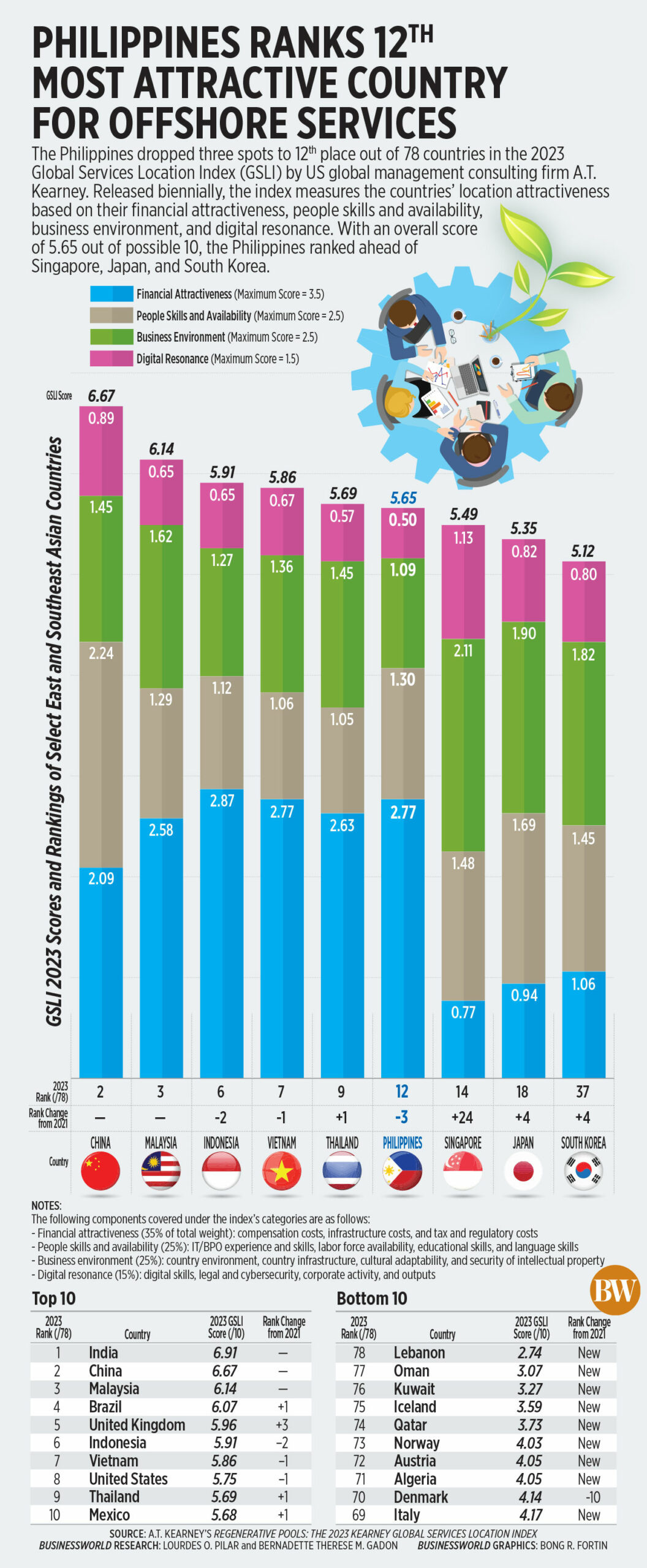
THE PHILIPPINES has dropped three spots in a global ranking that measures the attractiveness of countries as a destination for offshore and outsourcing services, according to a report by global management consultancy firm Kearney released on Tuesday.

In Kearney’s 2023 Global Services Location Index (GSLI), the Philippines slipped to 12th out of 78 countries in terms of attractiveness as an offshore location of business services, from 9th spot in the last index in 2021.

“The Philippines continues to be the business process outsourcing (BPO) engine of Asia,” Kearney said, adding that it is home to over 1,000 BPO firms that employ over 1.2 million.

However, the Philippines dropped out of the index’s top 10, replaced by Mexico.

“(Philippines) slipped three spots in this year’s GSLI, primarily because of the rise of Mexico and Colombia as nearshore capability centers with proximity to the United States,” it said.

India topped the index, followed by China and Malaysia.

“Overall, the top three countries — India, China, and Malaysia — continue to lead thanks to their immense cost advantage, abundant talent pool, and strong skills,” Kearney said, adding that India and China showed strong talent regeneration capabilities.

The rest of the top 10 included Brazil, United Kingdom, Indonesia, Vietnam, United States, Thailand, and Mexico.   

Kearney’s biannual index measures four dimensions consisting of financial attractiveness; people skills and availability of the workforce; business environment; and digital resonance.

For the 2023 ranking, the Philippines had an overall GSLI score of 5.65. The country had a score of 2.77 in financial attractiveness, 1.30 in people skills and availability, 1.09 in business environment, and 0.50 in digital resonance.   

Arjun Sethi, Kearney Asia-Pacific region chairman, said that talent regeneration, or the country’s ability to rapidly reskill to meet changing demands is vital to maintain and improve an offshore location’s attractiveness.   

“A country’s ability to reskill and redeploy its workforce in response to changing market demands and technological disruptions is key to improving its attractiveness as an offshore location for business services,” Mr. Sethi said in a separate statement.

Jack Madrid, Information Technology and Business Process Association of the Philippines  president, told BusinessWorld he was not surprised the Philippines’ ranking slipped as other locations are improving.

“Because of the strong demand for totally offshoring business, there is also an attraction for locations that are closer to North America. That’s why you have countries like Mexico, Colombia, and Costa Rica, although they are much smaller in scale compared to the Philippines and India, they’re also growing their share of the global IT-BPO market,” Mr. Madrid said via mobile phone interview.

“We should just focus on our strength because we are a leader in customer experience. We are the world’s number one experience hub, maybe not in number but in reputation and country branding,” he added.   

Mr. Madrid said the drop in the Philippines’ ranking serves as a reminder to implement workforce upskilling and reskilling to meet the surging demand and new technologies such as artificial intelligence.   

“As we go on this digital transformation journey, the skills needed will be more digital in nature and that is what we need to focus on. Let’s not worry too much about surveys. But it is a reminder of the need to upskill and reskill. Technology is moving very fast,” Mr. Madrid said.

ADVERTISEMENT
ADVERTISEMENT