Home Blog Page 4528

Peso up on inflation, Fed bets

BW FILE PHOTO

THE PESO appreciated against the dollar on Monday on expectations of easing inflation and bets that the US Federal Reserve would keep rates steady following positive data last week.

The local currency closed at P54.88 versus the dollar on Monday, inching up by three centavos from Friday’s P54.91 finish, data from the Bankers Association of the Philippines’ website showed.

The local unit opened Monday’s session at P54.888 per dollar. Its weakest showing of the day was at P54.91, while its intraday best was at P54.75 against the greenback.

Dollars traded dropped to $1.03 billion on Monday from the $1.1 billion seen on Friday.

The peso strengthened on expectations that Philippine inflation eased in July, Rizal Commercial Banking Corp. Chief Economist Michael L. Ricafort added in a Viber message.

A BusinessWorld poll of 17 analysts yielded a median estimate of 4.9% for July headline inflation.

If realized, this would be below the 5.4% in June but would match the 4.9% seen in April last year. It would also match the upper end of the Bangko Sentral ng Pilipinas’ 4.1% to 4.9% forecast.

Still, this would be the 16th straight month that the consumer price index (CPI) exceeded the central bank’s annual 2-4% target.

The Philippine Statistics Authority will release July CPI data on Friday.

“The peso appreciated after the Federal Reserve’s preferred inflation gauge came in slightly weaker than market expectations at 3%, bolstering views of no further US rate hikes for the year,” a trader said in an e-mail.

Annual US inflation rose at its slowest pace in more than two years in June, with underlying price pressures receding, a trend that, if sustained, could push the Federal Reserve closer to ending its fastest interest rate hiking cycle since the 1980s, Reuters reported.

The personal consumption expenditures (PCE) price index increased 0.2% last month after edging up 0.1% in May, the Commerce department said. In the 12 months through June, the PCE price index advanced 3%. That was the smallest annual gain since March 2021 and followed a 3.8% rise in May.

The Fed hiked interest rates by 25 basis points (bps) last week, bringing its target rate to a range between 5.25% and 5.5%.

The US central bank has now raised rates by 525 bps since it began its tightening cycle in March last year.

For Tuesday, the trader said the peso could strengthen further against the dollar as the market awaits the July inflation report.

The trader sees the peso moving between P54.60 and P54.85 per dollar on Tuesday, while Mr. Ricafort sees it ranging from P54.80 to P55. — A.M.C. Sy with Reuters

PHL stocks decline on last-minute profit taking

BW FILE PHOTO

SHARES declined on Monday due to last-minute profit taking as investors await the release of July inflation data this week.

The Philippine Stock Exchange index (PSEi) declined by 33.79 points or 0.51% to close at 6,591.47 on Monday, while the broader all shares index dropped by 10.25 points or 0.29% to 3,516.67.

“The local market lost 33.79 points to 6,591.47 due to last-minute profit taking. The market mostly traded in the green territory on anticipation of a slower inflation in July at home but it failed to sustain the momentum due to negative sentiment overseas, especially in China, as China’s factory activity for July was in contraction territory,” Philstocks Financial, Inc. Research Analyst Claire T. Alviar said in a Viber message.

Selling pressure affected the market as investors adjusted their portfolios as July came to a close, China Bank Capital Corp. Managing Director Juan Paolo E. Colet said.

The Philippine Statistics Authority will release July consumer price index (CPI) data on Friday, Aug. 4.

A BusinessWorld poll of 17 analysts yielded a median estimate of 4.9% for July inflation.

If realized, this would be below the 5.4% in June but would match the 4.9% seen in April last year.  However, this would mark the 16th straight month that the CPI exceeded the central bank’s 2-4% target.

Meanwhile, China manufacturing activity fell for the fourth straight month in July as its services and construction edged along contraction, threatening growth prospects for the third quarter, Reuters reported.

The official manufacturing purchasing managers’ index inched up to 49.3 in July from 49 in June, staying below the 50-point mark that separates expansion from contraction.

At home, most sectoral indices fell on Monday except for services, which rose by 11.22 points or 0.7% to 1,613.19, and financials, which inched up by 0.54 point or 0.02% to 1,940.59.

Meanwhile, holding firms fell by 67.99 points or 1.06% to 6,328.99; mining and oil dropped by 50.9 points or 0.48% to 10,364.31; property declined by 12.63 points or 0.46% to 2,709.85; and industrials went down 29.59 points or 0.32% to 9,176.73.

Value turnover surged to P20.07 billion on Monday with 1.95 billion shares changing hands from the P2.91 billion with 635.55 million issues seen on Friday.

Decliners narrowly outnumbered advancers, 84 versus 83, while 64 names closed unchanged.

Meanwhile, Asian shares were trying to end the month on a firm note on Monday in a week littered with major economic releases, central bank meetings and earnings updates from mega-caps Amazon and Apple, Reuters reported.

MSCI’s broadest index of Asia-Pacific shares outside Japan  climbed 0.5%, having gained 5.2% so far in July to reach a five-month high.

The initial impetus for markets was positive following Friday’s US data showing an easing in wage costs and core inflation, which fueled hopes the US Federal Reserve was done tightening. — A.H. Halili with Reuters

NFA rice inventory drops to under two days’ worth of consumption

PHILSTAR FILE PHOTO

THE rice inventory held by the National Food Authority (NFA) is currently equivalent to 1.56 days’ demand, well below the nine days targeted by the agency, due to high domestic buying prices, the Department of Agriculture said.

Agriculture Assistant Secretary Rex C. Estoperez told reporters on Monday that the NFA’s holdings totaled 50,000 metric tons (MT) as of July 27, considerably below the 300,000 MT level required to meet nine days’ demand because private traders are outbidding the NFA.

The national daily consumption rate is equivalent to 679,670 bags or 33,983.5 MT, according to the NFA.

“As of now, it seems that the NFA is not able to buy from farmers because of the high price. The private sector can buy (unmilled rice, or palay) between P21-P23 per kilo (while) the NFA buys at P19,” he said.

Istrikto kasi ang NFA sa kanyang tinatawag na equivalent net weight (The NFA is strict in buying only equivalent net weight) as the P19 buying price is for clean and dry palay, while the private traders buy freshly harvested palay at P21-P23. The NFA cannot compete,” he added.

Under Republic Act No. 11203 or the Rice Tariffication Law, the NFA has been stripped of its power to import rice and has been reduced to maintaining an emergency inventory from domestically-grown rice.

Mr. Estoperez said that the NFA Council will submit a recommendation to the President to reconsider the NFA buying price and measures to build up inventory.

The NFA Council is headed by President Ferdinand R. Marcos, Jr., who is also the Secretary of Agriculture, while NFA Administrator Roderico R. Bioco serves as vice-chairman.

Mr. Estoperez said that Mr. Marcos will meet with various agencies to discuss measures to increase rice stocks, including imports.

“Our inter agency group will update the President tomorrow whether to finalize (import deals), what volume, where to source, on a government-to-government basis,” he said. — Sheldeen Joy Talavera

Budget dep’t seeking to fully digitize gov’t procurement process

BUDGET SECRETARY AMENAH F. PANGANDAMAN — DBM

THE Department of Budget and Management (DBM) said it is working on the full digitalization of public procurement.

In a statement on Monday, the DBM said its Procurement Service (PS) is shooting for “an efficient procurement system incorporating global best practices, including the complete digitization of all government procedures,” Budget Secretary Amenah F. Pangandaman said.

“The procurement process, widely seen as the most daunting bottleneck in budget utilization due to alleged rampant corruption, interpretational ambiguities, and a lackluster capability to carry out procurement tasks within government agencies, causes service delivery delays,” the DBM added.

The PS is also working on modernizing the Philippine Government Electronic Procurement System. Improvements include an integrated e-bidding system and electronic payment facility, among others.

“An efficient procurement system underpins effective public expenditure management and fast-tracks the delivery of optimal services to the public in a timely and cost-efficient manner,” PS Executive Director Dennis S. Santiago said.

In his State of the Nation Address last week, President Ferdinand R. Marcos, Jr. called for a new government procurement law.

“I think the procurement law is too stringent. Even digitalization and payment systems are not provided for in the law,” Ms. Pangandaman said.

The DBM is also working on implementing sustainable procurement practices.

“Green procurement is synonymous with responsible procurement. The integration of green solutions into the public procurement process brings us a step closer to our ultimate aim of promoting sustainable management and utilization of natural resources by 2030,” Ms. Pangandaman added.

The DBM has recently met with the United Nations Development Programme to enhance procurement digitalization and analytics. — Luisa Maria Jacinta C. Jocson

Business group supports optional senior high

PHILIPPINE STAR/ MIGUEL DE GUZMAN

THE Management Association of the Philippines (MAP) expressed support for a measure that would make senior high school optional.

“We in the MAP support the bill introduced that seeks to examine the K-12 (Kindergarten to Grade 12) system and replace it with a K+10+2 act,” MAP CEO Conference Committee Chairperson Alma Rita R. Jimenez told the House basic education and culture committee.

“The private sector (has a) continuing preference for hiring college or university graduates over those who finish K-12 primarily because those who finished Grades 11 and 12 still lack the competencies or skills at the level required for employment,” she said.

Ms. Jimenez cited the need to streamline the K-12 curriculum “so that it can fully integrate technical and vocational education and training program to increase enterprise-based learning where the senior high school student will have more immersive experiences through certification training and exposure to actual work settings.”

The committee was considering proposed amendments to Republic Act No. 10533 or the Enhanced Basic Education Act of 2013, which added two more years to basic education with the intent of making graduates employable and globally competitive. 

Committee chairman and Pasig Rep. Roman T. Romulo said House Bill 7893 will propose “multiple education pathways,” which will involve enhancing programs run by the Technical Education and Skills Development (TESDA), making these courses a more viable option for students after Grade 10.

“Meaning, when you reach Grades 10, 11 and 12, if you want to go to college, you’ll be under DepEd (Department of Education). If you want to go to techvoc (technical and vocational education), then enroll in TESDA,” he said.

“We will require TESDA to upgrade itself,” Mr. Romulo added, noting that the agency mostly issues certifications for graduates of Customer Services NC II, a short course to train staff for department stores, supermarkets, fast food outlets, and specialty stores.

He added that only a few students receive the Bookkeeping NC III certification.

Ms. Jimenez added that TESDA should revamp its programs to make them “future-oriented” and to usher in digital transformation. Teachers and instructors should also undergo training, she noted. — Beatriz Marie D. Cruz

PHL businesses to participate in ASEAN Online Sale

ONLINEASEAN.COM

PHILIPPINE BUSINESSES are set to participate in the ASEAN Online Sale Day (AOSD), the Department of Trade and Industry (DTI) said.

The DTI said in a statement on Monday that as of July 27, some 54 businesses are expected to join the event, which is scheduled for Aug. 8-22. The e-commerce event is intended to promote cross-border trade and economic collaboration within Southeast Asia. 

The AOSD, started in 2020, is expected to boost economic ties in the region, increase consumer trust in e-commerce, and provide opportunities for micro-, small- and medium-sized enterprises.

According to the DTI, the Philippines has fielded the highest number of participating businesses in the AOSD since 2020. Last year, 120 e-commerce businesses from the Philippines participated in the event.

The DTI said that a consumer complaint mechanism will be available to mediate any complaints arising from transactions completed during the event.

An onsite edition of the event will take place in Semarang, Indonesia between Aug. 19 and 22. — Revin Mikhael D. Ochave

Travel fair claims P110 million worth of actual, potential sales

Tourists are seen at the beach of Boracay island, Aklan province. — PHILIPPINE STAR/KRIZ JOHN ROSALES

THE Tourism Promotions Board (TPB) said a travel fair which it organized in Cebu generated actual and potential sales of over P110 million.

The three-day 11th Regional Travel Fair at the SM Seaside City in Cebu featured 70 exhibitors. The TPB did not give a breakdown of sales actually booked as against sales under negotiation.

TPB Chief Operating Officer Maria Margarita M. Nograles said in a statement on Monday that the results of the fair “signal a bright future for the tourism industry in the post-pandemic era.”

The TPB said its upcoming fair in Ilocos set for October could result in an even stronger performance.  

“We desire and aim to play a major role in shaping the future of tourism by creating a one-stop shop venue for industry collaboration and partnerships,” Tourism Undersecretary Shahlimar Hofer Tamano said. — Revin Mikhael D. Ochave

No deadline set for lifeline rate registration

BW FILE PHOTO

THE Department of Energy (DoE) said it will not set a deadline to register for the lifeline rate subsidy after issuing eligibility rules for beneficiaries.

“We are not imposing a deadline for consumers availing of the discounted rate. However, unless registered, they cannot avail of the benefits,” Energy Secretary Raphael P.M. Lotilla said in a statement on Monday.

The DoE said it urged all beneficiaries listed under the Pantawid Pamilyang Pilipino Program (4Ps) to register for the electricity lifeline rate.

“There are 4.2 million household beneficiaries of 4Ps, and registration for lifeline subsidy remains very low. Only those who register will continue to receive a reduction in their electricity bills beginning August 2023,” Mr. Lotilla said.

In June, the Energy Regulatory Commission together with the DoE and Department of Social Welfare and Development, issued an advisory requiring all distribution utilities to implement the revised lifeline rate rules.

The lifeline rate is a subsidy provided to customers with a monthly power consumption of 100 kilowatt-hours or less.

Under the revised rules, customers living in condominiums, subdivisions and those with net-metering services are no longer qualified for the lifeline rate despite being under the consumption ceiling.

“If they do not avail of the program through Meralco, they will have to shell out more or less P250.00, an amount which could otherwise be spent for their other needs such as food,” Mr. Lotilla said.

“For lifeline consumers who have been struggling to make ends meet, electricity discounts could help (provide relief),” the DoE said.

Qualified customers under the lifeline rate receive discounts of between 20% and 100%, depending on their power consumption. — Ashley Erika O. Jose

Bill proposes VAT exemption for medicine

PHILSTAR FILE PHOTO

A MEASURE has been filed in the House of Representatives seeking to grant a value-added tax (VAT) exemption to both generic and branded medicine.

“Given the rising cost of living today, price controls on medicine will not make it affordable,” TGP Party-list Representative Jose J. Teves, Jr. said of his House Bill No. 8565.

“One of the reasons for high prices of medicines is the VAT that is automatically added over and above the base prices,” he added.

The burden of paying the VAT is to be shifted to manufacturers, distributors or sellers of generic and branded medicines, according to the bill.

The VAT exemption will not affect discounts available to senior citizens and persons with disabilities.

The bill requires the Department of Health and the Food and Drug Administration to submit to Congress a list of generic and branded medicine to be covered by the VAT exemption.

The Philippine Statistics Authority estimates average per capita spending of P9,839.23 for healthcare goods and services in 2021, up 17% from a year earlier. — Beatriz Marie D. Cruz

What to expect from BIR tax mapping

Most of us welcome surprises for our birthdays, anniversaries, retirements, etc. However, as a taxpayer, would you still be delighted to receive a “surprise” from the Bureau of Internal Revenue (BIR), and if it’s in the form of a visit to check your tax compliance? This “surprise” visit is known as the BIR Tax Mapping/Tax Compliance Verification Drive (TCVD).

Pursuant to Revenue Memorandum Order (RMO) No. 09-2006, TCVD aims to expand the tax base, enhance compliance, and consequently boost collection efforts. This is merely a verification of the taxpayer’s compliance with basic administrative regulations and does not involve a thorough examination of books of account and other records.

As taxpayers, our usual question might be “What do the BIR’s representatives usually check during the conduct of TCVD?” This article summarizes the items that the BIR usually looks for during “surprise” visits and penalties imposed for any noncompliance.

Certificate of Registration (BIR Form No. 2303) and Payment of Annual Registration Fee (BIR Form No. 0605)

BIR Form No. 2303, also called Certificate of Registration (CoR), gives the holder the legal right to operate a business in the Philippines. It serves as proof that a business is registered as a taxpayer with the BIR. Hence, taxpayers should ensure that they are registered with the BIR on or before the commencement of their business, before payment of any tax due, or upon filing of a return, statement or declaration as required in the Tax Code.

Additionally, per Section 236 of the National Internal Revenue Code (NIRC) of 1997, an Annual Registration Fee (ARF) in the amount of P500 for every separate or distinct establishment or place of business, including facility types where sales transactions occur, must be paid upon registration and every year thereafter on or before the last day of January. Payment of the ARF must be made using BIR Form No. 0605 to an authorized agent bank located within the revenue district, or to the revenue collection officer, or duly authorized treasurer of the city or municipality where each place of business or branch is registered.

BIR Form Nos. 2303 and 0605 must be posted in the taxpayer’s place of business in areas conspicuous to the public.

“Ask for Receipt” signage or the new Notice to Issue Receipt/Invoice (NIRI)

The Notice to the Public/“Ask for Receipt” was first introduced by the BIR in Revenue Regulations (RR) No. 04-2000. Subsequently, this notice was replaced by the new Notice to Issue Receipt/Invoice (NIRI) pursuant to RR No. 10-2019. Taxpayers required to issue sales/commercial invoices and official receipts under existing rules are directed to post the notice in their places of business, including branches and mobile stores, in areas that are also conspicuous to the public.

As an update, in Revenue Memorandum Circular (RMC) No. 42-2022, as amended by RMC No. 75-2023, the old “Ask for Receipt” Notice issued by the RDO/LT Division to registered business taxpayers based on RR No. 07-2005 will be valid until Sept. 30, and must be replaced by the NIRI, which will be issued on a staggered basis to registered businesses on a timetable determined by the ending digit of their Taxpayer Identification Number (TIN).

Authority to Print (ATP) Invoices and Receipts (BIR Form No. 1906)

All persons, whether private or government, who are engaged in business must secure from the BIR an Authority to Print (ATP) principal and supplementary receipts/invoices. For newly registered taxpayers, the ATP must be secured simultaneously with the CoR. Fortunately, the previous five-year validity of the ATP receipts and invoices has been removed through the issuance of RR No. 06-2022 and will now have perpetual validity.

Registration of manual books of account/Approval of loose-leaf books of account

Taxpayers who use manual books of account, as provided in RMC 29-2019, must register their manual books before the deadline for filing of the first quarterly income tax return or the annual income tax return, whichever comes earlier. Meanwhile, loose-leaf books of account and other accounting records must be permanently bound and presented for registration together with a sworn statement attesting to the correctness of the entries made, and the number of all invoices, receipts, and books of account used for the period covered to the RDO/LTAD where the taxpayer is registered on or before 15 days after the end of each taxable year or within 15 days from the closure of business operations, whichever comes earlier.

Keep also in mind that books of account must always be kept at the place of business of the taxpayer. Such books and registers, together with records, vouchers, and other supporting papers and documents prescribed by the BIR, kept by taxpayers must be preserved intact, unaltered, and unmutilated.

Permit To Use (PTU) Cash Register Machines (CRM)/Point of Sale (PoS) Systems and Registration/PTU Computerized Accounting Systems (CAS)/Computerized Books of Account (CBA)

PTU CRM and PoS Systems must be secured first before the use of such systems. For new registrants, applications must be filed online using the Enhanced Electronic Accreditation and Registration (eAccReg) System for the Permit to Use and manually submitting the documentary requirements as provided in Annex B of RMO No. 24-2023. Once approved, the PTU can also be accessed on BIR’s eACCReg System.

On the other hand, pursuant to RMC No. 05-2021, for new registrants, PTUs for CBA and CAS are no longer applicable. Taxpayers only need to register the CAS or CBA by submitting the documentary requirements listed in the issuance. Upon submission of complete documentary requirements, an Acknowledgement Certificate (AC) is to be issued by the RDO. This document must be kept by the taxpayer as proof that the system has been duly registered.

Meanwhile, existing PTUs for CRM, PoS, CAS, and CBA are now perpetually valid pursuant to RR No. 06-2022, unless the PTU was revoked due to tampering of sales data to alter/avoid the recording of sale transactions or any major repair, upgrade, integration, and modification/alteration without prior notification and approval by the BIR.

PENALTIES
If BIR representatives find out during TCVD that any of the abovementioned administrative requirements have not been complied with, the following compromise penalties, as listed in RMO No. 07-2015, might be imposed on the taxpayer:

• Failure to register with the BIR — P5,000 to P20,000

• Failure to pay and display ARF (BIR Form No. 0605) — P1,000

• Failure to display CoR (BIR Form No. 2303) — P1,000

• Failure to display “Ask for Receipt”/NIRI — P1,000

• Failure to attach or paste authorized sticker authorizing the use of CRM/POS/CAS — P1,000/unit

• Failure to present application form (BIR Form Nos. 1900 and 1905) to use registered sales books/permit to use loose leaf sales books — P1,000

• Failure to issue receipts or invoices — P10,000 to P20,000

• Refusal to issue receipts or invoices — P25,000 to P50,000

• Use of unregistered receipts or invoices — P20,000 to P50,000

Use of unregistered cash registered machines and or components without a permit — P25,000/unit up to P50,000/unit

• Printing of receipts or invoices without authority from the BIR — P25,000 to P50,000

Further, avoidance of tax mapping/TCVDs or failure to comply with the BIR tax regulations can lead to more serious repercussions.

Complying with the BIR’s numerous administrative requirements, along with the timely and proper remitting of taxes, can be quite overwhelming. Taxpayers may have a hard time memorizing these, and some might not even know that these requirements exist. But as the saying goes “ignorance of the law excuses no one.” Hence, as responsible taxpayers and citizens, it is our duty to take note of these requirements and ensure that they are complied with, so we aren’t too surprised when BIR representatives knock on our doors.

Let’s Talk Tax is a weekly newspaper column of P&A Grant Thornton that aims to keep the public informed of various developments in taxation. This article is not intended to be a substitute for competent professional advice.


Trisha Amor M. Gatdula is a senior in charge from the Tax Advisory & Compliance Practice Area of P&A Grant Thornton. P&A Grant Thornton is one of the leading audit, tax, advisory, and outsourcing firms in the Philippines, with 29 Partners and more than 1000 staff members

Tweeter: @GrantThorntonPH

pagrantthornton@ph.gt.com

www.grantthornton.com.ph

EU to bolster sea cooperation with Philippines

PHILIPPINE STAR/KRIZ JOHN ROSALES

By Kyle Aristophere T. Atienza, Reporter

THE EUROPEAN UNION (EU) would boost maritime security cooperation with the Philippines, European Commission President Ursula von der Leyen said on Monday, as she cited the need to make the Indo-Pacific region “free from coercion.”

The 27-member bloc seeks to boost information-sharing and threat assessment with the Philippines on maritime security, she told a joint briefing with Philippine President Ferdinand R. Marcos, Jr. after their bilateral meeting in Manila.

“We are ready to strengthen the cooperation with the Philippines on maritime security in the region,” she said, adding that the EU would also help build the capacity of the Philippine Coast Guard.

China’s increasing assertiveness in the South China Sea has prompted the Marcos government to boost security ties with allies including the United States.

Ms. Von der Leyen reaffirmed the EU’s support for a 2016 arbitration ruling that voided China’s claim to more than 80% of the disputed waterway based on a 1940s map.

The ruling of the Permanent Court of Arbitration in the Hague is “legally binding” and “provides the basis for peacefully resolving disputes between the parties,” she added.

Don Mclain Gill, a geopolitical analyst who teaches foreign relations at De La Salle University, noted that nearly 40% of European trade passes through the South China Sea.

“As China continues to ramp up its militarization, while also catalyzing more fault lines within the Association of Southeast Asian Nations, maritime security becomes an even more critical issue, especially for extra-regional powers such as the EU,” he said in a Facebook Messenger chat.

“The most practical way forward is to forge strong relations with like-minded resident Indo-Pacific powers such as the Philippines.”

In her speech, Ms. Von der Leyen said the security of Europe and the Indo-Pacific region is “indivisible.”

“Challenges to the rules-based order in our interconnected world affect all of us,” she said. “Our societies pay through higher energy bills through higher food costs. This is why we are concerned about the rising tensions in the Indo-Pacific.”

She stressed the importance of making the region “free of the threats of coercion,” saying it is “key to all our stability, to our peace and to the prosperity of our people.”

The EU now feels the “circumstantial effects of China’s bid to global dominance,” Chester B. Cabalza, founder of Manila-based International Development and Security Cooperation, said via Messenger chat.

“This obvious collective deterrence shown by Western powers and trumpeted in their strong messages as they try to pivot now to the Indo-Pacific region shows the global importance of our region to make it as a sea of peace and a wide security space for all powers to maintain rule-based norms free from coercion,” he said.

He also said Europe would want to secure the Indo-Pacific region “as the fulcrum of the global economy and trade, center of geopolitics today and tomorrow, and the meta-center for ecological and environmental sustainability.”

The EU now sees the region as “the hope and future of the world” despite resident Asian powers such as China and India “dominating the newly constructed geopolitical region,” Mr. Cabalza said. “The world’s workforce is seen in our region and that is the reason full-scale intercontinental cooperation should be fostered for the survival of humanity.”

Ms. Von der Leyen’s Philippine visit was the first by a European Commission president in almost six decades.

Mr. Gill said her visit showed that Western countries recognize that the geopolitical significance of the Philippines in the region continues to increase “along with Manila’s overt and formidable policy shifts toward its like-minded allies and strategic partners.”

“This recognition continues to converge with the growing assertiveness and power projection of China in the region’s maritime domain,” he said. “Therefore, the Philippines serves as a natural partner of the EU in this regard.”

DoTr OK’s LRT fare increases

PHILIPPINE STAR/EDD GUMBAN

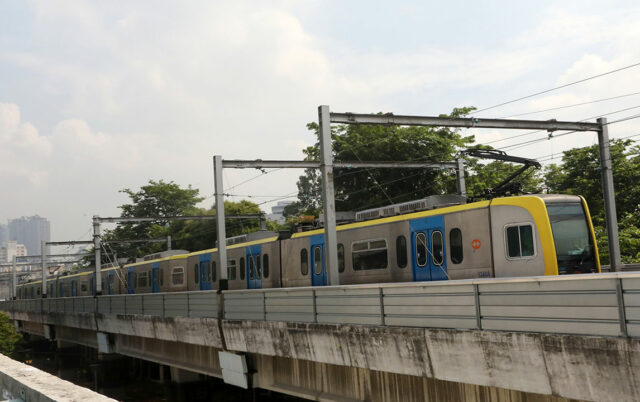
THE DEPARTMENT of Transportation (DoTr) has approved petitions to increase ticket prices at the Light Rail Transit Lines 1 and 2 effective Aug. 2.

The minimum boarding fee will increase from P11 to P13.29, while distance fare will increase to P1.21 from P1 per kilometer, the Light Rail Transit Authority said in an advisory on Monday.

For LRT-1, stored value card users will pay a minimum fare of P14 for one station to P35 from end to end, while single-journey fares will cost P15 to P35.

For LRT-2, stored value card fares will cost P15 for one station to P33 from end to end, while single-journey fares will cost P15 to P35.

“Despite the absence of fare adjustments in previous years, we have established major improvements in the 38-year-old railway line with the increase in trains deployed to service more commuters,” Light Rail Manila Corp. (LRMC) Chief Operating Officer Rolando J. Paulino III said in a statement.

He also cited improved waiting time, station rehabilitation and expansion and the construction of LRT-1 Cavite extension project.

“We are determined to give people back their time through efficient transport and put more value one very peso that our passengers spend for every LRT-1 ride,” he added.

The last time a fare increase was enforced was in 2015, the LRTA said in the advisory. The latest increases would be used to fix and improve LRT-2 facilities, it added.

Meanwhile, transport groups opposed the fare hike, saying it should be shouldered by the government.

Prices remain high despite easing inflation, said Primo V. Morilla, convenor of Passenger Forum, said by telephone.

“People don’t feel like their lives have improved,” he said in Filipino, noting that higher train fares would make it more difficult for them. “This could be solved by subsidies.”

AltMobility PH Director Ira F. Cruz said it is well within LRCM’s right to enforce a fare increase, but this would add to commuters’ daily expenses.

“It is within their concession agreement to increase their fares; however, it has to be balanced by the government,” he said in a separate phone interview. “The concessionaire needs to be able to cover expenses but at the same time, it has to be within a level that commuters will be able to afford.”

Mr. Cruz said the government has yet to come up with a satisfactory mass transport system plan.

“The government has to be able to create a transportation system where people have a choice of mode of transportation so that we don’t encounter things like these, where people are severely affected by one mode of transportation,” he said.

“People have to be presented with an option to consider another form of transportation and that could be in the form of mass road public transportation such as jeepneys or active transportation,” he added. — J.I.D. Tabile

ADVERTISEMENT
ADVERTISEMENT