Home Blog Page 4510

Philippines accuses China of blocking, firing water cannon at resupply ship

PHOTO FROM PHILIPPINE COAST GUARD

By Kyle Aristophere T. Atienza and Beatriz Marie D. Cruz, Reporters

THE PHILIPPINES on Sunday accused China’s coast guard of blocking and shooting water cannons at its vessels conducting a resupply mission to a Philippine miltary outpost in the South China Sea, condemning the “excessive and offensive actions.”
The Chinese moves against the Philippine Coast Guard vessels, which were escorting two supply boats charted by the Philippine Navy to deliver food and other supplies to Filipino troops stationed at the Second Thomas Shoal, were done “in wanton disregard of the safety of the people on board and in violation of international law,” the Armed Forces of the Philippines said in a statement.
The incident occurred on Saturday near Second Thomas Shoal, which Manila calls Ayungin, a submerged reef where a handful of its troops live on a rusty World War II-era US ship that was intentionally grounded in 1999.

The Chinese coast guard’s “dangerous maneuvers” prevented a second boat from unloading the supplies and completing the mission, the Philippine military said.

The Chinese Embassy in Manila did not immediately respond to a request for comment.

China claims sovereignty over more than 80% of the South China Sea, an assertion rejected internationally, while Malaysia, Vietnam, Brunei, Taiwan and the Philippines have claims to certain areas.

China often irks its neighbors with maritime actions they call aggressive and with longer-term activities like building islands on reefs and equipping them with missiles and runways.

“We call on the China Coast Guard and the Central Military Commission to act with prudence and be responsible in their actions to prevent miscalculations and accidents that will endanger peoples’ lives,” the Armed Forces said.

The Philippine Coast Guard said the Chinese actions violated laws including two international conventions and a ruling from a global tribunal.

The Permanent Court of Arbitration in the Hague in 2016 voided China’s expansive claim to the South China Sea. China has ignored the ruling.

The Philippine Coast Guard “calls on the China Coast Guard to restrain its forces, respect the sovereign rights of the Philippines in its exclusive economic zone and continental shelf, refrain from hampering freedom of navigation and take appropriate actions against the individuals involved in this unlawful incident,” its spokesman Commodore Jay Tarriela said.

After the incident, the US State Department said China’s “repeated threats to the status quo in the South China Sea (were) directly threatening regional peace and stability” and that Washington stands with its Philippine allies in the face of such “dangerous actions.”

“The United States reaffirms an armed attack on Philippine public vessels, aircraft, and armed forces — including those of its coast guard in the South China Sea — would invoke US mutual defense commitments under Article IV of the 1951 US Philippines Mutual Defense Treaty,” it said in a statement.

The German Embassy in Manila said it was concerned about the use of water cannons by Chinese Coast Guard vessels against a lawful Filipino resupply mission within the Philippine’s own exclusive economic zone.
“We urge all parties to respect the rules-based international maritime order (UNCLOS and Convention on the International Regulations for Preventing Collisions at Sea), with the 2016 arbitral award at its center,” it said in a statement. “In light of recent events, Germany stresses that disputes must be resolved peacefully not by force or coercion.”

Beijing has “dramatically increased” its presence in Second Thomas Shoal in the past month, sending as many as four coast guard vessels and 32 maritime militia ships, said Raymond M. Powell, a fellow at the Stanford University’s Gordian Knot Center for National Security Innovation.

“While most of this armada remained around their nearby Mischief Reef base during the actual resupply mission, they did deploy out of the port as a demonstration of their capacity to completely swarm the mission if they chose to do so,” he said in an e-mail.

‘MIGHT VS RIGHT’
China has engaged in such an “escalatory cycle” in the belief that the government of President Ferdinand R. Marcos, Jr. would eventually back down, he said. “But the effect thus far has been the opposite.”

Instead, the Philippines has gained substantial international support for its position and expanding security ties with the US and other like-minded countries such as Japan, Australia, the European Union and even India, he said.

Australia is also concerned by the Chinese Coast Guard’s latest actions directed against the Philippines Coast Guard, “which are dangerous and destabilizing,” Australian Ambassador to the Philippines Hae Kyong Yu tweeted.

“We reiterate our call for peace, stability and respect for UNCLOS in the South China Sea — a vital international waterway,” she said.

China’s actions were “totally unacceptable,” infringing on “lawful activities of the sea and endanger the navigational safety,” Japanese Ambassador to the Philippines Koshikawa Kazuhiko tweeted separately.

“The question is whether China will continue to double down on this coercive strategy, or will it recognize its failure so far to subdue Manila and change its approach?” Mr. Powell said.

China’s firing of water cannons defeated the Philippine Coast Guard’s conscious use of “chartered boats” in its resupply missions, which are “humanitarian” in nature, Chester B. Cabalza, founder of the Manila-based International Development and Security Cooperation, said in a Facebook Messenger chat.

“This only shows China’s disrespect for our maritime entitlements and obvious show of force in their gray zone strategy,” he added.

“This is yet again a manifestation of its ‘might vs right’ treatment of its peaceful neighbors,” Senate President Juan Miguel “Migz” F. Zubiri told reporters via Viber. “By its actions, it shows diplomatic duplicity, of preaching about amity, but practicing hostile behavior. We want to make friends but why is it difficult to love you, China?”

Senator Ana Theresia “Risa” N. Hontiveros-Baraquel said the Chinese Coast Guard does not have the right to block, let alone fire a water cannon on Philippine supply vessels. “They have no right to leave Filipinos in Ayungin Shoal starving.”

The Philippine Senate last week adopted a resolution urging the Department of Foreign Affairs (DFA) to file a resolution before the UN General Assembly calling on China to stop harassing Philippine vessels and violating Philippine rights at sea.

The resolution also called on DFA to bring to international attention China’s harassment of Filipino fishermen in the South China Sea and its refusal to follow the Hague ruling and UNCLOS.

In his second address to Congress last month, Mr. Marcos Jr. touted his foreign policy — “a friend to all and enemy of none” — that he said has proven effective.

He said the government would continue to forge more international partnerships “that will lead to a more balanced trade strategy and a healthier economic position.”

China is the Philippines’ largest trade partner, with total trade hitting $3.01 billion in April, according to the local statistics agency. Philippine exports to China reached $772.47 million, while imports hit $2.26 billion.

Security analysts have said boosting trade with China would unlikely temper its expansive activities in the South China Sea.

Ex-President Rodrigo R. Duterte, who met with Chinese President Xi Jinping last month in Beijing, had a meeting with Mr. Marcos at the presidential palace last week to inform him about his China visit.

“His silence in the past six years, and even until the present, continue to compromise our arbitral victory,” Victor Andres C. Manhit, president of think tank Stratbase ADR, said via Messenger chat. “He should respect the mandate of the current administration, and the national interests, and move on from engaging with antagonistic and coercive states.”

Tensions between the two countries were heightened after a Chinese Coast Guard vessel used a military-grade laser against its Philippine counterpart near Second Thomas Shoal in mid-February.

In late April, a Chinese coast guard ship blocked a Philippine patrol vessel carrying journalists, causing a near-collision that gained international backlash. — with Reuters
State terror labels could aid impunity — analysts

PHILIPPINE STAR/RUSSELL PALMA

By John Victor D. Ordoñez, Reporter

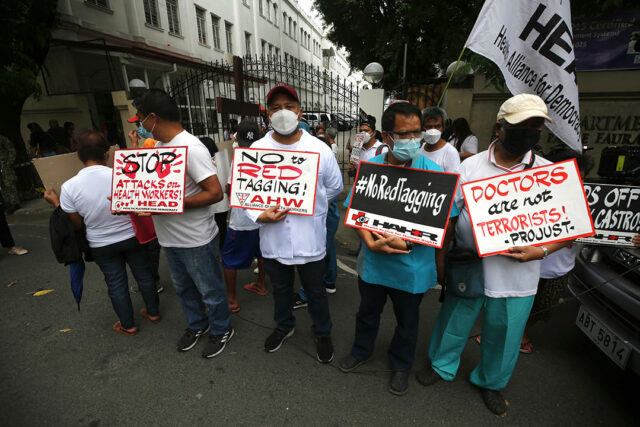
THE PHILIPPINE government’s rampant classification of people as terrorists could foster impunity and endanger ordinary citizens, political experts said at the weekend.

This comes after the Anti-Terrorism Council labeled Negros Oriental Rep. Arnolfo A. Teves, Jr. and members of his armed group terrorists, months after the lawmaker went into hiding after the killing of a Philippine governor.

“The designation is a bit concerning since there is always a possibility that it can be politicized by the government,” Arjan P. Aguirre, who teaches political science at the Ateneo de Manila, said in a Facebook Messenger chat.

The law could be abused and used against government critics, he said, adding that the Anti-Terrorism Council should be overseen by anti-terror experts instead of political appointees.

Justice spokesman Jose Dominic F. Clavano IV said the government’s anti-terrorism efforts would not foster impunity and that the government would uphold the rule of law.

“The evil sought to be prevented is clear,” he said in a Viber message. “We do not want our fellow Filipinos living under fear and intimidation for a selfish purpose.”

Mr. Teves is suspected to have masterminded the assassination of former Negros Oriental Governor Roel R. Degamo, along with nine other people inside the late official’s house in Pamplona town in March.

The lawmaker, whom the House of Representatives has suspended, left the Philippines for the United States for a supposed stem cell therapy four days before the ex-governor and his companions were murdered on March 4.

The anti-terror agency also labeled his brother, ex-Negros Oriental Governor Pryde Henry Teves, a political nemesis of Mr. Degamo, and Marvin H. Miranda, Mr. Teves’ alleged co-mastermind, terrorists.

Suspected gunmen facing murder complaints over the killing were also tagged as terrorists.

Fides M. Lim, convenor of human rights group Kapatid, said the government law allows it to serve as judge, jury and executioner at the same time.

“The designation Teves as a terrorist dramatizes yet again why the Anti-Terrorist law is a most dangerous law because it is a tool of vengeance and impunity — and muddleheadedness,” she said.

Mr. Teves’ lawyer Ferdinand S. Topacio earlier said they were not surprised by the government’s latest move, accusing the state of political harassment.

He said his client had been tagged the mastermind without investigation. Police searches in his properties were illegal, he added.

In Defense of Human Rights and Dignity Movement said the Anti-Terror law should have a more concrete definition of terrorism.

“The designation (of Mr. Teves) further confused the already vague definition of terrorism in the anti-terror law,” it said in a Twitter message. “The Supreme Court sadly upheld the law and now we are seeing the consequences of its implementation.”

Under the law, terrorism is committed by someone who kills or hurts another or someone who engages in acts intended to destroy government property, develops and manufactures weapons, and releases dangerous substances.

In April last year, the Supreme Court stood by its decision upholding the legality of the law that was passed in 2020 and the basis of the Anti-Terrorism Council’s creation.

The High Court in 2021 voided a provision of the law that said a protest could be considered terrorist if it seeks to cause death or physical harm, endanger a person’s life, or create a serious public safety risk. It said the provision was “overbroad and violative of freedom of expression.”

The tribunal also struck down a provision that allowed the council to adopt requests by other local and foreign entities to designate people and groups as terrorists.  

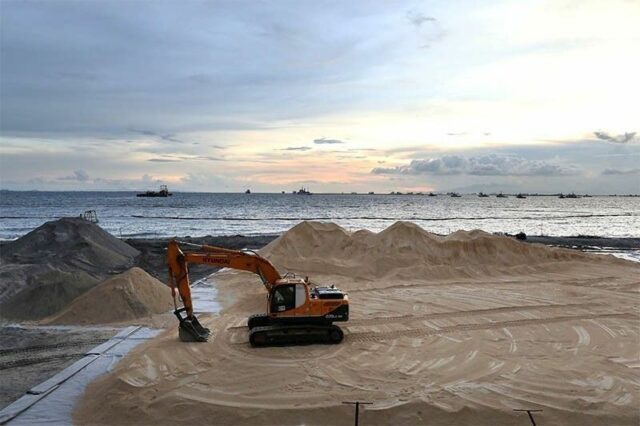
Group seeks moratorium on Manila Bay reclamation

PHILIPPINE STAR/MIGUEL DE GUZMAN

A GROUP of Filipino scientists has urged the Environment department to impose a moratorium on reclamation projects in Manila Bay.

It also asked the agency to consider inputs from social scientists to determine the social impacts of the projects. 

In a statement, the Advocates of Science and Technology for the People said the impact assessment planned by the Department of Environment and Natural Resources (DENR) “should not only focus on the ecological but also on the social impacts of reclamation and associated dredging activities.”

“We welcome DENR’s initiative to look into the possible impacts of reclamation projects in Manila Bay,” it said. “However, we notice that the DENR secretary has not mentioned including a social scientist among its pool of experts.”

Last week, DENR said a team of scientists that include physical and chemical oceanographers, fishery experts and marine biologists, and engineers would assess the overall impact of the reclamation projects.

“In order to prevent further irreversible damage to the environment, we continue to demand the DENR to impose a moratorium on ongoing reclamation projects,” the group said.

DENR’s decision to conduct the assessment is “long overdue because various reclamation projects have already inflicted irreversible damage on marine ecosystems and the livelihood of coastal people,” fisherfolk group Pamalakaya said in a separate statement.

Abandoned fish ponds in some towns in Cavite province south of the Philippine capital could have been converted into productive mangrove areas “but were wiped out for reclamation,” it said.

There are two-dozen reclamation projects in the bay, which is surrounded by Metro Manila and the provinces of Bataan, Pampanga, Bulacan in central Luzon and Cavite in Southern Tagalog.

Permits for the projects were completed from 2019 to 2021 under the administration of former President Rodrigo R. Duterte, who led a foreign policy pivot to Beijing in exchange for investment pledges, few of which had materalized.

The US Embassy in Manila last week flagged the reclamation projects’ ties to China Communications Construction Co., which  Washington had blacklisted “for its role in helping the Chinese military construct and militarize artificial islands in the South China Sea.”

The scientist group also urged DENR to look at similar “dump-and-fill projects” in nearby provinces.

The DENR should release a public document showing the status of these projects, including the mangroves destroyed and communities displaced, it added.

The group said local communities that relied on a balanced environment in Manila Bay “now struggle to catch enough fish for a healthy diet and sustainable income.” 

“Fisherfolk are already complaining about their dwindling fish catch. Why does the DENR administration continue to be tone-deaf to the realities of communities affected by reclamation?” it asked. — Kyle Aristophere T. Atienza

August may bring normal rainfall

THE PHILIPPINES is expected to experience generally near normal rainfall conditions in August due to the effects of the southwest monsoon, the state weather bureau said at the weekend. 

In an El Niño advisory, the Philippine Atmospheric, Geophysical and Astronomical Services Administration (PAGASA) said some areas in western Luzon would likely get above normal rainfall. 

“The probabilistic forecast also suggests higher chances for above normal rainfall conditions in Luzon, while near to above normal in the Visayas and Mindanao,” PAGASA said. 

This is amid high chances of below-normal rainfall conditions that may bring dry spells and droughts in some areas of the Philippines, it said. 

In July, PAGASA declared the onset of El Niño that is expected to last until the first quarter of 2024, showing signs of strengthening in the coming months. 

“However, the enhanced southwest monsoon season is still expected, which may result in above-normal rainfall conditions over the western part of the country,” it said. — Sheldeen Joy Talavera

Lawmaker eyes higher wages for nurses

PHILIPPINE STAR/ MICHAEL VARCAS

THE BASE pay of government nurses should be increased amid the brain drain involving nursing graduates, Quezon City Rep. Marvin D. Rillo said in a statement on Sunday. 

“Congress should not dilly-dally in raising the base pay of our public nurses who are being pirated by other countries,” he said. 

A total of 18,104 Filipino nursing graduates spent a combined P200 million to take licensure examinations in the United States (US) from January to June, the lawmaker said.   

This was more than twice the number of Philippine-educated nurses who took the National Council Licensure Examination (NCLEX) for the first time, not counting repeaters, a year earlier, he added. 

An applicant must pay $200 (P11,107) to take the US licensure exam for nurses, according to the NCLEX website. 

Mr. Rillo expects 46% of Filipino applicants to pass the exams. 

His House Bill 5276 seeks to raise the monthly pay of government nurses to salary grade 21 or about P64,000 a month. — Beatriz Marie D. Cruz

Intel fund transfer to cancer fight sought  

CONGRESS should consider transferring even a small part of the P10-billion confidential funds in the 2024 budget to save about 9,000 Filipinas who die of breast cancer each year, according to Kasuso Foundation. 

“In behalf of our Filipina sisters who are suffering and whose pain can be prevented and eased, Kasuso Foundation is joining other cancer groups in asking Congress for more funds for early cancer detection and treatment,” Kasuso Foundation convenor Aileen Antolin said in a statement on Sunday. 

Each year, there are about 27,000 new breast cancer cases, while 9,000 who were diagnosed in previous years die, the group that educates women on cancer prevention and survival said. 

Data show only 1% percent of Filipinas get tested for cancer each year — probably the lowest in the world — compared with 20% in neighboring countries and 50% in rich countries, Kasuso said. 

The congressional budget for cancer this year is only 1.56 billion. 

Ms. Antolin said the extra budget next year would help women who test positive to prevent their breast cancer from progressing. — NPA

Davao Light power rates falling

BW FILE PHOTO/

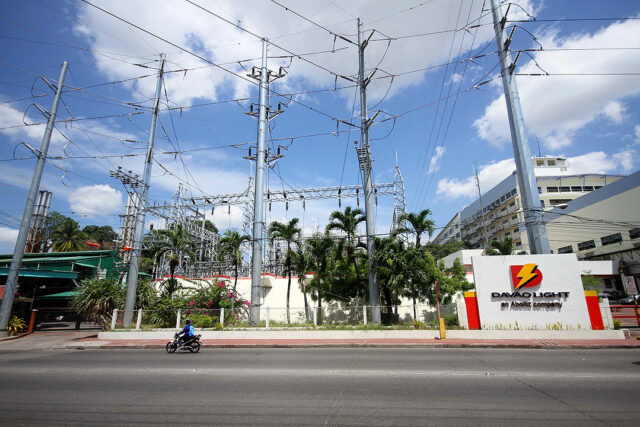
DAVAO CITY — Davao Light and Power Co., Inc. last week said its power rates have been trending down due to the Wholesale Electricity Spot Market (WESM) and stabilizing coal prices. 

Its power rates have been going down since January, and the average rate is P8.75 per kilowatt-hour, P1.49 lower than last month, Davao Light President and Chief Operating Officer Rodger S. Velasco told reporters.  

“The price of coal is continuing to stabilize” despite the war in Ukraine, he said. “The price of crude oil has been fluctuating but coal has gone down already. Our rates have been trending down since January this year due to WESM and the price of coal.” 

Mr. Velasco said the prices of coal have gone down to $125 per metric ton (MT) after rising to $400 following Russia’s invasion of Ukraine. “Still not normal but cheaper than last year’s $400.” Maya M. Padillo

Davao City has new speed limits

DAVAO CITY — This city is seeking to fully implement a new speed limit ordinance next year,Councilor Luna Maria Acosta said. 

The City Council approved on final reading on Aug. 1 the speed limit that she proposed. 

Under the law, the speed limit on highways from Lacson checkpoint in Calinan to Marilog District-Buda border, Carabao Monument Waypark in Toril to Binugao-Sta. Cruz border and Bunawan Crossing to the Lasang-Panabo City border will be raised to 80 from 60 kilometers per hour (kph). 

Ulas Crossing to Lacson checkpoint in Calinan, Ulas Crossing to Carabao Monument Waypark, Panacan Crossing to Bunawan Crossing, Davao City Coastal Road from Tulip Drive to Bago Aplaya will have a speed limit of 60 kph. 

The speed limit of 40 kph remains on local and national roads that are primary or secondary within the city limits, while city streets and interior roads will have a speed limit of 30 kph.The speed limit on public subdivision roads, village roads and school zones is 20 kph. — Maya M. Padillo

Basilan to build desalination facility 

COTABATO CITY — Residents of Tabuan Lasa island municipality in Basilan province are expected to benefit from a P15-million desalination facility project that will give them safe drinking water from the sea, the first ever in the province. 

In separate statements on Sunday, Tabuan Lasa Mayor Moner Sabbihi Manisan and Basilan Governor Jim Hataman Salliman said the project, funded by the Ministry of the Interior and Local Government-Bangsamoro Autonomous Region in Muslim Mindanao, was launched on Friday. 

Residents of Tabuan Lasa need to sail to seaside villages in Sumisip in mainland Basilan, about two nautical miles away, to fetch potable water. 

Mr. Salliman said Bangsamoro Local Government Minister Naguib G. Sinarimbo and the mayor of Tabuan Lasa would jointly oversee the construction of the desalination facility. — John Felix M. Unson

China’s Ukraine peace talks gambit shows shifts amid hard realities

REUTERS

BEIJING — China’s decision to join international talks in Saudi Arabia this weekend seeking to end Russia’s war in Ukraine signals possible shifts in Beijing’s approach but not a U-turn in its support for Moscow, analysts say.

While Beijing declined to join earlier talks in NATO member Denmark, analysts said it feels far more comfortable joining the effort in Saudi Arabia, even if Russia is not present and Ukraine is pushing its own plan.

China has refused to condemn Moscow for the invasion it launched in February 2022 but has offered its own peace plan, Beijing appears to be confronting some hard realities as the conflict drags on.

“Beijing has been gearing more toward peace efforts but it also knows that a peace initiative led by Beijing is unlikely to be embraced by the West at this point,” said Yun Sun, a director of the China program at the Stimson Center think tank in Washington.

“Beijing will not want to be absent from other credible peace initiatives that are led by non-Western countries.”

Peace envoy Li Hui was joining senior officials from some 40 countries in Jeddah, China’s foreign ministry said on Friday, for talks that Ukrainian and Western envoys hope will forge key principles for an eventual settlement to end the war.

Beijing’s latest move on the global diplomatic stage comes as President Xi Jinping grapples with a host of internal issues, including the unexplained replacement last month of Qin Gang as foreign minister, the abrupt replacement of the top brass at the People’s Liberation Army Rocket Force and deepening woes for the world’s second-biggest economy.

China did not attend the talks in Copenhagen in late June, despite being invited and having proposed its own 12-point plan for peace.

Beijing has maintained close economic and diplomatic ties with Russia since President Vladimir Putin ordered the invasion and has accused US-led Western forces of seeking to prolong the conflict by providing arms and support to Ukraine.

The foreign ministry did not respond to requests for comment over the weekend.

Ukrainian Foreign Minister Dmytro Kuleba called Mr. Li’s involvement a “considerable breakthrough”, according to Ukrainian media.

China has been courting oil giant Saudi Arabia, which is part of the non-aligned Global South, a grouping China is keen to lead.

Russia is eventually “bound to be defeated,” said Shanghai-based international relations scholar Shen Dingli, so China must look for international cooperation while not accelerating any collapse in Russia.

“We can put forward different opinions, and we can also put forward some suggestions to jointly promote the early and proper political settlement of problems we see,” Mr. Shen said. 

While China’s move was good for its image, Singapore-based analyst Li Mingjiang said Beijing would be looking to fine-tune its positions.

It wants to better understand others’ positions and “is probably also trying to explore a space of China’s own adaptability, China’s own maneuverability,” said Li, an associate professor of international relations at the S. Rajaratnam School of International Studies.

That evolution was occurring as some analysts detect mounting Chinese angst at the protracted nature of the war and Russia’s recent bombing of Ukrainian grain ports, upsetting previously protected shipments from the global grain powerhouse.

Geng Shuang, China’s deputy permanent representative to the United Nations, told the Security Council on July 26 that his delegation was deeply concerned there seemed to be no end to the war.

“Now the situation is increasingly complex for Beijing to maneuver, as the escalation of the war directly impacts China’s economic and political interests,” said Moritz Rudolf, a scholar at Yale Law School’s Paul Tsai China Center. — Reuters

X to pay legal bills of people ‘unfairly treated’ for posting on platform

‘X’ logo is seen on the top of the headquarters of the messaging platform X, formerly known as Twitter, in downtown San Francisco, California, US, July 30, 2023. — REUTERS/CARLOS BARRIA

ELON Musk has said his X social media platform will pay the legal bills and sue on the behalf of people who have been treated unfairly by employers because of posting or liking something on the site formerly known as Twitter.

“If you were unfairly treated by your employer due to posting or liking something on this platform, we will fund your legal bill,” Mr. Musk said in a post on X late on Saturday, adding that there will be no limits to funding the bills.

“And we won’t just sue, it will be extremely loud, and we will go after the boards of directors of the companies too,” Musk said later in response to a post about nothing changing behavior in the US faster than a threat of legal action.

Late last month, Mr. Musk said that monthly users of X reached a “new high” and shared a graph that showed the latest count as over 540 million.

The figures came as the company is going through organizational changes and is looking to boost falling advertising revenue.

It was also the latest in a series of comments from X executives claiming strong traction in usage, after Meta Platforms launched a competing platform called Threads on July 5.

After 17 years with an iconic blue bird logo that came to symbolize the broadcasting of ideas to the world, billionaire Mr. Musk renamed Twitter as X and unveiled a new logo in July, marking a focus on building an “everything app.”

Mr. Musk earlier in July had said that the platform’s cash flow remains negative because of a nearly 50% drop in advertising revenue and a heavy debt load. An upturn in advertising revenue that had been expected in June failed to materialize. — Reuters

Hiroshima marks A-bomb anniversary, mayor calls nuclear deterrence ‘folly’

THE ATOMIC BOMB DOME is seen in front of the venue holding a ceremony to mark the 75th anniversary of the atomic bombing at the Hiroshima Peace Memorial Park in Hiroshima, western Japan, Aug. 6, 2020. — KYODO/VIA REUTERS

TOKYO — Japan on Sunday marked the 78th anniversary of the US atomic bombing on Hiroshima, where its mayor urged the abolition of nuclear weapons and called the Group of Seven (G7) leaders’ notion of nuclear deterrence a “folly.”

The day to commemorate the victims of the world’s first nuclear attack comes as Russia has raised the specter of using nuclear weapons in its war with Ukraine.

It also comes as biopic Oppenheimer, chronicling the creation of the atomic bomb, has become a box-office hit in the United States. Some have criticized the film for largely ignoring the weapons’ destruction of Hiroshima and Nagasaki — bombed three days later, on Aug. 9, 1945.

The film’s release in Japan has yet to be announced.

Also causing controversy in Japan, the distributor of Barbie, a blockbuster released on the same day as Oppenheimer, latched on to fan-produced “Barbenheimer” memes that depicted the actors in the title roles alongside images of nuclear blasts.

Hiroshima was in the spotlight in May, where Prime Minister Fumio Kishida hosted a G7 summit in the western city, his home constituency. G7 leaders issued a statement expressing their commitment to achieving disarmament but said that as long as nuclear weapons existed, they should serve to deter aggression and prevent war.

On Sunday, a peace bell tolled at 8:15 a.m. (2315 GMT on Saturday), the time the bomb was dropped. About 50,000 participants in the outdoor memorial ceremony including ageing survivors observed a moment of silence, with the summer heat hitting 30 degrees Celsius (86 Fahrenheit)

“Leaders around the world must confront the reality that nuclear threats now being voiced by certain policymakers reveal the folly of nuclear deterrence theory,” Hiroshima Mayor Kazumi Matsui said at the ceremony, also attended by Mr. Kishida.

The prime minister said the road to a world without nuclear weapons was getting steeper, due in part to Russia’s nuclear threats, but that this made it all the more important to bring back international momentum towards that goal.

United Nations Secretary-General Antonio Guterres expressed his support.

“World leaders have visited this city, seen its monuments, spoken with its brave survivors, and emerged emboldened to take up the cause of nuclear disarmament,” he said in remarks read by a U.N. representative. “More should do so, because the drums of nuclear war are beating once again.”

The bomb dropped on Hiroshima on Aug. 6, nicknamed “Little Boy”, killed thousands instantly and about 140,000 by the end of the year. Japan surrendered on Aug. 15. — Reuters

ADVERTISEMENT
ADVERTISEMENT