Home Blog Page 4503

Del Monte Pacific Limited to hold Annual General Meeting on Aug. 29


Spotlight is BusinessWorld’s sponsored section that allows advertisers to amplify their brand and connect with BusinessWorld’s audience by enabling them to publish their stories directly on the BusinessWorld website. For more information, send an email to online@bworldonline.com.

Join us on Viber at https://bit.ly/3hv6bLA to get more updates and subscribe to BusinessWorld’s titles and get exclusive content through www.bworld-x.com.

Bivalent COVID-19 shots

Health Secretary Ted Herbosa gets a bivalent COVID-19 vaccine shot during the launching ceremony at the Philippine Heart Center in this photo taken on June 21. — YUMMIE DINGDING / PPA POOL

The Department of Health (DoH) has renewed its call for the public to get vaccinated and get their booster shots to remain protected against COVID-19. It also “strongly recommends” adhering to layers of protection such as wearing of face masks, isolating when sick, and ensuring good air ventilation.

The fresh calls came amidst the announcement that a new Omicron strain had been detected in the country. The new EG.5 subvariant is a sublineage of Omicron XBB.1.9.2. The World Health Organization (WHO) earlier designated this new subvariant under the list of Omicron variants under monitoring.

The WHO explained that all viruses, including SARS-CoV-2, change over time. Some of these changes may affect the properties of the virus. These variations include “how a virus easily spreads, the associated disease severity, or the performance of vaccines, therapeutic medicines, diagnostic tools, or other public health and social measures.”  Aside from variants under monitoring, other classifications are the so-called variants of interest and variants of concern.

The WHO added that a virus under monitoring designation means that a specific subvariant, as in the case of EG.5, has genetic changes that are suspected to affect virus characteristics and early signals of growth advantage relative to other circulating variants. An enhanced monitoring and reassessment are required since the evidence of its epidemiological impact remains to be seen. The virus under monitoring listing will be crucial as subvariants under this classification can have a growth advantage in a region or even globally.

In the past two weeks, the EG.5 was responsible for more than 17% of new COVID-19 cases in the United States. In the Philippines, the XBB variants are still the dominant circulating strains. Metro Manila logged the highest number of new COVID-19 cases in the past two weeks with 107, followed by Calabarzon and Central Luzon.

It is true that the COVID-19 status was downgraded as a result of the pandemic being on a downward trend in the course of 12 months. Death rates have also continued to spiral down. Global health experts attributed this breakthrough to the “highly effective vaccines developed in record time to fight the disease.”

Despite this, the WHO said COVID-19 is “still killing” especially for those belonging to the vulnerable population.

With the high risks still associated with COVID-19, the DoH is ramping up efforts to vaccinate specific priority groups using bivalent shots. It said the bivalent vaccine is intended to be a booster dose for healthcare workers, senior citizens and those with comorbidities. It is important for people under these priority health groups to speak with a healthcare professional to discuss the benefits or any potential side effects when getting the shots. The DoH through the Office of Secretary Teodoro Herbosa and the Public Health Services Team is also organizing an information campaign that seeks to communicate to the public the value of booster vaccination for intended priority groups.

The US Food and Drug Administration (FDA) said bivalent COVID-19 vaccines include a component that corresponds to the original virus strain to provide broad protection against COVID-19 and a component that corresponds to the Omicron variant to give better protection against it. Pfizer-BioNTech and Moderna are two vaccine manufacturers that have developed the bivalent or also called updated vaccines.

The Yale Medicine explained that bivalent vaccines use mRNA technology, which is a way of sending instructions to host cells in the body to make copies of a spike protein. The cells then recognize that this protein is foreign, and the immune system reacts by activating immune cells, thereby producing antibodies. This will then prompt the body to recognize and attack the real SARS COV-2 spike protein if one is infected by the virus.

From monovalent vaccines to bivalent booster shots, vaccination continues to work in three ways. One, COVID-19 vaccines work by lowering the chance of getting the virus. Two, they can also  protect a person from getting seriously ill and can lower the chance of hospitalization and death from COVID-19. Finally, they make a vaccinated person less likely to pass the disease to others.

Vaccines for other diseases also work in the same three ways. Vaccination remains to be one of the most cost-effective and efficient ways to prevent diseases. Apart from COVID-19 booster vaccination, life-course immunization is an equally important aspect of public health to ensure that people from all ages would not have to die or suffer from vaccine-preventable diseases.


Teodoro B. Padilla is the executive director of Pharmaceutical and Healthcare Association of the Philippines (PHAP). PHAP represents the biopharmaceutical medicines and vaccines industry in the country. Its members are in the forefront of research and development efforts for COVID-19 and other diseases that affect Filipinos.

Yields on gov’t debt end mostly higher

YIELDS on government securities (GS) mostly went up last week, tracking US Treasuries, as the market kept its defensive stance while waiting for the release of July Philippine inflation data.

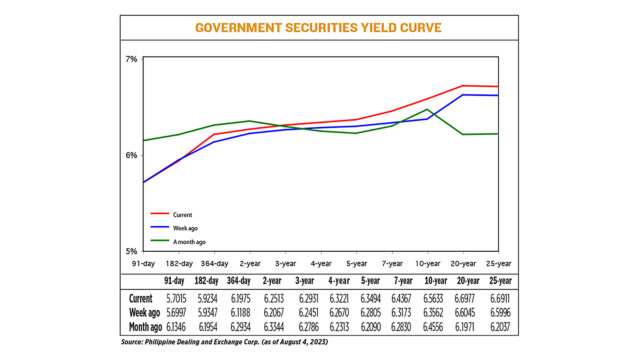
GS yields, which move opposite to prices, went up by an average of 7.25 basis points (bps) week on week, according to the PHP Bloomberg Valuation Service Reference Rates as of Aug. 4 published on the Philippine Dealing System’s website.

Yields on the 91- and 364-day Treasury bills (T-bills) went up by 0.18 bp and 7.87 bps to 5.7015% and 6.1975%, respectively. On the other hand, the 182-day T-bill saw its rate drop by 1.13 bps to 5.9234%. 

Rates at the belly rose, with the two-, three-, four-, five-, and seven-year Treasury bonds (T-bonds) climbing by 4.46 bps (to 6.2513%), 4.8 bps (6.2931%), 5.51 bps (6.3221%), 6.89 bps (6.3494%), and 11.94 bps (6.4367%).

At the long end, yields on the 10-year paper surged by 20.71 bps to 6.5633%. The 20- and 25-year papers also climbed by 9.32 bps and 9.15 bps to 6.6977% and 6.6911%, respectively.

Total GS volume reached P10.77 billion on Friday, up from P9.52 billion on July 28.

The market tracked US Treasury yield movements ahead of the release of Philippine inflation data on Friday, a bond trader said in a Viber message.

Investors were defensive and “volume was relatively light, and most deals were suspected client requirements,” the trader said.

“On a normal day, market players would have celebrated the CPI (consumer price index) data which were better than expected. However, the increase in US Treasury yields may have pushed players on the sidelines and wait for US jobs data before deciding on next move,” the trader added.

Philippine headline inflation eased to 4.7% in July from 5.4% in June.

This was within the Bangko Sentral ng Pilipinas’ forecast range of 4.1%-4.9%. However, this remained above the target of 2-4%.

Meanwhile, bonds at the long end were affected by the US soft landing narrative, Fitch Ratings’ downgrade of the US’ credit rating, and the market “further digesting the implications of the recent move by the Bank of Japan towards a more flexible yield curve with higher yield tolerance,” Robinsons Bank Corp. Assistant Vice-President and Peso Fixed Income Trader Kevin S. Palma said in an e-mail.

“These factors did not bode well for local bonds, leading many market participants to remain defensive, especially in light of the sharp rise in long-end US Treasuries [last] week,” Mr. Palma said.

For this week, the market will track US Treasuries ahead of the release of the second- quarter gross domestic product (GDP) report on Thursday.

“Looking ahead, continued volatility is expected, particularly in anticipation of the release of Philippine second-quarter GDP data. Any movements in the local GS market will likely be highly contingent on the day-to-day performance of US Treasury yields,” Mr. Palma said. — Bernadette Therese M. Gadon with Reuters

Globe named most reliable network by Ookla in Q1-Q2

REUTERS

GLOBE Telecom, Inc. has been named as the most reliable mobile network in the first to second quarters by network testing company Ookla, it said in a statement.

“Globe’s supremacy in reliability, which only a few operators in the world achieve, reflects our relentless pursuit to improve our network and services to uplift the lives of Filipinos,” Globe President and Chief Executive Officer Ernest L. Cu said in a statement over the weekend.

“Our commitment to our customers goes beyond network quality; it’s about enhancing their lives through connectivity. We will continue to invest in our infrastructure to ensure that we live up to this title and provide even better services in the future,” he added.

Ookla’s report covering the first and second quarters showed that Globe had the highest consistency score of 83.64%. It also had the highest score in terms of most available all-technology mobile network at 92.63%.

To be named most reliable, Globe said an operator must achieve the highest scores in two key metrics: All Technology Consistency and All Technology Availability.

Its recent win is the fifth consecutive time Globe was named as the most reliable network since the second quarter of 2022 when it had a 79.44% consistency score and an all-technology mobile network availability score of 93.11%.

In the fourth quarter of 2022, Globe continued its momentum with a consistency score of 83.13% and an availability score of 92.38%.

“Globe’s victory in reliability underscores the brand’s ongoing dedication to delivering top-notch service, fortifying its position as the foremost mobile network in the Philippines,” the company said. — J.I.D. Tabile

Shell Advance, Ducati PHL back Access Plus Racing’s Superbike campaign

Access Plus Racing riders TJ Alberto and Lawrence Macalinao aboard their Ducati Panigale V4 motorcycles with (from left) Shell Mobility Lubricants Category Manager Shannen Lee, Ducati Philippines President and CEO Toti Alberto, Shell Lubricants Philippines Vice-President Jackie Famorca, Shell Lubricants Philippines Marketing and Business Development Manager Leo Mendoza, and Shell Advance Brand Manager Chi Malabanan. — PHOTO FROM SHELL ADVANCE

SHELL ADVANCE and Ducati Philippines have teamed up to support the Access Plus Racing Team in the ongoing Philippine Superbike Championship (PSBK). Led by Timothy Joseph “TJ” Alberto, who is poised for a hat trick, alongside Lawrence Macalinao, the team is building on its top-spot sweeps in the Pro and Expert categories during the third round of the PSBK 2023 series.

Shell Advance and Ducati have a long history of collaboration, with over 150 race wins combined in premier global motorcycle championships MotoGP and World Superbike. This partnership brings together decades of experience and innovation and has led to the development of high-performance oil formulations, including the technologically advanced Shell Advance Ultra 15w50. This oil meets the high-performance requirements of Ducati motorcycles, and is essential for ensuring longevity, horsepower, and the ability to withstand the elements in the challenging climate of the Philippines, where temperatures can reach 40 degrees Centigrade.

“This iconic global partnership has run for over 20 years now, and we are ecstatic to see it fully materialized here in the Philippines through the Ducati Access Plus Racing team. We are in full support of their quest for three-peat victory this year,” said Shell Advance Brand Manager Chi Malabanan.

Shell Advance fully synthetic range is the only oil being used and recommended by Ducati for performance and protection. With its patented Pureplus Technology, the product’s proven and tested technical claims ensure that Ducati motorbikes on the track are protected against extreme temperature up to 175 degrees, additional horsepower at 355.9kph, and more fuel-efficient for longer at 17,000rpm.

“Ducati Philippines is driven by a profound commitment to nurture Philippine motorsports from its very roots,” said Ducati Philippines President and CEO Toti Alberto. “Through dedicated grassroots programs, we aim to empower and educate young riders, imparting the vast racing knowledge we’ve gathered from our global exploits. Filipino motorsports fans can look forward to a more exciting competition in the PSBK and with the support of Shell, expect to see more up-and-coming young racing talents and more red bikes on the podium.”

As the championship event progresses through its 12-round series, all eyes are on Access Plus Racing as it aims for another victory. “I’m so excited to be racing for Access Plus this season especially with the support of Shell and Ducati. These are two of the most successful brands in motorsport, and their partnership is a dream come true for any racer. Every component counts to achieve maximum performance and results, including motor oil. Our team is eager and optimistic as we strive to improve our overall stats throughout this season,” said TJ Alberto.

Echoing Mr. Alberto’s sentiments, Lawrence Macalinao is in high spirits and eagerly anticipates a much-improved performance as he strives to clinch victory in the Expert Class title. He emphasized that the shared passion for high-performance racing between Shell Advance and Ducati Philippines gives him “the confidence of having a strong support group and ensures that my machinery always performs at its best.”

Major effort ongoing to contain Panama disease in banana crop

REUTERS

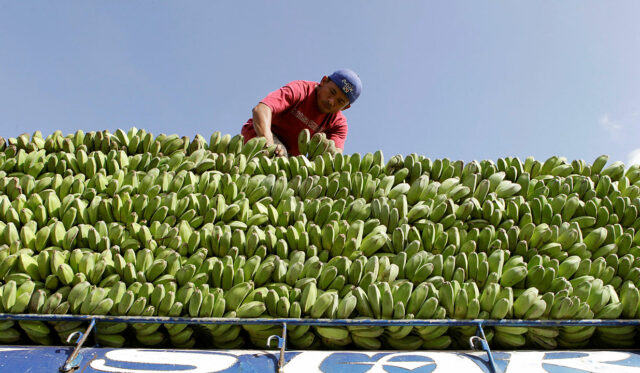
THE Bureau of Plant Industry (BPI) said that it is ramping up its efforts to contain Fusarium wilt, also known as Panama disease, in the banana industry.

“We’re really focusing on the best management because it doesn’t matter how will we produce if lose to pests and diseases,” BPI Director Gerald Glenn F. Panganiban told reporters last week.

Fusarium wilt is a soil-borne fungal disease that blocks the banana plant’s vascular system and deprives it of minerals, nutrients, and moisture. Affected plants turn yellow and die.

The Tropical Race 4 (TR4) strain was first detected in Davao City in 2009 and continues to threaten the Cavendish banana, the main export variety.

“We are partnered with the Philippine Space Agency to initiate a project that will allow us to really know the scope of damage,” he said.

In its banana market review, the Food and Agriculture Organization (FAO) of the United Nations said that the Philippines exported 2.24 million metric tons in 2022, down 6.21%.

The Philippines is the second top banana exporter next to Ecuador.

“The main exporter from the region continues to be the Philippines, which supplies some 60% of Asian banana shipments on average but has seen production severely affected by the spread of TR4 in the country as well as the high costs of inputs and fertilizer,” the FAO said. — Sheldeen Joy Talavera

No public event to mark first anniversary of the Queen’s death

BRITAIN’S King Charles will not mark the first anniversary of the death of Queen Elizabeth with an official public event or a private family gathering, a royal spokesperson said on Friday.

Charles, 74, ascended to the throne on Sept. 8 after the death of his mother Elizabeth.

The death of the 96-year-old monarch, Britain’s longest-reigning king or queen, prompted an outpouring of emotion around the globe, a 10-day mourning period and a state funeral with crowds of thousands of people lining the streets of central London.

But the first anniversary of the day she died will not be a public affair. The king and his wife, Queen Camilla, will be spending the day quietly and privately, said a spokesperson for Buckingham Palace.

In doing so, Charles follows in the footsteps of his mother, who used to spend the anniversary of her father’s death in the same way. — Reuters

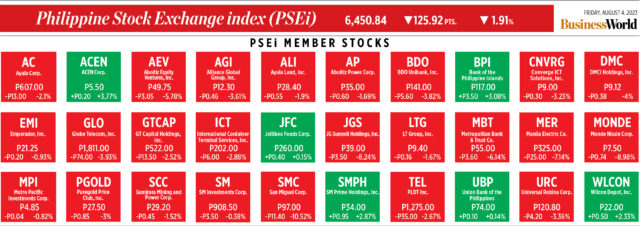
How PSEi member stocks performed — August 4, 2023

Here’s a quick glance at how PSEi stocks fared on Friday, August 4, 2023.


PHL stocks likely to rebound on bargain hunting

PHILIPPINE SHARES are expected to climb this week on bargain hunting after dropping last week as investors await the release of US consumer inflation data and the Philippine second quarter gross domestic product (GDP) report.

The benchmark Philippine Stock Exchange index (PSEi) sank by 125.92 points or 1.91% to close at 6,450.84 on Friday, while the broader all shares index dropped by 51.88 points or 1.48% to 3,447.61.

Week on week, the PSEi declined by 174.42 points or 2.63% from its close of 6,625.26 on July 28.

“In last week’s trading, the local market gave up its ground above the 6,600 level as Fitch’s downgrade of the US’ long term credit rating pushed the US long-term yields higher and raised concerns over the US and consequently, the global economy. In the process, the local bourse also fell below its 50-day and 200-day exponential moving averages,” Philstocks Financial, Inc. Senior Research Analyst Japhet Louis O. Tantiangco said in a Viber message.

Fitch Ratings last week downgraded the US government’s top credit rating, from AAA to AA+, a move that drew an angry response from the White House and surprised investors, coming despite the resolution of the debt ceiling crisis two months ago, Reuters reported.

The rating agency first warned the US of the possible downgrade in May and maintained its position last June after the country’s debt ceiling crisis was resolved saying it intended to finalize the review in the third quarter of this year.

For this week, China Bank Capital Corp. Managing Director Juan Paolo E. Colet said the local bourse may see volatile trading after the PSEi posted its largest weekly loss since September 2022.

“The steep selloff last Friday, induced mainly by institutional trades for the PSEi rebalancing, could prompt an index rebound on Monday. Activity for the rest of the week will be driven by Philippine second quarter GDP and US July inflation prints, corporate earnings reports, and the MSCI index review announcement,” Mr. Colet said in a Viber message.

Second-quarter Philippine GDP data and the July US consumer price index report will be released on Thursday.

Philstock’s Mr. Tantingco likewise said that the market will be mainly driven by investors hunting for bargains after the sell-off last week.

“However, any advancement would be challenging as headwinds weigh on sentiment. Aside from the renewed worries over the US economy, upside inflationary risks are also building up for the Philippines which may cause worries over our near-term inflation outlook,” Mr. Tantiangco added.

Mr. Colet placed the PSEi’s major resistance at 6,700-6,750 and support at 6,370-6,400, while Mr. Tantiangco placed support and resistance at 6,400 and 6,600, respectively. — A.H. Halili with Reuters

Peso may stay at P55:$1 level

BW FILE PHOTO

THE PESO may remain at the P55-per-dollar level this week following the release of US jobs data that could affect the US Federal Reserve’s policy path.

The local unit closed at a one-month low of P55.74 versus the dollar on Friday, weakening by 22 centavos from Thursday’s P55.52 finish, data from the Bankers Association of the Philippines’ website showed.

This was the peso’s weakest close since its P55.77-per-dollar finish on June 23.

Week on week, the peso dropped by 83 centavos from its P54.91 close on July 28.

The local unit opened Friday’s session at P55.60 per dollar. Its intraday best was at P55.55, while its weakest showing was at P55.777 against the greenback.

Dollars traded went down to $1.14 billion on Friday from the $1.28 billion recorded on Thursday.

The peso declined further on Friday amid elevated global crude oil prices after Saudi Arabia extended its oil production cut of one million barrels per day for another month and hinted at further reductions, Rizal Commercial Banking Corp. Chief Economist Michael L. Ricafort said in a Viber message.

Saudi Arabia will extend a voluntary oil output cut of one million barrels per day for another month to include September, it said on Thursday, adding it could be extended beyond that or deepened, Reuters reported.

The kingdom’s production for September will be around nine million barrels per day, the state news agency SPA cited an official source at the energy ministry as saying.

On Friday, Brent crude futures rose by $1.10 or 1.3% to settle at $86.24 a barrel, while the US West Texas Intermediate crude gained $1.27 or 1.6% to close at $82.82 a barrel. Both benchmarks hit their highest levels since mid-April on Friday.

“The peso [was] also weaker due to the tail-end of the seasonal increase in OFW (overseas Filipino workers) remittances for tuition and other school opening-related payments,” Mr. Ricafort added.

For this week, he said the peso may weaken further after the release of US labor data for July, which may affect the Fed’s future policy decisions.

The US economy added fewer jobs than expected in July, but solid wage gains and a decline in the unemployment rate back to 3.5% pointed to continued tightness in labor market conditions, Reuters reported.

The Labor department’s employment report on Friday also showed job gains in May and June were revised lower, potentially suggesting demand for labor was slowing in the wake of the Fed’s hefty interest rate hikes.

But with 1.6 job openings for every unemployed person in June, the moderation in hiring may also be the result of companies failing to find workers.

The mixed report did not change growing perceptions among economists that the Fed could engineer a “soft landing” for the economy, though much would depend on the direction of inflation after annual increases in prices slowed sharply in June.

Nonfarm payrolls increased by 187,000 jobs last month, the Labor department’s survey of establishments showed. Data for June was revised lower to show 185,000 jobs added instead of the previously reported 209,000. The job growth in June was the slowest since December 2020.

The economy created 49,000 fewer jobs in May and June than previously reported. Economists polled by Reuters had forecast a gain of 200,000 jobs. Payrolls growth has averaged 218,000 jobs per month over the past three months, a sharp slowdown from the average of 434,000 during the same period last year.

The Fed raised borrowing costs by 25 basis points (bps) in its July 25-26 meeting, bringing its target interest rate to a range between 5.25% and 5.5%.

The US central bank has hiked rates by a cumulative 525 bps since it began its tightening cycle in March last year.

The Federal Open Market Committee will next meet on Sept. 19-20 to review policy.

Mr. Ricafort expects the peso to trade between P55.45 and P55.95 per dollar this week. — A.M.C. Sy with Reuters


S. Korea ready to sign trade deal; PHL working on internal approval

REUTERS

THE Department of Trade and Industry (DTI) said South Korea has declared its readiness to sign a free trade agreement (FTA) with the Philippines, which is still working on domestic approval processes which could take two months.

“(The Philippines-South Korea FTA) could be signed within the next two months,” Trade Undersecretary Ceferino S. Rodolfo told reporters on the sidelines of the International Tobacco Agricultural Summit in Taguig City last week.

He added that formal discussions for other proposed trade deals with the United Arab Emirates (UAE) and India could begin within the year.

According to Mr. Rodolfo, “South Korea has sent a letter to us saying that they are ready to sign and that they have finished the domestic process. It is now up to us. We are completing the certificates of concurrence (CoC) so that we can get the signing authority,” Mr. Rodolfo said.

“The process changed. Before, we needed to get signing authority, which will be signed by the Trade Secretary, and then it will return to the President to be ratified, and that is when we will get the CoC. But now, the Office of the President (OP) wants, out of prudence, is that before the signing authority is given, the CoC is already there. It is front-loaded,” he added.

FTA negotiations between the Philippines and South Korea started in June 2019 and ended in October 2021.

Some of the Philippine products expected to benefit from the FTA with South Korea include banana, pineapple, and other tropical fruit, while South Korean vehicles and auto parts are expected to gain expanded market access.

Mr. Rodolfo said a trade deal with the UAE will take the form of a comprehensive economic partnership agreement (CEPA).

“We are already preparing for the Philippines-UAE CEPA. The next step is to start the negotiations. It could happen within the year,” Mr. Rodolfo said.

In February 2022, the Philippines and the UAE signed the joint statement formally announcing the intent to pursue a CEPA.

According to Mr. Rodolfo, some of the Philippine products that could benefit from a CEPA include consumer durables, garments, leather products, halal food products, and tropical fruit.

He added that the UAE could also become an investor in the Philippine renewable energy sector.

“The UAE is more service-driven. They are really more of a market,” Mr. Rodolfo said.

Meanwhile, Mr. Rodolfo said that scoping discussions for the proposed preferential trade agreement (PTA) between the Philippine and India could also start within this year.

He disclosed that the talks have been delayed due to the pandemic.

“Within this year, we could begin the scoping for the PTA negotiations,” Mr. Rodolfo said.

For the PTA talks, Mr. Rodolfo said the Philippines is seeking increased trade in agricultural products.

“We will also push for some provision to ensure that we have access to critical Indian products. There should be no imposed export distinction,” Mr. Rodolfo said.

Last month, the Indian government banned exports of non-basmati white rice to preserve its domestic supply. — Revin Mikhael D. Ochave

Electronics, mining, agri seen as major beneficiaries in EU free trade agreement

REUTERS

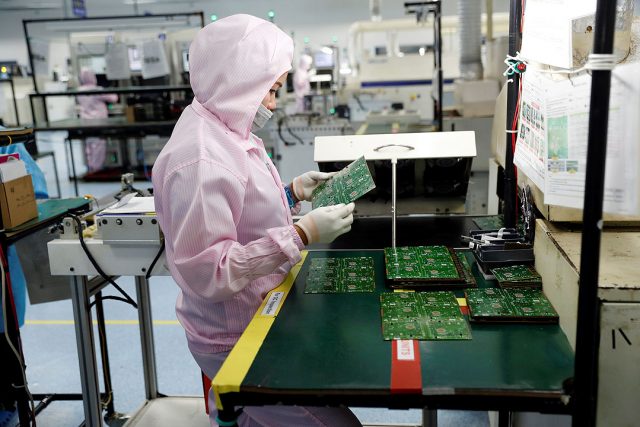
THE electronics, mining, and agriculture industries are positioned to benefit the most from a possible free trade agreement (FTA) with the European Union (EU), the Philippine Economic Zone Authority (PEZA) said.

PEZA Director General Tereso O. Panga said on the sidelines of a joint memorandum circular signing event in Taguig City last week that he welcomed the resumption of FTA negotiations with the EU.

“Electronics has always been our strength. So on top of electronics, if we are able to export as well agro-based products, and mineral products, this will boost our exports to the EU,” Mr. Panga said.

“EU members like Germany and the Netherlands are among our biggest investors in PEZA’s ecozones,” he added.

He said such a deal could simplify compliance for agricultural products for entering specific European markets.

“That should be spelled out in the FTA, including the availment of the Generalized Scheme for Preferences Plus (GSP+); how we can maximize it so that more companies in the Philippines can export to EU,” Mr. Panga said.

On July 31, President Ferdinand R. Marcos, Jr. and European Commission (EC) President Ursula von der Leyen announced the resumption of the Philippines-EU FTA negotiations.

Official FTA negotiations between the EU and the Philippines began in December 2015 and last took place in 2017. The FTA talks have faced delays following disputes on intellectual property rights and data exclusivity, among others.  

Trade Secretary Alfredo E. Pascual has announced that the scoping process for the FTA will begin in September and could conclude within the year, while formal negotiations could start in 2024.  

Meanwhile, Mr. Panga said the FTA is needed for the protection of Philippine exporters as the country is expected to achieve upper-middle income status by 2025, which would make it ineligible for the GSP+.

“A lot of our locators are exporting to the EU and used to benefit from the GSP+. Now because of this impending renewal, whatever is the case, I think it makes sense for the Philippine government to engage the EU in terms of signing an FTA,” Mr. Panga said.  

“Something bilateral between the Philippines and the EU will be more a protection to our exporters to the EU,” he added.

GSP+, set to expire in December, grants the Philippines zero-tariff exports on 6,274 products or 66% of all EU tariff lines.

In June, the EC proposed to extend the validity of the current GSP regulations until Dec. 31, 2027. The proposal still needs the approval of the European Parliament and the European Council.

PEZA recorded a 258% increase in first half investment approvals to P80.59 billion.

This year, PEZA is targeting 10% growth in investment approvals from the P140.7 billion recorded in 2022. — Revin Mikhael D. Ochave

ADVERTISEMENT
ADVERTISEMENT