Home Blog Page 4457

The crude truth is oil’s not what it used to be
CHRIS-LIVERANI-UNSPLASH

TO JUDGE by the energy industry’s most trusted forecasters, consumption of crude oil is blasting ahead with no peak in sight.

Usage will rise to a record 102.2 million barrels a day (mb/d) this year, the International Energy Agency (IEA) said on Friday. It will still be climbing at a brisk pace when it hits 105.7 mb/d at the end of the IEA’s current five-year forecast in 2028. Demand for oil will rise by about 16 quads, or roughly 7.5 mb/d, between 2021 and a peak in 2040, according to Exxon Mobil Corp.’s latest energy outlook.

That’s hard to square with the picture on the ground. Saudi Arabia said earlier this month that it would extend its 2 mb/d production cuts into September and consider deepening them further. China’s gasoline demand will peak this year, two years earlier than expected, thanks to the rapid uptake of electric vehicles, said an official with China National Petroleum Corp. The country’s overall oil demand may have peaked in the second quarter this year, dashing expectations of surging imports toward the end of 2023.

The disconnect makes far more sense if you consider just how slippery that term “oil” can be.

A century ago, it was simple. A refiner would buy barrels of viscous black liquid drilled from the ground — crude oil — and process it into fuel for engines and boilers. If you counted the barrels leaving refineries and made a few adjustments, you had a decent proxy for “oil demand.”

That’s changed. Though we still count “oil demand” in roughly the same way, biofuels, plus a suite of volatile chemicals from gas wells (known as natural gas liquids or NGLs), now constitute nearly a fifth of the feedstock for the world’s oil processors.

That shift explains the disconnect. To most of the world, “oil” is synonymous with “crude oil” — the sticky black liquid that’s subject to quotas set by the Organization of Petroleum Exporting Countries (OPEC), is priced off the Brent and West Texas Intermediate futures contracts, and has an API gravity of less than 45. To energy analysts, however, “oil” is synonymous with “refinery products” — and increasingly, the raw materials for that industry come not from oil fields, but from gas wells and farms.

OPEC’s bearish output cuts make a lot more sense when seen in that light. Output from refineries will be up about 1.7 million daily barrels this year, compared to its pre-pandemic peak in 2019. This sounds like evidence of a rising market. Almost all of the increase, however, comes from NGLs and biofuels. Supply of crude oil, the product that OPEC ministers target, will average about 200,000 barrels a day below 2019’s levels, according to the IEA’s data, and 600,000 daily barrels below 2018’s number, which was higher still.

Will output of crude oil ever regain its 2018 levels? That’s heavily dependent on both total demand for refined products, and output of biofuels and NGLs. The IEA now sees crude supply level with its 2018 peak next year, before it bounces back in 2025 to a level about 1.7 million barrels above the previous record. In 2028, it will hit 1.9 billion barrels above a decade earlier.

That margin could be eroded rapidly, though. India and Indonesia, home to two of the fastest-growing vehicle fleets, will now require respectively 20% and 50% of their road fuel to come from biofuels by 2025, a sharp increase from current rates of 10% and 35%. If supply matches the IEA’s accelerated scenario rather than the more pedestrian numbers in its oil market forecast, some 700,000 barrels of that 1.9 million barrel increase vanishes.

NGLs may also perform more strongly than expected. The chemicals are an inevitable by-product of natural gas production, so any increase in gas output is likely to add more NGLs into the market. Output soared over the past few decades as the US took efforts to reduce flaring and leaking of methane from its gas fields, and several major producers have promised to repeat the trick under the Global Methane Pledge announced in 2021. Abu Dhabi National Oil Co. in July announced plans to cut its methane emissions to zero by 2030, while Saudi Arabian Oil Co. said in March that it was in the process of adding 1 mb/d of NGL output.

Put all that together, and the path for crude oil to rise above previous peak levels may be far narrower than you’d think from hearing bullish reports of refinery output. Last September, I predicted a global recession driven by fast-rising interest rates would prevent crude oil demand ever rising above its pre-pandemic record. The recession hasn’t materialized, but crude demand is still waiting to recover. Should biofuels and NGLs continue to outperform, we may come to look back on 2018 as the year that 150 years of crude oil demand finally peaked.

BLOOMBERG OPINION
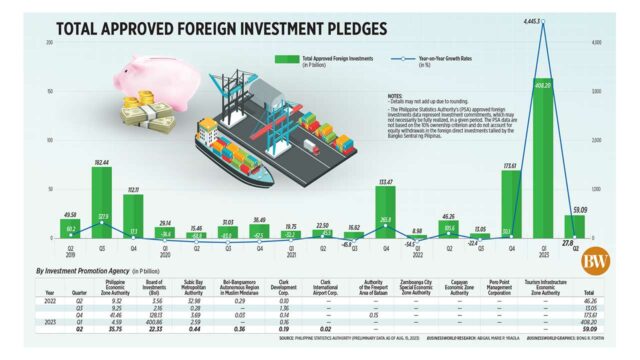
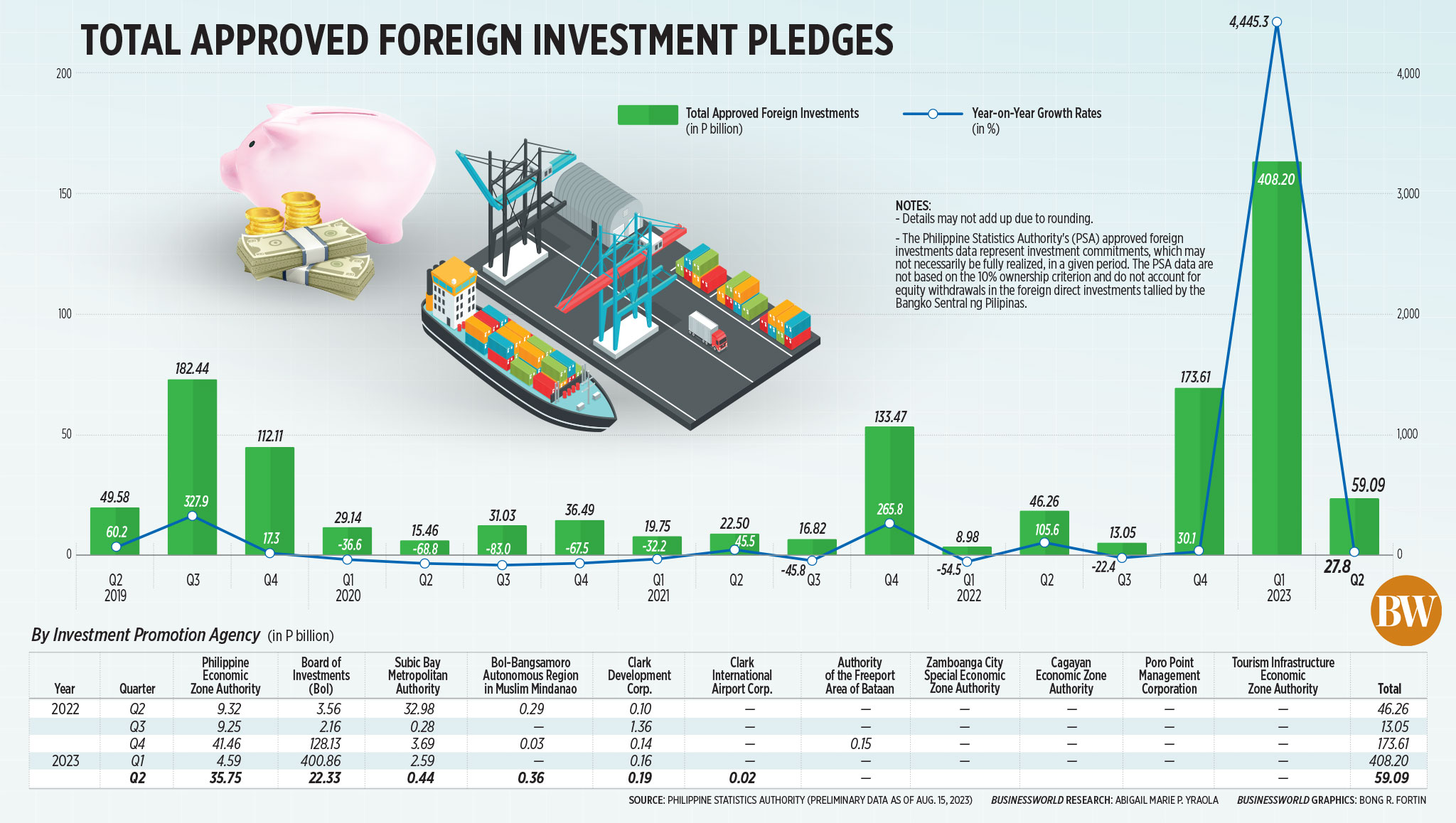
Total approved foreign investment pledges

FOREIGN INVESTMENT PLEDGES approved by investment promotion agencies (IPAs) rose by an annual 27.8% in the second quarter, data from the Philippine Statistics Authority (PSA) showed. Read the full story.

UK watchdog starts ‘politically exposed persons’ review

LONDON — Britain’s Financial Conduct Authority (FCA) said on Monday it will ask lawmakers to report any problems they have opening or maintaining a bank account ahead of a formal investigation.

The review is part of a wider look at “debanking,” which recently became a political issue after former Brexit Party leader Nigel Farage said his account at private bank Coutts, part of NatWest, had been closed due to his political views.

“We are reviewing how financial services firms have applied the Politically Exposed Persons (PEP) regime and whether any changes are needed for UK PEPs,” the FCA said.

Under global rules, politicians, their families and close associates are seen as potentially more susceptible to bribery and corruption given the influence they can have on decision making and transfer of funds, and therefore face tougher checks on opening and maintaining bank accounts.

Britain’s financial services minister Andrew Griffth said last month that he had asked the FCA to consider creating a domestic PEP regime to reflect the lower category of risk from those that have no international role.

The FCA wants to hear some early evidence before it publishes the full terms of reference of its review in September, with a report next June.

“We are keen to hear directly from UK PEPs on their experiences, including any problems they have encountered — so we’re proactively reaching out to parliamentarians and other UK PEPs at an early stage,” the FCA said in a statement.

The watchdog will initially contact lawmakers from both Houses of Parliament, chairs of parties polling more than 5%, senior civil servants and senior ranks of the armed forces.

The PEP rules were drafted by the Financial Action Task Force on money laundering, and the FCA issued guidance in 2017 on how they should be applied.

The review is separate from an urgent data gathering exercise into the scale of debanking called for by British finance minister Jeremy Hunt, who suggested that any lender involved in widespread and unjustified debanking should be fined.

The outcome of the data-finding exercise is due by mid-September. — Reuters

Screenwriter’s Stranger Things copyright lawsuit ends

Stranger Things (2016) —IMDB.COM

NETFILX and the makers of its hit show Stranger Things have resolved a lawsuit brought by a screenwriter who claimed they copied his screenplay about a girl with special powers who fights monsters from another dimension, according to a filing in Los Angeles federal court. Jeffrey Kennedy’s Irish Rover Entertainment agreed on Friday to drop its lawsuit against Netflix and Matt and Ross Duffer with prejudice, which means it cannot be refiled.

Stranger Things was independently conceived by the Duffer Brothers, came into existence because of their creativity, and has succeeded because of their vision and hard work,” a Netflix spokesperson said on Monday. “This lawsuit was completely meritless and we’re glad to be able to put it behind us.”

Representatives for Irish Rover did not immediately respond to a request for comment on Monday.

A trial in the case was scheduled to begin next month.

Stranger Things, the story of a group of adolescent friends in rural Indiana in the 1980s who battle creatures from an alternate dimension called the “Upside Down,” debuted on Netflix in 2016 and became a smash hit for the streaming platform.

Mr. Kennedy’s company sued Netflix and the show’s creators the Duffer Brothers in 2020 for allegedly copying from his screenplay for a project called Totem.

Mr. Kennedy said his work was based on one of his childhood friendships in South Bend, Indiana, in the 1980s. He said that Totem and Stranger Things both revolve around a young girl with supernatural powers seeking to “rescue a loved one from having been abducted by a monster and carried to an alternate dimension that is a dark copy of their current reality.”

The lawsuit says Mr. Kennedy’s screenplay and Stranger Things have several similarities in their characters, plot, dialogue, and themes. Mr. Kennedy accused an artist who developed concept art for both his project and Stranger Things of sharing his work with the Duffer Brothers.

Netflix and the makers of Stranger Things denied the allegations in court filings and said the stories are “objectively different” by “virtually every imaginable measure.”

“Most glaringly, Stranger Things features a core group of children who fight off evil monsters while navigating teenage social issues,” the defendants said. “Totem, on the other hand, features adults, and its characters and storylines are deeply immersed in Native American imagery and mythology.” — Reuters

What is critical infrastructure under the Public Service Act

RAWPIXEL-FREEPIK

Republic Act No. 11659, amending Commonwealth Act No. 146 or the Public Service Act (PSA), was passed into law on March 21, 2022, with the intent to, among others, expand investments into the public services sector, a sector that has been generally considered as “highly regulated.”

With the passing of the amended PSA, clarification as to what are considered as public utilities was made, enumerating such to cover distribution of electricity; transmission of electricity; petroleum and petroleum products pipeline transmission systems; water pipeline distribution systems and wastewater pipeline systems, including sewerage pipeline systems; seaports; and public utility vehicles. For these public utilities, a requirement for a legislative franchise and a 40% maximum foreign equity threshold was confirmed. In carving out the public utilities from the greater set of public services, the ambiguity on what public utilities are covered within the realm of public services has somewhat been eradicated.

While the amended PSA has been lauded as legislation that finally opens a market long been ripe for foreign investments, in the same breadth, the amended PSA introduced industries considered as “critical infrastructure,” over which a specific set of rules apply. Under the amended PSA, a critical infrastructure is defined as “any public service which owns, uses, or operates systems and assets, whether physical or virtual, so vital to the Republic of the Philippines that the incapacity or destruction of such systems or assets would have a detrimental impact on national security, including telecommunications and other such vital services as may be declared by the President of the Philippines.”

On its face, “critical infrastructure” has a broad definition, one that grants the President discretion to identify industries as critical infrastructure, as long as such industries fall under the amended PSA. As of this writing, only telecommunications has been identified in the amended PSA as a critical infrastructure, with the caveat that “no other public service shall be considered critical infrastructure unless declared by the President.”

In relation to that caveat, the Implementing Rules and Regulations (IRR) of the amended PSA allows the President to identify additional critical infrastructure through executive orders, and further allows the National Economic and Development Authority (NEDA) or the applicable administrative agency, such as the National Telecommunications Commission for telecommunications, to recommend to the President additional industries as possible critical infrastructure.

Although the NEDA issued the IRR in June of this year, seeking to further contextualize the broad strokes made in the amended PSA, the ambiguity with respect to critical infrastructure remains present.

What are the possible issues that come with investing in critical infrastructure? At the outset, foreign investors seeking to invest into industries considered as critical infrastructure must consider the limits on equity ownership in such industries. As a general rule, foreign nationals (natural or juridical) cannot own more than 50% of the capital of entities considered as critical infrastructure, unless reciprocity is accorded to Filipino nationals. This reciprocity is satisfied when Philippine nationals are allowed to own more than 50% of capital stock in any activity related to agriculture, industry, and services in the home country of the foreign investor; or if the home country of the foreign investor allows Philippine nationals to invest the same value of capital in any economic activity related to agriculture, industry, and services [IRR, Section 45].

More importantly, foreign investors should consider the latitude of the discretion granted to the President that poses a risk to investors. For one, commercial decisions are not made in a few days. The decision to invest in any industry, especially by foreign investors, is painstaking and deliberate. As such, the identification of “critical infrastructure” and the latitude granted to the President to determine them, leave these investors in a bind. To drive this point home, imagine a foreign investor who has prepared for months and raised funds to invest in a certain entity engaged in industry, only to later have the President declare such an industry as critical infrastructure. What will happen to that investment? What if the foreign investor has breached the maximum foreign equity limits, or the home country of that investor does not grant reciprocity to Filipino nationals? The potential capacity of that investment to revitalize that industry is all but hampered.

In some way, foreign investments in industries likely to be considered as critical infrastructure poses risks that can only be limited through further identification of what industries these are, through an executive order issued by the President identifying additional critical infrastructure. Perhaps by limiting the list of industries considered as critical infrastructure, investors can find guidance on the type of industries potentially to be classified as such. Until such time, investors will have to take the risk in respect of investing in sensitive industries and will need to manage the timing and extent of their investments in the same.

The views and opinions expressed in this article are those of the author. This article is for general informational and educational purposes only and not offered as and does not constitute legal advice or opinion.


Roilan Rigil Kent A. Alonzo is an associate of the Corporate and Special Projects Department of the Angara Abello Concepcion Regala & Cruz Law Offices (ACCRALAW).

raalonzo@accralaw.com

(02) 8830-8000

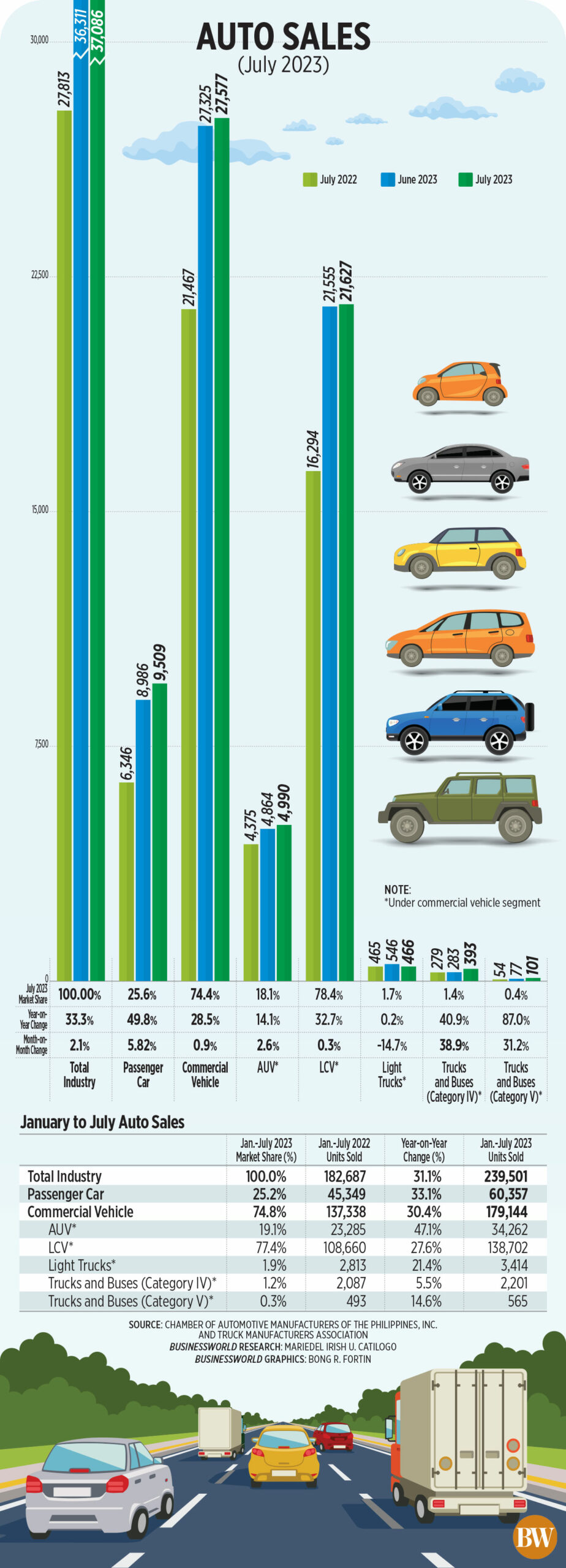
Auto Sales

THE PHILIPPINE auto industry recorded a 33% increase in vehicle sales in July, even as elevated inflation dampens overall consumer spending. Read the full story.

ACEN unit to power JPMorgan Chase Bank

ACEN Corp. through its unit ACEN Renewable Energy Solutions (ACEN RES) has partnered with financial services firm JPMorgan Chase Bank, N.A. to supply the latter’s Philippine office in Taguig City with renewable energy.

The Ayala-led energy company said JPMorgan Chase, through its lessor Asia Affinity, signed a retail electricity supply agreement with ACEN RES to energize its 25-storey building in Taguig City.

“The Ayala Group and JPMorgan Chase have a long history of cooperation, and we are very proud that this relationship has evolved towards our shared value of sustainability. We are grateful for the trust in ACEN as the renewable energy partner of choice,” Eric T. Francia, president and chief executive officer of ACEN, said in a media release.

ACEN said it will source renewable energy from its portfolio of wind, solar, and geothermal plants.

“Through this partnership and the shift to renewable energy solutions, we affirm our global commitment to environmental sustainability and our continued efforts to achieve a low carbon footprint for JPMorgan Chase in the Philippines,” said Carlos Ma. G. Mendoza, senior country officer of JP.Morgan.

ACEN RES is the retail electricity supply business of ACEN. It focuses on providing renewable energy solutions to businesses to help meet their decarbonization targets while also helping them save on electricity.

ACEN has around 4,200 megawatts of attributable capacity spread across the Philippines, Vietnam, Indonesia, India, and Australia. The energy company is targeting to expand its renewable energy portfolio to 20 gigawatts by 2030.

At the local bourse on Tuesday, shares in the company closed unchanged at P5.15 each. — Ashley Erika O. Jose

Filipino startup seeks to help enterprises save on energy costs

ALEXANDER-JAWFOX-UNSPLASH

TECHNOLOGY startup SolX Technologies, Inc. said an end-to-end digital energy solutions platform can help local businesses make cost-effective decisions with their energy consumption.

The startup aims to aid Philippine companies in identifying ideal power contracts and retail electricity suppliers while negotiating the best value for money, Sergius U. Santos, chief executive officer and co-founder of SolX Technologies, said in an e-mailed statement.

The system has helped some companies “save an average of 25% … on their energy costs by going a level deeper and providing them contract optimization and insights on demand charges to further the savings,” he added.

The Philippines remains one of the countries in Southeast Asia with the most expensive electricity.

In December 2021, the Philippines’ residential rate was $0.16/kilowatt hour (kWh), second to Singapore ($0.18/kWh) and higher than Thailand ($0.10/kWh), Indonesia ($0.10/kWh), and Malaysia ($0.05/kWh).

The Philippines has a 2020-2040 energy plan that “advocates for the development and use of existing and emerging technologies in the most efficient and sustainable manner.”

Among the plan’s goals are a 35% renewable energy share in the power generation mix by 2030, as well as a 5% penetration rate of electric vehicles for road transport by 2040.

“Our grid is primarily still coal and natural gas… but some MSMEs [micro, small, and medium enterprises] are now opting for green energy (solar, hydro, wind, geo combination),” Mr. Santos said in an e-mail on Aug. 12.

Rural Industrial Corp., a paper recycling company in Bulacan, is one such enterprise.

Its energy costs total between 25% to 30% of its monthly expenses nowadays, according to its general manager Max L. Sy.

The company, which uses a combination of coal and electricity to generate steam and operate its machines, “is exploring using solar and reusable energy to save on energy costs,” Mr. Sy said in an e-mail on Aug. 14.“[We also have a] continuous focus on operational efficiency to increase output while reducing other input costs,” he said. — Patricia B. Mirasol

How PSEi member stocks performed — August 15, 2023

Here’s a quick glance at how PSEi stocks fared on Tuesday, August 15, 2023.


Philippine stocks inch higher on bargain hunting

PHILIPPINE STAR/KRIZ JOHN ROSALES

STOCKS edged higher on Tuesday on bargain hunting following Monday’s decline, amid lingering concerns over the world’s second-largest economy and ahead of the Bangko Sentral ng Pilipinas’ (BSP) policy review this week.

The Philippine Stock Exchange index (PSEi) rose by 6.72 points or 0.1% to close at 6,335.91 on Tuesday, while the broader all shares index inched up by 2.98 points or 0.08% to end at 3,400.87.

“The market was marginally higher amidst cautious bargain hunting after China announced a surprise cut to a key policy rate in an attempt to boost its flagging economy. China cut its medium-term lending facility rate by 15 bps to 2.5%,” China Bank Capital Corp. Managing Director Juan Paolo E. Colet said in a Viber message.

“The index remains on shaky ground as many investors are worried about disappointing macroeconomic data from China and rising US yields,” Mr. Colet added.

Unicapital Securities, Inc. Senior Equity Research Analyst Carlos Angelo O. Temporal likewise said investors were cautious amid concerns over the Chinese economy and ahead of the BSP’s meeting on Thursday.

A broad array of Chinese data on Tuesday highlighted intensifying pressure on the economy from multiple fronts, prompting Beijing to cut key policy rates to shore up activity but analysts say more support is needed to revitalize growth, Reuters reported.

Less than an hour before the release of a batch of July data, China’s central bank unexpectedly cut key policy rates for the second time in three months, underlining the rapid loss of the post-COVID economic rebound that has shaken global financial markets.

Tuesday’s batch of data released by the National Bureau of Statistics, which comes on top of a raft of weak indicators from last week, showed retail sales, industrial output and investment all growing at a slower than expected pace.

Meanwhile, a BusinessWorld poll last week showed that 13 of 15 analysts see the BSP’s Monetary Board keeping its policy rate steady at a near 16-year high of 6.25% at its meeting on Thursday.

Sectoral indices increased on Tuesday, except for mining and oil, which fell by 122.89 points or 1.24% to 9,785.41, and industrials, which declined by 110.49 points or 1.23% to 8,861.77.

Meanwhile, services climbed by 15.40 points or 1% to 1,548.19; property increased by 15.65 points or 0.59% to 2,634.40; financials gained 4.77 points or 0.25% to end at 1,904.43; and holding firms inched up by 0.41 point to 5,970.40.

Value turnover surged to P24.82 billion on Tuesday with 472.74 million shares changing hands from the P4.58 billion with 716.17 million issues seen on Monday.

Decliners outnumbered advancers, 99 versus 80, while 42 names closed unchanged.

Net foreign buying stood at P107.17 million on Tuesday versus the P361.26 million in net selling recorded on Monday.

For Wednesday, Mr. Colet placed the PSEi’s immediate support at 6,300 and resistance at 6,400. — A.H. Halili with Reuters

Peso weakens further vs dollar

BW FILE PHOTO

THE PESO declined to a fresh eight-month low against the dollar on Tuesday as the safe-haven greenback remained strong due to concerns over the Chinese economy.

The local currency closed at P56.84 versus the dollar on Tuesday, down by six centavos from Monday’s P56.78 finish, data from the Bankers Association of the Philippines’ website showed.

This was the peso’s weakest close in over eight months or since its P56.94 per dollar finish on Nov. 23, 2022.

The local unit opened Tuesday’s session slightly stronger at P56.65 per dollar. Its intraday best was at P56.60, while its weakest showing was at P56.865 against the greenback.

Dollars traded dropped to $1.09 billion on Tuesday from the $1.41 billion on Monday.

The peso declined as the dollar remained among one-month highs, Rizal Commercial Banking Corp. Chief Economist Michael L. Ricafort added in a Viber message.

The safe-haven dollar stayed firm against major peers while the yuan sank to a nine-month trough after China’s central bank unexpectedly cut key policy rates for a second time in three months on Tuesday to shore up the country’s sputtering economy, Reuters reported.

The dollar index, which measures the currency against six developed market counterparts including the euro and yen, was about flat at 103.08 after hitting a 1-1/2-month high at 103.46 on Monday, buoyed by demand for the safest assets following a spate of disappointing Chinese economic indicators that raised concerns about global growth.

Punctuating those worries, Chinese data on industrial output, retail sales and investment released shortly after the People’s Bank of China’s rate cut showed unexpected slowdowns.

“The peso depreciated ahead of a potentially upbeat US retail sales report tonight,” a trader added in an e-mail on Tuesday.

For Wednesday, the trader said the peso might continue to weaken as the market stays cautious ahead of the Bangko Sentral ng Pilipinas’ policy meeting on Thursday.

The trader expects the peso to move between P56.70 and P56.90 per dollar on Wednesday, while Mr. Ricafort sees it ranging from P56.75 to P56.95. — AMCS with Reuters

Philippines told to start drilling oil at Reed Bank amid rising tensions

PHOTO FROM GOOGLE MAP

A FORMER Supreme Court justice on Tuesday renewed his call for the Philippines to start oil exploration at Reed Bank in the South China Sea amid China’s alleged muscle-flexing.

The Chinese Coast Guard’s water cannon attack on Philippine resupply vessels at Second Thomas Shoal on Aug. 5 was a signal that Manila should not send survey ships to Reed Bank, ex-Supreme Court Justice Antonio Carpio told the ABS-CBN News Channel.

“I think that is connected,” he said. “It’s very clear that they are flexing their muscle to intimidate us not to send our survey and drilling ship to Reed Bank.”

The Chinese embassy in Manila did not immediately reply to a Viber message seeking comment.

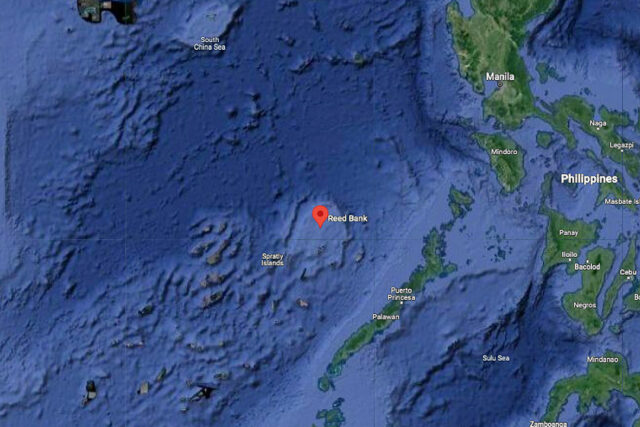
Mr. Carpio said the Philippines needs the support of its navy once it sends survey and drilling ships to the bank, a large isolated underwater volcanic mountain with a flat top northeast of the Spratly Islands. It covers an area of almost 9,000 square kilometers.

Mr. Carpio said it is urgent to get oil and gas deposits at Reed Bank amid rising energy costs and the drying up of the Malampaya natural gas field.

“We have no choice but to get the gas in Reed Bank, [otherwise] our economy will suffer tremendously,” he added.

Mr. Carpio said Manila should enter into joint patrols with the US and seek the help of the Philippine Navy when it launches exploration activities at Reed Bank.

The late President Benigno S.C. Aquino III ordered a halt on exploration activities at Reed Bank in 2012 amid rising tensions with China.

His successor, Rodrigo R. Duterte, lifted the suspension in 2020, resuming drilling activities in the disputed water, including Reed Bank, and advancing a 2018 deal with China for joint oil and gas exploration.

In March 2022, months before the end of his six-year term, the tough-talking leader said the Philippines should honor its Reed Bank exploration deal with China to avoid potential “trouble.”

In July, the Armed Forces of the Philippines (AFP) spotted a swarm of Chinese vessels roaming Iroquois Reef south of Reed Bank.

“Recto Bank, a significant feature for the Philippines holding immense potential for the country’s energy security and economic growth, stands as a focal point in this rising concern over China’s recent behavior,” the AFP said.

The Philippines and US are set to hold joint patrols in the South China Sea this year.

China has been critical of the Philippines’ growing security ties with the US, calling the latter a threat to regional peace after the Marcos government gave it increased access to military bases under their 2014 Enhanced Defense Cooperation Agreement.

Defense Secretary Gilberto Teodoro, Jr. has said defense arrangements that the Philippines has entered into are “nobody else’s business.”

Reed Bank may hold as many as 5.4 billion barrels of oil and 55.1 trillion cubic feet of natural gas, according to a 2013 report from the US Energy Information Administration.

China’s coast guard last week released a video of its ship shooting jets of water at a smaller Philippine boat near Second Thomas Shoal, saying it had handled the incident according to law.

The Aug. 5 video showed the water barely hitting the makeshift Philippine boat that was trying to deliver food and other supplies to Filipino troops stationed at the shoal.

The shoal, which the Philippines calls Ayungin, is a submerged reef in the South China Sea where a handful of its troops live on a rusty World War II-era US ship that Manila intentionally grounded in 1999 to assert it claim.

Second Thomas Shoal is about 200 kilometers (124 miles) from the Philippine island of Palawan and more than 1,000 kilometers from China’s nearest major landmass, Hainan Island.

The Chinese Coast Guard in a website posting said the Philippine boats had entered Second Thomas Shoal illegally. It maintained “rational restraint throughout the process,” it added.

China’s Foreign Ministry has urged the Philippines to remove the outpost from the shoal. China has communicated to the Philippines about the Second Thomas Shoal issue “many times” through diplomatic channels, but its goodwill and sincerity have been ignored, it said last week.

China is willing to handle maritime issues through talks and consultations, the Foreign Ministry said.

Jonathan Malaya, spokesman of the Philippines’ National Security Council, has said the Philippines would never abandon its post at Second Thomas Shoal. KATA