Home Blog Page 445

Groups urge PHL to refrain from sending Myanmar poll observers

A MYANMAR protester residing in Japan uses a face mask with an image of Myanmar’s detained former leader Aung San Suu Kyi during a rally denouncing an upcoming election led by the military junta and demanding the immediate release of Ms. Suu Kyi and all political prisoners, outside Myanmar’s embassy in Tokyo, Japan on Dec. 14, 2025. — REUTERS/ISSEI KATO

A LOCAL labor coalition on Monday urged the Philippine government to refrain from sending observers to Myanmar’s military junta-run elections, as recognizing “sham” polls would undermine the country’s upcoming 2026 chairmanship and expose businesses to reputational and legal risks.

The Nagkaisa Labor Coalition (NAGKAISA) said that the junta’s elections, running from Dec. 28 into late January 2026, are being held under repression, mass arrests, and civil conflict, and cannot be considered genuine democratic exercises.

“Not sending poll observers to a sham election is the correct, principled position,” Sonny G. Matula, NAGKAISA chairperson and Federation of Free Workers president, said in a statement.

“You cannot monitor democracy where there is none and sending observers is like camouflaging a sham election sponsored by a military junta. You cannot observe an election initiated by a military junta and held at gunpoint.”

Labor experts warned that Myanmar’s instability poses tangible risks for Philippine businesses, as companies operating in Myanmar or linked to regional supply chains must comply with the International Labour Organization’s (ILO) Article 33 on forced labor and human rights.

“Regional instability raises the cost of doing business: investors price in political risk across ASEAN, supply chains get disrupted, and confidence drops when rule of law and civilian governance look fragile,” Mr. Matula told BusinessWorld over Viber.

Mr. Matula emphasized that tolerating sham elections could normalize an undemocratic “Myanmar formula” in the region, which he said would be “bad for workers, bad for institutions, and bad for investment credibility.”

Josua T. Mata, secretary-general of SENTRO, added that companies operating in Myanmar or linked to regional supply chains “must comply with the ILO’s Article 33 sanctions, aimed at cutting off the economic lifelines of the junta,” noting that “failure to comply exposes companies to massive reputational damage.”

He said that the junta’s reliance on forced labor, human trafficking, and even large-scale cybercrime networks not only increases economic and compliance risks but also imposes direct financial harm on Filipinos, particularly through scams and fraudulent schemes funded by the military.

Both groups urged President Ferdinand R. Marcos, Jr. as incoming ASEAN chair, to prevent member states from legitimizing Myanmar’s elections, noting concerns as Cambodia plans to send observers while Malaysia has criticized the polls.

Last month, the Department of Foreign Affairs stated that the Philippines remains ready to support a “Myanmar-led and Myanmar-owned” political process but has yet to take a definitive stance on the legitimacy of the current polls. — Erika Mae P. Sinaking

Trump says US and Ukraine ‘a lot closer’ on peace deal but ‘thorny issues’ remain

UKRAINIAN President Volodymyr Zelensky waves as he meets US President Donald J. Trump at the White House, amid negotiations to end the Russian war in Ukraine in Washington, DC, US, Aug. 18. — REUTERS/KEVIN LAMARQUE

PALM BEACH, Florida — US President Donald J. Trump said on Sunday that he and Ukrainian President Volodymyr Zelensky were “getting a lot closer, maybe very close” to an agreement to end the war in Ukraine, while acknowledging that the fate of the Donbas region remains a key unresolved issue.

The two leaders spoke at a joint news conference after meeting at Mr. Trump’s Mar-a-Lago resort in Florida on Sunday afternoon. Both leaders reported progress on two of the most contentious issues in peace talks — security guarantees for Ukraine and the division of eastern Ukraine’s Donbas region that Russia has sought to capture.

Both Mr. Trump and Mr. Zelensky offered few details and did not provide a deadline for completing a peace deal, although Mr. Trump said it will be clear “in a few weeks” whether negotiations to end the war will succeed. He said a few “thorny issues” around territory must be resolved.

Mr. Zelensky said an agreement on security guarantees for Ukraine has been reached. Mr. Trump was slightly more cautious, saying that they were 95% of the way to such an agreement, and that he expected European countries to “take over a big part” of that effort with US backing.

French President Emmanuel Macron, in an X post published after Mr. Trump met with Mr. Zelensky, said progress was made on security guarantees. Mr. Macron said countries in the so-called “Coalition of the Willing” would meet in Paris in early January to finalize their “concrete contributions.”

Mr. Zelensky has said previously that he hopes to soften a US proposal for Ukrainian forces to withdraw completely from Donbas, a Russian demand that would mean ceding some territory held by Ukrainian forces. While Moscow insists on getting all of Donbas, Kyiv wants the map frozen at current battle lines.

Both Mr. Trump and Mr. Zelensky said on Sunday the future of the Donbas had not been settled, though the US president said discussions are “moving in the right direction.” The United States, seeking a compromise, has proposed a free economic zone if Ukraine leaves the area, although it remains unclear how that zone would function in practical terms.

“It’s unresolved, but it’s getting a lot closer. That’s a very tough issue,” Mr. Trump said.

Nor did the leaders offer much insight into what agreements they had reached on providing security for Ukraine after the war ends, something Mr. Zelensky described the meeting as “the key milestone in achieving a lasting peace.”

Russia has said any foreign troop deployment in Ukraine is unacceptable.

Mr. Zelensky said any peace agreement would have to be approved by Ukraine’s parliament, or by a referendum. Mr. Trump said he would be willing to speak to parliament if that would secure the deal.

TRUMP AND PUTIN SPEAK BEFORE ZELENSKY MEETING
Shortly before Mr. Zelensky and his delegation arrived at Mr. Trump’s Florida residence, Mr. Trump and Russian President Vladimir Putin spoke in a call described as “productive” by the US president and “friendly” by Kremlin Foreign Policy Aide Yuri Ushakov.

Mr. Ushakov, in Moscow, said Mr. Putin told Mr. Trump a 60-day ceasefire proposed by the European Union and Ukraine would prolong the war. The Kremlin aide also said Ukraine needs to make a decision regarding the Donbas “without further delay.”

Mr. Trump said he and Mr. Putin spoke for more than two hours. He said the Russian president pledged to help rebuild Ukraine, including by supplying cheap energy. “Russia wants to see Ukraine succeed,” Mr. Trump said. “It sounds a little strange.”

As Mr. Trump praised Mr. Putin, Mr. Zelensky tilted his head and smiled.

Mr. Trump said he would call Mr. Putin again following the meeting with Mr. Zelensky.

The Kremlin expressed support for Mr. Trump’s negotiations.

“The whole world appreciates President Trump and his team’s peace efforts,” Kirill Dmitriev, Mr. Putin’s special envoy, posted on X early on Monday after Mr. Trump’s talks with Mr. Zelensky.

NUCLEAR PLANT DISCUSSED
US negotiators have also proposed shared control over the Zaporizhzhia nuclear plant. Power line repairs have begun there after another local ceasefire brokered by the International Atomic Energy Agency, the agency said on Sunday.

Negotiators, Mr. Trump said, have made progress on deciding the fate of the plant, which can “start up almost immediately.” The US president said “it’s a big step” that Russia had not bombed the facility.

Russia controls all of Crimea, which it annexed in 2014, and since its invasion of Ukraine nearly four years ago has taken control of about 12% of its territory, including about 90% of the Donbas, 75% of the Zaporizhzhia and Kherson regions, and slivers of the Kharkiv, Sumy, Mykolaiv and Dnipropetrovsk regions, according to Russian estimates.

The day before Mr. Zelensky arrived in Florida to meet with Mr. Trump, Russian forces attacked Kyiv and other parts of Ukraine with hundreds of missiles and drones, knocking out power and heat in parts of the Ukrainian capital. Mr. Zelensky has described the weekend attacks as Russia’s response to the US-brokered peace efforts, but Mr. Trump on Sunday said he believes Mr. Putin and Mr. Zelensky are serious about peace.

After Saturday’s air attacks, Mr. Putin said Moscow would continue waging its war if Kyiv did not seek a quick peace. Russia has steadily advanced on the battlefield in recent months, claiming control over several more settlements on Sunday.

European heads of state joined at least part of Sunday’s meeting by phone. European Commission President Ursula von der Leyen said on X that “Europe is ready to keep working with Ukraine and our US partners,” and added that having ironclad security guarantees will be of “paramount” importance.

A spokesman for UK Prime Minister Keir Starmer said European leaders “underlined the importance of robust security guarantees and reaffirmed the urgency of ending this barbaric war as soon as possible.” — Reuters


China launches war games around Taiwan as island vows to defend democracy

A fishing boat sails past a Chinese warship during a military drill off the Chinese coast near Fuzhou, Fujian Province, across from the Taiwan-controlled Matsu Islands, China, April 11, 2023. — REUTERS

BEIJING/TAIPEI — China staged live-fire drills around Taiwan on Monday, deploying troops, warships, fighter jets and artillery for its “Justice Mission 2025” exercises, as the island scrambled soldiers and showcased US-made hardware to rehearse repelling an attack.

The Eastern Theatre Command said it had concentrated forces to the north and southwest of the Taiwan Strait and carried out live firing and simulated strikes on land and maritime targets. The drills would continue on Tuesday and include exercises to blockade the island’s main ports and encircle it.

A senior Taiwan security official told Reuters dozens of Chinese military boats and aircraft were operating around the island, some of which were “deliberately closing in” on Taiwan’s contiguous zone, defined as 24 nautical miles from its coast.

This marks China’s sixth major round of war games since 2022 after then-US House Speaker Nancy Pelosi visited the democratically governed island, and follows a rise in Chinese rhetoric over Beijing’s territorial claims after Japanese Prime Minister Sanae Takaichi suggested a hypothetical Chinese attack on Taiwan could trigger a military response from Tokyo.

The exercises began 11 days after the US announced $11.1 billion in arms sales to Taiwan, the largest ever weapons package for the island, drawing a protest from China’s defense ministry and warnings the military would “take forceful measures” in response.

Analysts say Beijing’s drills increasingly blur the line between routine military training exercises and what could be stage-setting for an attack, a strategy intended to give the US and its allies minimal warning of an assault.

“This (the drills) serves as a serious warning to ‘Taiwan Independence’ separatist forces and external interference forces,” said Shi Yi, a spokesperson for the Eastern Theatre Command.

Taiwan’s government condemned the drills, while its defense ministry posted a video on Facebook showcasing various weapons, including US-made HIMARS rocket systems, a highly mobile artillery system with a range of about 300 kilometers (186 miles) that could hit coastal targets in China’s southern province of Fujian, on the other side of the Taiwan Strait, in the event of a conflict.

Taiwan’s coast guard added that it had dispatched large ships in reaction to Chinese coast guard activity near its waters and that it was working with the island’s military to minimize the drills’ impact on maritime routes and fishing areas.

The island’s aviation authority said China had designated a “temporary danger zone” in Taipei’s airspace for 10-hours of live-fire drills scheduled for Tuesday and that it was working to identify alternative flight routes.

RAPID RESPONSE
Taiwan’s defense ministry said two Chinese military aircraft and 11 ships had been operating around the island over the past 24 hours, and that Taiwan’s military was on high alert and poised to carry out “rapid response exercises.”

That particular drill is designed to move troops swiftly in case China suddenly turns one of its drills around the island into an attack.

“All members of our armed forces will remain highly vigilant and fully on guard, taking concrete action to defend the values of democracy and freedom,” the defense ministry said.

Taiwan stock markets were unaffected by the drills, up 0.8% to a record high in morning trading.

“I think these drills are just meant to scare us,” said Lin Wei-ming, a 31-year-old teacher based in the capital, Taipei. “Similar drills have happened before … the political side of things can only be handled by Taiwan’s current government and how they choose to respond.”

Taiwan rejects China’s claimed sovereignty, maintaining that only its people can decide the island’s future.

‘SMASH THE SEPARATIST SCOUNDRELS’
The Chinese military released two posters titled “Shields of Justice: Smashing Illusions,” and “Arrows of Justice: Control and Denial”, along with a third graphic depicting four locations across the island with targets locking on, following the drill announcement.

China’s state broadcaster said the exercises would focus on sealing off Taiwan’s vital deep-water Port of Keelung to the island’s north and Kaohsiung to Taiwan’s south, the island’s largest port city.

While the PLA practiced port blockades around Taiwan during war games last year, this marks the first time it has publicly stated that drills around the island are aimed at “deterrence” of outside military intervention.

The Japanese prime minister’s remarks triggered a surge in Chinese messaging stressing its sovereignty claims. Chinese leader Xi Jinping told US President Donald Trump in November that Taiwan’s “return to China” after World War Two was central to Beijing’s vision of the global order.

The first poster appeared to show the armada of civilian ships China is mobilizing to help in an attack on Taiwan, vessels with ramps and open decks that could be used to carry out an amphibious assault.

“Any foreign interference that touches the shield (of justice) shall perish!” the poster read. “Any separatist scoundrels who encounter the shield shall be destroyed!”

“I think their (China’s) goal is, as they said, ‘keep the island, not the people,’” said Stephanie Huang, a 56-year-old interior designer. “They just want to save face by claiming Taiwan as part of their own country, but Taiwanese people don’t see it that way.”

“We are who we are; they are who they are.” — Reuters

South Korea’s ex-First Lady Kim received bribes and meddled in state affairs, prosecutor says

SOUTH KOREA’s former first lady Kim Keon Hee arrives at the special prosecutor’s office in Seoul, South Korea, Aug. 6. — REUTERS/KIM HONG-JI

SEOUL — The wife of former South Korean President Yoon Suk Yeol interfered in state affairs in return for expensive valuables and money, a special prosecutor said on Monday.

The special prosecutor’s investigations, which wrapped up on Sunday, came amid a year-long probe into Mr. Yoon’s brief imposition of martial law last year and related scandals linked to the once-powerful couple.

The prosecution team earlier this month sought a 15-year prison sentence for former First Lady Kim Keon Hee, who is under detention and currently on trial for suspected acceptance of bribes for mediation and other charges.

Ms. Kim has denied any wrongdoing. She apologized to the public for causing concerns during a court hearing earlier this month.

Ms. Kim “took advantage of the status of the president’s spouse to receive money and expensive valuables, and has been widely involved in various personnel appointments and nominations,” special prosecutor Min Joong-ki said at a news conference marking the end of his investigation.

A lower court ruling on Ms. Kim is expected on January 28.

“Investigations do not end because one says so, but are eventually completed with evidence in court,” Ms. Kim’s lawyers said in a statement on Monday, adding they will work “to ensure that procedural legitimacy and defense rights are thoroughly guaranteed so that facts are not exaggerated or distorted into political framing.”

The prosecution team has also indicted Unification Church leader Han Hak-ja, now on trial, after the religious group was suspected of giving Ms. Kim valuables including two Chanel bags and a diamond necklace as part of its efforts to win influence.

Ms. Han has denied that she directed her church to bribe Ms. Kim.

“Various people who did not have a common denominator with each other visited Kim Keon Hee, not the president, and asked for what they wanted, and gave money and goods,” said assistant special prosecutor Kim Hyeong-geun.

“As a result, their request was realized.”

Ousted President Yoon is on trial for suspected masterminding of an insurrection, a charge that could mean a life sentence or even a death penalty. He has denied the charges.

A lower court ruling on Mr. Yoon is expected early 2026. — Reuters

German business groups expect job cuts in 2026 as economic crisis drags on

A German national flag flies atop the illuminated Reichstag building in Berlin, Germany. — REUTERS

BERLIN — A majority of German business associations expect job cuts in 2026 as the country’s economic crisis persists, with industry hit hardest by global protectionism and weak exports, a survey by the German Economic Institute IW showed on Monday.

Of 46 business associations surveyed, 22 anticipate workforce reductions next year. Only nine expect to increase hiring and 15 foresee stable employment levels.

The automotive, paper, and textile industries are among those expecting production declines. They have been hurt by rising protectionism, weak exports, and high domestic costs that have eroded Germany’s price competitiveness, the survey found.

“Those who hoped for a swift and comprehensive end to the economic crisis will also be disappointed in 2026,” said IW director Michael Huether. The economy is “stabilizing at a lower level,” he added.

Investment plans remain subdued. Just 11 associations expect increases while 14 anticipate cuts and 21 see stagnant investment at low levels, the survey showed.

BRIGHT SPOTS

Some bright spots emerged in sectors benefiting from increased defense spending, including aerospace and shipbuilding. Services also reported improved conditions compared to last year.

Business sentiment showed modest improvement, with 19 associations expecting higher production than in 2025 versus nine anticipating declines. This marks the first positive outlook balance in years. — Reuters

DepEd, DBM urged to release P20k incentive before 2026

Kindergarten students attend their first day of classes at the President Corazon Aquino Elementary School in Quezon City, June 16, 2025. — PHILIPPINE STAR/MIGUEL DE GUZMAN

A teachers’ group on Saturday urged the Department of Education (DepEd) and the Department of Budget and Management (DBM) to release the full Service Recognition Incentive (SRI), citing concerns over possible delays in payouts.

“Reports from the ground indicate continued uncertainty and uneven implementation regarding the release of the SRI, with concerns that only partial amounts may be disbursed or that release may be delayed beyond the year,” Alliance of Concerned Teachers Philippines Chairman Ruby Bernardo said in a statement.

“Any delay or reduction of the SRI would severely undermine its intended purpose and further demoralize education workers who have already sacrificed much,” she added.

Under Administrative Order No. 40, eligible DepEd personnel with regular, contractual, and co-terminus appointments nationwide are expected to receive a P20,000 incentive, to be released in two tranches and directly credited to the employees’ ATM payroll.

The first release will amount to P10,000 to P14,500, while the remaining balance will be released after the approval of the request for modification of allotments.

The DepEd said on Dec. 20 that it will begin releasing year-end incentives to its employees, which include the SRI, Productivity Enhancement Incentive (PEI), the Collective Negotiation Agreement (CNA) incentive for eligible personnel, and gratuity pay for contract-based workers.

Although the last banking day for the year is on Dec. 29, Ms. Bernardo said the group is still hopeful that all the agencies involved will “act decisively” and release the entire incentive before the year ends in honor of the “indispensable role” of teachers in public education and service.

“The SRI has become an important form of relief amid persistent inflation, delayed benefits, and mounting household expenses, especially during the holiday season,” Ms. Bernardo said.

“Timely and full compliance will demonstrate the government’s commitment to honoring its obligation to teachers and education workers, not merely in words but in action,” she added.

About one million teaching and non-teaching DepEd staff are set to receive the SRI, PEI, gratuity pay, and CNA incentives. — Almira Louise S. Martinez

Kaspersky says telecoms-related threats to persist in 2026

RAWPIXEL.COM-FREEPIK

Kaspersky warned that telecommunications-related scams are set to rise in 2026, as the rollout of newer technologies introduces fresh operational risks for the sector, the cybersecurity firm said.

“Telecom operators need visibility across both dimensions: maintaining strong defenses against known threats while building security into these new technologies from day one. The key is continuous threat intelligence that spans from endpoint to edge to orbit,” Kaspersky said in a statement on Monday.

Kaspersky said that advanced persistent threats and SIM-enabled frauds will continue to put pressure on telecommunications operators next year, amid the growing technology landscape.

It said that operators are set to face challenges as threat actors are expected to leverage emerging technologies like artificial intelligence, while telco firms’ continued expansion further broadens areas for vulnerabilities.

“The threats that dominated 2025 — APT campaigns, supply chain attacks, DDoS (Distributed Denial-of-Service)  floods — aren’t going away. But now they intersect with operational risks from automation, quantum-ready cryptography, and satellite integration,” said Kaspersky Global Research and Analysis Team (GReAT) Senior Security Researcher Leonid Bezvershenko.

Technology transition could pose disruption if deployed unevenly or without strong controls, Kaspersky said, adding that AI-assisted network management can also further increase configuration errors which could lead to interoperability and performance issues.

Kaspersky said between November 2024 and October 2025, 12.79% of users in the telecommunications sector faced web threats and 20.76% reported on-device threats.

To recall, the Philippine cybersecurity industry is urging the government and private sector to abandon reactive, fragmented policies and adopt consistent standards and resilient infrastructure to combat rising cyber threats. — Ashley Erika O. Jose

Nepal’s former rapper to run for PM in key vote after Gen Z protests

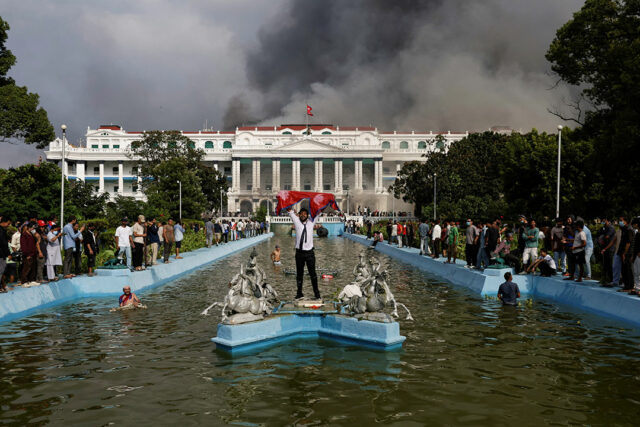
A demonstrator holding Nepal’s flag celebrates at the Singha Durbar office complex that houses the Prime Minister’s office and other ministries after storming it during a protest against Monday’s killing of 19 people after anti-corruption protests that were triggered by a social media ban, which was later lifted, during a curfew in Kathmandu, Nepal, Sept. 9, 2025. — REUTERS/NAVESH CHITRAKAR

KATHMANDU — Two popular leaders have formed an alliance ahead of March parliamentary elections in Nepal that will challenge the older parties which have dominated the Himalayan nation’s politics for over three decades, party officials and analysts said on Monday.

Rapper turned-Kathmandu mayor Balendra Shah, known as Balen, a popular elected official, joined the Rastriya Swatantra Party (RSP) or national independent party, led by a former TV host-turned politician Rabi Lamichhane on Sunday, party officials said.

They said under the agreement with RSP, 35-year old Balen will become the prime minister if the RSP wins the March 5 elections while Mr. Lamichhane will remain the party chief.

Both have vowed to address the demands raised during the “Gen Z” or youth-led protests against widespread corruption in September in which 77 people were killed and led to Prime Minister K.P. Sharma Oli resigning.

“It is a very smart and strategic move by the RSP to bring in Balen and his young supporters into its fold,” analyst Bipin Adhikari said.

“Traditional political parties are in pain for fear of losing their young voters to RSP,” he said.

The election commission says nearly 19 million of Nepal’s 30 million people are eligible to vote in the elections. Nearly one million voters – mostly youths – were added after the protests.

Balen was in the spotlight after the protests and was an undeclared leader of the youngsters who led the September protests.

He also helped form the interim government of former Chief Justice Sushila Karki to oversee the vote.

Mr. Oli’s Communist Party of Nepal (Unified Marxist-Leninist) or UML and the centrist Nepali Congress party have shared power between them for most of the past three decades and are most likely to be challenged by Balen. — Reuters

China blames military drills for reef damage around disputed Scarborough Shoal

THIS PHOTO taken by the Philippine Coast Guard (PCG) shows one of the two Chinese coast guard vessels shadowed by the BRP Cabra about 26 nautical miles (48.15 kilometers) east of Scarborough Shoal, Nov. 23, 2025. — PCG

BEIJING — China said without naming any country that military activities such as bomb-dropping training in the waters around Scarborough Shoal have damaged the coral reefs there, state broadcaster CCTV said on Monday citing an ecological report.

The report, conducted by the country’s natural resources ministry, also said that “illegal fishing” and frequent intrusion activities in recent years have threatened the ecosystem around the shoal.

China and the Philippines both claim territorial rights to Scarborough Shoal, one of Asia’s most contested maritime features prized for its rich fisheries, its protective lagoon and proximity to major shipping lanes. But sovereignty has never been established.

It is effectively under Beijing’s control although Filipino boats continue to operate there.

In September, China approved the creation of a national nature reserve at the shoal, a plan the Philippines condemned as a “clear pretext for occupation”. — Reuters

Return of global funds puts Southeast Asia in spotlight for 2026

More companies may go public in 2024. — IMAGO/WESTLIGHT VIA REUTERS CONNECT

Foreign capital is coming back to Southeast Asia’s stock markets this month, positioning the cohort as one of the must-watch pockets of global finance for 2026.

Drawn by cheap valuations and the need to diversify portfolios, foreign funds have poured $337 million into Southeast Asia’s emerging markets in December — poised to be the most since September 2024. Markets in Indonesia and Thailand have led the way in luring investors back after they sold regional equities in 10 of the previous 11 months. Overall, outflows for 2025 still stand at about $15 billion.

A dearth of stocks linked to the booming artificial intelligence sector has been one key reason for the MSCI Asean Index to trail a broader Asia Pacific gauge by about 13 percentage points in 2025, the most in five years. Besides affordable valuation, the bloc is attracting money managers keen to find alternatives to their high exposure to tech stocks given the worries around an AI bubble.

“Asean should benefit from the overall need for investors to broaden their exposure out of the US, and out of very crowded parts like AI,” said Christopher Wong, portfolio strategist at Fidelity International. Asean markets have “very different growth engines behind them,” he said.

Some Asean markets like Vietnam are also seen gaining from global supply-chain shifts away from China and the Federal Reserve’s expected interest-rate cuts. The country’s stocks will also benefit from an upgrade to secondary emerging-market status by FTSE Russell, announced in October.

Earnings prospects for markets like Indonesia, Vietnam and the Philippines are improving, thanks to major fiscal spending plans by governments to bolster infrastructure and boost household demand, as well as a favorable monetary policy backdrop in some nations.

Benchmark equity indexes in Indonesia, Thailand, Malaysia and Vietnam are trading at valuation multiples that range between 12 and 15 times their one-year forward earnings estimates, while the Philippines’ gauge is trading at a multiple below 10. In comparison, the S&P 500 Index is valued at over 22 times.

There are risks though. Two of the region’s largest economies face economic challenges from political turmoil at home. Thailand’s Prime Minister Anutin Charnvirakul dissolved parliament earlier this month and set elections for Feb. 8. In Indonesia, investors are wary about President Prabowo Subianto’s populist policies.

At the same time, should the AI theme continue to win favor among investors, Asean markets will struggle to shake their underperformance.

Analysts at JPMorgan Chase & Co. said last month that “undemanding valuations are making Asean incrementally more attractive for value investors, especially if earnings growth rebounds.” That has proved prescient given the December flows.

If foreign positioning reverts to the median level of the last three years, Southeast Asian markets as a whole may see a potential inflow of $20 billion, analysts including Khoi Vu wrote in a note dated Nov. 28. — Bloomberg

Group flags ‘abusive loan sharks’ targeting education workers

A teacher conducting basic reading comprehension exercises in Kamuning Elementary School in Quezon City, May 21, 2025. — PHILIPPINE STAR/MIGUEL DE GUZMAN

Some teachers and workers in the education sector are facing “abusive” and “predatory” loan sharks amid the holiday season, according to a teachers’ group.

“We had a discussion with teachers who are worried about their ATM (Automated Teller Machine) payroll that was garnished by atrocious lending companies operating as loan sharks,” Teachers Dignity Coalition National Chairman Benjo G. Basas said in Filipino in a video statement on Wednesday.

“We are not dismissing the liability of our fellow teachers who were not careful or vigilant,” he added. “However, they should not be squeezed dry financially or have all of the money that goes into their ATM be taken because of garnishment.”

Teaching professionals often take loans from private lending institutions (PLI) due to insufficiency fueled by economic challenges, said Mr. Basas.

“This propensity to borrow is not because of the teachers’ personal interest or desire to take on debt. This is caused by insufficiency. This is because of the economic challenges our teachers face every day,” he said.

In the written appeal to the Department of Education (DepEd), TDC noted that financially struggling teachers have been lured by private lending institutions (PLI) into loan agreements that have “deceptive terms, excessive penalties, unconscionable fees, and compounded interest.”

“This appeal is made for teachers and DepEd employees who—after already being victimized, harassed, and financially penalized—are now facing yet another devastating blow: the inability to provide for and celebrate the holiday season with their families,” the group said.

“When borrowers inevitably fall behind, these institutions resort to legal maneuvers designed to secure court orders of garnishment, effectively stripping teachers of their salaries and leaving them financially incapacitated,” it added.

The group also raised concerns about reports on certain personnel from the Schools Division Offices (SDO) who have directly and indirectly accommodated the said PLIs that placed teachers in financial jeopardy.

“This appeal is made for teachers and DepEd employees who—after already being victimized, harassed, and financially penalized—are now facing yet another devastating blow: the inability to provide for and celebrate the holiday season with their families,” it added.

Along with the matter raised by the group, TDC has appealed that the year-end incentives of teachers be given in cash or check upon request.

“Granting this request would help spare them from an extremely difficult and distressing situation—so severe that some have felt compelled to personally go to Malacañang to seek the President’s mercy,” it said.

On Dec. 20, the Education department announced that it would begin releasing year-end incentives to approximately one million eligible DepEd employees nationwide.

Teachers and non-teaching personnel are set to receive P20,000 Service Recognition Incentive (SRI) and P5,000 Productivity Enhancement Incentive (PEI).

Meanwhile, non-teaching staff would receive an additional P10,000 Collective Negotiation Agreement (CNA) incentives, and contractual and job order workers could receive up to P7,000 gratuity pay, depending on their length of service.— Almira Louise Martinez

Golden Haven introduces ‘Golden Anywhere,’ offering unmatched flexibility for memorial lot investors

Golden Haven Manaoag

Golden Haven, the country’s leading developer of premium, beautifully designed memorial parks, proudly introduces Golden Anywhere — an innovative benefit that offers families unparalleled flexibility, convenience, and long-term value in their memorial planning.

Golden Anywhere allows both existing and future Golden Haven investors to inter their loved ones in any Golden Haven Memorial Park across the Philippines, regardless of where their original lot was purchased. This ensures that every investor’s memorial property remains valuable and relevant, even as life circumstances evolve.

Recognizing that families move, careers shift, and new opportunities arise, Golden Haven created Golden Anywhere to adapt to these changes. Whether you relocate for work, begin a new chapter in another city, or choose to settle in a different region, your memorial investment can move with you.

With over 30 beautifully developed memorial parks nationwide, Golden Haven ensures that each location meets its signature standards of elegance, dignity, and tranquility. Through Golden Anywhere, these parks become accessible options for families seeking convenience without compromising quality.

This level of adaptability is rare in the memorial industry and reflects Golden Haven’s ongoing commitment to offering investor-centered, forward-thinking solutions that support families through every stage of life.

Golden Haven remains committed to providing meaningful, practical, and future-ready benefits. Golden Anywhere is a testament to that promise — ensuring your memorial investment continues to serve your family with flexibility, dignity, and lasting value wherever life leads.

Golden Haven invites you to explore the Gold Standard in Memorial Care. Visit www.goldenhaven.com.ph for more information, or reach out to us on our social media pages. For inquiries, call us at 0919-079-0205 / 0919-079-0208 / 0919-079-0209. Let us help you honor your loved ones with the dignity, care, and compassion they deserve.


Spotlight is BusinessWorld’s sponsored section that allows advertisers to amplify their brand and connect with BusinessWorld’s audience by publishing their stories on the BusinessWorld Web site. For more information, send an email to online@bworldonline.com.

Join us on Viber at https://bit.ly/3hv6bLA to get more updates and subscribe to BusinessWorld’s titles and get exclusive content through www.bworld-x.com.