Home Blog Page 4446

FPIP, Red Cross organize disaster response teams in Batangas

LOPEZ-LED First Philippine Industrial Park, Inc. (FPIP) has tied up with the Philippine Red Cross to boost the country’s disaster response capability.

In a media release on Thursday, the ecozone developer said it had agreed with the humanitarian organization to jointly organize volunteers who will be trained to quickly respond to emergencies and disasters.

The Red Cross, through its Batangas Chapter Administrator Ronald G. Generoso, and FPIP, through Vice-President Ramon A. Carandang, signed a service agreement to implement the joint project, which will be in Tanauan City, Batangas.

The initiative aims to strengthen local disaster risk reduction and management system.

Under the agreement, the parties will help each other in mobilizing grassroots-level volunteers who will train and familiarize themselves with Red Cross programs, in particular, with the Red Cross 143 Program or RC143.

“Red Cross created RC143 to build community resilience where RC143 volunteers — composed of one leader and 43 members — serve as [its] eyes, ears, hands, and feet,” the release stated.

“The program aims to promote a culture of self-help in schools, workplaces, and communities by developing a network of Red Cross volunteers who will prepare for disasters and respond rapidly to emergencies,” it added.

FPIP is a subsidiary of the Lopez family’s First Philippine Holdings Corp., which along with Japanese partner Sumitomo Corp., created the ecozone developer as a location for global manufacturers and traders.

It also serves as a platform for creating jobs for ordinary Filipinos and tax revenues for the government.

Philippines slips in broadband speed tracker

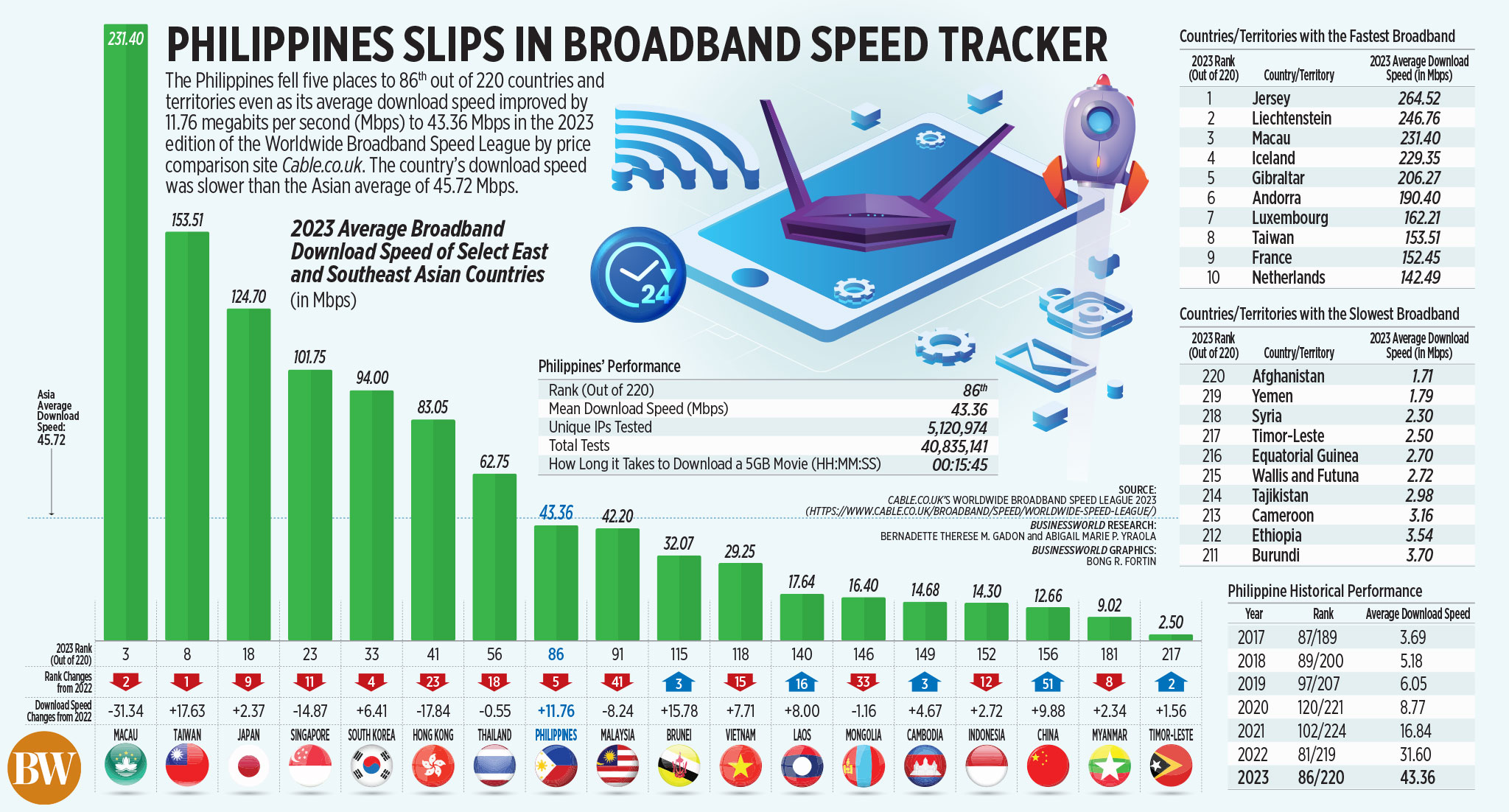
The Philippines fell five places to 86th out of 220 countries and territories even as its average download speed improved by 11.76 megabits per second (Mbps) to 43.36 Mbps in the 2023 edition of the Worldwide Broadband Speed League by price comparison site Cable.co.uk. The country’s download speed was slower than the Asian average of 45.72 Mbps.

How PSEi member stocks performed — August 17, 2023

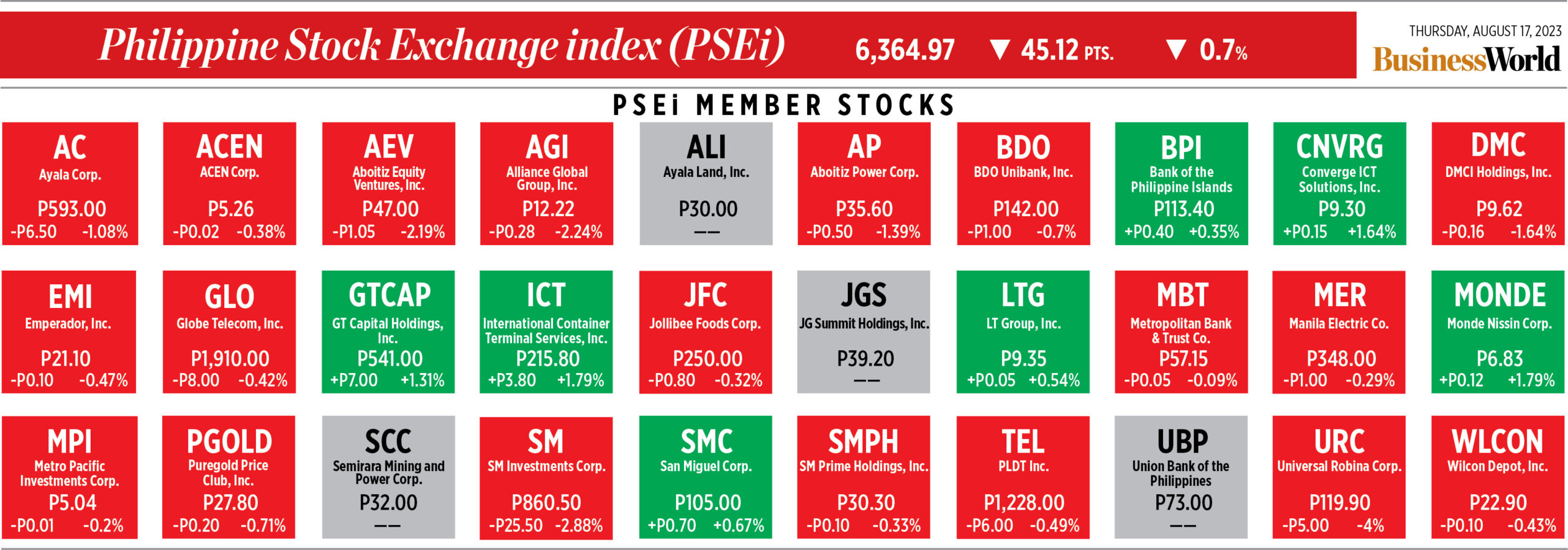
Here’s a quick glance at how PSEi stocks fared on Thursday, August 17, 2023.


Peso weakens anew vs dollar following BSP’s policy decision

BW FILE PHOTO

THE PESO weakened anew against the dollar on Thursday after the Bangko Sentral ng Pilipinas (BSP) held its benchmark rates steady and raised its inflation forecasts for 2023, 2024 and 2025.

The local currency closed at P56.77 versus the dollar on Thursday, dropping by 25.50 centavos from Wednesday’s P56.515 finish, data from the Bankers Association of the Philippines’ website showed.

The local unit opened Thursday’s session at P56.67 per dollar. Its intraday best was at P56.57, while its weakest showing was at P56.81 against the greenback.

Dollars traded went down to $960.55 million on Thursday from $1.02 billion on Wednesday.

The peso declined against the dollar after the Monetary Board kept borrowing costs unchanged and raised its inflation forecasts following its meeting on Thursday, Rizal Commercial Banking Corp. Chief Economist Michael L. Ricafort said in a Viber message.

“The peso continued to weaken as market participants remained cautious ahead of the BSP policy decision,” a trader said in a Viber message.

The BSP on Thursday kept benchmark interest rates unchanged for a third straight meeting as it expects inflation to return within its 2-4% target next quarter, even as upside risks to prices remain.

The Monetary Board maintained its policy rate at a near 16-year high of 6.25%. The interest rates on the BSP’s overnight deposit and lending facilities were also kept at 5.75% and 6.75%, respectively.

The decision was in line with the results of a BusinessWorld poll last week, which showed that 13 out of 15 analysts see the central bank keeping rates steady.

The BSP raised borrowing costs by a total of 425 basis points (bps) from May 2022 to March 2023.

The central bank also raised its inflation forecasts to 5.6% from 5.4% for 2023, 3.3% from 2.9% for 2024, and 3.4% from 3.2% for 2025.

Headline inflation eased for the sixth consecutive month to 4.7% in July from 5.4% in June, bringing the seven-month average to 6.8%.

The peso was also dragged down by hawkish signals from the minutes of the US Federal Reserve’s July 25-26 meeting, Mr. Ricafort added.

Fed officials were divided over the need for more interest rate hikes at the US central bank’s July 25-26 meeting, with “some participants” citing the risks to the economy of pushing rates too far even as “most” policy makers continued to prioritize the battle against inflation, according to minutes of the session that were released on Wednesday, Reuters reported.

In general, the minutes said, Fed policy makers agreed that the level of uncertainty remained high, and that future interest rate decisions would depend on the “totality” of data arriving in “coming months” to “help clarify the extent to which the disinflation process was continuing” — a possible indication of a more patient approach to any further rises in borrowing costs.

The Fed raised borrowing costs by 25 bps at its July 25-26 meeting, bringing its benchmark overnight rate to a 22-year high of 5.25% to 5.5%.

Since it began its tightening cycle in March 2022, the US central bank has hiked rates by a cumulative 525 bps.

The US central bank will hold its next policy meeting on Sept. 19-20.

For Friday, the trader said the peso could continue to weaken after the BSP’s monetary policy decision.

The trader expects the peso to move between P56.65 and P56.90 per dollar on Friday, while Mr. Ricafort sees it ranging from P56.65 to P56.95. — A.M.C. Sy with Reuters

Stocks slip on profit taking before BSP decision

BW FILE PHOTO

STOCKS dropped on Thursday as investors pocketed gains ahead of the Bangko Sentral ng Pilipinas’ (BSP) monetary policy decision.

The Philippine Stock Exchange index (PSEi) fell by 45.12 points or 0.7% to close at 6,364.97 on Thursday, while the broader all shares index went down by 16.61 points or 0.48% to end at 3,409.80.

“Investors locked in their gains ahead of the MB (Monetary Board) policy rate decision announcement today. The street expects that the BSP won’t be mimicking the Federal Reserve’s recent rate hike this time around,” Regina Capital Development Corp. Head of Sales Luis A. Limlingan said in a Viber message ahead of the BSP’s policy announcement on Thursday.

“Stocks slid due to concerns regarding divergent trends in benchmark yields. While US yields were on the rise due to recent stronger than anticipated economic data, local GDP (gross domestic product) growth fell significantly short of expectations, prompting a series of downgrades in growth forecasts for the Philippines. Consequently, this constrains the Bangko Sentral ng Pilipinas from aligning with potential interest rate hikes in the United States,” AB Capital Securities, Inc. Vice-President Jovis L. Vistan said in a Viber message.

The BSP on Thursday kept benchmark interest rates unchanged for a third straight meeting as it expects inflation to return within its 2-4% target next quarter, even as upside risks to prices remain.

The Monetary Board maintained its policy rate at a near 16-year high of 6.25%. The interest rates on the BSP’s overnight deposit and lending facilities were also kept at 5.75% and 6.75%, respectively.

The decision was in line with the results of a BusinessWorld poll last week, which showed that 13 out of 15 analysts see the central bank keeping rates steady.

The BSP raised borrowing costs by 425 basis points (bps) from May 2022 to March 2023.

For its part, the Fed last month raised borrowing costs by 25 bps, bringing its target interest rate to a range between 5.25% and 5.5%.

The US central bank has now hiked rates by a total of 525 bps since March 2022.

Almost all sectoral indices declined on Thursday, except for services, which gained 4.08 points or 0.26% to end at 1,564.03.

Meanwhile, holding firms declined by 99.90 points or 1.64% to 5,974.47; mining and oil slid by 91.87 points or 0.92% to 9,874.65; industrials decreased by 75.32 points or 0.83% to 8,913.89; financials fell by 4.33 points or 0.22% to 1,896.59; and property went down by 3.89 points or 0.14% to 2,651.70.

Value turnover rose to P4.92 billion on Thursday with 343.14 million shares changing hands from the P3.86 billion with 385.87 million issues seen on Wednesday.

Decliners outnumbered advancers, 95 versus 74, while 62 names closed unchanged.

Net foreign buying went down to P76.12 million on Thursday from the P100.99 million on Wednesday.

For Friday, Mr. Vistan placed the PSEi’s support at 6,250. — AHH

PNOC plans Batangas facility serving offshore wind industry

PHILIPPINE National Oil Co. (PNOC) said it plans to build a logistics center servicing the offshore wind power industry in Batangas, part of its slate of five major projects for 2024.

“We have five high-impact initiatives for 2024, the first two pertaining to our two properties, in Batangas and Bataan,” PNOC President and Chief Executive Officer Oliver B. Butalid told the House appropriations committee on Wednesday.

For 2024, PNOC has an operating budget of P2.21 billion, of which 64.82% will be allotted for capital outlays, including a solar photovoltaic (PV) system for government entities, and the development of the Batangas offshore wind power logistics port.

About P552 million will be set aside for maintenance and other operating expenses for off-grid power generation facilities, electric vehicle charging stations, and a Bataan terminal for liquefied natural gas (LNG).

The PNOC’s 2024 proposed corporate operating budget will be entirely funded by internally generated funds, Mr. Butalid said.

Mr. Butalid said the PNOC hopes to transform its 19.2 hectare-property in Mabini, Batangas into a dedicated port for offshore wind power projects in nearby service contract areas.

“The redevelopment of this strategically located port will take about two years, just in time for the first offshore wind turbines to be launched in 2026,” he said.

He added that PNOC will also develop the remaining available land at its Bataan Industrial Park as a liquefied natural gas terminal. 

“Having LNG in Bataan will not only improve access of this fuel source to more users but will provide energy security,” Mr. Butalid said.

The PNOC said it also intends to gain first-mover advantage in the vehicle charging station industry by seeking locations along major highways.

PNOC will seek to increase its footprint in underserved segments of the energy industry, Mr. Butalid said, adding that the company will pursue opportunities where it can be more efficient than the private sector.

“Our mission is to complement… in areas that the private sector can be more effective, PNOC will not operate there,” he said. 

Separately, the Energy department said late Wednesday that it is seeking a budget of P2.59 billion for 2024, up 16.7% from its 2023 allocation.

Energy Secretary Raphael P.M. Lotilla said the department needs the additional funding for programs to develop renewable energy.

Some P1.25 billion of the DoE’s proposed budget will go to maintenance and other operating expenses, while P700.85 million will pay for personnel services. Capital outlays will total P645.46 million, representing 25% of its proposed budget.

The proposed 2024 national budget is P5.768 trillion, up 9.5% from this year’s P5.268-trillion spending plan.

The government has set a target for renewable energy to account for 35% of all power generated by 2030, rising to 50% by 2040.

In 2023, the DoE’s spending priorities were total electrification, renewable energy development, energy efficiency and conservation, and alternative fuels and technologies. — Ashley Erika O. Jose

BCDA, Tarlac to co-develop 47-hectare Clark tech hub

NEW CLARK CITY

THE Bases Conversion and Development Authority (BCDA) said it will develop a 47-hectare site in New Clark City into a technology hub in partnership with Tarlac province.

In a statement on Thursday, BCDA said it signed a memorandum of agreement with Tarlac province on Aug. 11.

The agreement gives Tarlac province the right of usufruct, allowing it to use the site.

According to the BCDA, the site will host agro-industry projects, research and development facilities, logistics centers, and technology-focused operations like hyperscale data centers.

“We are grateful that through the efforts of the provincial government, we are realizing our dream of developing New Clark City as the Philippines’ model for future smart cities,” BCDA President and Chief Executive Officer Joshua M. Bingcang said.

Tarlac Governor Susan A. Yap said the technology hub is expected to generate investment and jobs for the province. — Revin Mikhael D. Ochave

Budget dep’t sets terms for release of unspent personnel services funds

BW FILE PHOTO

THE Department of Budget and Management (DBM) said it will require government agencies to file special requests to access unspent personnel services funds, with the requests to include explanations for why the funds were not utilized.

In a circular signed by Budget Secretary Amenah F. Pangandaman on Aug. 15, the DBM said instances covered by the policy include “deficiencies” in disbursing salaries, bonuses, allowances, and associated premiums of government employees.  

The deficiencies include unspent compensation or benefits, including instances of leaves of absence without pay, vacancies, as well as delays in onboarding newly hired workers. It also includes errors in computation of employee benefits.  

If allotments are not available, the head of an agency or the president of a State University or College (SUC) is to submit a special budget request to the DBM to set in motion a special allotment release order authorizing the payment for the deficiencies.  

“All units under decentralized departments shall submit their requests to their respective Central Offices (COs) for evaluation or consolidation,” the DBM said.

“All departments and agencies, including the CO of decentralized departments, shall submit their request to the DBM central office,” it said.

The DBM added that SUCs are to submit their requests to DBM regional offices.

It also said it will only process requests for release of funds supported by financial accountability reports, and other documents that justify the deficiencies in personnel services appropriations.

The new requirements come in the middle of a DBM crackdown on underspending, as well as a drastically reduced budget for benefits.

According to the DBM, the programmed appropriations of the Miscellaneous Personnel Benefits Fund (MPBF) have been reduced to P26.6 billion from the P89 billion proposed in the 2023 national budget.

“Hence, the release of funds for the Performance-Based Bonus including PS deficiencies provided under the MPBF (pursuant to Special Purpose No. 1) has been hampered,” it added. — Keisha B. Ta-asan

EDSA busway superior to old right-lane passenger pickup system — MAP

Commuters line up at the Main Avenue station of the EDSA bus carousel in Quezon City, July 18, 2022. — PHILIPPINE STAR/MIGUEL DE GUZMAN

THE Management Association of the Philippines (MAP) said the EDSA busway system has demonstrated its potential for moving more commuters, and declared its opposition to a bid by bus operators to revert to the previous practice of picking up passengers waiting along the rightmost lanes. 

In a statement on Thursday, the business group said the government should instead focus on completing and upgrading the EDSA busway in partnership with the private sector. The statement was signed by MAP President Benedicta Du-Baladad and MAP Infrastructure Committee Chairman Eduardo H. Yap.

“The MAP likewise strongly opposes the proposal of the bus operators for the simple reason that for the past three years, it has been demonstrated that the EDSA Busway and Bus Carousel Line system is a far superior public bus transport system as it was able to carry a one-day peak load of 454,649 passengers on Dec. 27, 2022 using no more than 550 bus units running on just one innermost busway lane, with more spare system capacity to meet higher demand,” MAP said.  

“We earnestly urge the Department of Transportation (DoTr) to stay the course and expedite the completion of this project, preferably, in partnership with a private concessionaire, while adhering to global standards and best practices,” it added.

The Mega Manila Consortium of city bus operators proposed to again be allowed use of the two rightmost lanes along EDSA, including the lane currently serving bicycle riders. They cited losses incurred in busway operations and lower bus utilization.

The Metropolitan Manila Development Authority has come out in support of continuing with the EDSA busway system, which limits buses to driving on the leftmost lane and requires passengers from the EDSA center island at designated stops.

According to MAP, the average daily busway ridership totaled 154.10 million between June 2020 and December 2022, while average daily busway ridership was 380,378 during last year’s Christmas season.

“Drivers are better disciplined and they stop only at bus stations and do not linger there. Commuters’ travel time was reduced, allowing them to be more productive at work and enjoy quality time with their families. The busway has also facilitated travel for ambulances and emergency vehicles. This high performance was achieved due to the higher efficiency of the inner lane busway as a people mover,” it said.

The MAP said the capital expenditure on the busway by the National Government was P500 million, which it noted constituted the “lowest capital cost-to-passenger ratio among transit systems.”

The MAP cited the need for a bus exchange system to facilitate the transfer of commuters to feeder lines, saying that such a system will help persuade motorists to use public transit more.

“This shift will… decongest EDSA. Car lanes may also be reduced to make way for wider sidewalks to enhance non-motorized mobility and planting of trees. Efficient mass public transport and non-motorized mobility are the long-term solution to traffic congestion as envisioned in the National Transport Plan,” the MAP said.

The MAP said the return of buses to the two rightmost lanes is not ideal in “high-density urban corridors” and will be detrimental to commuters.

“The drivers were impervious to discipline. Buses loaded and unloaded anywhere with impunity, weaving in and out of lanes in chaotic fashion. Reverting to the failed yellow bus lane system will be grossly detrimental to commuters, to bus operators themselves, and to the economy,” the MAP said. — Revin Mikhael D. Ochave

Expanded collaboration within ASEAN needed to unlock climate funding

REUTERS

THE Association of Southeast Asian Nations (ASEAN) is missing out on regional collaboration opportunities for climate finance, the Asian Development Bank (ADB) said in a study.

“There is massively underused potential for subregional collaboration in climate finance under ASEAN leadership,” the bank said.

The ADB said that such projects could help ASEAN countries reach their nationally determined contribution climate goals.

Increasing the visibility of flagship projects will also increase the capacity of member states to develop bankable projects and access international funding.

“ASEAN has been working to harmonize guidelines for financing project loans, such as the ASEAN Taxonomy for Sustainable Finance and the ASEAN Green Bond Standards, to provide the subregion with a common language for communicating their climate vision to a wide range of investors so they can play more critical roles in filling the financial gaps in the future,” the ADB said.

Meanwhile, climate budget tagging or climate change expenditure tagging, which countries use to account for financial flows, will enable governments to determine and prioritize adaptation initiatives with the most impact as investment information becomes public.

Budget tagging will also increase the capacity of the public-private partnership funding system.

The ADB cited the ASEAN Climate Finance Mobilization and Access Strategy currently under development. The strategy will “harmonize the use of more bottom-up and peer-to-peer sharing of tools and frameworks for tracking finance flows in the subregion.”

However, ASEAN faces multiple challenges in increasing adaptive financing due to uneven budgeting and limited private contributions.

“Southeast Asia is also faced with the issue of uneven adaptation-mitigation funding, limiting the countries’ capacity to reverse the effects of climate change and to make their vulnerable populations more climate resilient,” ADB said.

Lenders still find adaptation financing risky due to the long planning and implementation period, as well as the small scale of projects.

Financial institutions are also displaying a preference for mitigation financing due to quicker returns on investment, apparent climate-related impact, and more favorable market conditions.

“Their involvement will help in tapping new adaptation-related business opportunities, such as in developing markets for new goods and services that support the strengthening of climate resilience, and designing financing mechanisms and business models for the implementation of adaptation priorities,” the ADB said.

The region is also lacking in institutional readiness and prioritization in adaptation financing.

“Southeast Asian countries should regard adaptation as an extension of sustainable development practices intended to build resilience and minimize the costs of emissions that have been locked into the climate system,” the ADB said.

“The window of opportunity for addressing the climate crisis is rapidly shrinking, and governments must consider further efforts to rebalance the risks to shareholders with the urgency of responding to the climate adaptation needs of the most vulnerable countries,” the ADB said. — Aaron Michael C. Sy

Locators seek retention of tax incentive schemes

MABALACATCITY.GOV.PH

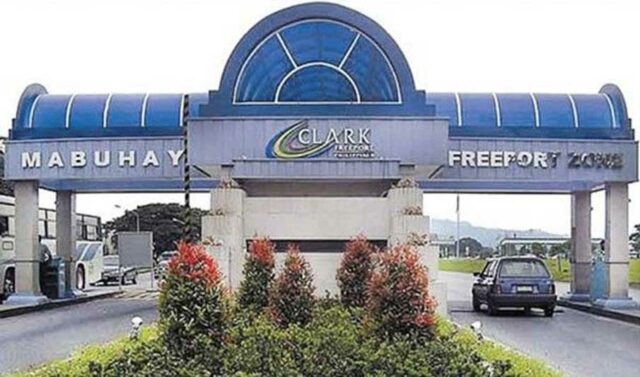
LOCATORS inside the Clark and Subic freeports asked the government to suspend the new rules which they said are taking away their tax incentives. 

The request was contained in a joint resolution issued by the Clark Investors and Locators Association (CILA), Subic Bay Freeport Chamber of Commerce, American Chamber of Commerce, Metro Clark Chamber of Commerce and Industry, Tarlac Chamber of Commerce and Industry, Metro Clark ICT Council, and IT and Business Process Association of the Philippines.

The resolution is dated May 19 and was released to reporters on Thursday.

It calls for the immediate suspension of Revenue Regulations (RR) No. 21 2021 and Revenue Memorandum Circular (RMC) 24-2022, both issued by the Bureau of Internal Revenue (BIR).

The signatories said the implementing rules and regulations (IRR) of Republic Act No. 11534 or the Corporate Recovery and Tax Incentives for Enterprises (CREATE) Act and the two BIR issuances have “effectively stopped the enjoyment of the tax incentive and other fiscal perks,” as some investors are now charged value-added tax (VAT), among others.

“We appeal in the strongest terms for the government to cure the situation by ordering the review and amendment of the IRR and the immediate suspension of RR-21-2021, RMC 24-2022 in order to preserve the original intent of the CREATE Act,” the signatories said.

“The IRR and BIR revenue regulations RR-21-2021, RMC 24-2022 went beyond and against the provisions of the CREATE Act insofar as the transitory provision in Section 311 of Chapter VI is concerned,” it added.

According to the signatories, the IRR and the issuances have also caused “massive confusion as well as substantive impairment to the cost structure, business models and the viability of existing and potential investors.”

Asked for further comment, CILA Chairman Cristopher A. Magdangal told BusinessWorld by phone that the group is asking the executive department to honor the CREATE Law’s 10-year transitory provision. 

The transitory period gives locators “ample time to restudy our business models and rethink our investment priorities,” Mr. Magdangal said.

“This (issue) applies as well across other freeport zones… It is making local suppliers less competitive because their costs are rising,” he added.

Last week, the Finance and Trade departments approved Rule 18 Section 5 of the CREATE IRR, which provides that transitory registered domestic market enterprises within an economic or freeport zone availing of the 5% gross income tax regime can register as VAT taxpayers.

Queried on the amendment, Mr. Madrigal said it will hamper loca or competitiveness.    

“As far as our information is concerned, it is providing a channel for locators to pass on VAT to their customers. The very reason investors are coming into Clark is because of the incentives making them very competitive,” Mr. Magdangal said.

The inability to pass on VAT as 5% gross income taxpayers adds to the burden on locators, apart from the high cost of utilities and red tape, he added.

“We cannot pass on VAT because we are registered for the 5% tax on gross income earned (GIE). There is no mechanism to pass on VAT. But if we volunteer to register for VAT, what we’re losing is our competitiveness because our cost now will be 12% higher with VAT,” he added.

Mr. Madrigal added that locators have been incentivized to prefer imported raw materials instead of sourcing from domestic suppliers.

“If my company is export-oriented, I would rather import raw materials rather than getting from Philippine companies because that is what the law is telling us. We’re trying to communicate that to them, but we are having a hard time because they are focused on tax collection,” Mr. Magdangal said.

Finance Undersecretary Maria Cielo D. Magno said by phone that the real issue concerns Republic Act No. 10963 or the Tax Reform for Acceleration and Inclusion (TRAIN) Law.

“Their main contention is the cross-border doctrine, but the problem with that is it’s under TRAIN. Essentially, the TRAIN law made the domestic enterprises VAT-able and that only exporting companies or activities are entitled to zero rating. Even if domestic enterprises are located in freeports, they will have to be VAT-able,” Ms. Magno said.

“You don’t treat VAT as an incentive anymore. It’s a consumption tax. As long as it’s consumed locally, you have to impose VAT. Now what we’re trying to do is ready the domestic enterprises that are transitioning. That’s what we did (with the IRR),” she added.

According to Ms. Magno, the companies complaining are those that enjoyed the incentives prior to CREATE and were given a transitory period.

“The question is that under the original IRR of CREATE, they were imposed VAT, but not because of CREATE but because of TRAIN. What we’re trying to do here now is recognizing that VAT has to be passed on somewhere. The IRR of CREATE tries to address the concern without violating the provision of the TRAIN law,” Ms. Magno said.

“If you look at the last part of the IRR, even if they are under the 5% (GIE), they are allowed to be VAT registered and that’s a special case. It is only applicable to them. They can claim input VAT for zero-rated transactions,” she added. — Revin Mikhael D. Ochave

Plastic Bank touts ‘gamified’ waste collection business model

PHILIPPINE STAR/EDD GUMBAN

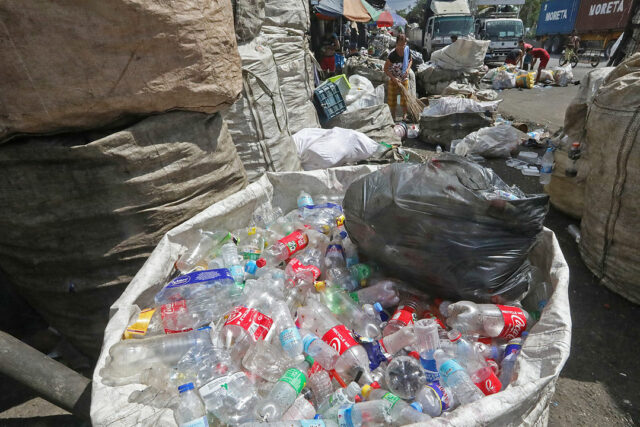
VANCOUVER-BASED social enterprise Plastic Bank said it is proposing a “gamified” business model for collecting plastic waste, with participants incentivized to generate higher volumes with benefits like health insurance, grocery vouchers, and school supplies, apart from payments.

“We ultimately gamify the collection of material by providing a remarkable incentive in areas that are producing the most amount of the material,” Plastic Bank Chairman and Founder David Katz said at a media roundtable on Thursday.

Plastic Bank is evaluating parts of Mindoro, Antique, Cebu and other sites interested in becoming “collection and recycling ecosystems.”

Plastic Bank proposes to partner with junk shops and plastic waste collectors, who will be provided with digital tools and equipment to enable their waste collection efforts. The enterprises provide sacks, uniforms, weighing scales, and shop signage.

Collections are recorded via a mobile application which makes the collected plastic traceable through the recycling process and facilitates reporting on operational metrics.

“There will be a market fluctuations but we also provide an incentive and a bonus on top of that, so there is always a financial incentive all the time,” he said.

Plastic Bank currently operates in the Philippines, Indonesia, Brazil, and Egypt, with licensed partner-based expansion on the pipeline within Southeast Asia and Africa.

At present, the enterprise has about 36,000 registered members globally, including 8,000 in the Philippines, which has a network of 200 collection sites.

Plastic Bank Marketing Manager Camille Nuñez estimates that a member can earn an average of P8 to P15 per kilogram of collected material.

“The benefit of a member joining Plastic Bank is they earn incentives on top of the market price that they receive from the junk shop that they deliver the scraps to,” she said.

Plastics are sorted and transferred to an affiliated processor which will repurpose them into ethically sourced “social plastics,” for use by partner manufacturers like SC Johnson & Son, Inc. 

“This is the challenge… recycling has been stigmatized. If someone sees you recycling, the conclusion is that you must be poor,” she said.

“We have to reduce the use of plastic. We have to eliminate virgin plastic production — that’s also a part of it because if we stop making more plastic, the demand for recycled content will increase, and the price will increase,” Mr. Katz said. — Sheldeen Joy Talavera

ADVERTISEMENT
ADVERTISEMENT