Home Blog Page 4445

Swedish digital creative school maps Asian expansion

HYPERISLAND.COM

HYPER ISLAND Institute of Higher Education, a digital creative business school, aims to expand its services in Asia after it started offering its program in the Philippines.

“We are founded on the principle of learning by doing as a way to embrace technological developments,” Peachy Pacquing, managing director of Hyper Island, told BusinessWorld in a Zoom interview.

She said the school brings together the foundation and insights “from the world of behavioral science, adult development and creativity to design experiences, products and tools that will equip you to tackle the challenges of the future.”

Hyper Island has expanded its operations in Asia with the inclusion of the Philippines. It launched its programs in the country earlier this year.

Established in Sweden two decades ago, Hyper Island provides an unconventional way of learning, Ms. Pacquing said, adding that the institute now operates in the United Kingdom, Brazil, North America, and Singapore.

It aims to expand its operations in Asia with the hope of bringing its operations to India and Indonesia within this year.

“It was born because the Swedish government realized that the way they were doing education was no longer sufficient, or relevant and therefore there was a challenge to reimagine education more than 20 years back,” Ms. Pacquing said.

In the Philippines, the global creative business school offers a digital management accelerator program, a master of arts in digital management, and business solutions.

“Let’s begin first with how we facilitate learning. First of all, we are in the business of adult education. So, the way we facilitate learning at Hyper Island [is] to develop critical thinking, a key deliverable of our education,” she said.

Ms. Pacquing said Hyper Island is introducing an alternative way of learning to bridge the gap between technology and human development. — Ashley Erika O. Jose

DMCI Homes unveils beach park condotel complex in San Juan

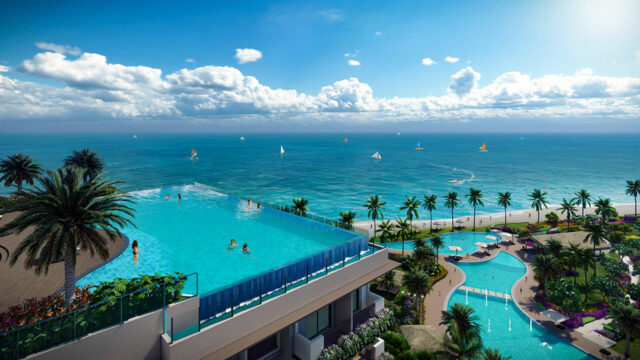
SOLMERA COAST is a project of DMCI Homes Leisure Residences. — COMPANY HANDOUT

DMCI Homes recently unveiled its latest project — a beach park condotel complex in San Juan, Batangas.

Solmera Coast is a tropical Asian-inspired beach park condotel which offers an “opportunity for a rewarding investment as well as a haven for leisure and pleasure,” DMCI Homes Leisure Residences said in a statement.

Matahari tower, the first of five mid-rise buildings, is expected to be ready for occupancy by February 2027. The Kartika and Bumi towers will be ready for occupancy by May and August 2027, respectively.

At Solmera Coast, unit cuts range from 34 to 91.5 square meters for studio, one-bedroom, and two-bedroom units.

Units are furnished with fixtures for beds, bathrooms, and even a split-type air conditioning unit upon turnover.

Solmera Coast is not just resort-themed but is an actual beach park with residential condominium buildings just a few meters away from the shoreline.

The 7.5-hectare beach park features expansive open spaces for residents looking to relax, and event spaces for big gatherings.

Solmera Coast spans Barangays Subukin and Calubcub II in San Juan which is a preferred beach destination for tourists.

Solmera Coast will feature five swimming pools, a game area, a gym, two restaurants, and a convention center.

DMCI Homes Leisure Residences, a new brand under DMCI Homes, focuses on resort living in vacation destinations all over the country.

BRICS energy and Philippine hosting of FIBA games

Two important events occurred last week. One was the BRICS (Brazil, Russia, India, China, S. Africa) summit that ended on Aug. 24, and they announced membership expansion to six other countries starting January 2024. No. 2 was the start of Federacion International de Basketball (FIBA) World Cup on Aug. 25 at the Philippine Arena.

BRICS EXPANSION
The original five BRICS member-countries were already huge in population. With the addition of six more countries, the bloc will now be called BRICS-11 and would have a combined population of 3.64 billion people as of 2022 — a huge consumer market.

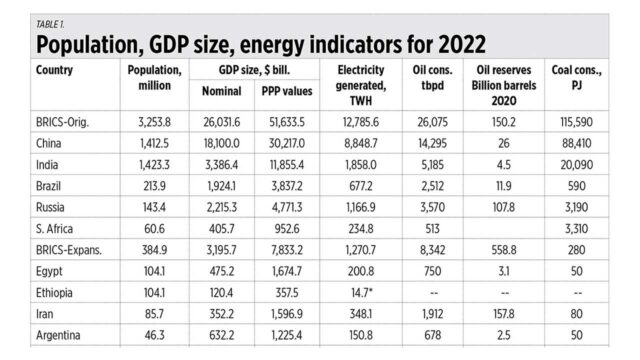
— Table 1 compares some basic economic and energy data on BRICS, the expanded members, G7 industrialized countries and the ASEAN-6. Here are the basic facts as of 2022.

One, in terms of population, BRICS-11 is 4.7x larger than G7 and 6.1x larger than ASEAN-6.

Two, in GDP size, G7 is still larger than BRICS-11 in nominal values but in purchasing power parity (PPP) values, it is 1.2x larger than G7. The Philippines is now a trillion-dollar economy in PPP values along with Vietnam, Thailand and Malaysia.

Three, in total electricity generation, BRICS-11 is 1.8x larger than G7. China alone with 8,849 terawatt-hours (TWH) is larger than G7 combined. This is mainly because BRICS and ASEAN countries have significantly expanded their conventional fossil fuel plants, while G7 has pulled back.

Four, oil consumption of BRICS-11 at 34.4 million barrels per day (bpd) is now larger than G7. In ASEAN-6, Singapore and Thailand have nearly three times each larger than the Philippines. They are huge airport and international trading hubs in the region.

Five, in proven oil reserves, Iran, Saudi Arabia and the United Arab Emirates (UAE) are OPEC-member countries and now that they are with BRICS-11, their combined oil reserves of 709 billion barrels are three times larger than G7. One would say that BRICS expansion is primarily an energy security project, and secondarily an economic integration project.

Six, in coal consumption the original BRICS (except Brazil, which is mainly hydro) with 115,600 petajoules (PJ) have powered their GDP expansion and electricity generation mainly from coal, while G7 countries have significantly pulled back from coal. Check my Aug. 17 column titled “Energy realism: Decarbonization and deindustrialization.” Good thing that ASEAN-6 has a similar energy policy as the original BRICS except Singapore, which is mainly using other fossil fuels — oil-gas (see Table 1).

The long-term economic and energy implications of BRICS-11, which may become BRICS-20, etc. in the coming years, is more energy security for them and their economic allies, more stable energy and consumer prices. The G7 and allies with their continued anti-fossil fuels and decarbonization rhetoric will likely continue their high energy and consumer prices. The Philippines and other developing countries should stay away from the G7 and western climate and energy agenda, prioritize faster economic growth and job creation for its people.

FIBA WORLD CUP
The FIBA Basketball World Cup is held every four years. The first and last time the Philippines hosted it was in 1978 or 45 years ago. This year, the Philippines through the Samahang Basketbol ng Pilipinas (SBP) is co-hosting it with Japan and Indonesia for the group elimination games, but the quarterfinals to final games will be hosted only by the Philippines.

I watched the opening games at the Philippine Arena in Bulacan on Aug. 25. I brought my 12-year-old daughter Bien Mary and two Filipino-German boys Simon and Luis, sons of our friends who live in Bavaria, Germany and now on vacation here.

The crowd was huge — more than 38,000 — a new attendance record in FIBA World Cup history. The previous record was about 32,600 in Canada in 1994. My daughter, who does not watch basketball, became an instant fan of the game. Simon and Luis were surprisingly happy to see for the first time a World Cup basketball live — the entertainment between the games, the atmosphere and energy of Gilas Pilipinas fans and the games of the four teams/countries. They said they will not forget the day and they have shared their experience and observations with their friends in Germany and other countries.

Experiences like these can be translated into more tourism and more good vibes about the Philippine economy. Kudos to SBP for hosting the FIBA World Cup and hats off to SBP President Al Panlilio and SBP Chairman Emeritus and member of the Central Board of the FIBA, Manuel V. Pangilinan or MVP. Good job, sirs.

When foreign visitors watch live international sports competitions like FIBA games, they watch not only the games and the arena; they also see our hotels, our malls, our musicians, dance troupes and other entertainers. They see the country and the always-smiling Filipinos. Tourism later translates into trade and investments, economic growth and job creation.

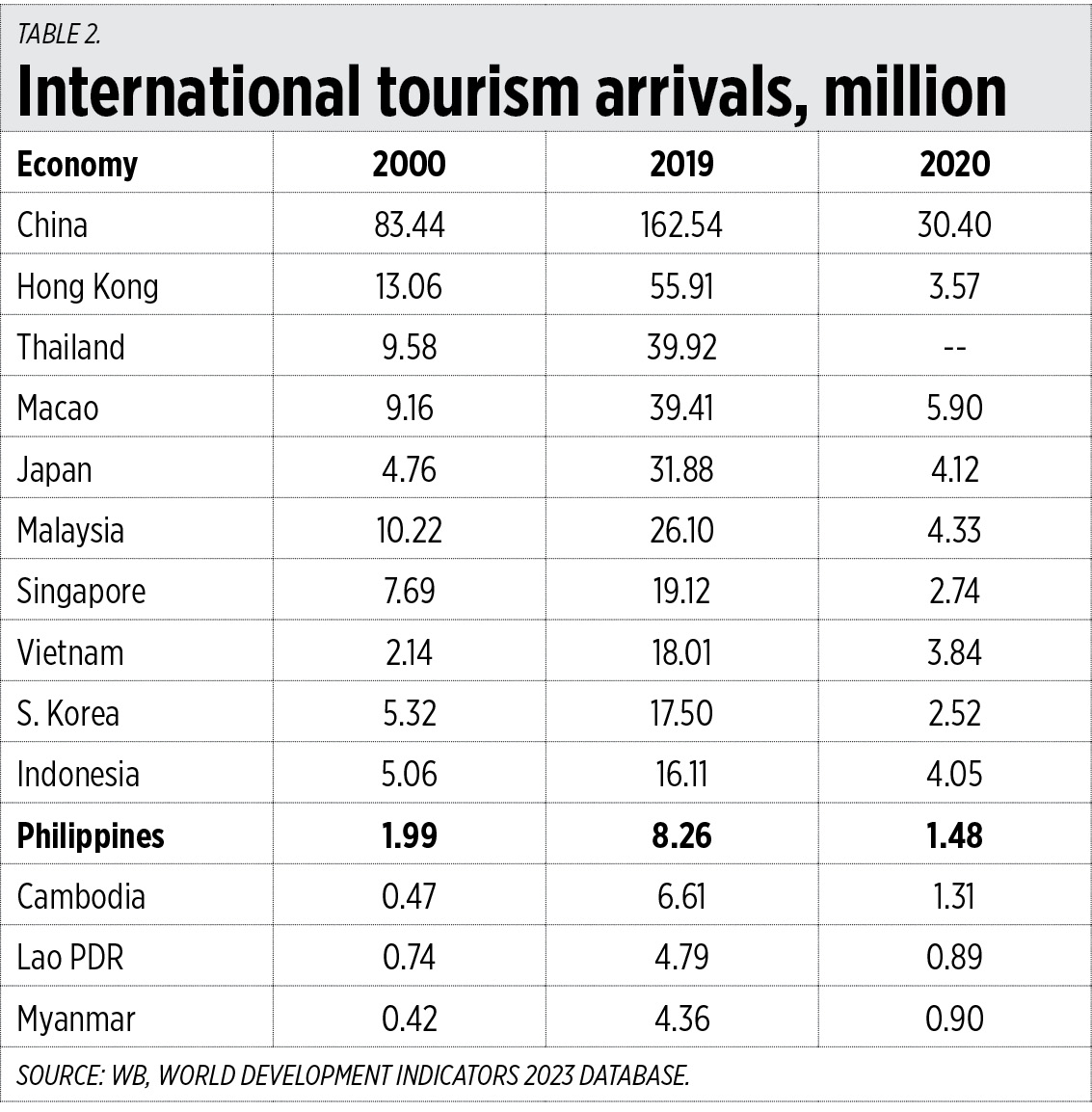
Because of our geography — detached from mainland Asia, an archipelago that requires flight-hopping from one big island to other islands — plus other factors, our tourism arrivals are not as big as those in Indonesia, Malaysia and Vietnam (Table 2).
Tour de France is the most popular sport in the world in terms of live audience, estimated at 23 million people on the roads for three weeks. The last French cyclists who won the Tour were Bernard Hinault and Laurent Fignon in 1978-1985 except 1980. All other winners in the past three decades were from other countries. But Tour de France continues mainly because of the sports tradition and tourism revenues, and not so much hoping that another French cyclist or team will win the Tour.

Same for hosting this FIBA tournament — the goal should be to help boost tourism and investments in the country. So far, Gilas Pilipinas has lost their two games with the Dominican Republic and Angola. Our players did their best, but the two other teams played better. Nonetheless, it is the hosting of the FIBA games that matters more than our team winning the games.

I like this observation by Joe Zaldariaga in his column “Sports: A game changer for the economy” (Philippine Star, Aug. 10). He wrote:

“The hosting of this event is more than a celebration of basketball as a cherished national passion; it’s an invitation from the Philippines to the world. As the nation welcomes the international basketball community, it sends a clear signal that it’s ready to step onto the global stage as a prime destination for international business.”


Bienvenido S. Oplas, Jr. is the president of Bienvenido S. Oplas, Jr. Research Consultancy Services, and Minimal Government Thinkers.

minimalgovernment@gmail.com

Russia’s top Barbie fan sees herself in movie

A scene from the movie Barbie. — IMDB

AS THE proud owner of 12,000 Barbie dolls, Russian collector Tatiana Tuzova was more excited than most to watch the Hollywood movie based on her idol.

She was not disappointed.

Like the character played by Margot Robbie in the film, Ms. Tuzova inhabits both a fantasy realm of beautiful dolls and a real world where things are far less perfect.

Of the two, she prefers the first, depicted in the move as Barbie Land.

“To some extent, this is my world as well. And I even recognized myself in the film character a little bit, because I also feel sad when I come back to gray reality,” she told Reuters.

“I want everything in the real world to be as bright, beautiful and glamorous (as Barbie Land). But when you’re out in the real world, there are so many things missing.”

Hit by Western sanctions over Ukraine, Russia is coming late to the Barbie party. The film is not available for official distribution, but some cinemas plan to get around that by screening a digital copy of it “for free” as part of a double bill with a shorter film in Russian.

Ms. Tuzova has supplied 300 of her dolls to go on show at an unofficial premiere of the film in Moscow on Sept. 9. She said she had hoped to see it for the first time on the big screen, but reluctantly watched a pirate version to satisfy media requests for her reaction.

Her obsession with Barbie began in childhood.

“I think Barbie is a role model. Her slogan is ‘You can be anything’. I looked at her and understood that I could be anything as well,” she said in an interview in her apartment, dressed all in pink with an enormous bow in her hair.

Behind her, an entire wall was filled with hundreds of Barbies, from Army and Air Force to Party Time and Pretty Flower — all in their original boxes to preserve their value.

Ms. Tuzova said her father died when she was six months old and she had “nothing” as a child.

“And I decided that I would have everything. And everything will be pink.”

She said she liked the fact that the Barbie heroine of the film remained true to herself even when she crossed into the real world.

“She remained herself: she didn’t put on weight, didn’t dye her hair brunette. She just adapted, let’s say, to the real world — as, in general, I did.” — Reuters

Phoenix Petroleum expects lower oil prices in fourth quarter as stockpiles rise

PHOENIXFUELS.PH

LISTED independent oil firm Phoenix Petroleum Philippines, Inc. is expecting the prices of dated Brent to go down by the fourth quarter as oil stockpiles are seen to build up, an official said.

“We expect dated Brent prices to increase into the $80s in the third quarter. But with stocks expected to start gradually building back in the fourth quarter, prices should then ease again,” Raymond T. Zorrilla, senior vice-president for external affairs of Phoenix, said in a Viber message.

Mr. Zorrilla said the company is hoping that the Mean of Platts Singapore (MOPS) — the benchmark for local fuel products — will remain steady at $80.

MOPS is the daily average of all trading transactions of diesel and gasoline reported by Singapore-based market wire service Platts of S&P Global, Inc.

Mr. Zorrilla said the company also wants to see the dollar-peso exchange rate stabilize within the range of $54 to $55 to help bring down local oil prices.

“Commercial crude and key product stocks have gradually declined from January and draws are set to over 2 million bpd (barrel per day) in July/August. That is deeper than our outlook from last month,” he said.

“However, prices have been eroding with sufficient supply to cover prompt needs and very little interest by financial participants in oil,” he added.

In its short-term energy outlook, the Energy Information Administration (IEA) projected global oil production to increase by 1.4 million bpd in 2023 and by 1.7 million bpd in 2024.

“Rising global oil production in 2024 in our forecast keeps pace with oil demand and puts moderate downward pressure on crude oil prices beginning in the second quarter of 2024,” the IEA said.

Mr. Zorrilla said commercial oil inventories are set to “draw rapidly” in the third quarter, but “a skeptical market is waiting for visible signs before pushing prices higher.”

In the second quarter, Phoenix Petroleum incurred an attributable net loss of P1.097 billion, reversing its P143.48 million net income in the same quarter last year.

Revenues fell by 63.2% to P14.6 billion from P39.7 billion previously.

In March, Phoenix Petroleum signed a memorandum of understanding (MoU) with Malaysian state oil firm Petronas for a joint exploration of downstream marketing business and associated technology solutions.

Under the MoU, the two companies will conduct a joint feasibility study on what will be the next phase of the partnership.

At the stock exchange on Monday, the company’s shares went down by P0.80 or 10.26% to close at P7 apiece. — Sheldeen Joy Talavera

Choosing a president

PEXELS-ELEMENT DIGITAL

SINGAPOREAN voters will cast their ballots on Sept. 1 to choose their president, the fifth time they will directly make their choice. Before 1993, Parliament appointed the president. Given the dominance of the People’s Action Party (PAP) that Lee Kuan Yew founded, which has not lost a general election since Singapore gained independence in 1965, it was clear that the president served mainly a ceremonial role and did not need to intervene in governance matters.

Ceremonial did not mean unimportant. With its multiethnic population, Singapore needed a person in the presidential palace who would be perceived as transcending partisan politics and could play a unifying role. The Constitution imposed stringent qualifications for the presidency. Popular appeal was advantageous, but not adequate. The candidates’ record must command the respect and, hopefully, the admiration of the national community for unquestionable integrity and competence, this latter demonstrated, not by testimonials but by quantitative measures.

For the 2023 elections, the Presidential Elections Committee (PEC) declared the eligibility of three candidates. Tharman Shanmugaratnam received a pass. Previous government service at ministerial level (Education and Finance) and as deputy prime minister made it unnecessary to subject him to scrutiny. The PEC approved the candidacy of Ng Kok Song, former chief investment officer at sovereign wealth fund GIC, and Tan Kin Lian, former chief executive of National Trade Union Congress Income Insurance.

Entrepreneur George Goh, a fourth aspirant, failed to clear the eligibility bar. The PEC noted a key requirement for presidential candidates from the private sector; they must show that in the previous three years they had managed profitably as CEO a company with shareholders’ equity of at least $500 million. Goh had documented his top management positions in five companies whose combined shareholders’ equity amounted to S$1.52 billion (P64 billion). None of the five companies met the required $500 million in shareholders’ equity. The PEC ruled that combining the resources of five companies was not acceptable.

Despite his control over the PAP and the party’s control of government, Lee Kuan Yew worried that elections might someday bring to power incompetent bureaucrats who might appoint officials unqualified for the posts or corrupt opportunists who would place personal over national interests and raid the Treasury to enrich themselves. Changes in the Constitution in 1991 expanded the president’s role so that the office could serve to check corruption or incompetence in government.

The amendments empowered the presidency to serve as the last line of defense to block attempts by the government to draw from the reserves what it had not accumulated, or to appoint unsuitable officials to critical civil service positions.

For the president to fulfill this function, the government decided to make the post elective. Direct election of presidents would make them accountable to the people whose votes would give them the legitimacy and the right to exercise state power in their name.

Direct elections also raised potential problems. First, the Chinese community accounted for about 70% of the population; it would be difficult for the Malay or Indian candidate to win in a head-to-head competition with a Chinese contender. A presidency permanently occupied by a Chinese incumbent would defeat the objective of projecting the president as a unifying symbol for the multi-ethnic community. Another constitutional change in 2017 addressed this problem by providing that the presidency would be reserved to an ethnic group excluded from the presidency for five continuous terms (or 30 years). Thus, in 2016, Halimah Yacob was elected from the Malay community and was also the first woman to serve as president.

The second problem was more politically complicated and immediately surfaced during the term of the first elected president, Ong Teng Cheong (1993-1999). After his education at the University of Adelaide in Australia (BS Engineering Honors) and at MIT in the US (MS Industrial Management), Ong distinguished himself in the private sector, serving as chairman and managing Director of Neptune Orient Lines. He became a leading figure in the PAP, serving in Parliament for more than 20 years and receiving ministerial appointments in Communications and Labor, as well as deputy prime minister. He also served as NTUC Secretary-General from 1983 to 1993.

Ong took his constitutional duty and powers as president to raise hard questions about the budgeting process and the allocation of surpluses. He was particularly concerned about the state of the country’s financial reserves and the conditions for drawdowns, stressing the need for greater transparency and accountability in their access and use. He also asked for more information and influence over appointments to such key institutions as the Corrupt Practices Investigation Bureau, Attorney-General’s Chambers and Central Provident Fund Board.


Edilberto C. De Jesus is a former president of the Asian Institute of Management. He served as Education secretary under then President Gloria Macapagal Arroyo from 2002 to 2004.

Delay in release of licenses may lead to rise in ‘colorum’ sales agents

ROMAIN DANCRE-UNSPLASH

INDUSTRY groups are seeking the faster release of licenses for aspiring real estate salespersons to increase efficiency in the sector.

Accredited Real Estate Salespersons (ACRES) National President Chris Malazarte said in a statement that there is a need for faster release of licenses to avoid so-called “colorum” sales agents.

“There must be a way to make the experience more encouraging for aspiring registered salespersons. This will lessen the evil we’ve been wanting to avoid — ‘colorum’ sales agents,” Mr. Malazarte said.

Anthony Gerard O. Leuterio, A Better Real Estate Philippines founder, said the licenses of real estate salespersons take three to four months, with some instances reaching as long as eight months.

The oath-taking of real estate salespersons has been limited to 100 individuals weekly despite being done online, he added.

“Delaying such would result in the rise of ‘colorum’ or unlicensed salespersons. Selling can’t wait. If somebody wants to buy from you, you can’t ask them to wait for your license,” Mr. Leuterio said.

“We just want things to be efficient because we are promoting nation-building. We are talking about thousands of salespersons wanting to help the real estate industry flourish. And more importantly, if we are delaying the process, it will create more ‘colorum’ practitioners,” he added.

Before being allowed to sell real estate properties, salespersons need to secure licenses from the Department of Human Settlements and Urban Development (DHSUD) and the Professional Regulatory Commission.

According to the ACRES, about 80% of sales are closed by a real estate salesperson.

Meanwhile, Mr. Malazarte said the registration experience of salespersons under current government policies have not been “simplistic.”

“The policies provided for by Republic Act 9646 or the Real Estate Service Act and Housing and Land Use Regulatory Board (HLURB) Board Resolution 922-14 are simple, but the experiences of the salespersons during registration are not simplistic,” Mr. Malazarte said. 

“We understand that there is a need for the DHSUD to regulate the real estate practice, and our organization appreciates the efforts of the department to improve its policies by making it more responsive to the climate of the industry today,” he added.

A Better Real Estate Philippines is an advocacy coalition and the mother organization of ACRES. The ACRES and other real estate groups had a consultation meeting with the DHSUD on Aug. 24 regarding the agency’s policies on business firms, brokers, and salespersons.

ACRES is an organization of accredited real estate salespersons. It currently has around 3,000 members. — Revin Mikhael D. Ochave

Treasury bill, bond yields to track secondary mart

BW FILE PHOTO

RATES of Treasury bills (T-bills) and bonds on offer this week could track secondary market yield movements following US Federal Reserve Chair Jerome H. Powell’s speech at the Kansas City Jackson Hole Economic Policy Symposium over the weekend.

The Bureau of the Treasury (BTr) will auction off P15 billion in T-bills on Tuesday, or P5 billion each in 91-, 182- and 364-day papers.

On Wednesday, it will offer P30 billion in reissued 10-year Treasury bonds (T-bonds) with a remaining life of five years and four months.

T-bill rates may track the decline seen in secondary market rates due to lower global crude oil prices recently, Rizal Commercial Banking Corp. Chief Economist Michael L. Ricafort said in a Viber message.

At the secondary market on Friday, the 91-, 182-, and 364-day T-bills went down by 1.27 basis points (bps), 0.03 bp, and 2.42 bps week on week to end at 5.7522%, 5.9993%, and 6.3043% respectively, based on the PHP Bloomberg Valuation Service Reference Rates data published on the Philippine Dealing System’s website.

The 10-year bond also inched down by 3.02 bps week on week to end at 6.5225% as the market awaited signals from Mr. Powell’s speech on Friday, Mr. Ricafort said.

The Fed may need to raise interest rates further to cool still-too-high inflation, Mr. Powell said on Friday, promising to move with care at upcoming meetings as he noted both progress made on easing price pressures as well as risks from the surprising strength of the US economy, Reuters reported.

While not as hawkish a message as he delivered this time a year ago at the annual Jackson Hole Economic Policy Symposium, Mr. Powell’s remarks still delivered a punch, with investors now seeing one more rate hike by yearend more likely than not.

The Fed raised interest rates by 25 bps last month, bringing its benchmark overnight rate to a range between 5.25% and 5.5%. It has hiked rates by a cumulative 525 bps since it began its tightening cycle in March last year.

The Federal Open Market Committee will meet on Sept. 19-20 to review policy.

Another lead for this week’s auctions would be the release of the September borrowing plan, a trader added in an e-mail.

The BTr has so far raised P118.32 billion out of its P225-billion program for this month — P79.385 billion via T-bonds and P38.935 billion through T-bills.

Last week, the Treasury raised P15 billion as planned via the T-bills it auctioned off as total bids reached P42.991 billion or more than twice the amount on offer.

Broken down, the Treasury made a full P5-billion award of the 91-day T-bills as tenders for the tenor reached P18.164 billion. The average rate of the three-month paper went down by 3.3 bps week on week to 5.671%, with accepted rates ranging from 5.643% to 5.69%.

The government also raised P5 billion as planned from the 182-day securities as bids for the tenor reached P10.495 billion. The average rate for the six-month T-bill was at 5.986%, rising by 4.1 bps, with accepted rates at 5.9% to 6.1%.

Lastly, the BTr borrowed the programmed P5 billion via the 364-day debt papers as demand stood at P13.882 billion. The average rate of the one-year T-bill likewise inched up by 0.9 bp to 6.334%. Accepted yields were from 6.25% to 6.35%.

Meanwhile, the reissued 10-year bonds to be offered on Wednesday were last auctioned off on July 12, 2022, where the government raised P35 billion as planned at an average rate of 6.76%. — A.M.C. Sy with Reuters

Knight Frank: Manila posts highest first-half rental growth in Asia-Pacific

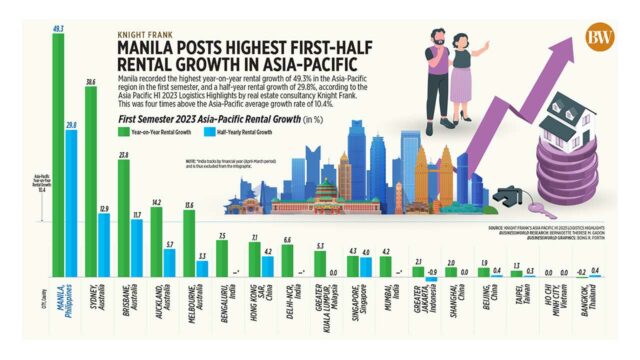
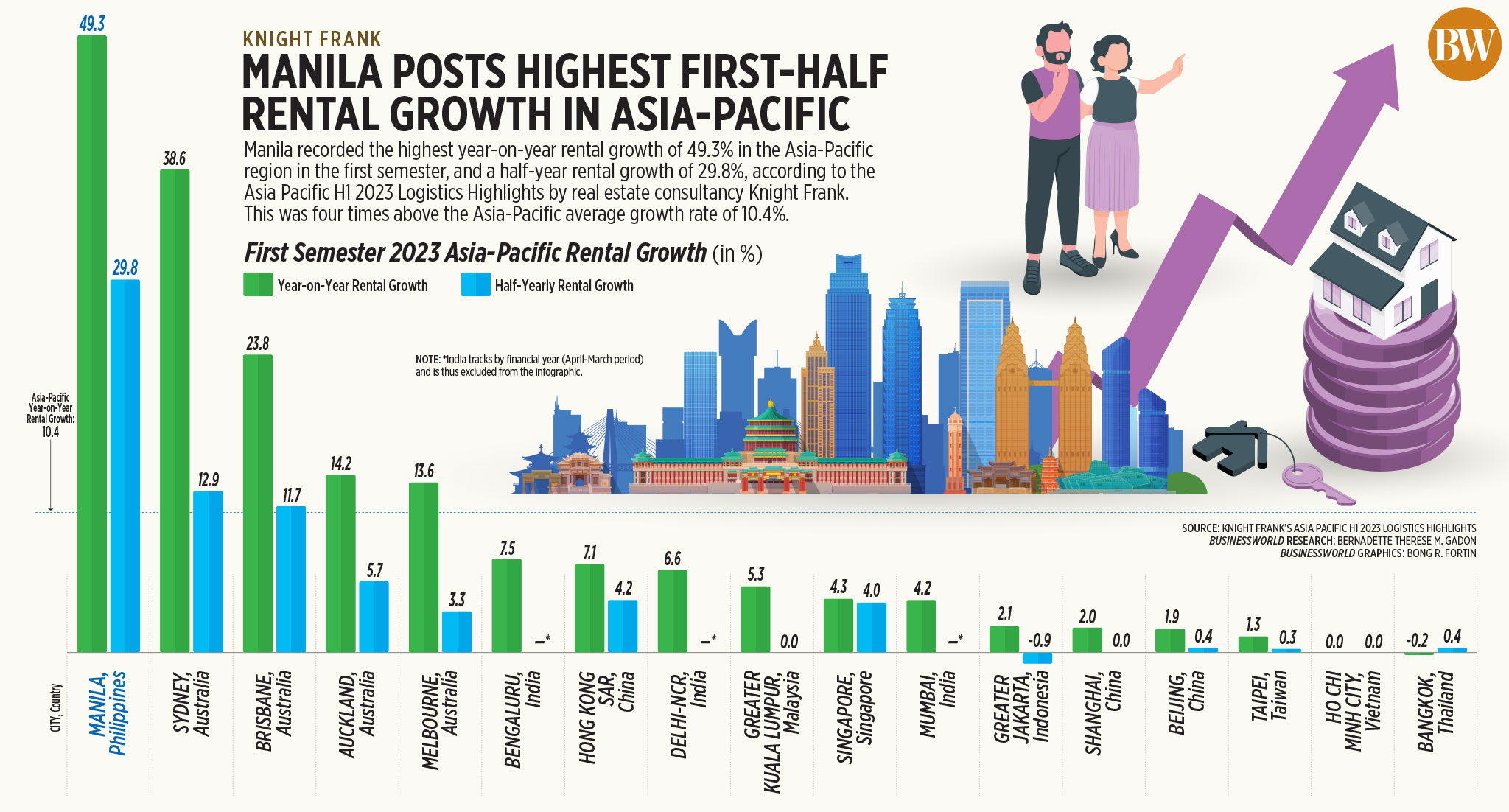
Manila recorded the highest year-on-year rental growth of 49.3% in the Asia-Pacific region in the first semester, and a half-year rental growth of 29.8%, according to the Asia Pacific H1 2023 Logistics Highlights by real estate consultancy Knight Frank. This was four times above the Asia-Pacific average growth rate of 10.4%.

Peso expected to remain weak versus dollar until next month

BW FILE PHOTO

THE PESO is expected to remain weak against the greenback until next month amid a seasonal rise in dollar demand for imports this quarter, analysts said.

“This third quarter, there really is a seasonal depreciation as businesses buy US dollars to import and stock up on inventories ahead of the holiday season,” China Banking Corp. Chief Economist Domini S. Velasquez said in a Viber message.

“In the fourth quarter, we will likely see the peso appreciate again as remittances come in,” Ms. Velasquez said.

The local unit closed at P56.57 versus the dollar on Friday, strengthening by 19 centavos from Thursday’s P56.76 finish, data from the Bankers Association of the Philippines’ website showed.

For the year so far, the peso has depreciated by 1.44% against the dollar from its P55.755 close on Dec. 29, 2022.

The peso could recover to the P55 level in the fourth quarter amid the seasonal increase in remittances, Rizal Commercial Banking Corp. Chief Economist Michael L. Ricafort likewise said in a Viber message.

Ms. Velasquez added the peso could also appreciate if the US Federal Reserve signals that they will hike one more time this year.

“Fundamentally, the peso is stronger because we have smaller trade deficits this year, continued inflow of remittances, and increasing tourist arrivals,” she said.

The Fed may need to raise interest rates further to cool still-too-high inflation, Fed Chair Jerome H. Powell said on Friday, promising to move with care at upcoming meetings as he noted both progress made on easing price pressures as well as risks from the surprising strength of the US economy, Reuters reported.

While not as hawkish a message as he delivered this time a year ago at the annual Jackson Hole Economic Policy Symposium, Mr. Powell’s remarks still delivered a punch, with investors now seeing one more rate hike by yearend more likely than not.

The Fed raised borrowing costs by 25 basis points (bps) last month, bringing its target rate to a range between 5.25% and 5.5%.

It has hiked rates by a cumulative 525 bps since it began its tightening cycle in March last year.

Bank of the Philippine Islands Lead Economist Emilio S. Neri, Jr. likewise said the peso’s weakness will likely continue next month amid rising imports.

“Slower inflation prints for the Philippines combined with seasonal strength of remittances may bring us back to the P55 level by yearend,” he added.

Headline inflation slowed for a sixth straight month to 4.7% in July. For the first seven months, inflation averaged 6.8%, above the central bank’s 5.6% forecast and 2-4% target. — AMCS with Reuters

Shares may rise on bargain hunting before data

PHILIPPINE STAR/KRIZ JOHN ROSALES

LOCAL STOCKS may climb this week on bargain hunting after the US Federal Reserve said rates could stay high and as investors await the release of latest Philippine manufacturing data.

The Philippine Stock Exchange index (PSEi) fell by 65.17 points or 1.04% to close at 6,160.61 on Friday, while the broader all shares dropped by 25.17 points or 0.75% to end 3,332.40.

Week on week, the PSEi likewise dropped by 129.66 points or 2.06% from its close of 6,290.27 on Aug. 18.

“We may see episodes of bargain hunting given the local market’s current position,” Japhet Louis O. Tantiangco, senior research analyst at Philstocks Financial, Inc., said in a Viber message.

“However, we may not see a strong rally yet as confidence towards the economy is weighed down by mounting inflationary risks and a tempered outlook,” he added.

Philippine headline inflation eased for the sixth consecutive month to 4.7% in July from 5.4% in June, bringing the seven-month average to 6.8%.

The Bangko Sentral ng Pilipinas this month raised its inflation forecasts to 5.6% from 5.4% for 2023, 3.3% from 2.9% for 2024, and 3.4% from 3.2% for 2025.

“The market might enter a consolidation phase with a downward inclination. This projection stems from escalating concerns about rising Fed rates in the wake of Fed Chair Powell’s speech, signaling a substantial likelihood of an additional rate hike within this year,” Unicapital Securities, Inc. Senior Equity Research Analyst Carlos Angelo O. Temporal said in a Viber message.

“This move could counteract any upward movements triggered by bargain hunting, especially as the index approaches its critical support level,” Mr. Temporal said.

The US Federal Reserve may need to raise interest rates further to cool still-too-high inflation, Fed Chair Jerome Powell said on Friday, promising to move with care at upcoming meetings as he noted both progress made on easing price pressures as well as risks from the surprising strength of the US economy, Reuters reported.

While not as hawkish a message as he delivered this time a year ago at the annual Jackson Hole Economic Policy Symposium, Mr. Powell’s remarks still delivered a punch, with investors now seeing one more rate hike by year-end more likely than not.

The Fed has raised rates by 5.25 percentage points since March 2022, and inflation by the Fed’s preferred gauge has moved down to 3.3% from its peak of 7% last summer. Although the decline was a “welcome development,” Mr. Powell said, inflation “remains too high.”

Both analysts said that investors are awaiting the release of  the S&P Global Philippines Manufacturing Purchasing Managers’ Index data on Sept. 1 (Friday) and the producer price survey report on Aug. 30 (Wednesday) for leads.

For this week, Mr. Tantiangco placed the PSEi’s support at 6,000-6,100 and resistance at 6,400. — S.J. Talavera with Reuters

Backs-to-the-wall Gilas faces Italy after dropping ‘winnable’ first 2 games

PHILIPPINE STAR/KRIZ JOHN ROSALES

Games Today
(Smart Araneta Coliseum)
4 p.m. — Angola vs Dominican Republic
8 p.m. — Philippines vs Italy

AFTER letting two supposedly “winnable” games slip through their fingers, Gilas Pilipinas is feeling the pressure to get into the win column against powerhouse Italy.

To breathe life into their sagging fortunes as hosts of the FIBA World Cup, the nationals must deliver their very best performance and take down Italy, the group’s top dog, in their final pool assignment tonight at the Smart Araneta Coliseum.

And it won’t be enough to simply upset the world No. 3 Azzurri (1-1) in the 8 p.m. matchup to stay afloat in the Group A race to the second round.

The embattled Pinoy cagers need to beat the Italians by 13 points or more while praying the unbeaten Dominican Republic (2-0) defeats Angola (1-1) in the other tussle at 4 p.m.

Under this scenario, the hosts get into a triple tie with Italy and Angola and carry superior quotient in the tiebreaker for the coveted No. 2.

But more than keeping the flickering bid for Round 2 and Asia’s ticket to the Paris Olympics alive, it’s really about restoring the pride of a supportive nation that deserves a rewarding result, nothing less.

“We ain’t going to give up, we’ll keep fighting, we’ll keep competing,” Fil-Am NBA star Jordan Clarkson said.

His teammates are definitely on the same page.

Laban pa rin kami. May laro pa, hindi kami susuko,” gunner RR Pogoy said.

The 40th-ranked nationals are dire straits after bowing to the Karl-Anthony Towns-powered No. 23 Dominican Republic in a tight contest in front of a record 38,115 crowd at the Philippine Arena, 81-87, and No. 41 Angola before 12,784 fans at the Big Dome, 70-80.

“There’s a game to be played on Tuesday and we’ll prepare as best as we can to play a Top 10 team (Italy). That’s all we can do right now,” according to coach Chot Reyes. “Whatever’s happening to the other teams is not within our control so we can only focus on what’s within our control right now.”

The Philippines is also engaged in an informal competition with other Asian teams for an outright Paris berth. Co-host Japan took the lead after a massive 98-88 comeback win over Finland in Okinawa for a 1-1 card. The rest of the aspirants are still searching for that first W in their respective groups.

“The objective is to get to the Olympics so no matter how flickering that hope is, that hope is still alive. So we still have to keep our heads up and find a way to play our best in the next game,” Mr. Reyes said.

“We hope Japan loses its last game and we win our last game then it’s all tied. I don’t know how they’re going to break that tie but in the end, it’s going to be dependent on the other games. It’s not going to be in our hands. The only thing that is in our control right now is the next game. We can’t worry about the other things that are going on.” — Nelson Beltran

ADVERTISEMENT
ADVERTISEMENT