Home Blog Page 4435

LANDBANK approves loans worth over P8B for hog repopulation as of end-June

REUTERS

LAND BANK of the Philippines (LANDBANK) said it approved loans for hog repopulation worth P8.05 billion in the six months to June.

In a statement on Sunday, the bank said 36 borrowers took out loans from its Special Window and Interim Support to Nurture Hog Enterprises (SWINE) Lending Program.

The projects to be financed include the purchase of hogs and feed, construction and expansion of piggeries. Some of the loans were also for working capital.

The bank said commercial hog farmers registered as cooperatives or farmer’s associations, small and medium enterprises, and large enterprises or corporations may borrow up to 80% of the project cost.

Working capital loans are payable in a year, while permanent working capital financing may be repaid over five years, the bank said.

“Loans for fixed assets and construction of facilities are payable based on project cash flow (over) its economic useful life,” it added.

The SWINE Lending Program is a partnership with the Department of Agriculture.

LANDBANK said AJ Piggery Farm, which is among the beneficiaries of the program, was able to borrow P24 million for its startup commercial farm.

The loan covers construction of three piggery buildings, support facilities, a manure lagoon, wastewater treatment facilities, and the acquisition of young female hogs for breeding. — Sheldeen Joy Talavera

‘The five-seater subcompact SUV segment is an emerging one’

Mr. Bravante — PHOTO FROM TOYOTA MOTOR PHILIPPINES

TMP Vice-President for Product Planning Nico Bravante says the Yaris Cross is a perfect option for category browsers

Interview by Kap Maceda Aguila

Mr. Bravante — PHOTO FROM TOYOTA MOTOR PHILIPPINES

VELOCITY: How is the Yaris Cross a fit for the Philippine market?

NICO BRAVANTE: The subcompact SUV segment is one of the fastest-growing segments in the country, and those looking in this segment are also looking for a balance between affordability and high specifications. This makes the Yaris Cross a perfect fit. The five-seater subcompact SUV segment is an emerging one where Toyota did not previously have a model in.

What are its unique value propositions in its price point versus competitors?

We believe that the Yaris Cross is the most affordable hybrid with advanced and safety specs in the subcompact segment. Its strong hybrid system can run the vehicle using either gasoline or battery (or both) depending on driving conditions. At the very least, its specifications are on par with its main competitors, and it comes with a suite of both active and passive safety features including the full Toyota Safety Sense package. The hybrid variant can muster up to 27.8kpl (combined city and highway driving), while the gas models are still quite fuel-efficient at up to 18.2kpl.

The Yaris Cross is also going to be the hero model in TMP’s multi pathway to carbon neutrality. Please explain how this fits the bill, and how it expresses the company’s vision.

The multi pathway of Toyota means providing several electrified types depending on customer requirements and needs. The hybrid electric vehicle is one of them. We believe that the hybrid is the most practical solution, and we want to make the Toyota Hybrid System more accessible to everyone. How would you describe the appetite or readiness of the market now with respect to hybrids?

The Philippine market is a lot more accepting of hybrids as shown by our sales. This technology is reinforced by an eight-year warranty to ease customer concerns. This increase in acceptance can also be attributed to non-fiscal incentives like number-coding exemption.

How does the Yaris Cross compare to the Corolla Cross?

The Yaris Cross belongs to the B-SUV segment, while the Corolla Cross is in the C-SUV segment. They attempt to capture their respective customers by offering unique product packages, specific to that market’s needs. This introduction is for us to be able to capture B-SUV customers, while also providing the practicality of a value-for-money offering, especially for everyday driving. Customers who prefer a larger vehicle body, comfort, and better engine performance would be more likely to choose Corolla Cross over the Yaris Cross.

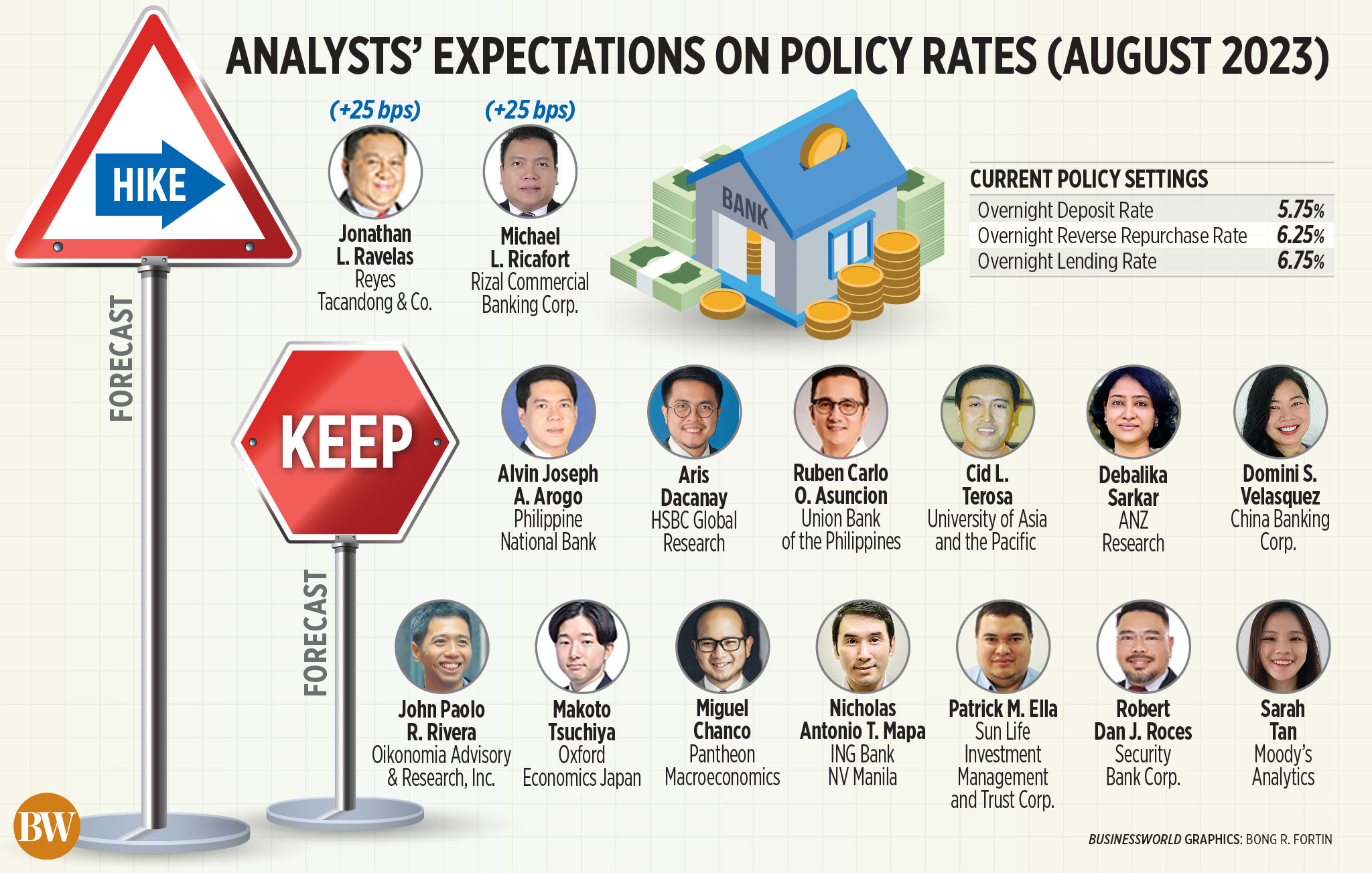
Analysts’ expectations on policy rates (August 2023)

THE PHILIPPINE central bank will likely keep its benchmark policy rates steady at 6.25% for a third straight meeting on Thursday, amid easing inflation and slowing economic growth. Read the full story.

Torre Lorenzo still looking to conduct IPO

TORRE Lorenzo Development Corp. (TLDC) is still looking to conduct an initial public offering (IPO) as it continues to grow its property portfolio, an official said on Friday.

“I think right now what we want to do is really build our organization and make it IPO-ready,” TLDC Chief Operations Officer Cathy Casares-Ko told reporters on the sidelines of a launch event.

“When you go for an IPO, you have to have a really good story. So, [this] contributes to the story, we are building it… but it is still on the table. We want the growth to be steadier before we go to the market,” Ms. Casares-Ko added.

In 2018, the company said that it was looking at capital-raising activities as it wants to grow as fast as other property firms in the market and is eyeing a listing between 2020 and 2023.

In 2020, the company also said it is eyeing a real estate investment trust for its property portfolio.

On Friday, the company announced that it is set to develop the west tower of its Torre Lorenzo Loyola property, a short distance from the 36-storey Torre Lorenzo Loyola east tower in Loyola Heights, Quezon City.

The new project is set to have up to 500 units within the new residential tower. It will also house upscale amenities for residents.

Meanwhile, the company said it has sold and turned over about 90% of the property’s P1.9-billion east tower development.

The project has a total of 654 units, with studio types spanning 21 to 28 square meters (sq.m.) and one-bedroom units spanning 38.3 sq.m. to 47.5 sq.m.

The company also announced its plan to expand its integrated development in Tierra Davao by adding a residential property, the Crown Residences, and an office and commercial center.

The developer is carrying out expansion activities within its Dusit Thani Lubi Plantation Resort in Davao de Oro.

During the first half, the company more than doubled its reservation sales from the same period last year. This represents 71% of its target for the year. — A.H. Halili

Interest rates on loans hit 790% in Latin America’s big fintech shakeout

THE NUMBERS sound almost implausible. As Brazilian consumers fall behind on debts and rattle a slew of financial-technology (fintech) startups in Latin America’s largest economy, one venture keeps notching ever higher.

Nu Holdings Ltd. now has reeled in enough customers — more than 85 million and counting — to rank among Latin America’s largest financial firms. The online bank and credit-card issuer, with early backers including Warren Buffett’s Berkshire Hathaway, Inc., has watched its stock soar more than 90% this year, for a market value 200 times greater than its most recent 12-month reported profits. And to protect earnings, the firm has boosted rates on its cards — in some cases touching 790%.

Welcome to Latin America’s fintech shakeout, where economic turmoil is threatening to upend thousands of startups across the continent and leaving relatively few to dominate. It’s a swift turn in a decade-long rush by venture capitalists into the region, speeding up the process of deciding winners and losers.

Nubank is among a handful of platforms, such as Mercado Pago, the fintech arm of e-commerce giant MercadoLibre, Inc., that have managed to reach critical mass and stay ahead of the economic quakes. Others are merging to strengthen their position in the market. Many more are cutting workers, shelving ambitions or in some cases selling assets, going dormant or shutting down.

In one of the starkest signs yet of the shakeout, a report to be published by data provider Distrito later this month shows the number of fintechs being launched has plummeted in Latin America to just a half-dozen this year — down from a peak of 290 in 2018.

“When there is less capital available there are fewer fintechs born,” said Distrito Chief Executive Officer Gustavo Araujo. “Before, with interest rates close to zero, investors wanted growth at any cost. Now, with higher rates, investors are seeking healthy companies capable of expanding in a sustainable way.”

Even then, there are mounting questions among analysts over whether the biggest fintechs can maintain their eye-popping profitability and continue to expand.

Startups that got going by catering to poor people are likely to run into stiffer competition as they try to woo middle-class customers away from traditional banks. In other major markets, such as Mexico and Colombia, there are now ample competitors and tighter credit spreads.

And in Brazil almost 72 million people were late on debt payments at the end of June. Lenders have compensated for that by boosting interest they levy on loans. By the middle of that month, average rates on revolving credit-card lines reached almost 350% at Nubank and 560% at Mercado Pago, according to the central bank. Rates for individual borrowers can vary widely, and in some cases are hundreds of percentage points higher.

That’s fueling a political debate.

Card rates are “stratospheric,” Finance Minister Fernando Haddad complained earlier this year, floating the possibility of imposing a cap. Nubank and traditional banking rivals were initially able to quell that discussion, saying it’s the only way lenders can keep credit available in the current environment. But last week Mr. Haddad brought up the issue again, calling the charges “shameful” and promising to take measures.

The conundrum, central bank chief Roberto Campos Neto added Thursday, is that if rates are capped, lenders will close card accounts, potentially slowing spending. “It’s something you know how it starts but not how it ends,” he said.

The reality, according to Nubank Chief Executive Officer (CEO) David Velez, is that fintechs are forcing banks to lower their fees. He estimates his firm has saved customers 39 billion reais ($8 billion) in what they would have paid otherwise.

When his firm was founded in 2013, “financial services were a market outside the ‘realm’ of entrepreneurs, a market hitherto dominated by the largest companies in Latin America,” Mr. Velez said in a statement. “We broke the glass ceiling and allowed other entrepreneurs to enter this market, in different verticals. In a way, we were leaders of this revolution in the industry, and we are very proud of it.”

SOFTBANK’S BILLIONS
Venture capitalists flocked to Latin America after watching the meteoric rise of fintechs in Asia, where WeChat and Alipay became global behemoths by signing up China’s unbanked masses. Hoping for a similar feat in Latin America, backers pumped capital to legions of startups, especially in Brazil, aiming to capitalize on improvements in digital infrastructure in areas long ignored by banks.

SoftBank Group Corp., making the biggest bet, set up a $5-billion fund dedicated to the region in 2019 and 30 months later announced a second with $3 billion. Capital and financing came from Brazilian billionaires Jorge Paulo Lemann, Marcel Telles and Carlos Sicupira, as well as stalwarts of Silicon Valley and US finance, such as Sequoia Capital, Goldman Sachs Group, Inc., JPMorgan Chase & Co. and Visa, Inc.

Nubank was among the first to get its footing. The firm targeted young, poor, unbanked clients. Its big lure was a digital credit card without fees.

Its well-connected co-founders — CEO Velez had been a partner at Sequoia, Cristina Junqueira a card executive at Itau Unibanco Holding SA and Edward Wible a software engineer at Boston Consulting Group —quickly found backers. By early 2016, Goldman began pumping in hundreds of millions of dollars in finance to help Nubank ramp up lending.

When the pandemic arrived in 2020, online commerce got a boost and digital banking and payments took off. The next year, venture capital investments in Latin American fintechs reached a record of $6.16 billion, according to the LAVCA association for private equity investments in the region. That December, Nubank raised $2.8 billion in an initial public offering valuing the firm at $45 billion — more than any bank in Latin America at the time.

Many other fintechs were planning to announce their own public offerings, but everything changed when interest rates climbed in the US, Europe and Latin America. As bonds offered juicier returns, the appetite for risk that drove many venture-capital bets began to wane.

The fading investment frenzy left behind some 2,595 startups offering credit, cryptocurrencies, payments or general financial infrastructure services born in Latin America, according to Distrito’s report, which drew on support from SoftBank and Upload Ventures. That includes 403 in Mexico and 1,476 in Brazil.

Their combined share of outstanding credit in Brazil — about 4% — shows that many lending platforms have yet to gain momentum.

In an era of higher interest rates, legions of small ventures will struggle to get the additional capital they need to grow.

That gives an advantage to larger fintechs that have established funding sources, deposits from clients and the ability to adjust what they charge borrowers.

“The sheer magnitude of local interest rates tends to compensate for higher delinquency through the cycle and positions credit as one of the most valuable businesses for startups in Latin America,” said Pedro Pereira, head of technology investment banking for the region at Bank of America Corp.

Nubank, which pays savers about 11% for deposits, generated $815 million in net interest income in this year’s first quarter, more than double a year earlier.

Smaller fintechs that want to succeed in a world with less capital available will need a product “a thousand times superior to what already exists on the market,” and will probably have to cut costs and abandon projects that aren’t central to their strategy, Nubank CEO Velez said.

The shakeout also offers another big lesson: For a fintech to survive in Latin America it may need to act a bit like a traditional bank. Indeed, Nubank is emulating some aspects of the incumbents it once sought to challenge. Back then, it chided traditional lenders for offering interest rates that were about 50% higher.

“Something is really, really broken here,” Mr. Velez told Bloomberg in an interview in 2015, referring to rates as high as 500% on cards issued by big banks. “In a competitive market, you wouldn’t see those.”

‘NOT ALL WILL SURVIVE’
The arrival of fintechs set off an oversupply of credit in the region. Some previously unbanked consumers signed up for as many as six cards.

By the end of last year, almost half of nonbanks’ Brazilian credit-card customers had low incomes, compared with about a quarter at the big banks, according to a report from Fitch Ratings. A sharp rise in the nation’s benchmark interest rate to almost 14% from 2% in just 15 months hit those borrowers especially hard. Last week, the central bank started easing, cutting rates by 50 basis points to 13.25%.

Big lenders can adjust and weather the storm, said Pedro Carvalho, a Fitch analyst.

“Most at risk are the smallest fintechs,” he said. “One thing is certain: Not all will survive.”

Mercado Pago — offering loans, credit cards and a popular payments platform — accounted for about 44% of retailer MercadoLibre’s revenue in the second quarter, up from 31% a year earlier. Its $3.3-billion credit portfolio compares with Nubank’s $12.8 billion.

But Mercado Pago’s new lending is expected to decelerate in 2023’s more challenging environment, higher funding costs and increasing household indebtedness in Brazil. On Thursday MercadoLibre announced Chief Financial Officer  Pedro Arnt is leaving after two decades to pursue new opportunities. He will be replaced by Martin De Los Santos, a senior executive in its credit division.

Nubank wants to expand into the middle class, where competition with big banks is stronger, and in secured lending, such as payroll lending and credit with collateral, where delinquency rates are lower. Fintechs such as General Atlantic-backed Neon Pagamentos, a Brazilian unicorn that received a capital injection from Banco Bilbao Vizcaya Argentaria of $300 million last year, are also growing and competing for the same clients.

EXPANDING ABROAD
Other markets look tough, too.

Nubank, which generates 90% of its revenue in Brazil, faces risks with its effort to expand into Mexico. There, incumbent banks have already set up digital platforms to compete with fintechs, in some cases allowing them to operate more independently and enter strategic alliances, said Alejandro Tapia, another Fitch analyst. 

Banorte, Mexico’s second-biggest bank by loan portfolio, for example, partnered with ecommerce and Bogota-based delivery-service firm Rappi on a credit card. Argentine fintech Uala got regulatory approval to acquire Mexico’s ABC Capital Bank and expand operations in the country, launching a high-yield savings account. 

Mexico’s economy is more informal with credit-card transactions amounting to only 20% of the volume in Brazil, according to a report by Citigroup Inc. And its credit spreads are also much tighter, making it more difficult to compensate for loan losses. Four non-bank lenders defaulted over the past two years.

“Mexico is a country with great potential,” Nubank’s Velez said. “The opportunities are enormous, as service penetration is much lower – an estimated 60% of Mexicans are unbanked. But, as always, we have expanded our operation attentively and cautiously.”

FIRING THOUSANDS
Amid such challenges, many Latin American fintechs are adjusting course. They have fired more than 2,000 staff in the past 12 months, according to data compiled by Bloomberg. That includes PagSeguro Digital Ltd., a provider of credit-card machines for small and midsize companies that eliminated about 500 positions, or 7% of its workforce.

One of the pioneers in unsecured loans to individuals in Brazil, Open Co., backed by SoftBank and LTS Investments, the family office of billionaires Lemann, Telles and Sicupira, recently announced a merger with BizCapital, which provides credit for small firms. Open Co. itself was already the result of a merger between Geru and Rebel.

Some banks are reintegrating their digital platforms or closing them. At Bradesco, digital bank Next was reincorporated into the bank and clients of its digital credit-card portfolio Bitz were invited to instead open an account at its other fintech, Digio. Banco Safra SA, Brazil’s eighth-biggest bank, integrated clients from its fintech AgZero to an internal digital account named Safra One.

Meanwhile, lower-income Brazilians who piled on too much debt are falling further behind, struggling to pay bills or rents, and in some cases opening credit lines with even higher interest rates as they try to make ends meet. Once interest payments get compounded their debt snowballs even further.

The political situation is now so intense that President Luiz Inacio Lula da Silva recently announced a 50 billion-real fiscal stimulus to help lenders renegotiate unpaid debts. Banks that agree to forgive a portion of qualifying customers’ outstanding debts can get a tax credit of an equal amount.

Now, “when you see the data from the central bank, you realize that many fintechs charge clients with interest rates that are even bigger than banks,” said Isaac Sidney, president of Febraban, an association representing the big banks. “That’s no longer a trophy they can call theirs.” — Bloomberg


Does size matter?

GIORGIO TROVATO-UNSPLASH

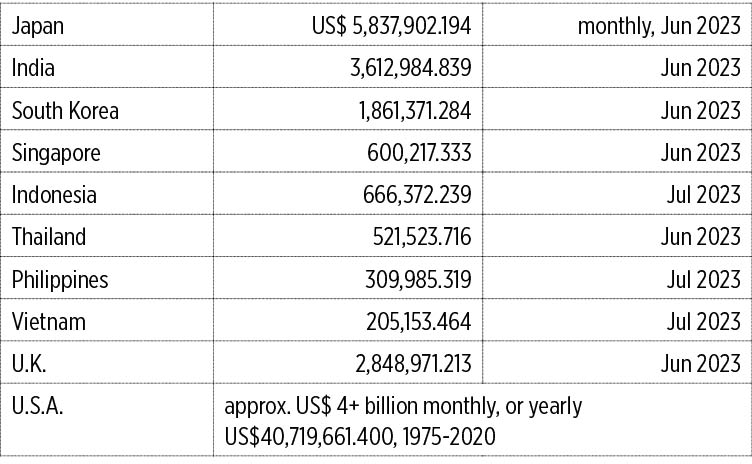
Philippines Market Capitalization accounted for $309.985 billion in July 2023, compared with $300.014 billion in the previous month. It accounted for 75.2% of its Nominal GDP in December 2022, compared with a percentage of 93.2% in the previous year.

A comparison of the size of market capitalization of elected countries, which accompanies this column, is from www.ceicdata.com/en/indicator/philippines/market-capitalization.

Does size matter? At the Ayala-FINEX Finance Summit “Reigniting the Philippine Capital Market towards a Sustainable Future” on Aug. 10, that was the bothersome question — why is the Philippines, which first opened its stock exchange in 1927, now so much smaller in the capital markets than its ASEAN neighbors Singapore, Indonesia, and Thailand?

A capital market is a financial market in which long-term debt (over a year) or equity-backed securities are bought and sold, in contrast to a money market where short-term debt is bought and sold. According to the Financial Times (FT), capital markets overtook bank lending as the leading source of long-term finance in 2009, reflecting the risk aversion and the tightening of bank regulation in the wake of the 2008 financial crisis. Proceeding from this observation by the FT, perhaps the same disenchantment with depository banks gave rise to investment banks and even regular banks who tailored their services to meet the re-directed needs of investors or borrowers for an underwriter or lead bank to organize a network of brokers to sell bonds or shares.


When raising long-term finance, Government will sell bonds in the capital markets, under the same protocols it had ordered for underwriting and syndication or brokerage. Companies choose between issuing bonds or shares to raise capital. In this situation, “from an investor’s point of view, shares offer the potential for higher returns and capital gains if the company does well. Conversely, bonds are safer if the company does poorly, as they are less prone to severe falls in price, and in the event of bankruptcy, bond owners may be paid something, while shareholders will receive nothing,” one analyst pointed out.

At the Ayala-FINEX conference, Pol de Win, Head of Global Sales and Origination of the Singapore Exchange (SGX), spoke on Asia’s most international, multi-asset exchange, and its operating environment that had fostered its successes in the capital markets. He pointed out that the government and the private sector plan and work together to achieve macro objectives prioritized over the micro goals of businesses. “Everybody gets to work together,” he said, and that is political will exercised in solidarity, to ensure sustainability. At the Q&A, Mr. De Win clarified that companies do not all go to the market for liquidity. Same for generational transitions (estate planning) — as market forces and opportunities maximize the best “deal” for the common All. Liquidity has costs — trading costs, but not taxes.

Francis Ed. Lim, Chairman of the FINEX Academy and Past FINEX President, spoke about the Philippine capital markets and the delayed, much-studied plans for its development. Mr. Lim was President, Chief Executive Office, and Director at Philippine Stock Exchange, Inc. and President and CEO of Securities Clearing Corp. of the Philippines (a subsidiary of the Philippine Stock Exchange, Inc.). He deplored that the Philippine capital market has not advanced since 2005 when the Capital Market Development Council was set up amid high hopes that the Philippines would zoom together with its ASEAN neighbors to take prominence as active leaders and movers of the global financial markets. It has been 20 years in the to-and-fro of recommendations and “Roadmaps” on the capital markets, and we have not moved forward. There is no political will. We have been overtaken by Thailand, Mr. Lim said.

And yet Vietnam has performed spectacularly, even if its market size is smaller than the Philippines’, Mr. De Win commented. “It is a controlled market in Vietnam; everything is controlled in Vietnam,” he said. But perhaps the secret for this small economy is its domestic focus. Contrary to the usual global financial competitive stance, Vietnam has a domestic focus that is micro-driven. “Companies must get something from investing in another,” Mr. De Win emphasized. With its prioritizing of its domestic markets, Vietnam has accelerated its growth by strengthening from the inside.

At the conference, Jaime Alfonso Zobel de Ayala spoke on the “Ayala Corp. investment opportunities and sustainable future.” “The Philippines has the lowest market turnover in Asia,” he said. “We might seem OK in general, but from a much lower base. We must grow and sustain that growth.” It might have been in response that Erwin Sta. Ana, Deputy Treasurer of the Bureau of the Treasury offered yet another “Philippine Capital Markets Roadmap” which outlined general fiscal and monetary plans of government in the post-COVID recovery.

On Feb. 7, the Philippine government raised an initial P162.180 billion in an auction of retail Treasury bonds (RTBs), the second under the Marcos administration. Tenders at the rate-setting auction hit P196.109 billion, or more than six times the P30 billion on offer at the BTr’s first retail bond offer this year. The five-and-a-half-year RTBs fetched a coupon rate of 6.125%, 37.5 basis points (bps) higher than the 5.75% set for the previous RTB offering in August 2022 (BusinessWorld, Feb. 8, 2023).

The government may launch a retail dollar bond offering in the third quarter of 2023, National Treasurer Rosalia V. de Leon said. The offer size will be around $2 billion (up from $1.5 billion earlier announced to be in May), surpassing its previous retail dollar bond issuance. The Philippines’ last retail dollar bond sale was in 2021, when it raised almost $1.6 billion or P80.91 billion. “We are looking for a more comfortable exchange rate. It’s a moving target, we’re now looking at the third quarter. We are planning this carefully, because otherwise we’ll be adding more debt,” she said. (BusinessWorld, May 15, 2023).

At the FINEX conference, hushed discussions at the lunch tables worried about “adding more debt” amidst the inflation and sticky prices still choking the economy. The peso-dollar exchange rate has not gone down from the P55.5+ per US dollar level, strangling debt repayments and massive imports. Are we to be excited with the government about the expanded opportunities to borrow and/or solicit investments in the global capital markets, when we know we have to attend to pressing issues and needs here first?

The example of Vietnam focusing first on its micro concerns and domestic urgencies seems a good suggestion. Vietnam has chosen to go slow and think out the more prudent and practical plans for its people. This was the way Singapore designed its spectacular rise as an independent and self-sufficient nation since it was expelled from Malaysia and became an independent republic on Aug. 9, 1965. Now tiny city-state Singapore is ranked No. 34 of the major economies and acknowledged to be the most competitive country in the world.

Size does not matter.


Amelia H. C. Ylagan is a doctor of Business Administration from the University of the Philippines.

ahcylagan@yahoo.com

Unconventional luxury brand collaborations are everywhere. What is the appeal?

AN OUTFIT from the Doraemon x Gucci collection. — GUCCI.COM

In 2017, Louis Vuitton caused a stir in the luxury industry by partnering with the New York skateboarding brand Supreme.

This collaboration became a milestone in the luxury industry, showcasing the potential of unexpected partnerships between luxury brands and an unconventional partner seemingly at the opposite end of the design spectrum, a street wear brand.

The iconic brand raised interest again when, in 2019, it partnered with the video game franchise League of Legends.

It may appear odd for a renowned French luxury design house and a game developer to team up. After all, their audiences are quite different. Whereas anyone with an internet connection can jump into a “free-to-play” game, few can afford a luxury brand.

So why are luxury brands collaborating with street brands, cartoons, and video games? Part of the reason is their success with young Asian consumers, who are driving demand for luxury consumer goods.

Given their growing importance for the luxury industry, we conducted a study of unconventional luxury brand collaborations. We wanted to investigate why this strategy appeals to Chinese luxury consumers of the post-1990s generation.

The study reveals potential opportunities for Australian brands, for instance, through partnerships with old-world luxury brands.

Luxury typically brings to mind ultra-expensive products such as yachts and private jets that are not within most people’s reach. However, there is another kind of luxury in which products that are not inherently expensive, like cosmetics, perfume, or even chocolate, can be luxurious through their brand’s prestige.

Business managers call this approach the luxury strategy. It has specific rules that luxury managers must follow. One of them is that luxury brands must remain above controversy, using aesthetics and tradition to signal exclusivity. Luxury brands are timeless because they resist the whims of fashion and don’t date.

New ways to convey exclusivity and uniqueness in digital and experiential contexts are emerging. For example, consumption experiences can feel like “a moment of luxury” if they convey a pleasurable escape from day-to-day routines.

As a result, new forms of luxury consumption, like second-hand luxury markets, are popping up.

While luxury brands are known to collaborate with artists, they have been pushing the boundaries of the luxury strategy by teaming up with unexpected non-luxury partners. One early example was between the Swedish fast-fashion retail outlet H&M and designer Karl Lagerfeld in 2004.

A partnership between a designer house and a fast-fashion retailer builds upon each other’s strengths, brand prestige, and mass distribution. However, luxury brands are growing more creative with their partnerships.

There are renowned luxury pairings like Fendi x Versace but also pairings with streetwear brands including Adidas x Gucci, with celebrities such as Kanye West x Louis Vuitton, animé characters like Doraemon x Gucci, and now video game franchises like Fortnite x Balenciaga.

These collaborations are becoming increasingly popular, especially with Chinese consumers.

Australian designers and producers of high-end goods must keep young adult Chinese consumers top of mind given the growing importance of Asian consumers in the luxury industry.

Reports by consulting agencies Bain & Company and McKinsey predicted that, by 2025, East Asia can become the world’s largest personal luxury goods market. China alone will consume about half the global market value of luxury goods.

In 2019, McKinsey reported that “Chinese consumers are now the engine of worldwide growth in luxury spending,” driven in part by consumers “born between 1980 and 2015 [who] are reshaping global luxury.”

Our study focused on the generational divide that is a uniquely Chinese phenomenon.

The 1990s economic reforms and China’s one-child policy shaped the generation. In 1979, a government program restricted (most) Chinese families to having one child each. The policy was updated to two children per family in 2016 and three in 2021.

During the 1990s, the media called lone children “little emperors” because they became the sole recipient of the family’s attention and financial support.

Analysts often subdivide the cohort into an affluent post-1980s generation consolidating their careers and a post-1990s generation characterized by urban lifestyle and social media savviness.

The post-1990s cohort of Chinese young adults, now in their 20s or early 30s, is characterized by their economic prowess, always-online presence, international mobility, and taste for luxury brands.

We find that Chinese luxury consumers of the post-1990s generation appreciate when luxury brands collaborate with non-luxury partners seemingly at the opposite spectrum of design, image and values. These collaborations are exciting when they are ephemeral, trendy, and playful.

Ephemeral collaborations are transitory, existing only for a limited time, and will not reappear. Trendy collaborations help consumers navigate the ebbs and flows of social media to capture novelty and hype. Playful collaborations appeal to a youthful audience by mocking traditions and not being too serious.

In the words of one of our respondents, “Most of my friends in China like these collaborations […] Sometimes they are like: ‘Oh! Wow, your limited edition! Where? How did you get this? Oh my gosh! You must have connections.”

Collaborations are instantly recognizable in social media. When asked why purchase a collaboration, a respondent said: “Selfies (giggles). I mean, I am going to take a selfie with it. You must post it! (giggles). Others will see it and ask me how I got it.”

The popularity of unconventional luxury brand collaborations among young adult Chinese consumers opens timely strategic opportunities for Australian designers and producers of high-end goods.

The young adult Chinese segment remains important in Australia because of its purchasing power and influence in redefining luxury. By seeking collaborations that are ephemeral, trendy and playful, Australian brands can meet this segment’s preferences and adapt to the changing rules of luxury.

Australian brands can also position themselves as attractive partners for fresh collaborations. As global luxury brands seek partners who, in the words of one of our study participants, “bring something new to break through old-fashioned limits,” Aussie brands can offer just that.

Upcoming Australian designers are known for their effortless elegance, down-to-earth aesthetics, and their values of sustainability and ethics, making them great potential partners for luxury brands.

Aussie brands and consumers are intrepid innovators in outdoor gear and adventure activities, like water sports, offering hype, trendiness, and authenticity.

This sets Aussie brands up well to enter the coveted luxury market, gaining a foothold in the fast-growing Chinese market and opening opportunities worldwide. — The Conversation via Reuters Connect


Carlos Diaz Ruiz is an Assistant Professor at the Hanken School of Economics while Angela Cruz is a Senior Lecturer in Marketing, Monash University.

Mountain Province capital Bontoc bans live hogs, pork from Ilocos Sur due to ASF

PHILSTAR FILE PHOTO

BONTOC, the capital of Mountain Province, is temporarily banning hogs and pork products from Cervantes, lIocos Sur, after the detection of African Swine Fever (ASF) there.

Bontoc Mayor Jerome Tudlong, Jr. in a public advisory warned his constituents about cases of ASF spreading from Ilocos to adjoining areas.

“To prevent further spread of this disease and to help protect the livelihood of our swine raisers against the re-infection of ASF in our municipality, the entry of live swine/pigs, pork, locally processed pork products and by-products from the said area is hereby suspended,” the mayor said.

ASF was detected in a barangay in Cervantes in July, prompting other towns in Ilocos Sur to erect barriers against pigs or pork products from that town.

On July 24, the government of Benguet province issued a temporary ban on the entry of hogs and swine products from Cervantes.

In the first week of August, Abra province and Bauko, Mountain Province did the same.

Checkpoints were set up at the border of Ilocos Sur and nearby provinces.

On Aug. 12, three hog traders were intercepted at the border transporting 11 pigs. — Artemio A. Dumlao

Forensic audit criticizes ‘misconduct’ at Lebanon central bank, urges oversight

BEIRUT — An audit of Lebanon’s central bank urged action to mitigate further risks from “misconduct” at the institution and says its former governor had “unconstrained” discretion as he pursued costly financial engineering policies.

The audit by accounting firm Alvarez & Marsal (A&M) also found evidence that “illegitimate commissions” of $111 million were paid from a central bank account from 2015 to 2020, saying this appeared to be a continuation of a scheme that has prompted investigations into ex-governor Riad Salameh at home and abroad.

The forensic audit was demanded by donor states after Lebanon was hit by a financial collapse that has frozen most depositors out of their savings since 2019, sinking the currency by 98% and fueling poverty. The audit, a copy of which was reviewed by Reuters, covered a period from 2015 until 2020.

Mr. Salameh, who stepped down last month, defended the policies in written comments to Reuters. The central bank’s media office told Reuters that “the concerned parties are not at the bank anymore.” Fares Gemayel, media adviser to caretaker prime minister Najib Mikati, declined to comment, saying the report was meant to be “confidential.”

Mr. Salameh, who left at the end of his latest term on July 31 after three decades in office, has denied accusations he abused his powers to embezzle Lebanese public money. France and Germany have issued arrest warrants for Mr. Salameh.

On Thursday, the United States, Britain and Canada announced sanctions against Mr. Salameh, accusing him of corrupt actions to enrich himself and his associates.

The A&M audit cited a “lack of overall good governance and risk management arrangements” at the central bank, also known as Banque du Liban (BDL), and called for improved oversight “to mitigate any further risk arising from BDL’s misconduct.”

In written comments to Reuters, Mr. Salameh said the qualification of misconduct was “arbitrary” and said the central bank had acted according to the law.

The bank’s financial engineering siphoned off dollars from local banks at high interest rates from 2015 to help finance the heavily indebted state. The audit said BDL disguised losses equal to $76 billion from the engineering.

The audit said the central bank reported profits every year by transferring costs to its balance sheet, even in years “in which the actual losses were several billion dollars.”

Mr. Salameh said there was “no hiding” of losses. It was published and in accordance with the accounting procedure approved by the central council and communicated to the government, he said.

Citing minutes of council meetings, the audit said “the governor monopolized the discussions and decisions.” The council “fell significantly below the minimum standards of good governance found in central bank practice internationally.”

Mr. Salameh said the council had found financial engineering to be the “best response to a deteriorating balance of payment” and that he had not “intervened” in decision making on engineering.

The council comprises the governor, four deputies, and two senior government officials.

The audit said that four vice governors appointed in June 2020, specifically first Vice Governor Wassim Mansouri — who is currently acting as interim governor — tended “to challenge more the governor in his thinking.”

‘COMMISSION SCHEME’
The legal investigations into Salameh focus on commissions which the central bank charged commercial banks on the purchase of government securities, the proceeds from which went to Forry Associates, a company controlled by Mr. Salameh’s brother Raja Salameh. The Salameh brothers deny diverting or laundering public funds.

European judicial officials suspect Mr. Salameh and his brother illegally took more than $300 million from the central bank between 2002 and 2015.

The A&M audit said it had identified payments over the following half-decade totaling $111.3 million to seven banks — one Swiss and six of them Lebanese — from a central bank account that has been a focal point of those probes.

“This appears to be a continuation of the commission scheme under investigation by Lebanese and international prosecuting authorities,” the audit said.

It said it found no record of a service actually performed in exchange for the commissions and that the ultimate beneficiary could not be confirmed because BDL had removed details, citing a banking secrecy law. — Reuters

‘Morizo’ to headline Gazoo Racing Fest in Manila

Toyota Motor Corp. Chairman Akio ‘Morizo’ Toyoda in Thailand — PHOTO BY KAP MACEDA AGUILA

IT’S A MILESTONE year for Toyota Motor Philippines (TMP) as it marks 35 years of operations. With the theme “Creating Happiness in Mobility,” TMP has prepared special activities and promotions geared to enable customers “to experience the thrill and joy of moving together.”

In a release, TMP President Atsuhiro Okamoto said, “We dedicate this celebration to the generations of Filipino Toyota customers who have embraced the Toyota brand and became Toyota’s brand ambassadors. To thank our customers for this milestone and to give them a glimpse of our exciting future together, we are treating them to exciting and unforgettable activities this month to kick-start our 35th year.”

Following its “Go Electrified with Toyota” fair at the Bonifacio Global City last weekend, TMP is set to welcome Toyota Motor Corp. Chairman Akio Toyoda to the Philippines. Known as “Morizo” when he participates in motorsports events, Mr. Toyoda will top-bill the Toyota Gazoo Racing Festival (TGR Fest) on Aug. 23 and 24.

The event — open to the public, and free of charge — is a gathering of motorsports enthusiasts and car afficionados celebrating the thrill and joy of driving Toyota cars. This festival is expected to serve as a grand meetup of TGR drivers and fans, aiming to form the biggest assembly of GR cars in one venue.

Morizo is set to perform “exciting and challenging driving exhibitions” — usually held in some of the world’s most renowned racetracks — in front of the Filipino audience. He will be joined by other Japanese champion racers from the Toyota Gazoo Racing team, Norihiko Katsuta and Masahiro Sasaki, bringing with them the legendary race cars that have run the rally courses of global racing events — Toyota WRC Yaris and Corolla D1. Driving alongside them in a series of drifting and gymkhana challenges are Filipino representatives Alex Perez, Luis Gono, Marlon Stockinger, and Ryan Agoncillo using TGR’s performance cars GR Supra, GR Yaris, and GR 86.

All Toyota customers, fans, and spectators are welcome to join in the fun and expect more attractions and surprises, including getting the chance to ride with the guest professional racers, winning official TGR merchandise, and witnessing the national finals of TMP’s biggest national sim racing championship, the Toyota Gazoo Racing Gran Turismo Cup Philippines (TGR GT Cup PH). Performers like Ely Buendia, Ben&Ben, Parokya ni Edgar, and Kamikazee will also be at the festival to entertain the crowd. More information about the event will be shared on the official Facebook account of Toyota Gazoo Racing Philippines.

ACEN dips after weaker-than-expected Q2 GDP growth

AYALA-LED ENERGY firm ACEN Corp.’s shares went down last week as the country’s slower-than-expected economic growth affected market sentiment.

Data from the Philippine Stock Exchange (PSE) showed a total of P342.49 million worth of 64.90 million in ACEN shares were traded from Aug. 7 to 11, making it the 15th most actively traded stock in the local bourse last week.

The Ayala-led energy company’s share price fell by 7.1% week on week after finishing at P5.11 per share on Friday from its P5.50 closing last Aug. 4. Year to date, it has dropped by 32.9%.

“The market’s overall negative sentiment — brought about mainly by disappointing second quarter data — likely dragged on ACEN’s stock price. This raised investor concerns that full-year growth will fall below the government’s target of 6-7% and drag the performance of listed companies,” Globalinks Securities and Stocks, Inc. Head of Sales Trading Toby Allan C. Arce said in an e-mail.

Philippine gross domestic product (GDP) growth to its slowest pace in to more than two years to 4.3% in the second quarter amid the lagged effect of rising borrowing costs and government underspending. It was slower than the 6.4% growth in the previous quarter and the 7.5% last year.

For Luis A. Limlingan, head of sales at Regina Capital Corp., the slower worldwide growth would likely sway the energy sector as public expenditure may continue to narrow.

Meanwhile, Mr. Arce said despite the decline, the energy company’s outlook is still optimistic and may drive the stock’s uptrend in the next quarters.

“ACEN’s current price is still a modest valuation for a company with its growth potential and will be a good investment for long-term investors,” he said.

The energy company announced last week that it signed a renewable energy contract area utilization agreement with the Laguna Lake Development Authority to lease 800 hectares of renewable energy portfolio.

The agreement is set to develop a large-scale floating solar project that will be located on Laguna Lake and is expected to add 1,000 megawatts (MW) to its renewable capacity.

The energy company has around 4,000 MW of attributable capacity, which comprises 98% of the total capacity in the Philippines, Vietnam, Indonesia, India, and Australia. It is also targeting to expand its renewable energy portfolio to 20 gigawatts by 2030.

Its net income attributable to equity holders of the parent company rose by 24% to P2.21 billion in the second quarter. Consolidated revenues also climbed 32.3% to P11.33 billion during the same period.

This brought ACEN’s attributable net profit to P4.23 billion in the first semester, almost double the P2.18 billion in bottom line last year.

Its top line also increased by 28.1% to P20.47 billion in the January to June period.

Mr. Arce expects ACEN’s net income to reach P2.6 billion in the third quarter, while full-year earnings are estimated at P9.3 billion.

Mr. Limlingan placed the company’s support level at P5.05 and resistance at P5.30.

“For [this] week, support is seen at P5.00, while resistance is at P5.50,” Mr. Arce said. — Mariedel Irish U. Catilogo

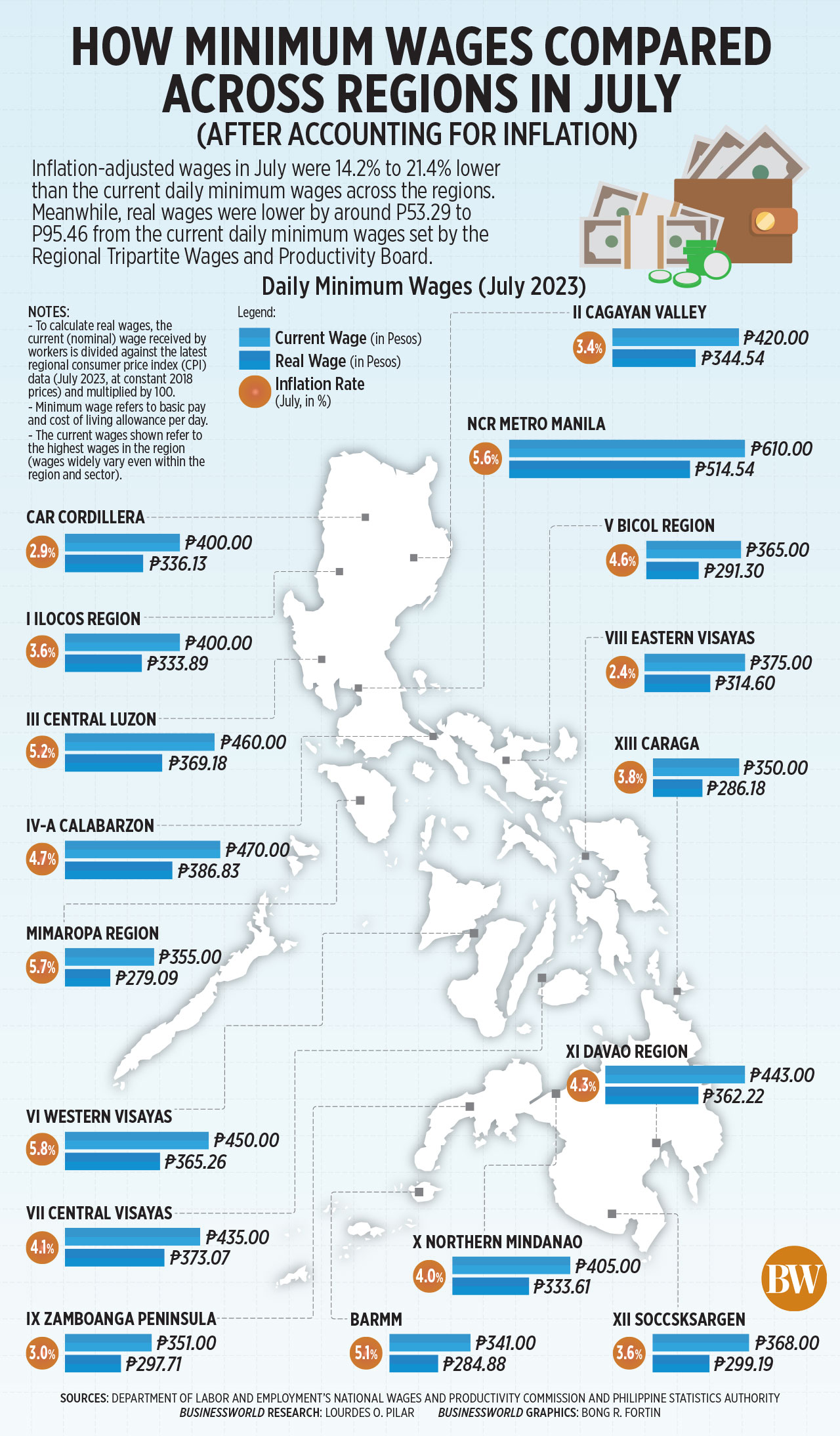
How minimum wages compared across regions in July

Inflation-adjusted wages in July were 14.2% to 21.4% lower than the current daily minimum wages across the regions. Meanwhile, real wages were lower by around P53.29 to P95.46 from the current daily minimum wages set by the Regional Tripartite Wages and Productivity Board.