Home Blog Page 4428

DMW’s promise of greener pastures for land-based OFWs

ANETE LUSINA-UNSPLASH

Republic Act No. 11641 created the Department of Migrant Workers (DMW), which has the mandate to regulate the recruitment, employment, and deployment of Overseas Filipino Workers (OFWs), among others. On June 9, the Department, headed by Secretary Susan Ople, issued the 2023 Rules and Regulations Governing the Recruitment and Employment of Land-based OFWs. This new set of rules effectively repealed the 2016 Revised Rules and Regulations Governing the Recruitment and Employment of Land-based OFWs.

The DMW claims that the new rules effectively simplified the process. It also asserts that the new rules now offer better protection for OFWs. Here are some of the salient provisions:

First, the rules redefined the meaning of OFW. Under the old rules, an OFW is “a person who is to be engaged, is engaged, or has been engaged in a remunerated activity in a State or country of which the worker is not a citizen.” However, in the new rules, an OFW is now defined as a “Filipino who is to be engaged, is engaged, or has been engaged in remunerated activity in a country of which he or she is not an immigrant, citizen, or permanent resident or is not awaiting naturalization, recognition, or admission, whether land-based or sea-based regardless of status; excluding a Filipino engaged under a government-recognized exchange visitor program for cultural and educational purposes.”

What does this mean for OFWs? The new rules made it more specific and excluded not just those who are already immigrants, citizens, or permanent residents, but also those awaiting naturalization, recognition, or admission. For example, a Filipino who is awaiting permanent residency in Australia, and is currently being sponsored a working visa, is no longer within the definition of OFW under the new rules. In effect, the protection and even the disciplinary actions and penalties laid down in the rules will not apply to that Filipino.

Second, the new rules provided a longer validity for licenses of recruitment agencies. From the initial two-year provisional license, the new rules made it three years. As for the regular licenses, the four-year validity is now extended to six years.

However, with this new validity, the new rules now require payment of license fees amounting to P200,000 every time an agency applies for either provisional, regular, or renewal of license.

Third, the enforcement of provision of accommodation facilities and other adequate provisions is now made stricter. The new rules provide: “All accommodation facilities provided by either the Philippine recruitment agency or the foreign principal/employer shall provide OFWs with adequate provisions such as food, drinking water, beds, blankets, toilet facilities, and other amenities to ensure decent and humane living conditions, free of charge.” (Rule XIV. Accommodation Facilities. Secs. 101) This provision has no equivalent in the old rules.

Under the old rules, one of the minimum provisions of the contract is “food and accommodation or the monetary equivalent which shall be commensurate to the cost of living in the host country, or off-setting benefits…”

The new rules provide assurance to OFWs that they will be given decent and humane living conditions while they are far from home. They also provide prohibitions against employers, in relation to the accommodation facilities: a.) the travel and employment documents of OFWs shall not be withheld, and, b.) the OFW shall not be prevented from freely leaving the accommodation or from communicating or contacting their family and loved ones.

To enforce this provision, the Department requires quarterly reports to be submitted, which must be attested by the caretaker or house manager. Failure to comply with this requirement is a new ground for disciplinary action under Section 139 (Light Offenses), which has a penalty of suspension of license.

Lastly, applicants through agencies, agencies, and principal employers must be wary of committing any graft and corrupt practices as the new rules sanction such with cancellation of license. The new rules provide the following as grounds for serious offense: “Directly or indirectly committing acts constituting graft and corrupt practices, involving any official, employee, or personnel of the Department.” This provision has no equivalent in the old rules.

Many of the requirements, processes, and procedures were deleted in the new rules, with a note that the Department will prescribe guidelines and Rules for Adjudication. With the repeal of the 2016 Revised Rules and the absence of these guidelines, there is some confusion regarding these aspects, especially that the Department is exposed to a lot of queries and applications every day.

So, is the grass greener on the other side for OFWs? The Department is surely experiencing some birth pains as a new agency in the country, but the future still looks promising.

The views and opinions expressed in this article are those of the author. This article is for general informational and educational purposes only. It is not offered as and does not constitute legal advice or legal opinion.


Shikyna Joy Castillo is an associate of the Labor and Employment of the Angara Abello Concepcion Regala & Cruz Law Offices or ACCRALAW.

(632) 8830-8000
sjcastillo@accralaw.com

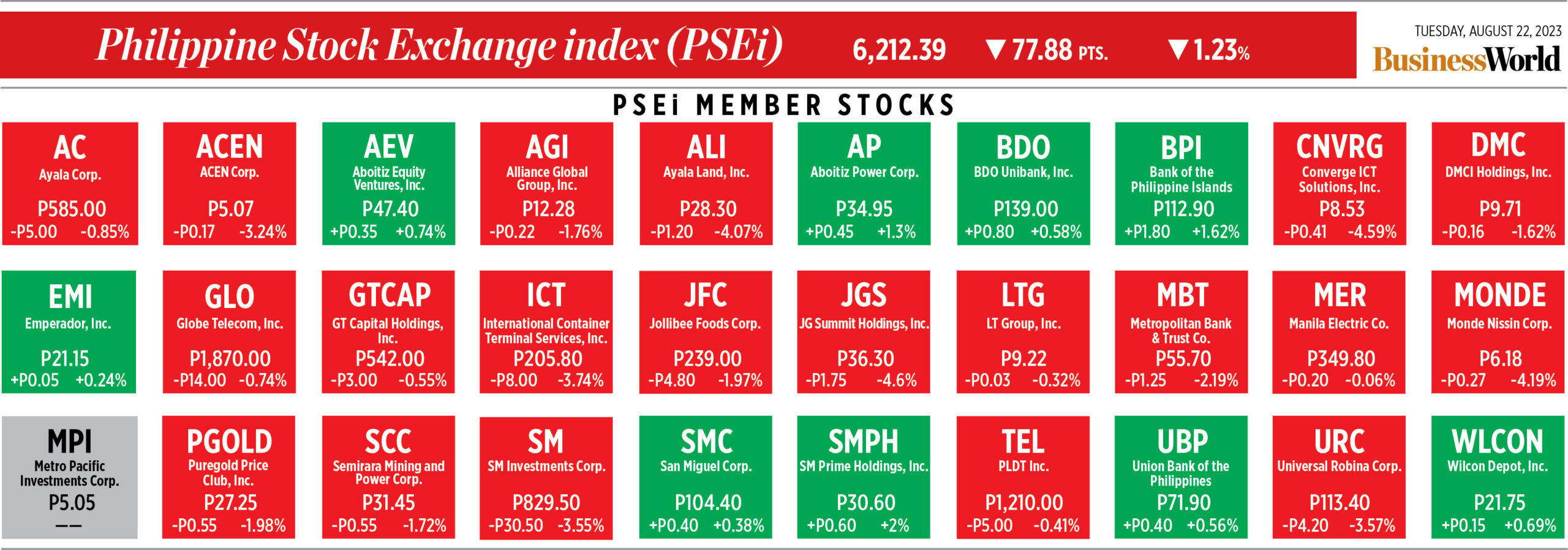
How PSEi member stocks performed — August 22, 2023

Here’s a quick glance at how PSEi stocks fared on Tuesday, August 22, 2023.


YouTube starts Music AI incubator with Universal Music as partner

YOUTUBE is launching an incubator to work with artists and musicians to explore the use of artificial intelligence (AI) in music, according to a blogpost on Monday.

The Alphabet unit has signed up Universal Music as its first partner for the Incubator, and will work with artists including Anitta, ABBA’s Björn Ulvaeus, and Max Richter.

“The incubator will help inform YouTube’s approach as we work with some of music’s most innovative artists, songwriters, and producers across the industry,” YouTube CEO Neal Mohan said in the blog.

The group “will help gather insights on generative AI experiments and research that are being developed at YouTube,” said Mr. Mohan, adding that YouTube would bring on board more partners.

Generative AI is artificial intelligence capable of generating text, images, sounds and other data.

With the launch of ChatGPT late last year, the technology has been adopted in a range of industries and use-cases even as lawmakers deliberate rules that prevent its misuse including copyright infringement and spam.

YouTube said it will further invest in AI-powered technology, including evolving its copyright management tool, Content ID, to protect viewers and creators. — Reuters

Philippines drops in Global Presence Index

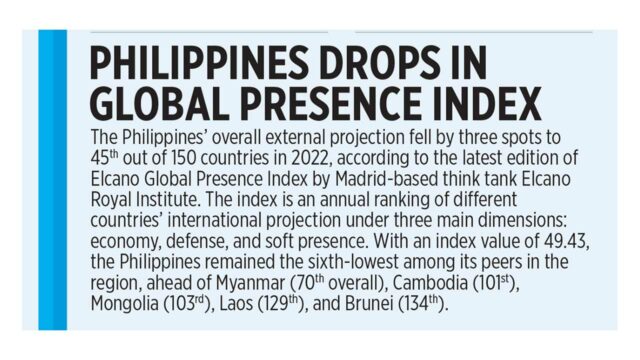
The Philippines’ overall external projection fell by three spots to 45th out of 150 countries in 2022, according to the latest edition of Elcano Global Presence Index by Madrid-based think tank Elcano Royal Institute. The index is an annual ranking of different countries’ international projection under three main dimensions: economy, defense, and soft presence. With an index value of 49.43, the Philippines remained the sixth-lowest among its peers in the region, ahead of Myanmar (70th overall), Cambodia (101st), Mongolia (103rd), Laos (129th), and Brunei (134th).

Peso weakens against dollar on hawkish Fed expectations

BW FILE PHOTO

By Aaron Michael C. Sy, Reporter

THE PESO fell against the dollar on Tuesday due to expectations of hawkish comments from US Federal Reserve Chairman Jerome H. Powell on Friday.

It closed at P56.38, weakening by 20 centavos from Friday’s P56.18 finish, data from the Bankers Association of the Philippines’ website showed.

Markets were closed on Monday for a national holiday.

The local currency opened at P56.30 a dollar, appreciated to as much as P56.085 and weakened to as much as P56.40 against the greenback. Dollars traded went down to $1.44 billion from $1.46 billion.

“The peso weakened from hawkish expectations ahead of Fed Chairman Powell’s speech in the Jackson Hole symposium of central bankers,” a trader said in an e-mail.

Mr. Powell is set to deliver a speech on the economic outlook at the Kansas City Jackson Hole Economic Policy Symposium on Aug. 25.

The Fed raised interest rates by 25 basis points (bps) last month, bringing its benchmark overnight rate to 5.25-5.5%.

The US central bank has hiked benchmark rates by 525 bps since it started its tightening cycle in March last year. The Federal Open Market Committee will next meet on Sept. 19-20 to review policy.

The peso was also dragged down by signals from the central bank that this year’s economic growth target would be missed, Michael L. Ricafort, chief economist at Rizal Commercial Banking Corp. said in a Viber message.

The Bangko Sentral ng Pilipinas (BSP) in its monetary policy report said it expects full year growth to be below the government’s 6-7% target.

“The full-year growth forecasts for 2023 and 2024 were adjusted downward from the previous monetary policy report to reflect slower-than-expected Q2 2023 GDP growth outturn of 4.3%, benign global economic conditions and higher global crude oil prices,” it said.

“The growth forecasts indicate continued economic expansion, albeit at a slower pace, with projected impact of the BSP’s policy rate adjustments peaking in 2024,” it added.

The trader expects the peso to depreciate further against the dollar on Wednesday due to potentially hawkish remarks from other Fed officials.

The trader sees the peso moving between P56.25 and P56.50 a dollar, while Mr. Ricafort expects it to trade between P56.25 and P56.45.

PSEi dips as US Treasury yield hits 16-year peak

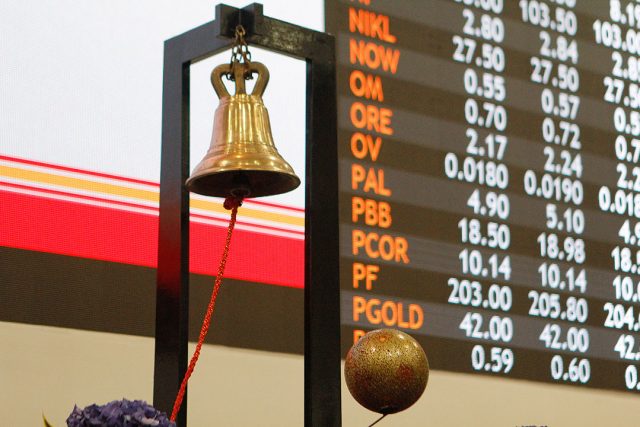
BW FILE PHOTO

PHILIPPINE STOCKS fell on Tuesday after the US Treasury yield reached its 16-year peak and China lowered its key lending rates.

The Philippine Stock Exchange index (PSEi) fell by 1.23% or 77.88 points to close at 6,212.39, while the broader all-share index declined by 0.9% or 30.46 points to 3,352.95.

Financial markets were closed on Monday for a national holiday.

“Philippine shares fell as the yield on the 10-year Treasury reached its highest level since November 2007,” Regina Capital Development Corp. Head of Sales Luis A. Limlingan said in a Viber message.

The US 10-year Treasury yield rose to its 16-year peak of 4.366%, but later dropped to 4.334%, Reuters reported.

In July, the US Federal Reserve raised borrowing costs by 25 basis points (bps), bringing the Fed target fund rate to 5.25-5.5%. It will next meet on Sept. 19-20 to discuss policy.

“Simultaneously, investors expressed dissatisfaction with China’s decision to reduce its key lending rates lower than anticipated,” AB Capital Securities, Inc. Vice-President Jovis L. Vistan said in a Viber message. “It’s worth noting that China, a significant trading partner for the Philippines, has encountered economic challenges over the past few quarters.”

On Monday, China slashed its one-year loan prime rate by 10 bps to 3.45% amid efforts to raise credit demand.

Almost all sector indices dropped at the local bourse except for financials, which gained 0.45% or 8.43 points to 1,870.47.

Holding firms slipped by 2.15% or 128.49 points to 5,832.66; services decreased by 1.96% or 30.36 points to 1,517.44; industrials fell by 1.48% or 130.79 points to 8,665.01; mining and oil fell by 0.9% or 89.05 points to 9,809.64; and property dipped by 0.6% or 15.99 points to 2,608.92.

Value turnover rose to P4.79 billion, with 391.66 million shares changing hands from 348.61 million shares worth P4.48 billion on Friday.

Decliners outnumbered advancers 122 versus 60, while 40 stocks were unchanged. Net foreign selling hit P264.81 million.

Markets were “relatively quiet” on Tuesday after the Monday break as investors await the release of the budget balance for July on Aug. 25, Mr. Limlingan said.   

Mr. Vistan placed the PSEi’s support at 6,100 points. — Sheldeen Joy Talavera

E-marketplace among reforms being eyed for gov’t procurement

BW FILE PHOTO

THE Department of Budget and Management (DBM) said its proposed amendments to the procurement law of 2007 include an e-marketplace and changes to the longstanding practice of awarding contracts to the lowest bidder.

The proposed amendments to the Government Procurement Reform Act of 2007 are designed to achieve greater efficiencies in government purchasing, Budget Secretary Amenah F. Pangandaman said at a Palace briefing on Tuesday.

The proposed reforms will also encourage green procurement, she added.

Ms. Pangandaman said the e-marketplace will initially focus on vehicle purchases.

The DBM will also seek to extend the applicability of its Most Economically Advantageous Tender system to goods from the current practice of using it only for services, Budget Undersecretary Dennis S. Santiago said at the same briefing.

“We always go for the lowest and cheap-but-not-nice, so we are looking at areas where we can… improve the evaluation method (for awarding bids).”

“We will apply it to goods and even infrastructure,” he added, noting that weightings will be assigned to a number of bid criteria. “There’s a certain percentage for the technical aspect, there’s a certain percentage for the financial aspect, and when you put them together, you will have the highest-rated bid, the most economically advantageous tender.”

The proposed reforms will also allow a no-bid acquisition process for goods costing less than a threshold of about P250,000,” or even lower,” Mr. Santiago said.

Under such a system, “the procuring entity will set its own technical requirements and then approach the appropriate (supplier).”

Ms. Pangandaman said President Ferdinand R. Marcos, Jr., who called for a new government procurement law during his second address to Congress in July, “agrees” with most of the proposed amendments.

“We need to understand that he also came from local government, and he understands the procurement process, so he was able to explain the areas where local government units (LGUs) are experiencing difficulty.”

Mr. Marcos represented the second district of Ilocos Norte at the House of Representatives between 1992 and 1995. He also served as the province’s governor between 1998 and 2007.

Ms. Pangandaman said it will take two weeks to come up with “specific amendments per provision.”

At the briefing, Ms. Pangandaman blamed slow government spending on procurement bottlenecks.

The government failed to spend P170 billion of allocated funds in the first half, she noted, adding that as a result, “the contribution of government spending to gross domestic product (GDP) was reduced,” Ms. Pangandaman said.

As of June 30, the top five agencies with the lowest obligation rates — a measure of how much cash has been cleared for spending — were the Department of Communications and Technology, the Commission on Elections, the Department of Agrarian Reform, the Department of Social Welfare and Development, and the Department of Energy, she said. — Kyle Aristophere T. Atienza

Palace approves Palawan, Mindoro grid link

ANDREY METELEV-UNSPLASH

PRESIDENT Ferdinand R. Marcos, Jr. has approved a proposal to connect Palawan and Mindoro to the power grid, the Palace said at a briefing.

He made the decision during a meeting on missionary electrification, press briefer Daphne Oseña-Paez said on Tuesday.

Palawan and Mindoro are the two largest islands which are currently not connected to the national power grid. The grid currently connects Luzon, the Visayas, and Mindanao.

She said Mr. Marcos also ordered an evaluation of potential renewable energy projects for 125 other off-grid islands “served by the Small Power Utilities Group (SPUG).”

SPUG is an arm of the National Power Corp. specializing in operating small power generation facilities for off-grid areas.

“He ordered for all new renewable energy sources to be more holistic in outlook, to look beyond supplying power to households, and to support the growth of industries in the countryside,” she added.

In his second address to Congress in July, Mr. Marcos promised to achieve full household electrification by the end of his six-year term. — Kyle Aristophere T. Atienza

PPP measure expected to clear third reading in Senate this week

PPP.GOV.PH

THE Public-Private Partnership (PPP) Center said it expects the proposed PPP Act to win third-reading approval this week.

“Right now, we are still in the period of amendments, and we hope to reach third reading within the week. We are closely coordinating with the Senate team,” PPP Center of the Philippines Executive Director Cynthia C. Hernandez said.

The proposed PPP Act is currently awaiting second reading in the Senate. Its counterpart bill at the House of Representatives was approved on third reading in December.

In May, President Ferdinand R. Marcos, Jr. certified the PPP legislation as urgent, facilitating the expedited approval of the measure by doing away with the waiting period between readings.

“We are integrating amendments as requested by the Senate. We are hoping that before the end of the current session, the PPP Act will finally happen,” Ms. Hernandez said.

Ms. Hernandez said that the bill addresses ambiguities in the existing law.

“The PPP Act intends to fold in joint ventures (JVs) under a unified PPP legal framework. It’s easier and it helps in the perception of market risk or country risk to have one legal framework to cover business ventures. It would be somewhat of a headache explaining to investors why JVs are under a separate law or certain entities have a different law governing their PPP projects. That’s one of the things we want to improve,” she said.

“Another would be to provide a predictable tariff regulation regime that protects the public interest,” she added.

The measure also aims to address bottlenecks and challenges in the PPP process.

Ms. Hernandez said that the bill updates the approval threshold for national PPP projects, delegates approval of local PPP projects to local government unit councils or boards of universities and colleges and shores up the institutional authority of the PPP Center.

The proposed PPP Act also seeks to improve the framework for unsolicited proposals, among others.

“To this end, the state shall provide an enabling environment for the private sector to mobilize its resources for the purpose of financing, designing, construction, operations, and maintenance of infrastructure and development projects. As provided by law, the government shall foster robust private sector participation by providing financial incentives and by reducing costs of doing business,” according to the Senate bill.

As of Aug. 11, 180 PPP projects have been awarded worth P2.638 trillion, including 122 national and 58 local projects.

In the pipeline are 106 PPP projects worth P2.491 trillion, not including projects undergoing study and yet to achieve financial closing.

Of the government’s 194 Infrastructure Flagship Projects, 47 will be implemented via PPP. They consist of 43 transportation, three health, and one water supply projects. — Luisa Maria Jacinta C. Jocson

NEDA may monitor crops via satellite for early warning on inflation trends

EUROPEAN SPACE AGENCY

THE National Economic and Development Authority (NEDA) said it is considering monitoring crops using satellites for early indications on the direction of inflation.

“Currently, we utilize Philippine Statistics Authority (PSA) data to inform our inflation policy, but in order to enhance our inflation analysis, we need to augment our data sources. This is particularly important in the case of rice, our staple, and amid volatile weather,” NEDA Officer in Charge Assistant Director Rory Jay S.C. Dacumos said in a statement on Tuesday.

NEDA said the Philippine Rice Information System (PRiSM) could be tapped in aid of this effort.

“It was pointed out that PRiSM can provide validated rice field data… every seventh day of the succeeding month, compared to the quarterly PSA data,” NEDA said.

“We have also learned during the lectures and the field demonstration that PRiSM data is reasonably accurate,” raising the possibility of using the system to “enhance our policy recommendations on inflation,” Mr. Dacumos added.

PRiSM uses satellite Synthetic Aperture Radar (SAR) in collecting data on rice.

“The data collected through SAR has up to 95% overall accuracy, vis-a-vis the ground validated data with the help of PRiSM data collectors in the field,” NEDA said.

“When the SAR images are insufficient, PRiSM can process secondary data, such as data collected using drones,” it added.

The Sentinel-1A satellite provides the SAR images used by PRiSM. The next satellite is due for launch this year.

Mr. Dacumos added that while PRiSM currently monitors only rice, it may also be adapted to other crops. — Luisa Maria Jacinta C. Jocson

Meat imports drop 4.5% in seven months to July

PHILSTAR FILE PHOTO

MEAT imports fell 4.5% year on year in the seven months to July, with the declines broadly based as shipments of beef, pork, and turkey weakening, the Bureau of Animal Industry (BAI) reported.

The BAI said that in volume terms, imports amounted to 702.17 million kilograms during the seven months. The total for July was 111.48 million kilos, down from 112.44 kilos in June and 134.79 million kilos a year earlier.

Beef shipments fell 19.1% year on year to 77.71 million kilos in the seven months. Beef accounted for 10.9% of all meat imports.

Brazil was the top beef supplier at 27.45 million kilos, followed by Australia with 23.07 million and Ireland 8.99 million.

Pork accounted for 49.4% of meat imports with 346.79 million kilos in the seven months to July, down 12.8% from a year earlier.

Spain remained the top pork supplier, providing 90.2 million kilos, followed by Canada with 65.16 million and Brazil 51.13 million.

Turkey and buffalo shipments fell 58.2% to 114.42 million and 1.03% to 27.57 million, respectively, during the seven months.

Chicken, duck, and lamb imports rose during the period.

Chicken imports rose 17.4% year on year to 249.37 million kilos. Chicken accounted for about 35% of all meat imports during the period.

Some 55.2% or 138.21 million kilos of chicken imports came in the form of mechanically deboned meat used mostly in canned products. The category declined 43.2% for the period.

Brazil was the top chicken supplier with 144.4 million kilos, followed by the US with 86.14 million and Canada 9.24 million.

Duck imports surged to 197.76 million kilos from 48.52 million a year earlier, while lamb shipments rose 20.3% to 485.13 million kilos. — Adrian H. Halili

Retailers seeking clarity on which plastics will be taxable under single-use measure

PHILSTAR FILE PHOTO

THE Philippine Retailers Association (PRA) said it is seeking to clarify which plastics will be categorized as single-use and subject to a proposed tax.

“It is a good environmental (measure) but our biggest concern right now is which plastics (are taxable)… There are plastics which are 30% degradable and even 50% degradable,” PRA President Roberto S. Claudio told reporters recently.

“We want more clarity and they need to define (more clearly) what single-use means,” he added, asking whether the tax applies to recyclable plastic.

At his second State of the Nation Address, President Ferdinand R. Marcos, Jr. appealed to Congress to focus on tax measures, including an excise tax on single-use plastics.

Mr. Claudio said the retail industry will be on the frontlines of implementing such a measure.

“We are the ones selling the products; we are the ones responsible for packaging the products that we give to the customers,” he said.

“One of the solutions we see is to encourage the use of reusable bags. If customers have their own reusable bags, they will not be charged, but if they ask for a plastic bag we will charge them,” he said.

“And then, I will use that fee to pay for the tax once the government decides to (impose) tax on single-use plastics. So eventually, who shouldered the burden? The consumer. They are the ones who will pay for it,” he added.

He cited the potential for “confusion” if the rules aren’t cleared up, though the industry “supports the idea of reducing plastic use.”

Last year, the House of Representatives approved on the third reading House Bill (HB) 4102, or the proposed Single-Use Plastic Bags Tax Act, which seeks to impose an excise tax of P100 per kilogram of bags made of single-use plastic.

HB 4102 defines single-use plastic bags as “secondary-level plastics made of synthetic or semisynthetic organic polymer,” which include “ice” and “sando” bags.

The House approved the bill in November. Its counterpart measure remains with the Senate ways and means committee. — Justine Irish D. Tabile

ADVERTISEMENT
ADVERTISEMENT